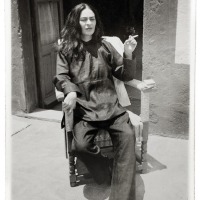
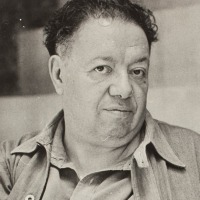
Taking advantage of the Diego Rivera exhibition we mentioned in yesterday's article, I bring a part of one of the last text I posted. Here the last sentence that ends the article: .../... Now the score that is played appears to be a cacophony where the only interest is the torrid economy. That is to say, freedom, illusion, science, culture and passion appear to be a cocktail that is too explosive to be real. Nevertheless, it was a real combination that arose during a gray time where optimism and looking forward to a better future also had their place.

During the depression that characterized the 1930s in the United States, a period known as the "New Deal", traveling and exchanges were constants between post-revolutionary Mexico and its industrial albeit depressed neighbor to the North, the U.S.A.

The search for an art form that was clearly American, the development of programs like the Federal Art Project, and the ease with which important business people, such as the Ford or Rockefeller families, commissioned works from Mexican muralists was fairly commonplace. José Clemente Orozco or Diego Rivera created important murals in California, New York and Detroit (1), and the same time painters like Marlon and Grace Greenwood, Pablo O'Higgins or Isamu Noguchi were creating murals in Mexico City.

The woman

Due to this, it is not surprising to note that Diego Rivera and Frida Kahlo remained in the United States to work almost permanently between 1931 and 1934, nor for the reverse to be the case, and in 1935 the young Isamu Noguchi spent almost the entire year in Mexico City creating a mural in the Abelardo L. Rodriguez Market. Even if the mural that he created there is little known and has remained forgotten for a long time from the majority of historigraphies about Isamu Noguchi, the passionate affair that he maintained with Frida Kahlo has always existed within a fog of ambiguity.

In 1934 Diego Rivera managed to reconstruct the mural the "Man and the Crossroads" in the Palacio de Bellas Artes (Palace of Fine Arts) of Mexico, which he was unable to do in the hall of the Rockefeller Center. Within a few months Frida Kahlo discovered another of Diego Rivera's infidelities with her sister, Cristina, who had been posing as a model in two murals. Although since their wedding in 1929, the relationship between the two had been very open, Frida could not tolerate this unfaithfulness being with her sister and early in 1935, terribly hurt by this relationship, she left the house in San Angel where she had lived with Diego and moved to a rented apartment on Avenue Insurgentes in the center of Mexico City. That did not resolve anything and during the summer, in July of 1935, she decided to leave with her friend Anita Brenner to New York.

The trip

Frida was not the only one to take this same trip in this same year between New York and Mexico. Noguchi, looking for a way out of his current work and in the face of his failed attempts to become involved in projects by the Administration, such as the Works Progress Administration (WPA) Art Program, he decided to look for other ways to carry out his work. Noguchi met José Clemente Orozco and was fascinated by his work and his roll as a revolutionary artist. Noguchi left New York and moved to Holywood, California and later made his way south to Mexico City in a car (a Hudson) lent to him by his friend Buckminster Fuller.

Due to the reduced size of the artistic community in Mexico during this era and Frida's desire to become more and more independent from Diego, even if only out of spite, it seems inevitable that Noguchi and Frida would meet at an artists' gala organized by the Guggenheim Foundation in the city (2). His projects began to take shape and, thanks to the help of his compatriots, the artists Marlon and Grace Greenwood, he was commissioned for mural in the Abelardo L. Rodriguez Market where they had also been participating as muralists.

“How different Mexico was! here all of a sudden I didn't feel strange for being an artist. All artist were useful people, a part of the community. A group of artists that worked at the Abelardo Rodríguez Market offered me a wall to sculpt if I accepted the same kind of salary that those who painted the fresco received, per square meter. I happily accepted.

This was how I created my first large work, in colored cement and sculpted brick, two meters high and twenty-two long, which I called “The History of Mexico”.(3)

.../...

[Extract from the text "One market. One formule. A mural by Isamu Noguchi". By José Juan Barba]

More information

José Juan Barba (1964). Architect from the Madrid School of Architecture (ETSAM) in 1991. He received his PhD in Architecture from ETSAM in 2004, graduating summa Cum laude with the doctoral thesis "Inventions: New York vs. Rem Koolhaas, Bernard Tschumi, Piranesi." In 1991, he received a Special Mention in the Spanish National Graduation Awards. Until 1997, he worked as an advisor to several NGOs. In 1992, he founded his architectural practice in Madrid (www.josejuanbarba.com). 

He is an architectural critic and, since 1998, Editor-in-Chief of the internationally acclaimed bilingual architecture journal METALOCUS (Spanish/English), recipient of several national and international awards.

Barba is an Associate Professor at the University of Alcalá and a member of several research groups. He has been invited to participate in numerous international forums on architecture and urbanism, including the II Forum of Mexican World Heritage Cities, Urban Development, History and Modernity, organized by the Pan-American Committee for Urban Development and Historical Heritage; the World Urban Development Forum (FMDU), held in Culiacán, Sinaloa, Mexico; and the International Conference on Architecture and Urbanism from the Perspective of Women Architects. He has also been invited as lecturer and guest critic at numerous national and international institutions, including the National Building Museum, Roma Tre University, Politecnico di Milano, University of Genoa, Université Pierre Mendès France Grenoble, the Madrid and Barcelona Schools of Architecture, National Autonomous University of Mexico, the Faculty of Architecture in Montevideo, the Schools of Architecture of Medellín and Ecuador, Universidad Iberoamericana, IE University, as well as the Schools of Architecture of Zaragoza, Valladolid, Málaga, Granada, Seville, and A Coruña, among others.

He has extensive professional experience in architecture, urbanism, landscape intervention, and territorial regeneration. His work has received numerous awards, including First Prize in the “Gran Vía Posible” competition for Delirious Gran Vía, Madrid; recognition for the Rivers Interpretation Centre in Zamora, awarded and exhibited at the World Architecture Festival 2008; and recognition for the Santa Bárbara Park project in Toledo. He was also awarded the Erich Degner Prize for Architecture (1995), promoted by the BBVA Foundation. His project for a Day Centre for the Elderly was included in Volume 3 of the Madrid Architecture Guide published by the Official College of Architects of Madrid (COAM) in 2007. His work has been widely published in national and international books and journals.

He served as Maître de Conférences at the Institut d’Urbanisme de Grenoble, Université Pierre Mendès France Grenoble, during the 2013–14 academic year, following his appointment through a European open competition. His work has been published internationally. He regularly serves on academic and professional juries, including the editorial competition jury for the journal Quaderns (2011), the selection committee for the European Union Prize for Contemporary Architecture – Mies van der Rohe Awards (2007–present), and the jury panels for EUROPAN 13 (2015–16) and TRANSFER, Zurich (2019). He was also invited to participate in the Biennale di Venezia 2016 as part of the exhibition Spaces of Exception / Spazi d’Eccezione.

He has authored several books, including "The Dark Line. michele&miquel, dA Vision Design" (2024), "CONGRESO ANYWAY. La ciudad de las ciudades" (2020), "#Positions" (2016), and "Inventions: New York vs. Rem Koolhaas, Bernard Tschumi, Piranesi" (2015). He has also contributed to publications such as "Espacio público Gran Vía. La Ciudad del Turismo" (2020), "Spaces of Exception / Spazi d’Eccezione" (2016), "La manzana de la discordia" (2015), and "Contemporary Japanese Architecture: New Territories" (2015), as well as chapters in numerous books, including "Women Architects: A Professional Challenge" (2009), "21st Century Architectures" (2007), "Ruta de la Plata, New Conquerors of Space" (2019), and "The City of Tourism" (2020).

Selected awards include:

•    “SANTIAGO AMÓN” AWARD, award for the promotion of architecture, COAM Madrid, 2000.
•    “PANAYIOTI MIXELI AWARD,” SADAS-PEA, award for the promotion of architecture, Athens, 2005.
•    “PIERRE VAGO” ICAC. International Committee of Art Critics Award, London, 2005.
•    FAD Award 07, Ephemeral Interventions, First Prize, M.C. Escher Exhibition, Arquin-FAD, Barcelona, 2007.
•    World Architecture Festival, Center for Research and Interpretation of the Rivers, Tera, Esla, and Órbigo, Finalist, Barcelona, 2008.
•    Gran Vía Posible, First Prize, Delirious Gran Vía, Madrid, 2010.
•    Reform of the Río Segura Surroundings, Award, Murcia, 2010.

Read more
Isamu Noguchi (November 17, 1904 – December 30, 1988) was one of the twentieth century’s most important and critically acclaimed sculptors. Through a lifetime of artistic experimentation, he created sculptures, gardens, furniture and lighting designs, ceramics, architecture, and set designs. His work, at once subtle and bold, traditional and modern, set a new standard for the reintegration of the arts.

Noguchi, an internationalist, traveled extensively throughout his life. (In his later years he maintained studios both in Japan and New York.) He discovered the impact of large-scale public works in Mexico, earthy ceramics and tranquil gardens in Japan, subtle ink-brush techniques in China, and the purity of marble in Italy. He incorporated all of these impressions into his work, which utilized a wide range of materials, including stainless steel, marble, cast iron, balsa wood, bronze, sheet aluminum, basalt, granite, and water.  

Born in Los Angeles, California, to an American mother and a Japanese father, Noguchi lived in Japan until the age of thirteen, when he moved to Indiana. While studying pre-medicine at Columbia University, he took evening sculpture classes on New York’s Lower East Side, mentoring with the sculptor Onorio Ruotolo. He soon left the University to become an academic sculptor.

In 1926, Noguchi saw an exhibition in New York of the work of Constantin Brancusi that profoundly changed his artistic direction. With a John Simon Guggenheim Fellowship, Noguchi went to Paris, and from 1927 to 1929 worked in Brancusi’s studio. Inspired by the older artist’s reductive forms, Noguchi turned to modernism and a kind of abstraction, infusing his highly finished pieces with a lyrical and emotional expressiveness, and with an aura of mystery.

Noguchi’s work was not widely recognized in the United States until 1938, when he completed a large-scale sculpture symbolizing the freedom of the press, which was commissioned for the Associated Press building in Rockefeller Center, New York City. This was the first of what would become numerous celebrated public works worldwide, ranging from playgrounds to plazas, gardens to fountains, all reflecting his belief in the social significance of sculpture.

In 1942, Noguchi set up a studio at 33 MacDougal Alley, in Greenwich Village, having spent much of the 1930s based in New York City but traveling extensively in Asia, Mexico, and Europe.   

The Japanese attack on Pearl Harbor and the backlash against Japanese-Americans in the United States had a dramatic personal effect on Noguchi, motivating him to become a political activist. In 1942, he started Nisei Writers and Artists Mobilization for Democracy, a group dedicated to raising awareness of the patriotism of Japanese-Americans. He also asked to be placed in an internment camp in Arizona, where he lived for a brief seven months. Following the War, Noguchi spent a great deal of time in Japan exploring the wrenching issues raised during the previous years. His ideas and feelings are reflected in his works of that period, particularly the delicate slab sculptures included in the 1946 exhibition “Fourteen Americans,” at The Museum of Modern Art, New York.

Noguchi did not belong to any particular movement, but collaborated with artists working in a range of disciplines and schools. He created stage sets as early as 1935 for the dancer/choreographer Martha Graham, beginning a lifelong collaboration; as well as for dancers/choreographers Merce Cunningham, Erick Hawkins, and George Balanchine and composer John Cage. In the 1960s, Noguchi began working with stone carver Masatoshi Izumi on the island of Shikoku, Japan; a collaboration that would also continue for the rest of his life. From 1960 to 1966, he worked on a playground design with the architect Louis Kahn

Whenever given the opportunity to venture into the mass-production of his interior designs, Noguchi seized it. In 1937, he designed a Bakelite intercom for the Zenith Radio Corporation, and in 1947, his glass-topped table was produced by Herman Miller. This design—along with others such as his designs for Akari Light Sculptures which were initially developed in 1951 using traditional Japanese materials—are still being produced today.

In 1985, Noguchi opened The Isamu Noguchi Garden Museum (now known as The Noguchi Museum), in Long Island City, New York. The Museum, established and designed by the artist, marked the culmination of his commitment to public spaces.  Located in a 1920s industrial building across the street from where the artist had established a studio in 1960, it has a serene outdoor sculpture garden, and many galleries that display Noguchi’s work, along with photographs and models from his career.

Noguchi’s first retrospective in the United States was in 1968, at the Whitney Museum of American Art in New York City. In 1986, he represented the United States at the Venice Biennale. Noguchi received the Edward MacDowell Medal for Outstanding Lifetime Contribution to the Arts in 1982; the Kyoto Prize in Arts in 1986; the National Medal of Arts in 1987; and the Order of Sacred Treasure from the Japanese government in 1988. He died in New York City in 1988.
Read more
Published on: December 29, 2011
Cite:
metalocus, JOSÉ JUAN BARBA
"One market. One formule. A mural by Isamu Noguchi" METALOCUS. Accessed
<https://www.metalocus.es/en/news/one-market-one-formule-a-mural-isamu-noguchi> ISSN 1139-6415
Loading content ...
Loading content ...
Loading content ...
Loading content ...
Loading content ...
Loading content ...
Loading content ...
Loading content ...
Loading content ...
Loading content ...
Loading content ...
Loading content ...
Loading content ...
Loading content ...
Loading content ...
Loading content ...
Loading content ...
Loading content ...
Loading content ...
Loading content ...
Loading content ...
Loading content ...
Loading content ...
Loading content ...
Loading content ...
Loading content ...
Loading content ...
Loading content ...
Loading content ...
Loading content ...
Loading content ...
Loading content ...
Loading content ...
Loading content ...
Loading content ...
Loading content ...
Loading content ...
Loading content ...
Loading content ...
Loading content ...
Loading content ...
Loading content ...
Loading content ...
Loading content ...
Loading content ...
Loading content ...
Loading content ...
Loading content ...
Loading content ...
Loading content ...
Loading content ...
Loading content ...
Loading content ...
Loading content ...