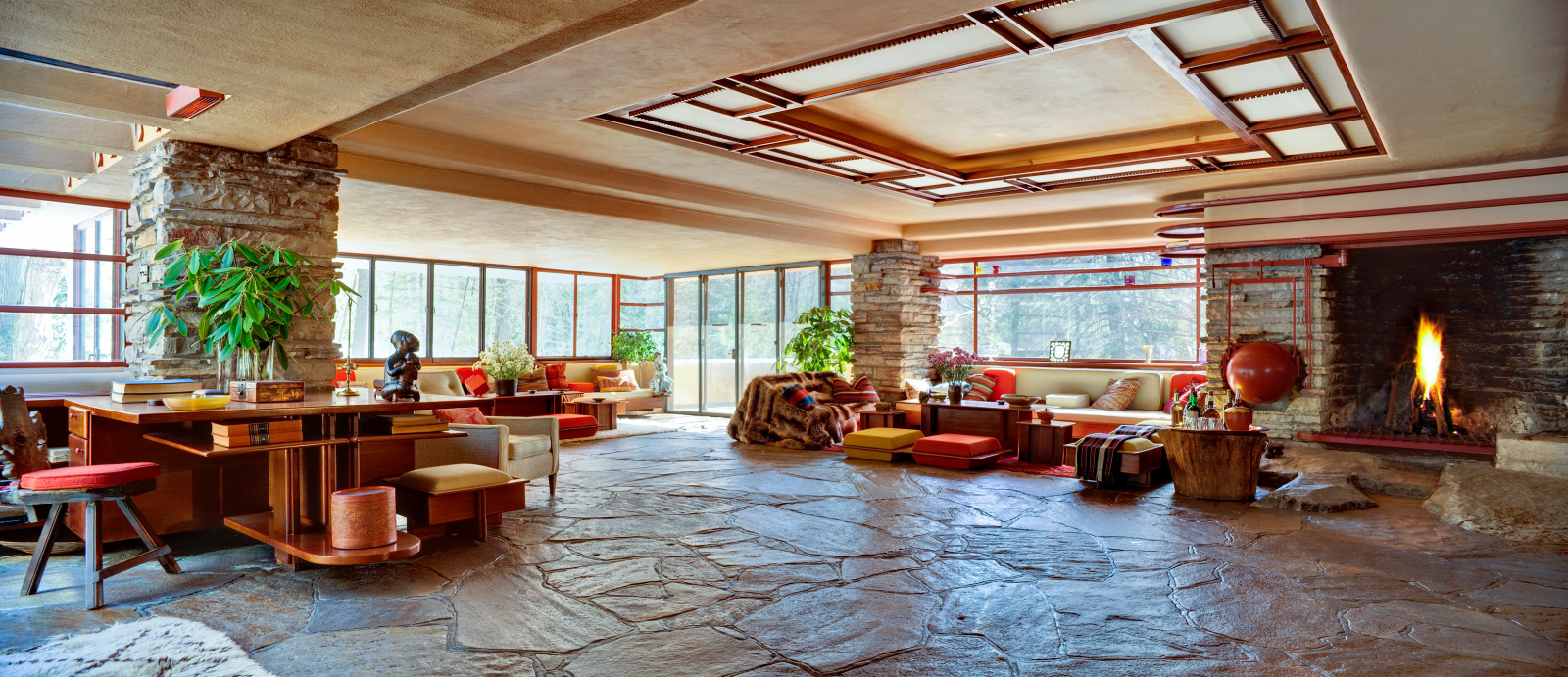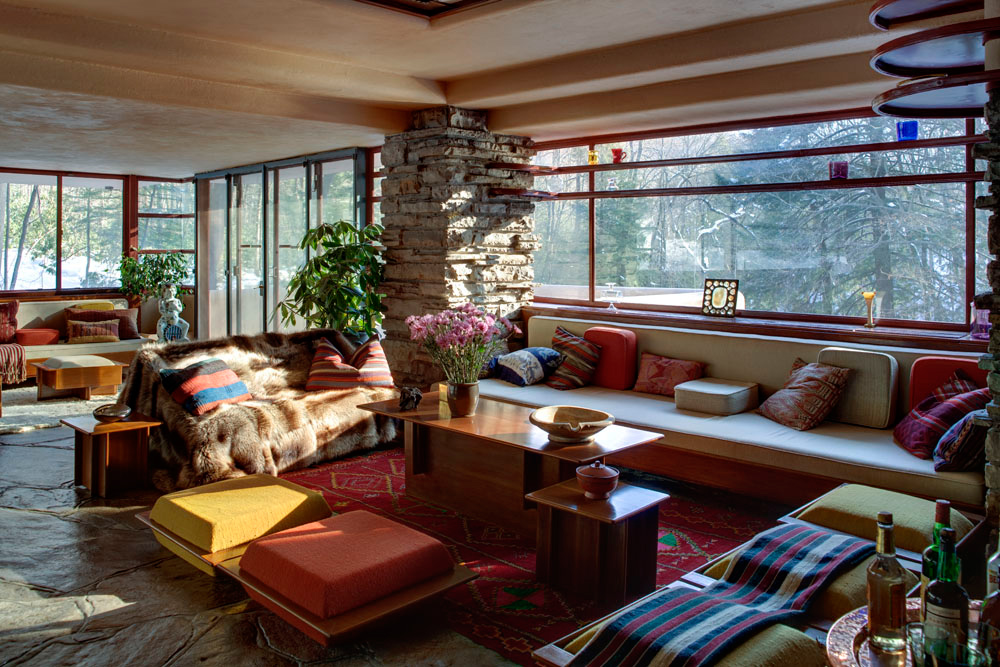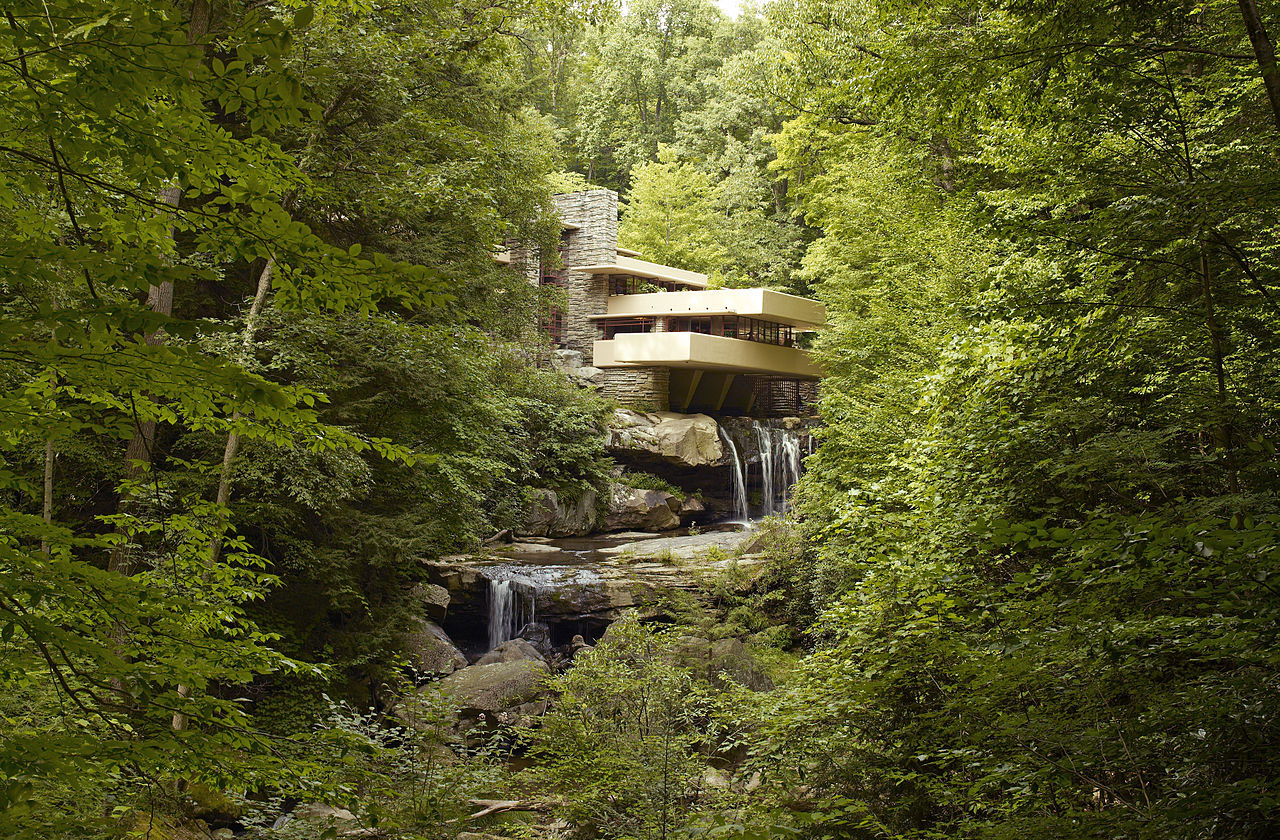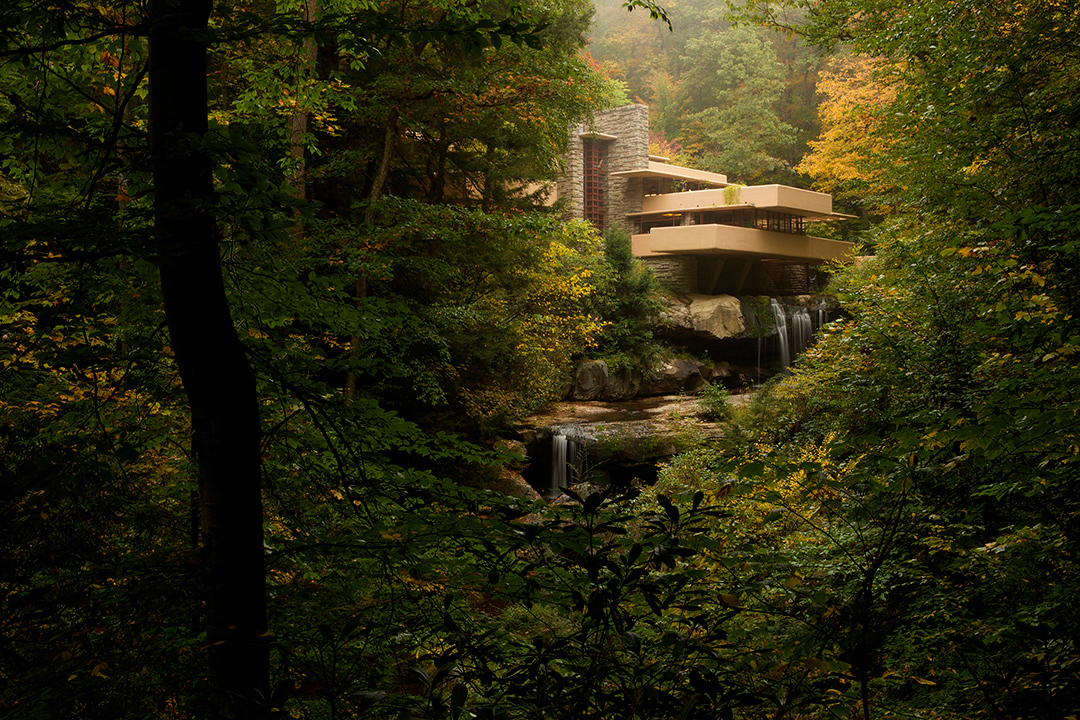
Fallingwater, the celebrated residence by Frank Lloyd Wright and one of the key figures of architecture in the past century, turns 80 this year. The building, thought as the second residence for the Kaufmann family, became a masterpiece of architecture shortly after its construction -1936 to 1939- over a waterfall in souhwestern Pennsylvania. Today, Fallingwater is a National Historic Landmark.

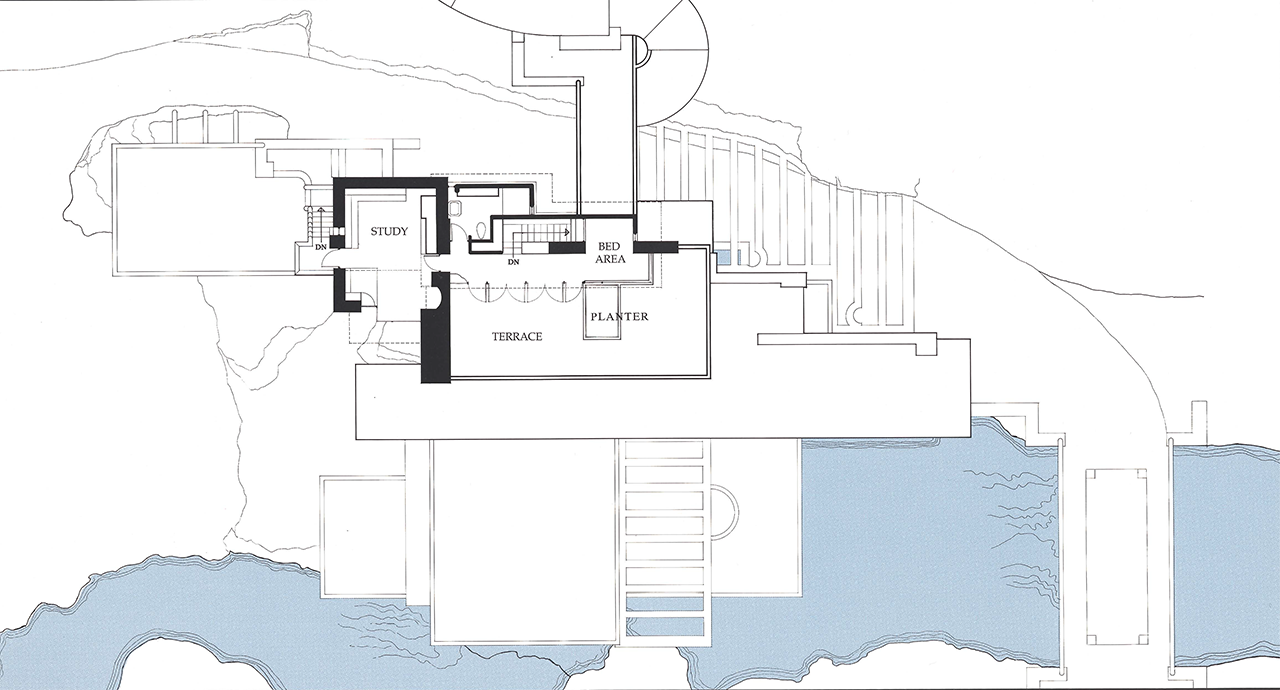
In 1935, at age 67, the architect Frank Lloyd Wright began the design of house, commissioned by the Kaufmann family from Pittsburg, placing it over a small river and waterfall, with an architecture whose presence would magnify the perception of the natural environment.

Fallingwater, even before completion, appeared in the background of the cover of Time magazine (January 17, 1938) in which F. L. Wright was the main figure. It was completed in 1939 and very soon after it would be classified by Time and the American Institute of Architects as "the best work of Architecture in American history".
 

"It's a house that doesn’t even appear to stand on solid ground, but instead stretches out over a 30’ waterfall. It captured everyone’s imagination when it was on the cover of Time magazine in 1938."

Pittsburgh at the time was sometimes called the “Smoky City”, due to the high concentration of pollution in the air, created by Pittsburgh’s steel industry. People who could afford to take the train to the mountains relished the chance to breathe fresh, cool mountain air. When the Kaufmanns decided it was time to build a modern vacation house, they turned to Frank Lloyd Wright to design it for them. At the time, their son was fascinated with Wright’s ideas and was even studying with him at Wright’s school, the Taliesin Fellowship.

Wright decided to build the house directly over the waterfall thus emphasizing the sound of the water over the views which was what the clients were expecting. Wright explained his aim was to design a house in which they would actually live with the waterfalls, make them part of their everyday life, and not just to look at them now and then.

Despite its technical and structural modernity for the time being, with long concrete cantilevers, the building harmonizes exterior appeareance tuning in its colors with the natural environment. The exterior walls create a cohesion effect through the use of two colors: a light ocher in the concrete elements and Cherokee red for the steel elements.

This architectural icon, although it had to receive a major structural renovation in 2002, has received over 4.5 million visits since the Western Pennsylvania Conservancy opened its doors in 1964. Its unique environment, Bear Run Nature Reserve, has led to the creation of a historical monument whose architecture is linked more than ever to its surrounding environment.

CREDITS. DATA SHEET.-

Architect.- Frank Lloyd Wright.
Owners.- Kaufmann Family (1936-1963), Western Pennsylvania Conservancy (1963 - 2015).

Dates.- 1936-1938 (manor house), 1939 (guest house).
Budget.- 155.000 $.
Area.- 495 sqm (268 sqm. interior, 227 sqm terraces). 160 sqm guest house.

Read more
Read less

More information

Frank Lloyd Wright was born in Richland Center, Wisconsin in 1869 and died in Phoenix, Arizona in 1959. He is considered one of the Modern Movement’s fathers in architecture and one of the most important architects of the XX Century, with Le Corbusier, Ludwig Mies van der Rohe and Walter Gropius. Wright was placed in Chicago, San Francisco, Spring Green (Wisconsin) and Phoenix (Arizona). His life as an active architect in the USA was from 1889 to 1962 and in Japan between 1915 and 1923.

Wright was born into a protestant family. His father was a preacher of the unitary church, from which he inherited a romantic view, in continuous searching of the universality and the non-conformism. In 1885 he began to study civil engineering at Wisconsin University and worked as a draughtsman for an engineer-constructor. Two years later, in 1887 he was placed in Chicago where he worked for Joseph Lyman Silsbee, an architect of picturesque nature. Shortly afterwards he became a member of Louis Sullivan’s and Dankmar Adler’s studio, and he was responsible for it in 1889. In thid year, he started the construction of his first house, in Oak Park, Chicago (1889-1890).

With Sullivan, he made the Charley’s House in Chicago (1891-1892). But at the same time and independently of his work at Sullivan’s studio, he took part of the construction of the Wainwright Building (1890-1891) and the Schiller Building (1891-1892). In 1893 he broke up with Sullivan and he established on his own account, working as domestic architecture.

In 1901 he began his first great creative phase, the “Prairie Houses” period. In this phase, he made the space a real discipline. His most outstanding works were Susan Lawrence Dana’s House in Springfield ¡1902-1904), Avery Coonley’s House in Riverside (1906-1908) Frederick C. Robie’s House in Chicago (1906) and the unitary temple of Oak Park (1905-1908). He also built the Larkin Company Administration Building in Buffalo, New York (1902-1906) where he tacked the theme of the work space.

Wright published in the Architectural Record magazine in 1908, the called 6 organic architecture principles; although he said he had written them in 1894. The principles are: simplicity and elimination of the superfluous; to each client, his lifestyle and his house style; correlation among the nature, topography and architecture; adaptation and integration of the building in his environment and the harmony of the used materials (conventionalization); material expression; and at least, the analogy between the human qualities and the architecture.

In 1909 he decided to travel to Europe and he prepared two synoptic publications with the editor Wasmuth in Berlin. In this phase, Wright has already more than 130 works built. He came back to the United States in 1910. In 1922 he was placed in the family lands in Spring Green. Here he planned the called Taliesin House, which would be his house, architecture studio, art gallery and farm. He would extend and modify it during the next years because of two fires in 1914 and 1925.

In 1913 he changed his ornamental language due to European influence and his architecture became more geometric as a consequence, inclusively cubist. This change can be appreciated in the Midway Garden in Chicago (1913-1914) or the Imperial Hotel of Tokyo (1913-1923).

He planned after Mrs. George Madison Millard’s house “The Miniature” in Pasadena (1923), John Storer’s house in Hollywood (1923-1924) and Samuel Freeman’s and Charles Ennis’s houses in Los Ángeles (1923-1924); houses built with reinforced rubblework and walls made of moulding concrete ashlars. But Wright moved to the Arizona desert in 1927, where he found other natural conditions to adapt to. Here he projected a hotel complex in San Marcos, near Chandler, Arizona (1928-1929), which is a growth model that Wright compared with the landscape.

In the 30s, the financial scandals and the consequences of the great depression prevented him from carrying out many of his designs and he only projected the Kaufmann Family’s Vacation House: “Fallingwater”, in Bear Run, Pennsylvania; where Wright unified the nature, the technology and the social organization. In this phase, Wright used the term “Usonians” Which referred to the union of the terms USA, utopia and “organic social order”. One example of that is Herbert Jacops’s House in Madison, Wisconsin (1936-1937). Simultaneously, he built the de Johnson & Company’s headquarters in Racine Wisconsin (1936-1939) and his adjoining tower, where are the investigation laboratories (1943-1950). In 1943, his most important project came: the Art Museum “non-objective”, put in charge by Solomon Guggenheim on 5th Avenue in New York, finished in 1959.

In the 50s, Wright exaggerated increasingly the formal aspect of his buildings. His last projects were: the unitary church of Madison (1945-1951), the synagogue of Beth Sholom in Alkins Park, Pennsylvania (1953-1959), the Annunciation Church in Wauwatosa, Wisconsin (1955-1961) and the Martin County’s civic centre in San Rafael, California (1957-1962).

Read more

José Juan Barba (1964) is an architect, graduated from ETSA Madrid (1991), and holds a Doctorate in Architecture from ETSA Madrid, awarded Cum laude for his thesis Inventions: New York vs. Rem Koolhaas, Bernard Tschumi, Piranesi (2004). He received a special mention in the National Awards for Completion of Studies (1991) and served as an advisor to various NGOs until 1997. He founded his studio in Madrid in 1992 (www.josejuanbarba.com). 

Barba is an architecture critic and has been the director of METALOCUS magazine since 1999. Since 1998, he has directed the International Architecture Magazine METALOCUS (bilingual, Spanish/English), which has been recognized with multiple national and international awards.

He is a Full Professor at the University of Alcalá, leading the project line of the Habilitation Master's Architecture and City, responsible for several courses in Theory and Criticism, heading the Urban Planning area of the Department of Architecture, and participating in the research group Architecture, History, City, and Landscape at UAH. He has been invited to numerous architecture and urbanism forums, including the II Forum of Mexican Cities World Heritage: Urban Development, History, and Modernity, organized by the Pan-American Committee for Urban Development and Historical Heritage, and the World Urban Development Forum (FMDU) in Culiacán, Sinaloa, Mexico. He has also participated in the International Architecture and Urbanism Conferences from the perspective of women architects, and has lectured at prestigious national and international universities, including the National Building Museum (Washington, DC), Roma TRE, Politecnico di Milano, UPMF Grenoble, ETSA Madrid, ETSA Barcelona, University of Thessaly (Volos), UNAM Mexico, the Faculty of Architecture Montevideo, schools of architecture in Medellín, Quito-Ecuador, Alicante, Málaga, Granada, Seville, A Coruña, Zaragoza, Valladolid, Universidad Iberoamericana Mexico, IE School, Universidad Europea Madrid, UCJC Madrid, ESARQ-UIC Barcelona, or Università Degli Studi di Genova.

Barba has extensive professional experience in architecture, urban planning, landscape design, and territorial recovery. He has received numerous awards, including the First Prize for Gran Vía Posible for Delirious Gran Vía (Madrid), the River Interpretation Center (Zamora), exhibited at the World Architecture Festival (Barcelona 2008), Santa Bárbara Park (Toledo), the Erich Degner Architecture Prize 1995 promoted by the BBVA Foundation, and his Day Care Center for the Elderly project, featured in Volume 3 of the COAM Madrid Architecture Guide (2007). His work has been published in numerous national and international books and magazines.

He was also Maître de Conférences at IUG-UPMF Grenoble (2013–14), in a position obtained through a European competition. His work has been published internationally. He regularly serves on academic juries, including the editorial competition of Quaderns magazine (2011), as a selector for the Mies van der Rohe Awards (2007–2026), as juror for EUROPAN13 Spain (2015–16), TRANSFER in Zurich (2019), and was invited to participate in the Venice Biennale 2016 as part of the exhibition Spaces of Exception / Spazi d’Eccezione.

He has published several books, including The Dark Line. michele&miquel, dA Vision Design (2024), CONGRESO ANYWAY. The City of Cities (2020), #Positions (2016), and Inventions: New York vs. Rem Koolhaas, Bernard Tschumi, Piranesi (2015). He has contributed to other publications such as Public Space Gran Vía. The Tourism City (2020), Spaces of Exception / Spazi d’Eccezione (2016), La mansana de la discordia (2015), and Contemporary Architecture of Japan: New Territories (2015), as well as chapters in numerous books including Architects: A Professional Challenge (2009), 21st Century Architectures (2007), Ruta de la Plata, New Conquerors of Space (2019), and The Tourism City (2020).

Selected awards include:

- “PIERRE VAGO” ICAC. International Committee of Art Critics Award, London, 2005
- “PANAYIOTI MIXELI AWARD,” SADAS-PEA, award for the promotion of architecture, Athens, 2005
- “SANTIAGO AMÓN” AWARD, award for the promotion of architecture, COAM Madrid, 2000
- FAD Award 07, Ephemeral Interventions, First Prize, M.C. Escher Exhibition, Arquin-FAD, Barcelona, 2007
- World Architecture Festival, Center for Research and Interpretation of the Rivers, Tera, Esla, and Órbigo, Finalist, Barcelona, 2008
- Gran Vía Posible, First Prize, Delirious Gran Vía, Madrid, 2010
- Reform of the Río Segura Surroundings, Award, Murcia, 2010

Read more
Published on: November 6, 2015
Cite:
metalocus, JOSÉ JUAN BARBA
"80 years of Fallingwater, by Frank Lloyd Wright" METALOCUS. Accessed
<https://www.metalocus.es/en/news/80-years-fallingwater-frank-lloyd-wright> ISSN 1139-6415
Loading content ...
Loading content ...
Loading content ...
Loading content ...
Loading content ...
Loading content ...
Loading content ...
Loading content ...
Loading content ...
Loading content ...
Loading content ...
Loading content ...
Loading content ...
Loading content ...
Loading content ...
Loading content ...
Loading content ...
Loading content ...
Loading content ...
Loading content ...
Loading content ...
Loading content ...
Loading content ...
Loading content ...
Loading content ...
Loading content ...
Loading content ...
Loading content ...
Loading content ...
Loading content ...
Loading content ...
Loading content ...
Loading content ...
Loading content ...
Loading content ...
Loading content ...
Loading content ...
Loading content ...
Loading content ...
Loading content ...
Loading content ...
Loading content ...
Loading content ...
Loading content ...
Loading content ...
Loading content ...
Loading content ...
Loading content ...
Loading content ...
Loading content ...
Loading content ...
Loading content ...
Loading content ...
Loading content ...