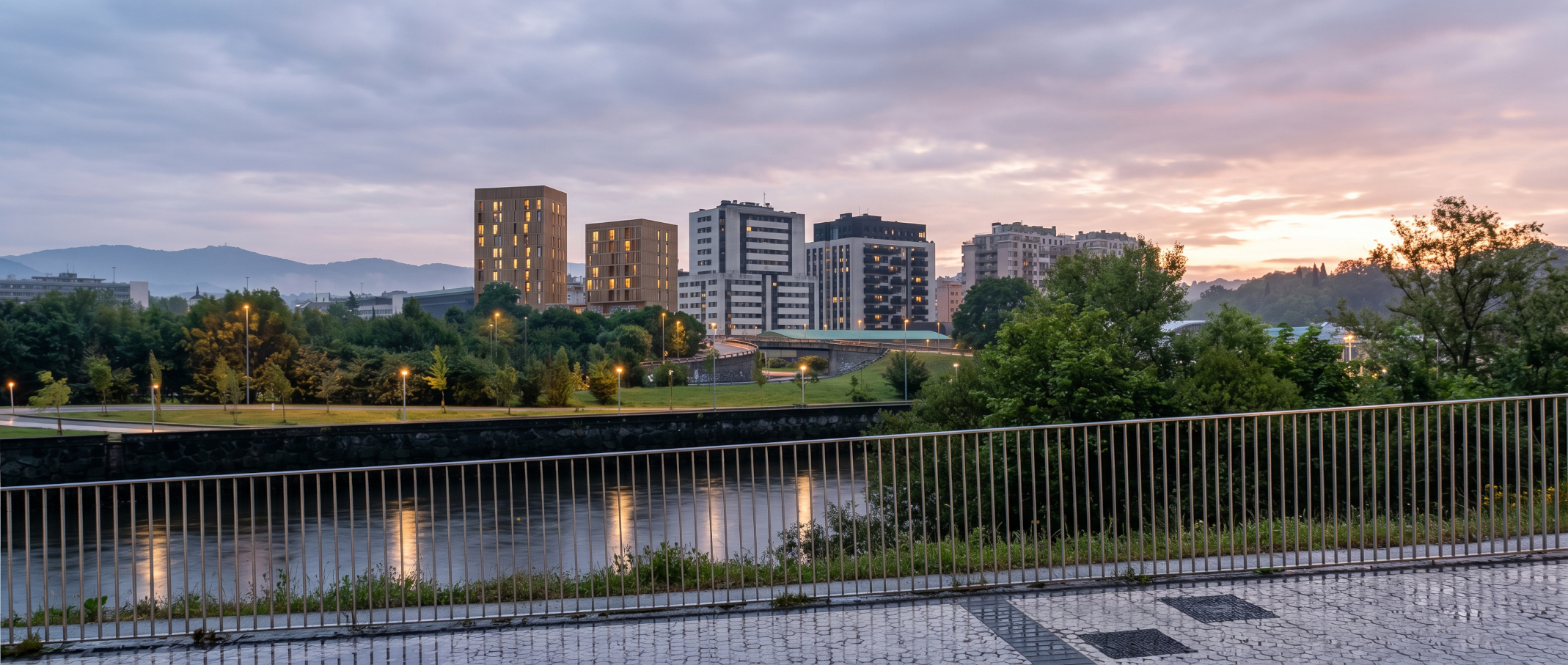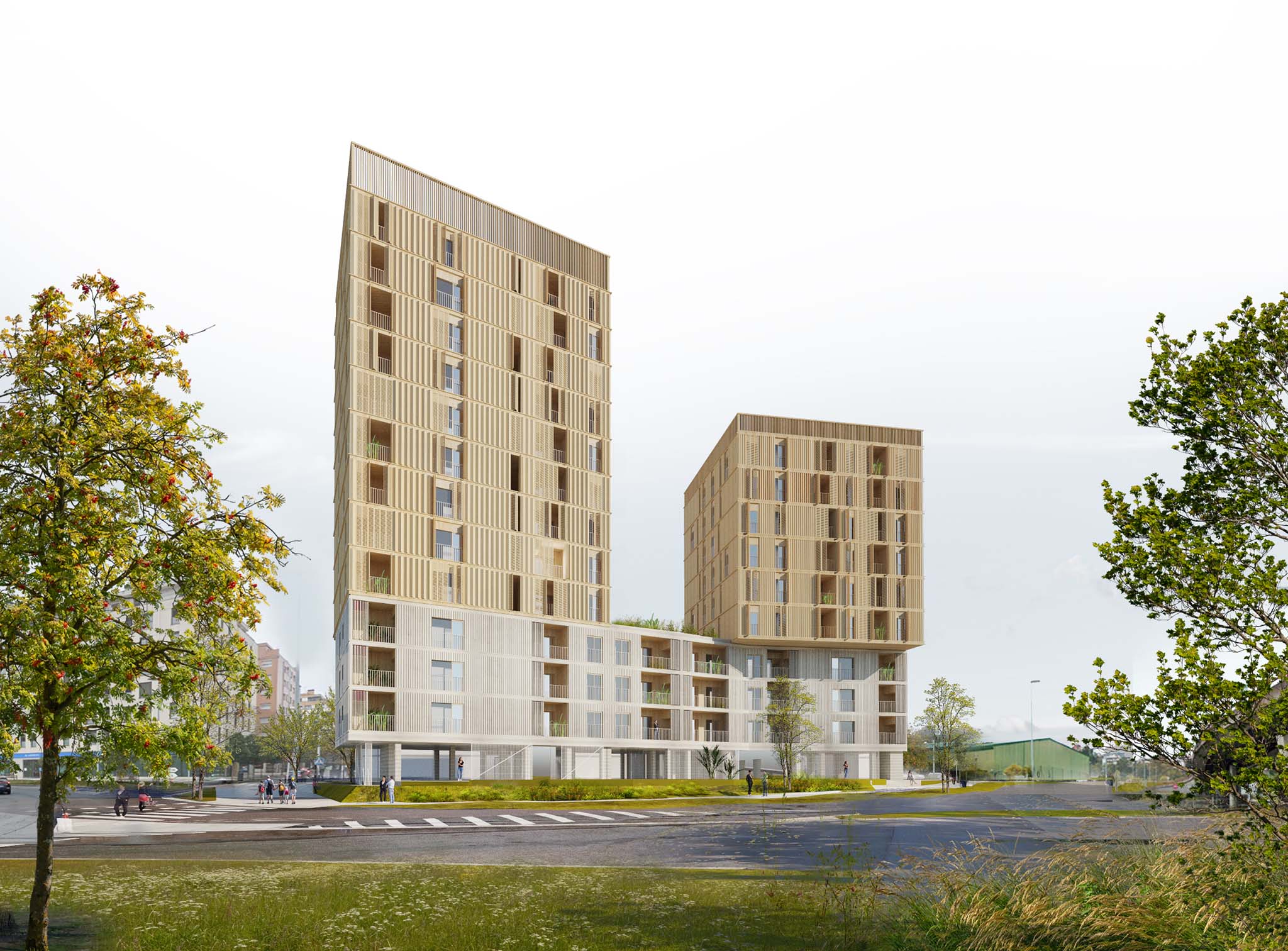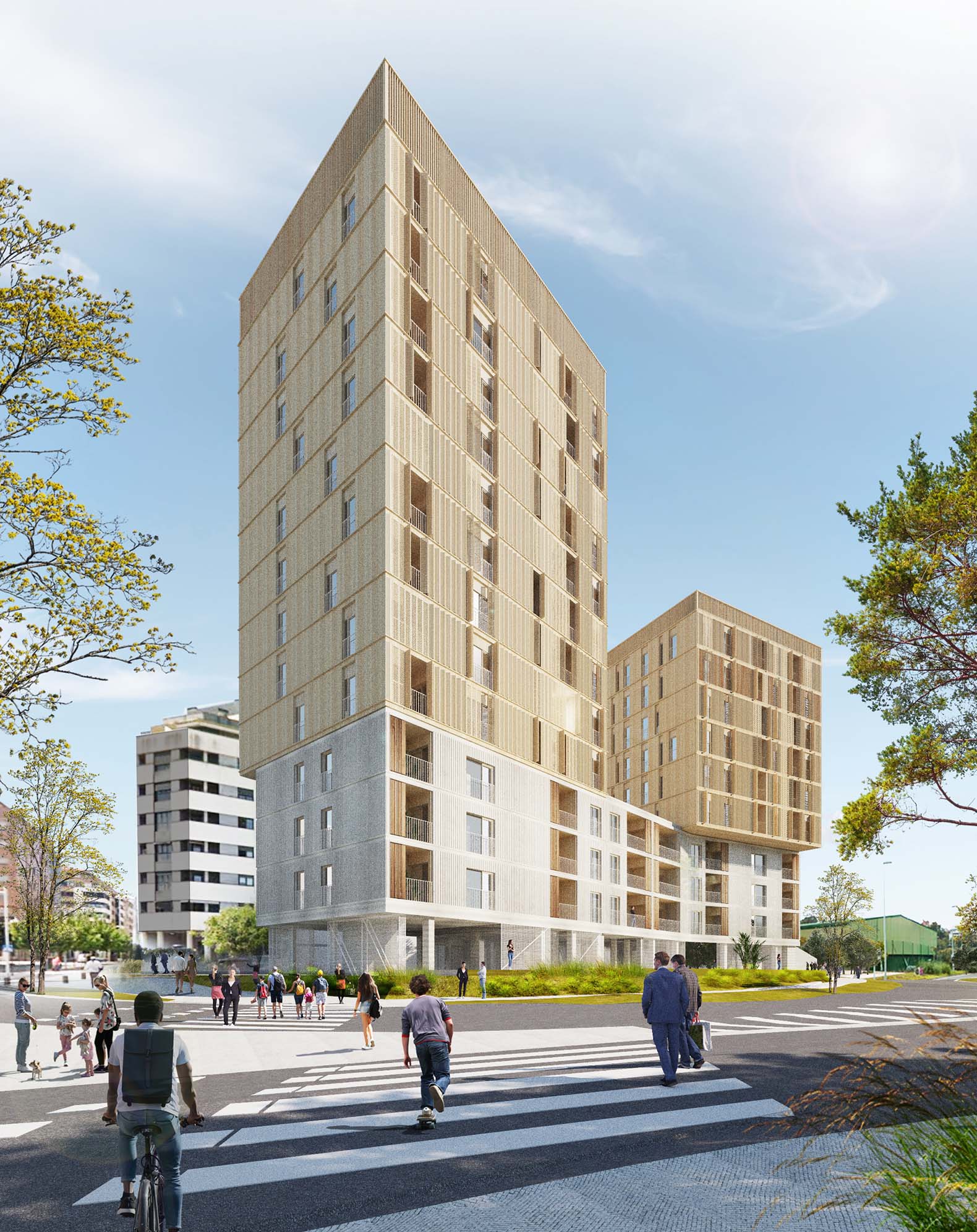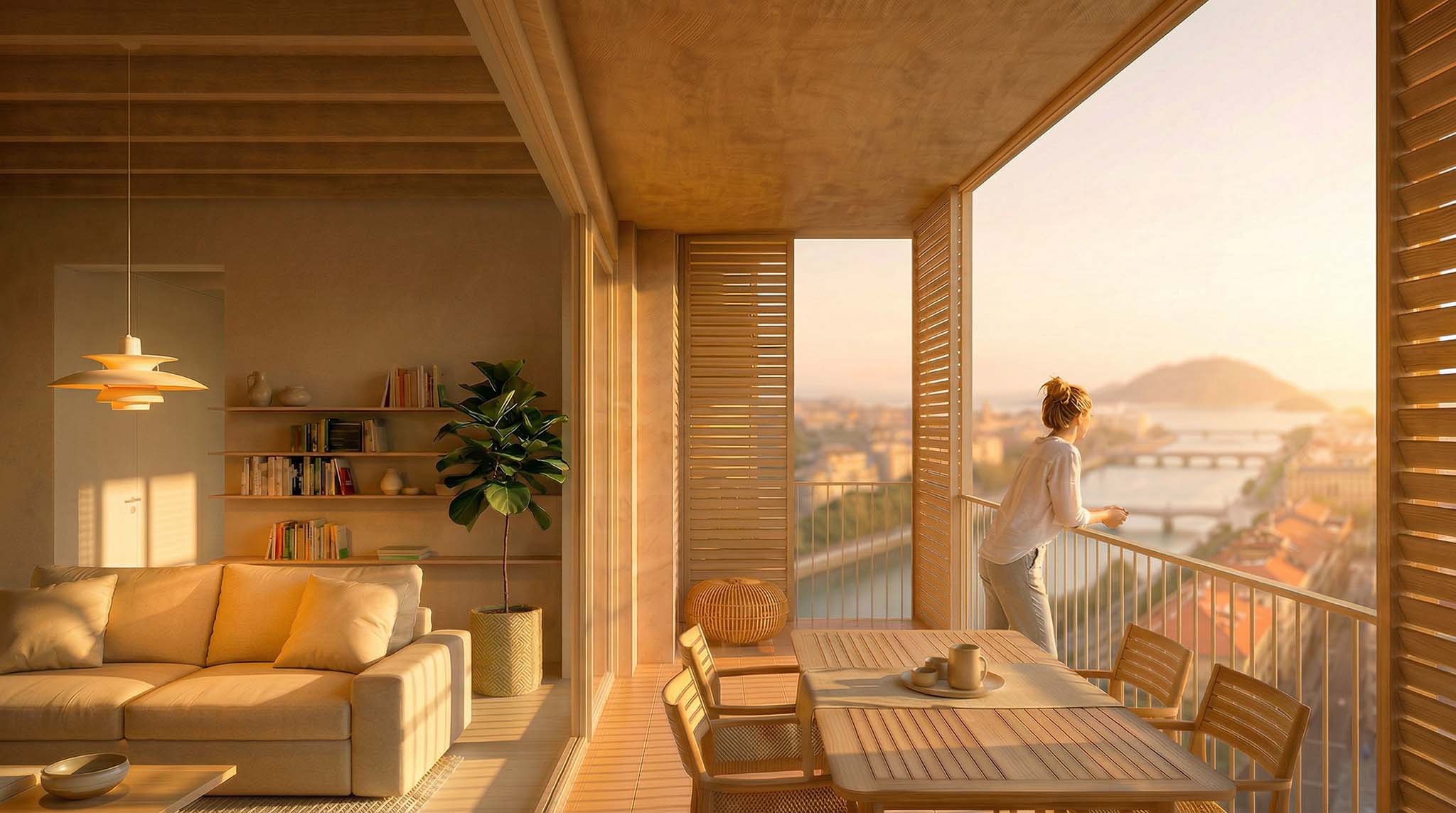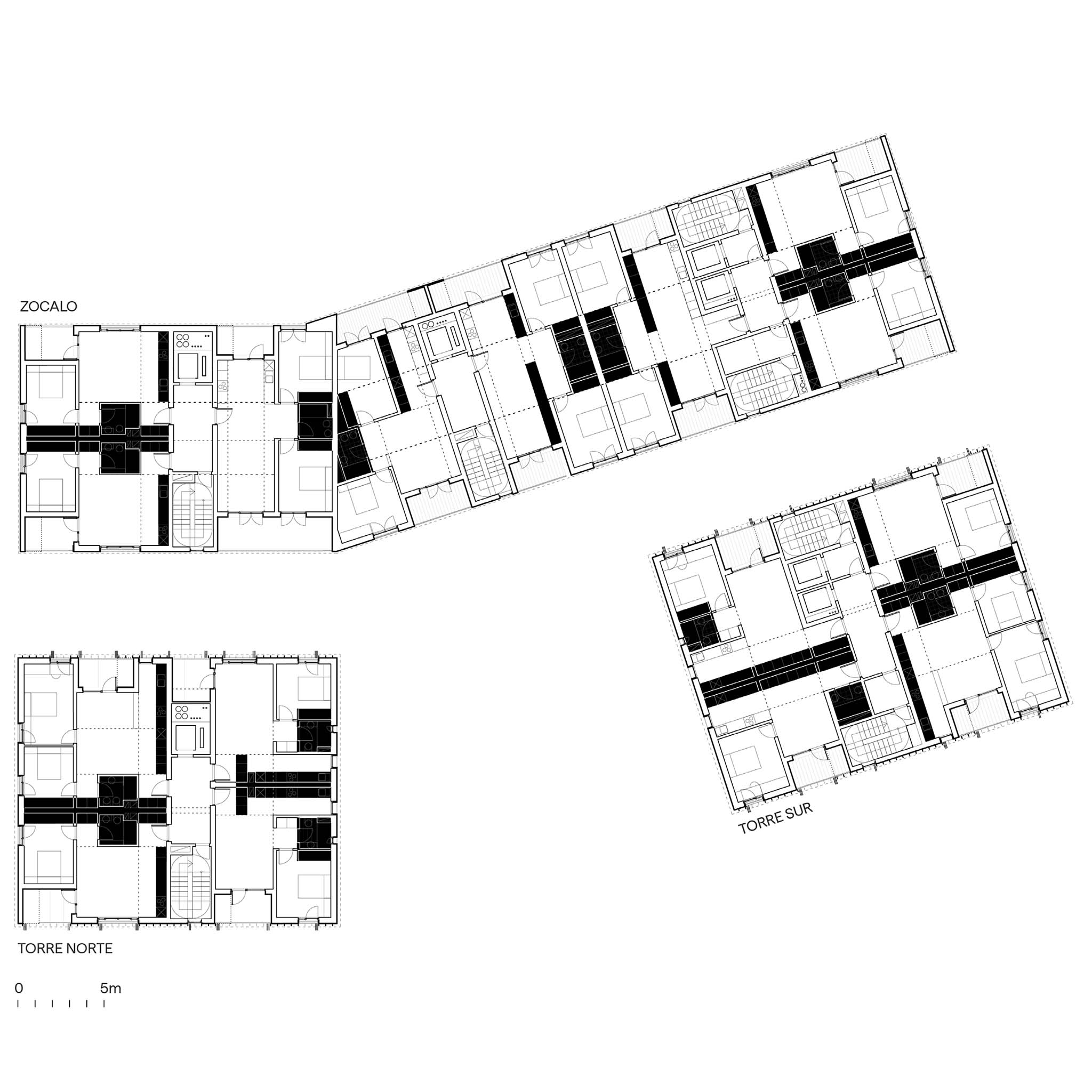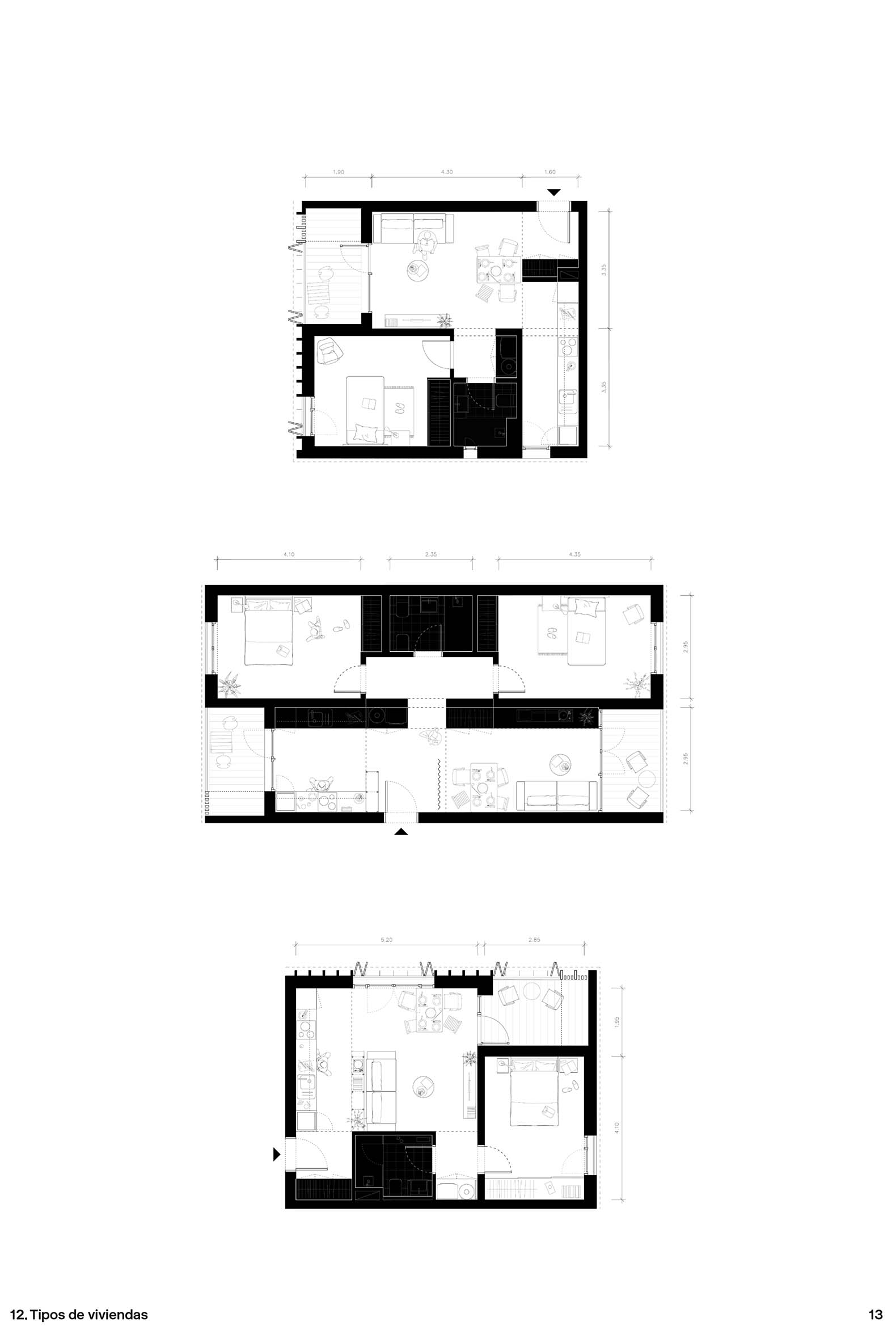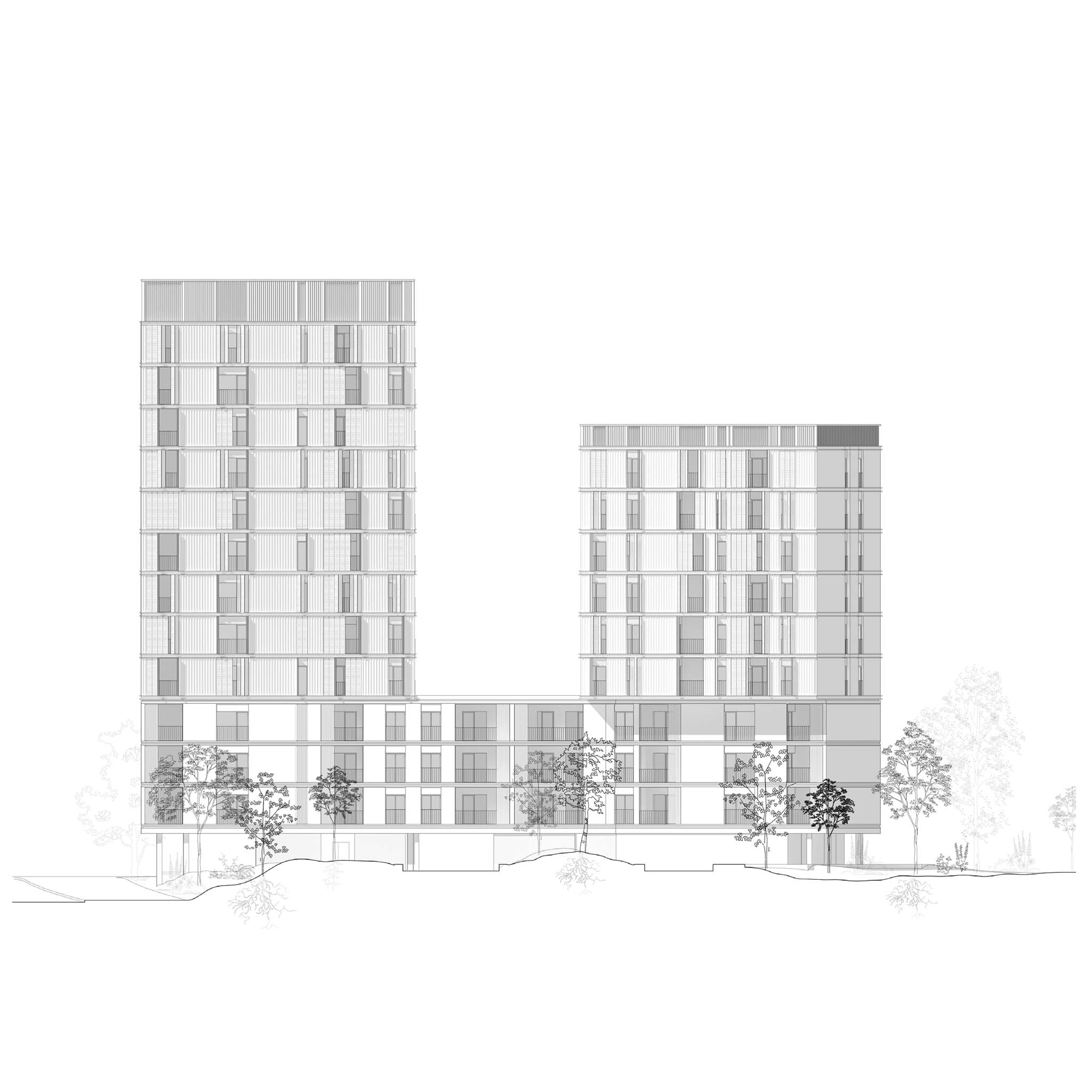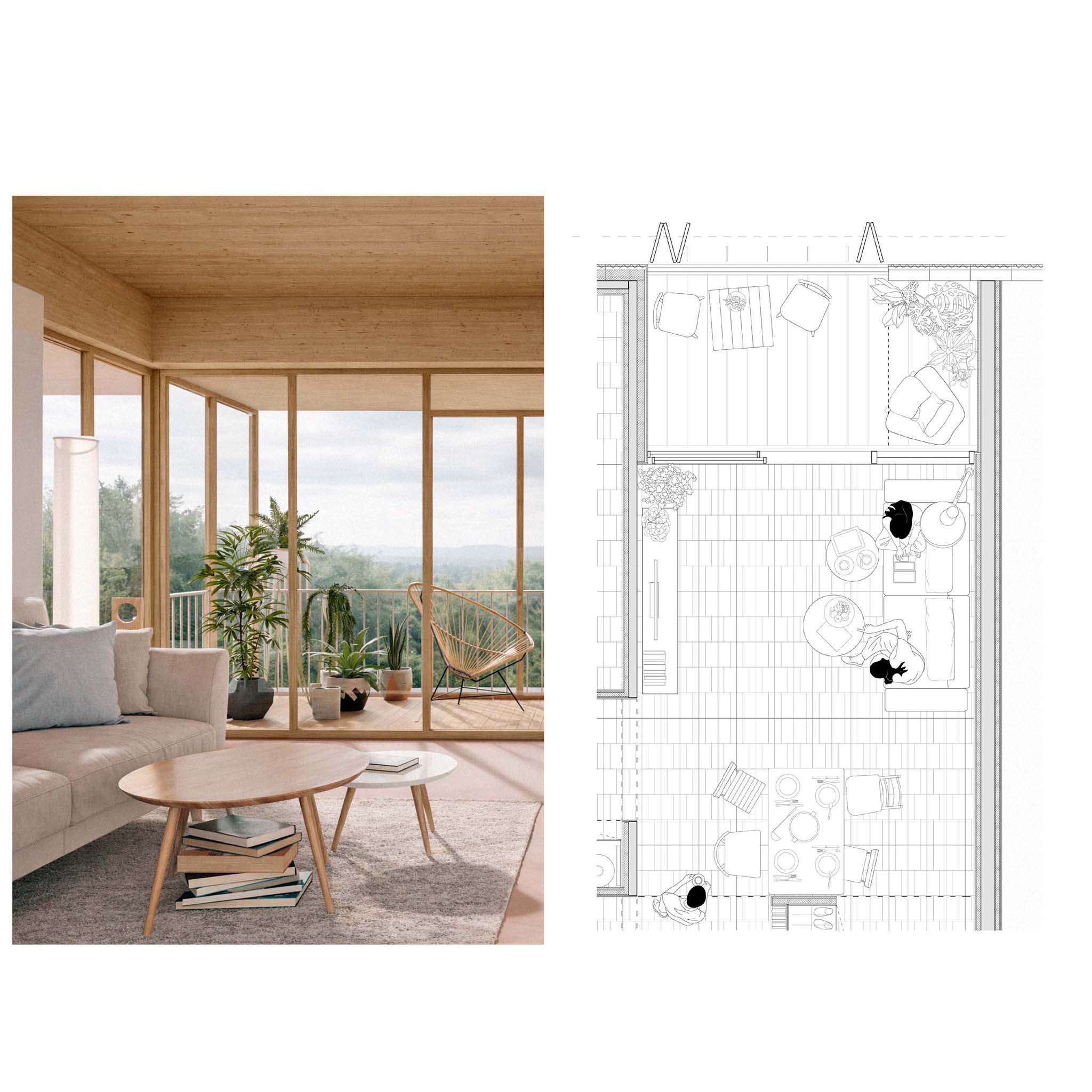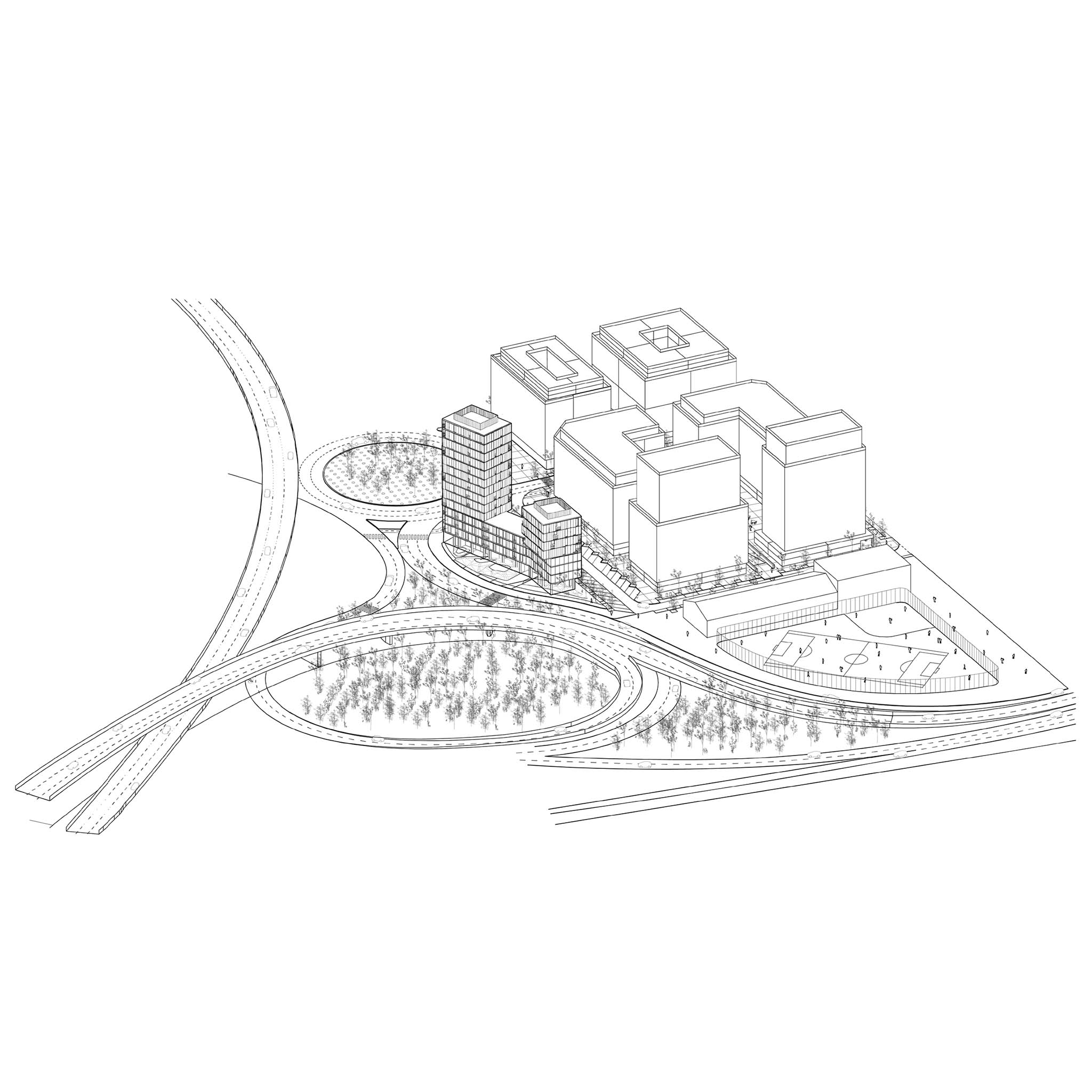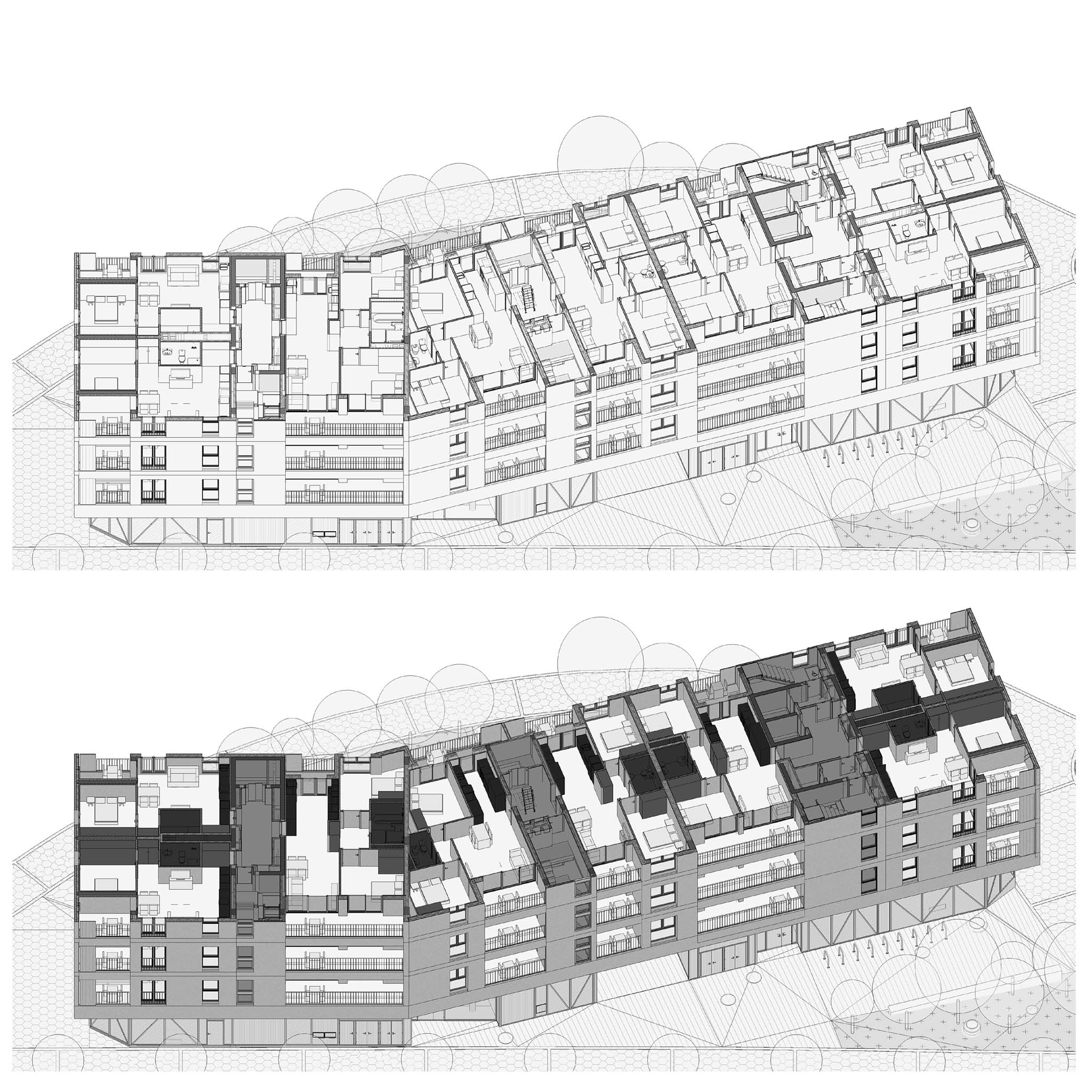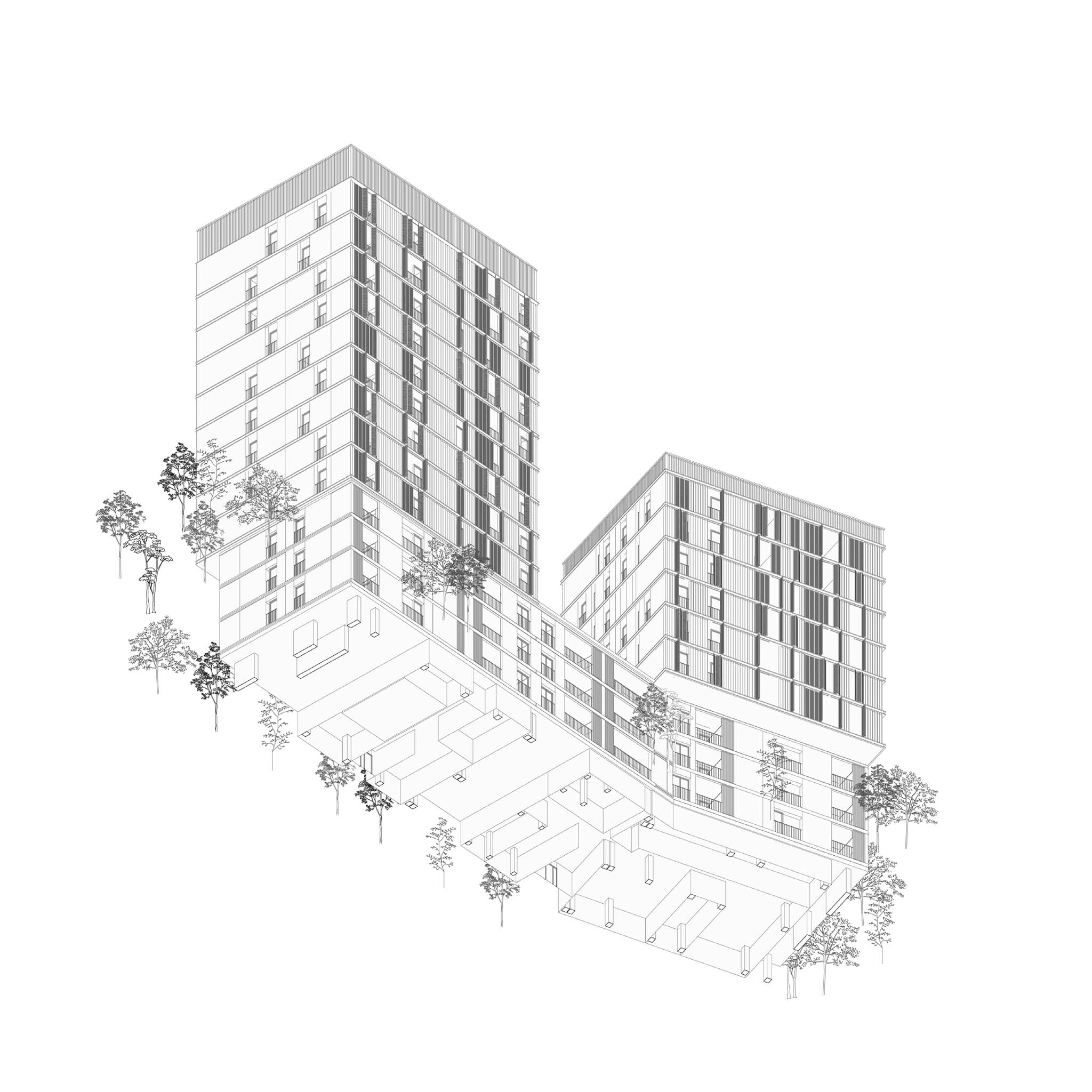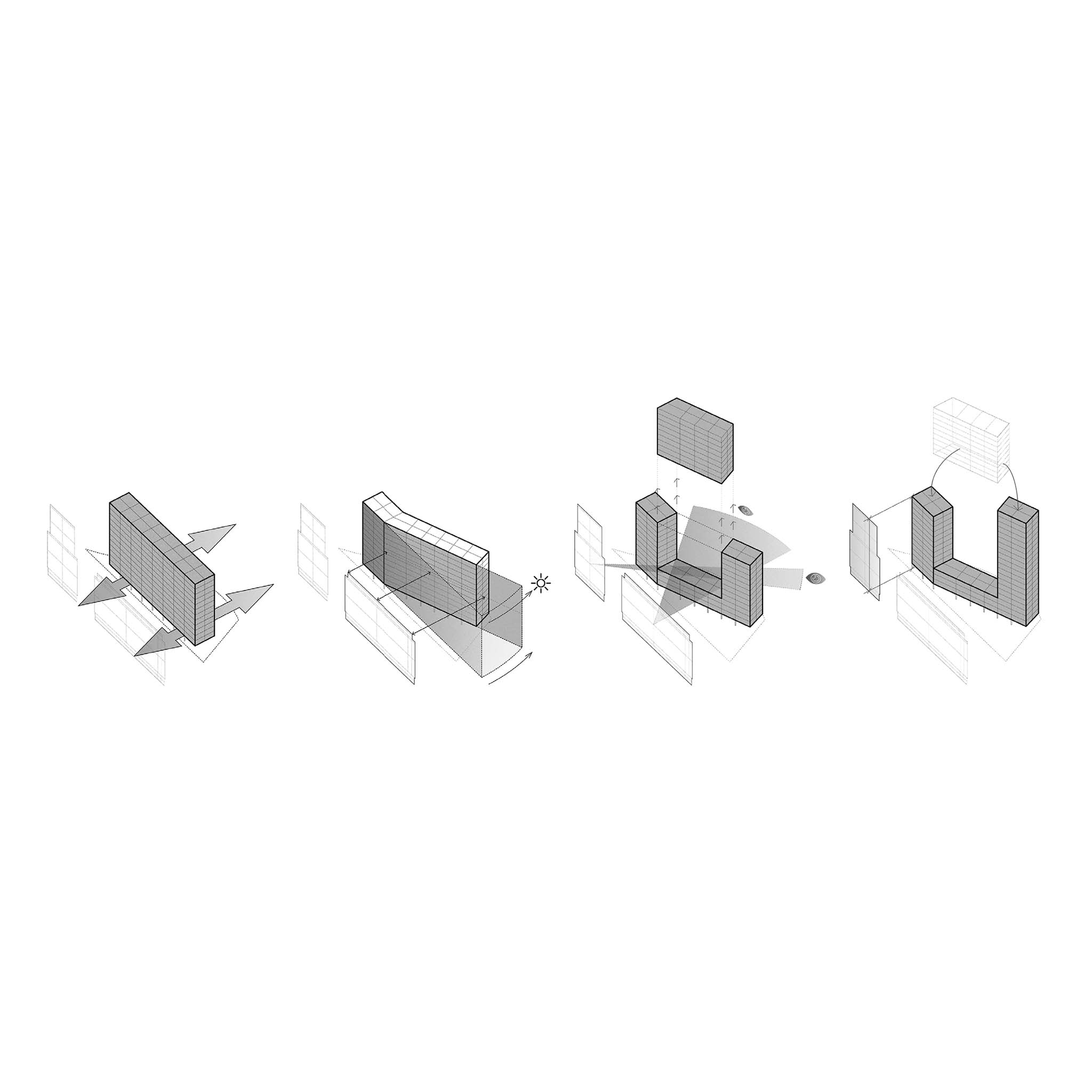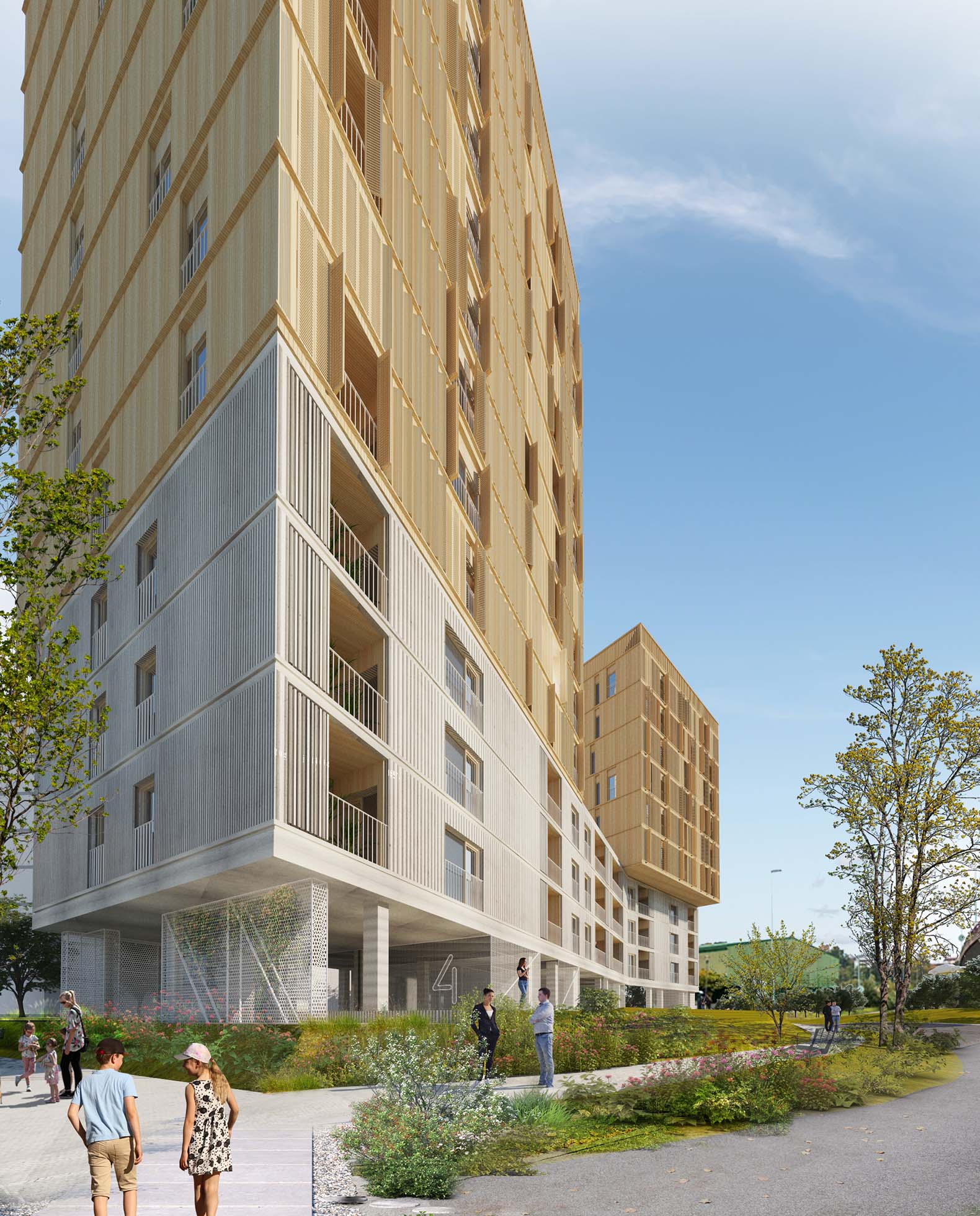
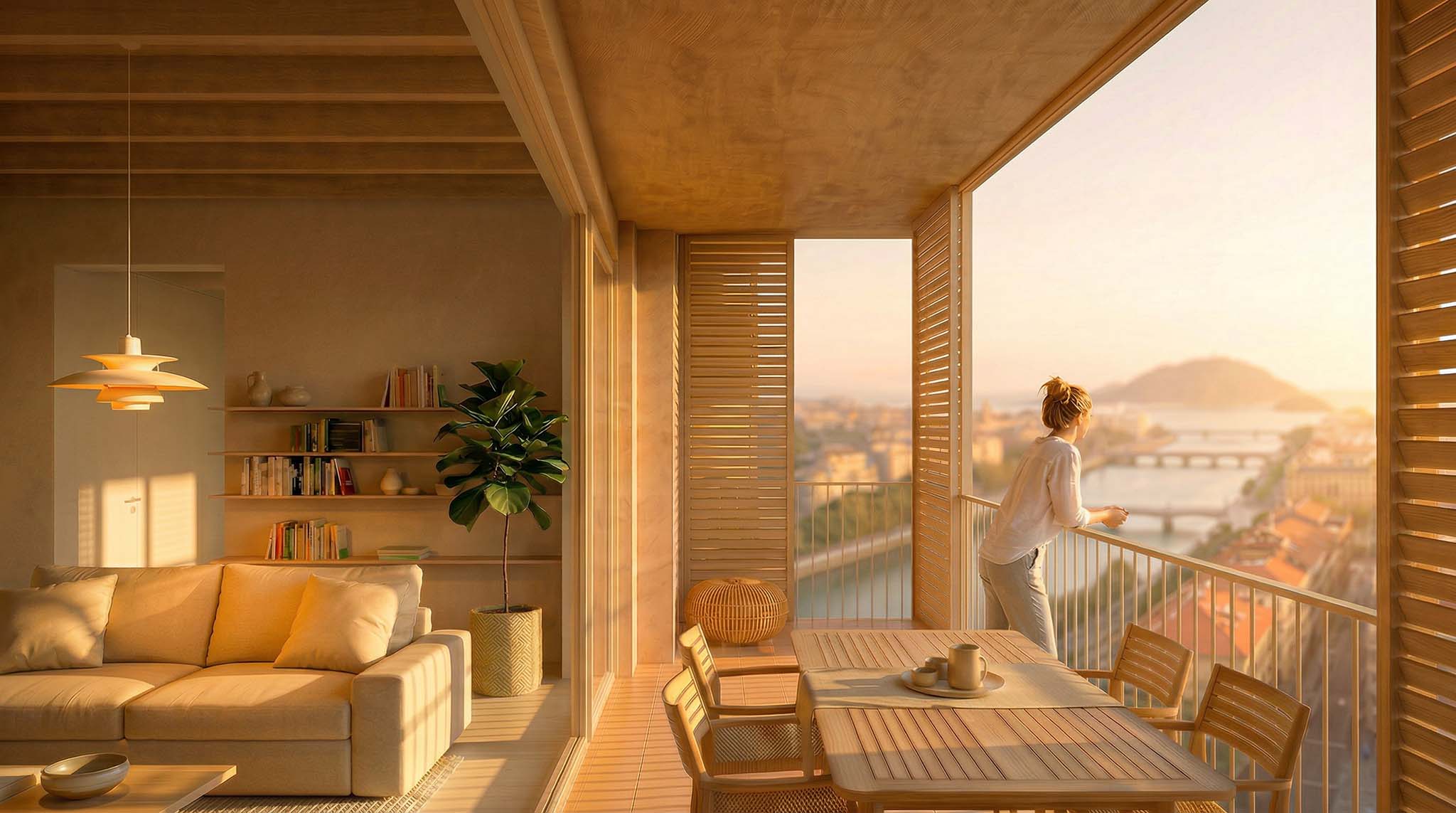
The building, designed by Nexo Arquitectura, ComboLab y Equipo.exe, unfolds as a single volume folded away from the street. This design creates a dynamic silhouette that responds to both solar conditions and the scale of its surroundings. The complex houses 83 one- and two-bedroom units, designed with cross-ventilation to optimize sunlight and environmental comfort. The kitchens, ranging from 7 to 12 square meters, reclaim their role as central living spaces, while the terraces facing the Urumea River function as bioclimatic features.
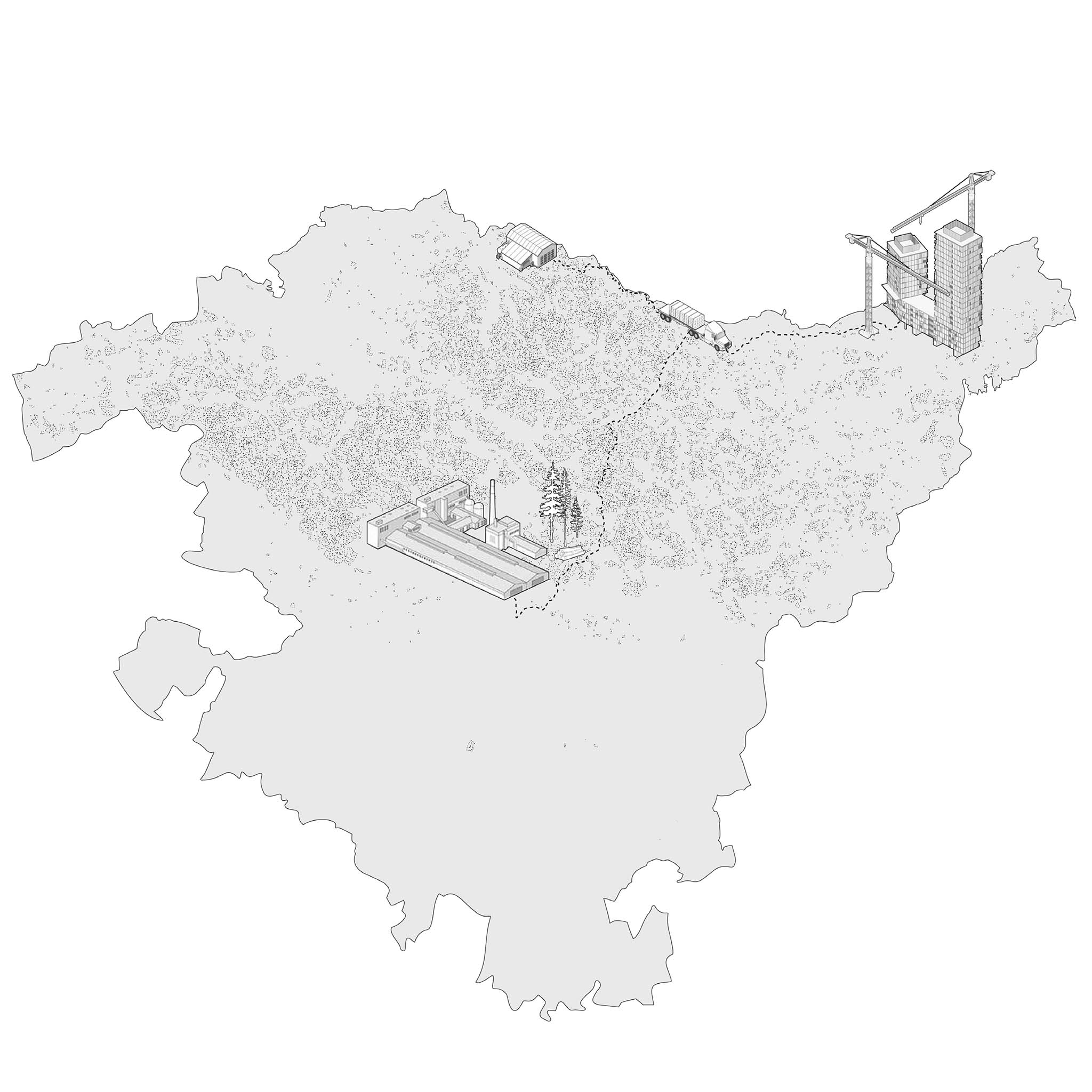
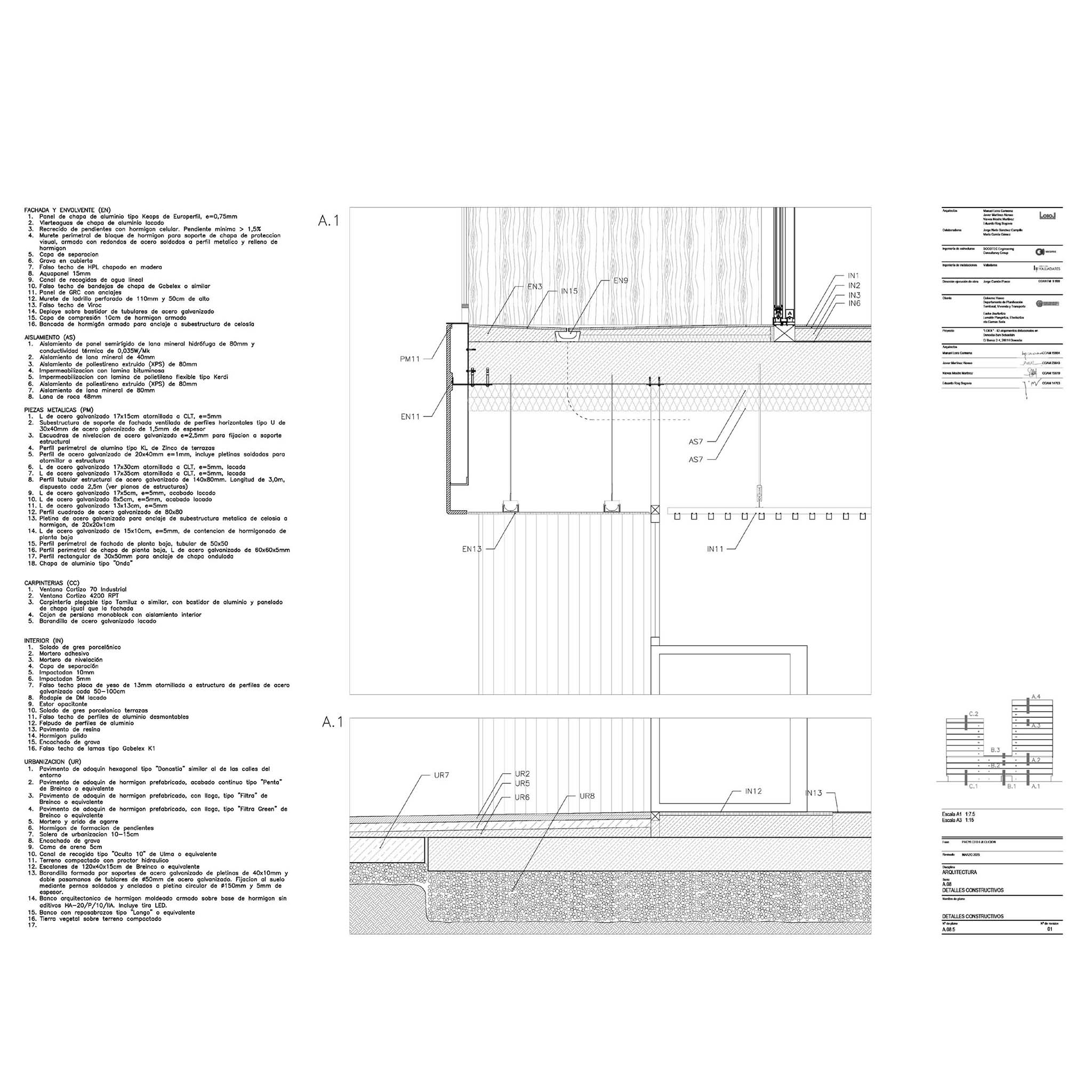
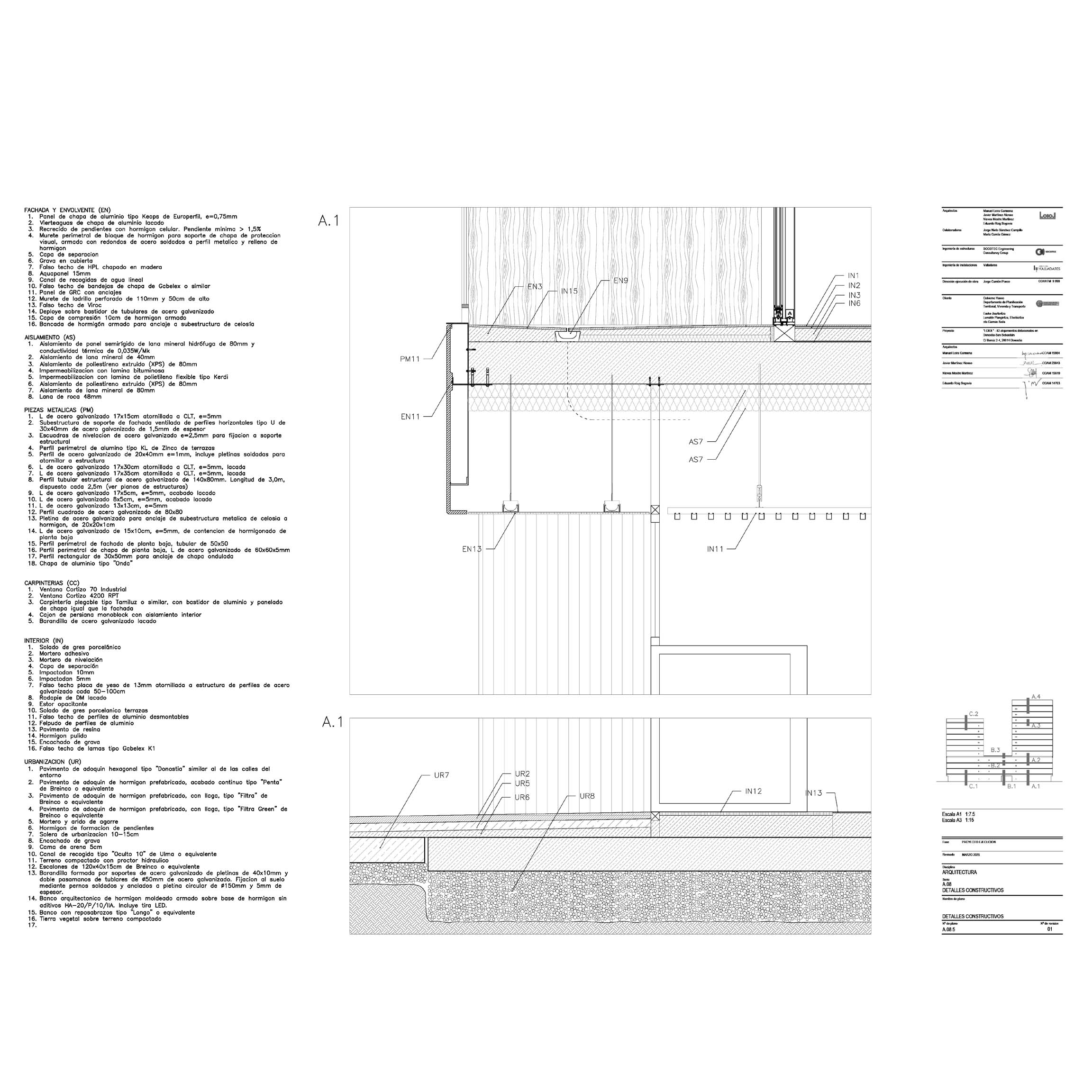
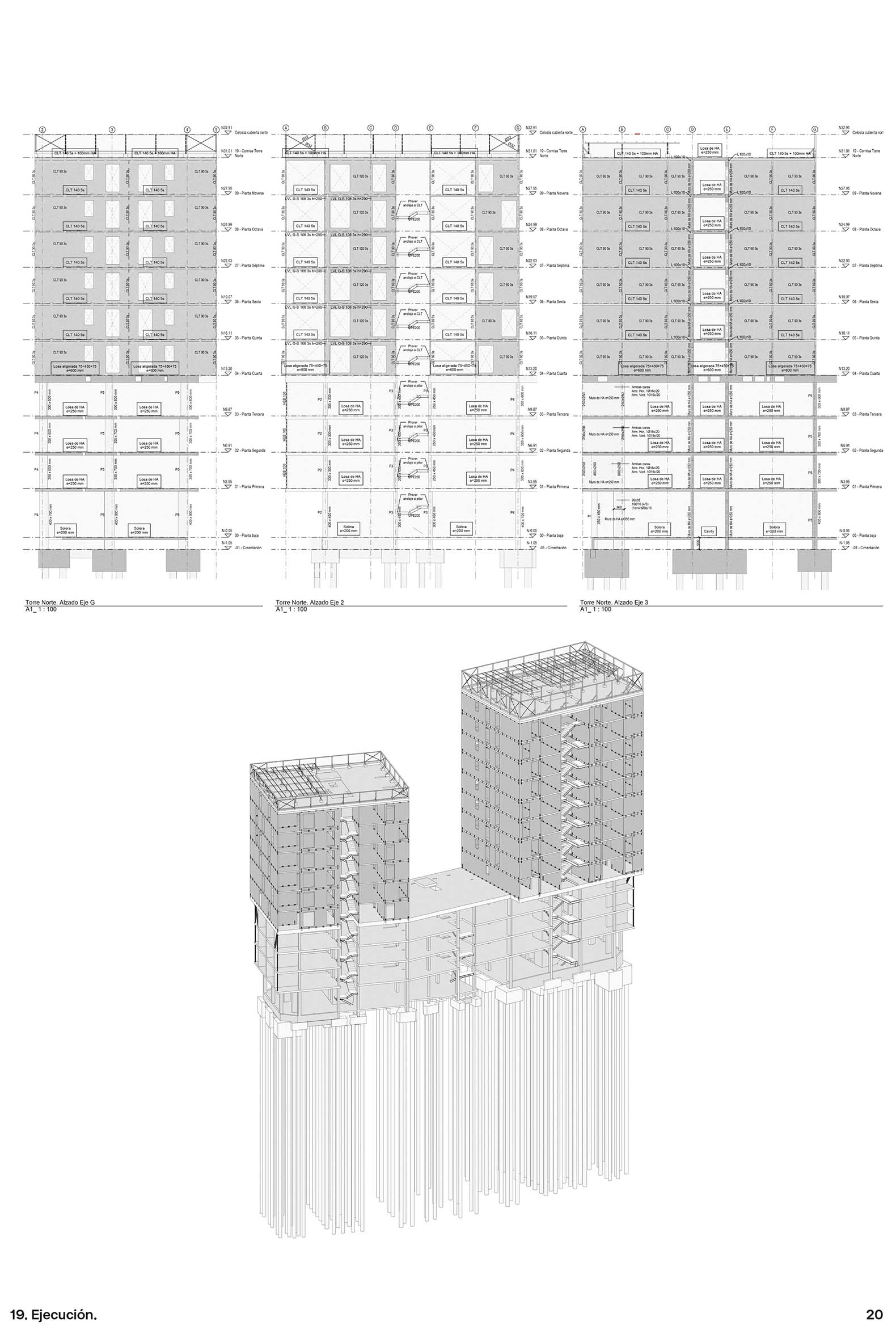
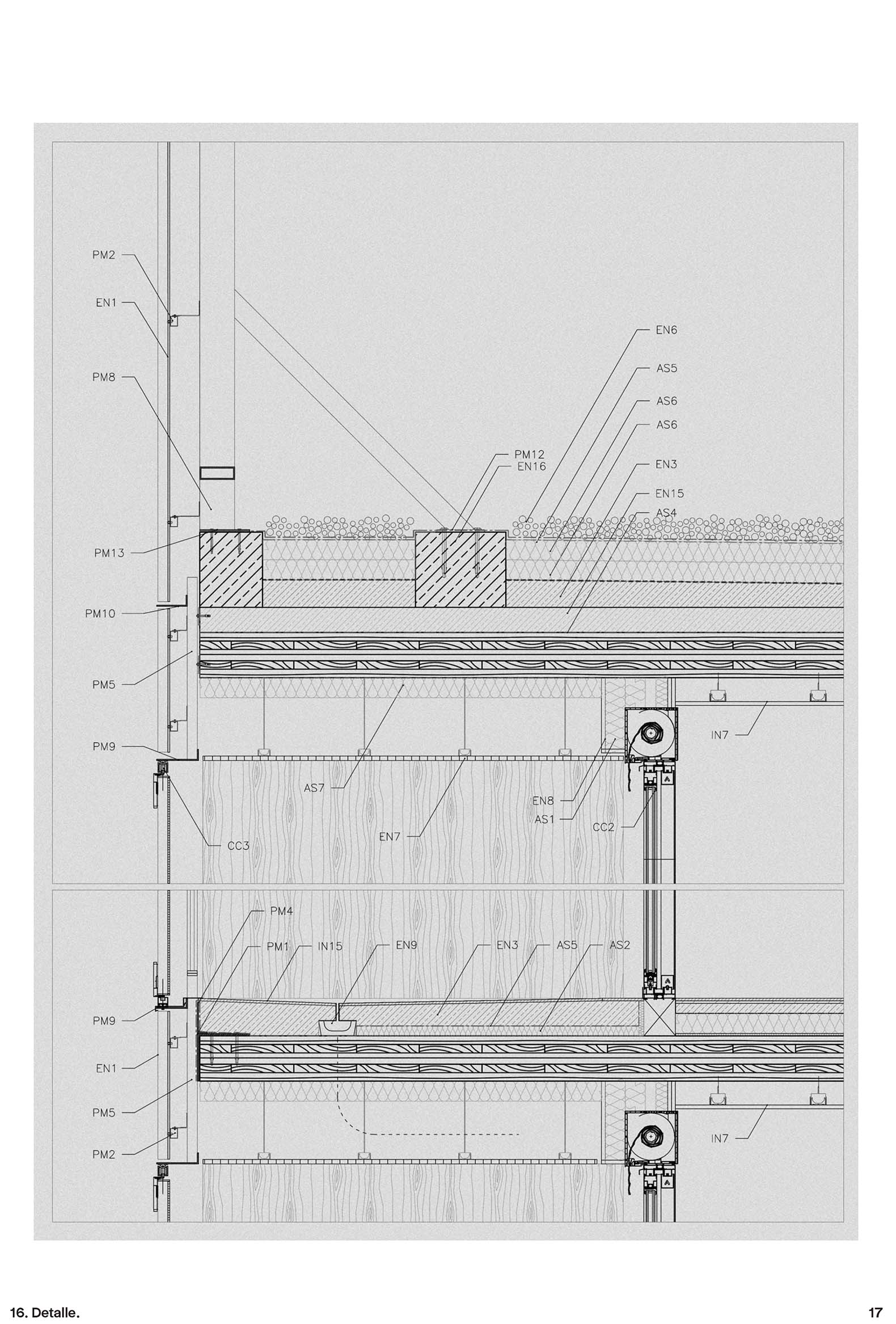
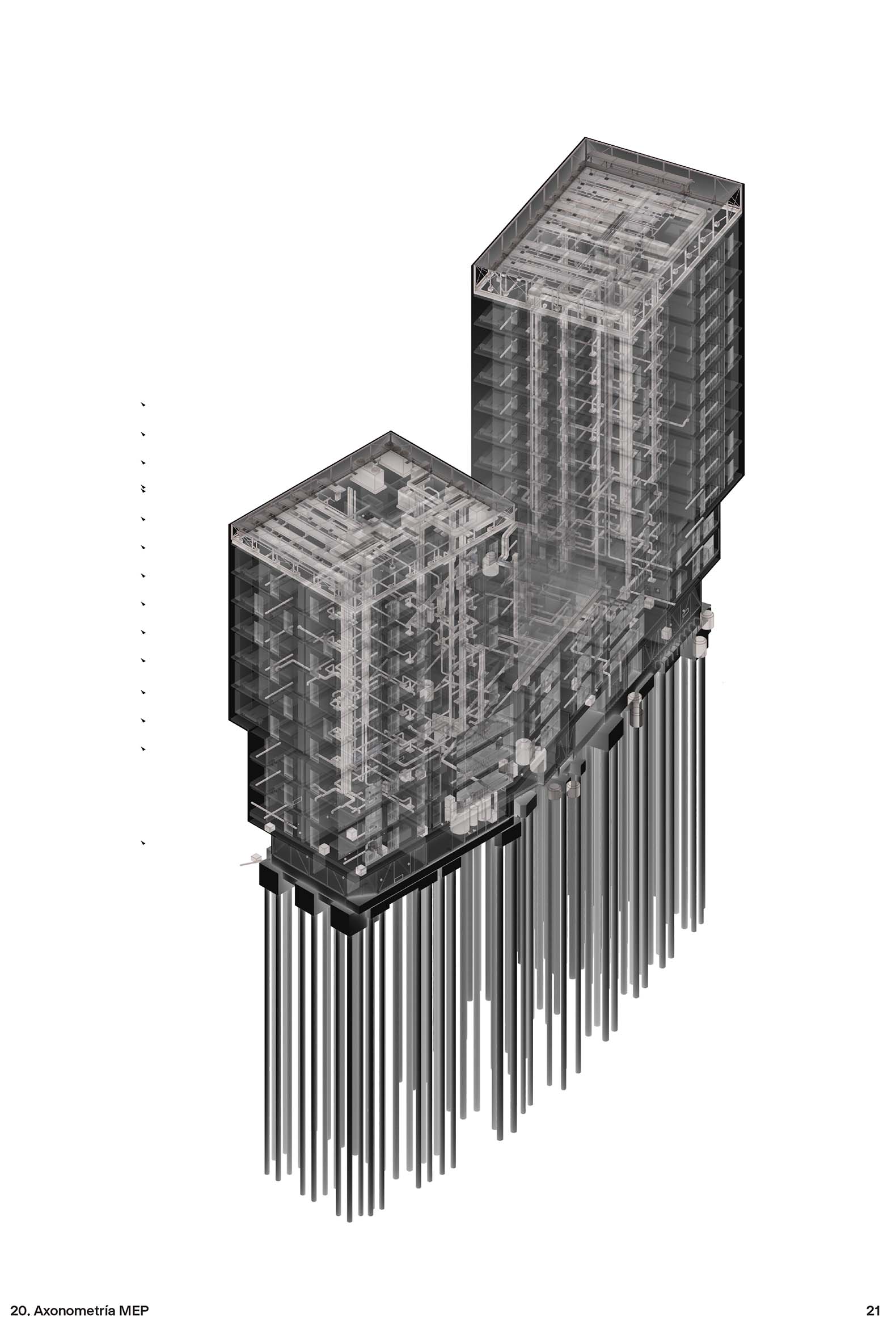
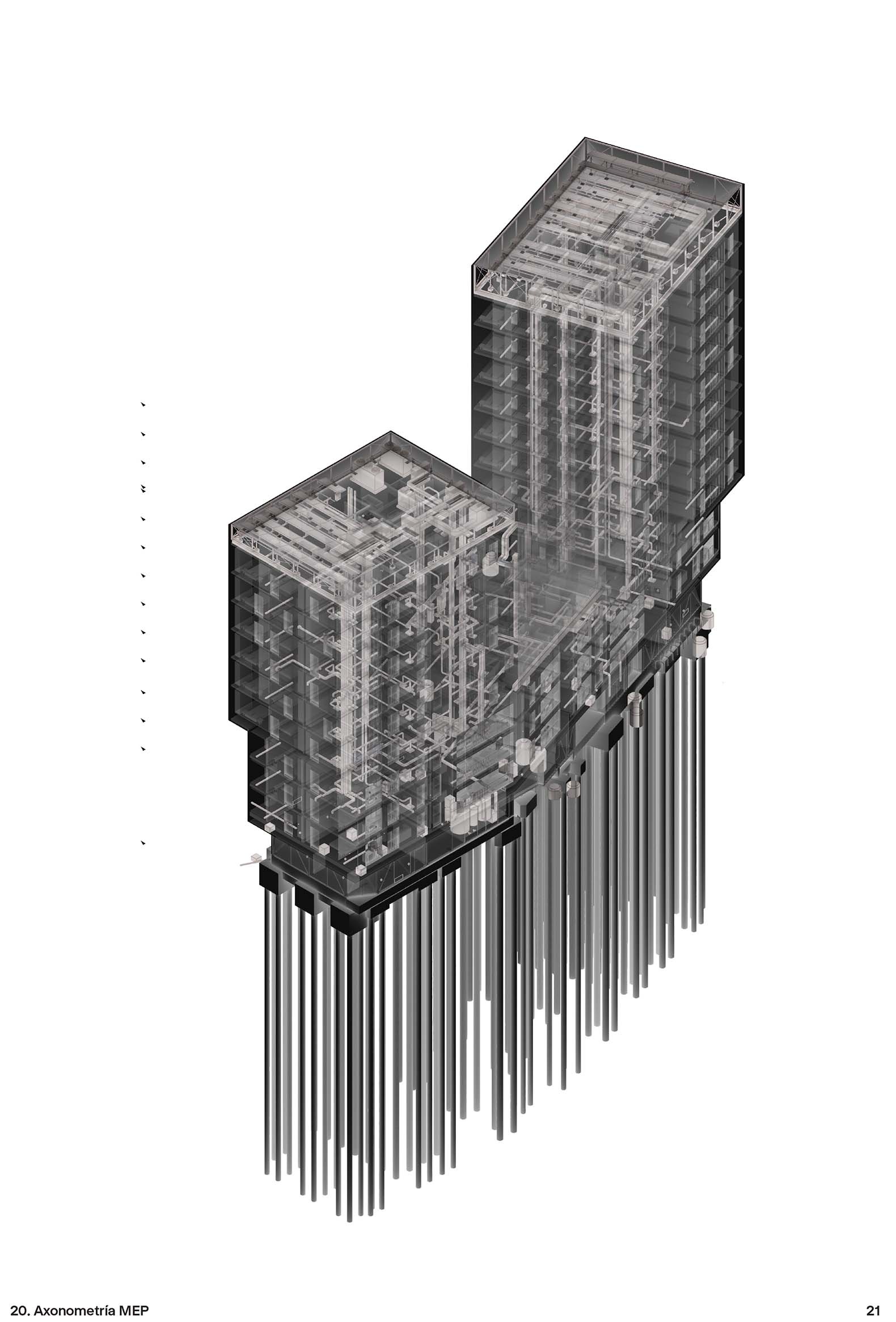
From a construction standpoint, the project prioritises industrialised, highly prefabricated systems to reduce construction time and environmental impact. The structure combines a concrete and steel base with upper volumes constructed from CLT (cross-laminated timber) panels, integrating low-impact solutions with a visible tectonic logic.
83 subsidized housing units by Nexo Arquitectura + ComboLab + Equipo.exe. Rendering courtesy of Nexo Arquitectura + ComboLab + Equipo.exe.
Project description by Nexo Arquitectura + ComboLab + Equipo.exe
The social housing project in Riberas de Loiola proposes a contemporary reinterpretation of collective housing through a typological hybridization of tower and plinth. These two forms are integrated into a single volume of varying height that folds away from the street alignment, maximizing exposure to the south. This design minimizes solar obstruction while simultaneously offering an iconic response to the unique urban context. The result is a volume sculpted by the sun, reminiscent of the work of Eduardo Chillida and Jorge Oteiza in its conception of emptiness and its dialogue with materials.
The complex houses eighty-two one- and two-bedroom apartments, designed with maximum flexibility and adaptability in mind. All units feature cross ventilation, optimizing both sunlight and environmental comfort. In this sense, domesticity is reconfigured based on the parameters established by the Basque Government's Habitability Decree, which incorporates gender and post-COVID health criteria. The kitchens, ranging from 7 to 12 m², regain their central role as communal spaces, while generous terraces of at least 4 m² extend the domestic sphere outdoors. Oriented towards the Urumea River, these terraces are conceived as climate-mediating devices, capable of capturing solar gain in winter and improving the overall energy performance. Thus, the dwelling is redefined as an isotropic space, where the rooms have equivalent dimensions and allow for multiple uses.
The building's bioclimatic strategy is based on three fundamental principles: volumetric compactness, the use of solar radiation through galleries and terraces, and the harnessing of the ground's thermal inertia through geothermal systems. In addition, sensor-equipped installations will allow for the creation of a digital twin of the building, facilitating real-time monitoring of its performance. This approach places residents at the heart of the management process, with particular attention to issues such as energy poverty.
From a construction standpoint, the building prioritizes highly prefabricated systems that reduce both construction time and environmental impact. The structural framework consists of a concrete base and metal structure, upon which rest two volumes built with cross-laminated timber (CLT), thus integrating industrialized solutions with low-impact materials. This construction logic connects with vernacular references, such as farmhouses or fishermen's cottages, whose timber-framed structures were organized as a framework of braced porticos: the structure shapes the interior space, making the building's tectonics visible; the upper beams and ridge beam extend to support the roof overhang and the balconies on the upper floors. This mechanism allows for the creation of significant cantilevers to the south, achieved through a light and integrated design.
The project is situated at the intersection of tradition and contemporary design, proposing a model of collective housing that, beyond responding to technical and regulatory requirements, explores a new paradigm of living: understood as urban amenities, more open, resilient and energy conscious.