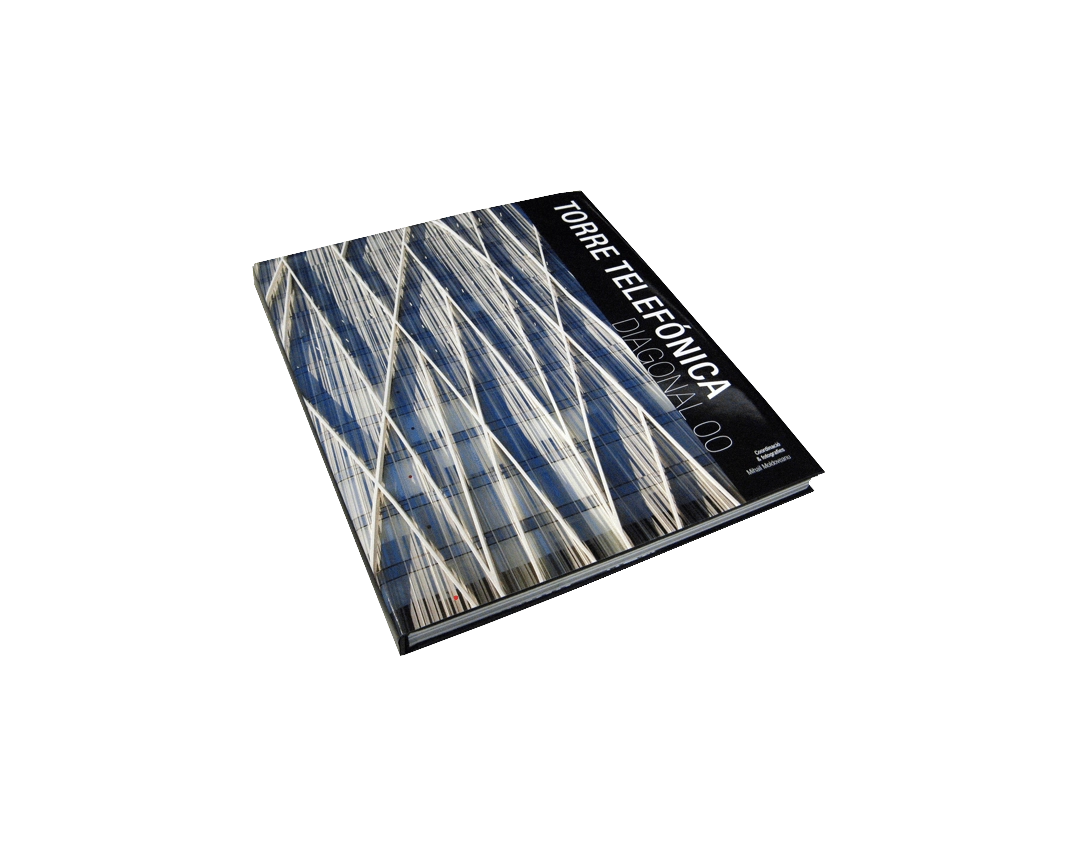
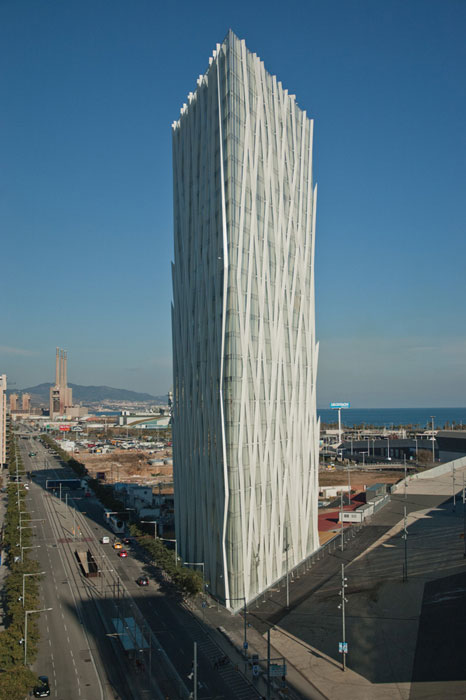
Today, opeing the exhibition about Telefónica Diagonal 00 Tower by Enric Massip-Bosch, at the COAC. The first book that has been published on this work, I am sure there will be more, is at the height of this exceptional building. It is a book with a great profusion of good images and contrary to what is usual for this type of format, it goes a step further and includes support images, the necessary technical drawings and different texts by renowned architects and architecture critics.

[Spanish] La presencia de la red está haciendo que las editoriales tengan que mejorar su publicaciones, de manera consciente o inconsciente, como es el caso. En los últimos meses algunas de ellas, como Taschen con "Project Japan. Metabolism Talks…" y ahora Lunwerg con este libro, nos han sorprendido con libros que se salen de su tónica habitual demasiado dependientes de la profusión fotográfica.

El libro se convierte en un documento imprescindible para entender el edificio, con imágenes de maquetas, fotografías de trabajos previos, imágenes de la construcción y de su estado final, planos técnicos e imágenes complementarias que acompañan un grupo de textos que de manera brillante escanean desde diferentes puntos de vista las múltiples facetas del edificio.

El grupo de textos viene firmado por Jordi Badia, José Juan Barba, Antoni Güell, Julio Martínez, Josep Lluis Mateio Mihail Moldoveanu, Llàtzer Moix, Enric Massip-Bosch.

Es un libro muy recomendable, que acompaña a una exposición que no te puedes perder.

A continuación algunos extractos del libro:

  • "No es exagerado decir que la Torre Telefónica Diagonal 00 es, desde su mismo nacimiento, un edificio emblemático de Barcelona." Antoni Güell.
  • "Junto a su planta de forma romboidal, diamantina, esta segunda estructura es probablemente el elemento que mejor distingue la Torre... la que concreta su personalidad". Llàtzer Moix.
  • "Las singularidades que presenta el proyecto estructural y que reflejan los aspectos fundamentales de la tensibilidad señalada del edificio se centran principalmente en la forma en planta del mismo y en las características específicas que se dan en el conjunto de la doble malla, también interconectada, que constituye la fachada exterior portante". Julio Martínez.
  • "...blanco, sin duda un gran acierto- que no le viene mal al lugar, sobredimensionado de geometrías ortogonales". Josep Lluís Mateo.
  • "El Gigante sensible". Jordi Badia.
  • "En el camino hacia la construcción de la Barcelona vertical, la Torre Telefónica Diagonal 00 tiene un papel privilegiado." José Juan Barba


Read more
Read less

More information

Enric Massip-Bosch (Barcelona, 1960), architect. Associate Professor of Design at the UPC since 1994. As a student, he worked at Shinohara Atelier, Japan (1987-1988). In 1991, he founded EMBA (Estudi Massip-Bosch Aquitectes), with which he has developed projects of various typologies in several countries. EMBA has won numerous international competitions and awards, including the 2011 LEAF AWARDS for Best World Office Building for the Diagonal ZeroZero skyscraper in Barcelona, ​​and the 2009 ABITARE IL MEDITERRANEO Award for the redevelopment of Place République in Leucate, France. The monograph EMBA-ENRIC MASSIP-BOSCH: ARCHITECTURE 2005-2015 compiles the last 10 years of EMBA's projects (TC Cuadernos no. 121, December 2015). The publication of the new EMBA monograph, Architecture-Metamorphosis 2015-2025, is currently in preparation.

Founding member of the Barcelona Chapter of the Council on Tall Buildings and Urban Habitat. Member of the Urban Habitat Advisory Council of the Barcelona City Council (2011-2015), member of the Urban Planning and Territory Commission of the 22@Network Association, member of the Italian National Agency for Evaluation of the University System and Research (Italian government, 2012-2015), and co-founder and director of the Master's Program in Urban Design, Building the City Now, offered in Barcelona and St. Petersburg (Russian Federation) since 2014, accredited by the Polytechnic University of Catalonia-BarcelonaTECH.

His work has been published in journals and books: Experimental Housing, 1971-1994 (Barcelona: Ediciones UPC, 1996), Architecture on the Horizon (London: RIBA, 1996), Concealed Complexities (Tokyo: TOTO, 1999), and Diagonal ZeroZero (Barcelona: Lunwerg, 2011). He was a co-founder and member of the editorial board of WAM-Web Architecture Magazine (1996-2001). He is currently working on a compilation of his articles, published under the title "Minima Enciclopedia" in the journal El Temps de les Arts, Edicions 3i4, Valencia.

Visiting professor at schools in various cities around the world, he has given lectures and participated in seminars in Barcelona, ​​Madrid, Valencia, Zaragoza, Seville, Valladolid, Mérida, Vigo, Tokyo, Kawasaki, Chiba, Kyoto, Shanghai, Buenos Aires, Rosario, New York, Miami, Budapest, Amsterdam, Maastricht, Vienna, Paris, Bergamo, Milan, Piacenza, Pescara, Venice, Rome, Genoa, Matera, Porto, Bucharest, Izhevsk, St. Petersburg and Moscow.

Read more

José Juan Barba (1964) is an architect, graduated from ETSA Madrid (1991), and holds a Doctorate in Architecture from ETSA Madrid, awarded Cum laude for his thesis Inventions: New York vs. Rem Koolhaas, Bernard Tschumi, Piranesi (2004). He received a special mention in the National Awards for Completion of Studies (1991) and served as an advisor to various NGOs until 1997. He founded his studio in Madrid in 1992 (www.josejuanbarba.com). 

Barba is an architecture critic and has been the director of METALOCUS magazine since 1999. Since 1998, he has directed the International Architecture Magazine METALOCUS (bilingual, Spanish/English), which has been recognized with multiple national and international awards.

He is a Full Professor at the University of Alcalá, leading the project line of the Habilitation Master's Architecture and City, responsible for several courses in Theory and Criticism, heading the Urban Planning area of the Department of Architecture, and participating in the research group Architecture, History, City, and Landscape at UAH. He has been invited to numerous architecture and urbanism forums, including the II Forum of Mexican Cities World Heritage: Urban Development, History, and Modernity, organized by the Pan-American Committee for Urban Development and Historical Heritage, and the World Urban Development Forum (FMDU) in Culiacán, Sinaloa, Mexico. He has also participated in the International Architecture and Urbanism Conferences from the perspective of women architects, and has lectured at prestigious national and international universities, including the National Building Museum (Washington, DC), Roma TRE, Politecnico di Milano, UPMF Grenoble, ETSA Madrid, ETSA Barcelona, University of Thessaly (Volos), UNAM Mexico, the Faculty of Architecture Montevideo, schools of architecture in Medellín, Quito-Ecuador, Alicante, Málaga, Granada, Seville, A Coruña, Zaragoza, Valladolid, Universidad Iberoamericana Mexico, IE School, Universidad Europea Madrid, UCJC Madrid, ESARQ-UIC Barcelona, or Università Degli Studi di Genova.

Barba has extensive professional experience in architecture, urban planning, landscape design, and territorial recovery. He has received numerous awards, including the First Prize for Gran Vía Posible for Delirious Gran Vía (Madrid), the River Interpretation Center (Zamora), exhibited at the World Architecture Festival (Barcelona 2008), Santa Bárbara Park (Toledo), the Erich Degner Architecture Prize 1995 promoted by the BBVA Foundation, and his Day Care Center for the Elderly project, featured in Volume 3 of the COAM Madrid Architecture Guide (2007). His work has been published in numerous national and international books and magazines.

He was also Maître de Conférences at IUG-UPMF Grenoble (2013–14), in a position obtained through a European competition. His work has been published internationally. He regularly serves on academic juries, including the editorial competition of Quaderns magazine (2011), as a selector for the Mies van der Rohe Awards (2007–2026), as juror for EUROPAN13 Spain (2015–16), TRANSFER in Zurich (2019), and was invited to participate in the Venice Biennale 2016 as part of the exhibition Spaces of Exception / Spazi d’Eccezione.

He has published several books, including The Dark Line. michele&miquel, dA Vision Design (2024), CONGRESO ANYWAY. The City of Cities (2020), #Positions (2016), and Inventions: New York vs. Rem Koolhaas, Bernard Tschumi, Piranesi (2015). He has contributed to other publications such as Public Space Gran Vía. The Tourism City (2020), Spaces of Exception / Spazi d’Eccezione (2016), La mansana de la discordia (2015), and Contemporary Architecture of Japan: New Territories (2015), as well as chapters in numerous books including Architects: A Professional Challenge (2009), 21st Century Architectures (2007), Ruta de la Plata, New Conquerors of Space (2019), and The Tourism City (2020).

Selected awards include:

- “PIERRE VAGO” ICAC. International Committee of Art Critics Award, London, 2005
- “PANAYIOTI MIXELI AWARD,” SADAS-PEA, award for the promotion of architecture, Athens, 2005
- “SANTIAGO AMÓN” AWARD, award for the promotion of architecture, COAM Madrid, 2000
- FAD Award 07, Ephemeral Interventions, First Prize, M.C. Escher Exhibition, Arquin-FAD, Barcelona, 2007
- World Architecture Festival, Center for Research and Interpretation of the Rivers, Tera, Esla, and Órbigo, Finalist, Barcelona, 2008
- Gran Vía Posible, First Prize, Delirious Gran Vía, Madrid, 2010
- Reform of the Río Segura Surroundings, Award, Murcia, 2010

Read more

Josep Lluís Mateo was born in Barcelona (1949) and graduated in Architecture in 1974 from the ETSAB, later obtaining his PhD (cum laude) from the Polytechnic University of Catalonia in 1994. He is also Professor Emeritus, Doctor of Architecture and Design at ETH Zurich (Swiss Federal Institute of Technology). He has taught and lectured at major academic institutions worldwide, including the Getty Foundation in Los Angeles (Scholar), the Berlin Sommer Akademie, and Harvard Graduate School of Design (Guest Professor), among others.

In 1991, he founded mateoarquitectura, a practice based in Barcelona that has developed a broad range of projects—office buildings, urban planning, public spaces, housing—always with a strong international focus. Mateo’s practice is currently involved in a number of local and international projects such as the new Film Theatre of Catalonia in Barcelona, the new headquarters for PGGM Pension Fund Company in Zeist, Holland, and the office building on the former site of Renault factories in Boulogne-Billancourt, Paris, among others.

With each of his projects, Mateo seeks to connect the practice of construction with research and development in both intellectual and programmatic terms. His work lies at the intersection between conceptual thinking and built reality, combining technical rigor with ongoing inquiry. His architecture has been widely published and exhibited globally, receiving numerous awards and honors. In 2011, he received the Aplus Award for Best Career Achievement; in 2019, DOMUS named him among the 100 best architecture studios worldwide; and in 2021, he was named Author of the Year by the Juanzong Archive Awards (China).

Among his most significant projects in Spain are the Toni Catany International Photography Center in Mallorca, the Barcelona International Convention Center (CCIB), the Filmoteca de Catalunya, the renovation and extension of the Mercat del Ninot in Barcelona, and the paving of the historic center of Ullastret. Internationally, his work includes the headquarters for PGGM in Zeist (Netherlands), La Factory office building in Boulogne-Billancourt, the ESMA School in Montpellier, and the Castelo Branco Cultural Center.

Academic collaborations and teaching:
Josep Lluís Mateo has been Professor of the Architecture Department at the Swiss Federal Polytechnic in Zurich (ETH-Z) since 2002. He has also taught and lectured at numerous institutions around the world, including Princeton, Columbia University in New York, the Harvard Graduate School of Design, ABK Stuttgart, UP8 Paris, OAF Oslo and ITESM Mexico. He was Visiting Scholar at the Jean P. Getty Center in Los Angeles from 1991 to 1992. Josep Lluís Mateo is President since 2009 of the Board of Directors of the Barcelona Institute of Architecture. He has been a member of a number of juries and expert committees, including the Quality Committee of Barcelona City Council (2000-2008), and for prizes such as the European Landscape Award and the Thyssen Award.

Recent exhibitions and prizes:
The practice’s work has been exhibited on numerous occasions thanks to its international influence. New York’s MoMA devoted a space in the exhibition “Spain: On Site” (2006) to its apartment building in Valencia for the Sociopolis Project. Individual exhibitions include those at Ras Gallery (Barcelona, 2009), Architekturgalerie Aedes (Berlin, 2004), Architekturzentrum Wien (Vienna, 1998), Col•legi d’Arquitectes de Catalunya (Barcelona, 1998),Galerie Fragner (Prague, 1998), Galerie Aedes (Berlin, 1994), Architekturgalerie Luzern (Luzern, 1992) and Architekturgalerie Munich (Munich, 1991).

The work of Josep Lluís Mateo has been awarded many prizes, including:
- Top International Purpose-Built Venue 2008, First Prize. Best International Convention Centre category.
Organized by C&IT magazine, London. Project: CCIB-Barcelona International Convention Centre
- 2008 Archizinc Award, First Prize. Collective Housing category. Project: Sant Jordi Students’ Hall of Residence, Barcelona
- European Union Prize for Contemporary Architecture - Mies van der Rohe Award 2005, Runner-up. Project: CCIB- Barcelona International Convention Centre
- 15th Award of Grupo Dragados de Arquitectura.

Read more

Jordi Badia (Barcelona, 1961) graduated in architecture from the ETSAB (Barcelona School of Architecture) in 1989. Between 1989 and 1993 he practiced a professional partnership with Tonet Sunyer. In 1994, he founded the BAAS architecture study, Jordi Badia combined his professional task as an architect with that of a professor at the Department of Architectural Projects at ETSAB since 2001 and at ESARQ-UIC since 2009. He also collaborated with the newspaper ARA since 2010 and has been editor of the Hic Architecture since 2009. He curated the Catalan and Balearic Pavilion, along with Felix Arranz,  at the 13th Venice Architecture Biennale 2012.

The practice is currently working on various projects, including the town hall in Montroig del Camp, the headquarters of the Barcelona Supercomputing Centre and the new premises of the MUHBA (Museum of History of Barcelona) in Poblenou district, Barcelona. The office is also working on the citizens building in Palamós, the extensive rehabilitation of the Alta Diagonal office building in Barcelona and the Radio and TV University in Katowice, Poland.

Read more
Published on: January 19, 2012
Cite:
metalocus, PEDRO NAVARRO
"TORRE TELEFÓNICA. DIAGONAL 00" METALOCUS. Accessed
<http://www.metalocus.es/en/news/torre-telefonica-diagonal-00> ISSN 1139-6415
Loading content ...
Loading content ...
Loading content ...
Loading content ...
Loading content ...
Loading content ...
Loading content ...
Loading content ...
Loading content ...
Loading content ...
Loading content ...
Loading content ...
Loading content ...
Loading content ...
Loading content ...
Loading content ...
Loading content ...
Loading content ...
Loading content ...
Loading content ...
Loading content ...
Loading content ...
Loading content ...
Loading content ...
Loading content ...
Loading content ...
Loading content ...
Loading content ...
Loading content ...
Loading content ...
Loading content ...
Loading content ...
Loading content ...
Loading content ...
Loading content ...
Loading content ...
Loading content ...
Loading content ...
Loading content ...
Loading content ...
Loading content ...
Loading content ...
Loading content ...
Loading content ...
Loading content ...
Loading content ...
Loading content ...
Loading content ...
Loading content ...
Loading content ...
Loading content ...
Loading content ...
Loading content ...
Loading content ...