Rogers Stirk Harbour & Partners are the winners of the inaugural City of London Building of the Year award and the project along with the finalist projects will be unveiled in an exhibition that will be open to the public, running from 17 September to 16 October, in the City Centre in The Guildhall where it will be exposed the criteria of the competition: buildings that support the ambitions of the City of London taking care of the environment, the quality of the architectural design and the impact the building has had on the city street scene.
The Leadenhall Building has a public area that integrates with St Helen's Square and it will become one of the largest open spaces in the City of London, providing a 1858 sqm park-like area in one of the most active and densely developed parts of the capital.
Description of the project by Rogers Stirk Harbour + Partners
Having achieved project completion for shell and core in July 2014, the building is at the beginning of a nine-month fit out programme led by developers British Land and Oxford Properties for its anchor tenants Aon and Amlin. The completion of the public space, including the opening of the north-south pedestrian route and landscape integration into the adjacent St Helen's Square, is scheduled for 2015. This will create a 20.000 square foot park-like area in one of the most active and densely developed parts of the capital and fulfil the building's urban function.
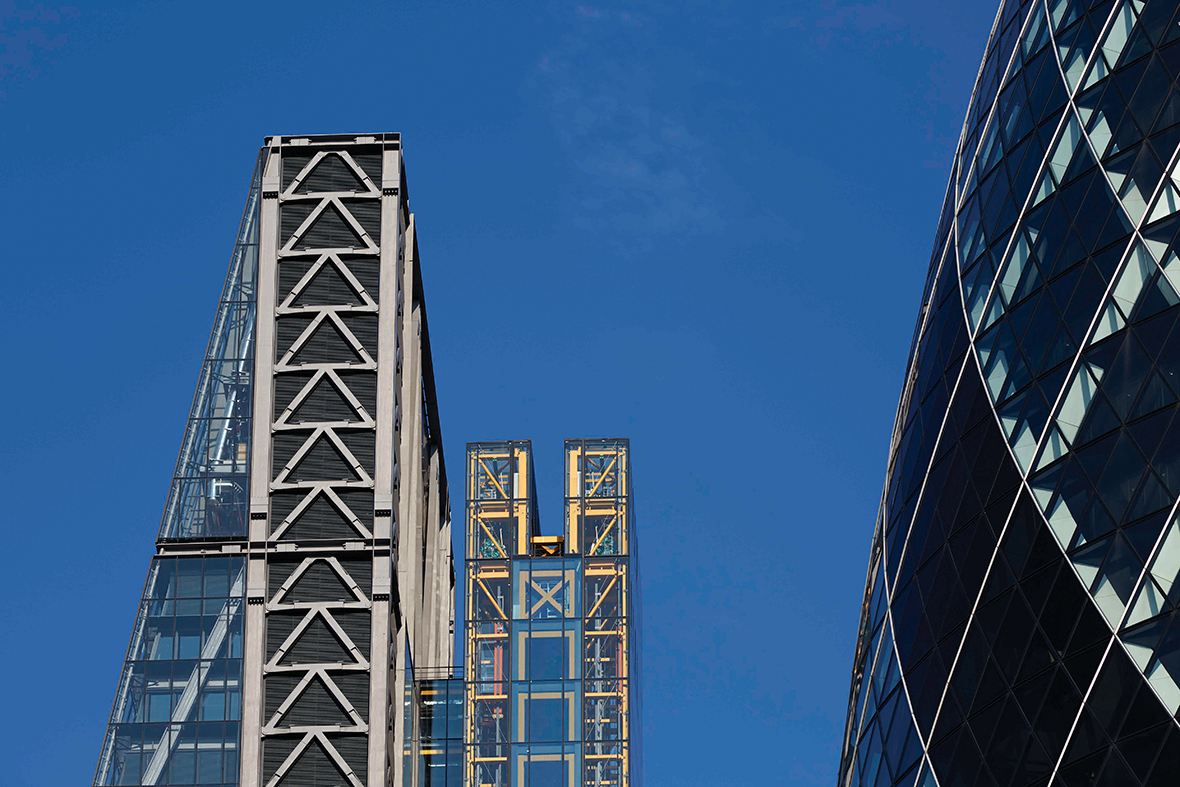
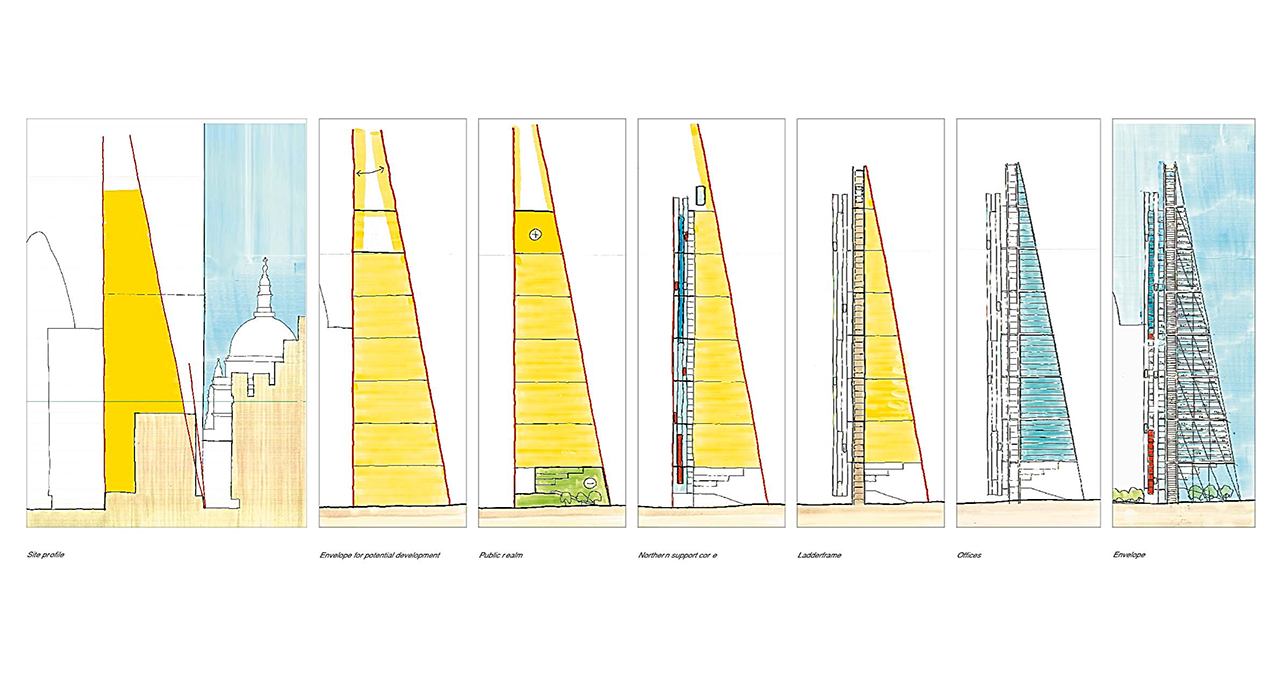
Profile.- The building's tapering profile is prompted by a requirement to respect views of Sir Christopher Wren's St Paul's Cathedral, in particular from Fleet Street. Increasing the height of the building within the development envelope allows the mass of the building to pull away from the sensitive view and ensure that the cathedral's dome is still framed by a clear expanse of sky from the key Fleet Street vantage point. This produces a sharp form in contrast to the soft profile of the dome and complements its setting, surrounded by the existing spires of the north and south entry towers and Wren's St Artin within Ludgate, while also creating its own distinctive profile among the Eastern Cluster.
Structure.- Instead of a traditional central core providing structural stability, the building employs a full-perimeter braced tube, which defines the edge of the office floor plates and creates stability under wind loads by adding rigidity to the megaframe. Based on a seven-storey sequence, the structural tube is a clear expression of the vertical cantilever and the most visible feature of the external envelope, reinforcing the composition without decoration and providing the legibility of primary elements when viewed from a distance.
Detail.- The yellow steel structure of the North Core is a slender 200 sqm high tower in its own right housing 22 lifts, 45 lobbies and 82 washrooms along with a diverse range of building services plant. The prefabricated, elemental nature of the North Core is a strong visual element of the Leadenhall Building and the bold yellow color of the steel was chosen to enhance its legibility through the glass outer skin.
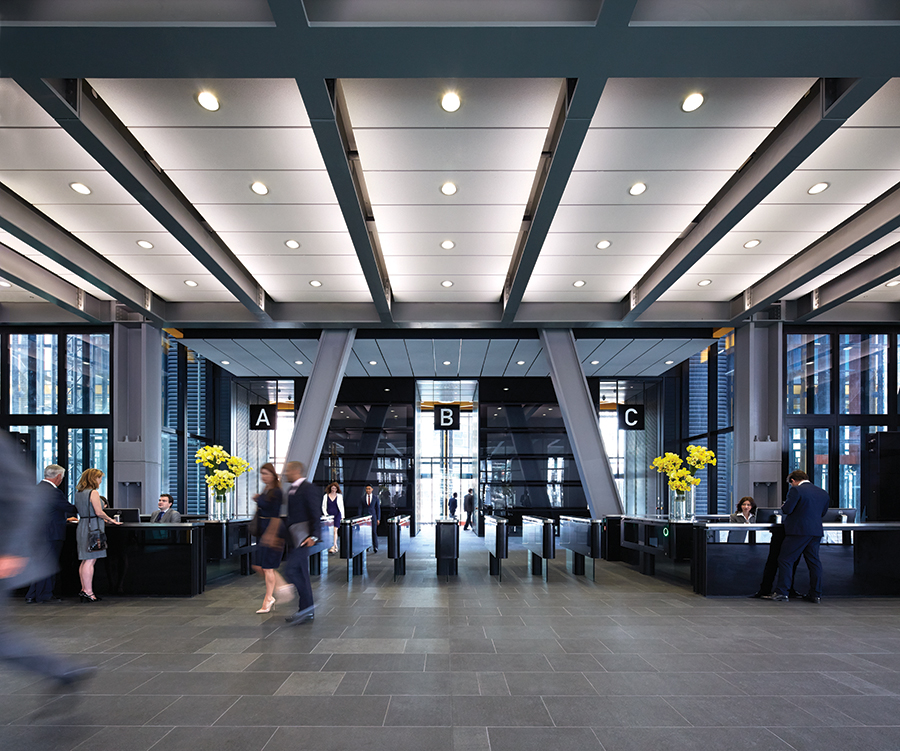
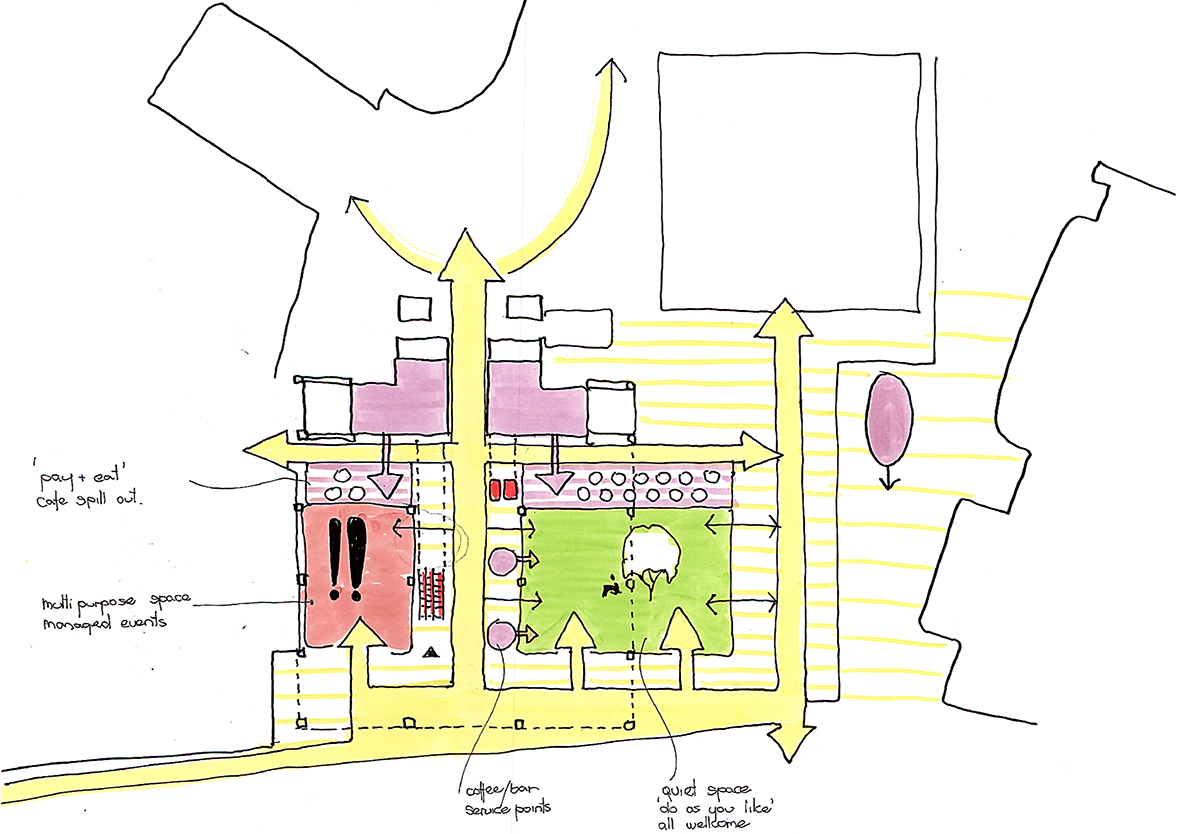
Public space.- Although the development occupies the entire site, by building high an unprecedented allocation of public space was returned at street level. Recessing the lowest five levels of accommodation creates a sun-lit seven-storey high space covering around half an acre and rising to 28 metros at its highest point. The space passes right under the building, opening up new north-south walking routes that recall the alleyways and cut-throughs of the medieval City.
The public space was designed as four distinct zones: a pocket park to the east, to be integrated with St Helen's Square; a central thoroughfare running beneath the building from north to south; a retail area; and a hard landscaped area to accommodate exhibitions and events. Currently home to an exhibition on the making of The Leadinghall Building, this area was left deliberately open so that it can evolve to reflect the needs of the building's occupiers and the local community.
CREDITS. DATA SHEET.-
Architects.- Rogers Stirk Harbour and Partners.
Collaborators.- Laing O'Rourke (Design & Build Contractor), Arup (Structural & Services Engineer), Edco Design London (Landscape Design), DL Aecom ( Quantity Surveyor), WSP (Project Manager), M3 Consulting (Strategic Planning & Consultation Strategy), DP9 (Planning Consultants), Fancis Golding (Townscape Consultant), Bovis Lend Lease (CDM Coordinator), Corporation of London DS Office (Building Inspector), Bentley Microstation (CAD Software)
Client.- The British Land Company plc and Oxford Properties.
Location.- London, UK.
Date.- 2002-2015.
Area.- site area.- 3000 sqm; lettable area.- 60,250 sqm; gross internal area.- 84,424 sqm.
Project cost.- £ 500 million; cost per sqm.- £3,900.