Suspended over a steep slope on the island of Menorca, the house designed by Nomo Studio, called "Steel House," is conceived as a compact volume that establishes a constant dialogue between mass and lightness. Concrete, metal, and glass combine in an honest and minimalist composition, where materiality defines both the architectural expression and its relationship with the landscape.

With its precise geometry and construction using materials in their purest form, the house demonstrates meticulous work in the formwork, whose grooves emphasize the repetition of the modules and the integration of the structural elements. A system of vertical louvers completes the envelope, functioning as a solar control device that regulates the entry of light and views.

Access to the house designed by Nomo Studio is via a series of exposed concrete platforms leading to an intermediate level. Inside, the warmth of a wood-clad entrance hall contrasts with the solidity of the structure. The layout is organized around an open-plan L-shaped space, where the living room, dining room, and kitchen flow seamlessly together, while a metal staircase connects the different levels of the house.

The building envelope creates a double skin between the glazed enclosure and the louvers, configuring a shaded intermediate space that blurs the boundaries between interior and exterior. Large expanses of glass and transition zones leading to the garden reinforce this relationship, consolidating a spatial experience that oscillates between opacity and transparency, solidity and lightness.
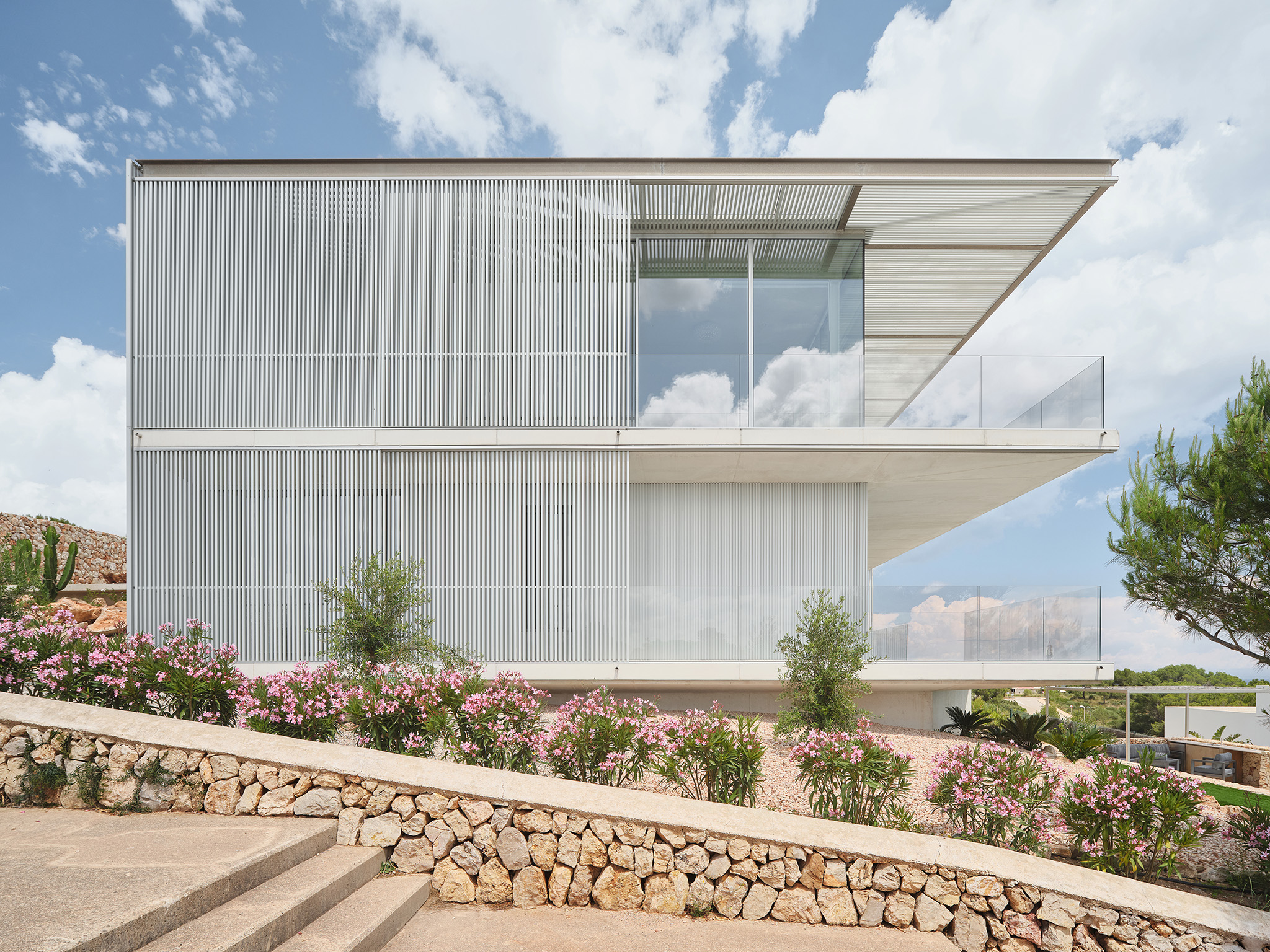
Steel House by Nomo Studio. Photograph by Adrià Goula.

Steel House by Nomo Studio. Photograph by Adrià Goula.

Project description by Nomo Studio

The house is conceived as a monolithic volume with refined geometry, suspended over a steeply sloping topography. Access is through an intermediate level, via a recessed entrance in a completely blank façade, which reinforces the perception of mass and opacity in contrast with the lightness of the main volume. The concrete platforms leading to the house replicate the effect of suspension, establishing a formal dialogue with the building and accentuating the sensation of floating above the ground.

The envelope, rigorously and minimally composed, derives its richness from the treatment of its three essential materials: concrete, metal, and glass—organized in large surfaces interrupted by vertical bands that emphasize the proportion and modulation of the whole. The materials are displayed in their purest state, without cladding or embellishment, encouraging natural aging that enhances the contrast between the solidity of the concrete and the lightness of the aluminum and glass.

Casa de acero por Nomo Studio. Fotografía por Adrià Goula.
Steel House by Nomo Studio. Photograph by Adrià Goula.

The mixed concrete, present both inside and out, reveals meticulous work in the arrangement of the formwork, where precise grooves highlight the repetition of segments and the integration of construction elements—lighting fixtures, drip edges, embedded rails, and concealment systems—within a coherent tectonic logic.

A system of vertical-profile louvers—both fixed and movable—acts as a mechanism for regulating light and views. These filter sunlight, provide privacy, and at the same time, allow for views from the interior. The double skin created between the glazed enclosure and the louvers forms an intermediate shaded space, an ambiguous zone between inside and outside that is incorporated into the home through large sliding glass doors. Throughout the day, the interaction between light and materiality generates a mutable perception of the envelope, where the chromatic variations of concrete, aluminum, and glass absorb and reflect the atmosphere of the surrounding landscape.

Casa de acero por Nomo Studio. Fotografía por Adrià Goula.
Steel House by Nomo Studio. Photograph by Adrià Goula.

The interior entry is resolved through a wood-paneled vestibule, whose warmth provides a counterpoint to the mineral expressiveness of the structure. A metal staircase, lightly traced with a minimal structure, connects the different levels in a vertical sequence permeable to light.

The layout of the program is organized around an open-plan spatiality, where living, kitchen, and dining areas intersect in an “L”-shaped floor plan, allowing the kitchen to recede into the background without losing continuity with the rest of the space. The connection to the garden is formalized through a spacious transitional area that reinforces the fluidity between interior and exterior.

Casa de acero por Nomo Studio. Fotografía por Adrià Goula.
Steel House by Nomo Studio. Photograph by Adrià Goula.

The interior atmosphere is defined by the commanding presence of exposed concrete slabs, freestanding metal elements, and large glazed surfaces that blur the boundaries, establishing a direct relationship with the landscape and enhancing a spatiality that fluctuates between opacity and transparency, solidity and weightlessness.

More information

Label
Architects
Text

Nomo studio. Lead Architects.- Alicia Casals, Karl Johan Nyqvist.

+ + copy Created with Sketch.
- + copy Created with Sketch.
Label
Project team
Text

Partner-in-Charge.- Alicia Casals.
Project Leader.- Karl Johan Nyqvist.
Team.- Jennifer Méndez, Mira Botseva, Blanca Algarra, Gonzalo de la Parra.

+ + copy Created with Sketch.
- + copy Created with Sketch.
Label
Client
Text

Private.

+ + copy Created with Sketch.
- + copy Created with Sketch.
Label
Area
Text

250 sqm.

+ + copy Created with Sketch.
- + copy Created with Sketch.
Label
Dates
Text

2025.

+ + copy Created with Sketch.
- + copy Created with Sketch.
Label
Location
Text

Menorca, Spain.

+ + copy Created with Sketch.
- + copy Created with Sketch.
Label
Photography
+ + copy Created with Sketch.
- + copy Created with Sketch.
Nomo studio, based in Barcelona and Stockholm, the study was founded by Alicia Casals and Karl Johan Nyqvist. Both got professional experience in well-known architecture studios such as OMA (Rotterdam), BIG (Copenhagen), Shigeru Ban (Tokyo), Kengo Kuma (Tokyo), MVRDV (Rotterdam), UnStudio (Amsterdam), BüroOS (Beijing), give the company a solid base of knowledge in large scale projects.

They are currently involved in a wide range of projects all over Europe including private villas, housing complex, pavilions, museums, schools, art/culture centres and landscape and masterplans. Furthermore theri holistic approach has lead them to the design of stands, faucets, books and interventions in marginalised suburbs.

They work closely with their clients in all phases offering a complete project management service supported by BIM technology. They believe in design as a powerful tool for creating extraordinary spatial qualities. Their interests lie on cutting-edge design, experimentation with materials, details and structural solutions. The strong curiosity they feel for diverse social and cultural environments leads them to always seek a specific approach to each project. They do not resign theirselves to anything less than creativity, uniqueness and strong concepts in their work.
 
Read more
Published on: April 28, 2026
Cite:
metalocus, AGUSTINA BERTA
"Between mass and lightness. Steel House by Nomo studio" METALOCUS. Accessed
<http://www.metalocus.es/en/news/between-mass-and-lightness-steel-house-nomo-studio> ISSN 1139-6415
Loading content ...
Loading content ...
Loading content ...
Loading content ...
Loading content ...
Loading content ...
Loading content ...
Loading content ...
Loading content ...
Loading content ...
Loading content ...
Loading content ...
Loading content ...
Loading content ...
Loading content ...
Loading content ...
Loading content ...
Loading content ...
Loading content ...
Loading content ...
Loading content ...
Loading content ...
Loading content ...
Loading content ...
Loading content ...
Loading content ...
Loading content ...
Loading content ...
Loading content ...
Loading content ...
Loading content ...
Loading content ...
Loading content ...
Loading content ...
Loading content ...
Loading content ...
Loading content ...
Loading content ...
Loading content ...
Loading content ...
Loading content ...
Loading content ...
Loading content ...
Loading content ...
Loading content ...
Loading content ...
Loading content ...
Loading content ...
Loading content ...
Loading content ...
Loading content ...
Loading content ...
Loading content ...
Loading content ...