Architecture of Contemporary Venustas
Creating architecture in the simulated city raised two difficult problems. The first was to understand how to generate an architecture with its own entity, at a time when the meaning of things as such is being lost. And the second is the firmitas or the creation of an architecture that lasts in a context that denies the idea of a local community, now simply virtualized by social networks, in a constant process of appearance and disappearance.
A complex condition, building something real, a permanent space, despite the fact that architecture hardly has a concrete reality, a consequence of ephemeral relationships, and in a constant process of change. The validity of the Fontán lies in its ability to insert the fictitious and impermanent, that is, I am not talking about creating an ephemeral or provisional architecture that further accentuates the consumption process and ecological footprint, I am referring to the provocative capacity of space that only one good architecture possesses, as is the case of the Fontán, moving away from formal concretion.
In this idea proposed by Yi Fu Tuan, to which I have resorted so many times, the Fontan could be considered as the fixing of the place where specific or capricious actions of people and between people are produced, generated, and provoked, which change with the time and that the memory converts them into a determined space.
Architecture like an anthropized result of places, that create a soft, flexible, and open-to-change space, surrounding individuals. The freshness and difference between the Fontán and its surroundings is its ability to create a space as a soft metamorphosis, facilitating points of use, dissolving in the light that it introduces to itself, generating a collage open to interaction with the people who allow they to create their own space by uniting your actions. A result that becomes more explicit when faced with the creation of a monument as a gigantic skeleton.
Architecture in the landscape
We are facing an architecture where nature is transmuted into impact, not because of its physical conditions, to which it necessarily and obviously responds, but because of its ability to impact inside. In the declaration of the Fontán building as the building of the year, he commented:
Creating architecture in the simulated city raised two difficult problems. The first was to understand how to generate an architecture with its own entity, at a time when the meaning of things as such is being lost. And the second is the firmitas or the creation of an architecture that lasts in a context that denies the idea of a local community, now simply virtualized by social networks, in a constant process of appearance and disappearance.
A complex condition, building something real, a permanent space, despite the fact that architecture hardly has a concrete reality, a consequence of ephemeral relationships, and in a constant process of change. The validity of the Fontán lies in its ability to insert the fictitious and impermanent, that is, I am not talking about creating an ephemeral or provisional architecture that further accentuates the consumption process and ecological footprint, I am referring to the provocative capacity of space that only one good architecture possesses, as is the case of the Fontán, moving away from formal concretion.
In this idea proposed by Yi Fu Tuan, to which I have resorted so many times, the Fontan could be considered as the fixing of the place where specific or capricious actions of people and between people are produced, generated, and provoked, which change with the time and that the memory converts them into a determined space.
Architecture like an anthropized result of places, that create a soft, flexible, and open-to-change space, surrounding individuals. The freshness and difference between the Fontán and its surroundings is its ability to create a space as a soft metamorphosis, facilitating points of use, dissolving in the light that it introduces to itself, generating a collage open to interaction with the people who allow they to create their own space by uniting your actions. A result that becomes more explicit when faced with the creation of a monument as a gigantic skeleton.
Architecture in the landscape
We are facing an architecture where nature is transmuted into impact, not because of its physical conditions, to which it necessarily and obviously responds, but because of its ability to impact inside. In the declaration of the Fontán building as the building of the year, he commented:
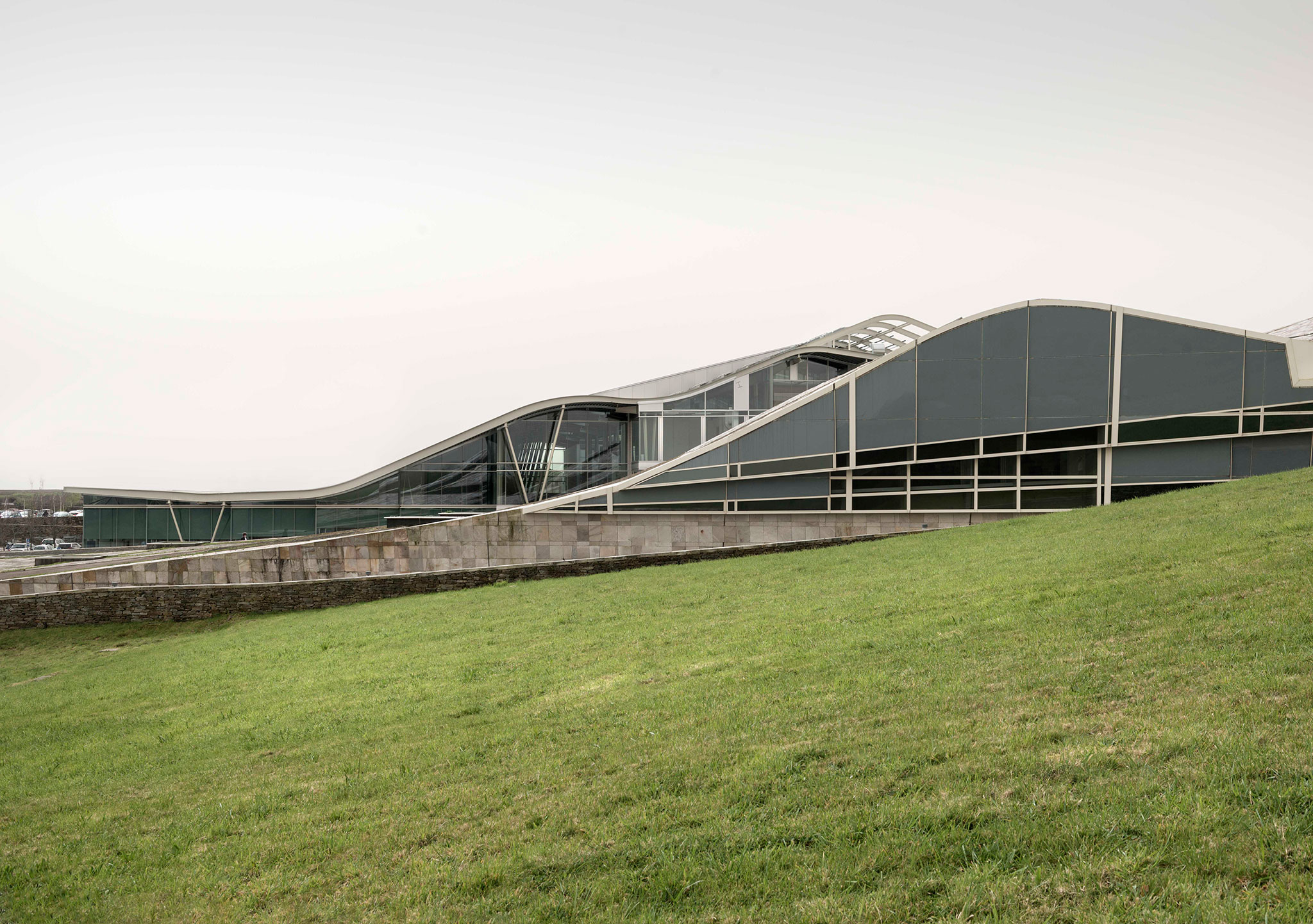
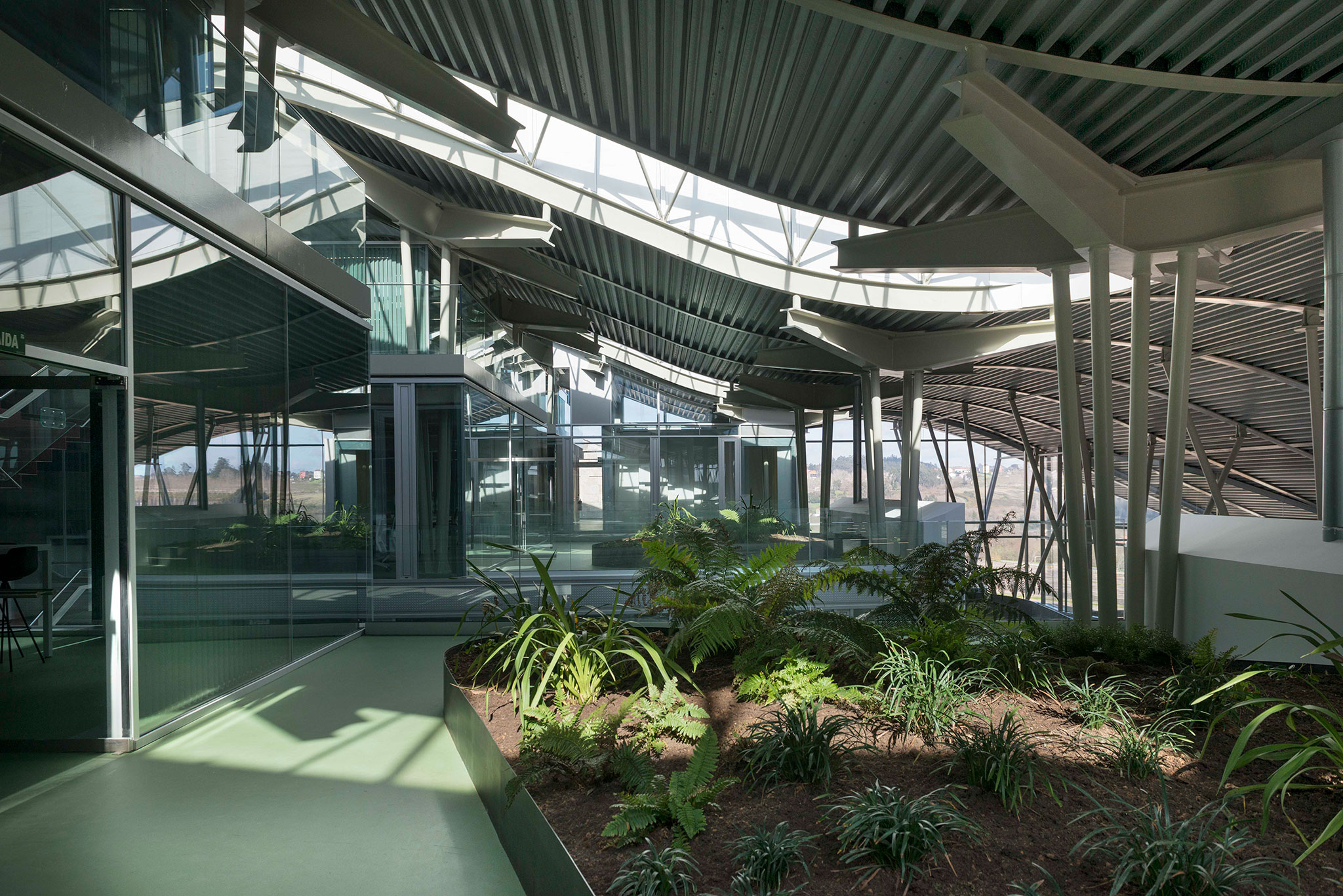
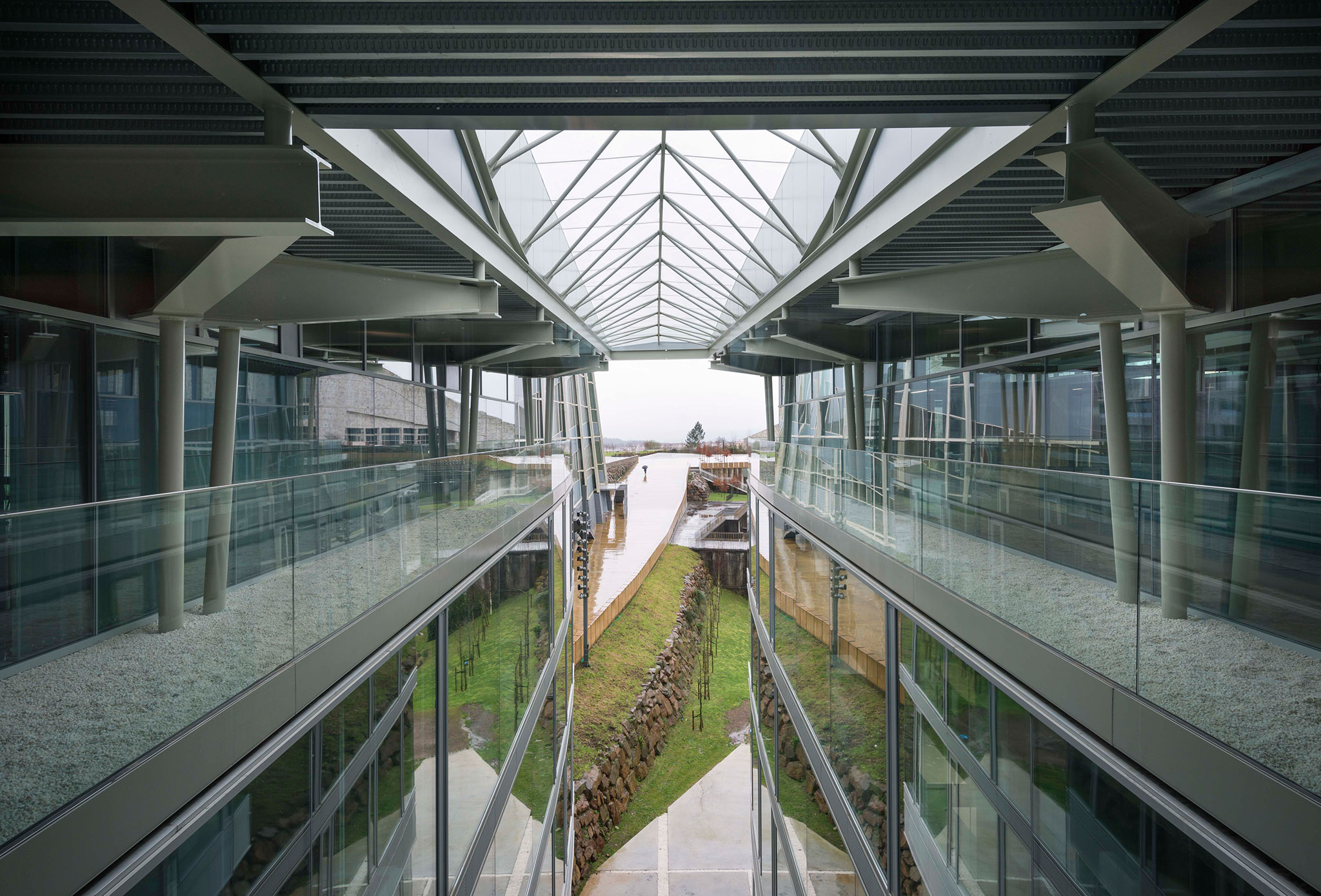
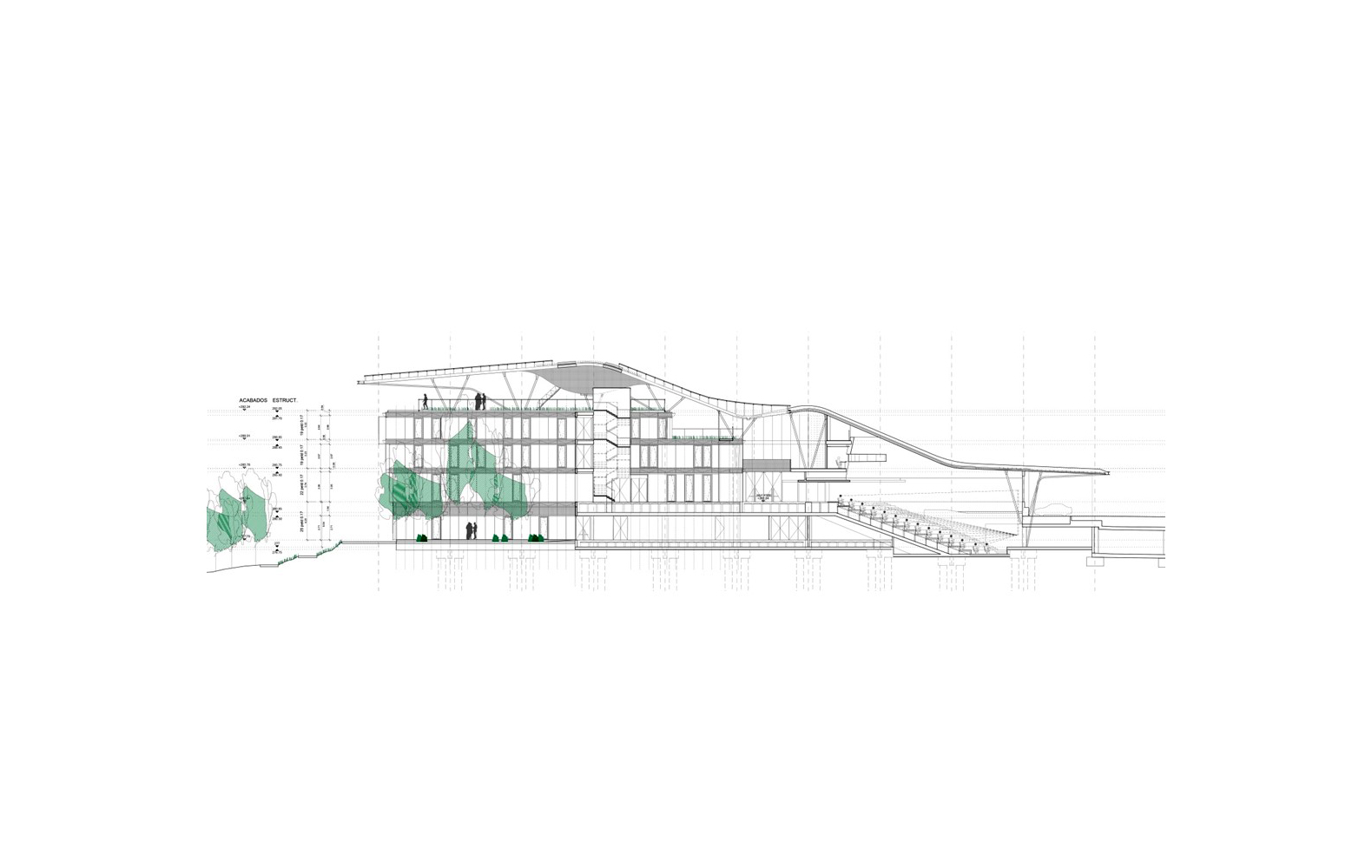
"The Fontán's innovation and its usefulness lie not only in generating places thanks to having people at the center of its action but also because of what is most interesting and innovative: the building itself builds a place by interacting with the Galician landscape, introducing it inside, showing its occupants that they are not in a "no place", and making visible the changes from outside to inside, of the light, of the movement of the mist, of their open gaze towards the West, towards the Atlantic.
In this sense, the Fontán recognizes and admires the Galician landscape and its climate."
In this sense, the Fontán recognizes and admires the Galician landscape and its climate."
Faced with the archaic conception of architecture only as a destination, standardized and fossilized of public buildings, the architecture of the Fontán is presented as an architecture that makes transparent and relativizes functions such as hybridization between spaces.
The architecture of the Fontán is also shown as a transformation of external agents, in which one of its protagonists, the wind, achieves corporeality and, when thrown onto the architecture, generates a thin film that is used as a cover, becoming a light skin, an external skin that eliminates the formal heaviness that oppresses bodies and space. An architecture that is attached to the human body, light and refreshing, an architecture that proposes openness and change in the face of the functional rigidity and heaviness of the roof of its neighbors.
Technique manifesto
El Fontán is a "model to be highlighted for his attitude", and for his ability to rethink through technique the relationship between people and work, the economy, or the environment. El Fontán is the necessary return to utopian thought, in the face of so much saturating dystopia. The recovery of collective values against personal gain, or social utility against individual solutions, talks about intersection and openness, transversality, and cooperation.
«Construction, pure construction; it is the perfect route for another beauty.”
Andrés Perea, Elena Suárez and Rafael Torrelo.
Andrés Perea, Elena Suárez and Rafael Torrelo.
In the Fontán people experiment and innovate so that others benefit from their contributions, incorporating them into the project in such a way that they become collective responses to shared problems (see exciting topics such as the absence of joints, the slender solid pillars, the relationship with the structure existing, the cover, the fragmentation of its pieces,...). A process whose reading is not exempt from the pedagogical and essay vision of many of his extraordinary contributions.
I found the ability to stir and investigate, in part from its authors, thirty-one years ago and since then I have seen generations become trapped by the ideal to which they aspire and their research work to help the rest of the world with its results. society, to share and transmit a social and technical architecture.
Text by Texto porJosé Juan Barba