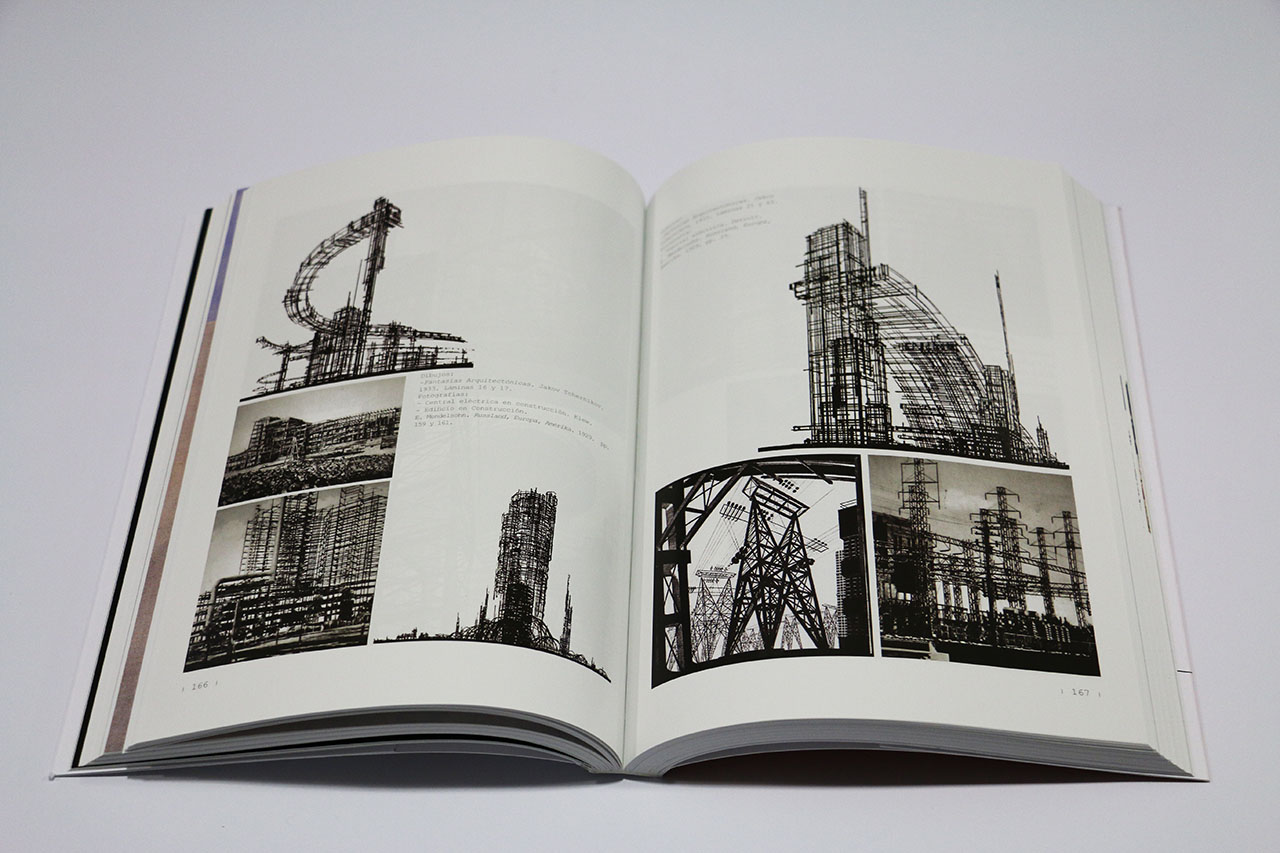
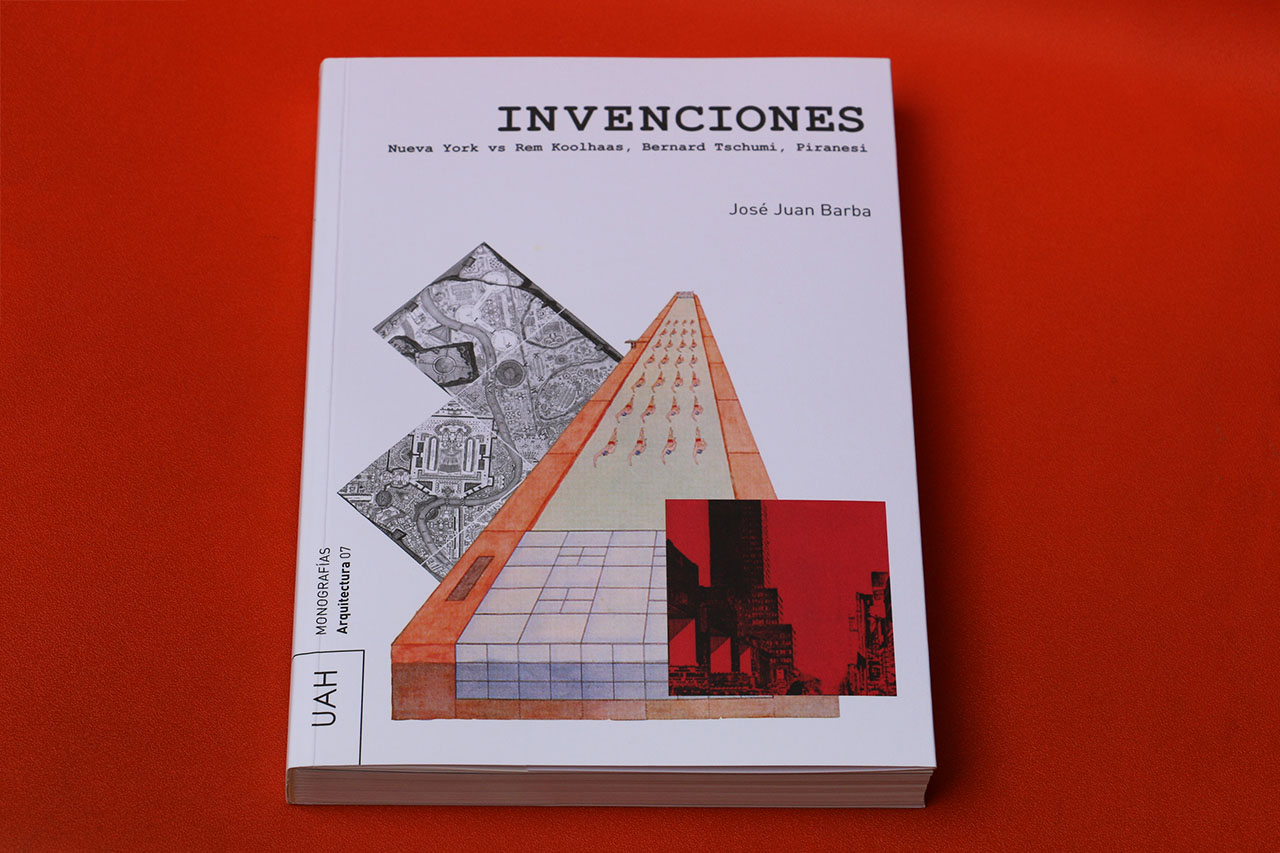
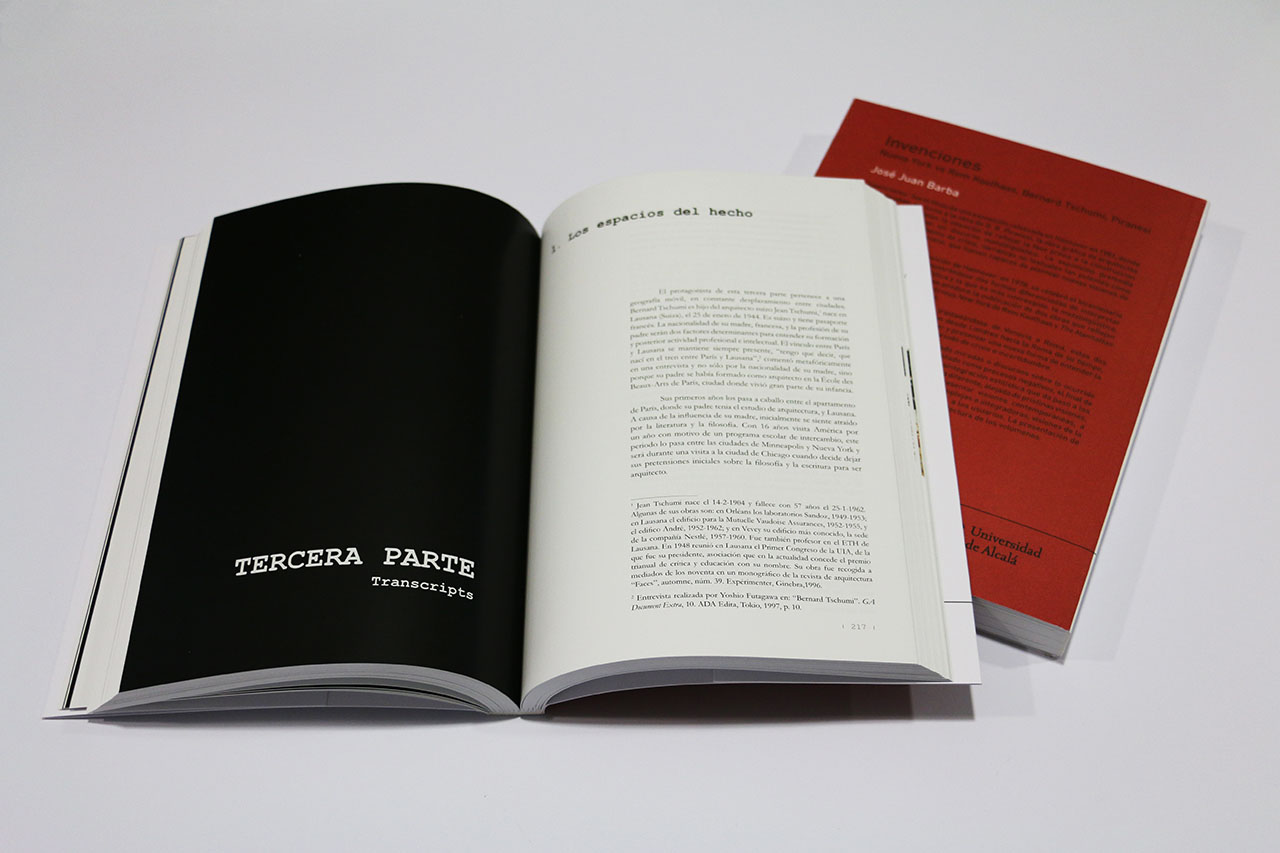
'Inventions: New York vs. Rem Koolhaas, Bernard Tschumi, Piranesi' is the new book by José Juan Barba, an essay which looks into the texts, inventions, drawings and ideas of Rem Koolhaas, Bernard Tschumi and the great Italian engraver Giovanni Battista Piranesi, in search of new perspectives which broaden the way we see, think and make Architecture.

On 'Invenciones: Nueva York vs. Rem Koolhaas, Bernard Tschumi, Piranesi' José Juan Barba establishes a metaliguistic discourse which explores the relationship between the work and drawings by G.B. Piranesi and the graphic work of two of the most relevant architects of Cotemporary Architecture, Rem Koolhaas and Bernard Tschumi.

In contrast to pristine views and selective scientific approaches, the author seeks to present contemporary views of Architecture, sometimes retroactive, but always more complex, inclusive and nearer to reality and which include the observers, the users. In the author's words, "a presentation of the Architecture of places, as opposed to the architecture of solids."

Architect, professor and academician Luis Fernández-Galiano prefaces the book with the essay "Black Brains", a very interesting reflection based on the title of an essay by Marguerite Yourcenar, "Le cerveau noir de Piranèse", and which helps the reader to understand the complex context which surrounds the thesis. "Marguerite Yourcenar - the same one who described Piranesi as a 'cerveau noir' - would say that 'l'oeuvre au noir' is the necessary alchemical formula in order to pursue the 'Great Work', and that this 'opus nigrum' represents the tests which the spirit must overcome in its liberation process."

The late seventies were indeed years of change, and in which it is possible to imagine a great strain between a luminous and liberal Postmodernism which extracted its formal analysis tools from Nolli - many would shorten it to Wittkower, Rowe and Eisenman's theoretical affiliation - and a sombre and radical Postmodernism, fascinated by Piranesi's Carceri as much as by Surrealism or Constructivism, which would have Koolhaas as its most articulated representative and Tschumi as the one who introduced the situationist universe.

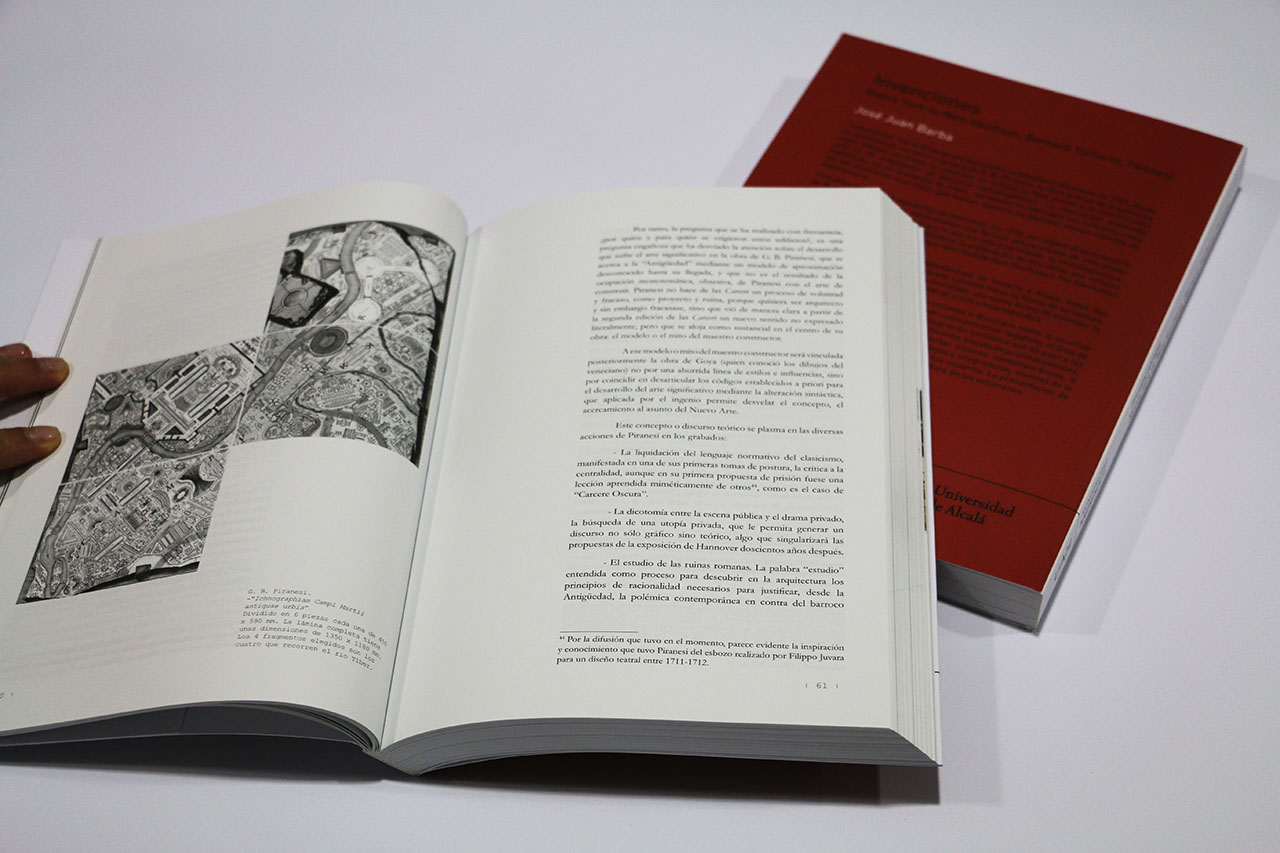
In addition, architect Carmen Díez Medina introduces the book with a preface entitled "Creation of places": "The few Carceri plates redrawn by Piranesi (1749 and 1761) are published here for the first time together with the preparatory drawings that preceded them. This rough sequence of three phases is intentionally used by José Juan Barba, not just to present an interpretation of space from the point of view of the observer - or not only - but rather to claim the value of  interpretation and metalinguistic criticism based on the representation of the spatial conditions in which individuals who are deprived from freedom live."

The contribution of unpublished material from MoMA and the National Spanish Library is especially interesting, all of it well indexed in the corresponding chapters.Its joint publication, along with other documents hitherto scattered, materializes this ambitious attempt to relate three discourses that are presented as three meta-languages. In this way, the author seeks to overcome the instruments which are most frequently used to talk about architecture up until the eighties, and offer a personal, conceptual, complex and kaleidoscopic reading of contemporary architecture.

'Inventions' was the title of an exhibition held in Hannover in 1981 which gathered together graphic work by different architects  around the work of G.B. Piranesi. The drawings displayed here were not intended to reflect the pre-construction phase but to establish a metalinguistic discourse. The exhibition seeked to identify a non-textual narrative as powerful as the Venetian architect and able to suggest new points of view for architecture in a moment of crisis.

The bicentennial celebration of Piranesi's death took place only three years before Hannover's exhibition, in 1978. It revealed two different ways of understanding his work, a first approach that strictly referred to style and a second and more interesting metalinguistic interpretation. Besides, two of the books that best reflect our contemporaneity were published during this three-year period between both exhibitions: Delirious New York by Rem Koolhaas and The Manhattan Transcripts by Bernard Tschumi.

Just like Piranesi moved from Venezia to Rome, these two European architects went from London to the Rome of our time, Manhattan, in order to develop, exhibit and present a new way of understanding contemporary architecture in a time of crisis and uncertainty.

In Architecture, most of the views and discourses outlining what happened during this decade have been presented as negative processes: the end of Modernity or the consolidation of the stylistic disintegration that gave way to 'Po-Mo' or postmodernism. This book seeks to outline a different vision, far removed from pristine views and selective scientific approaches, that presents more contemporary views, sometimes retroactive and always more complex, inclusive and nearer to reality. Architecture visions which include the observers, the users. A presentation of the Architecture of places, as opposed to the architecture of solids.

'Inventions: New York vs. Rem Koolhaas, Bernard Tschumi, Piranesi' is the new volume of a series of monographs published by the University of Alcalá in order to spread relevant and visionary research essays in the field of Architecture.
More information

Label
Title
Text
Invenciones: Nueva York vs. Rem Koolhaas, Bernard Tschumi, Piranesi.
+ + copy Created with Sketch.
- + copy Created with Sketch.
Label
Author
Text
José Juan Barba
+ + copy Created with Sketch.
- + copy Created with Sketch.
Label
Number of pages
Text
368 pages.
+ + copy Created with Sketch.
- + copy Created with Sketch.
Label
Format
Text
Paperback. 17x24 cm.
+ + copy Created with Sketch.
- + copy Created with Sketch.
Label
Publisher
Text
Universidad de Alcalá de Henares.
+ + copy Created with Sketch.
- + copy Created with Sketch.
Label
Language
Text
Spanish.
+ + copy Created with Sketch.
- + copy Created with Sketch.
Label
ISBN
Text
9788416133444.
+ + copy Created with Sketch.
- + copy Created with Sketch.

José Juan Barba (1964) is an architect, graduated from ETSA Madrid (1991), and holds a Doctorate in Architecture from ETSA Madrid, awarded Cum laude for his thesis Inventions: New York vs. Rem Koolhaas, Bernard Tschumi, Piranesi (2004). He received a special mention in the National Awards for Completion of Studies (1991) and served as an advisor to various NGOs until 1997. He founded his studio in Madrid in 1992 (www.josejuanbarba.com). 

Barba is an architecture critic and has been the director of METALOCUS magazine since 1999. Since 1998, he has directed the International Architecture Magazine METALOCUS (bilingual, Spanish/English), which has been recognized with multiple national and international awards.

He is a Full Professor at the University of Alcalá, leading the project line of the Habilitation Master's Architecture and City, responsible for several courses in Theory and Criticism, heading the Urban Planning area of the Department of Architecture, and participating in the research group Architecture, History, City, and Landscape at UAH. He has been invited to numerous architecture and urbanism forums, including the II Forum of Mexican Cities World Heritage: Urban Development, History, and Modernity, organized by the Pan-American Committee for Urban Development and Historical Heritage, and the World Urban Development Forum (FMDU) in Culiacán, Sinaloa, Mexico. He has also participated in the International Architecture and Urbanism Conferences from the perspective of women architects, and has lectured at prestigious national and international universities, including the National Building Museum (Washington, DC), Roma TRE, Politecnico di Milano, UPMF Grenoble, ETSA Madrid, ETSA Barcelona, University of Thessaly (Volos), UNAM Mexico, the Faculty of Architecture Montevideo, schools of architecture in Medellín, Quito-Ecuador, Alicante, Málaga, Granada, Seville, A Coruña, Zaragoza, Valladolid, Universidad Iberoamericana Mexico, IE School, Universidad Europea Madrid, UCJC Madrid, ESARQ-UIC Barcelona, or Università Degli Studi di Genova.

Barba has extensive professional experience in architecture, urban planning, landscape design, and territorial recovery. He has received numerous awards, including the First Prize for Gran Vía Posible for Delirious Gran Vía (Madrid), the River Interpretation Center (Zamora), exhibited at the World Architecture Festival (Barcelona 2008), Santa Bárbara Park (Toledo), the Erich Degner Architecture Prize 1995 promoted by the BBVA Foundation, and his Day Care Center for the Elderly project, featured in Volume 3 of the COAM Madrid Architecture Guide (2007). His work has been published in numerous national and international books and magazines.

He was also Maître de Conférences at IUG-UPMF Grenoble (2013–14), in a position obtained through a European competition. His work has been published internationally. He regularly serves on academic juries, including the editorial competition of Quaderns magazine (2011), as a selector for the Mies van der Rohe Awards (2007–2026), as juror for EUROPAN13 Spain (2015–16), TRANSFER in Zurich (2019), and was invited to participate in the Venice Biennale 2016 as part of the exhibition Spaces of Exception / Spazi d’Eccezione.

He has published several books, including The Dark Line. michele&miquel, dA Vision Design (2024), CONGRESO ANYWAY. The City of Cities (2020), #Positions (2016), and Inventions: New York vs. Rem Koolhaas, Bernard Tschumi, Piranesi (2015). He has contributed to other publications such as Public Space Gran Vía. The Tourism City (2020), Spaces of Exception / Spazi d’Eccezione (2016), La mansana de la discordia (2015), and Contemporary Architecture of Japan: New Territories (2015), as well as chapters in numerous books including Architects: A Professional Challenge (2009), 21st Century Architectures (2007), Ruta de la Plata, New Conquerors of Space (2019), and The Tourism City (2020).

Selected awards include:

- “PIERRE VAGO” ICAC. International Committee of Art Critics Award, London, 2005
- “PANAYIOTI MIXELI AWARD,” SADAS-PEA, award for the promotion of architecture, Athens, 2005
- “SANTIAGO AMÓN” AWARD, award for the promotion of architecture, COAM Madrid, 2000
- FAD Award 07, Ephemeral Interventions, First Prize, M.C. Escher Exhibition, Arquin-FAD, Barcelona, 2007
- World Architecture Festival, Center for Research and Interpretation of the Rivers, Tera, Esla, and Órbigo, Finalist, Barcelona, 2008
- Gran Vía Posible, First Prize, Delirious Gran Vía, Madrid, 2010
- Reform of the Río Segura Surroundings, Award, Murcia, 2010

Read more
Published on: April 15, 2015
Cite:
metalocus, SARA REBOLLO
"Invenciones: Nueva York vs. Rem Koolhaas, Bernard Tschumi, Piranesi" METALOCUS. Accessed
<http://www.metalocus.es/en/news/invenciones-nueva-york-vs-rem-koolhaas-bernard-tschumi-piranesi> ISSN 1139-6415
Loading content ...
Loading content ...
Loading content ...
Loading content ...
Loading content ...
Loading content ...
Loading content ...
Loading content ...
Loading content ...
Loading content ...
Loading content ...
Loading content ...
Loading content ...
Loading content ...
Loading content ...
Loading content ...
Loading content ...
Loading content ...
Loading content ...
Loading content ...
Loading content ...
Loading content ...
Loading content ...
Loading content ...
Loading content ...
Loading content ...
Loading content ...
Loading content ...
Loading content ...
Loading content ...
Loading content ...
Loading content ...
Loading content ...
Loading content ...
Loading content ...
Loading content ...
Loading content ...
Loading content ...
Loading content ...
Loading content ...
Loading content ...
Loading content ...
Loading content ...
Loading content ...
Loading content ...
Loading content ...
Loading content ...
Loading content ...
Loading content ...
Loading content ...
Loading content ...
Loading content ...
Loading content ...
Loading content ...