The Madrid practice TallerDE2 architects by Arantza Ozaeta and Alvaro Martin have, designed this year the reform of a small apartment with few exterior views in the historic center of Madrid. 

To create an attractive space in these limited conditions, they proposed an intervention with full furnishing and very cheap materials. The design makes better use of space by integrating the entire program into furniture and responding to the demands of his customer, a "single".

In proposing the design for one person, it saves up space in the project raised by TallerDE2 Architects, and it allows more space to exchange of functions at any time of the day, dramatically improving the conditions of this apartment.

Description of project by TallerDE2 Arquitectos

Residence for a Metropolitan Single

‘POP-UP House’ is a fully refurbished flat for a recently emancipated thirty-something person, located in a mid-20th century residential building in Madrid.

‘POP-UP House’ is an experiment which deals with two crossed interests: on one hand, it explores the sociological reality linked to the increased number of one-person homes in the metropolis -known as the “single phenomenon” (1); on the other hand, it tests the infiltration of a thin and gathering domestic infrastructure (2).

1. Single Phenomenon
Higher development of countries is related to the global phenomenon of the increase in one-person housing for single residents. Apart from the extended phenomenon of sharing flats, the internet and social networks encourage a recent domestic option which probes that “living alone doesn’t mean being alone”; living alone is a new model fed by the increased people life expectancy, the stronger women emancipation and the higher number of independent people who don’t want to share.

In countries such as Germany, France, the UK and Japan, around 40% of current homes are occupied by single people. USA has 30 million “singles”. Surprisingly, instead of the current economic crisis, the number of this kind of homes is growing in Spain.

‘POP-UP House’ doesn’t try to design an optimum unique protocol of domesticity; however, it tries to test a proposal that explores the potentials of this reality.

2. Building a Thin Domestic Infrastructure
First of all, by erasing the dispensable partitions related to an obsolete domesticity, we get rid of those traces foreign to the new inhabitant. Only structure, supply connections and the client’s obsessions remain.

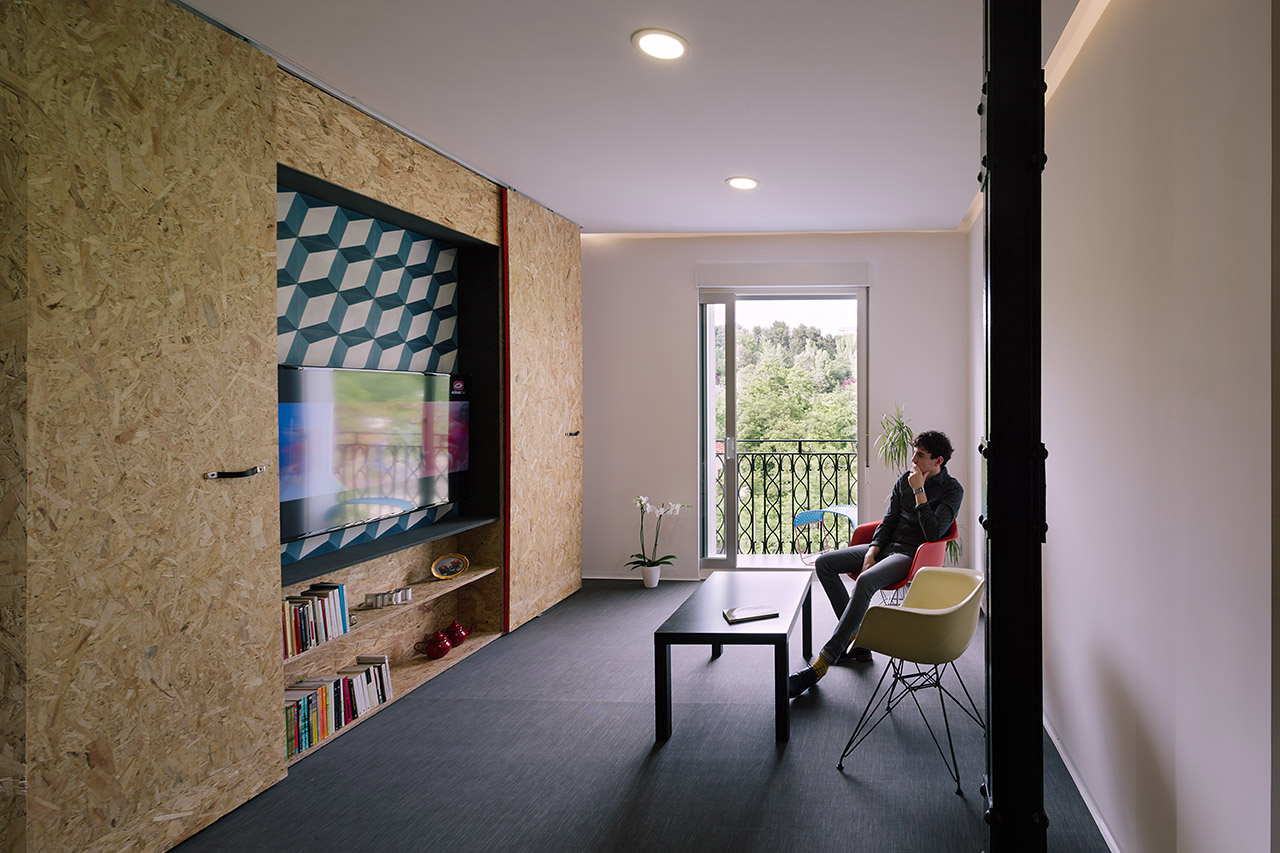
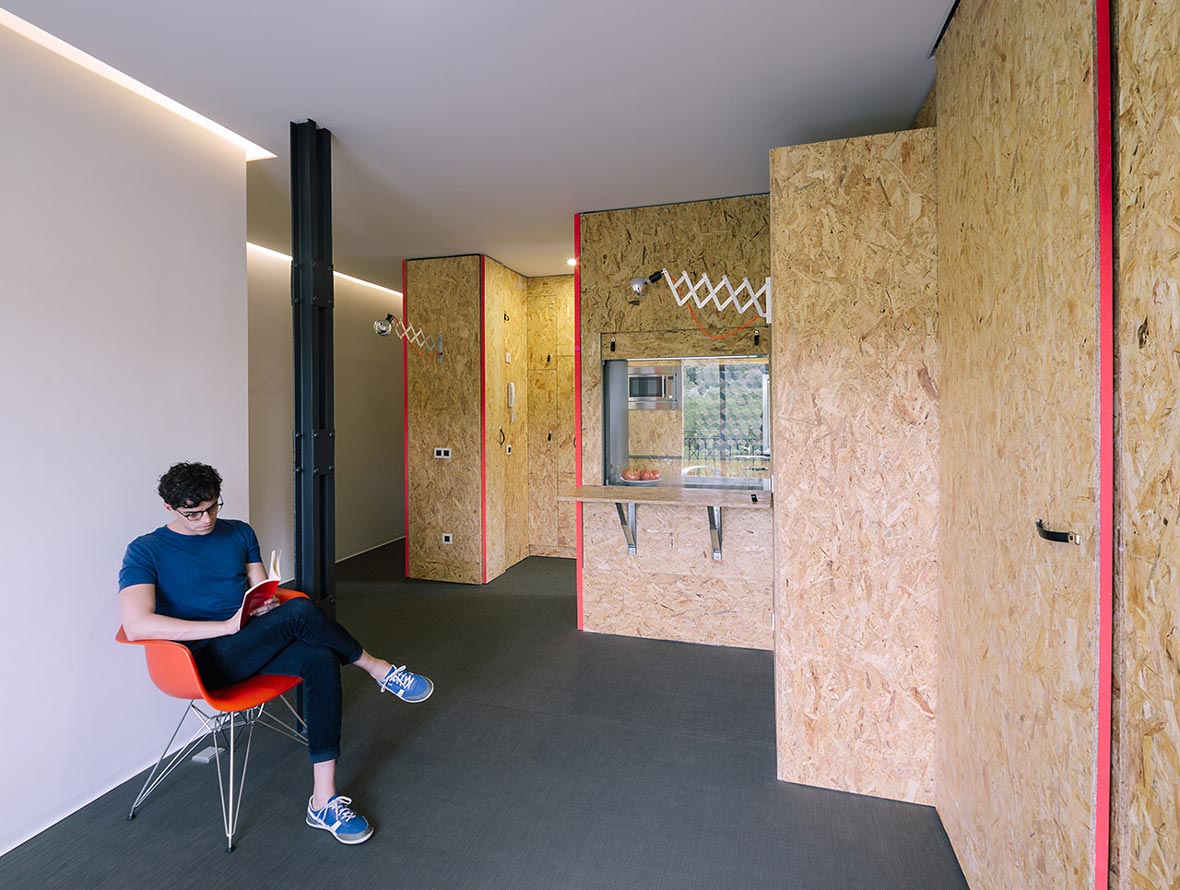
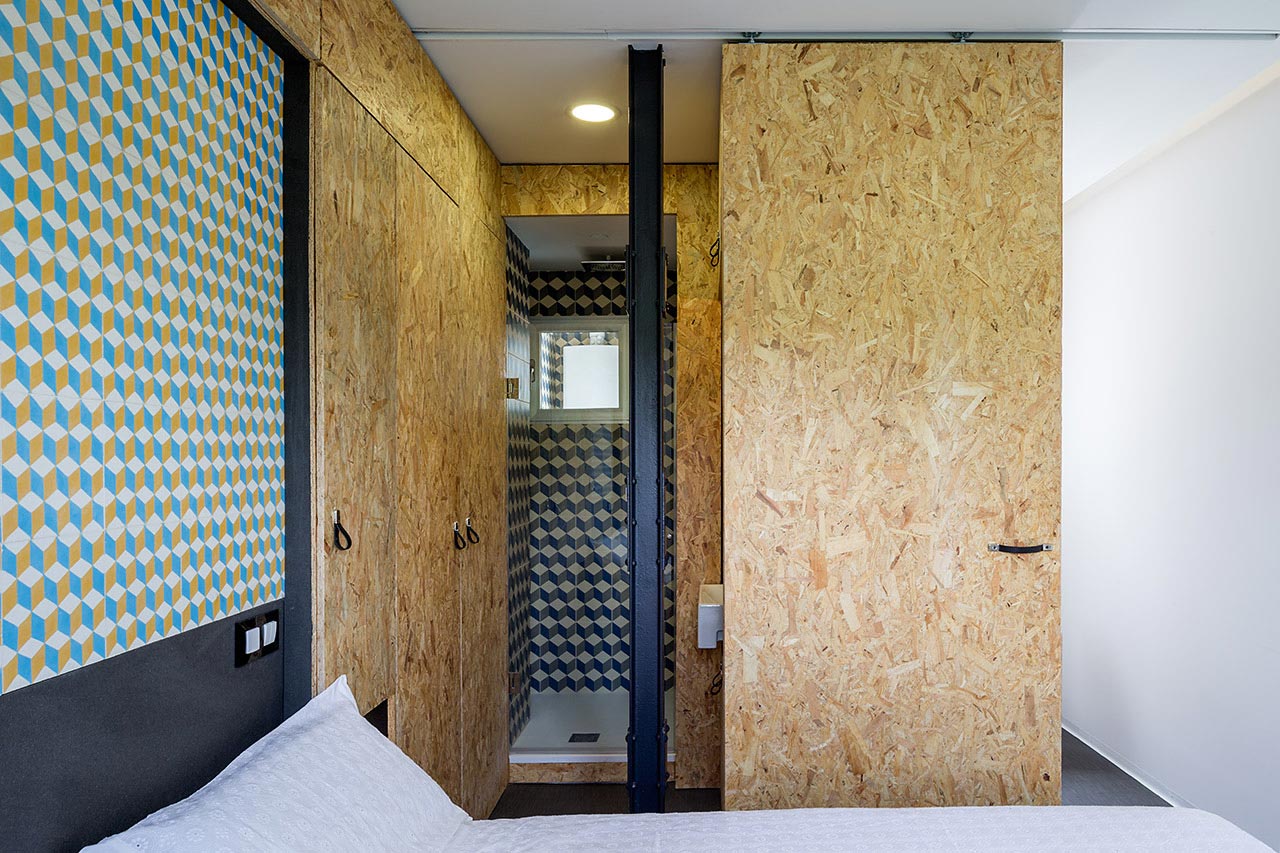
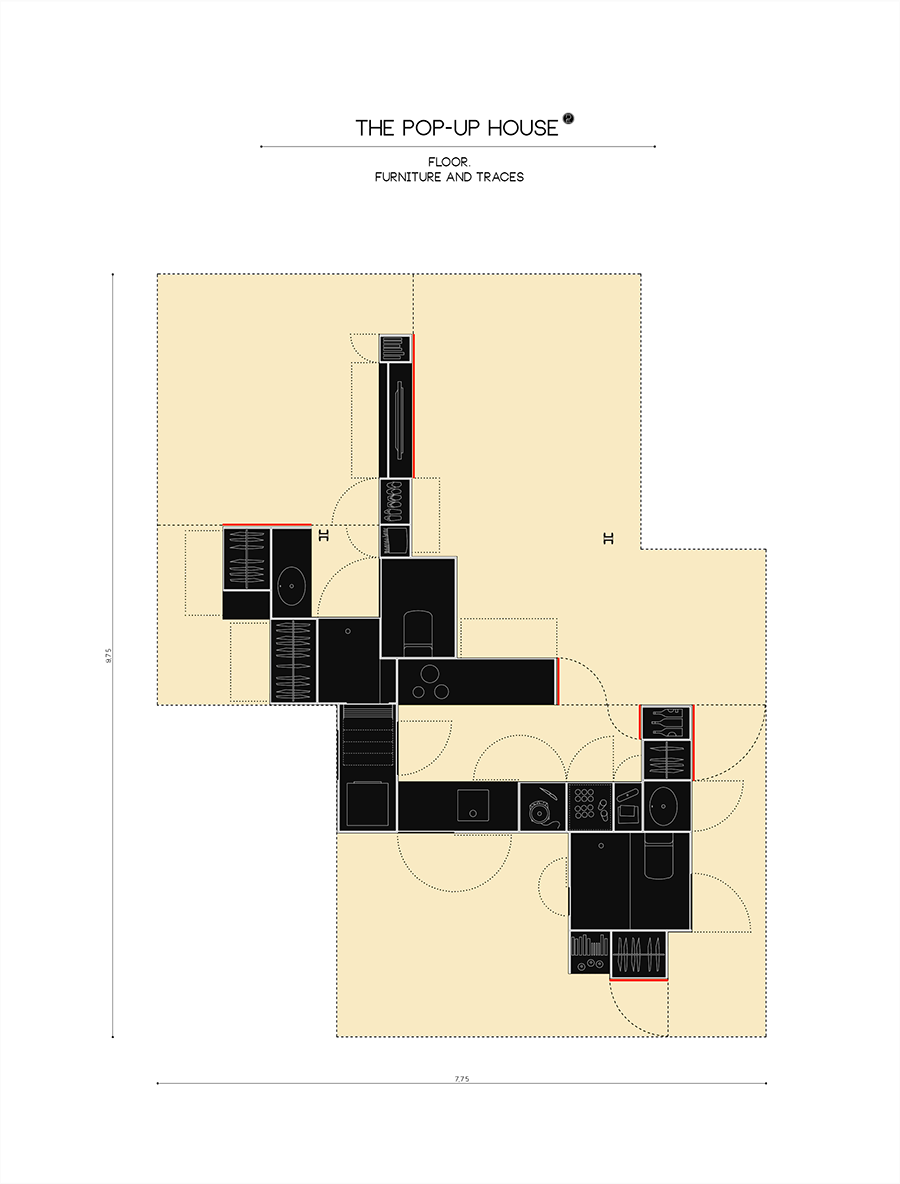
Infrastructural units that form a one-person dwelling are defined in the way of Toland Grinell’s matching travelling trunks, specialized elements with a unique function that occupy their surrounding space when they are opened. Here, traditional components that form a room become independent and dispersed, providing new domestic opportunities. We do not take a bathroom as a whole, but as an addition of a shower, a washbasin, a toilet, a mirror, a bathroom cabinet, etc. These individual components build up a catalogue as a communication tool, with which the client interacts by choosing, discarding and redefining. Fifty-four of these units are assembled into a gathering element, infrastructural more than aesthetic, dense and operative. This interactive entity is infiltrated into the dwelling and folds it up small in the way of a labyrinth, disorienting to whom gets into it; sometimes it encloses you, others It throws you out.

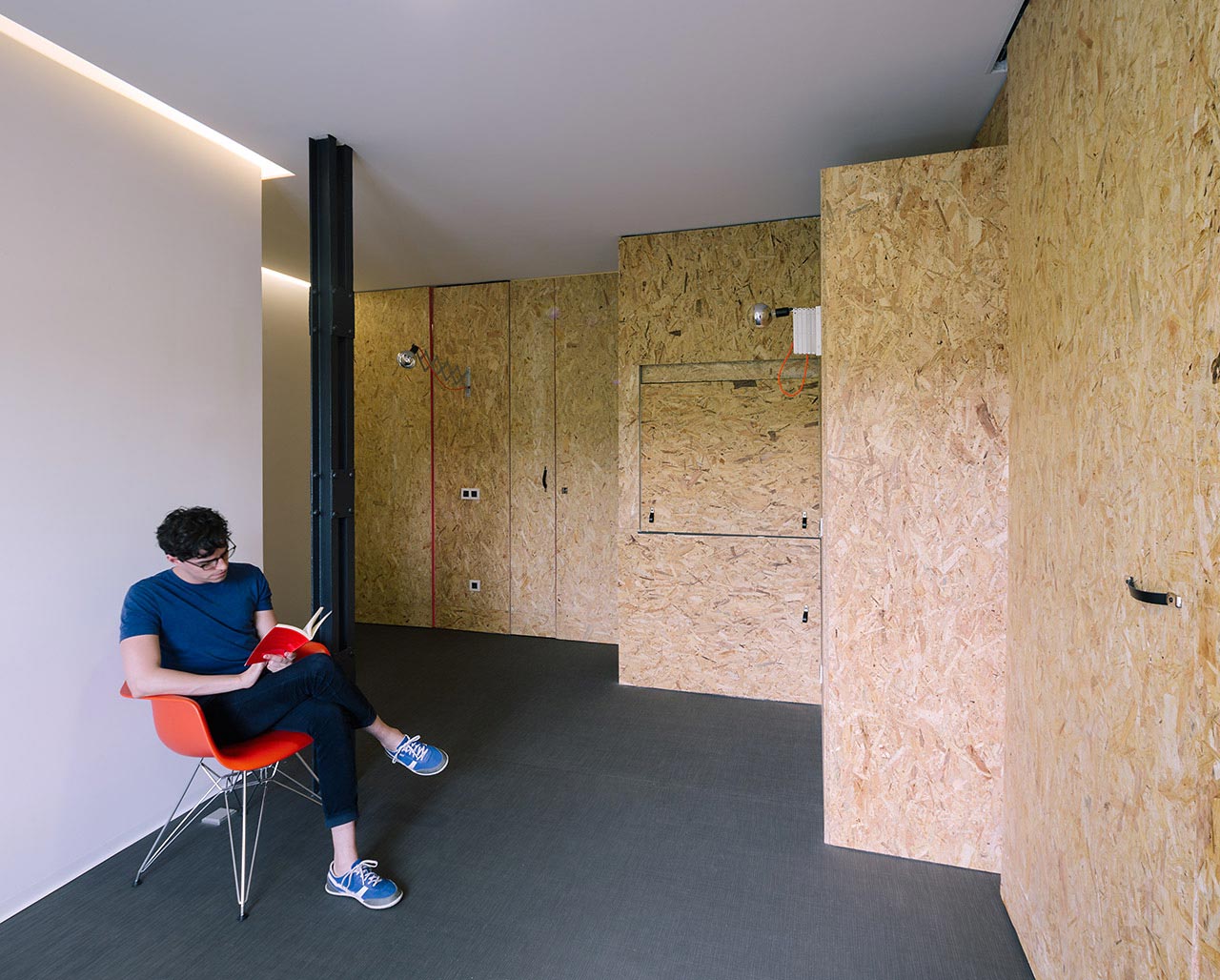
This gathering element does not move; however, it is unfolded. It is affixed to the supply connections and arranges a generic space around it –a laboratory for experiences, relationships, tolerances, overlaps and multiplicities. This space is activated when the dweller turns the infrastructural devices on. By opening and closing, extending and contracting, sliding and folding it up, the home is restructured, expanded, fragmented, connected or isolated. Here, the room does not contain a wardrobe, but the wardrobe contains a room.

This domestic infrastructure is thin. The slimming strategy is focused on usable elements (such as interior partitions, supply pipes and ducts, shafts, etc.) and it pursues the optimization of acoustic, insulating, organizational and connective features of the architectural elements. Fewer than 50% of the usable area in the previous traditional dwelling was available space, enclosed into tight rooms; now, 77% of the usable area is open and available for free appropriation in the new configuration.

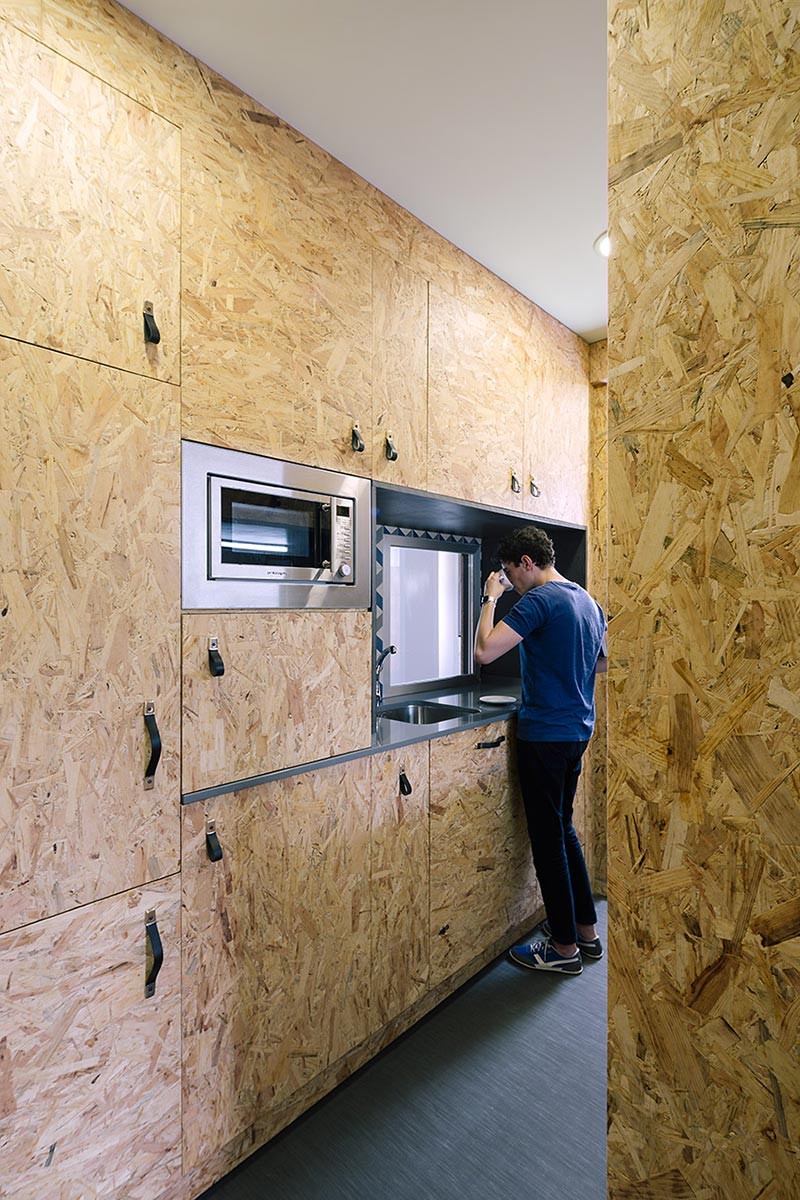
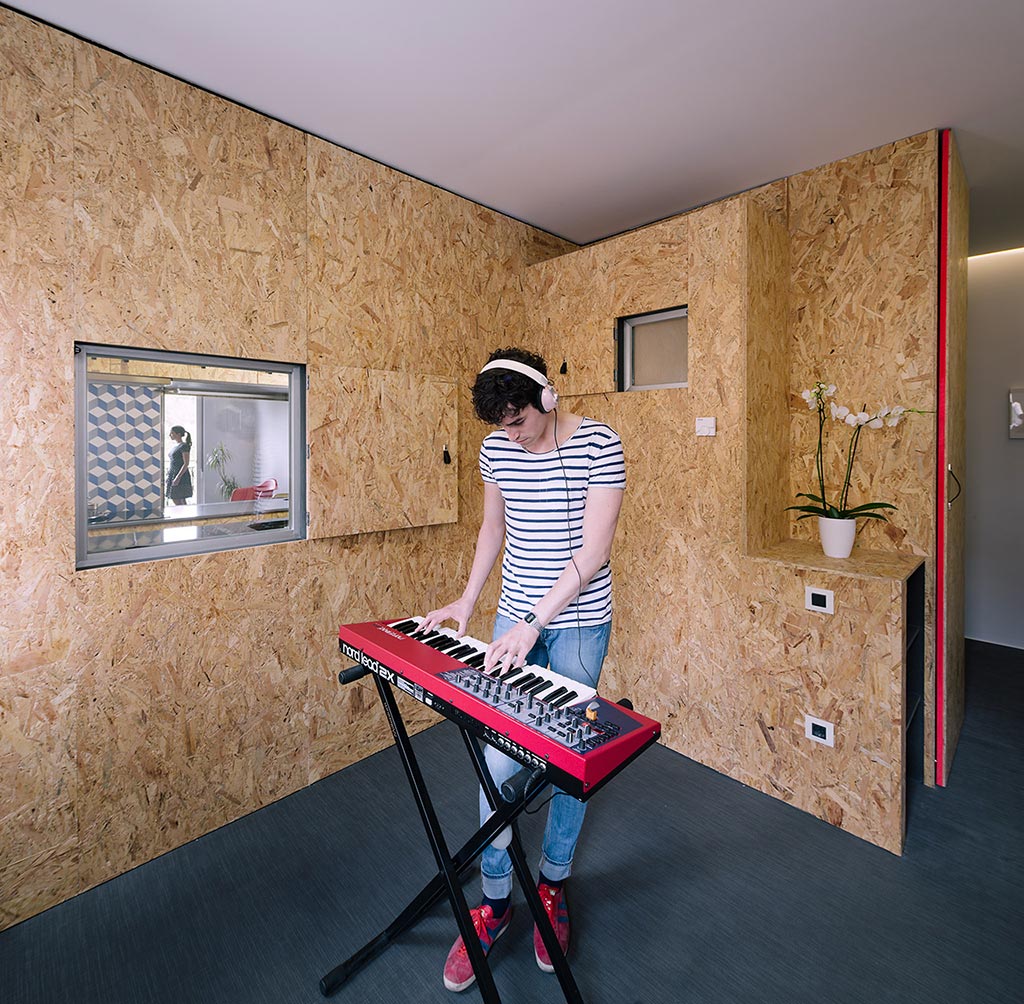
This infrastructure of daily life is built up with a unique material -economical and versatile-, oriented strand boards. While the exterior image is uniform, only specialized handles reveal the opening system of every device; interiors are distinguished. Tiles and wallpaper provide this inner space with colour and design typical of the elegant linings of classic suitcases.
Read more
Read less

More information

Label
Architects
Text

TallerDE2 Arquitectos. Architects.- Arantza Ozaeta Cortázar, Álvaro Martín Fidalgo.

+ + copy Created with Sketch.
- + copy Created with Sketch.
Label
Collaborators
Text

Cruz Calleja.

+ + copy Created with Sketch.
- + copy Created with Sketch.
Label
Client
Text

Juan Domínguez.

+ + copy Created with Sketch.
- + copy Created with Sketch.
Label
Builder
Text

Fedeclima -Paco Ferrero. Carpenters.- José Leal Fernández.

+ + copy Created with Sketch.
- + copy Created with Sketch.
Label
Area
Text

68,50 m² / 68.50 sqm.

+ + copy Created with Sketch.
- + copy Created with Sketch.
Label
Dates
Text

Commenced March 2013; Concept design June 2013; Completion May 2014.

+ + copy Created with Sketch.
- + copy Created with Sketch.
Label
Location
Text

Madrid, Spain.

+ + copy Created with Sketch.
- + copy Created with Sketch.
Label
Photography / Video
Text

Imagen Subliminal: Miguel de Guzmán, Rocío Romero.

+ + copy Created with Sketch.
- + copy Created with Sketch.

Ozaeta-Fidalgo (Before, TallerDe2 and OZAETA-FIDALGO since 2023) is an architecture practice founded in 2008 by Arantza Ozaeta Cortázar (1982) and Álvaro Martín Fidalgo (1980), established in Madrid, Spain. They conceive their work as a collaborative practice, gathering working teams with members whose diverse backgrounds contribute to achieving high-quality projects with responsible results for a happy life. Their interests focus on the exploration of architecture as a vehicle for urban regeneration, intergenerational care, and socio-environmental challenges, developing initiatives in collaboration with private, municipal and territorial agents in permanent commitment to innovative practice.

They have won and built national and international competitions, and their work has been recognized on multiple occasions, including the Architectural Record Design Vanguard 2025, the German Bauwelt-Preis Award (2013), the COAM-Luis Moreno Mansilla Award (2013), the FAD Award for Thought and Criticism (2016), in collaboration with the HipoTesis publisher, or the Europe 40under40 (2017) by the European Centre. Their work has also been selected and exhibited in the Spanish Architecture Biennial (2013-2021), the FAD International (2014) and the FAD Architecture (2020). Also in the international exhibitions “Archipaper. Dibujos desde el plano” (2018), “Architetus Omnibus?” (2015) or “Export Arquitectura Española en el extranjero” (2015). They have curated the lecture series Argument#1 “Sampling-Contexts” (2019), Argument#5 “Proximities” (2024) and TAG VOL.1 (2024) at the ETSAM, where they are also editors of the homonymous books that were recognized with the COAM-Diffusion Award (2021).

Arantza Ozaeta and Álvaro Martín Fidalgo combine their professional work with teaching and research. They have taught at the AA-Architectural Association School of Architecture in London, ETH Zurich, the Coburg University of Applied Sciences in Germany, and the Madrid School of Architecture (ETSAM), where they currently teach in the Architectural Design Department.

Read more
Published on: December 30, 2014
Cite:
metalocus, INÉS LALUETA
"The POP-UP House by TallerDE2 Architects" METALOCUS. Accessed
<https://www.metalocus.es/en/news/pop-house-tallerde2-architects> ISSN 1139-6415
Loading content ...
Loading content ...
Loading content ...
Loading content ...
Loading content ...
Loading content ...
Loading content ...
Loading content ...
Loading content ...
Loading content ...
Loading content ...
Loading content ...
Loading content ...
Loading content ...
Loading content ...
Loading content ...
Loading content ...
Loading content ...
Loading content ...
Loading content ...
Loading content ...
Loading content ...
Loading content ...
Loading content ...
Loading content ...
Loading content ...
Loading content ...
Loading content ...
Loading content ...
Loading content ...
Loading content ...
Loading content ...
Loading content ...
Loading content ...
Loading content ...
Loading content ...
Loading content ...
Loading content ...
Loading content ...
Loading content ...
Loading content ...
Loading content ...
Loading content ...
Loading content ...
Loading content ...
Loading content ...
Loading content ...
Loading content ...
Loading content ...
Loading content ...
Loading content ...
Loading content ...
Loading content ...
Loading content ...