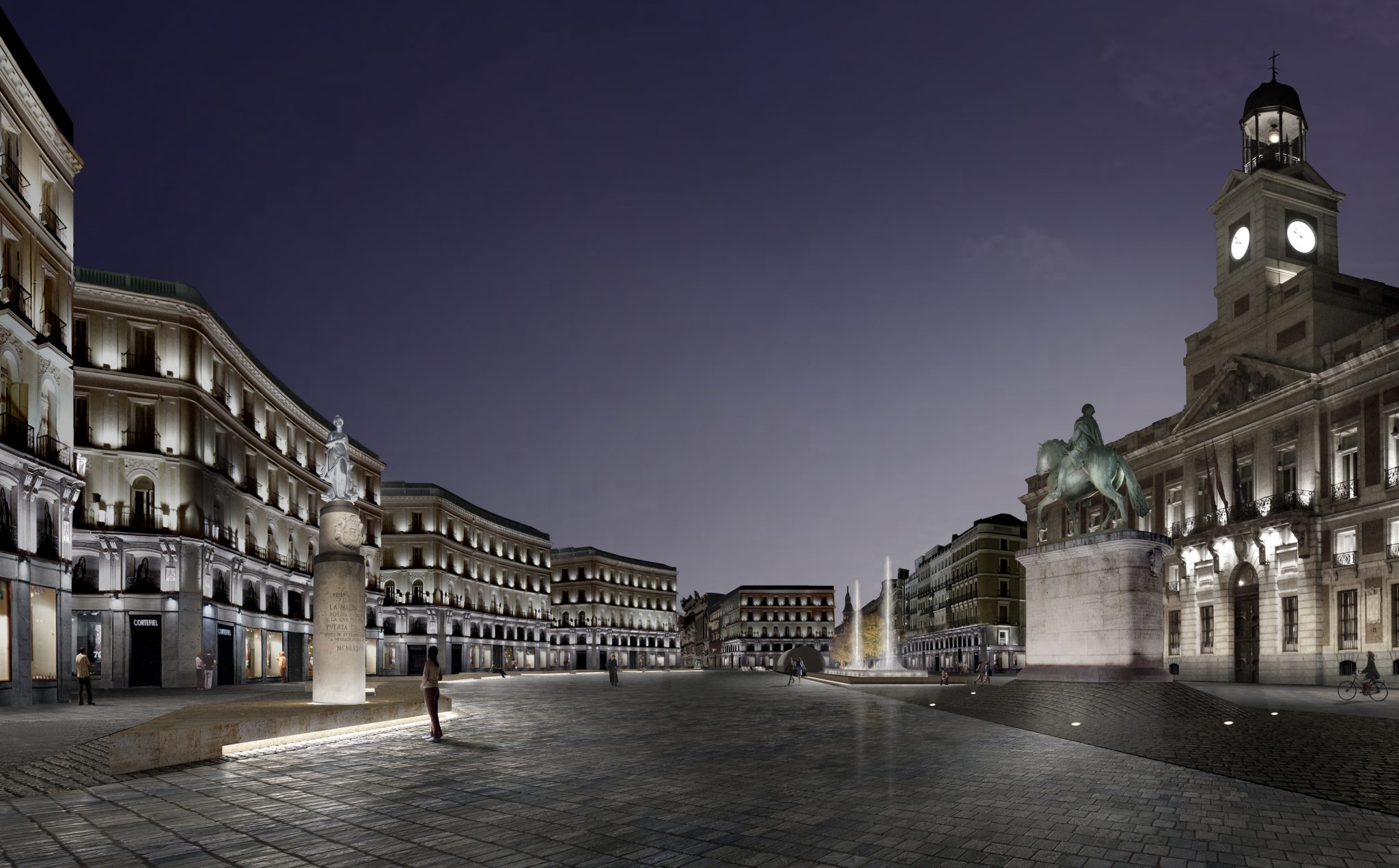
Yesterday was featured, The result of the contest sponsored by the COAM to recover the Puerta del Sol, chosen between 146 ideas received, the winning proposal is "El sol del membrillo." An intelligent proposal submitted by the author of one of the better recovered buildings in Lavapiés, Madrid, the Pías Schools byJosé Ignacio Linazasoro.

The jury’s reasons, articulated by architect Juan Herreros during the presentation, for unanimously awarding first prize to “El sol del membrillo,” by José Ignacio Linazasoro and Ricardo Sánchez (Linazasoro & Sánchez Arquitectura), were based on the proposal’s commitment to recovering the space and removing the elements contributing to its degradation. The scheme also proposes reorganizing the statues and iconic elements of the square, restoring the original Isabeline layout of the space, unifying the commercial ground floors, and creating a setting in which emptiness predominates, while still incorporating essential features required for its function as a public space, such as seating areas, kiosks, and metro entrances.

A proposal that speaks of emptiness as the support for its function, for its public program, before being occupied, used, or enjoyed by citizens. A moment of supreme nothingness.

Second prize was awarded to the proposal entitled “No es fácil establecer cuándo debe el poeta detenerse” (“It Is Not Easy to Determine When the Poet Should Stop”), by Luis Martínez Santa-María, which likewise seeks to clear the square for public use, with particular emphasis on the commercial awnings featured in the proposal. The competition jury decided not to award a third prize and instead granted three ex aequo mentions to “Los lunes en sol,” by José Manuel Calvo del Olmo, Javier de Esteban Grabayo, José Manuel de Andrés Moncayo, and Ana Sabugo Sierra; “Reload Sol,” by José María Sánchez García; and “Puerto Sol,” by Francisco Alonso de Santos.

The results of the ASIENTO 4SOL competition for the design of a bench intended for installation in the square, developed by Escofet and MTT, were also announced. The winning entry was Km. 0, by Mauro Doncel Marchán and Maitane Díaz Prieto, who proposed a seat reminiscent of an eraser shaped like a wayfinding element indicating distances to different locations, thereby “emphasizing Madrid’s hospitable character toward all those who once arrived and decided to stay,” as well as its centrality.

In addition to this first prize, the jury awarded five mentions to the following proposals:

“Viceversa,” by Antonio Rentero Pereira; “Fisol,” by Roberto Ortiz de Landázuri Monagas, Ignacio García, and Jaime Diz; “Organic, Functional and Contemporary City,” by Artur Jorge Dionisio de Sousa, André Pedro Gonçalves Terleira, and Helder Flavio de Oliveira Rodríguez; “Sun 4,” by Josep Muxart Escala and Javier Duarte Blanco; “Rolling Stone,” by Erica Santacruz Sastre, Gregorio Ramírez Vila, and María J. González Cabanellas; and “Rodasol,” by Miguel Ángel García-Pola Vallejo.

Notes to Notes, or Another Supreme Moment of Nothing

First of all, congratulations are due to the winners — my sincere congratulations to them.

It has taken a while, but at last, after the initial intention to announce the results in December and following constant postponements (to the point where they even stopped specifying the date on which the results would be made public), the announcement was finally made last week, for yesterday and, true to form, even the timing of the announcement changed during the day itself.

The competition does not entail the actual execution of the project, and in every press release the COAM has made it abundantly clear — extremely clear — that this is merely a “strategy for intervention in Puerta del Sol and its surroundings,” or, even more emphatically, a “definition of the intervention strategy for Puerta del Sol.” Phew… so much apprehension about the outcome, and so much qualification of terms.

The winning proposal includes neither trees nor terraces spread across the entire square, nor the famous awnings championed by the Dean of the College of Architects. The second prize, however, does include these famous awnings, and perhaps for that reason, the COAM states in its press release: “José Antonio Granero added that the ‘feasibility of the project opens up possibilities for reorganization,’ potentially leading to a combination with the second prize proposal and the correction of whatever may be necessary.” Ah! So corrections are already being discussed?

Mayor Ana Botella seems more convinced, or at least in the press release, she appeared more consistent and committed to the project when she stated that it “resolves two fundamental issues in a city: beauty and the capacity for lingering and inhabitation,” and, according to the COAM press release, considered the project viable because it respects both the uses and the conception of the square.

It may turn out that the Mayor is more convinced than the Dean himself — though perhaps it is all just a game of misdirection… In any case, what now? Now all that remains is to wait: to wait and hope that the winning proposal (the result of an exceptional jury evaluating proposals for one of the most frequently redesigned squares in Madrid) is ultimately executed, and that the outcome does not become a Frankenstein assembled from multiple combinations.

 
JURY MEMBERS.

President.- Dña. Ana Botella Serrano, Alcaldesa de Madrid.
Vowels.-
- D. Pedro María Corral Corral, Delegado del Área de Gobierno de las Artes, Deporte y Turismo del Ayuntamiento de Madrid.
- D. Javier Hernández Morales, Director General de Planeamiento Urbanístico del Área de Gobierno de Urbanismo y Vivienda del Ayuntamiento de Madrid.
- D. David Erguido Cano, Concejal Presidente del Distrito Centro.
- D. Jaime Ignacio Muñoz Llinás, Director General de Patrimonio Histórico de la Comunidad de Madrid.
- D. Antonio Bonet Correa, Director de la Real Academia de Bellas Artes de San Fernando.
- D. José Antonio Granero Ramírez, Decano del Colegio Oficial de Arquitectos de Madrid.
- D. Fernando de Porras-Isla Fernández, architect.
- D. Juan Herreros Guerra, Arquitecto.
- D. Emilio Tuñón Álvarez, Arquitecto
- Dña. Martha Thorne, Arquitecto.
- Un representante de cada uno de los grupos municipales con representación en el Ayuntamiento de Madrid.
- Un representante de la Confederación Empresarial de Madrid CEIM–CEOE.
- Un representante de la Federación Regional de Asociaciones de Vecinos de Madrid.
Secretary.-
- D. José Luis Barrero Peñalver, Director de la Oficina de Concursos del COAM (OCAM).
More information

Linazasoro&Sánchez Arquitectura. In July 2011, José Ignacio Linazasoro Rodríguez and Ricardo Sánchez González started the society Linazasoro&Sánchez Arquitectura SLP, based in Madrid. Since October 2011, they have worked together as Professors at the School of Architecture of Madrid.

José Ignacio Linazasoro Rodríguez was born in 1947 in San Sebastián. Linazasoro studied at the Schools of Architecture of Pamplona and Barcelona. He qualified as an architect at the School of Architecture of Barcelona in 1972 and obtained his PhD there in 1980.

Throughout his long professional career, he has combined independent architectural practice — with works widely recognised both in Spain and abroad — with teaching, the dissemination of architectural thought and participation in exhibitions. He taught at the School of Architecture of San Sebastián (1977–82), and later became Professor of Architectural Projects at the Schools of Architecture of Valladolid (1982–88) and Madrid, where he has held a chair since 1988.

Linazasoro has also been invited as a visiting professor to several schools of architecture, including Pamplona, Venice, Milan, Cesena, Bari, Lima and Lausanne. In addition, he has delivered lectures on his work in Italy, France, the United Kingdom, Sweden, Prague, Budapest, Mexico City, Puerto Rico and the United States. Since 1987, he has been a corresponding member of Architecture at the Real Academia de Bellas Artes de San Fernando. He lives in Madrid.

His work began to be published in the 1970s following the Hondarribia Ikastola project, designed in collaboration with Miguel Garay. During the 1980s, he completed notable works such as the reconstruction of the Church of Santa Cruz in Medina de Rioseco. In the 1990s, his project for the Central Library of the UNED received numerous awards and publications.

At the beginning of the twenty-first century, he designed the Church of San Lorenzo in Valdemaqueda (Madrid) and the Escuelas Pías University Centre in Madrid, one of his most widely published and awarded works. Later, he designed the Cathedral Square in Reims and the Congress Centre in Troyes (France). In 2011, he began collaborating with the architect Ricardo Sánchez, with whom he has completed projects including the Segovia University Campus (2011) and the remodelling of Puerta del Sol in Madrid (2023).

He has received numerous national and international awards for his work, including the COAM Award, the Moreno Mansilla Award, the COACYLE Award, the Iberfad Award, the International Brick Award, the Piranesi Prix de Rome, the Gutiérrez Soto Award and the Honorary Membership of the College of Architects of Cádiz, among others.

Author of theoretical texts such as La memoria del orden, Linazasoro has also published monographs on his work in Spain, France and Italy.

Ricardo Sánchez González was born in 1978 in Madrid (Spain). Sánchez is an architect from the School of Architecture of  Madrid, 2003 and a Professor at the  School of Architecture of Madrid since 2011. He lives in Madrid.

Read more

José Juan Barba (1964). Architect from the Madrid School of Architecture (ETSAM) in 1991. He received his PhD in Architecture from ETSAM in 2004, graduating summa Cum laude with the doctoral thesis "Inventions: New York vs. Rem Koolhaas, Bernard Tschumi, Piranesi." In 1991, he received a Special Mention in the Spanish National Graduation Awards. Until 1997, he worked as an advisor to several NGOs. In 1992, he founded his architectural practice in Madrid (www.josejuanbarba.com). 

He is an architectural critic and, since 1998, Editor-in-Chief of the internationally acclaimed bilingual architecture journal METALOCUS (Spanish/English), recipient of several national and international awards.

Barba is an Associate Professor at the University of Alcalá and a member of several research groups. He has been invited to participate in numerous international forums on architecture and urbanism, including the II Forum of Mexican World Heritage Cities, Urban Development, History and Modernity, organized by the Pan-American Committee for Urban Development and Historical Heritage; the World Urban Development Forum (FMDU), held in Culiacán, Sinaloa, Mexico; and the International Conference on Architecture and Urbanism from the Perspective of Women Architects. He has also been invited as lecturer and guest critic at numerous national and international institutions, including the National Building Museum, Roma Tre University, Politecnico di Milano, University of Genoa, Université Pierre Mendès France Grenoble, the Madrid and Barcelona Schools of Architecture, National Autonomous University of Mexico, the Faculty of Architecture in Montevideo, the Schools of Architecture of Medellín and Ecuador, Universidad Iberoamericana, IE University, as well as the Schools of Architecture of Zaragoza, Valladolid, Málaga, Granada, Seville, and A Coruña, among others.

He has extensive professional experience in architecture, urbanism, landscape intervention, and territorial regeneration. His work has received numerous awards, including First Prize in the “Gran Vía Posible” competition for Delirious Gran Vía, Madrid; recognition for the Rivers Interpretation Centre in Zamora, awarded and exhibited at the World Architecture Festival 2008; and recognition for the Santa Bárbara Park project in Toledo. He was also awarded the Erich Degner Prize for Architecture (1995), promoted by the BBVA Foundation. His project for a Day Centre for the Elderly was included in Volume 3 of the Madrid Architecture Guide published by the Official College of Architects of Madrid (COAM) in 2007. His work has been widely published in national and international books and journals.

He served as Maître de Conférences at the Institut d’Urbanisme de Grenoble, Université Pierre Mendès France Grenoble, during the 2013–14 academic year, following his appointment through a European open competition. His work has been published internationally. He regularly serves on academic and professional juries, including the editorial competition jury for the journal Quaderns (2011), the selection committee for the European Union Prize for Contemporary Architecture – Mies van der Rohe Awards (2007–present), and the jury panels for EUROPAN 13 (2015–16) and TRANSFER, Zurich (2019). He was also invited to participate in the Biennale di Venezia 2016 as part of the exhibition Spaces of Exception / Spazi d’Eccezione.

He has authored several books, including "The Dark Line. michele&miquel, dA Vision Design" (2024), "CONGRESO ANYWAY. La ciudad de las ciudades" (2020), "#Positions" (2016), and "Inventions: New York vs. Rem Koolhaas, Bernard Tschumi, Piranesi" (2015). He has also contributed to publications such as "Espacio público Gran Vía. La Ciudad del Turismo" (2020), "Spaces of Exception / Spazi d’Eccezione" (2016), "La manzana de la discordia" (2015), and "Contemporary Japanese Architecture: New Territories" (2015), as well as chapters in numerous books, including "Women Architects: A Professional Challenge" (2009), "21st Century Architectures" (2007), "Ruta de la Plata, New Conquerors of Space" (2019), and "The City of Tourism" (2020).

Selected awards include:

•    “SANTIAGO AMÓN” AWARD, award for the promotion of architecture, COAM Madrid, 2000.
•    “PANAYIOTI MIXELI AWARD,” SADAS-PEA, award for the promotion of architecture, Athens, 2005.
•    “PIERRE VAGO” ICAC. International Committee of Art Critics Award, London, 2005.
•    FAD Award 07, Ephemeral Interventions, First Prize, M.C. Escher Exhibition, Arquin-FAD, Barcelona, 2007.
•    World Architecture Festival, Center for Research and Interpretation of the Rivers, Tera, Esla, and Órbigo, Finalist, Barcelona, 2008.
•    Gran Vía Posible, First Prize, Delirious Gran Vía, Madrid, 2010.
•    Reform of the Río Segura Surroundings, Award, Murcia, 2010.

Read more
Published on: February 25, 2014
Cite:
metalocus, JOSÉ JUAN BARBA
"Winners, Piensa Sol. A moment of supreme nothingness" METALOCUS. Accessed
<http://www.metalocus.es/en/news/winners-piensa-sol-a-moment-supreme-nothingness> ISSN 1139-6415
Loading content ...
Loading content ...
Loading content ...
Loading content ...
Loading content ...
Loading content ...
Loading content ...
Loading content ...
Loading content ...
Loading content ...
Loading content ...
Loading content ...
Loading content ...
Loading content ...
Loading content ...
Loading content ...
Loading content ...
Loading content ...
Loading content ...
Loading content ...
Loading content ...
Loading content ...
Loading content ...
Loading content ...
Loading content ...
Loading content ...
Loading content ...
Loading content ...
Loading content ...
Loading content ...
Loading content ...
Loading content ...
Loading content ...
Loading content ...
Loading content ...
Loading content ...
Loading content ...
Loading content ...
Loading content ...
Loading content ...
Loading content ...
Loading content ...
Loading content ...
Loading content ...
Loading content ...
Loading content ...
Loading content ...
Loading content ...
Loading content ...
Loading content ...
Loading content ...
Loading content ...
Loading content ...
Loading content ...