Petra Blaisse’s installation at the Sonneveld House is great opportunity to discover other point of view on architecture. The house is one of Rotterdam’s modernity architectural gems, the house was designed by Brinkman & Van der Vlugt, the architects of the nearby Van Nelle Factory, where Mr. Sonneveld had worked his way up from clerk to co-director. Like the factory, now a Unesco World Heritage site, the house is a model of the Nieuwe Bouwen, or New Building, school of early-20th-century Dutch architecture whose defining qualities were “light, air and space.” Working to the Sonneveld’ brief, the architects used the latest construction techniques to create a steel structure with daylight flowing freely through big windows.

This year Het Nieuwe Instituut invited as guest curator Petra Blaisse offers visitors a totally new experience of Sonneveld House with one ingenious intervention. The house was designed in the early 1930s by architecture firm Brinkman en Van der Vlugt in the Dutch Functionalist style, with the interior created in collaboration with furniture designer W.H. Gispen.

Petra Blaisse’s project, which opened on 1st February and runs through Sept. 13, is part of a series of experiments with which Het Nieuwe Instituut (the New Institute), the cultural center that manages the Sonneveld House, is developing new ways of exhibiting design, architecture and technology. Inviting artists and designers to install their work in “house museums” like the Sonneveld is a proven means of encouraging more people to visit. But Petra Blaisse has gone further by raising questions about the functions of such places and their presumed authenticity.

“I enjoy visiting house-museums like Charles and Ray Eames’s home in Pacific Palisades and Lina Bo Bardi’s in São Paulo and seeing their knick-knacks as if they’d just left them there,” said Blaisse. “But we wanted to trigger something different here by asking what it means in a museological sense to preserve a place like this.”

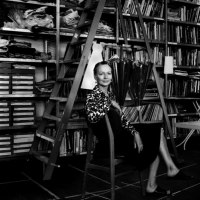
Interior designer and landscape architect Petra Blaisse explores the limits of architecture of Dutch Functionalism with her office Inside Outside by enhancing or temporarily transforming the unique qualities of buildings and their outdoor spaces. Blaisse is renowned for the soft yet compelling way she separates or envelops space with monumental curtain and her collaboration with OMA's projects.

The first floor of Sonneveld House features a sequence of open spaces. Generous expanses of fenestration set in elegant steel frames ensure an almost borderless connection with the surrounding garden. When daylight floods the interior, the room and furniture almost appear to float. With this transformation Inside/Outside responds to three principles of architecture: light, air and space.

Anyone visiting the house, which opened to the public in 2001, over the next few months will find the books and towels in their customary places, but will also see them from unexpected perspectives in the reflections on the mirrored floors. As well as creating exquisite visual effects from changes in the climate and light, the reflections expose things that are usually hidden from view, like the servants’ bell concealed beneath a dining table and the soundboard under the piano. They also remind visitors that they are not in a real home, but in a museological reconstruction, by revealing the sensors, alarms and other gizmos with which it is controlled.

“The key question for us is always how to set up a new type of discussion, and that’s precisely what Petra has done,” said Guus Beumer, the director of the institute.

Other cultural centers around the world are also rethinking their approaches to these fields. Until recently, architecture museums tended to focus on that discipline, while their design equivalents concentrated on industrial design, and technology was generally neglected.

“I am very curious to see how people will respond to seeing everything in the house, including things that are usually covered up,” said Blaisse.

Venue.- [museum house beside Het Nieuwe Instituut] Jongkindstraat 12, Rotterdam. The Netherlands.
Dates.- 1 February 2015. Through, 13 September 2015

Read more
Read less

More information

Petra Blaisse (London 1955), more popularly known in the world of architecture, for her colaboration in some of the most brilliant projects by Rem Koolhaas, as the carpets and finishes for the Seattle Central Library (2000-2004) or finishes and curtains for the Casa da Música in Porto (1999-2005) and acoustic walls, started her career at the Stedelijk Museum in Amsterdam, in the Department of Applied Arts. It was there that Blaisse first collaborated with Koolhaas. From 1987, she worked as freelance designer and won distinction for her installations of architectural work, in which the exhibited work was challenged more than displayed. Gradually her focus shifted to the use of textiles, light and finishes in interior space and, at the same time, to the design of gardens and landscapes.

In 1991, she founded Inside Outside. Since 1999 Blaisse invited specialist of various disciplines to work with her and currently the team consists of about ten people of different nationalities. Inside Outside works globally on projects of increasing technical sophistication and scale. Throughout the years, Inside Outside has collaborated with various architects and designers. Blaisse has lectured and taught extensively in Europe, Asia and the United States.

In the past years, the opening of a number of public and private buildings in which Inside Outside implemented interior and landscape interventions brought the work of Blaisse’s studio to the attention of a broader public. Examples are the restoration project for the Hackney Empire Theatre in London (all curtains, 2000-2005), the gardens, carpets and finishes for the Seattle Central Library (2000-2004), finishes and curtains for the Casa da Música in Porto (1999-2005) and acoustic walls and curtains for the Mercedes Benz museum in Stuttgart.

For landscape design, the studio presently works, together with OMA Hong Kong and Rotterdam, on the landscape masterplan for the West Kowloon Cultural District in Hong Kong and on public gardens (Shenzhen Stock Exchange, Qatar Foundation Headquarters and Education City Library) and on master plans for new urban development areas in Ghadames and Sebha, Libya.

ACT > 01.2019 

Read more

José Juan Barba (1964) is an architect, graduated from ETSA Madrid (1991), and holds a Doctorate in Architecture from ETSA Madrid, awarded Cum laude for his thesis Inventions: New York vs. Rem Koolhaas, Bernard Tschumi, Piranesi (2004). He received a special mention in the National Awards for Completion of Studies (1991) and served as an advisor to various NGOs until 1997. He founded his studio in Madrid in 1992 (www.josejuanbarba.com). 

Barba is an architecture critic and has been the director of METALOCUS magazine since 1999. Since 1998, he has directed the International Architecture Magazine METALOCUS (bilingual, Spanish/English), which has been recognized with multiple national and international awards.

He is a Full Professor at the University of Alcalá, leading the project line of the Habilitation Master's Architecture and City, responsible for several courses in Theory and Criticism, heading the Urban Planning area of the Department of Architecture, and participating in the research group Architecture, History, City, and Landscape at UAH. He has been invited to numerous architecture and urbanism forums, including the II Forum of Mexican Cities World Heritage: Urban Development, History, and Modernity, organized by the Pan-American Committee for Urban Development and Historical Heritage, and the World Urban Development Forum (FMDU) in Culiacán, Sinaloa, Mexico. He has also participated in the International Architecture and Urbanism Conferences from the perspective of women architects, and has lectured at prestigious national and international universities, including the National Building Museum (Washington, DC), Roma TRE, Politecnico di Milano, UPMF Grenoble, ETSA Madrid, ETSA Barcelona, University of Thessaly (Volos), UNAM Mexico, the Faculty of Architecture Montevideo, schools of architecture in Medellín, Quito-Ecuador, Alicante, Málaga, Granada, Seville, A Coruña, Zaragoza, Valladolid, Universidad Iberoamericana Mexico, IE School, Universidad Europea Madrid, UCJC Madrid, ESARQ-UIC Barcelona, or Università Degli Studi di Genova.

Barba has extensive professional experience in architecture, urban planning, landscape design, and territorial recovery. He has received numerous awards, including the First Prize for Gran Vía Posible for Delirious Gran Vía (Madrid), the River Interpretation Center (Zamora), exhibited at the World Architecture Festival (Barcelona 2008), Santa Bárbara Park (Toledo), the Erich Degner Architecture Prize 1995 promoted by the BBVA Foundation, and his Day Care Center for the Elderly project, featured in Volume 3 of the COAM Madrid Architecture Guide (2007). His work has been published in numerous national and international books and magazines.

He was also Maître de Conférences at IUG-UPMF Grenoble (2013–14), in a position obtained through a European competition. His work has been published internationally. He regularly serves on academic juries, including the editorial competition of Quaderns magazine (2011), as a selector for the Mies van der Rohe Awards (2007–2026), as juror for EUROPAN13 Spain (2015–16), TRANSFER in Zurich (2019), and was invited to participate in the Venice Biennale 2016 as part of the exhibition Spaces of Exception / Spazi d’Eccezione.

He has published several books, including The Dark Line. michele&miquel, dA Vision Design (2024), CONGRESO ANYWAY. The City of Cities (2020), #Positions (2016), and Inventions: New York vs. Rem Koolhaas, Bernard Tschumi, Piranesi (2015). He has contributed to other publications such as Public Space Gran Vía. The Tourism City (2020), Spaces of Exception / Spazi d’Eccezione (2016), La mansana de la discordia (2015), and Contemporary Architecture of Japan: New Territories (2015), as well as chapters in numerous books including Architects: A Professional Challenge (2009), 21st Century Architectures (2007), Ruta de la Plata, New Conquerors of Space (2019), and The Tourism City (2020).

Selected awards include:

- “PIERRE VAGO” ICAC. International Committee of Art Critics Award, London, 2005
- “PANAYIOTI MIXELI AWARD,” SADAS-PEA, award for the promotion of architecture, Athens, 2005
- “SANTIAGO AMÓN” AWARD, award for the promotion of architecture, COAM Madrid, 2000
- FAD Award 07, Ephemeral Interventions, First Prize, M.C. Escher Exhibition, Arquin-FAD, Barcelona, 2007
- World Architecture Festival, Center for Research and Interpretation of the Rivers, Tera, Esla, and Órbigo, Finalist, Barcelona, 2008
- Gran Vía Posible, First Prize, Delirious Gran Vía, Madrid, 2010
- Reform of the Río Segura Surroundings, Award, Murcia, 2010

Read more
Published on: February 16, 2015
Cite:
metalocus, JOSÉ JUAN BARBA
"Inside Outside/Petra Blaisse, Sonneveld House². Other vision on Dutch Modernity" METALOCUS. Accessed
<http://www.metalocus.es/en/news/inside-outsidepetra-blaisse-sonneveld-house2-other-vision-dutch-modernity> ISSN 1139-6415
Loading content ...
Loading content ...
Loading content ...
Loading content ...
Loading content ...
Loading content ...
Loading content ...
Loading content ...
Loading content ...
Loading content ...
Loading content ...
Loading content ...
Loading content ...
Loading content ...
Loading content ...
Loading content ...
Loading content ...
Loading content ...
Loading content ...
Loading content ...
Loading content ...
Loading content ...
Loading content ...
Loading content ...
Loading content ...
Loading content ...
Loading content ...
Loading content ...
Loading content ...
Loading content ...
Loading content ...
Loading content ...
Loading content ...
Loading content ...
Loading content ...
Loading content ...
Loading content ...
Loading content ...
Loading content ...
Loading content ...
Loading content ...
Loading content ...
Loading content ...
Loading content ...
Loading content ...
Loading content ...
Loading content ...
Loading content ...
Loading content ...
Loading content ...
Loading content ...
Loading content ...
Loading content ...
Loading content ...