


To ensure the safe use of public space, the intervention developed by EMBA opts for a mixed system of active and passive rockfall containment solutions, minimizing the environmental impact. In the most sensitive areas, safety nets anchored to the rock are used, gradually integrating with the vegetation, while in less critical areas, berms and earthen slopes formed with local materials are employed.
The quarry pit is approximately 190 meters long with a total drop of nearly 20 meters. To make the use of this slope feasible and accommodate the various planned uses within a limited budget, the urban development is concentrated in a single architectural element: a system of interconnected platforms that unfold along one side of the large central space.
This grand staircase, made of artificial stone pieces, acts both as a mediator between the forest and the quarry esplanade by means of a ramp-wall, and as a longitudinal urban connector that links two neighborhoods of Corbera, giving continuity to a pedestrian route that will be completed in future phases.
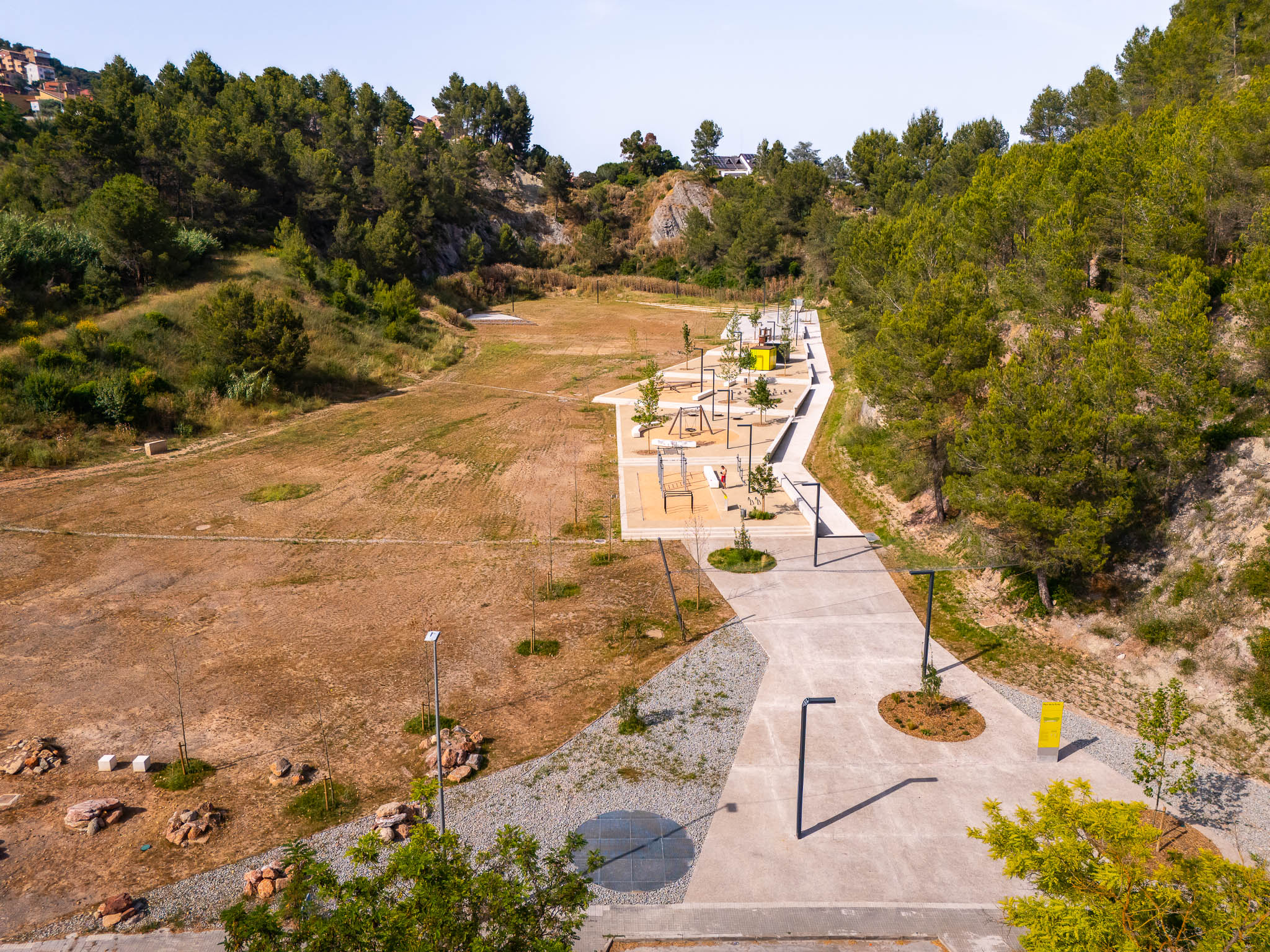
La Roda Metropolitan Park by EMBA. Recovery of the space of an old quarry and new urban park. Photography by Simón García.
Project description by EMBA
The old gypsum quarry in Corbera's Parc Central has been out of service for decades. It has no heritage protection, but it constitutes a very special space that can be understood as a summary of the different layers of life in Corbera, from the geotectonic and geological, through the agricultural and industrial, and even the social. It forms part of a network of open-pit gypsum mines active between the 1920s and 1970s, of which it is one of the few still recognizable as a quarry, despite being used as a landfill since its closure.
A guiding principle of the project has been to add itself as another layer to this historical evolution of the site, intervening minimally and respecting the natural processes of the place, both geological and botanical, with which the project seeks to integrate and coexist. We believe it is more productive to work in symbiosis with these dynamics and allow the land to express itself spontaneously, rather than trying to control them.
Since its designation as a public facility, La Pedrera has been the subject of several attempts to integrate it into the urban fabric. The most recent was in 2006, when the plan was to build a football stadium there, an initiative that was ultimately unsuccessful. In 2021, a consensus was reached among the public to transform it into a public space suitable for recreational activities and large events.
Throughout its history of mining, La Pedrera has gradually taken shape as a large void excavated in the forest, the result of extraction activities and subsequent landfill. The resulting platform is defined by excavations and very steep slopes, which are its most prominent feature.

Due to its composition, some of the geological strata are currently undergoing erosion and exhibit active areas of localized landslides. Converting the quarry into a freely accessible public space required, first and foremost, ensuring its safe use by stabilizing the slopes and protecting them from geotectonic processes, which cause the site to be in constant flux.
The project employs a mixed system of active and passive rockfall containment solutions to minimize environmental impact. On the one hand, at points where the proximity between potential rockfalls and existing uses or pathways is critical, triple-twist safety nets anchored to the rock have been used. These nets blend easily into the vegetation, quickly becoming spontaneously overgrown and hidden. This mesh is also used to define a symbolic gateway to the park, in the form of a pergola.

On the other hand, in the less critical areas, protection against rockfalls has been reinforced with berms and earthen embankments formed with materials from the same terrain and integrated into the natural structure of the site, preserving, as far as possible, the existing geological and tree-shrub formations. These berms are used compositionally to establish lines of connection between different parts of the project, reinforcing its unity and integration with the site.
The void formed by the old quarry is approximately 190 meters long and has a variable width of about 65 meters. The total difference in elevation from the access point to the highest point is about 20 meters, concentrated in the northeastern part of the area on a slope of about 15 meters. The area designated as a recreational area covers a difference in elevation of 5 meters from the access point to the bottom.

To make this slope usable and compatible with the multiple uses requested by the City Council and the limited available budget, the urbanization works have been concentrated on a single architectural structure consisting of a system of interconnected platforms along one side of the large central space. The rest of the site is treated simply with minimal ground preparation and hydroseeding.
The platform system is formed as a grand staircase made of large pieces of artificial stone, where each landing accommodates a specific use that, nevertheless, is visually and materially related to the others. The finishes on each platform have been achieved with various types of mineral materials, from sands of different colors to ballast or compacted earth with natural binders.

This grand staircase is conceived, on the one hand, as a transversal architectural mediator between the forest and the quarry esplanade, managing this relationship through the ramp-wall that defines it. On the other hand, it becomes a longitudinal urban connector that links two neighborhoods of Corbera, giving continuity to a pedestrian route that is currently only partially completed and that will be completed in a second phase until reaching the upper areas of the town.


