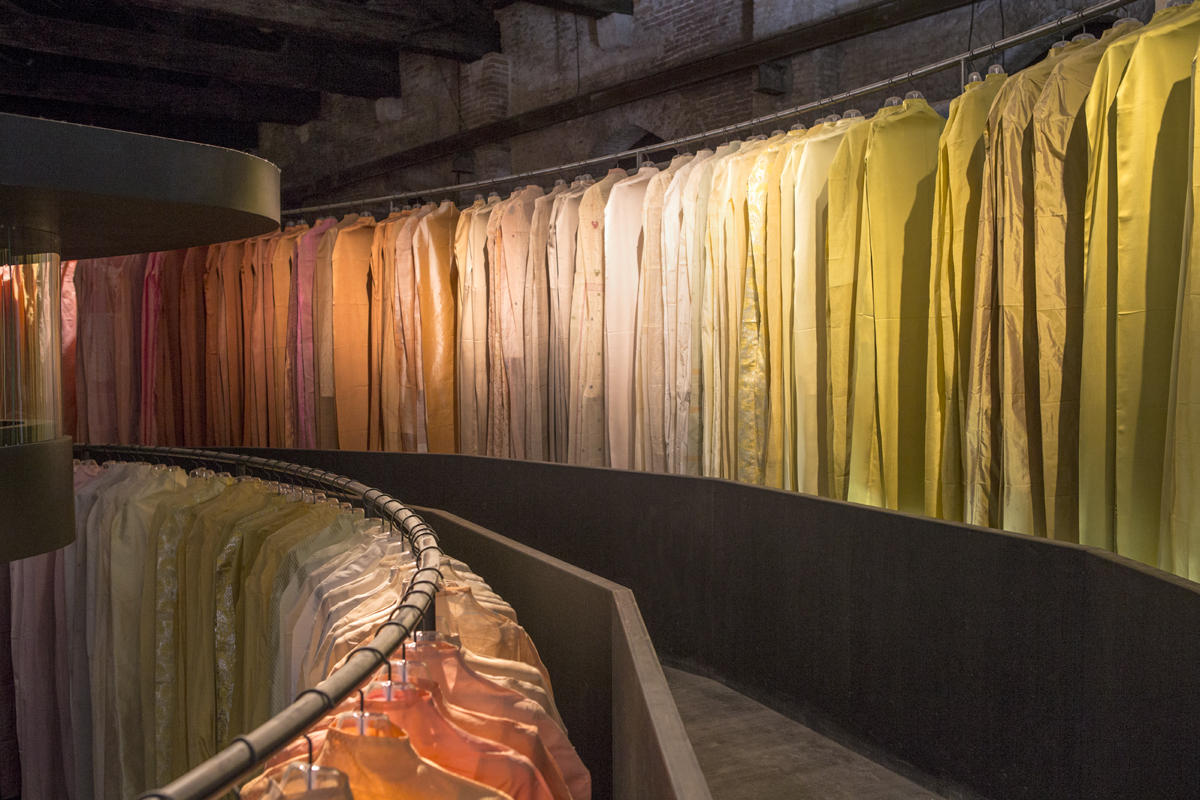
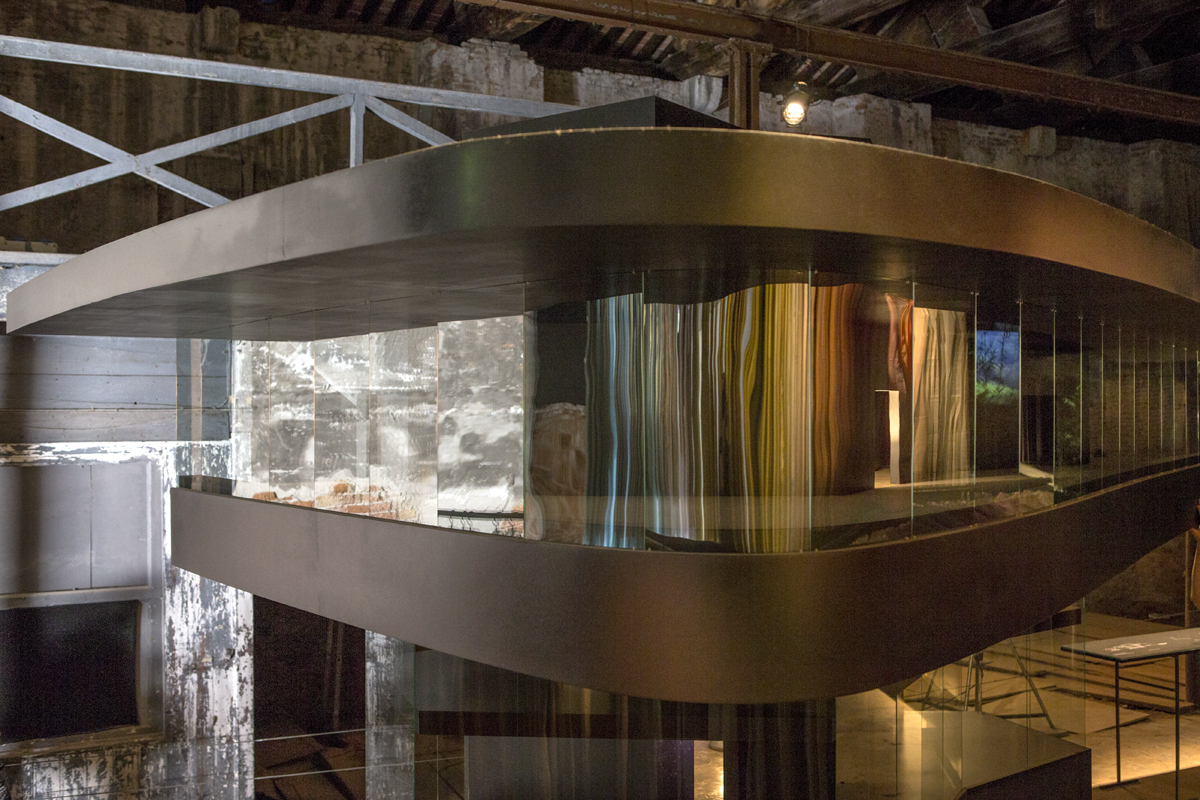
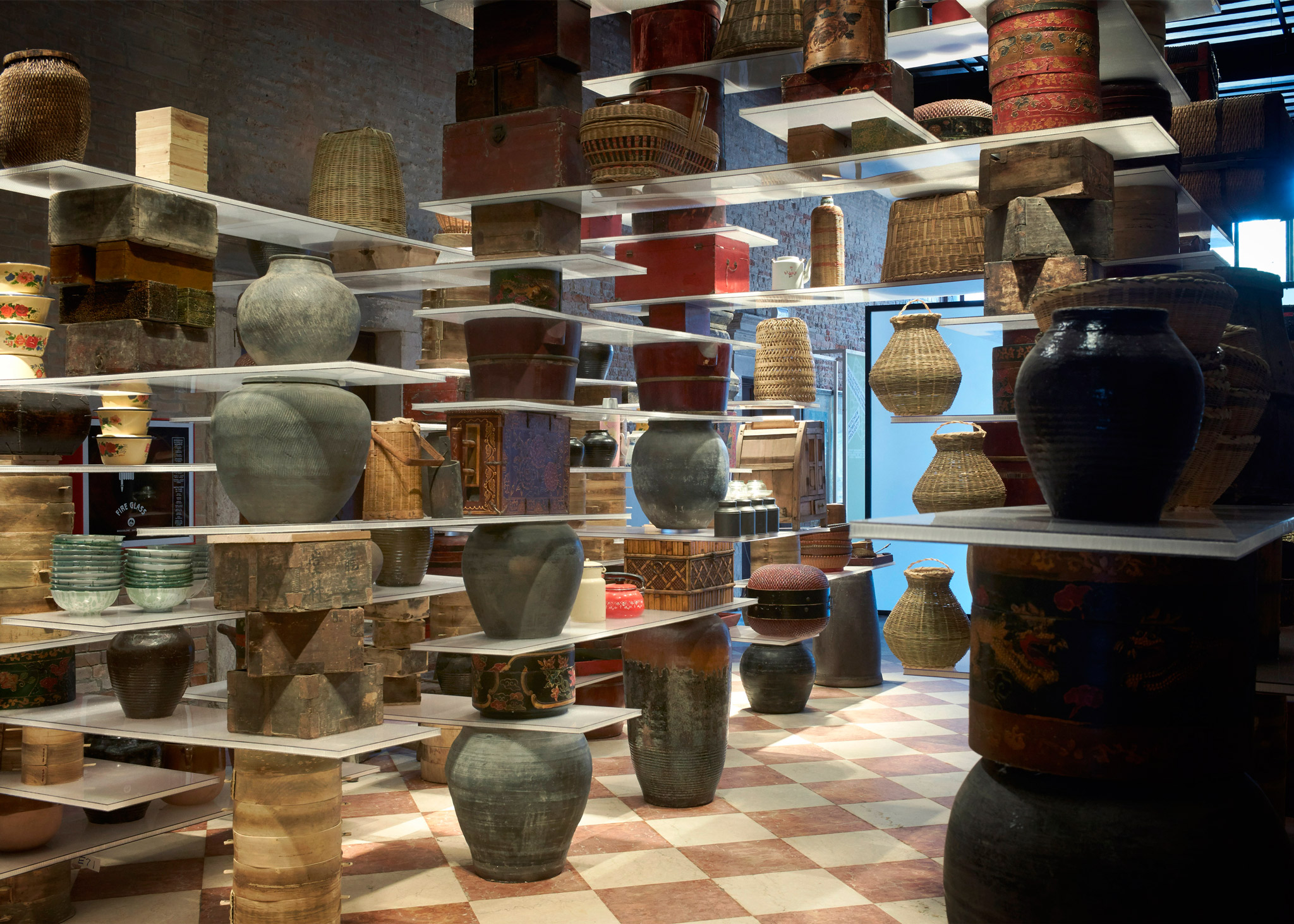
Two different exhibitions and however similar, also. Peter Zumthor showing his proposal for the new LACMA Museum Building using fabrics, hangers and colors. Kengo Kuma showing as structuralization of space can be achieved by connecting everyday dinnerware pieces of a house and people flowing through them. Colors and everyday items, to explain the architecture.

In the case of Kengo Kuma the exhibition is the development of a conceptual idea of habitat, more that the representation of a specific project. In this installation, "Floating Kitchen", he was creating a space solely upon the aggregation of structuralized “objects” — For Kengo Kuma, a primitive condition of space where the objects come in direct contact with people, and only the intensive aggregation and flow of those “objects” stand out in relief.

"Spaces for cooking and dining in China have always attracted me, spaces redolent of daily life and densely occupied by both objects and people. For the “Floating Kitchen”, I have collected and brought these “objects” together and reassembled them in Venice. The space is free from the predominant hierarchy of architecture, furniture, objects and people" and provides an exciting place where objects and people interact directly to create the space.

And almost following the same idea in the second exhibition, a model, of the building LACMA, was suspended giving the feeling of floating in a curved screen between works of textile art of Christina Kim, taking as background music, 'Ocean Music' by Walter De Maria, written in 1968.

Rather than bring along artwork from LACMA to exhibit alongside the model, Zumthor and LACMA director Michael Govan selected artist Kim to create a textile artwork consisting of two curving rows of fabrics in a gradient of colors. The idea uses fabrics picked up in the reflection of the model’s continuous glazed wall, where they serve as an abstraction of how the collection of paintings and artworks will contrast with the museum’s dark gray concrete shell.

Kim has previously worked with both LACMA and architectural themes as a participant in "Wear LACMA," in which Los Angeles-based designers were tapped by the museum to create pieces inspired by LACMA’s permanent collection. Kim’s label Dosa created a 10-piece collection inspired by paintings of Simon Rodia’s Watts Towers.
 
Other images can be seen  here and here.

The Arsenale exhibit also contains a small set of site plans and architectural drawings of Zumthor’s design, as well as a bamboo garden.

 
Read more
Read less

More information

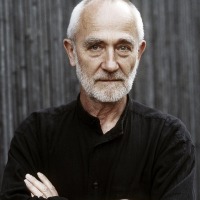
Peter Zumthor was born on April 26, 1943, the son of a cabinet maker, Oscar Zumthor, in Basel, Switzerland. He trained as a cabinet maker from 1958 to 1962. From 1963-67, he studied at the Kunstgewerbeschule, Vorkurs and Fachklasse with further studies in design at Pratt Institute in New York.

In 1967, he was employed by the Canton of Graubünden (Switzerland) in the Department for the Preservation of Monuments working as a building and planning consultant and architectural analyst of historical villages, in addition to realizing some restorations. He established his own practice in 1979 in Haldenstein, Switzerland where he still works with a small staff of fifteen. Zumthor is married to Annalisa Zumthor-Cuorad. They have three children, all adults, Anna Katharina, Peter Conradin, and Jon Paulin, and two grandchildren.

Since 1996, he has been a professor at the Academy of Architecture, Universitá della Svizzera Italiana, Mendrisio. He has also been a visiting professor at the University of Southern California Institute of Architecture and SCI-ARC in Los Angeles in 1988; at the Technische Universität, Munich in 1989; and at the Graduate School of Design, Harvard University in 1999.

His many awards include the Praemium Imperiale from the Japan Art Association in 2008 as well as the Carlsberg Architecture Prize in Denmark in 1998, and the Mies van der Rohe Award for European Architecture in 1999. In 2006, he received the Thomas Jefferson Foundation Medal in Architecture from the University of Virginia. The American Academy of Arts and Letters bestowed the Arnold W. Brunner Memorial Prize in Architecture in 2008.

In the recent book published by Barrons Educational Series, Inc. titled, Architectura, Elements of Architectural Style, with the distinguished architectural historian from Australia, Professor Miles Lewis, as general editor, the Zumthor’s Thermal Bath building at Vals is described as “a superb example of simple detailing that is used to create highly atmospheric spaces. The design contrasts cool, gray stone walls with the warmth of bronze railings, and light and water are employed to sculpt the spaces. The horizontal joints of the stonework mimic the horizontal lines of the water, and there is a subtle change in the texture of the stone at the waterline. Skylights inserted into narrow slots in the ceiling create a dramatic line of light that accentuates the fluidity of the water. Every detail of the building thus reinforces the importance of the bath on a variety of levels.”

In the book titled Thinking Architecture, first published by Birkhauser in 1998, Zumthor set down in his own words a philosophy of architecture. One sample of his thoughts is as follows: “I believe that architecture today needs to reflect on the tasks and possibilities which are inherently its own. Architecture is not a vehicle or a symbol for things that do not belong to its essence. In a society that celebrates the inessential, architecture can put up a resistance, counteract the waste of forms and meanings, and speak its own language. I believe that the language of architecture is not a question of a specific style. Every building is built for a specific use in a specific place and for a specific society. My buildings try to answer the questions that emerge from these simple facts as precisely and critically as they can.”

Read more

Kengo Kuma was born in Yokohama (Kanagawa, Japan) in 1954. He studied architecture at the University of Tokyo, finishing his degree in 1979. In 1987, he opened the "Spatial Design Studio". In 1990 he founded "Kengo Kuma & Associates" and extended the study to Europe (Paris, France) in 2008. Since 1985 and until 2009, has taught as a visiting professor and holder at the universities of Columbia, Keio, Illinois and Tokyo.

Notable projects include Japan National Stadium (2019), V&A Dundee (2019), Odunpazari Modern Art Museum (2019), and The Suntory Museum of Art (2007).

Kengo Kuma proposes architecture that opens up new relationships between nature, technology, and human beings. His major publications include Zen Shigoto(The complete works, Daiwa S hobo)Ten Sen Men (“point, line, plane”, IwanamiShoten), Makeru Kenchiku (Architecture of Defeat, Iwanami Shoten), Shizen na Kenchiku(Natural Architecture, Iwanami Shinsho), Chii sana Kenchiku (Small Architecture, IwanamiShinsho) and many others.

Main Awards:

· 2011 The Minister of Education, Culture, Sports, Science and Technology's Art Encouragement Prize for "Yusuhara Wooden Bridge Museum."
· 2010 Mainichi Art Award for “Nezu Museum.”
· 2009 "Decoration Officier de L'Ordre des Arts et des Lettres" (France).
· 2008 Energy Performance + Architecture Award (France). Bois Magazine International Wood Architecture Award (France).
· 2002 Spirit of Nature Wood Architecture Award (Finland).
· 2001 Togo Murano Award for “Nakagawa-machi Bato Hiroshige Museum.”
· 1997 Architectural Institute of Japan Award for “Noh Stage in the Forest”. First Place, AIA DuPONT Benedictus Award for “Water/Glass” (USA).

Read more

José Juan Barba (1964) is an architect, graduated from ETSA Madrid (1991), and holds a Doctorate in Architecture from ETSA Madrid, awarded Cum laude for his thesis Inventions: New York vs. Rem Koolhaas, Bernard Tschumi, Piranesi (2004). He received a special mention in the National Awards for Completion of Studies (1991) and served as an advisor to various NGOs until 1997. He founded his studio in Madrid in 1992 (www.josejuanbarba.com). 

Barba is an architecture critic and has been the director of METALOCUS magazine since 1999. Since 1998, he has directed the International Architecture Magazine METALOCUS (bilingual, Spanish/English), which has been recognized with multiple national and international awards.

He is a Full Professor at the University of Alcalá, leading the project line of the Habilitation Master's Architecture and City, responsible for several courses in Theory and Criticism, heading the Urban Planning area of the Department of Architecture, and participating in the research group Architecture, History, City, and Landscape at UAH. He has been invited to numerous architecture and urbanism forums, including the II Forum of Mexican Cities World Heritage: Urban Development, History, and Modernity, organized by the Pan-American Committee for Urban Development and Historical Heritage, and the World Urban Development Forum (FMDU) in Culiacán, Sinaloa, Mexico. He has also participated in the International Architecture and Urbanism Conferences from the perspective of women architects, and has lectured at prestigious national and international universities, including the National Building Museum (Washington, DC), Roma TRE, Politecnico di Milano, UPMF Grenoble, ETSA Madrid, ETSA Barcelona, University of Thessaly (Volos), UNAM Mexico, the Faculty of Architecture Montevideo, schools of architecture in Medellín, Quito-Ecuador, Alicante, Málaga, Granada, Seville, A Coruña, Zaragoza, Valladolid, Universidad Iberoamericana Mexico, IE School, Universidad Europea Madrid, UCJC Madrid, ESARQ-UIC Barcelona, or Università Degli Studi di Genova.

Barba has extensive professional experience in architecture, urban planning, landscape design, and territorial recovery. He has received numerous awards, including the First Prize for Gran Vía Posible for Delirious Gran Vía (Madrid), the River Interpretation Center (Zamora), exhibited at the World Architecture Festival (Barcelona 2008), Santa Bárbara Park (Toledo), the Erich Degner Architecture Prize 1995 promoted by the BBVA Foundation, and his Day Care Center for the Elderly project, featured in Volume 3 of the COAM Madrid Architecture Guide (2007). His work has been published in numerous national and international books and magazines.

He was also Maître de Conférences at IUG-UPMF Grenoble (2013–14), in a position obtained through a European competition. His work has been published internationally. He regularly serves on academic juries, including the editorial competition of Quaderns magazine (2011), as a selector for the Mies van der Rohe Awards (2007–2026), as juror for EUROPAN13 Spain (2015–16), TRANSFER in Zurich (2019), and was invited to participate in the Venice Biennale 2016 as part of the exhibition Spaces of Exception / Spazi d’Eccezione.

He has published several books, including The Dark Line. michele&miquel, dA Vision Design (2024), CONGRESO ANYWAY. The City of Cities (2020), #Positions (2016), and Inventions: New York vs. Rem Koolhaas, Bernard Tschumi, Piranesi (2015). He has contributed to other publications such as Public Space Gran Vía. The Tourism City (2020), Spaces of Exception / Spazi d’Eccezione (2016), La mansana de la discordia (2015), and Contemporary Architecture of Japan: New Territories (2015), as well as chapters in numerous books including Architects: A Professional Challenge (2009), 21st Century Architectures (2007), Ruta de la Plata, New Conquerors of Space (2019), and The Tourism City (2020).

Selected awards include:

- “PIERRE VAGO” ICAC. International Committee of Art Critics Award, London, 2005
- “PANAYIOTI MIXELI AWARD,” SADAS-PEA, award for the promotion of architecture, Athens, 2005
- “SANTIAGO AMÓN” AWARD, award for the promotion of architecture, COAM Madrid, 2000
- FAD Award 07, Ephemeral Interventions, First Prize, M.C. Escher Exhibition, Arquin-FAD, Barcelona, 2007
- World Architecture Festival, Center for Research and Interpretation of the Rivers, Tera, Esla, and Órbigo, Finalist, Barcelona, 2008
- Gran Vía Posible, First Prize, Delirious Gran Vía, Madrid, 2010
- Reform of the Río Segura Surroundings, Award, Murcia, 2010

Read more
Published on: October 16, 2016
Cite:
metalocus, JOSÉ JUAN BARBA
"Rainbow of fabrics for LACMA by Zumthor and The aggregation of structuralized “objects” by Kuma" METALOCUS. Accessed
<http://www.metalocus.es/en/news/rainbow-fabrics-lacma-zumthor-and-aggregation-structuralized-objects-kuma> ISSN 1139-6415
Loading content ...
Loading content ...
Loading content ...
Loading content ...
Loading content ...
Loading content ...
Loading content ...
Loading content ...
Loading content ...
Loading content ...
Loading content ...
Loading content ...
Loading content ...
Loading content ...
Loading content ...
Loading content ...
Loading content ...
Loading content ...
Loading content ...
Loading content ...
Loading content ...
Loading content ...
Loading content ...
Loading content ...
Loading content ...
Loading content ...
Loading content ...
Loading content ...
Loading content ...
Loading content ...
Loading content ...
Loading content ...
Loading content ...
Loading content ...
Loading content ...
Loading content ...
Loading content ...
Loading content ...
Loading content ...
Loading content ...
Loading content ...
Loading content ...
Loading content ...
Loading content ...
Loading content ...
Loading content ...
Loading content ...
Loading content ...
Loading content ...
Loading content ...
Loading content ...
Loading content ...
Loading content ...
Loading content ...