Estudio Carbajal SLP and Estudio Acta have been the winners of the competition to design the New Town Hall, the expansion of the Plaza de la Constitución and the adjacent public spaces of Roquetas de Mar, in Almería, Spain.

The project incorporates strategies such as aligning the façade of the Parish Church of Our Lady of the Rosary, effectively doubling the size of the Plaza de la Constitución. Furthermore, the demolition of existing buildings has created a new public space that will serve as a symbolic and identity-defining center for the town's residents. 

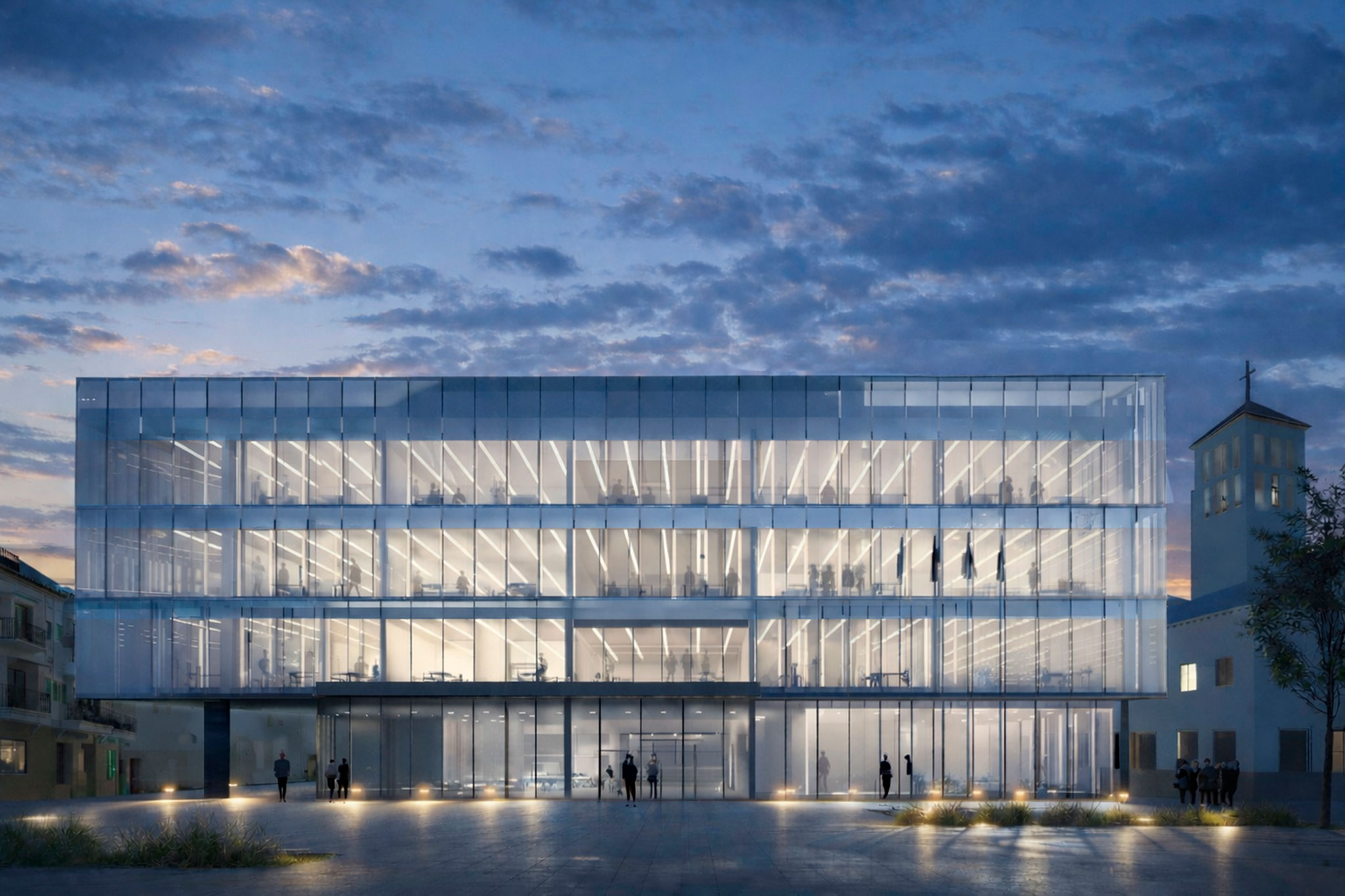
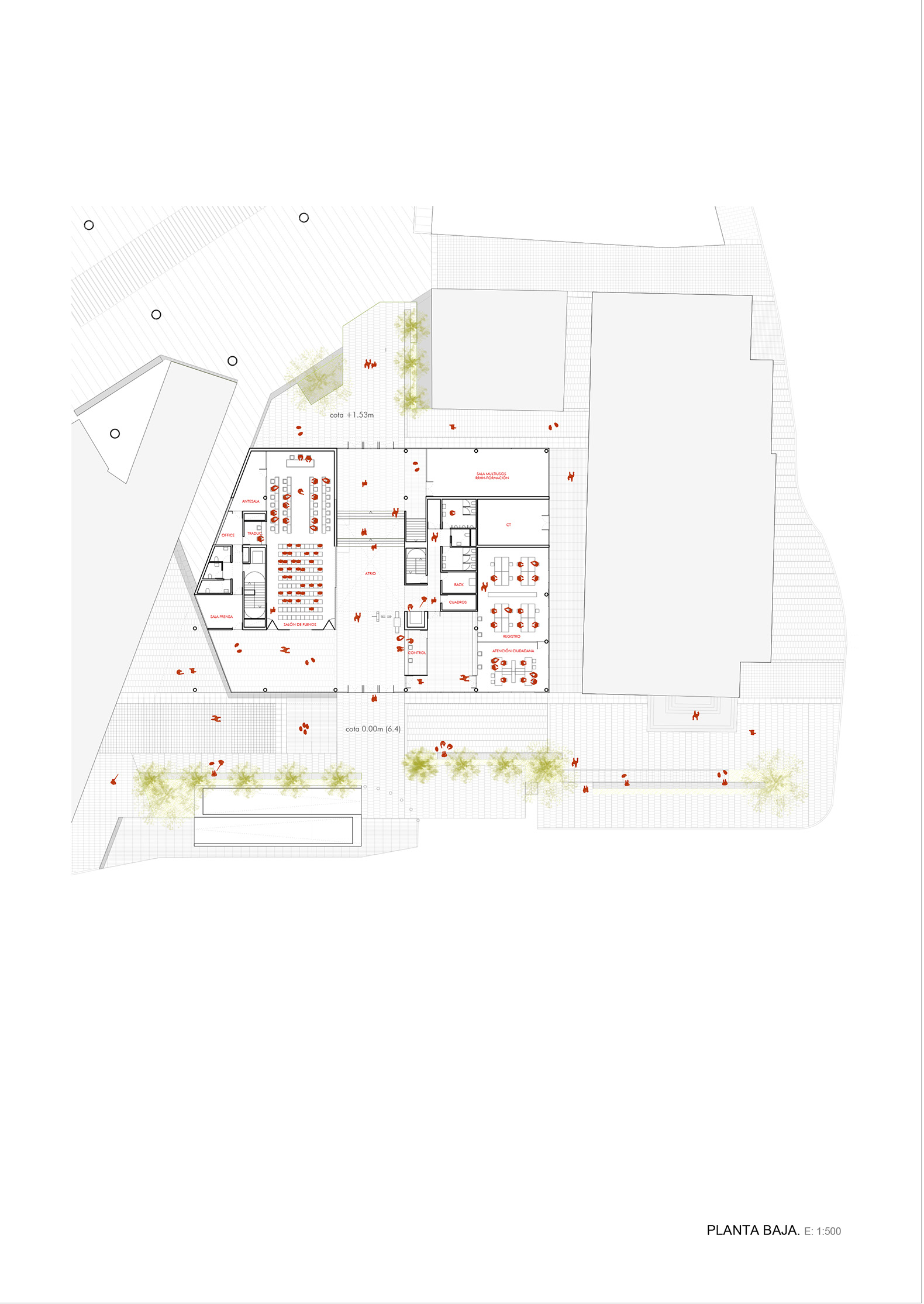
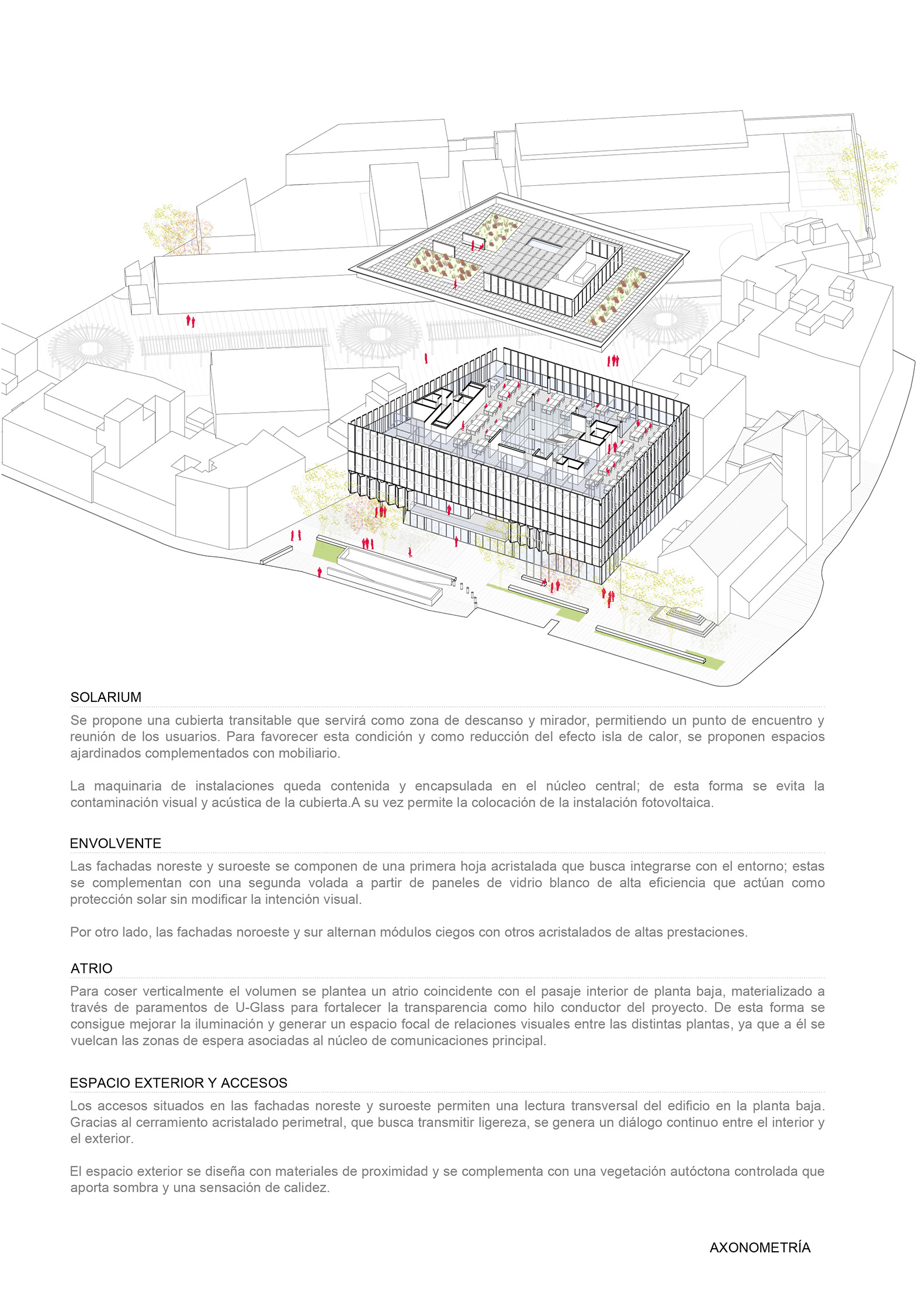
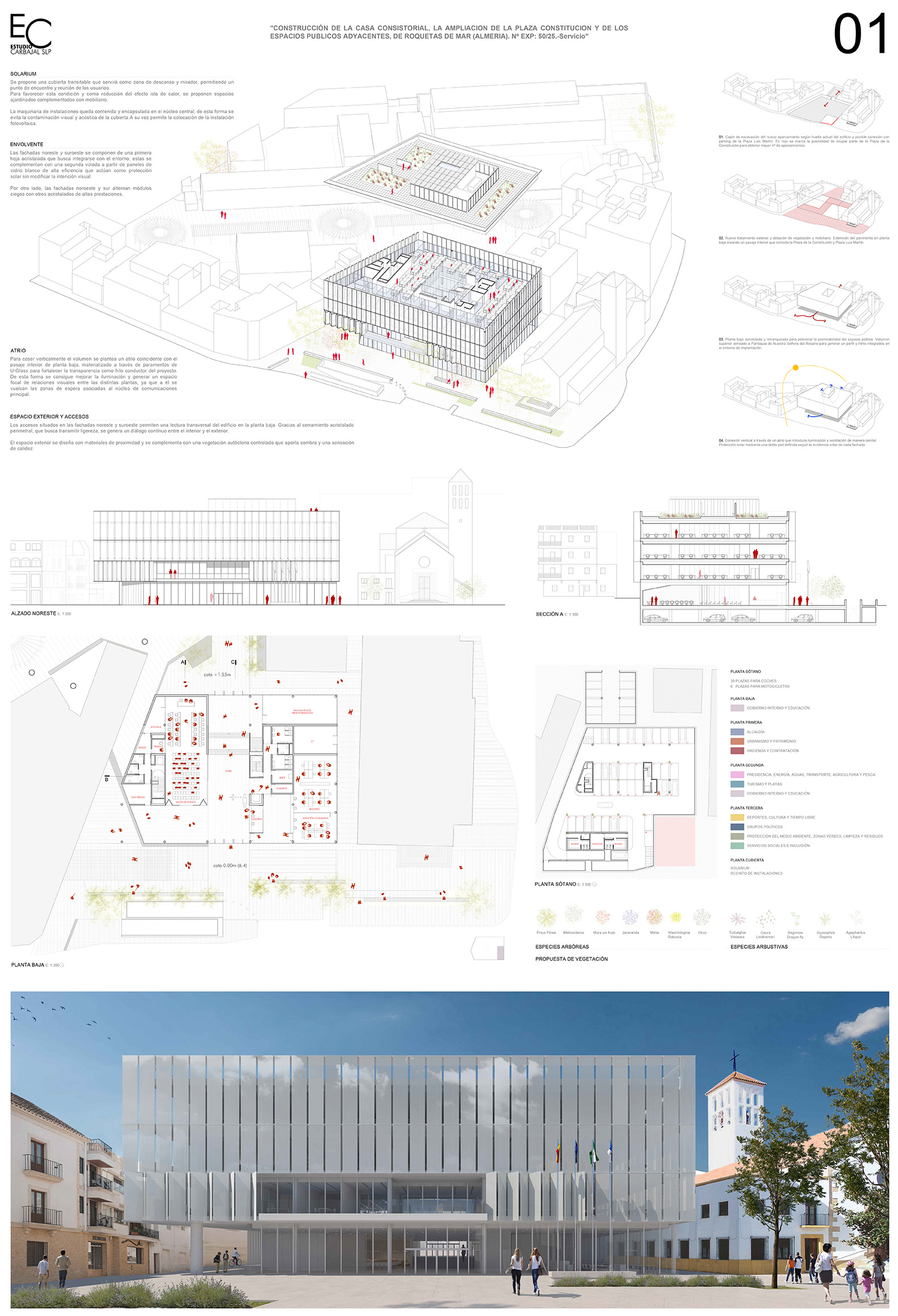
The new Roquetas de Mar Town Hall and the expansion of the Plaza de la Constitución, designed by Estudio Carbajal SLP and Estudio Acta, feature an open ground floor that will allow for free movement throughout the building and the central atrium. The ground floor houses public spaces, such as citizen services and the plenary hall. The intermediate levels contain the technical areas, and the building's roof will feature a landscaped solarium for relaxation and socializing.

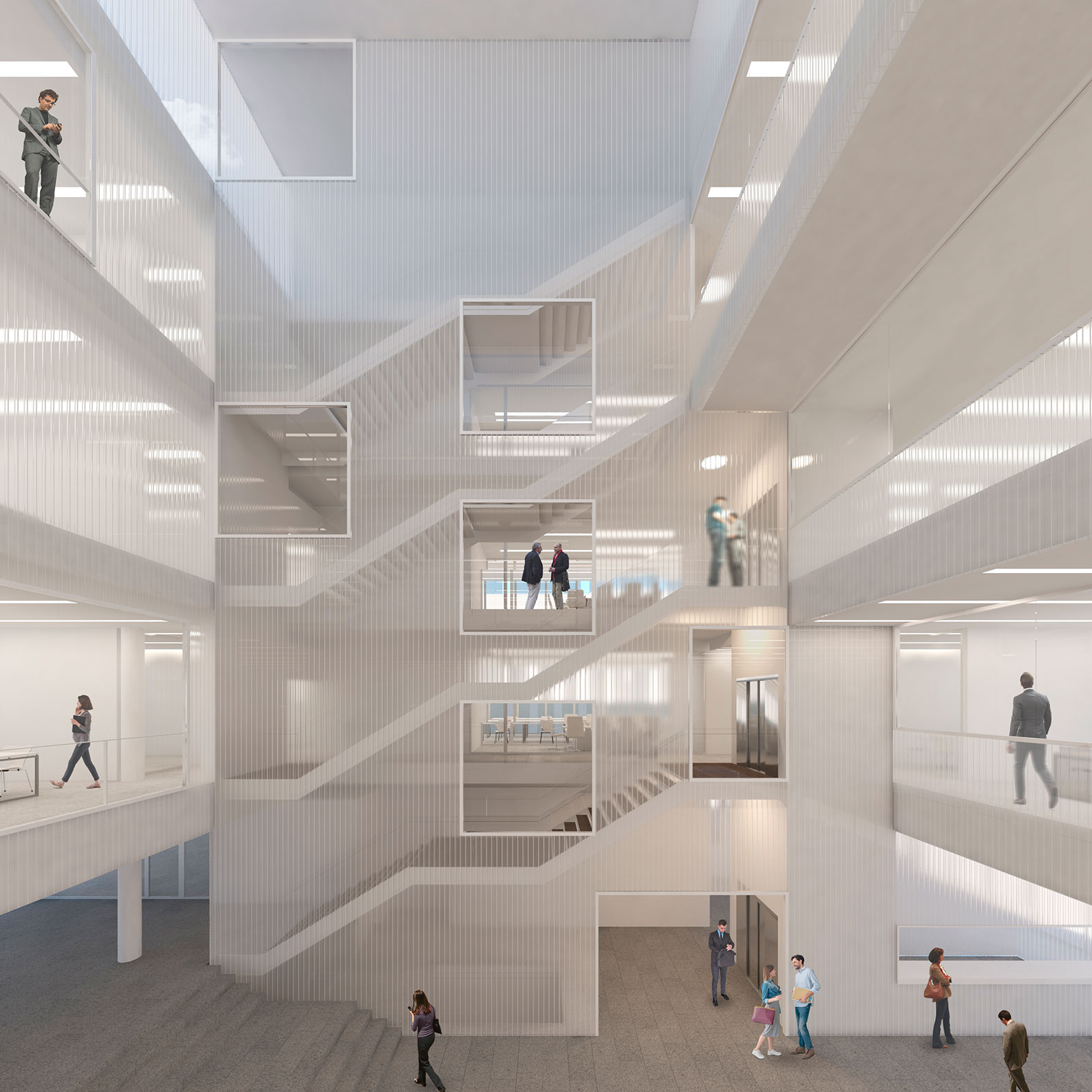
As one of its essential features, a covered atrium is planned for public use, for holding public events and celebrations. With construction scheduled for 2027, the design prioritizes the optimization of facilities and the selection of simple, easily maintained, and highly durable materials. 
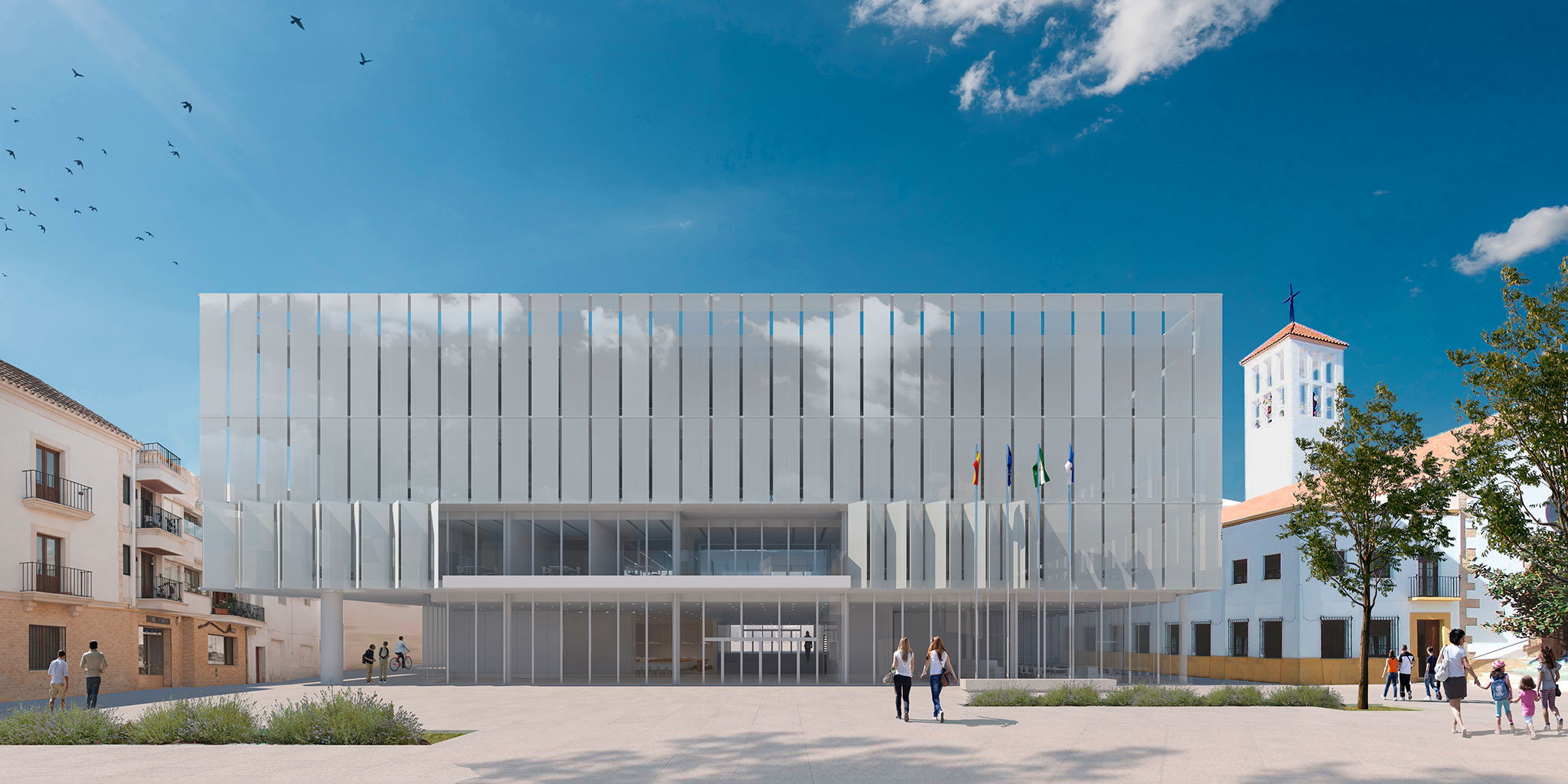
Nueva Casa Consistorial de Roquetas de Mar y ampliación de la plaza de la Constitución y los espacios públicos adyacentes por Estudio Carbajal SLP y Estudio Acta. Visualización cortesía de Estudio Carbajal SLP y Estudio Acta.

New Town Hall of Roquetas de Mar and expansion of the Plaza de la Constitución by Estudio Carbajal SLP and Estudio Acta. Visualization courtesy of Estudio Carbajal SLP and Estudio Acta.  

Project description by Estudio Carbajal SLP y Estudio Acta

The rapid transformation of the municipality of Roquetas has resulted in the typical features of contemporary urban sprawl, one of whose most notable characteristics is the absence of an urban center with memory, identity, and urban cohesion. This project aims to create a space that provides the missing elements to consolidate an urban living room in the heart of the city through a design that enhances the virtues of this location. It incorporates the space freed up after the demolition of the buildings that filled the block, creating a public space intended to function as a symbolic and identity-defining center for the community. To this end, the building aligns with the façade of the Parish Church of Our Lady of the Rosary, effectively doubling the area of ​​the Plaza de la Constitución. The resulting volume is carved and perforated at ground level to ensure permeability between the Plaza de la Constitución and the Plaza Luis Martín-C/ Duque de Ahumada intersection. The carving is achieved by opening up the corner of Cid Street to improve views and pedestrian flow, while the perforation consists of creating a possible passageway on the ground floor through the building, crossing the central atrium that organizes it.

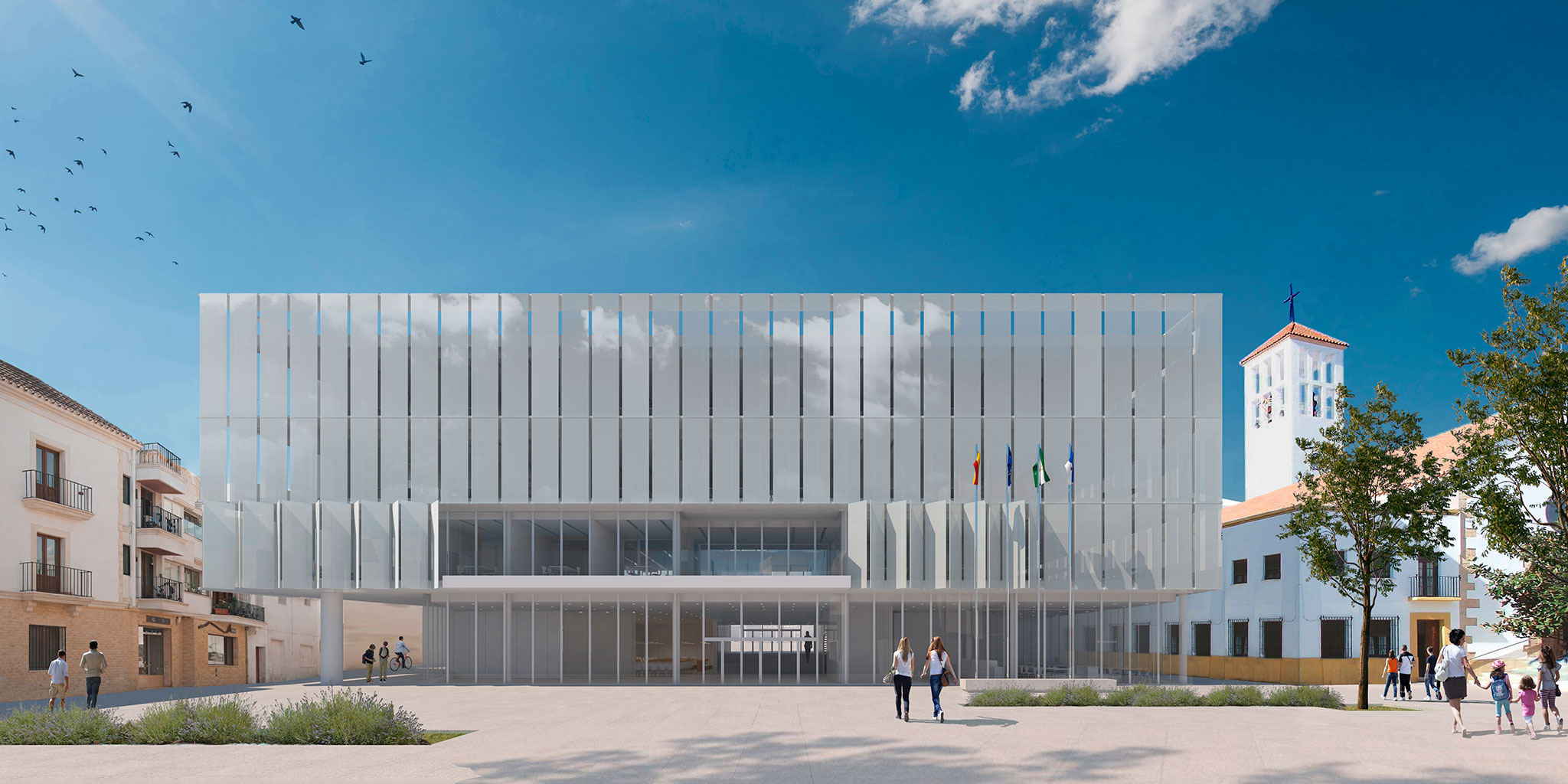
Controlling its scale and urban presence has been a key aim of the project. Following this premise, it draws on the scale and formal structure of the neighboring Parish Church and the nearby Historical Museum, attempting to contribute to the urban landscape of the renovated plaza with a neutral image that emphasizes the continuity of the ground floor space and the opening of the central balcony (the quintessential identifying element of the institutional image in the collective memory of the citizens), both marked by the depth of the shadows.

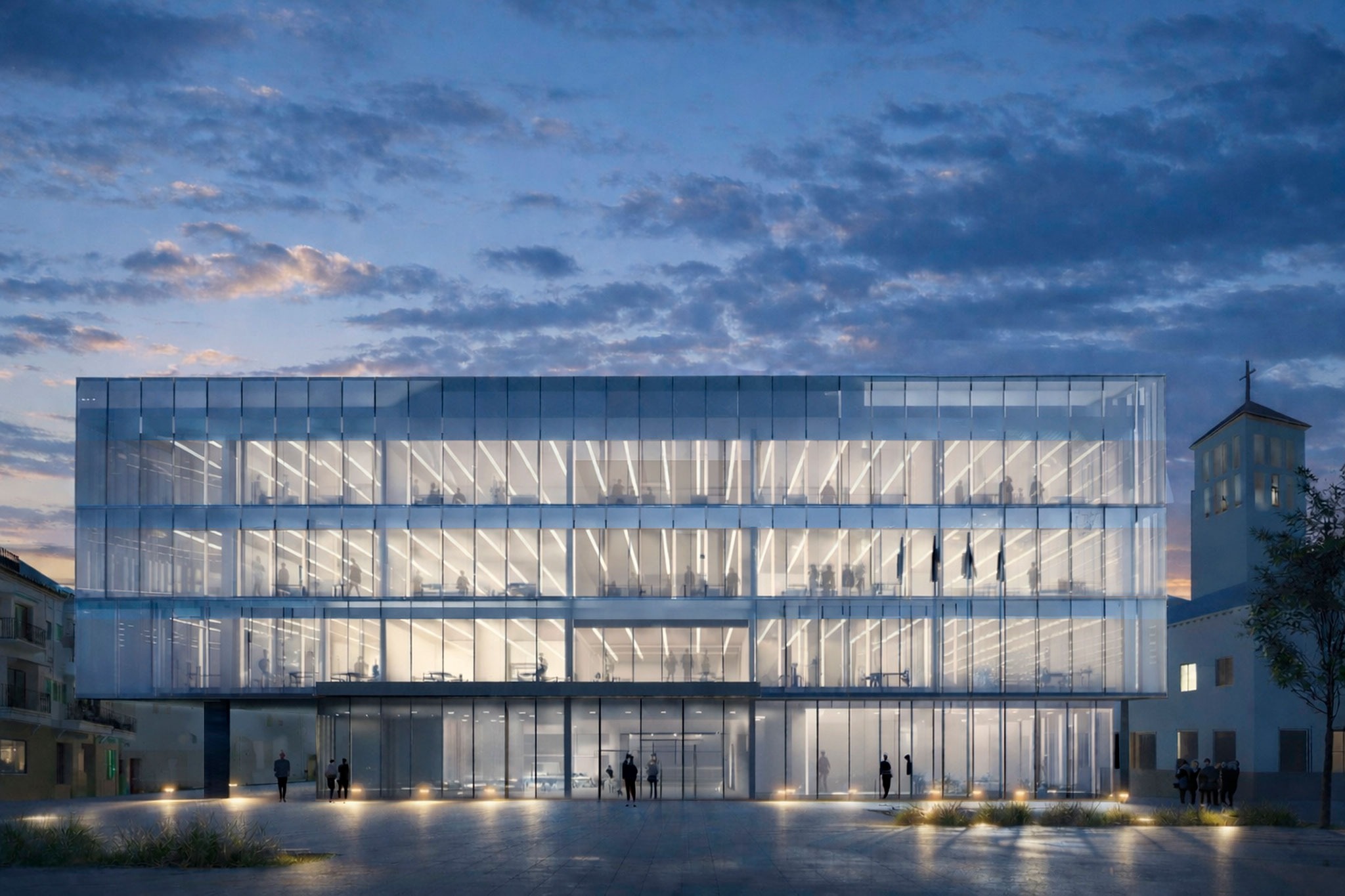
Nueva Casa Consistorial de Roquetas de Mar y ampliación de la plaza de la Constitución y los espacios públicos adyacentes por Estudio Carbajal SLP y Estudio Acta. Visualización cortesía de Estudio Carbajal SLP y Estudio Acta.
New Town Hall of Roquetas de Mar and expansion of the Plaza de la Constitución by Estudio Carbajal SLP and Estudio Acta. Visualization courtesy of Estudio Carbajal SLP and Estudio Acta.  

Ultimately, the proposal addresses the precarious situation of the current City Hall building—the result of a succession of buildings and diverse spaces added over the years—which is unable to meet the institutional, functional, accessibility, energy efficiency, or simply spatial needs it requires. Thus, the design decisions involved in relation to the implementation and configuration of the building seek to guarantee the achievement of diverse demands such as transparency, accessibility, sustainability, versatility, contemporaneity or functionality that guarantee this desire to build a new institutional headquarters capable of meeting current needs and taking on future ones.

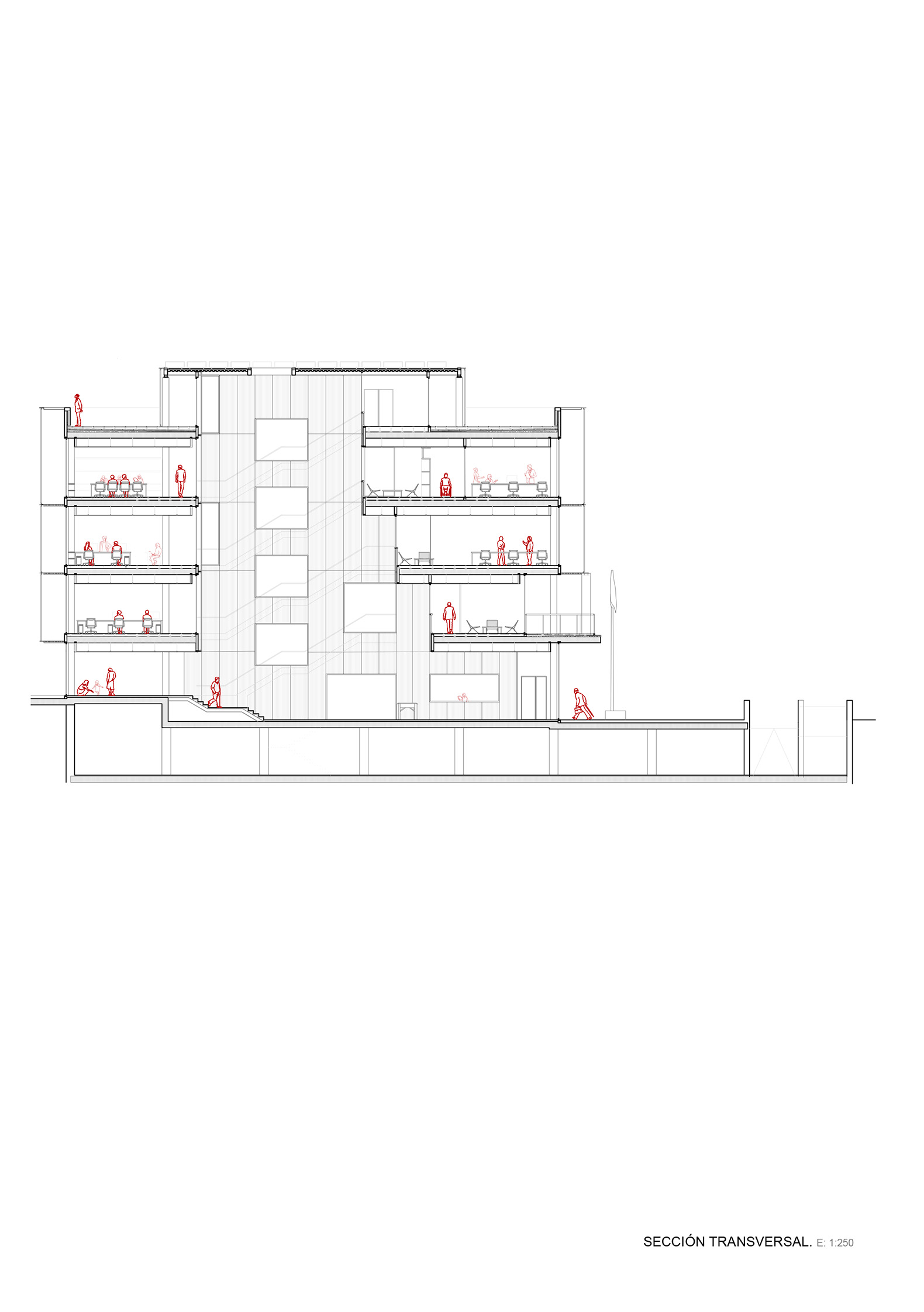
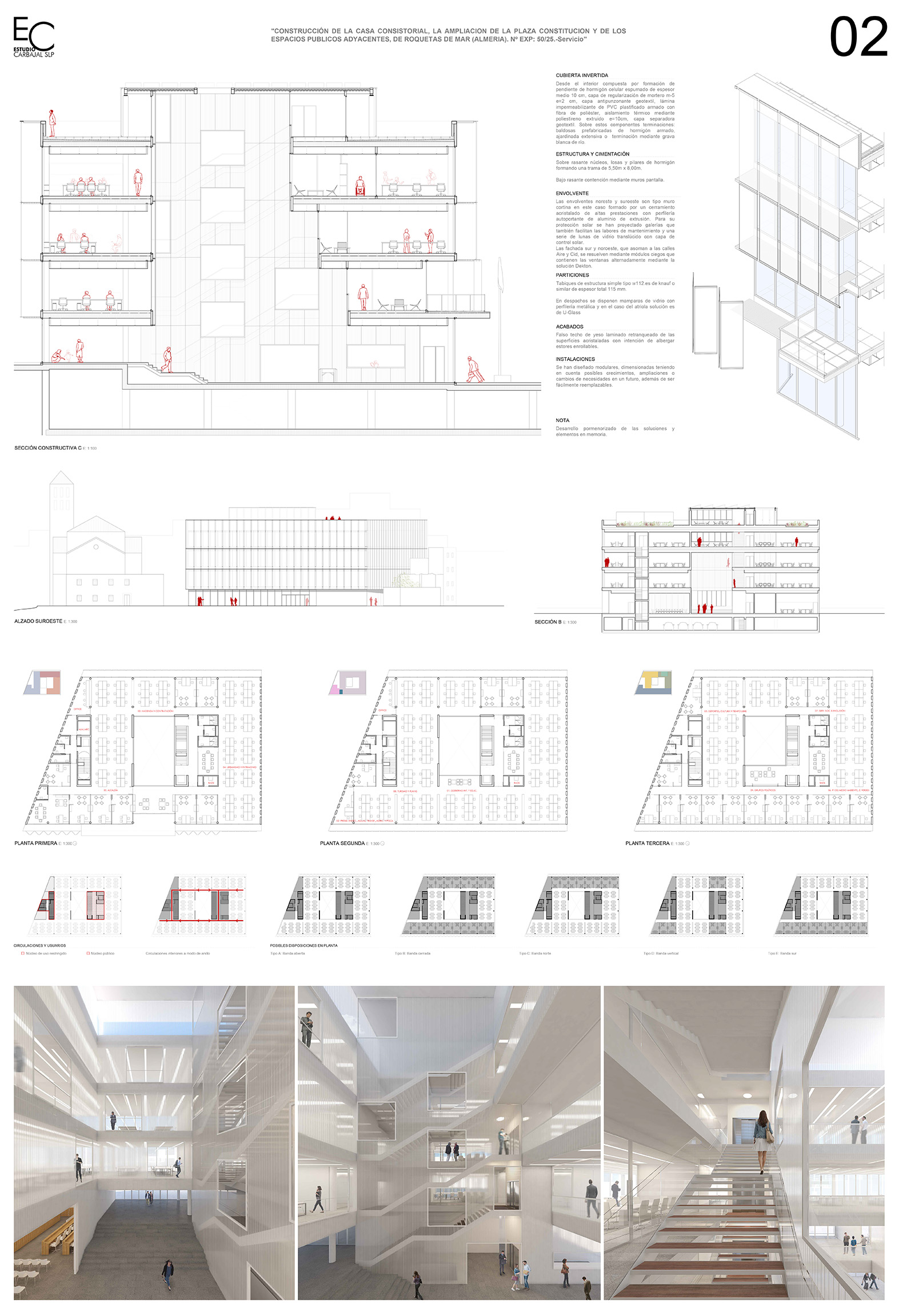
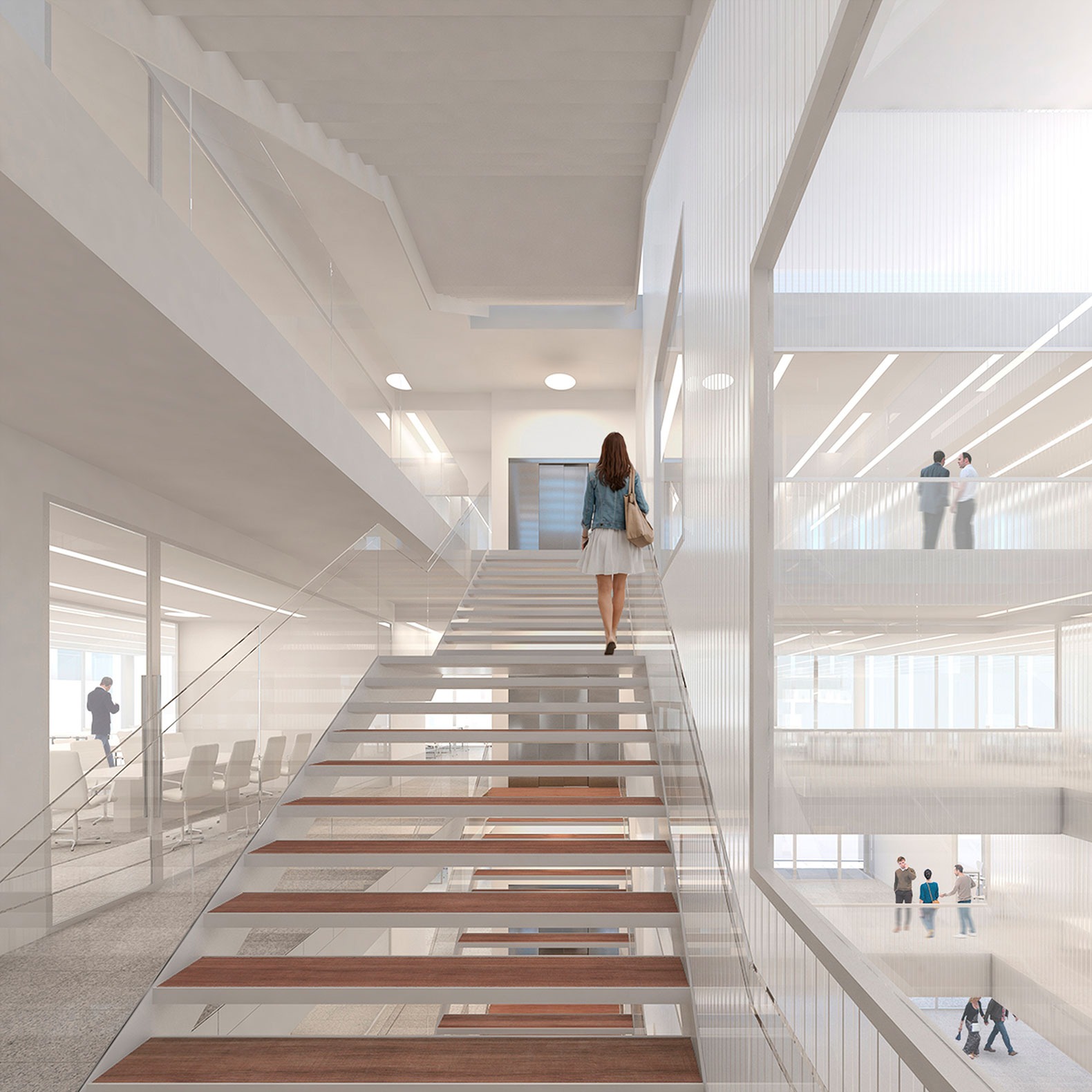
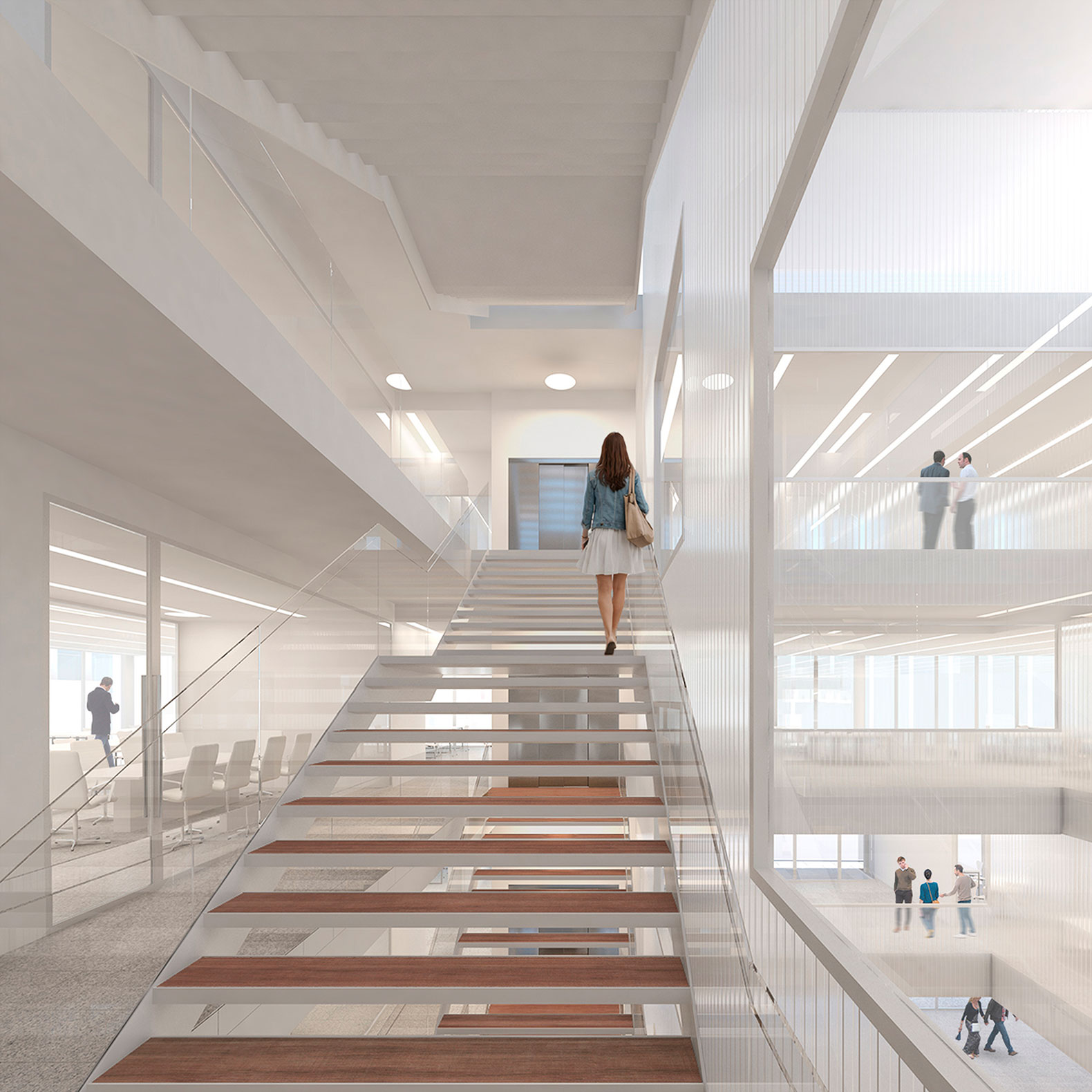
Essentially, the organizational structure places public-facing spaces (citizen services, plenary hall, access control, etc.) on the ground floor, technical areas on the intermediate levels, and meeting and relaxation areas on the roof. It addresses a dual need: facilitating the work of its users while simultaneously providing service to the public. To achieve this, open, well-lit, and ventilated spaces have been designed, creating a spacious and flexible environment that is both useful and comfortable. Clear circulation routes are easily identifiable by visitors, and appropriate spaces are available for each service that requires it. The design incorporates a versatile structure that can adapt to changing needs over time, thanks to the open floor plans and the structural modules used, which allow for both open and partitioned workspaces. The separate circulation routes (public and private) in their respective cores, and even the modular facade enclosures (which offer the possibility of dividing work areas into different surfaces), effectively realize this premise of flexibility and adaptability. The distribution of the bays, planned around the large atrium void, allows for communication between work areas and tangential and transverse circulation between them without interference. The support of services, communications, and amenities concentrated at both ends ensures this versatility. All of this will allow for the organization of spaces into homogeneous areas on different levels, designed by harmonizing criteria of internal organization, efficiency, and suitability for serving the public, while ensuring the well-being and comfort of the workers thanks to the amenities, square meter ratio per workstation, lighting, ventilation, safety, ergonomics, and accessibility of the spaces created.
Nueva Casa Consistorial de Roquetas de Mar y ampliación de la plaza de la Constitución y los espacios públicos adyacentes por Estudio Carbajal SLP y Estudio Acta. Visualización cortesía de Estudio Carbajal SLP y Estudio Acta.
New Town Hall of Roquetas de Mar and expansion of the Plaza de la Constitución by Estudio Carbajal SLP and Estudio Acta. Visualization courtesy of Estudio Carbajal SLP and Estudio Acta.  

The concept of the covered atrium as a large public space for diverse activities and events, and the building's rooftop as a landscaped solarium that can become a meeting place and relaxation area in the best Mediterranean tradition, are essential characteristics of the project. Also key are the building's orientation and the layout of the workspaces, as well as the use of sunshades on the most exposed facades and the distinct treatment of the building envelopes, which responds to the urban characteristics of each facade and its solar orientation.

This volumetric organization, in addition to formally controlling the urban space, allows, thanks to its form factor and the presence of the central courtyard, for improved bioclimatic conditions within the building, based on its solar orientation and controlled air circulation. The rational approach to functional, constructive and structural solutions, their modularity and ease of execution in order to favor maintenance and economy of future operation, the choice ultimately of solutions tested in buildings of this type and in this sense, the optimization of the proposed installations and the choice of materials according to criteria of simplicity, robustness, proximity, easy conservation and maximum durability, have guided the project.
Estudio Carbajal SLP and Estudio Acta

Read more
Read less

More information

Label
Architects
Text

Estudio Carbajal SLP. Lead architects.- José Antonio Carbajal Navarro, Nicolás Carbajal Ballell, Rodrigo Carbajal Ballell.  
Estudio Acta. Lead architects.- Ramón Pico Valimaña, Javier López Rivera. 

+ + copy Created with Sketch.
- + copy Created with Sketch.
Label
Collaborators
Text

Collaborating Architects.- Fernando Moreno, Alejandro Fernández, Pilar Miquelajauregui, Emile Rudy. Technical Architects.- Jesús Bozzo, Fernando Casquero.
Structural Engineering.- Pedro Lobato.
Mechanical and Electrical Engineering.- Miguel Sibón.

+ + copy Created with Sketch.
- + copy Created with Sketch.
Label
Area
Text

5,642 sqm. 

+ + copy Created with Sketch.
- + copy Created with Sketch.
Label
Dates
Text

Project - 2026.
Competition - 2026.
Construction - 2027-2028.

+ + copy Created with Sketch.
- + copy Created with Sketch.
Label
Location
Text

Constitution Square, Roquetas de Mar, Almería, Spain. 

+ + copy Created with Sketch.
- + copy Created with Sketch.
Label
Rendering
Text

Estudio Carbajal SLP, Estudio Acta. 

+ + copy Created with Sketch.
- + copy Created with Sketch.

Estudio Carbajal is an architecture firm founded in 2000 by José Antonio Carbajal Navarro and his sons, Nicolás and Rodrigo Carbajal Ballell, and based in Seville, Spain.

José Antonio Carbajal Navarro is an architect, having graduated from the Seville School of Architecture (ETSAS). He was a professor in the Department of Architectural Projects at the same school from 1968 to 1989, a period during which he combined this work with some professional practice. His sons both hold doctorates and are professors in the Department of Architectural Projects at ETSAS.

In 1990, he was awarded the Andalusia Culture Prize for the Defense of Historical and Artistic Heritage for the restoration of the Falla Theater in Cádiz. After leaving teaching, he has worked both independently and in collaboration, developing projects promoted by public administrations. His work has been featured in exhibitions and biennials such as the Spanish Architecture Biennial, the Venice International Architecture Biennial, and the Ibero-American Biennial, among others. In 1997, he received the Award for Best Professional Work from the Official College of Architects of Western Andalusia for his work on the New Seminary of Seville. In 2003, he was appointed Conservation Architect of the Royal Maestranza Bullring of Seville, a position he still holds. In 2021, he was appointed Academician of the Royal Academy of Fine Arts of Santa Isabel de Hungría, and in 2022, he was awarded the Andalusia Architecture Prize for his established career.

Nicolás Carbajal Ballell was born in 1971. He holds a PhD in Architecture from the University of Seville. After years of collaboration as a student in the studio of José A. Carbajal, he began his independent practice in 2000 at Estudio Carbajal. Alongside this work, he has collaborated on projects with R. Kruszewski, S. Solinas, and G. Verd. He is an Associate Professor in the Department of Architectural Projects at the Higher Technical School of Architecture of Seville.

Rodrigo Carbajal Ballell was born in 1974. He holds a PhD in Architecture from the University of Seville. After collaborating as a student in the studio of José A. Carbajal, he began his independent practice at Estudio Carbajal. He is an Associate Professor in the Department of Architectural Projects at the Higher Technical School of Architecture of Seville.

Read more
Acta estudio. Ramón Pico Valimaña and Javier López Rivera formed the ACTA team and established their base in Seville in 1993. Since they met during early courses at the Architectural School, their professional road movie runs its daily course between the provinces of Seville, Cadiz and Huelva, working on projects for both the public administration and the private sector. They have travelled to different places in the national and international geography (Bolzano, Milan, Piacenza, Nancy, Dubai, Shanghai) showing their work and carrying out teaching tasks as guest professors. 

They have obtained numerous recognitions for their constructed work, among which they emphasize: FAD Award 2003 (Sendero de la Algaida, Espacios Exteriores) and Finalists FAD 2002 (Architecture and Ephemeral Installations) and 2011 (Interior Design); Opinion Award 3-ª Bienal Europea del Paisaje de Barcelona 2003; Finalist in the VII Bienal de Arquitectura Española 2003 (Housing in Doña Blanca); Special Mention 1996 and Finalist in the Muestra de Jóvenes Arquitectos de la Fundación Camuñas 2004; Selection for the exhibition JAE (Jóvenes Arquitectos de España, 2006); Winner of the VIII Colegio Arquitectos Huelva 2000 Award; Winner of the Torres Clavé Award (1998-2003), Colegio Arquitectos Cádiz; Finalist in the Endesa Awards (2013). 

These and other works have been published in various regional, national and international media: Arquitectura COAM, Quaderns, Pasajes, Arquitectura Viva, Anuario A&V, Bauwelt, ON Diseño, Metalocus, Neutra, Archicreé, Garten+Landschaft, Arquitectura Ibérica, Detail, El Croquis etc. 

Ramón Pico Valimaña (El Puerto de Santa María, Cádiz, 1966). Architect, Escuela Técnica Superior de Arquitectura, Seville, 1991. Doctor Architect, ETSA. Seville, 2011. Master’s in Architectural Projects, C.S.A. Antonio Camuñas Foundation. Madrid, 1992-93. Professor of Construction from 1995-97 and of Contemporary History and PFC since 1998, ETSA. Seville. Co-director of the 1st Master's Degree in Design. Pablo Olavide University (Seville) and Director of the Summer Courses Bahia de Cádiz since 2003.

Javier López Rivera (Huelva, 1966). Architect, Escuela Técnica Superior de Arquitectura, Seville, 1991. Doctor Architect, ETSA. Seville, 2012. Master's Degree in Integrated Projects of Architecture. C.S.A. Antonio Camuñas Foundation. Madrid, 1990-91. Professor of Graphic Analysis, Graphic Ideation, Projects and PFC since 2004, ETSA. Seville. Winner of the 3rd, 7th and 19th editions of the Contemporary Architecture Photography Contest, COA Huelva. Finalist in the 3rd edition and Winner of the 4th edition of the ICAL-ETSAB International Artificial Light Photography Competition (2017, 2018).
Read more
Published on: February 6, 2026
Cite:
metalocus, CAMILA DOYLET
"Roquetas de Mar Town Hall and Plaza de la Constitución by Carbajal and Acta" METALOCUS. Accessed
<http://www.metalocus.es/en/news/roquetas-de-mar-town-hall-and-plaza-de-la-constitucion-carbajal-and-acta> ISSN 1139-6415
Loading content ...
Loading content ...
Loading content ...
Loading content ...
Loading content ...
Loading content ...
Loading content ...
Loading content ...
Loading content ...
Loading content ...
Loading content ...
Loading content ...
Loading content ...
Loading content ...
Loading content ...
Loading content ...
Loading content ...
Loading content ...
Loading content ...
Loading content ...
Loading content ...
Loading content ...
Loading content ...
Loading content ...
Loading content ...
Loading content ...
Loading content ...
Loading content ...
Loading content ...
Loading content ...
Loading content ...
Loading content ...
Loading content ...
Loading content ...
Loading content ...
Loading content ...
Loading content ...
Loading content ...
Loading content ...
Loading content ...
Loading content ...
Loading content ...
Loading content ...
Loading content ...
Loading content ...
Loading content ...
Loading content ...
Loading content ...
Loading content ...
Loading content ...
Loading content ...
Loading content ...
Loading content ...
Loading content ...