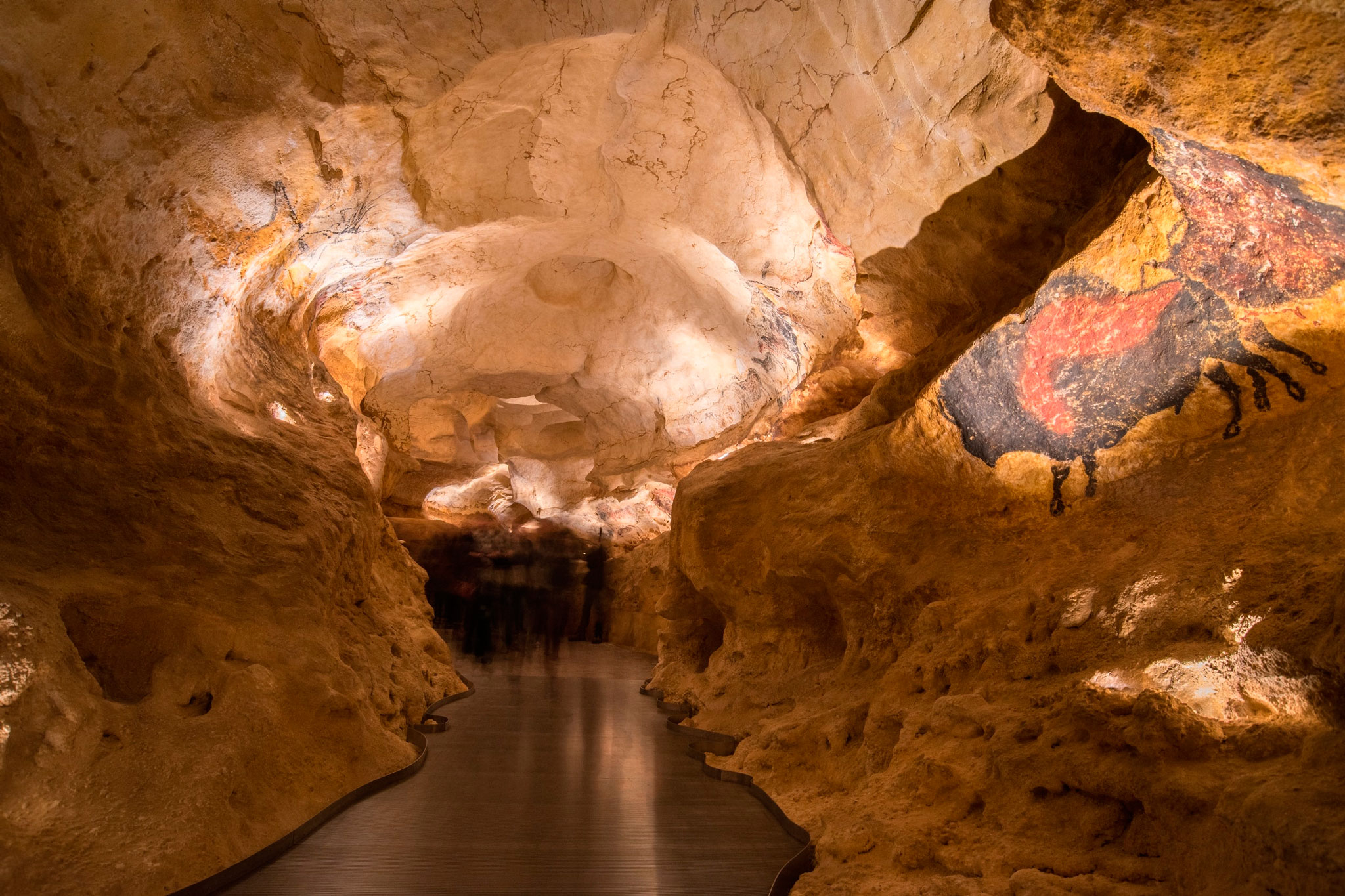
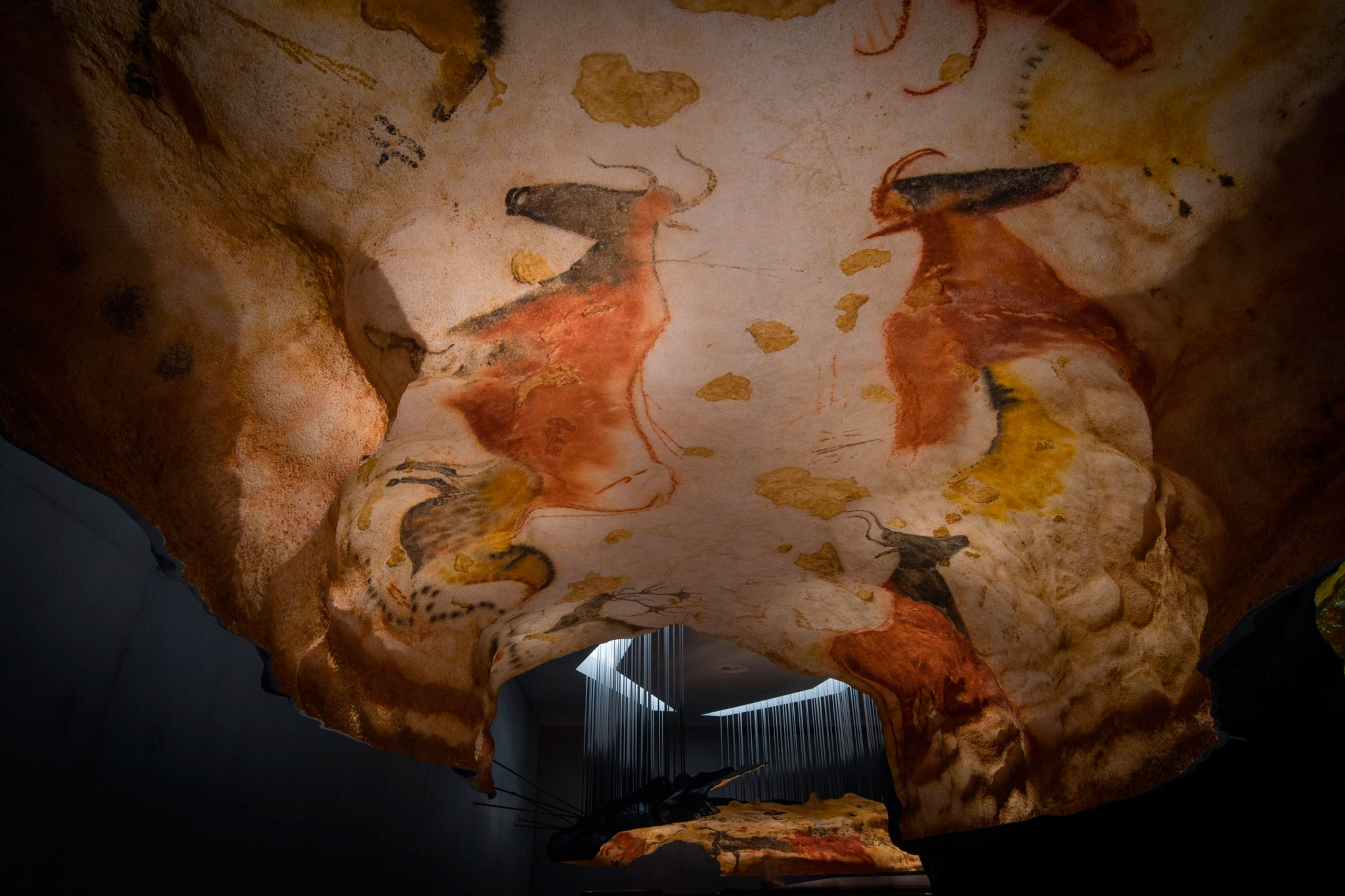
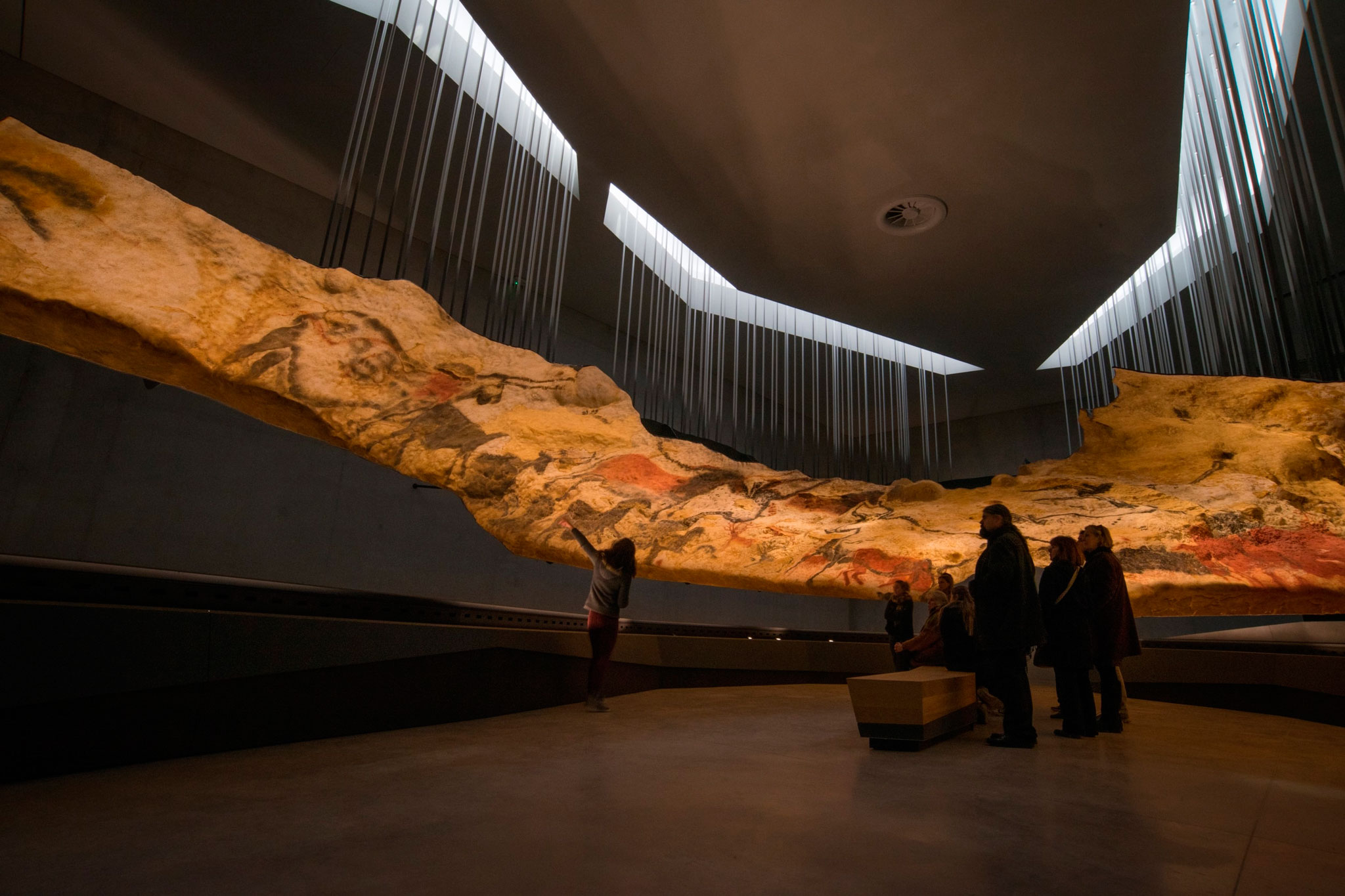
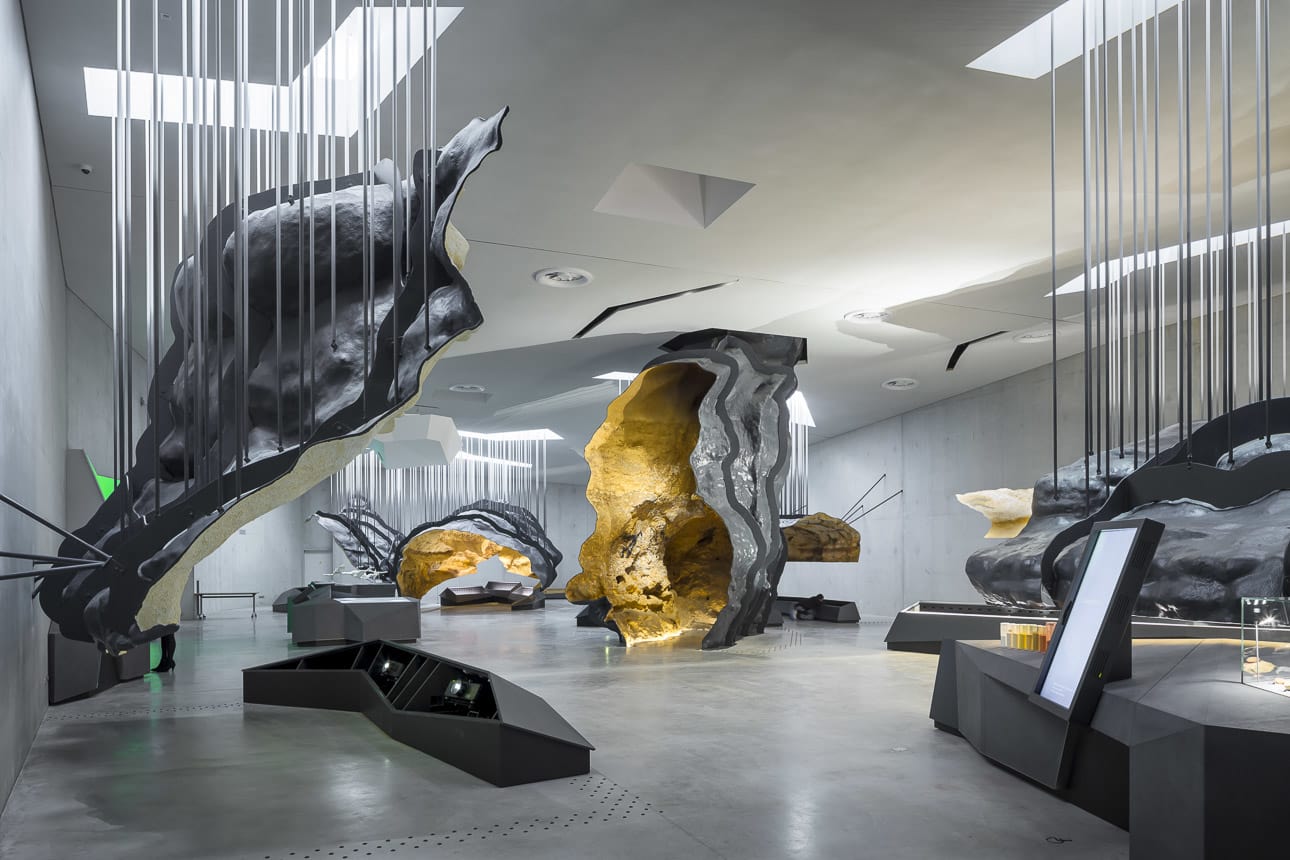
Snøhetta was the Norwegian architectural studio commissioned to create a complete replica of the famous Lascaux Cave in Montignac, France. This cave recreates ancient cave paintings using advanced technology and offers an immersive experience for visitors.

The Vézère valley in Dordogne, France, is one of most important place of prehistory. It contains about 15 major sites, all on the UNESCO World Heritage List. The Lascaux cave has one of the most important groups of Paleolithic rock wall art, both by its number and by the exceptional quality of its works.

Snøhetta worked with local firm Duncan Lewis and exhibition designers Casson Mann to create this neo-cave, after they won the design competition back in 2013.

It officially opened to the public last week, although some parts of the structure and landscape are still being finessed ahead of a bigger launch event scheduled for the spring, in 2017.

The Lascaux IV project is in line with the decades of reflections and initiatives focused on reconciling the safeguarding of a heritage that is unique for the history of humanity.

Snøhetta describing the building said, 

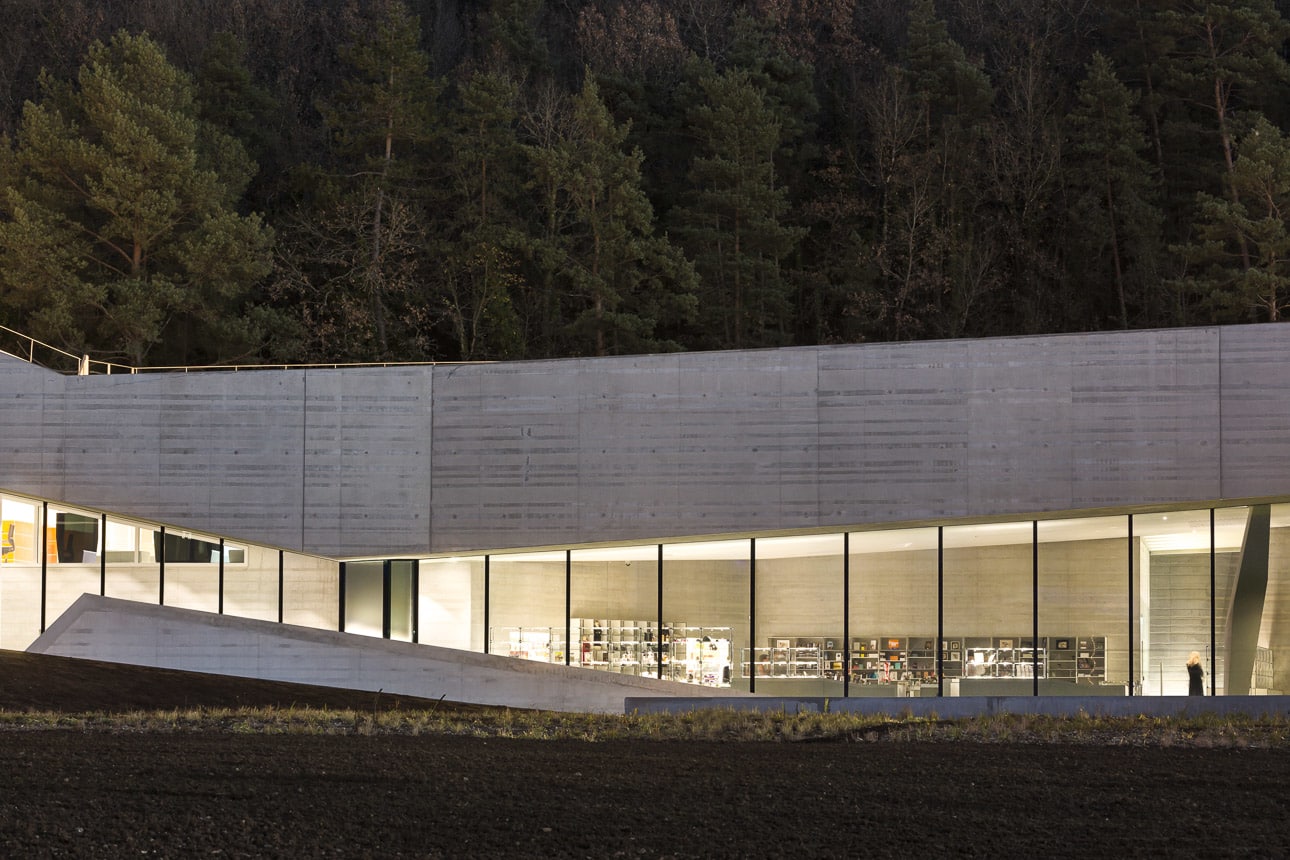
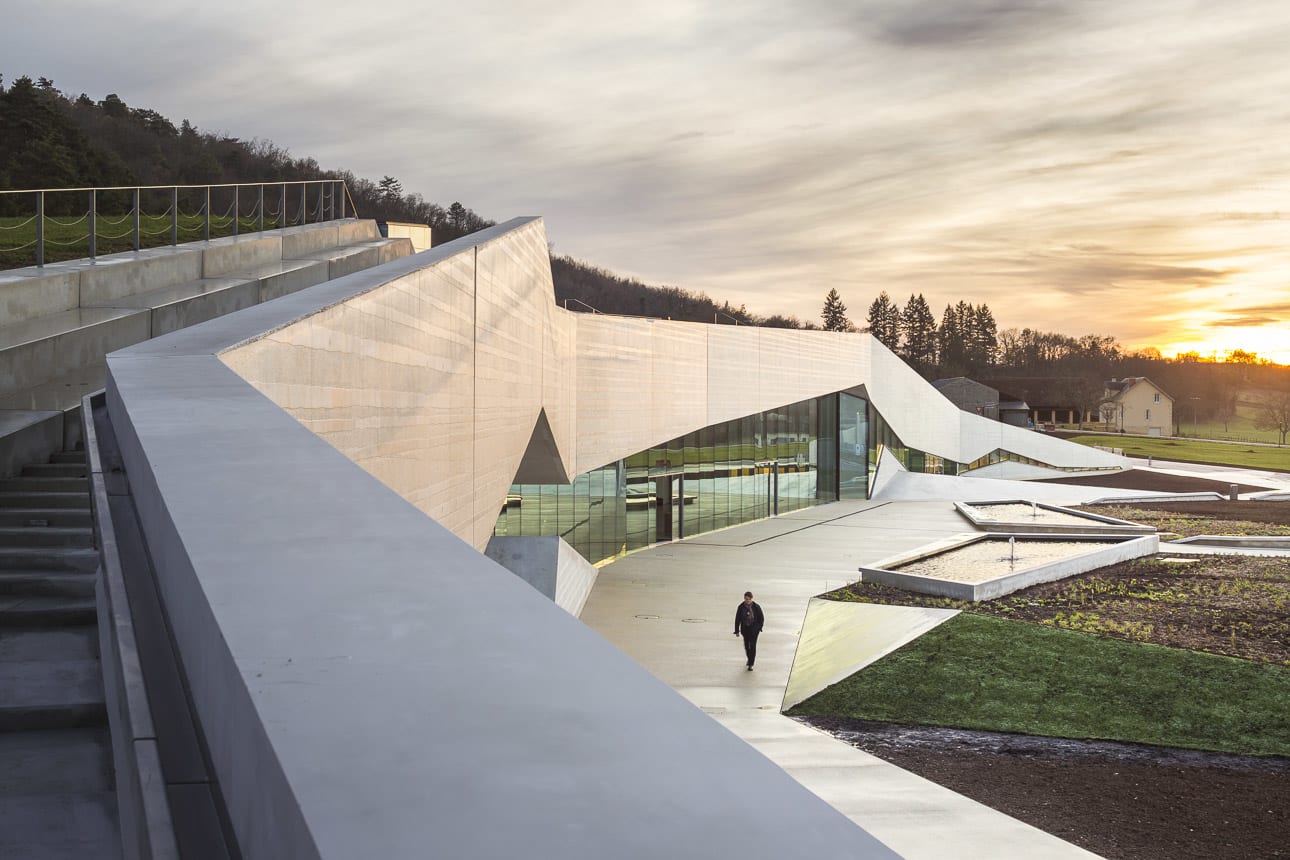
The project is like an incision, a horizontal fault that accentuates the line between the valley and the hill. It is stretched out along the edge of an agricultural territory marked by human activity, and a thick forest whose dense and tall vegetation plunges the undergrowth into the shade.

Snøhetta.

Description of project by Snøhetta

The Lascaux IV site, in the Montignac-sur-Vézère commune, is on the border of the Vézère valley and the Lascaux hill. It is stretched out along the edge of an agricultural territory marked by human activity and a thick forest whose dense and tall vegetation plunges the undergrowth into the shade. At the intersection of these two contrasting landscapes, the project takes advantage of the geography and relief. It is building-landscape that seems like an incision, a horizontal fault that accentuates the line between the valley and the hill. Following contextual reasoning, the International Center of Rock Wall Art of Montignac-Lascaux has been designed with the existing strengths, the natural irregularities, with the place’s roughness.

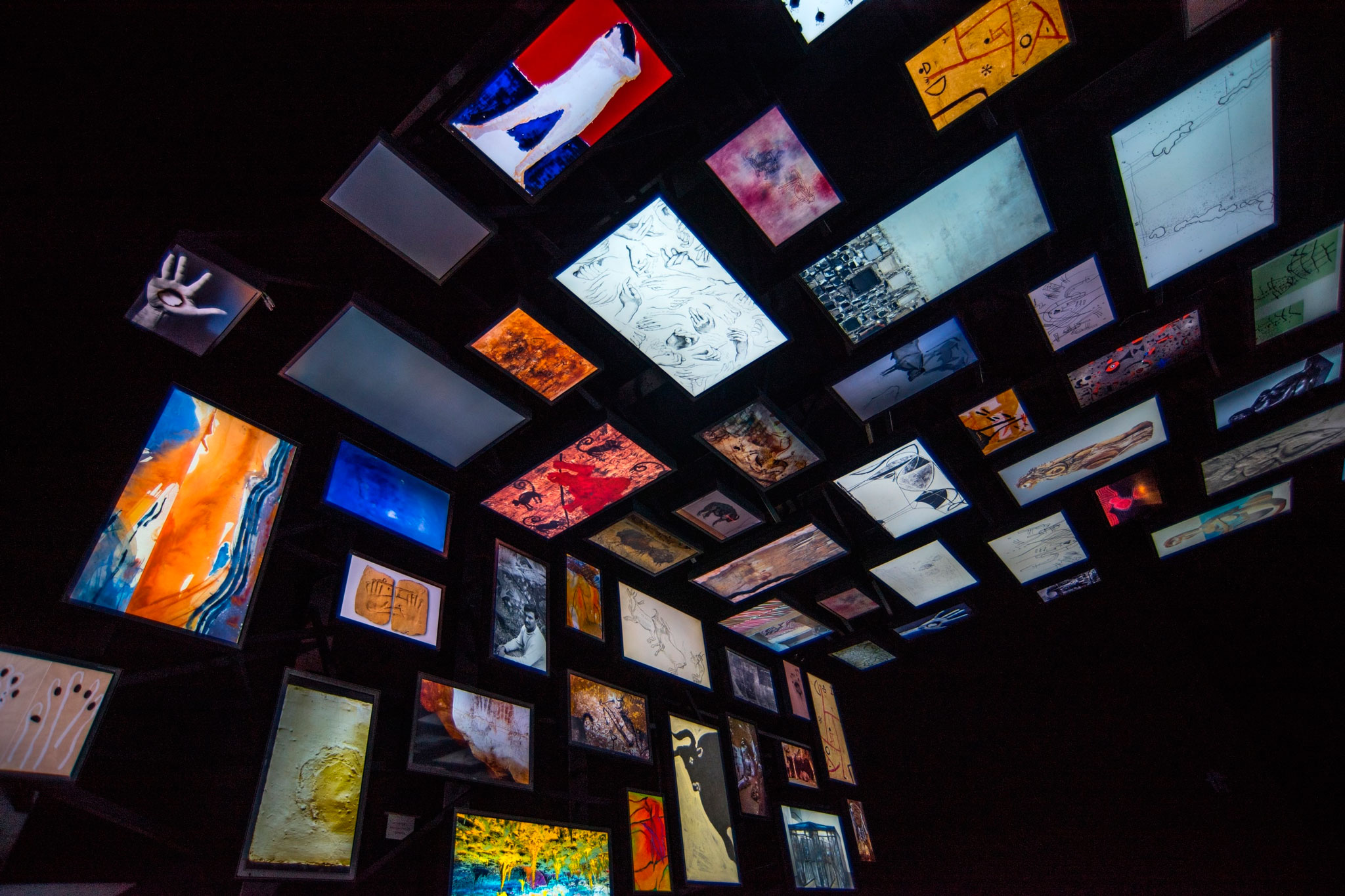
The Lascaux cave, discovered in 1940, was opened to visitors in 1948. Very quickly, however, the first signs of alteration were observed, and its access was prohibited in 1963. In the years that followed, the research undertaken made the preservation of the heritage the first priority; kept intact for thousands of years and nonetheless so fragile. Concurrently, the desire to transmit this invaluable scientific and cultural wealth of Lascaux to the public, resulted in the idea of a replica. A first work, which partially reproduced the cave (Hall of Bulls), was completed 200 meters from the original. Lascaux II opened to the public in 1983. Through the development of replica techniques, a major exhibition was mounted in Montignac in 2008. Lascaux: The International Exhibition, also called Lascaux III, revealed scenes appearing in the cave’s nave – a gallery that had not been represented in Lascaux II. Today, this exhibition is still traveling throughout the world.It was in 2010, for the 70th anniversary of the Lascaux cave’s discovery, that the International Center of Rock Wall Art of Montignac-Lascaux project was announced. This center, called Lascaux IV, will inaugurate a new phase in the promotion of the knowledge of this exceptional site. It is a large-scale project whose aim is to house the virtually complete replica of the original cave (Hall of Bulls, Axial Gallery, the Passageway, The Shaft, the Apse, and the Nave), accompanied by a digital presentation and rock wall art interpretation spaces.

In a certain way, the spirit of Lascaux also guided the project’s architectural stance. It contributed to the development of a sober architectural proposal, without any ostentation or excess in forms or materials, and gave off a genuine power, notably in its dialogue with the elements: the relief, the forest, the rocks, and the light.  

The choice of material was made in line with this desire for a building-landscape, which fits into the geography and which splits it. The floors (interior and exterior), the walls, the roof and the façade strip are made of the same architectural concrete that gives the whole a monolithic aspect. The unfinished treatment of the material evokes the mineral world - the rock of the hills and the cave. The project’s second material, glass, dominates in the façade and the roof of the orientation area. Together with the concrete, it produces a series of contrasting effects: opaqueness and transparency, light and shade, unfinished and sophisticated, rough and smooth. Their balance helps give the facility a unique contemporary feel.

As to uses and functions, International Center of Rock Wall Art of Montignac-Lascaux is an interpretation center. Unlike a museum in the traditional meaning of the word, an interpretation center does not exhibit collections of works, but has the objective of highlighting and explaining a site and its wealth. That is why architecture, site and pedagogic vocation are intrinsically combined here.

Visitors will be given 'Torches' at the beginning of the museum visit. When shined on the paintings, these interactive tools will reveal more info about the caves' history.

More information

Label
Architects
Text

Snøhetta. Lead architects.- Craig Dykers, Kjetil Thorsen.

+ + copy Created with Sketch.
- + copy Created with Sketch.
Label
Collaborators
Text

Scenography.- Casson Mann.

+ + copy Created with Sketch.
- + copy Created with Sketch.
Label
Architect
Text

SRA Architectes.

+ + copy Created with Sketch.
- + copy Created with Sketch.
Label
Associate Architect, studies
Text

Duncan Lewis Scape Architecture.

+ + copy Created with Sketch.
- + copy Created with Sketch.
Label
Client
Text

Conseil Général de la Dordogne.

+ + copy Created with Sketch.
- + copy Created with Sketch.
Label
Area
Text

8,600.00 sqm.

+ + copy Created with Sketch.
- + copy Created with Sketch.
Label
Dates
Text

2013 - 2016.

+ + copy Created with Sketch.
- + copy Created with Sketch.
Label
Location
Text

Lascaux International Center of Parietal Art, Montignac, France.

+ + copy Created with Sketch.
- + copy Created with Sketch.
Label
Photography
+ + copy Created with Sketch.
- + copy Created with Sketch.

Snøhetta is an architecture, landscape, and interior design studio with offices in Oslo, Norway, and New York City, USA. Founded in 1989, it is led by Craig Dykers and Kjetil Thorsen. The studio, named in honour of Mount Snøhetta, the highest peak in the Dovrefjell mountains of Norway, has approximately 100 collaborators working on large-scale international projects across a wide range of typologies. Their approach is deeply collaborative and transdisciplinary, bringing together architects, designers, engineers, and landscape professionals to explore multiple perspectives depending on the nature of each project.

Snøhetta has completed a series of world-renowned cultural and landmark projects, including the Bibliotheca Alexandrina in Egypt, the Oslo Opera House and Ballet, and the Lillehammer Art Museum in Norway. Current projects include the National Pavilion of the September 11 Memorial Museum at the World Trade Center site in New York, as well as urban and landscape developments that aim to merge local identity, sustainability, and public experience.

In 2004, Snøhetta was awarded the Aga Khan Award for Architecture, and in 2009, the Mies van der Rohe Award. The studio is the only practice to have won the World Architecture Award for Best Cultural Building twice in consecutive years: in 2002 for the Bibliotheca Alexandrina and in 2008 for the Oslo Opera House and Ballet, consolidating its international prestige.

Kjetil Trædal Thorsen (born 1958 on the coastal island of Karmøy, Norway) is a co-founder of the studio and a multiple award-winning architect. He is a visionary and humanist designer who has redefined the boundaries of contemporary practice. Under his leadership, Snøhetta has produced iconic, sustainable structures that are highly sensitive to their cultural context, combining technological innovation with a profound environmental awareness. Thorsen’s work is recognized for its focus on social interaction, sustainability, and the creation of spaces that foster human connection and sensory experience, establishing a benchmark in contemporary global architecture.

Craig Dykers (born 1961 in Frankfurt, Germany) is also a co-founder of the studio and director of its New York office. Snøhetta has earned a reputation for maintaining a deep integration of landscape, architecture, and urban experience across all its projects. Key works include the Bibliotheca Alexandrina in Egypt, the Oslo Opera House and Ballet, the National Pavilion of the September 11 Memorial Museum in New York, and the redesign of Times Square. Professionally and academically active, Dykers has been a member of the Norwegian Association of Architects (NAL), the American Institute of Architects (AIA), and the Royal Society of Arts in England. He has served as a diploma juror at the Architectural College in Oslo and as a distinguished professor at City College, New York. He has delivered numerous lectures across Europe, Asia, and the Americas, and has undertaken public art installation projects, many of which explore the interplay between context, landscape, and human experience.

Read more
Published on: December 26, 2016
Cite:
metalocus, CARLOS ARES
"Lascaux IV Caves Museum by Snøhetta" METALOCUS. Accessed
<http://www.metalocus.es/en/news/lascaux-iv-caves-museum-snohetta> ISSN 1139-6415
Loading content ...
Loading content ...
Loading content ...
Loading content ...
Loading content ...
Loading content ...
Loading content ...
Loading content ...
Loading content ...
Loading content ...
Loading content ...
Loading content ...
Loading content ...
Loading content ...
Loading content ...
Loading content ...
Loading content ...
Loading content ...
Loading content ...
Loading content ...
Loading content ...
Loading content ...
Loading content ...
Loading content ...
Loading content ...
Loading content ...
Loading content ...
Loading content ...
Loading content ...
Loading content ...
Loading content ...
Loading content ...
Loading content ...
Loading content ...
Loading content ...
Loading content ...
Loading content ...
Loading content ...
Loading content ...
Loading content ...
Loading content ...
Loading content ...
Loading content ...
Loading content ...
Loading content ...
Loading content ...
Loading content ...
Loading content ...
Loading content ...
Loading content ...
Loading content ...
Loading content ...
Loading content ...
Loading content ...