


The 53 houses building facing Conde Aranda Street, designed by Basilio Tobías, consists of a semi-basement and a basement level designated for parking, storage rooms, and a utility room. The ground floor houses offices, common areas, residential units, and a central lobby that is illuminated by a landscaped courtyard. The remaining floors are dedicated to residential units, connected by two vertical circulation cores.
The lower section of the building features a continuous series of planes on the façade that contrasts with the upper floors, which serve as a crowning element. This system adopted in the organization of the façades reflects the stratification of the program. The façades, constructed of pressed brick in harmony with the Escuelas Pías school, allow for the elimination of thermal bridges through a system of stainless steel anchors.
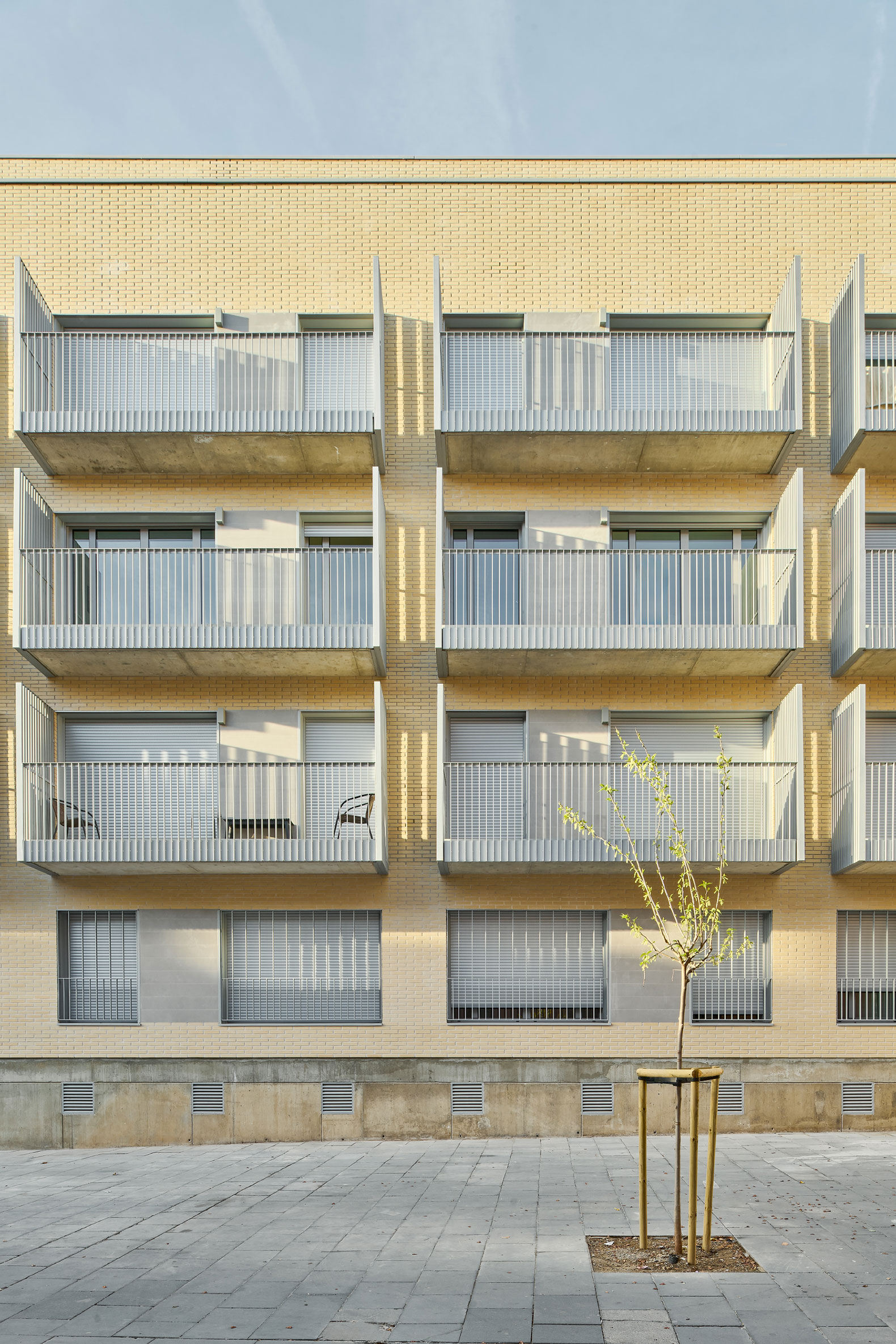
53 houses in Conde Aranda by Basilio Tobías. Photograph by Iñaki Bergera.
Project description by Basilio Tobías
The dimensions of the block, its detached condition, facing Conde de Aranda and its proximity to the Piarist Schools building have influenced the unitary nature of the proposal, the material resolution of its enclosure and the systematic arrangement of its openings.
A compact volume has been chosen in which, on the main body of the building, consisting of the ground floor and the first three floors, both the fourth floor and, already towards Conde de Aranda, the two upper floors are staggered.
This approach allows the planned building to relate appropriately to both the Piarist School building and the scale of the interior streets of the San Pablo neighborhood.
In contrast to the continuous facade planes of the lower section of the building, defined by a virtual cornice line, the upper floors take on a crowning quality, responding to the different characteristics of the adjacent streets. The orderly system adopted in the organization of the facades clearly manifests both the stratification of the program and the internal organization itself, ensuring that the chosen materials and the proportions of the openings give the building a poise appropriate to its location.
The facades have been made using pressed brickwork in ochre tones –in keeping with the factory of the Piarist Schools building– which passes in front of the edges of the floor slabs –allowing the insulation of the same and the elimination of thermal bridges– by means of a system of stainless-steel anchors.

Given the building's scale, it was deemed appropriate to establish generous dimensions for the openings and to define a façade system that could accommodate the needs of the different types of apartments. Thus, most of the façade openings have been paired, incorporated into the projecting balconies of consistent length and depth on the façades facing Conde de Aranda and Pedro Díez Gil square.
The building comprises a semi-basement and a basement level for parking, storage, and utility rooms, and seven above-ground floors. The ground floor houses the building's entrance hall, offices, common areas, and apartments. The entrance hall occupies the central area of the floor. Its layout, the natural light provided by the landscaped courtyard, and the use of the same brick façade are all in keeping with the building's character.

The remaining floors are intended for housing, connected by two vertical communication cores, each consisting of a staircase and an elevator, located at the north and south ends of the interior courtyard.
The trapezoidal shape of the block and the variety of apartment sizes have influenced the project's development. A systematic approach has been adopted, reflected in the building's overall character, maximizing the use of the façade perimeter and utilizing the interior courtyard to illuminate rooms in the adjacent apartments and the general distribution spaces on the ground floor and upper floors.


