For "Wave 4 & 5," FAAB has included rooms for patients under medical supervision, a restaurant and a spacious rehabilitation centre. Medical technology is discreetly integrated into the décor. The Coastal Garden, featuring native dune vegetation, occupies the space between the buildings, offering a therapeutic effect for patients. The complex, built on brownfield industrial land, transforms 5 hectares into green spaces and interconnected parks.
It draws on local building traditions, creating ornamental patterns on the façades; these, made of perforated aluminium, are inspired by the ‘Flower of Life’ pattern, an ancient symbol associated with healing properties. Depending on user requirements, two distinct façades have been constructed; a white envelope protects the south, east and west sides from overheating. 3D modelling techniques have optimised the use of materials and reduced construction time.
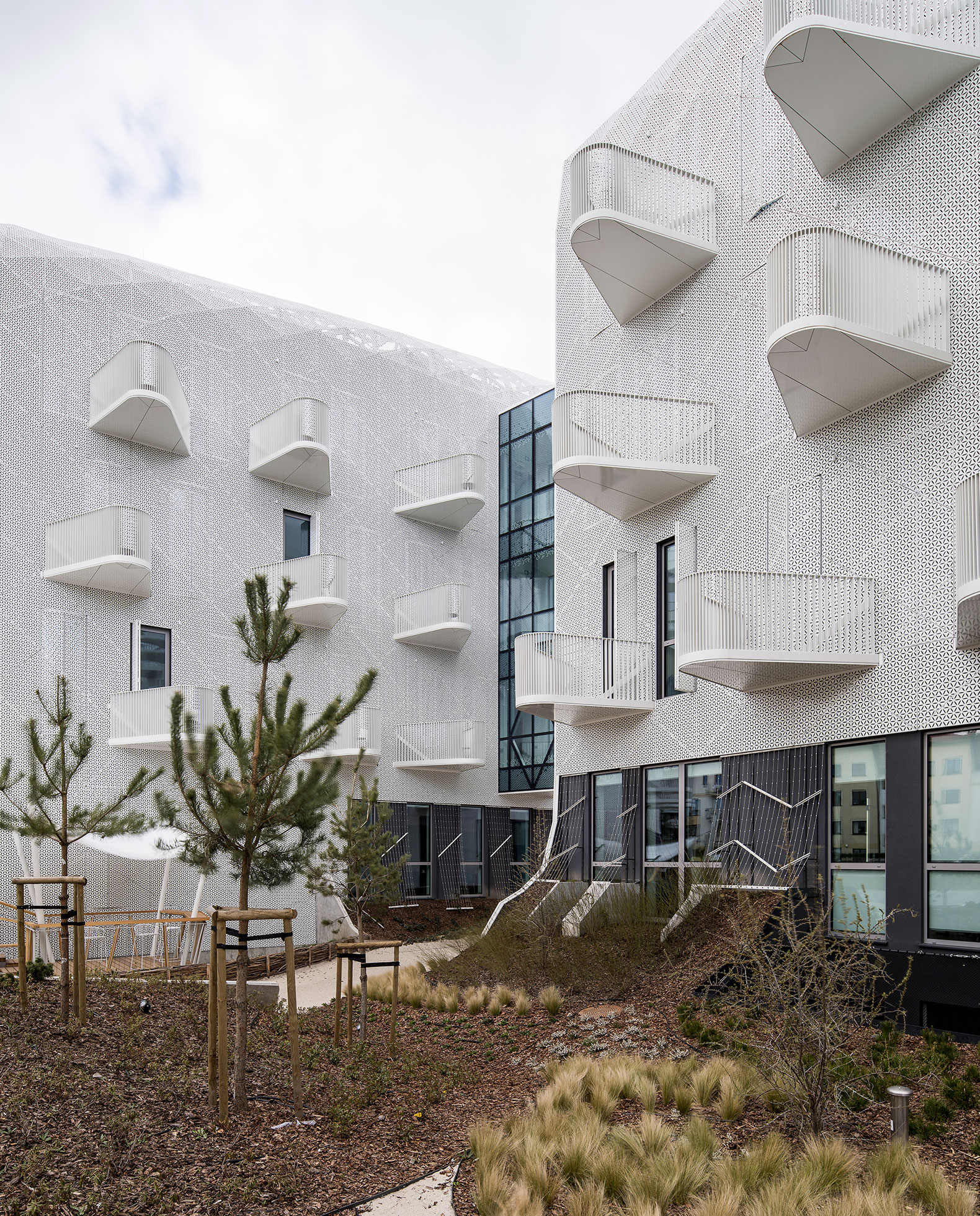
"Wave 4 & 5" by FAAB. Photograph by Jakub Certowicz.
Project description by FAAB
Healthcare Architecture for Recovery
The Wave 4 and 5 buildings form part of the ECR medical complex in Sopot, located just 400 meters (a quarter mile) from the Baltic Sea. The campus includes an analytical laboratory (Wave 1), outpatient clinic and day surgery hospital (Wave 2), specialist hospital (Wave 3), and pre/post-procedure care facilities (Waves 4 and 5). Waves 4 and 5 house supervised medical stay rooms, a restaurant, and an extensive rehabilitation center featuring movement therapy and advanced equipment, including laser beam technology, cryotherapy, and high-pressure systems that accelerate postoperative wound healing.
The buildings draw inspiration from Pierre Carreau's AquaViva photograph series, which captures close-up seascapes. Wave geometry is most evident in the upper building volumes and sculptural main entrance canopies. Sunlight gliding across the facade highlights its fine divisions, creating a dynamic three-dimensional presence. Perforated panels incorporate the sacred "Flower of Life" pattern, traditionally attributed with healing properties and found in ancient Egyptian temples, Indian architecture, and Mayan artifacts. This approach references local building traditions of placing ornamental patterns on facades. The designed pattern covers the entire facade of aluminum panels, including flat sections, those with variable geometry, and window shutters. Perforation flows seamlessly from one panel to another, creating visual continuity.

Depending on user needs, the buildings present two distinct faces. A white envelope reflects sunlight, protecting the south, east, and west walls from overheating. Shuttered window panels can create a continuous protective barrier when needed. The proportions between openings and opaque panel sections were refined through work with 1:1 physical models. The final effect allows comfortable use of the building even with all shutters closed, leading to summer energy savings by reducing cooling demands. Prefabricated balconies introduce rhythm and additional lightshadow play to the facade. Balcony railings limit views into private balcony spaces and adjacent rooms.
Interiors foster security and respite before and after procedures. Medical technology, including nurse call systems, blends discreetly into the decor. The Seaside Garden, visible from windows, balconies, and ground level, provides therapeutic impact, even for bedridden patients. Composed of native dune vegetation, it fills the space between buildings.

3D modeling played a crucial role in both design and construction phases. Separate models were created for the building's external skin, steel structure, and concrete structure. The modeling techniques optimised material use and shortened construction time.
Constructed on long-degraded brownfield land, the project transforms 5 hectares into connected green spaces and parks. Both buildings and surrounding grounds feature rainwater harvesting systems that significantly reduce municipal stormwater loads.