


In this context, the objective of the intervention developed by LUO studio is defined as the creation of a micro-museum capable of showcasing these traditional bridges, now disappearing due to urbanization. More than an autonomous object, the project is conceived as a cultural device that articulates architecture and art, incorporating exhibition spaces and basic services such as a café, rest areas, and restrooms, in keeping with the public and touristic nature of the initiative.
The materiality and construction system are directly inspired by the vernacular logics studied. The main volume, made of concrete, evokes the pillars of the baqiao, while an elevated walkway reinterprets the structure of the gaoqiao through a system of pillars and beams that recall traditional joints. The combined use of concrete and wood, along with details such as geometric openings and the reuse of construction elements, reinforces the connection with local craftsmanship and the construction process.
The proposal prompts reflection on the role of architecture in contemporary contexts marked by rapid transformation. Faced with the loss of rural landscapes and knowledge, the micromuseum acts as a gesture of recovery and reinterpretation, highlighting a building tradition that, although silent, remains an essential part of the territory's memory.
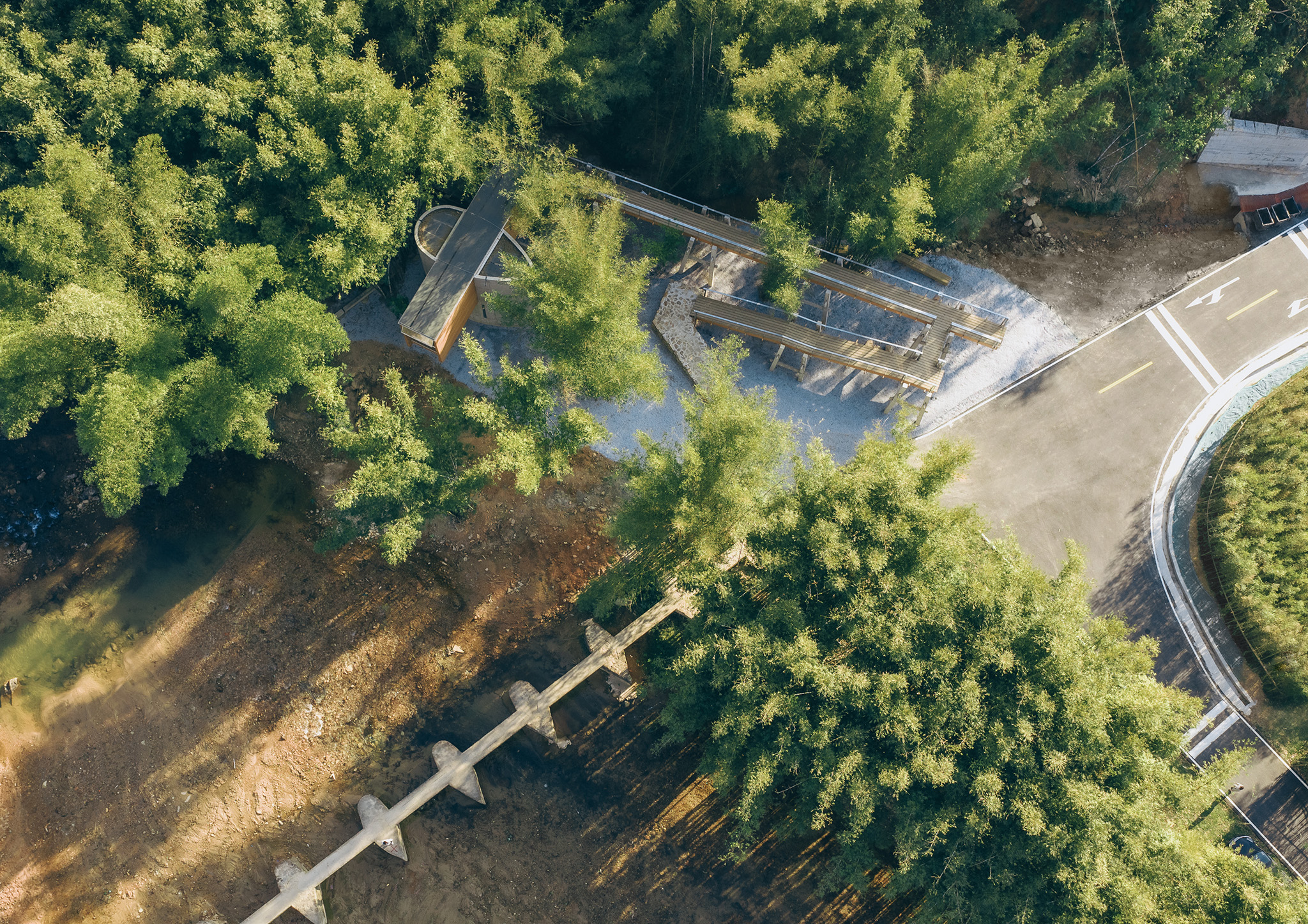
Huizhou Vernacular Historic Bridges Micro-Museum by LUO studio. Photograph by Zhu Yumeng.
Project description by LUO studio
Origin
Following the Sandstone Wood Pavilion designed for the “HU SHI GUANG · Art Eco Site” program in Longyou, Zhejiang, we were once again invited by Fengyuzhu—this time to engage in a regional-scale curatorial initiative—the “Nankunshan-Luofushan Rim Pioneer Zone (Huizhou) Architectural Art Project.” Drawing on Su Dongpo’s “Sixteen Delights of Life” as its curatorial framework, the initiative brings together architects and artists to create rural waystations and spatial installations along Huizhou’s 218-kilometer-long scenic tourism highway. Each participating team selected one of Dongpo’s sixteen delights as the theme, creating a spatial installation complemented by café and tea offerings. During early site visits with Bangbang, the initiative’s chief curator, a bamboo grove beside Shisanba Bridge in Mazha Town was chosen as our project site.
When we first saw Shisanba Bridge through photographs, it did not leave a particularly strong impression. Yet upon arriving on site and walking through the bamboo grove, the bridge revealed itself with striking clarity: thirteen stone piers unfold along the river in a precise and rhythmic sequence. Between each pair of piers, three bluestone slabs—worn smooth by decades of footsteps—are inserted through a mortise-and-tenon-like interlocking system. Standing by the bridge, we couldn’t help but wonder: why did the craftsmen adopt this structural logic? What materials and construction methods shaped these dimensions and forms? How many people must have crossed here, back and forth, to wear the stone into such a gently polished, tactile surface?
These questions led us to consider what kind of architectural response could be made in close proximity to such a distinctive piece of local bridge heritage. What intervention here would be appropriate—one that could meet the expectations of the government and the client, while allowing us, as architects, to remain true to our architectural values and methodology? Rather than beginning with design, our first step was to explore the local history of bridge building, tracing pre-industrial local knowledge and craftsmanship through field research.
Field Research
Through archival research and on-site fieldwork, we identified two primary vernacular bridge types in Huizhou.
The first type is the baqiao, represented by Shisanba Bridge. These bridges feature upstream-facing piers shaped like tapered spindles, with slightly raised tips evoking a goose’s chest—hence the local name, “goose-chest bridges.” They are typically found where the height difference between river and embankment is small, resulting in relatively low bridge decks, which are sometimes referred to as “low bridges.” Historic records revealed that when Su Dongpo governed Huizhou, he raised funds and oversaw the construction of a “floating bridge” to facilitate local travel. Dozens of boats were lined up across the river, with planks laid between adjacent boats to form a continuous bridge deck. This is said to be an early morphological prototype of the “goose-chest bridge.” Since the project’s curatorial narrative is thematically linked to “Dongpo’s Delights,” drawing on the spatial logic of the “goose-chest bridge” became a meaningful way to connect the project with this historical reference.
The second type is the gaoqiao, locally known as the “bench-leg bridge.” This form typically appears where the embankments rise markedly above the water level and the river channel is relatively narrow. To bridge the height difference and ensure structural stability, local craftsmen carved exceptionally long and slender stone posts—each with a cross-section of roughly 18 centimeters—and arranged them to splay outward and downward like the legs of a bench, providing greater support and improved resistance to overturning. The name “bench-leg bridge” derives directly from this distinctive structural posture.

Within the baqiao system, the number of piers varies according to the width of the river. Along the Dabeishui River, where Shisanba Bridge is located, we found bridges with eight, five, or four piers along the upstream and downstream stretches of the river, as well as its tributary branches. The stone slabs used for the deck remain relatively constant in length, while the span changes—making the number of piers an adaptive, site-specific structural response.
Baqiao bridges are also commonly found at the entrances of traditional Hakka walled compounds. These local compounds are often surrounded by waterways, requiring a small bridge at the entrance, typically built in the baqiao style. During our field survey of these bridges, we visited several local walled compounds and discovered a distinctive local architectural feature: gourd-shaped window openings, as well as semicircular and triangular ones, carved into the walls. These were not deliberate decorations, but rather traces of local construction practices and everyday life—elements that later became important references in our design process.
Our investigation of “bench-leg bridges” revealed even more directly the sophistication of local stone craftsmanship. Despite their slender proportions, the stone posts feature precisely carved mortise-and-tenon joints, with beams interlocked horizontally and vertically, demonstrating clear and robust structural logic. This corresponds closely with the refined stone details found throughout local dwellings—windows, frames, locks, thresholds. It became evident that such intricate mortise-and-tenon stone bridges found here could only have emerged from a long-established system of stone craftsmanship and accumulated artisan knowledge.

For us, this phase was not merely about gathering evidence to inform design decisions; it also yielded a key insight. Through observing and documenting these structures, we came to understand how a distinctive set of stoneworking techniques had been organized, transmitted, and ultimately crystallized into a visible construction language within the local environment.
Design Vision
During our research—identifying these vernacular historic bridges by name and location, and conducting on-site visits—we realized that the number of such bridges across Huizhou far exceeded our expectations. Once essential pathways for daily life and agricultural production, many of them have gradually been marginalized amid urbanization and transportation upgrades. As silent yet enduring pieces of vernacular infrastructure, they deserve not only to be recorded, but also to be made visible again.
For this reason, we defined a clear design vision: to establish a micro-museum—dedicated to these gradually forgotten vernacular historic bridges in Huizhou. Situated within a bamboo grove beside Shisanba Bridge, the museum was conceived with two fundamental components: exhibition spaces and supporting facilities. As part of the “Nankunshan–Luofushan Rim Pioneer Zone (Huizhou) Architectural Art Project” and under the curatorial theme of “Dongpo’s Delights,” the micro-museum was required to incorporate basic amenities such as tea and coffee services and restrooms. These facilities fulfill the project’s operational requirements while simultaneously aligning with the auxiliary functions inherent to a micro-museum.

We also invited the Guangdong-based printmaking artist Liu Qingyuan to create a collection of artworks documenting the stone bridges we surveyed in Huizhou. His works became the primary exhibits of the micro-museum, under the theme he proposed—“Bridges of the Countryside.” In this sense, we jointly assumed a curatorial role: architecture forming the vessel for narrative, and art becoming the medium to give voice to these vernacular bridges.
Design Moves
The design of the micro-museum responded to several spatial objectives.
First, to provide basic services for visitors—refreshments, restroom access, and resting areas. Accordingly, the micro-museum incorporates a café, restrooms, washbasins, and a system of indoor and outdoor seating.
Second, to enhance the experience of viewing the nearby historic Shisanba Bridge. An elevated walkway was introduced, inviting visitors to look out over the bridge and the river, thereby gaining a broader perspective and a more comprehensive understanding of the bridge’s sequential rhythm.

Third, to reinterpret two vernacular bridge systems—the baqiao (“goose-chest bridge”) and the gaoqiao (“bench-leg bridge”). The approach is twofold:
1. The architectural volume—evoking the baqiao typology
The building volume draws on the structural logic of the baqiao. Inspired by the interlocking relationship between the bridge’s stone piers and slabs, we created a spindle-shaped concrete volume representing the pier, penetrated by a timber-framed passage that symbolizes the bridge deck. Seating is placed at the end of the passage, offering the best vantage point for a sweeping view of the nearby Shisanba Bridge. The spindle-shaped concrete volume comprises two levels. The lower level accommodates a restroom and washbasins—serving visitors who may not enter the gallery—along with the entrance and part of the exhibition space, connected by an internal staircase to the upper level. The second floor houses the main gallery and a café offering drinks and light refreshments, with direct access to the elevated outdoor walkway.
2. The open-air structural system—reinterpreting the gaoqiao typology
The elevated walkway reinterprets the construction logic of the traditional gaoqiao. Cast in situ reinforced concrete, its posts and beams echo the mortise-and-tenon relationship characteristic of the vernacular bridge type. Its structural cross-section adopts a slender isosceles trapezoidal form, enhancing structural stability and mechanical performance.

Details
The long elevated walkway threads lightly through the bamboo grove, echoing the linear spatial form shared by both the local baqiao (“goose-chest bridge”) and gaoqiao (“bench-leg bridge”). Walking along it immerses visitors in an engaging visual dialogue with the nearby historic bridge. Timber planks are laid across the walkway deck with deliberately widened gaps, referencing the characteristic spacing between stone slabs on both the baqiao and gaoqiao. These gaps not only facilitate construction and everyday use, but also create a subtle play of light, shadow, and shifting sightlines.
Varied geometric openings are carved into the concrete walls, inspired by the gourd-shaped, semicircular, and triangular apertures commonly seen in the walls of local Hakka compounds. A gourd-shaped stone block collected from an abandoned house during fieldwork is displayed in the ground-floor gallery, presented as a tangible trace of local craftsmanship and architectural memory.
The steel molds used to cast the reinforced-concrete posts and beams of the elevated walkway were repurposed after construction as outdoor drainage channels, directing water from the washbasins into a gentle, cascading descent. Two surplus cast-in-place concrete beams were placed along the waterfront and transformed into a long bench, creating a quiet place for pause and rest.

Throughout the landscape design and construction process, we sought to preserve the existing bamboo grove as much as possible. This light-touch approach not only respects the site context but also aligns with the curatorial framework “Dongpo’s Delights,” particularly the poetic image of “bamboo by the window in drizzling rain,” identified from the outset as a key conceptual reference for the project.
Epilogue
We live in an era saturated with space, material abundance, and information. When “construction” takes place today, perhaps the real questions are what we ought to build, and in what way?
This project offers a telling example. Amid the rapid urbanization of the Greater Bay Area, numerous rural settlements shaped by agrarian culture have been falling into neglect. These places hold not only beautiful landscapes, but also a wealth of craftsmanship worth understanding, preserving, and retelling. Through this modest micro-museum of ancient bridges, we hoped to give these still-present yet gradually overlooked vernacular bridges a chance to be seen, recorded, and reinterpreted. The project invites visitors, in moments of movement and pause, to evoke a sense of connection to the place and its history.


