


The programmatic organization proposed by AGA Architectes Associés is structured around the existing topography of the site. The pronounced three-meter slope acts as an articulating element, giving rise to a hierarchical sequence of spaces that transitions from an urban-style platform to a garden with a more landscaped character. Along this path, the open-air garden theater is conceived as an active component that weaves together and connects the cultural experience offered at each level.
For its construction, the building employs a timber structural system combined with a concrete base. The careful selection of dark wood used as exterior cladding establishes a sensitive dialogue with the surroundings. Inside, the use of wood in natural tones creates a playful and recreational space that prioritizes light and acoustic comfort.
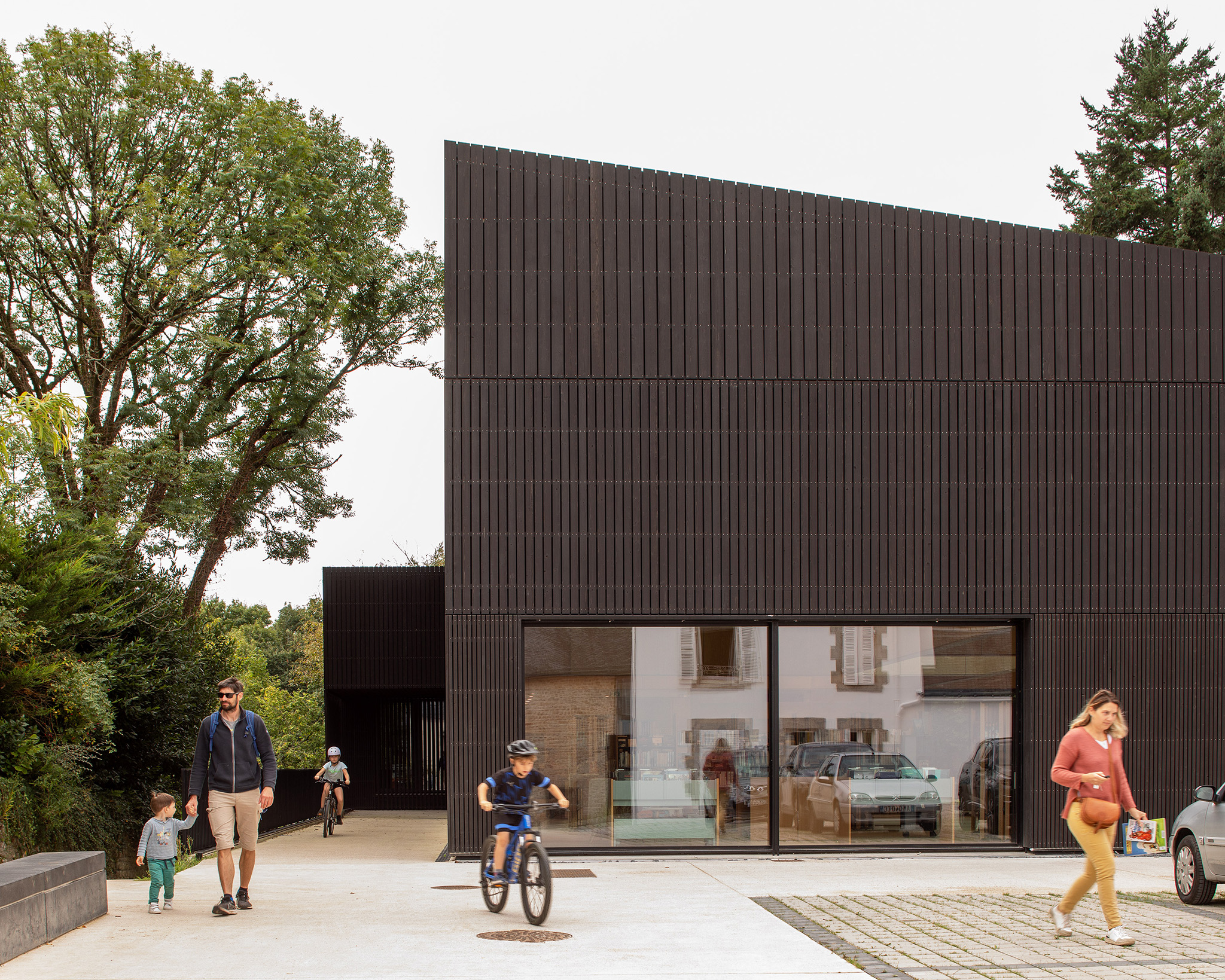
Pont-Scorff Cultural Center by AGA Architectes Associés. Photograph by Gaëtan Chevier.
Project description by AGA Architectes Associés
Located at the fringe of Pont-Scorff’s historic core, near the Maison des Princes, the project is conceived not as a monolith but as a cultural constellation of autonomous volumes. Positioned at the threshold between built heritage and the wooded landscape, the proposal establishes a dialectic between vernacular archetypes and contemporary abstraction.
The program is fragmented into three square-plan entities—a music school, media library, and game library. This morphological strategy negotiates the scale of the context, with each volume adopting a reinterpreted double-pitched roof that balances typological continuity with geometric control.
The site’s three-meter topography serves as the project’s generative structuring element. The music school anchors the upper urban plateau, while the media library forms the central symbolic nucleus. The game library is embedded within the lower stratum, minimizing ground coverage to liberate a landscaped open-air theater that sutures the site’s levels. This sequence constructs a clear spatial hierarchy, transitioning from an urban forecourt to a pastoral garden, where exterior spaces are treated as active components of the cultural experience rather than residual voids.
Internally, the project operates through a logic of spatial inversion. The media library is organized centripetally around a top-lit central void, creating a continuous perimeter loop. Conversely, the game library utilizes a solid central core to free its perimeter for flexible use.

Tectonically, the design relies on a hybrid concrete and timber system. Dark, thermally treated timber cladding resonates with the chromatic depth of the surrounding slate roofs, while bio-based interior finishes prioritize photometric and acoustic comfort.


