Swiss firm Herzog & de Meuron has designed a new mixed-use complex in the Dubai International Financial Centre (DIFC). Named Janu Dubai, the development covers approximately 121,000 square meters and integrates residential, hotel, office, and retail spaces.

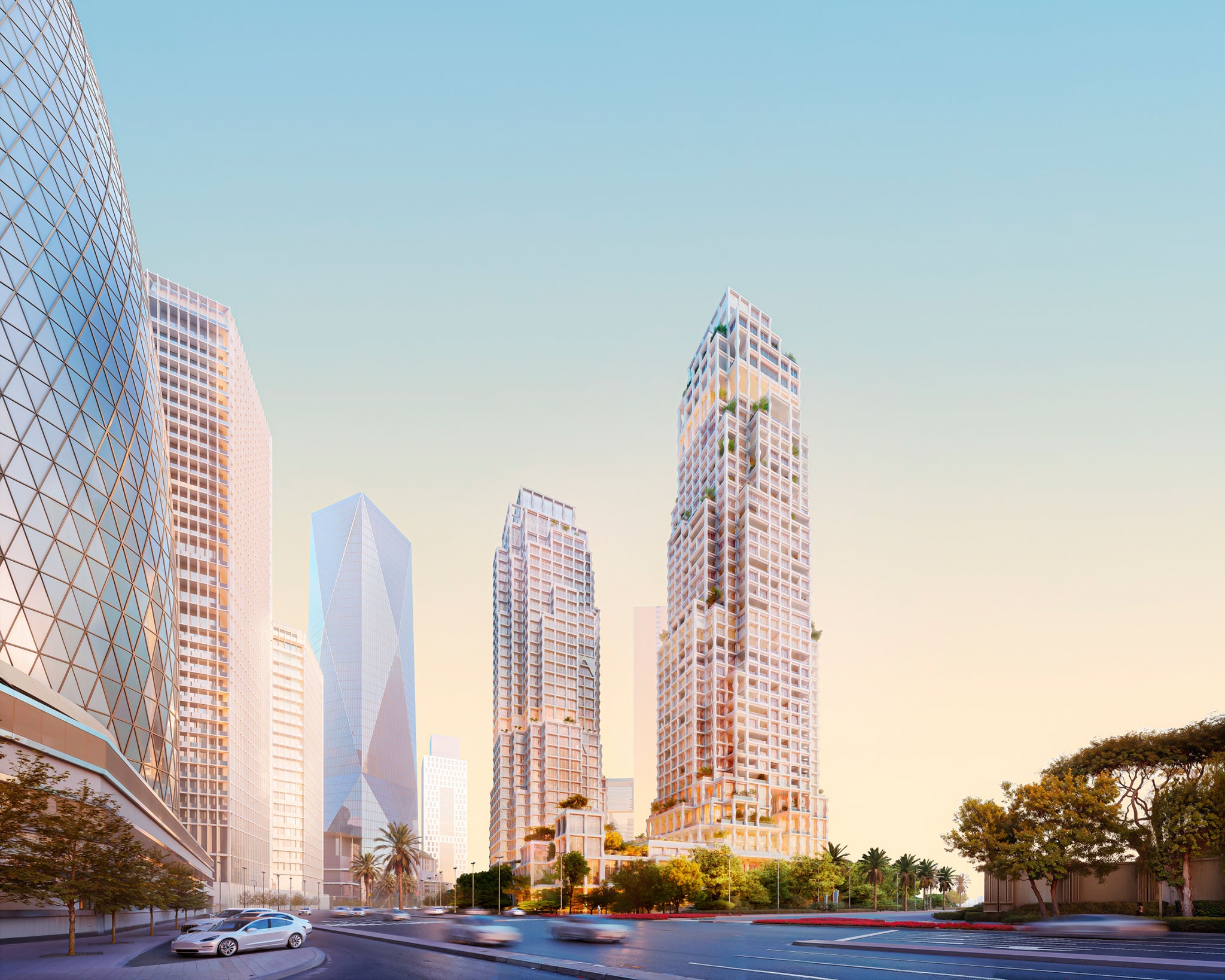
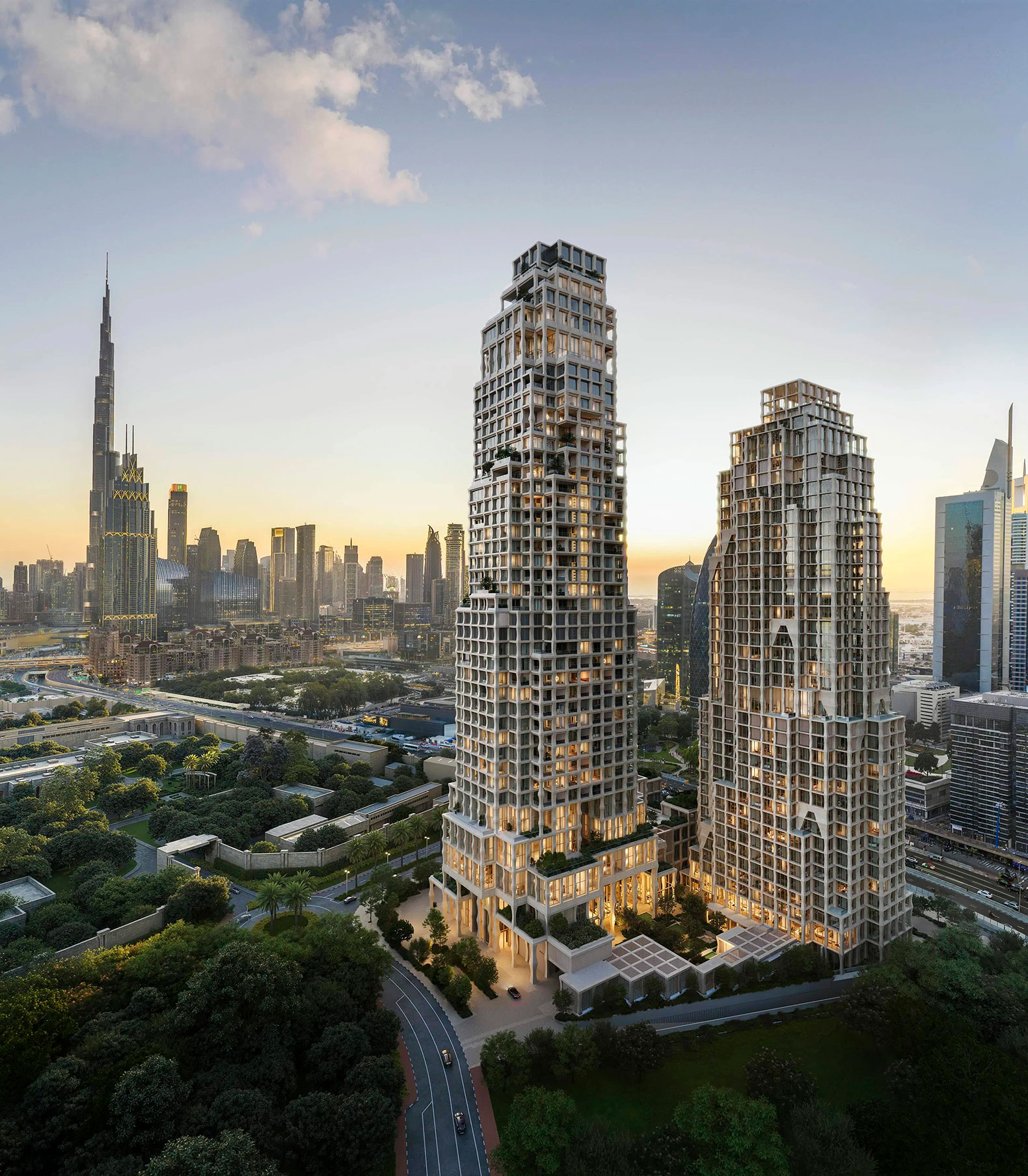
Janu Dubai, part of the Aman Group, is situated between the skyscrapers of the Dubai International Financial Centre (DIFC) and the adjacent palaces and gardens, attempting to establish a transition between different urban scales.

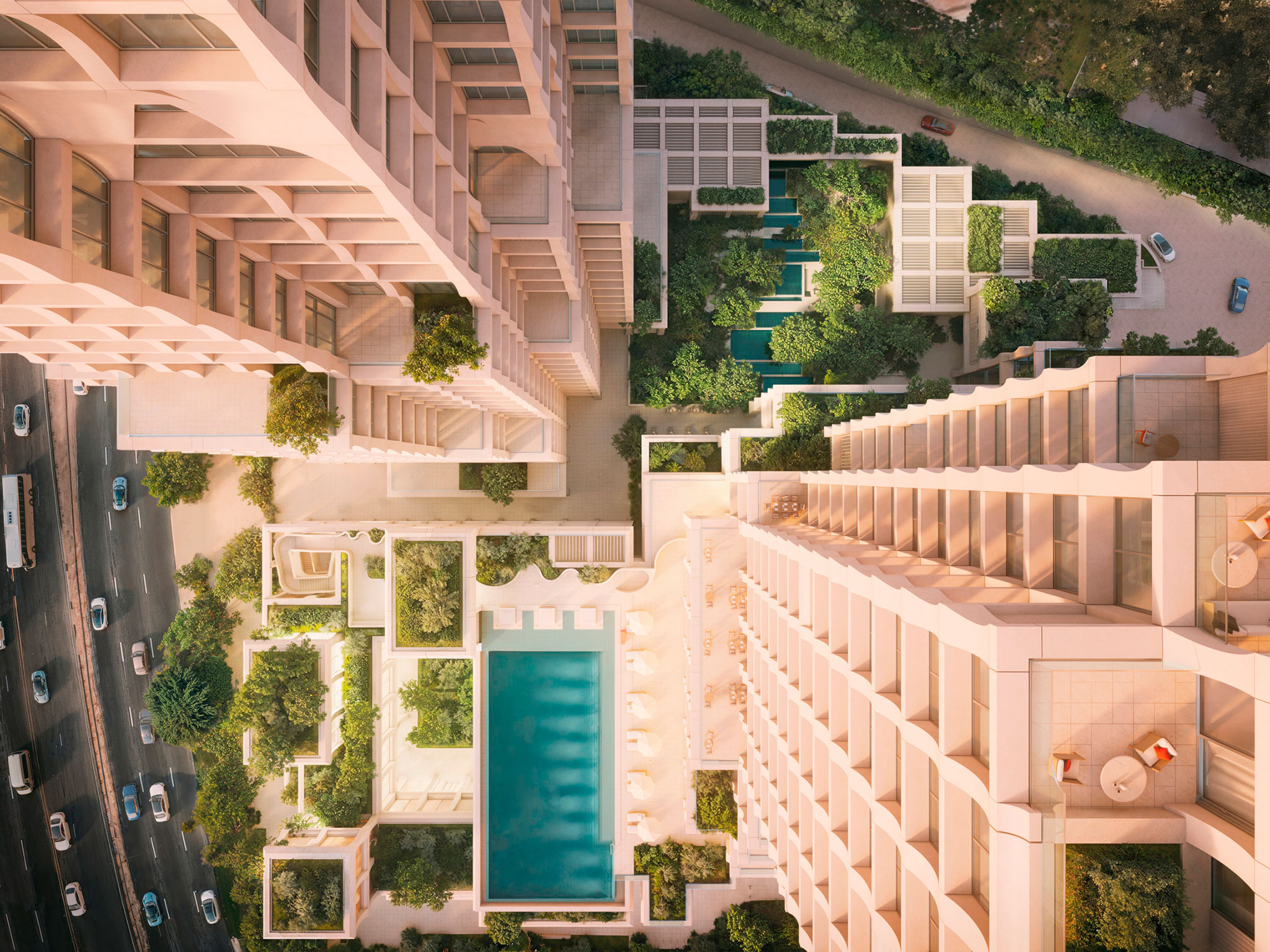
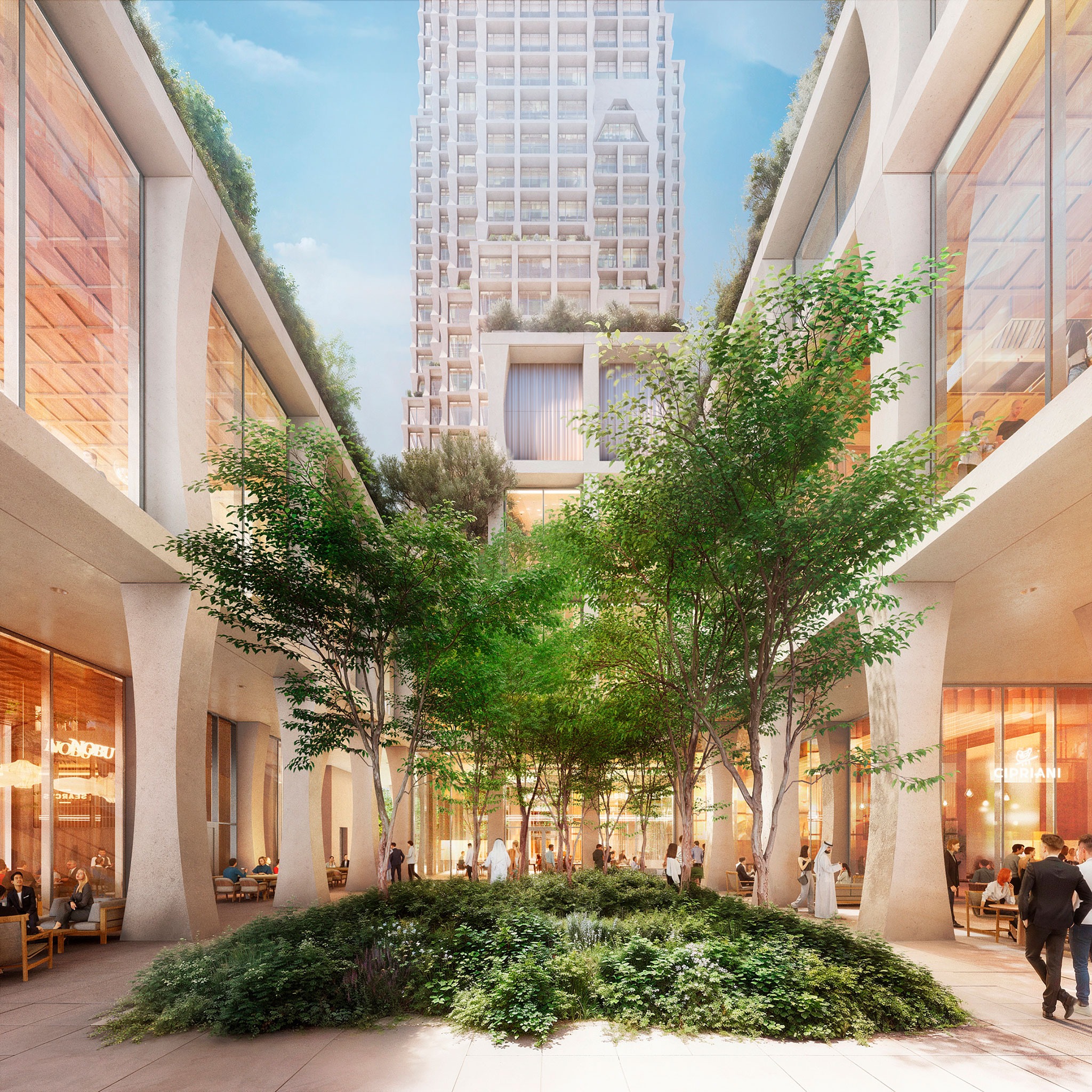
Herzog & de Meuron have designed a complex organized into two tessellated towers on a low-rise base articulated around a courtyard that evokes a traditional souk. The program comprises a hotel, residences, offices, and retail in a compact complex, which prioritizes pedestrian access through shaded pathways, landscaped terraces, and courtyards that replace the prominence of the automobile.

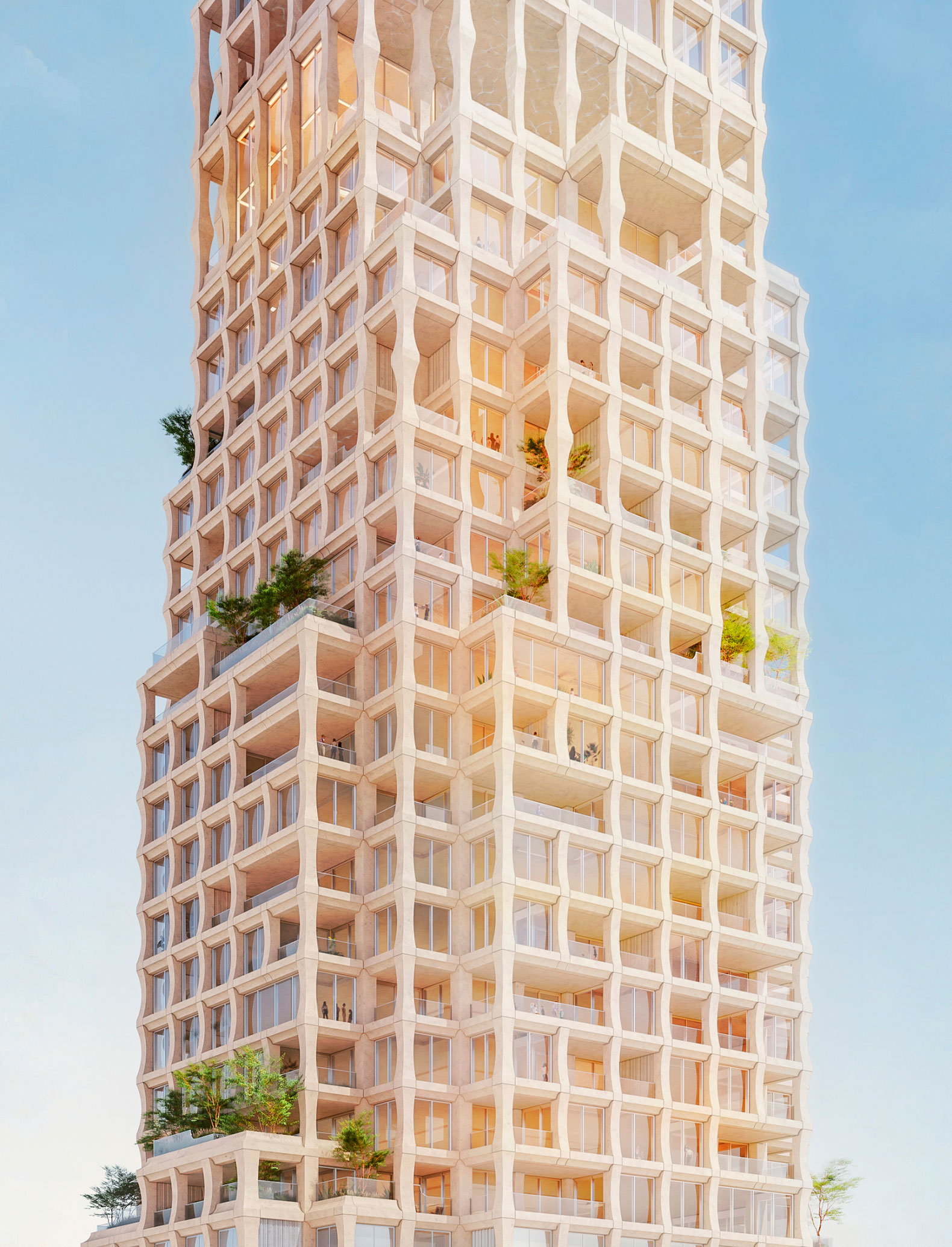
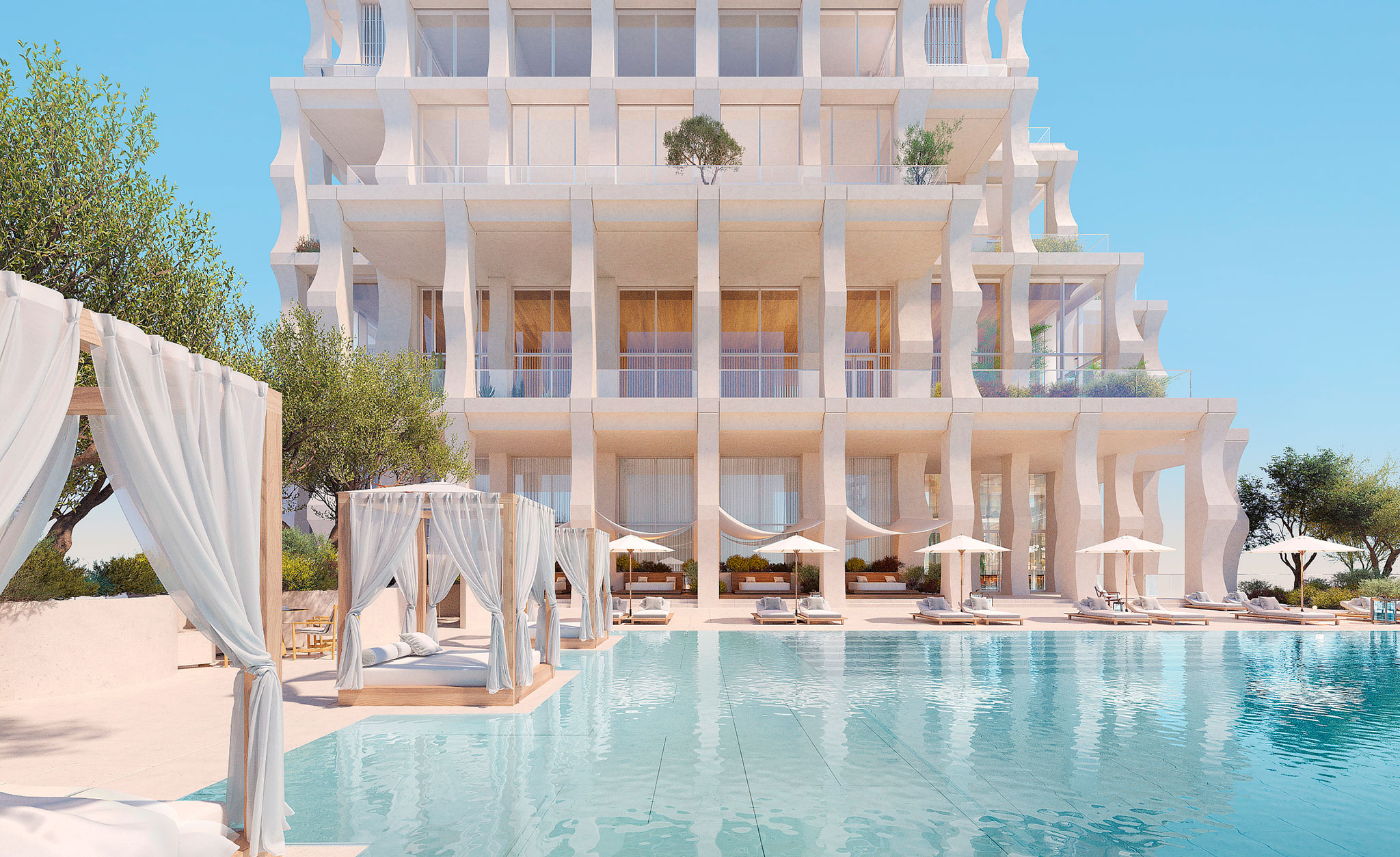
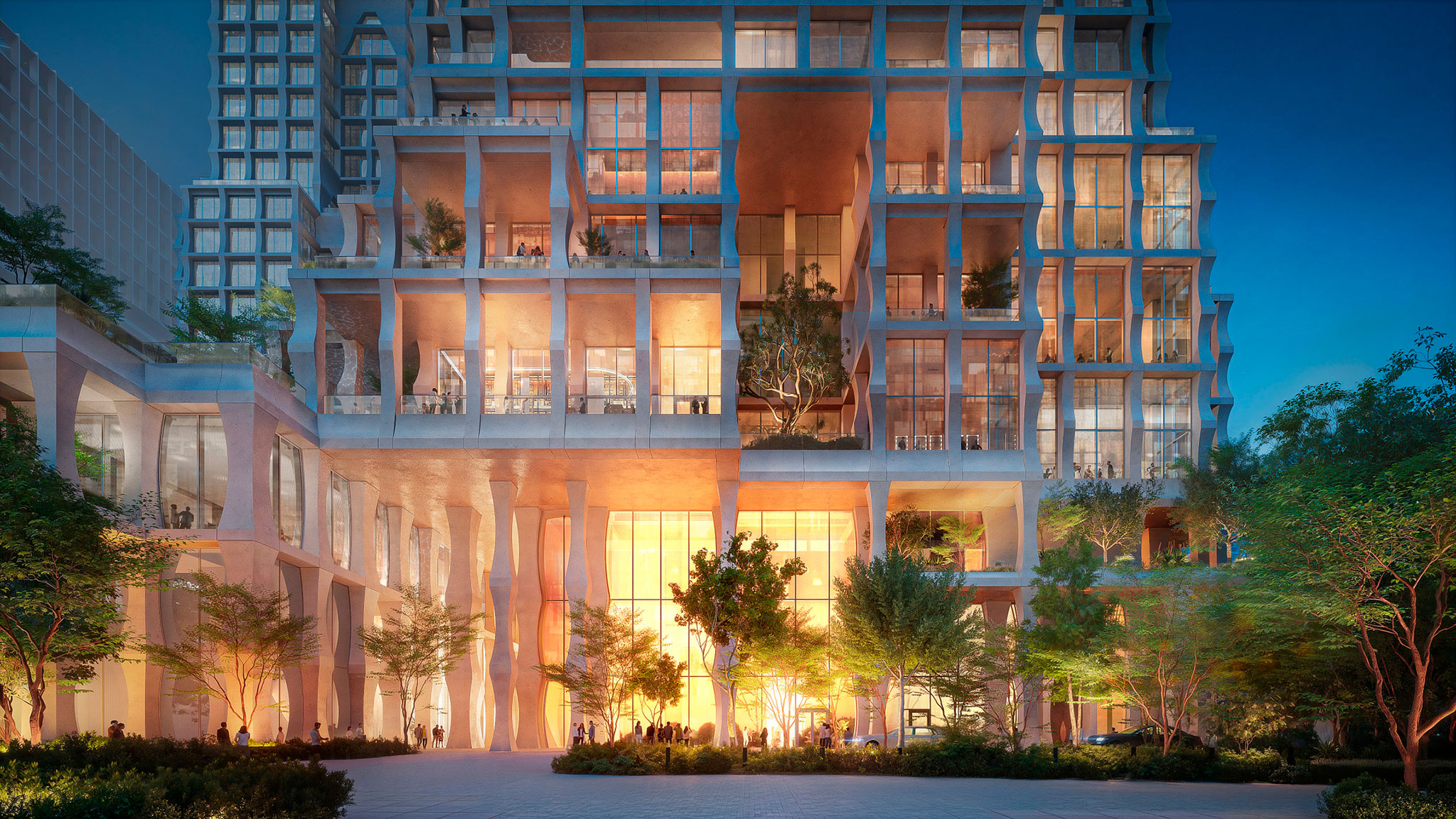
Inspired by vernacular architecture and early modern structures in Dubai, Herzog & de Meuron's project pays particular attention to climate efficiency. Self-protecting facades, staggered volumes, and wind-channelling geometries reduce solar radiation and enhance comfort. In contrast to conventional glass towers, the building presents itself as a mineral element, with deep recesses, freestanding columns, and plays of light and shadow.

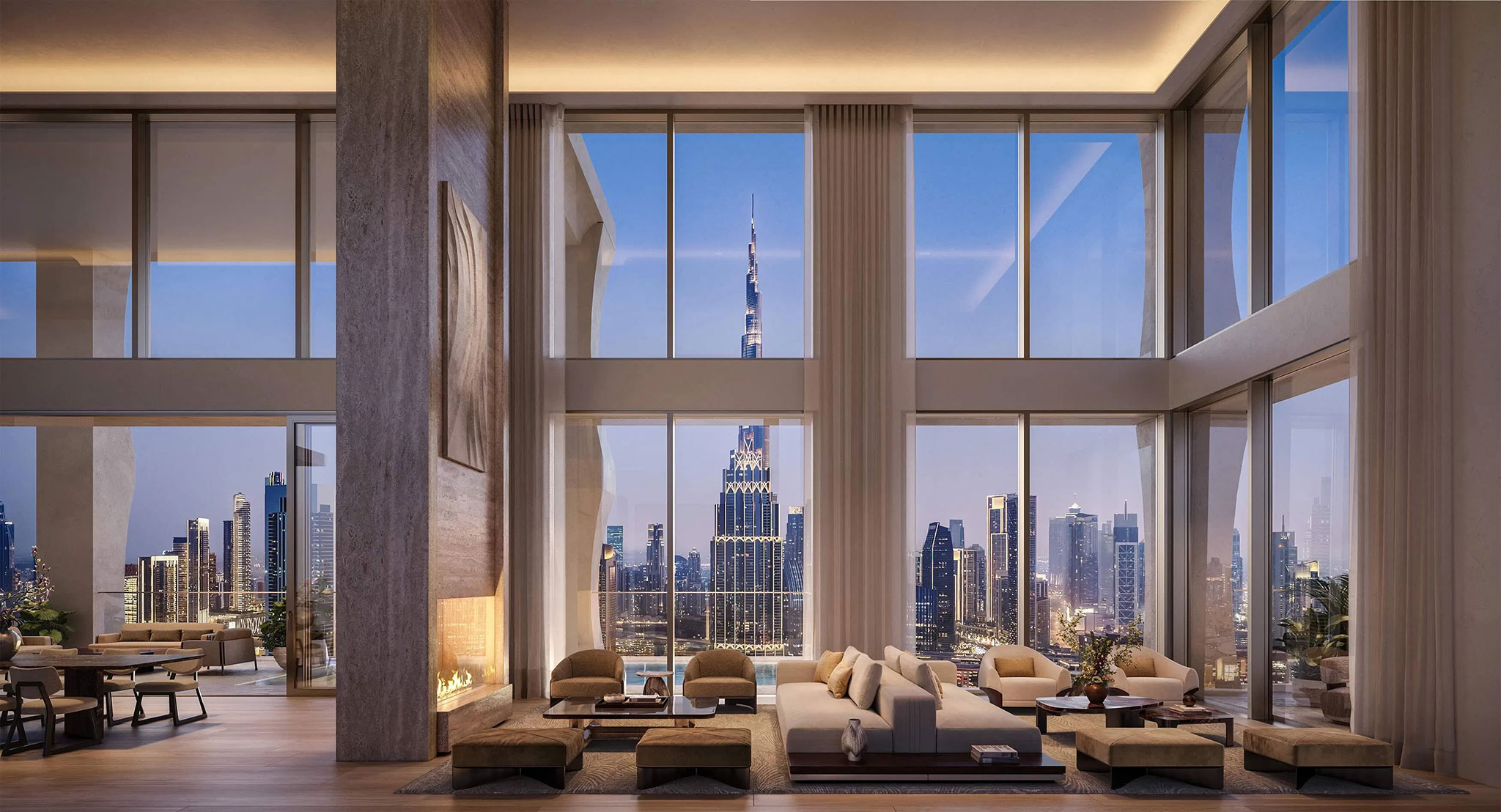
The hotel offers 150 rooms and extensive shared facilities, while the upper-floor residences boast terraces and panoramic views. The office tower incorporates flexible spaces, natural ventilation, and a rooftop garden accessible to the public.
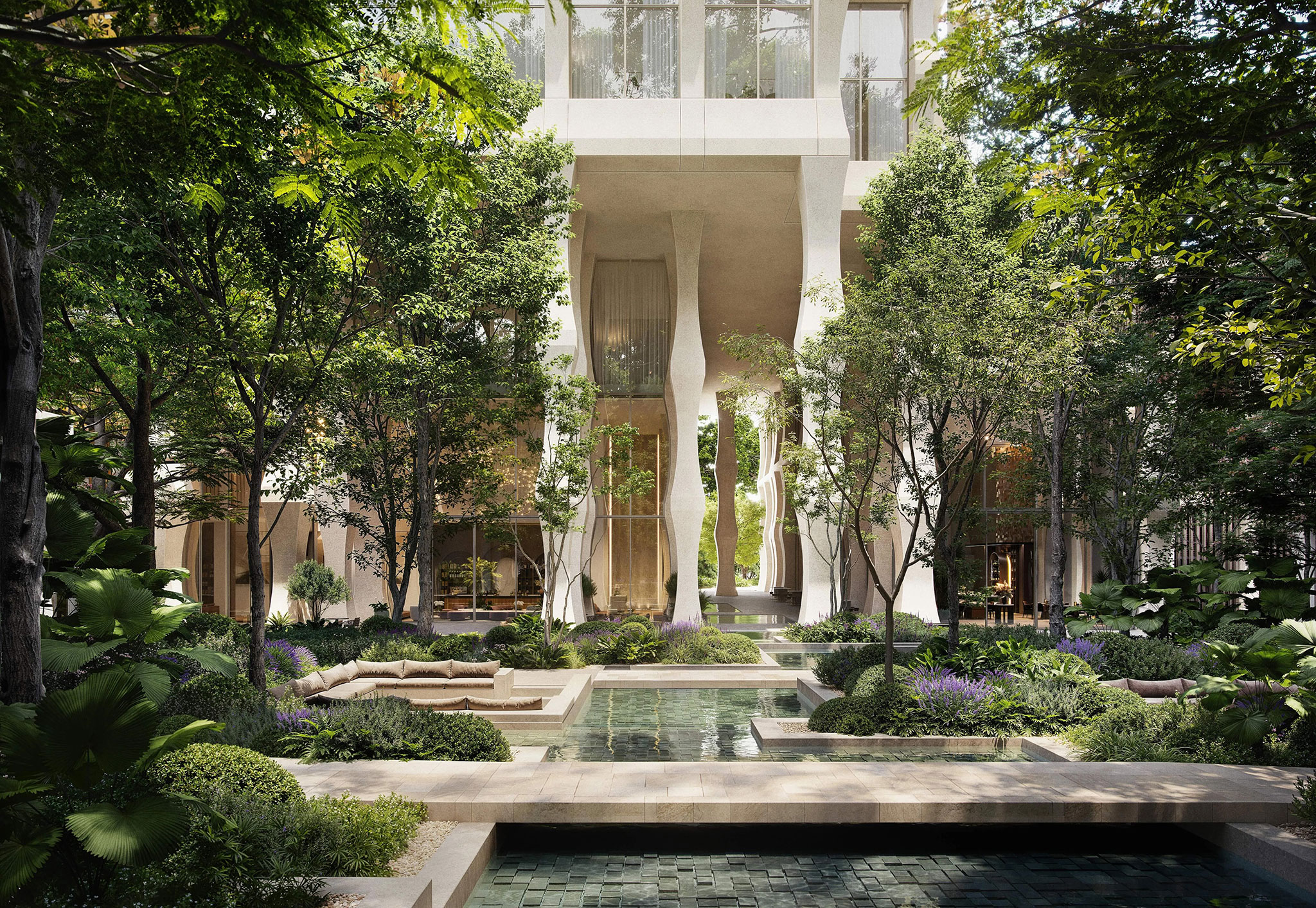
Rendering. Janu Dubai by Herzog & de Meuron

Rendering. Janu Dubai by Herzog & de Meuron.

Project description by Herzog & de Meuron

Janu Dubai, part of the Aman Group, is uniquely positioned at the threshold between the high-rises of the Dubai International Financial Centre (DIFC) and the adjacent low-rise palaces and gardens. The development introduces a new urban concept with two sculptural towers rising from a low-rise, base centred around a courtyard, reminiscent of a traditional souk. The project integrates hotel, residential, office, and retail spaces into a cohesive, climate-responsive architectural ensemble.

Drawing inspiration from climate-appropriate vernacular architecture of the region, the soft quality of the desert light, and the textured façades of Dubai’s early modernist structures, the design is shaped by performance. Self-shading facades, carefully calibrated massing, and wind-channelling forms help reduce solar gain, enhance comfort, and take advantage of prevailing breezes. Unlike more typical reflective glass towers on parking plinths, this architecture emphasizes a mineral presence and lived experience that is grounded, porous, and responsive to context.

In a city renowned for its spectacle, Janu Dubai poses a different question: how can architecture foster community, comfort, and cultural resonance, while still offering exceptional luxury?

Rendering. Janu Dubai by Herzog & de Meuron.

Mediating Between Scales
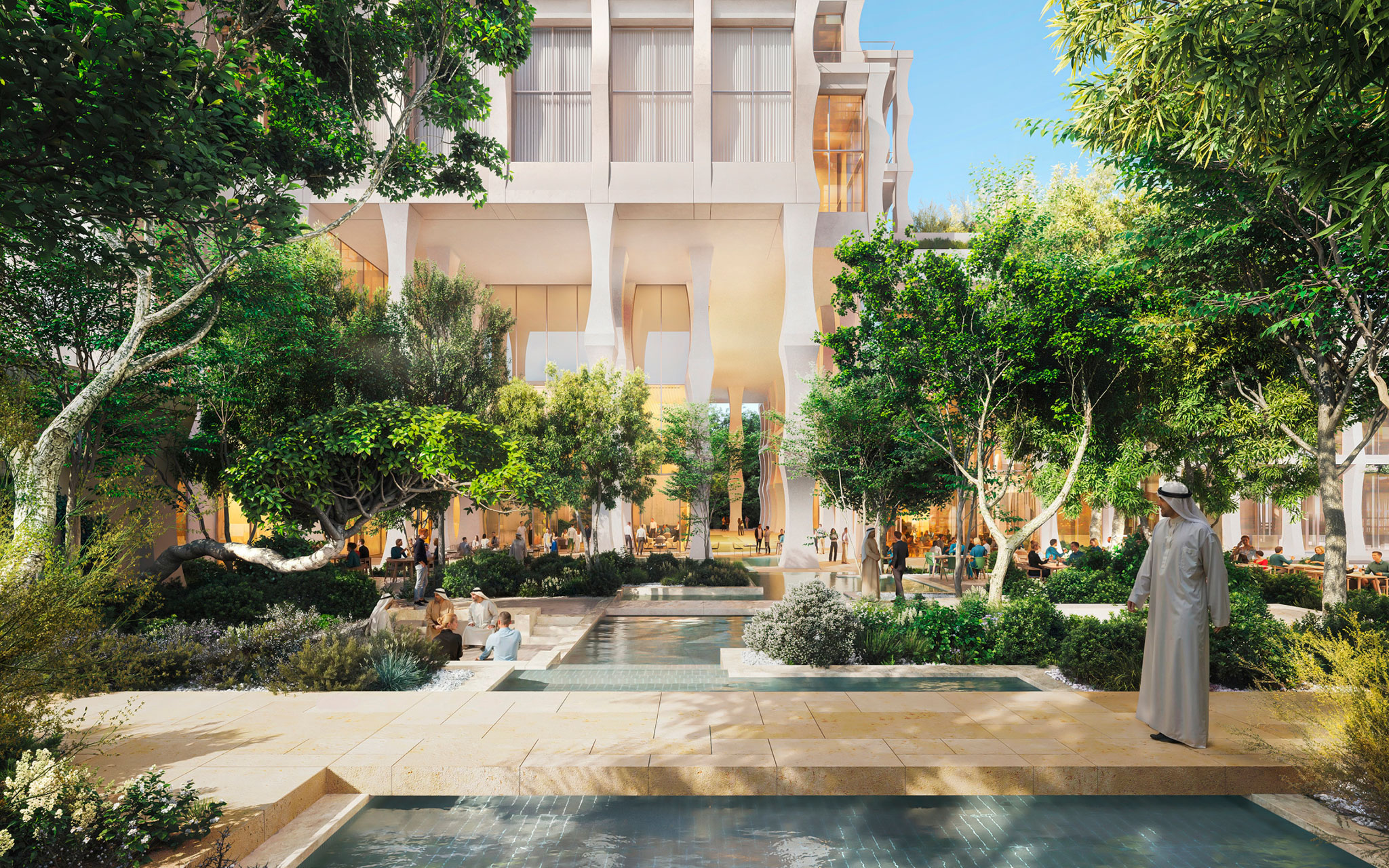
Janu Dubai bridges the vertical skyline of DIFC with the horizontal scale of nearby palaces and gardens, creating a gradual transition between these contrasting urban environments. Positioned at this intersection, the project transforms a previously vehicle-dominated zone into a pedestrian-friendly environment. Shaded walkways, lush courtyards, and a network of planted terraces activate the public realm and encourage movement through and around the site. The project embraces permeability and accessibility over monumentality.

Mineral Architecture
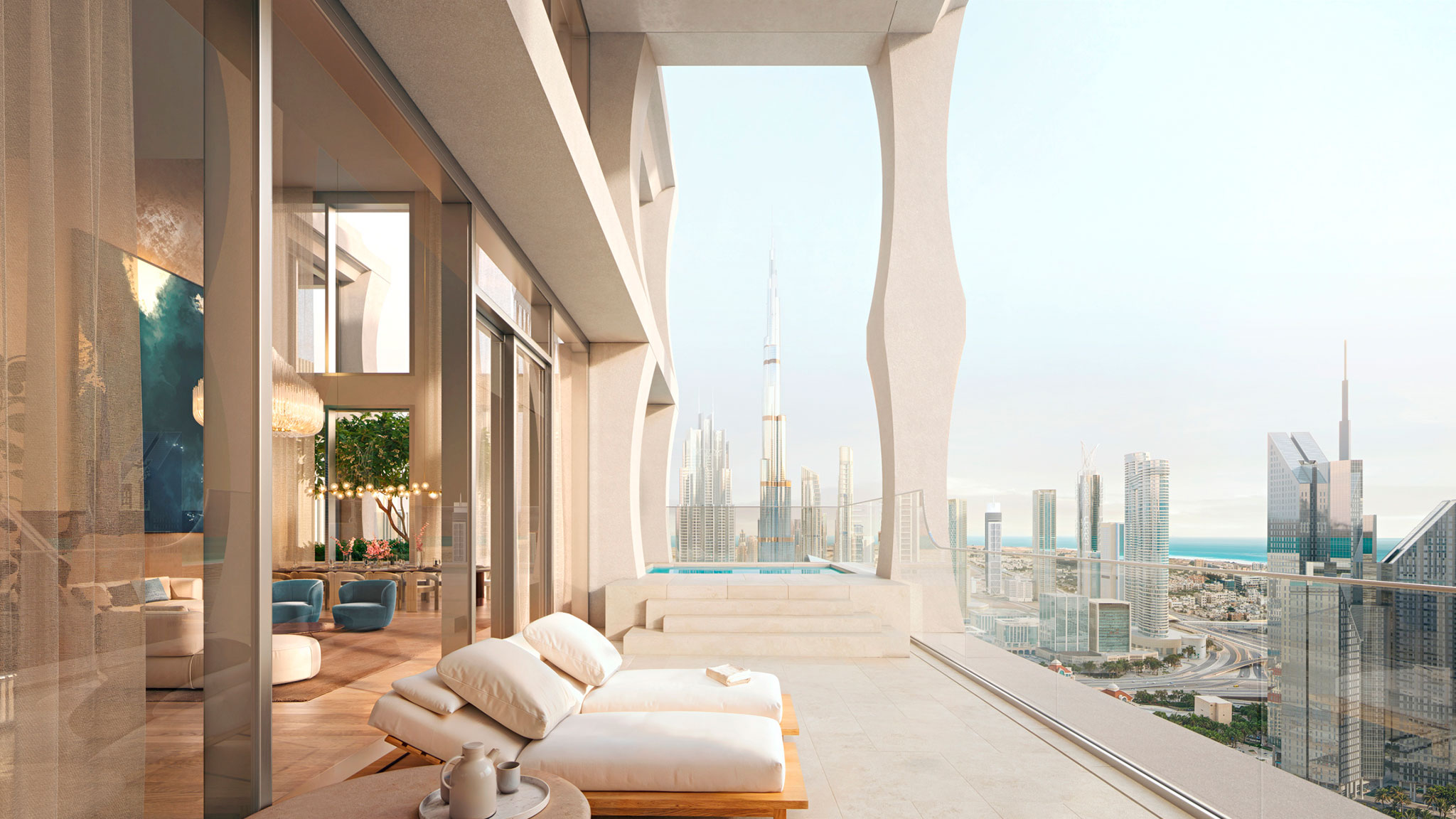
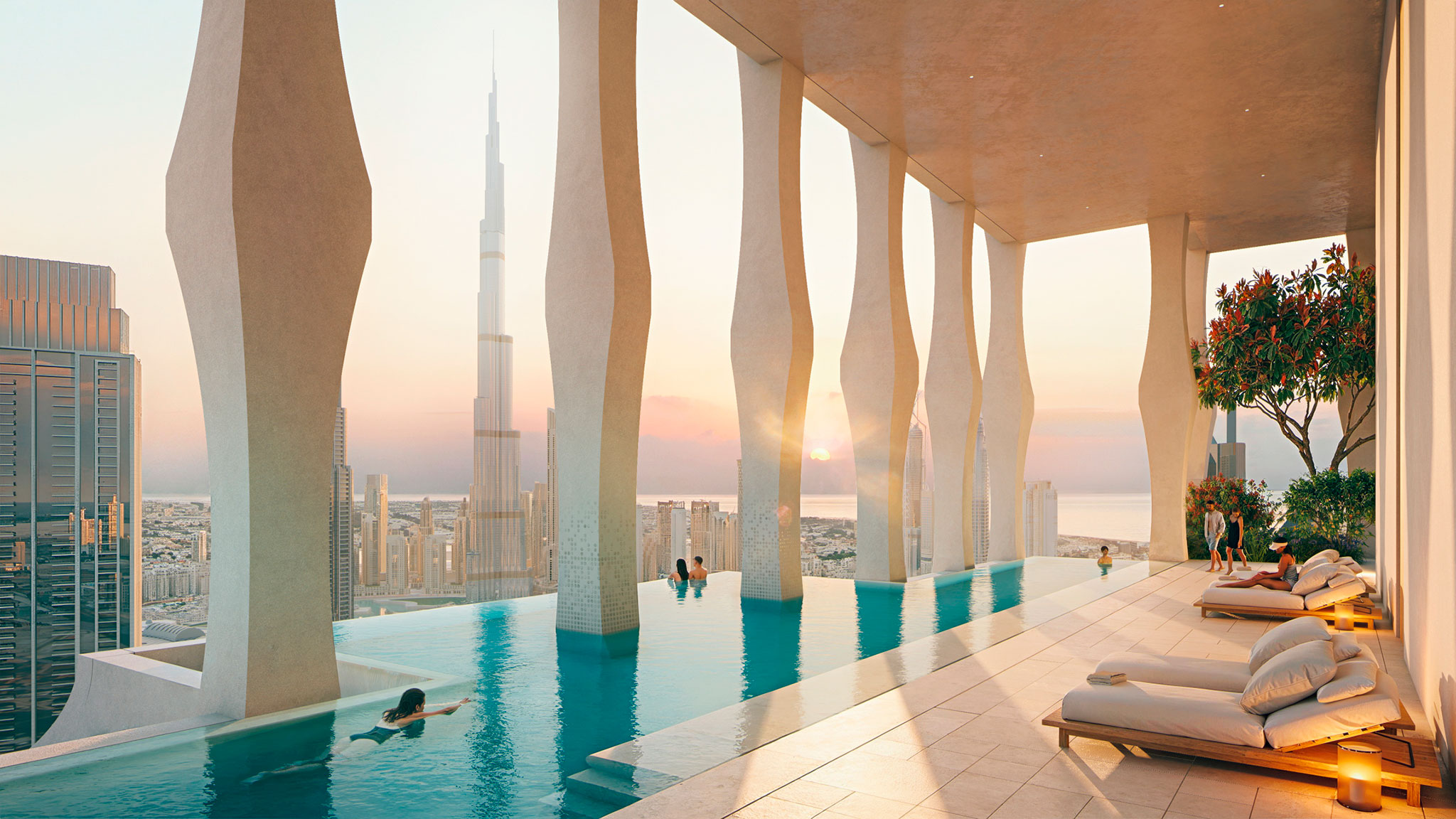
The towers depart from the sleek anonymity of surrounding glass skyscrapers. Their facades, conceived as stone forms gently shaped by wind, feature deep recesses and sculpted geometries that animate light and shadow throughout the day. The massing is articulated into stepped volumes and terraces, creating generous outdoor spaces with panoramic views. Freestanding sculptural columns frame exterior spaces and generate a rhythm of solid and void that filters sunlight, defines thresholds, and enhances spatial depth.

Courtyards and Gardens
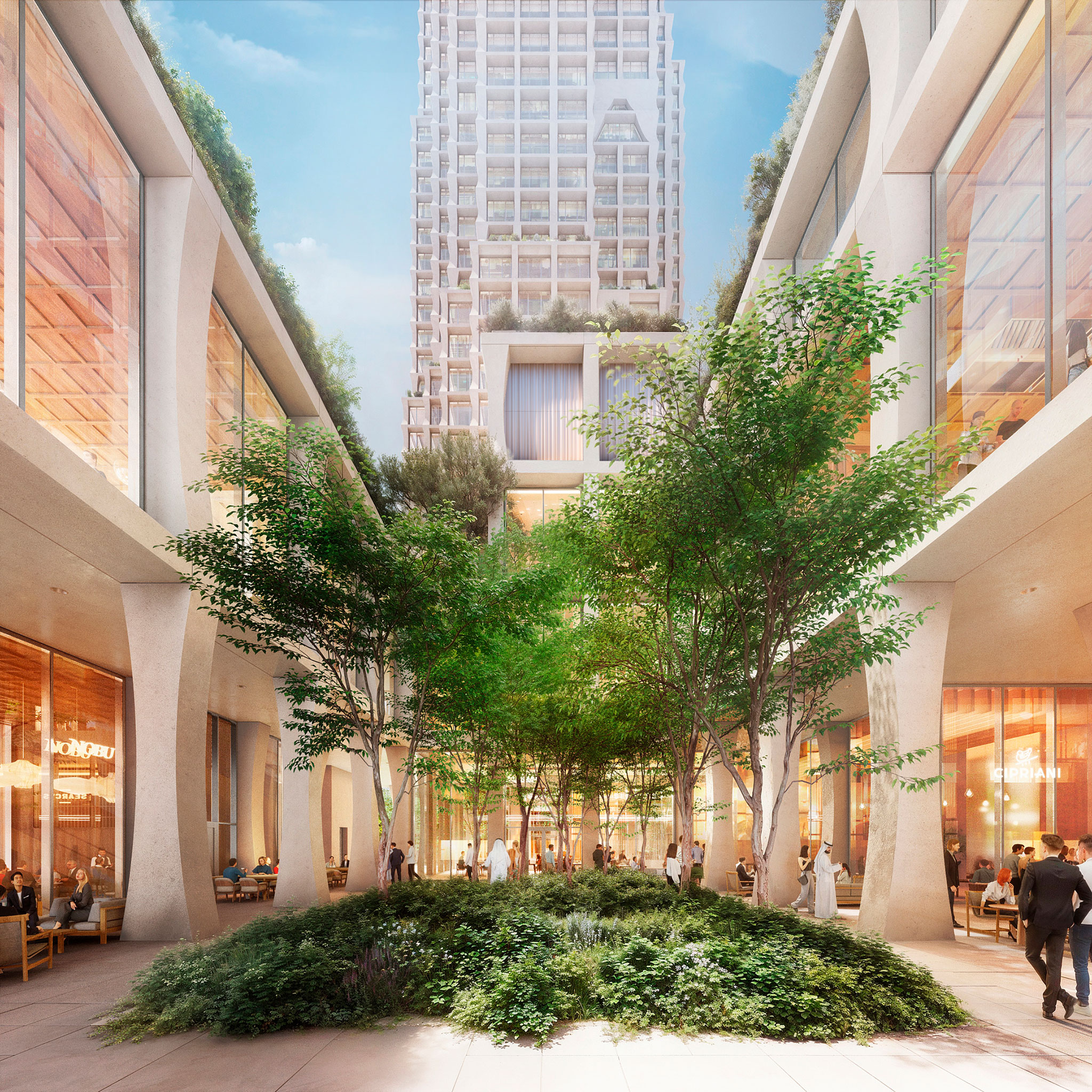
At ground level, a reimagined souk anchors the project—animated by retail and F&B spaces organized around shaded courtyards. The towers’ stepping volumes create both street-level gardens and accessible rooftops, forming an immersive, walkable environment that reinterprets the traditional souk. The landscaping integrates existing Ghaf trees and other indigenous species, ensuring biodiversity and grounding the project in local ecological heritage. Water features, shaded planting, and natural materials combine to create microclimates that reduce heat and enhance comfort throughout the year.

Retail Experience
The retail component establishes the project’s human-scale character through its low-rise, two-story structure. Strategically positioned and directly connected to DIFC, these spaces remain fully public. A sculptural outdoor staircase draws people from the drop-off area, providing access to both retail levels as well as to the central courtyard and surrounding amenities. The architecture activates the street edge through multiple outdoor terraces and arcade-like spaces—elements that become particularly valuable during the mild winter months.
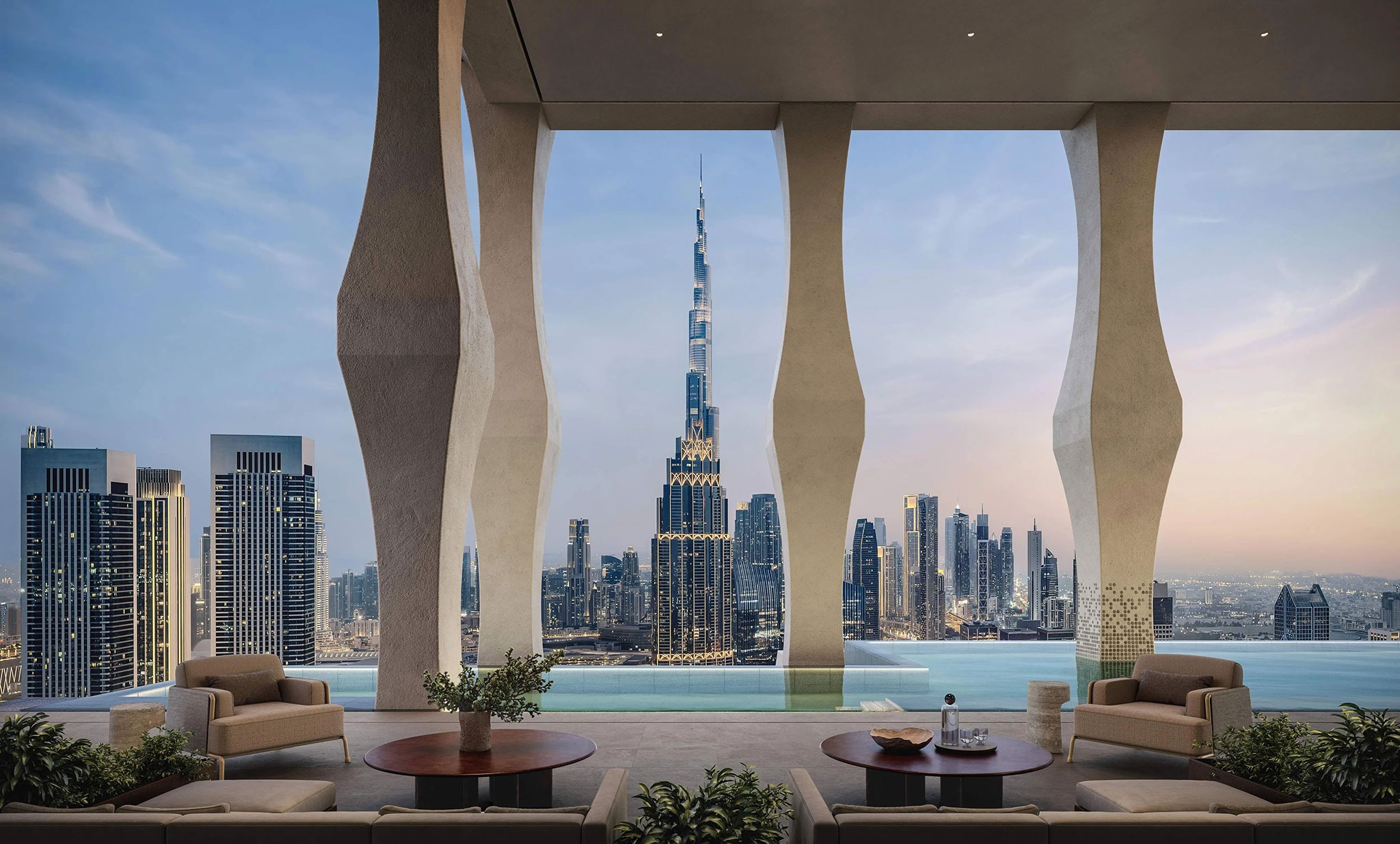
Rendering. Janu Dubai by Herzog & de Meuron.

Hotel and Residences
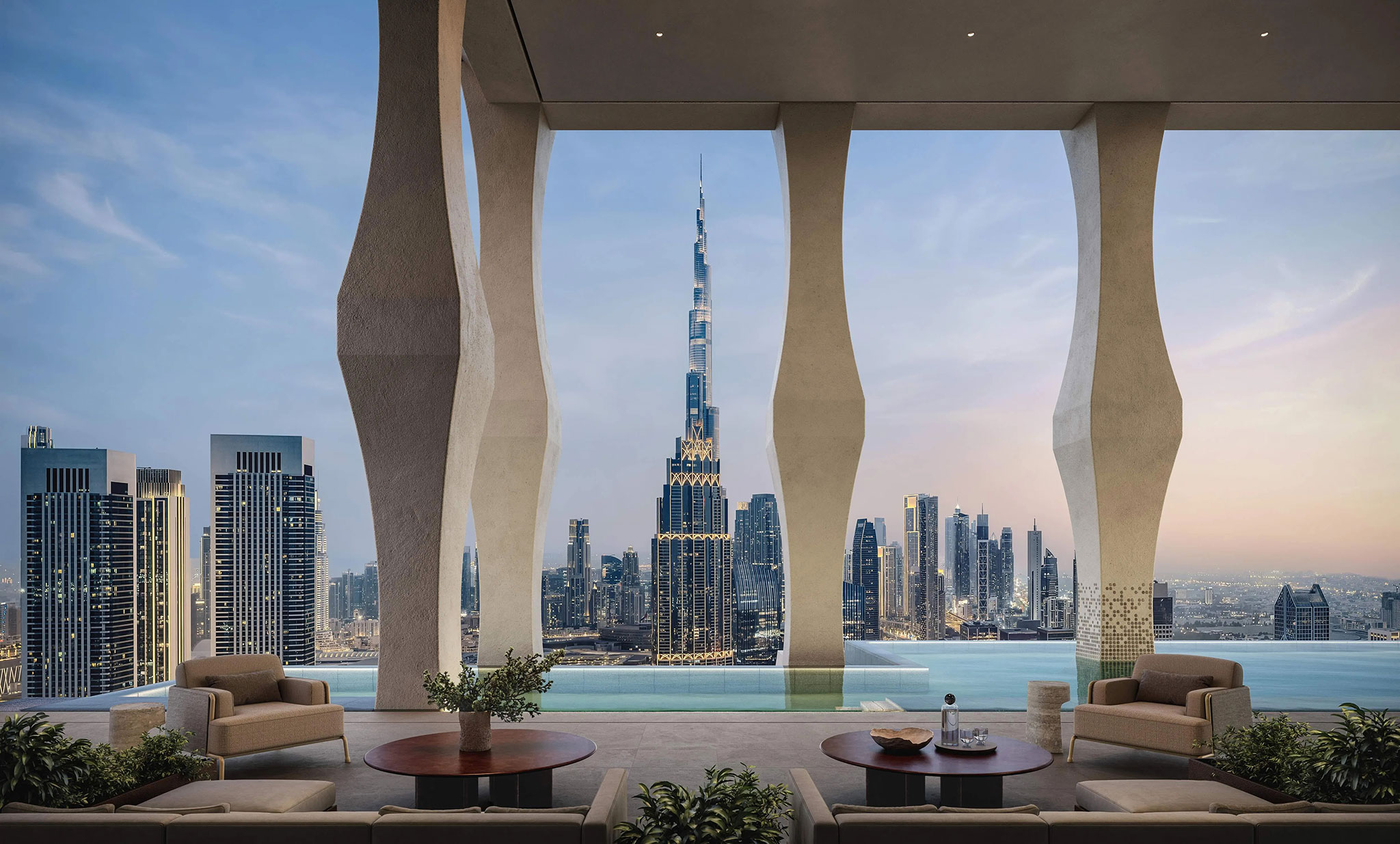
The Janu Hotel tower offers a ceremonial yet intimate arrival, framed by layered landscaping and a vertical 18-meter-high lobby. Directly accessible from the drop-off, the lobby connects hotel guests to a suite of amenities situated above, including a spa, fitness facilities, wellness center, dining terraces, multiple restaurants, a club and lounge all oriented around framed views and shaded outdoor spaces. The hotel offers 150 rooms across five typologies, many featuring private terraces, gardens, or plunge pools. Above, the branded residences—located in the most sculpted and panoramic part of the tower—offer a range of configurations with expansive outdoor living areas and uninterrupted views of the Burj Khalifa and surrounding palatial gardens.

Office Tower
Along Al Mustaqbal Street, the office tower provides high-quality, comfortable, flexible workspaces. Its identity is shaped by expressed A-frame structural elements that reveal the logic of the building’s load path through its façade. A triple-height lobby opens directly to the public space, enriched with indoor landscape and natural daylight. Office floors offer flexible layouts, natural ventilation, and access to outdoor balconies. At the crown, a triple-height sky garden serves as Dubai’s newest public destination, offering a shaded retreat with panoramic views toward DIFC and the wider Dubai skyline accessible to all visitors.

Janu Dubai represents a significant contribution to Dubai’s evolving skyline, balancing architectural distinction with human experience. As Dubai continues to establish itself as a global crossroads, Janu creates spaces where the city’s vibrant international community can connect, collaborate, and find moments of respite within the city.
More information

Label
Architects
Text

Herzog & de Meuron. Partners.- Jacques Herzog, Pierre de Meuron, Olga Bolshanina (Partner in Charge), Ascan Mergenthaler.

+ + copy Created with Sketch.
- + copy Created with Sketch.
Label
Project team
Text

Adriana Hernández Arteaga (Project Director), Marcelo Bernardi (Project Manager), Ramona Triolo (Project Manager), João Filipe Varandas (Project Manager), Farhad Ahmad, Bruno de Almeida Martins, Laurent Boutin-Neveu, Cinzia Bussola, Kaihong Chen, Benedict Choquard, Massimo Corradi, Ola Domian, Michael Drobnik, Michael Du, Kaleb Egger, Elizaveta Ermakova, Wilson Fung, Gabriel Furuya Alberti, Travis Gerhardt, Dylan Gibbs, Stefan Goeddertz, David Gonçalves Monteiro, Eleonora Guerra, Léa Hatil, Julia Hejmanowska, Ryoko Ikeda, Raphael Ishoh, Seongyun Jeong, Ian Yeonsuk Kim, Casper Klaren, Marcin Koltunski, Luka Korošec, Vladislav Kostadinov, Maria Krasteva, Matteo Lattanzio, Sahng O Lee, Yiyang Li, Francesco Mammarella Pilotti Aielli, Veronika Mayr, Erica Mensi, Gonzalo Mir, Ilia Moiseev, Edoardo Mosca, Omar Mowafy, Gedaile Nausédaité, Gourav Neogi, Dominik Nüssen, Maude Olignon, Riccardo Orsini, Sofia Papadopoulou, Vladislava Parfjonova, Felipe Pecegueiro Curado, Marco Puorto, Alessandro Racca, Aida Ramirez Marrujo, Pauli Rikaniemi, Rebecca Roberts, Beatriz Sanz Cerezo, Martin Schulte, Mara Seremeti, Purven Shah, Ivan Shatravin, Ken Sheppard, Valentina Teruzzi, Carlos Tolosa Tejedor, Una Vialard, Liane Yue Liang, Dorian Zank-Bach, Anna Zarubina, Song Zhang..

+ + copy Created with Sketch.
- + copy Created with Sketch.
Label
Client
Text

Alia Developments SPV Limited.

+ + copy Created with Sketch.
- + copy Created with Sketch.
Label
Area / dimensions
Text

Site Area.- 197,829 sqft, 18,379 sqm.
Gross floor area (GFA).- 1,369,996 sqft, 127'277 sqm.
GFA below ground.- 948,299 sqft, 88,100 sqm.

+ + copy Created with Sketch.
- + copy Created with Sketch.
Label
Location
Text

Dubai International Financial Centre (DIFC), Dubai. United Arab Emirates.

+ + copy Created with Sketch.
- + copy Created with Sketch.

Herzog & de Meuron Architekten is a Swiss architecture firm, founded and headquartered in Basel, Switzerland in 1978. The careers of founders and senior partners Jacques Herzog (born 1950), and Pierre de Meuron (born 1950), closely paralleled one another, with both attending the Swiss Federal Institute of Technology (ETH) in Zürich. They are perhaps best known for their conversion of the giant Bankside Power Station in London to the new home of the Tate Museum of Modern Art (2000). Jacques Herzog and Pierre de Meuron have been visiting professors at the Harvard University Graduate School of Design since 1994 (and in 1989) and professors at ETH Zürich since 1999. They are co-founders of the ETH Studio Basel – Contemporary City Institute, which started a research programme on processes of transformation in the urban domain.

Herzog & de Meuron is a partnership led by five Senior Partners – Jacques Herzog, Pierre de Meuron, Christine Binswanger, Ascan Mergenthaler and Stefan Marbach. An international team of 38 Associates and about 362 collaborators.

Herzog & de Meuron received international attention very early in their career with the Blue House in Oberwil, Switzerland (1980); the Stone House in Tavole, Italy (1988); and the Apartment Building along a Party Wall in Basel (1988).  The firm’s breakthrough project was the Ricola Storage Building in Laufen, Switzerland (1987).  Renown in the United States came with Dominus Winery in Yountville, California (1998). The Goetz Collection, a Gallery for a Private Collection of Modern Art in Munich (1992), stands at the beginning of a series of internationally acclaimed museum buildings such as the Küppersmühle Museum for the Grothe Collection in Duisburg, Germany (1999). Their most recognized buildings include Prada Aoyama in Tokyo, Japan (2003); Allianz Arena in Munich, Germany (2005); the new Cottbus Library for the BTU Cottbus, Germany (2005); the National Stadium Beijing, the Main Stadium for the 2008 Olympic Games in Beijing, China; VitraHaus, a building to present Vitra’s “Home Collection“, Weil am Rhein, Germany (2010); and 1111 Lincoln Road, a multi-storey mixed-use structure for parking, retail, a restaurant and a private residence in Miami Beach, Florida, USA (2010), the Actelion Business Center in Allschwil/Basel, Switzerland (2010). In recent years, Herzog & de Meuron have also completed projects such as the New Hall for Messe Basel Switzerland (2013), the Ricola Kräuterzentrum in Laufen (2014), which is the seventh building in a series of collaborations with Ricola, with whom Herzog & de Meuron began to work in the 1980s; and the Naturbad Riehen (2014), a public natural swimming pool. In April 2014, the practice completed its first project in Brazil: the Arena do Morro in the neighbourhood of Mãe Luiza, Natal, is the pioneering project within the wider urban proposal “A Vision for Mãe Luiza”.

Herzog & de Meuron have completed 6 projects since the beginning of 2015: a new mountain station including a restaurant on top of the Chäserrugg (2262 metres above sea level) in Toggenburg, Switzerland; Helsinki Dreispitz, a residential development and archive in Münchenstein/Basel, Switzerland; Asklepios 8 – an office building on the Novartis Campus in Basel, Switzerland; the Slow Food Pavilion for Expo 2015 in Milan, Italy; the new Bordeaux stadium, a 42’000 seat multifunctional stadium for Bordeaux, France; Miu Miu Aoyama, a 720 m² boutique for the Prada-owned brand located on Miyuki Street, across the road from Prada Aoyama, Tokyo, Japan.

In many projects the architects have worked together with artists, an eminent example of that practice being the collaboration with Rémy Zaugg, Thomas Ruff and with Michael Craig-Martin.

Professionally, the Herzog & de Meuron partnership has grown to become an office with over 120 people worldwide. In addition to their headquarters in Basel, they have offices in London, Munich and San Francisco. Herzog has explained, “We work in teams, but the teams are not permanent. We rearrange them as new projects begin. All of the work results from discussions between Pierre and me, as well as our other partners, Harry Gugger and Christine Binswanger. The work by various teams may involve many different talents to achieve the best results which is a final product called architecture by Herzog & de Meuron.”

Read more
Published on: February 15, 2026
Cite:
metalocus, ANTONIO GRAS
"Two tessellated towers in Dubai International Financial Centre by Herzog & de Meuron" METALOCUS. Accessed
<http://www.metalocus.es/en/news/two-tessellated-towers-dubai-international-financial-centre-herzog-de-meuron> ISSN 1139-6415
Loading content ...
Loading content ...
Loading content ...
Loading content ...
Loading content ...
Loading content ...
Loading content ...
Loading content ...
Loading content ...
Loading content ...
Loading content ...
Loading content ...
Loading content ...
Loading content ...
Loading content ...
Loading content ...
Loading content ...
Loading content ...
Loading content ...
Loading content ...
Loading content ...
Loading content ...
Loading content ...
Loading content ...
Loading content ...
Loading content ...
Loading content ...
Loading content ...
Loading content ...
Loading content ...
Loading content ...
Loading content ...
Loading content ...
Loading content ...
Loading content ...
Loading content ...
Loading content ...
Loading content ...
Loading content ...
Loading content ...
Loading content ...
Loading content ...
Loading content ...
Loading content ...
Loading content ...
Loading content ...
Loading content ...
Loading content ...
Loading content ...
Loading content ...
Loading content ...
Loading content ...
Loading content ...
Loading content ...