The carpentry workshop of the Bauhaus, like the rest, was raised from the beginning by its first director, Walter Gropius. The workshops of different specialties officially appear in the first curriculum, of 1921. In this case, to be able to access the carpentry workshop, they had to present themselves during a semester of test to the classes taught in the workshop and finally, after three years of training obtain the degree of officers according to the guidelines of the Handwerksk. In addition, they received an artistic training from which they were examined by the so-called Teachers Council of the Form.

Johannes Itten (1888-1967) painter, designer, teacher and writer.
Johannes Itten
Since 1920, the classes in the workshops were taught by a workshop director and an artist, the masters of the form. The first teacher and first director of this workshop was Johannes Itten. His teaching proposed to transfer to the wood the experience acquired on materials and form that had acquired in the preliminary course. Itten rejected all the orders, rejected the traditional operation of a workshop and its objective was to make unique artistic pieces that exceeded the proposals imposed by the industry, so he organized his classes with schedules that allowed him to work individually with each of his students.
Johannes Itten (1888-1967) painter, designer, teacher and writer.
Johannes Itten
Since 1920, the classes in the workshops were taught by a workshop director and an artist, the masters of the form. The first teacher and first director of this workshop was Johannes Itten. His teaching proposed to transfer to the wood the experience acquired on materials and form that had acquired in the preliminary course. Itten rejected all the orders, rejected the traditional operation of a workshop and its objective was to make unique artistic pieces that exceeded the proposals imposed by the industry, so he organized his classes with schedules that allowed him to work individually with each of his students.
"You should not work from other people's designs, or ideas from the Bauhaus masters."(1)
Johannes Itten
The carpentry workshop distanced itself from the formal expressionist ideas that the Bauhaus school followed to adopt a constructivist aesthetic. This new thinking, caused the workshop to undergo a change focused on the functionality of the design method.
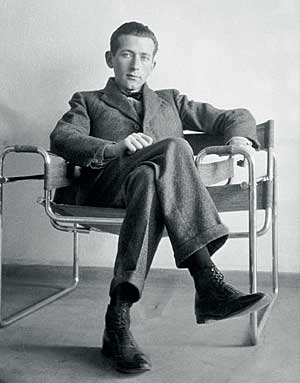
In the stage that was Johannes Itten as director of the workshop, we found few of his works. Despite this, the works carried out by their students are very outstanding and also clearly show the thinking of the workshop led by Itten. Among them we find the Bauhaus Crib, created by Peter Keler in 1922. In this work, basic geometric shapes are used: circle, square and triangle, together with the three primary colors. Another of the best-known works by Itten's students is the African Chair by Marcel Breuer from 1923, in which we find a fabric covering made by Gunta Stölzl.
When the Thuringian government asked for concrete results, Gropius was forced to give an answer presenting the last works of the Bauhaus in an exhibition. The carpentry workshop presented the house model "Am Horn", fully equipped and considered "the first example of a new concept of housing in Germany."(2) The avant-garde kitchen that we find in the house, made by Benita Otte and Ernst Gebhardt, proposes functional surfaces to save space with simple materials to maintain and the most innovative technical equipment.
The furniture that Marcel Breuer made for the living room and the female bedroom provided constructive aspects of the furniture with the use of colors and the combination of different types of wood. The room of the children, work of Alma Buscher, showed the concepts of the reformist ideology, with a container system that allowed to develop the imagination of the children and adapted to the different phases of its development.
"If the stepped chair is deployed and the backrest is placed on the floor, it is supported on wheels and can become a car, a fire escape, a vehicle to play... When the child grows, the wheels and the wheelchair can be separated. stool and so that same toy will become a normal size chair." (3)
Alma Buscher, student of the Bauhaus
At the end of 1921, Walter Gropius criticized the teaching of Johannes Itten because the school was facing economic problems and therefore the workshops had to be productive in order to improve that situation: "the current organization of the Bauhaus will remain or fail depending on the acceptance or rejection of the need to receive external orders".(4)
The differences between Johannes Itten and Walter Gropius would end a few years later with the resignation and abandonment of Itten of the Bauhaus in 1925. The last trigger was that Gropius wanted the carpentry shop to accept a private order on the seats of the Stadttheater in Jena, something of which Itten did not agree.

Marcel Breuer (1902-1981) student, teacher and director of the carpentry workshop.
Marcel Breuer
After the resignation of Johannes Itten, the direction of the workshop was given by Marcel Breuer, and despite the change of address, Walter Gropius continued with the planned program for the Weimar workshops:
"The Bauhaus workshops are, basically, laboratories in which the model of the typical instruments of our era must be developed and carefully improved, so that they are suitable for industrial reproduction. We want to form a new class of workers who are prepared for both industrial and craft work." (5)
Walter Gropius
Marcel Breuer was a former student of the carpentry workshop who finally managed to become a teacher and director of the same workshop in which he had been trained.
He worked on the idea of the table chair and for this he presented a club armchair in steel for the inauguration of the new school headquarters in 1926. An armchair made from his designs in the workshops of the aeronautical company Junkers, elaborated with un-welded Mannesmann steel pipes that could be manufactured industrially. Both the material and the elaboration responded to the social and cultural ideals proposed by the avant-garde. Breuer was criticized because his works were "cold", "typical of a hospital" and that they remembered "an operating table", to which he defended himself emphasizing the importance of functionality of the furniture.
"The starting point was the seat problem as a unique accommodation to the simplest construction possible. These needs were raised:
- Seat and backrest elastic but without landing, as it is heavy and expensive, in addition to dusting very easily.
- Transverse position of the seat to ensure that the thighs are supported throughout their length but without being pressed, as with the horizontal seats.
- Inclined position of the trunk.
- Free position of the spine, since any pressure on it is uncomfortable and unhealthy.
- Seat and backrest elastic but without landing, as it is heavy and expensive, in addition to dusting very easily.
- Transverse position of the seat to ensure that the thighs are supported throughout their length but without being pressed, as with the horizontal seats.
- Inclined position of the trunk.
- Free position of the spine, since any pressure on it is uncomfortable and unhealthy.
These objectives were fulfilled by introducing a cross-back, which supported the skeleton and the shoulder blades in an elastic manner." (6)
Marcel Breuer, director of the carpentry workshop

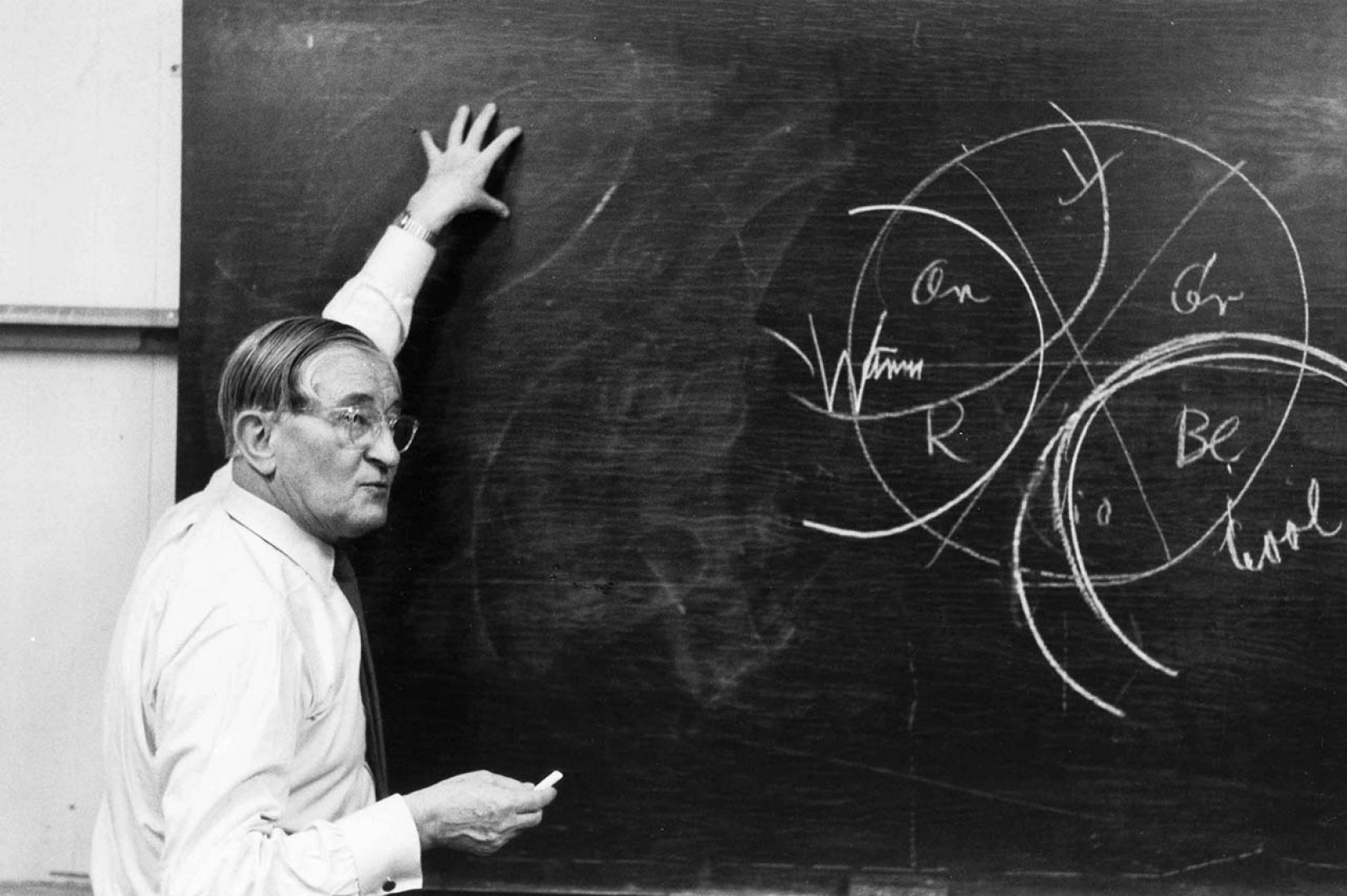
Josef Albers at Yale University, 1955-56. Juan March Foundation.
Josef Albers
Marcel Breuer left the direction of the workshop in 1928 to devote himself fully to architecture. Josef Albers succeeds him as manager of the carpentry shop, although he only worked for one year.
Between 1928 and 1930 Hannes Meyer directed the school of the Bauhaus, who created a link between the production of the school and its obligations to society. In the carpentry workshop, affordable furniture designed for village dwellings began to be produced instead of "individual manufacturing models for some snob fascinated by modernity"(7). The products had to be adapted to the real needs, so the students had to make a study of the customs of the people, of the social standards, physiological and psychological functions, of the production process and make a conscientious economic calculation.
Marcel Breuer left the direction of the workshop in 1928 to devote himself fully to architecture. Josef Albers succeeds him as manager of the carpentry shop, although he only worked for one year.
Between 1928 and 1930 Hannes Meyer directed the school of the Bauhaus, who created a link between the production of the school and its obligations to society. In the carpentry workshop, affordable furniture designed for village dwellings began to be produced instead of "individual manufacturing models for some snob fascinated by modernity"(7). The products had to be adapted to the real needs, so the students had to make a study of the customs of the people, of the social standards, physiological and psychological functions, of the production process and make a conscientious economic calculation.

Alfred Arndt with his wife, Gertrud Arndt, in Probstzella. Image courtesy © Gertrud Arndt.
Alfred Arndt
In 1929, Alfred Arndt assumed the direction of the carpentry workshop. In that same year, the director of the school Hannes Meyer unified the carpentry workshop with the one of metallurgy and mural painting with the intention of approaching more to the objective of the Bauhaus: the construction of the public, social housing.
From 1930, Mies van Der Rohe, the last director of the school, once again modified the carpentry workshop that was still under Arndt's charge. In 1931, the school successfully participated in a course organized by the Deutscher Werkbund to choose the decoration of the standard house. At the end of that year, Arndt resigned from his job for political reasons, so Mies van Der Rohe offered the position to Lilly Reich who was finally in charge of the fabric and interior design workshop, until the end of school.
The differences in criteria between the approaches that the school should have were always constant. Among those who thought with only creative criteria, when designing and projecting, or those who considered that the focus should be more focused on industrial production and its social use.
The criticisms for and against were constant, and an example of this was in 1932, Julius Poenes, critic of architecture, opposed to conceive the chair as a machine to sit: "the act of sitting is not the work of the chair but of the human body; it is said that there are people with the ability to sit on the most unexpected furniture, including practices."(8)
In 1929, Alfred Arndt assumed the direction of the carpentry workshop. In that same year, the director of the school Hannes Meyer unified the carpentry workshop with the one of metallurgy and mural painting with the intention of approaching more to the objective of the Bauhaus: the construction of the public, social housing.
From 1930, Mies van Der Rohe, the last director of the school, once again modified the carpentry workshop that was still under Arndt's charge. In 1931, the school successfully participated in a course organized by the Deutscher Werkbund to choose the decoration of the standard house. At the end of that year, Arndt resigned from his job for political reasons, so Mies van Der Rohe offered the position to Lilly Reich who was finally in charge of the fabric and interior design workshop, until the end of school.
The differences in criteria between the approaches that the school should have were always constant. Among those who thought with only creative criteria, when designing and projecting, or those who considered that the focus should be more focused on industrial production and its social use.
The criticisms for and against were constant, and an example of this was in 1932, Julius Poenes, critic of architecture, opposed to conceive the chair as a machine to sit: "the act of sitting is not the work of the chair but of the human body; it is said that there are people with the ability to sit on the most unexpected furniture, including practices."(8)
NOTES.-
(1) Jeannine Fiedler, Peter Feierabend. "Bauhaus". Barcelona: Könemann, 2000, p. 403.
(2) Ibidem (1), p. 406. "Magdalena Droste, Bauhaus 1919.1933. Colonia, 1922, p. 105."
(3) Cornelia Will, Alma Buscher.siedhoff. Entwürfe furioso Kinder am Bauhaus, Velber, 1997.
(4) Ibidem (1), p. 404.
(5) Ibidem (1), p. 409. “Grundsätze derBauhausproduktion”. En: Neue Arbeiten Der Bauhaus-Werkstätten, libro de la Bauhaus nº 7, 1925, p.7.
(6) Ibidem (1), p. 406. "Die Möbelabteilung des Staatlichen Bauhauses zu Weimar. En: Fachblatt für Holzarbeiter, nº20, 1925, p.18."
(7) Ibidem (1), p. 412.
(8) Ibidem (1), p. 410.
(2) Ibidem (1), p. 406. "Magdalena Droste, Bauhaus 1919.1933. Colonia, 1922, p. 105."
(3) Cornelia Will, Alma Buscher.siedhoff. Entwürfe furioso Kinder am Bauhaus, Velber, 1997.
(4) Ibidem (1), p. 404.
(5) Ibidem (1), p. 409. “Grundsätze derBauhausproduktion”. En: Neue Arbeiten Der Bauhaus-Werkstätten, libro de la Bauhaus nº 7, 1925, p.7.
(6) Ibidem (1), p. 406. "Die Möbelabteilung des Staatlichen Bauhauses zu Weimar. En: Fachblatt für Holzarbeiter, nº20, 1925, p.18."
(7) Ibidem (1), p. 412.
(8) Ibidem (1), p. 410.