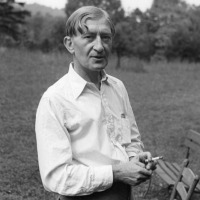
The Fundación Juan March presents the first retrospective in Spain on the work of the German-born, American abstract painter Josef Albers (1888-1976). A designer, photographer, typographer, poet and above all, abstract painter, Albers often said that among his aims in his art and life was that of achieving “maximum effect” through “minimum means.” This is reflected in the title of the present exhibition: JOSEF ALBERS. MINIMUM MEANS, MAXIMUM EFFECT.

The exhibition explores the artistic endeavours and teaching activities of Josef Albers, who was associated with the 20th-century’s most advanced experiments in art teaching (the Bauhaus and Black Mountain College)

Comprising more than one hundred works of art and other exhibits, in addition to furniture, objects, photography and a range of documentary material, this exhibition has been conceived and developed over the last three years in collaboration with the Josef and Anni Albers Foundation in Bethany, Connecticut.

Notwithstanding its retrospective character, the exhibition is not structured as a simple chronological survey of the artist’s work, although this would in itself be enormously enriching and instructive. Rather, it presents the work of Josef Albers as a project equally characterized by its coherence and its search for simplicity, its productive use of deliberately limited means and resources, its respect for manual labour and its emphasis on experimentation with colour, taking material shape in a body of work with a marked poetic and spiritual content. Albers’ output is decidedly the result of a judicious administration of artistic resources. In its totality, his oeuvre is the consequence of a true “economy of form”.

Albers’ theoretical and practical ideas are further detailed in the catalogue through a documentary section of texts by the artist, many previously unpublished and the majority translated into Spanish for the first time.

In conjunction with the exhibition in Madrid, the Fundación Juan March has organised an exhibition on the subject of Albers’ working process in his graphic work. Curated by Brenda Danilowitz, it will be shown at the museums in Palma (Museu Fundación Juan March, 2 April to 28 June 2014) and Cuenca (Museo de Arte Abstracto Español, 8 July to 5 October 2014). Albers’ graphic work, which he produced throughout his career, involves the same interest in economy of means, experimentation and innovation that characterise the rest of his oeuvre. Through a selection of more than 100 works loaned from the Josef and Anni Albers Foundation, this exhibition shows the variety of techniques used by the artist in his graphic work: intaglio printing, wood engraving, woodcut, lithography and silkscreen. In addition to prints, it also includes studies and drawings (many of them previously unexhibited), which reveal the artist’s working process and the way he gradually defined the image. Albers transformed the idea into form, offering the viewer unexpected visual experiences.

Read more
Read less

More information

Label
Dates
Text

From March 28th, to July 6th, 2014.

+ + copy Created with Sketch.
- + copy Created with Sketch.
Label
Location
Text

Fundación Juan March. Madrid, Spain.

+ + copy Created with Sketch.
- + copy Created with Sketch.

Josef Albers was born in 1888 in Bottrop, in the German region of Westphalia, into a family connected to artisanal trades. Before turning toward artistic practice, he worked as a primary school teacher, an experience that preceded a trajectory in which teaching and visual production would remain inseparably linked. After studying in Berlin, Essen, and Munich, he entered the Bauhaus in Weimar in 1920, one year after its founding by Walter Gropius as a site of convergence between art, technology, and industrial production in interwar Germany.

At the Bauhaus, Albers quickly moved from student to teacher. His initial training under Johannes Itten coincided with a period in which the school sought to redefine the material and perceptual foundations of artistic practice. In the glass workshop, he began developing abstract compositions made from fragments of industrial glass, investigating relationships between transparency, geometry, and seriality. From 1923 onward, he assumed teaching responsibilities within the preliminary course, the pedagogical core of the institution, where he promoted exercises focused on observation, the behaviour of materials, and formal economy. Following the Bauhaus’s relocation to Dessau in 1925 and later to Berlin, he continued to occupy a central position within the school’s academic structure, working alongside figures such as Paul Klee, Wassily Kandinsky, and László Moholy-Nagy. That same year, he married Anni Albers, whose textile research maintained multiple affinities with his own investigations into structure, repetition, and perception.

The closure of the Bauhaus in 1933, following pressure exerted by the Nazi regime on the institution, marked the beginning of his American exile. Josef and Anni Albers subsequently moved to North Carolina to join Black Mountain College, an experimental school that would bring together artists, musicians, poets, and choreographers associated with the cultural transformations of mid-twentieth-century America. There, between 1933 and 1949, Albers reformulated pedagogical methods previously developed in Germany and adapted them to a different intellectual context, one less oriented toward artisanal training and more closely aligned with interdisciplinary experimentation. His exercises on visual perception, contrast, and material structure influenced several generations of American artists, among them Robert Rauschenberg and Cy Twombly.

Albers’s teaching activity cannot be separated from his artistic production. His paintings, prints, and graphic studies developed from the 1930s onward emerged from specific problems related to chromatic perception and the spatial tensions generated by elementary forms. In 1949, he was appointed chair of the Department of Design at Yale University in New Haven, where he consolidated a pedagogical program centered on visual analysis and on the relationship between perceptual experience and formal construction. From Yale, he further expanded his influence on postwar American art education at a moment when art schools were redefining their curricula following the emigration of numerous European artists and intellectuals.

In 1950, he initiated the series Homage to the Square, developed over more than two decades and destined to become one of the central bodies of work in his visual research. Through systematic variations of concentric squares and precise chromatic combinations, these paintings examined how colour alters the perception of space, scale, and proximity between planes. Rather than establishing closed compositions, the works functioned as perceptual experiments in which each colour transformed the reading of the others. The same concern structured his pedagogical activity and found a decisive formulation in Interaction of Colour, published in 1963, a book conceived as an investigation into the perceptual instability of colour and the impossibility of understanding it as a fixed and autonomous property.

Throughout his career, Albers maintained a sustained attention to the relationships between perception, repetition, and structure. His travels to Mexico and other Latin American countries further expanded his interest in pre-Columbian architecture and in geometric systems embedded in walls, platforms, and constructive layouts, references that appear indirectly in several of his compositions and graphic series. In 1971, the Metropolitan Museum of Art in New York devoted a retrospective exhibition to his work, making him the first living artist to receive a solo exhibition at the institution. By that time, his work had come to occupy a central position in debates surrounding abstraction, pedagogy, and visual culture in the twentieth century, situated within a shared territory between artistic practice, theories of perception, and experimental teaching.

Read more
Published on: April 28, 2014
Cite:
metalocus, JOSÉ JUAN BARBA
"Josef Albers. Minimum Means, Maximum Effect" METALOCUS. Accessed
<https://www.metalocus.es/en/news/josef-albers-minimum-means-maximum-effect> ISSN 1139-6415
Loading content ...
Loading content ...
Loading content ...
Loading content ...
Loading content ...
Loading content ...
Loading content ...
Loading content ...
Loading content ...
Loading content ...
Loading content ...
Loading content ...
Loading content ...
Loading content ...
Loading content ...
Loading content ...
Loading content ...
Loading content ...
Loading content ...
Loading content ...
Loading content ...
Loading content ...
Loading content ...
Loading content ...
Loading content ...
Loading content ...
Loading content ...
Loading content ...
Loading content ...
Loading content ...
Loading content ...
Loading content ...
Loading content ...
Loading content ...
Loading content ...
Loading content ...
Loading content ...
Loading content ...
Loading content ...
Loading content ...
Loading content ...
Loading content ...
Loading content ...
Loading content ...
Loading content ...
Loading content ...
Loading content ...
Loading content ...
Loading content ...
Loading content ...
Loading content ...
Loading content ...
Loading content ...
Loading content ...