The "Community Central Pavilion" was one of the proposals made on the occasion of the invitation to design different temporary pavilions as part of Design Week 2018, in Mexico, on October 13th, a pavilion was erected in the Lincoln Park pond, Polanco, in Mexico City, presented as, Community Central, whose authors were the architecture studios, TO, (lead by José Amozurrutia and Carlos Facio) and LANZA Atelier (by Isabel Abascal and Alessandro Arienzo) and the architect and sculptor Alberto Odériz.
The pavilion is an ephemeral construction that was raised with the intention of having a second life when it was rebuilt as part of the Community Center that the architects are building in Ocuilan, a small town about 100km south of Mexico City, which was very affected by the earthquake of September 19, 2017. The pieces with which it was made, were stacked in the same way in which the blocks are placed to dry consists of twelve thousand bricks of compacted earth that echo the earthquakes occurred in 2017 and the subsequent reconstruction tasks.  
 
"From the beginning, our goal was to create a structure that would transcend. We decided to focus on a single material and utilized walls made from compacted earth, an extremely ecological material since the production uses 1% of the energy used to produce conventional materials."  

Built as a linear shape on the pond, through a path on water, also made with the same type of blocks, it ends up enclosed between three walls that show at the bottom what looks like a large rock floating in the air.
 
"We wanted to begin with a walkway, an invitation to stroll over the water. The path is enclosed between three walls that form a U-shape 2.20m above the pond, creating a structure that opens to the sky. The experience takes visitors on a 26-meter long path where water becomes air. Reflections, tricks of the light, and, finally, a stone that appears to be suspended in air, all add to the experience of gravity-defying magic."

The 60-centimeter-thick walls are perforated as a way to broaden the vision of the people who enter the pavilion. The blocks are manufactured using hydraulic pressure applied to the earth with a bit of mixed cement to give them structural stability. With this system blocks of high resistance, waterproof and with thermal and acoustic insulation are achieved. This same system could be applied to housing structures with a height of less than 5 floors and would be 25% cheaper than traditional means.

Centro Comunitario was carried out with the support of PienZa Sostenible, Échale a tu casa, Fideicomiso Fuerza México, Love Army Mexico, Reconstruct MX, FICA Fair of Friendly Cultures and Fundación Origen, and it was possible to visit in Lincoln Park, Polanco, Ciudad de Mexico until October 21, 2018.
Read more
Read less

More information

Label
Authors
Text
TO (Jose G Amozurrutia and Carlos Facio), LANZA ATELIER (Isabel Abascal and Alessandro Arienzo), Alberto Odériz.
+ + copy Created with Sketch.
- + copy Created with Sketch.
Label
Collaborators
Text
Alejandro Palafox, Úrsula Rebollar, Paul Ino; and the teams of Juan Manuel Escobar and Francisco Escobar.
+ + copy Created with Sketch.
- + copy Created with Sketch.
Label
Commisioners
Text
Design Week 2018, Arch Days CDMX, Échale a tu casa, Pienza Sostenible, Reconstruir México, #LoveArmyMexico, Fundación Origen, Fideicomiso Fuerza México.
+ + copy Created with Sketch.
- + copy Created with Sketch.

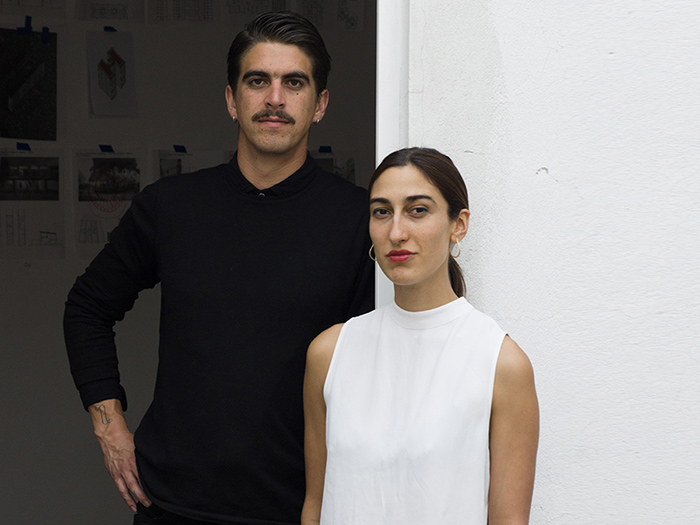
LANZA Atelier is an architecture studio based in Mexico City, founded in 2015 by Isabel Abascal and Alessandro Arienzo, with the purpose of making meaningful contributions to the beauty of the world. Since its foundation, LANZA atelier has been nominated for the 2016 Ibero-American Architecture Biennial Award, the Mies Crown Hall Award for Emerging Architects (IIT Chicago) in 2016 and 2022, and the Brick Award 2021. The studio received an Honourable Mention in the 2016 Competition for the El Eco Museum Pavilion and is a recipient of the Young Architects Prize 2017 and the Emerging Voices Award 2023 from the Architectural League of New York, which described their multimodal work as one that “expresses an inventiveness, a sensitivity to context, and a compositional refinement that spans scales and forms.”

LANZA atelier’s first solo exhibition, New Work, took place at SFMOMA in 2018. Since then, their work has been exhibited at the 12th São Paulo Architecture Biennale (2019), the Lisbon Triennale (2019), the Concéntrico Festival in Spain (2021), and the Latin American Architecture Biennial (BAL) 2023. In addition, they have presented their work at Syracuse University (2025), Yale University (2024), CU Denver (2024), UTSA (2023), Cal Poly Pomona as part of the VDL House Residency Program (2022), and the Constructing Practice Symposium at Columbia University (2019), among others. Upcoming projects include a solo exhibition of their furniture designs at AGO Projects in Mexico City, opening on 3 February 2026, and the design of the Pavilion of the Republic of Kosovo for the 61st Venice Art Biennale, curated by José Esparza Chong Cuy and presenting a new commission by Brilant Milazimi titled Hard Teeth (Dhembë të Fortë).

Isabel Martínez Abascal studied architecture at the Universidad Politécnica de Madrid, the Technische Universität Berlin, and the Vastu Shilpa Foundation in Ahmedabad under B. V. Doshi. She collaborated with SANAA (Tokyo), Aranguren y Gallegos (Madrid), Anupama Kundoo (Berlin), and Pedro Mendes da Rocha (São Paulo). She was a design studio professor for six years at the Faculty of Architecture and Urbanism, Escola da Cidade, in São Paulo. She has participated as a faculty member in the 24th International Workshop in Cartagena, the Ibero-American Biennial in Medellín (2010), the International Seminar in Curitiba (2012), and the Rio Olympics Workshop at the California College of the Arts (2012).

She participated in the comisariado of the 10th Biennial of Architecture of São Paulo (2013) and comisarió the exhibition 13 for the inaugural cycle of the La Conservera Museum, Murcia (2014), as well as the exhibition Visionary Instruments by artist Almudena Lobera at the ECCO Museum, Cádiz (2015). From 2015 to 2017, she was Executive Director of LIGA, Space for Architecture, in Mexico City. She co-edited the book Exposed Architecture, published by Park Books. Her proposal, Mother Architecture: Shaping Birth, was a finalist for the Harvard GSD 2023 Wheelwright Prize, and her project, "Investigaciones sobre creación y procreación", received the National Fund for the Arts Prize 2023.

Alessandro Arienzo studied architecture at the Universidad Iberoamericana in Mexico City, graduating with honours. In 2012, he designed Archivo Diseño y Arquitectura’s inaugural exhibition Happiness Is a Hot (and Cold) Sponge with Rodrigo Escandón. He collaborated with Taller de Arquitectura Rocha + Carrillo, Taller Tornel, and Frida Escobedo, with whom he developed the conceptual project for the Mexico Pavilion at the Victoria & Albert Museum during the London Design Festival 2015, the renovation of the Fondo de Cultura Octavio Paz bookshop (2013), and the Public Stage Pavilion for the Lisbon Triennial (2013).

He explores the possibilities of architectural practice through hand-drawing and publishing projects, including the Housetypes book series. In 2017, he received the National Fund for the Arts Young Creators Prize. With this grant, he developed an investigation into the Security and Citizen Participation Modules network, the resulting work of which became part of SFMOMA’s permanent collection in 2018. Several of his designs have been showcased institutionally, including A Family of 4, which is part of the Denver Art Museum collection.

2025 >

2025 >

Read more
TO is the architecture workshop, established in Mexico City, directed by José Amozurrutia and Carlos Facio. His collaboration begins in childhood with musical projects, later in the Faculty of Architecture of the UNAM with the development of academic projects. Later they are trained and collaborated with various architects such as Mauricio Rocha, Gabriela Carrillo, Tatiana Bilbao, Mario Lazo, Carla Juaçaba (Rio de Janeiro) and Fernando Viégas (São Paulo).

Recent projects include the winning contest for the 2018 Eco Pavilion, "Bell Tower", and the contest won to develop the Pavilion of the International Fair of Friendship Cultures 2018, in the Zócalo. They are currently developing a music school in Iztapalapa for the Khitara Foundation, a prototype Water Collection System for the CCHs of the UNAM in collaboration with Isla Urbana and various houses in the Valley of Mexico.

Currently the TO team is made up of Mariana Brito, Ursula Rebollar, Álvaro Martínez, Patricia García and Elisa Vargas.
Read more
Published on: November 25, 2018
Cite:
metalocus, INÉS LALUETA
"Community Central Pavilion: A pavilion to remember the fragility of matter" METALOCUS. Accessed
<https://www.metalocus.es/en/news/community-central-pavilion-a-pavilion-remember-fragility-matter> ISSN 1139-6415
Loading content ...
Loading content ...
Loading content ...
Loading content ...
Loading content ...
Loading content ...
Loading content ...
Loading content ...
Loading content ...
Loading content ...
Loading content ...
Loading content ...
Loading content ...
Loading content ...
Loading content ...
Loading content ...
Loading content ...
Loading content ...
Loading content ...
Loading content ...
Loading content ...
Loading content ...
Loading content ...
Loading content ...
Loading content ...
Loading content ...
Loading content ...
Loading content ...
Loading content ...
Loading content ...
Loading content ...
Loading content ...
Loading content ...
Loading content ...
Loading content ...
Loading content ...
Loading content ...
Loading content ...
Loading content ...
Loading content ...
Loading content ...
Loading content ...
Loading content ...
Loading content ...
Loading content ...
Loading content ...
Loading content ...
Loading content ...
Loading content ...
Loading content ...
Loading content ...
Loading content ...
Loading content ...
Loading content ...