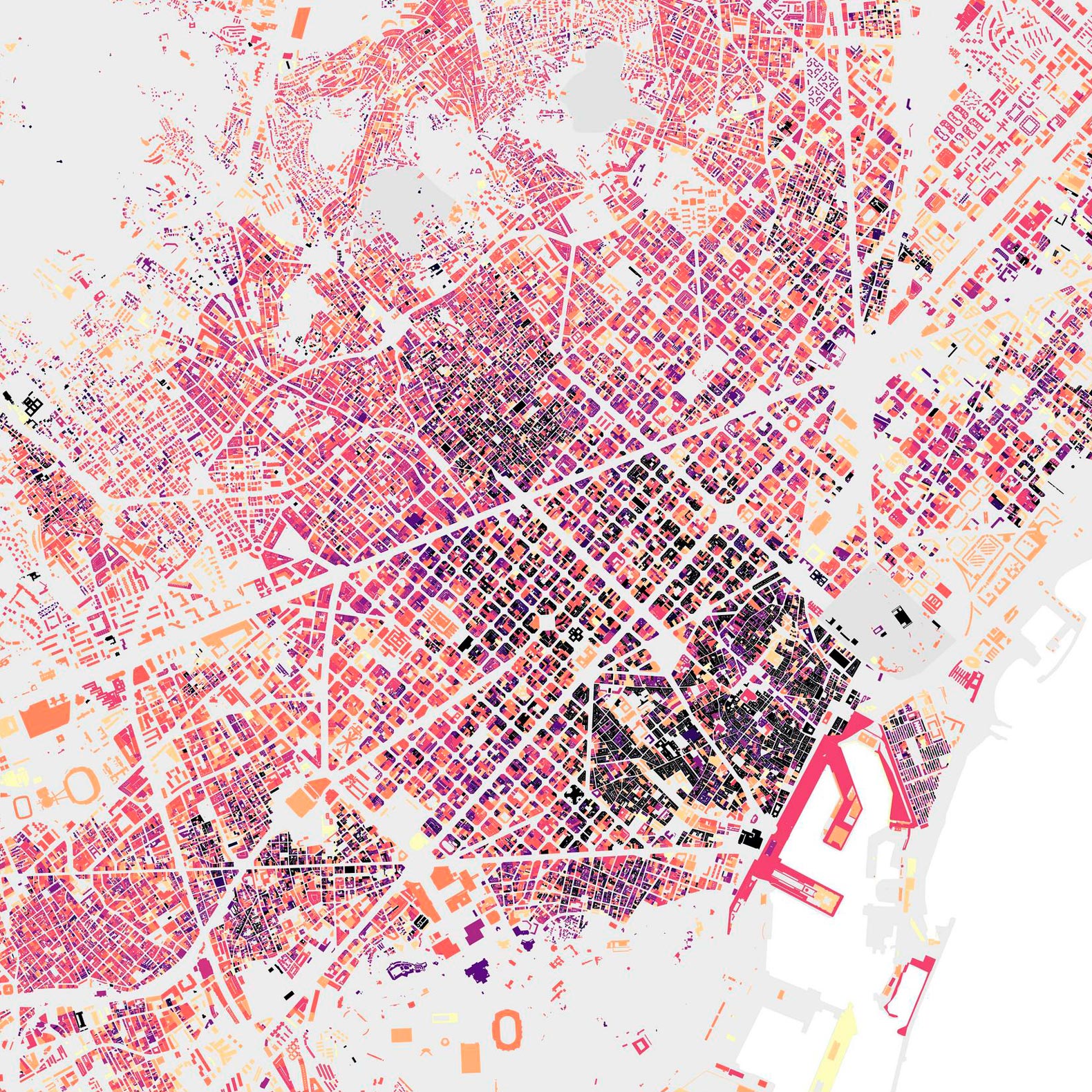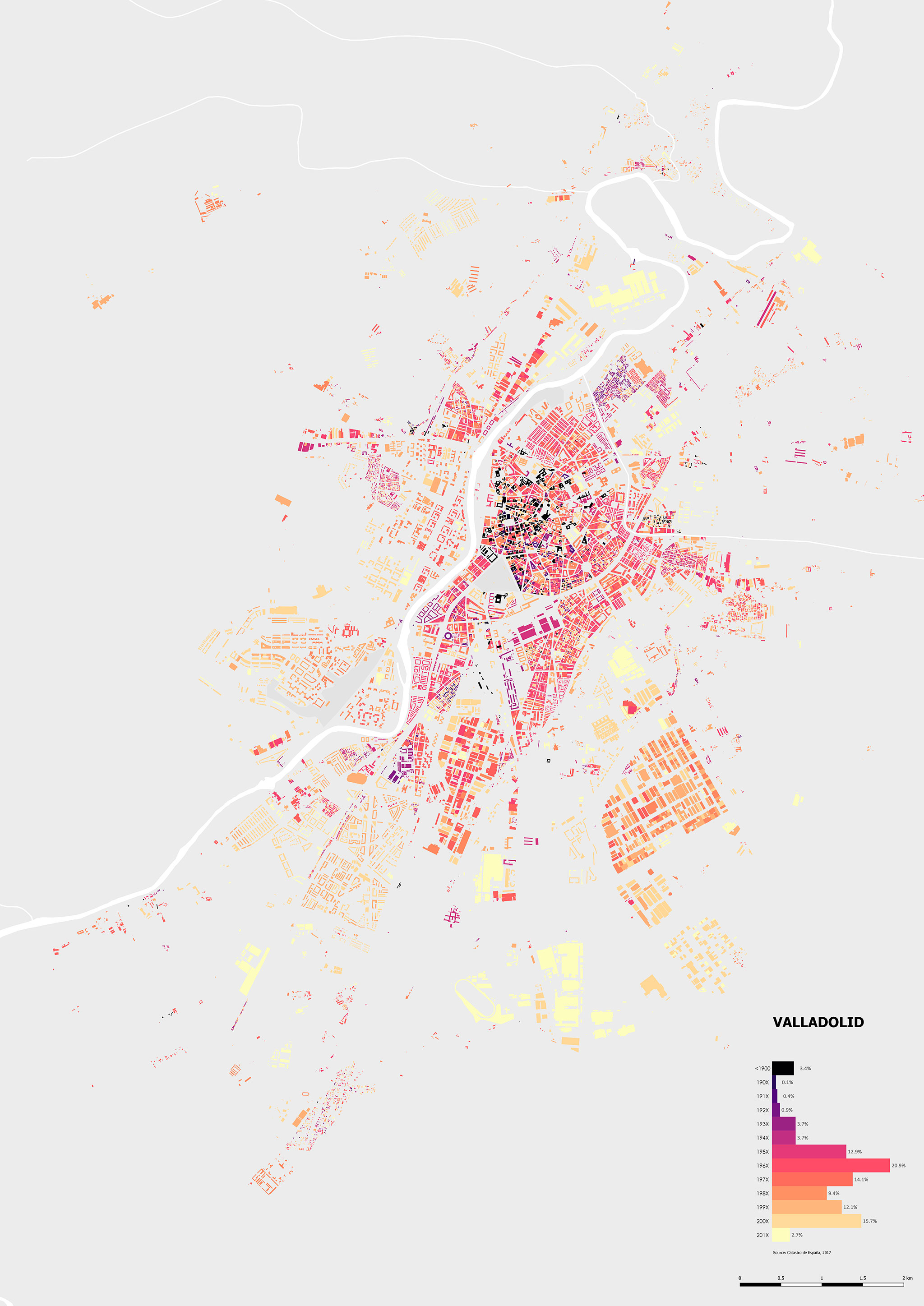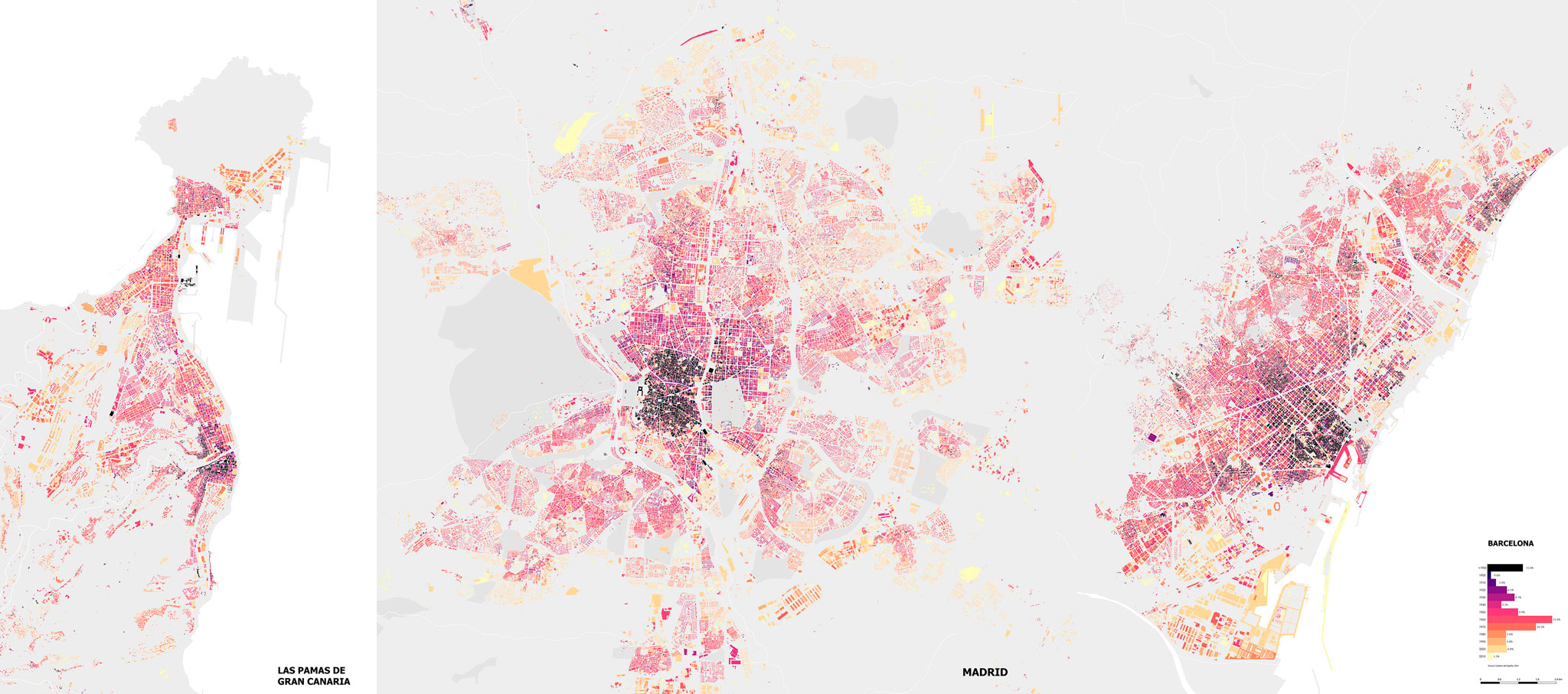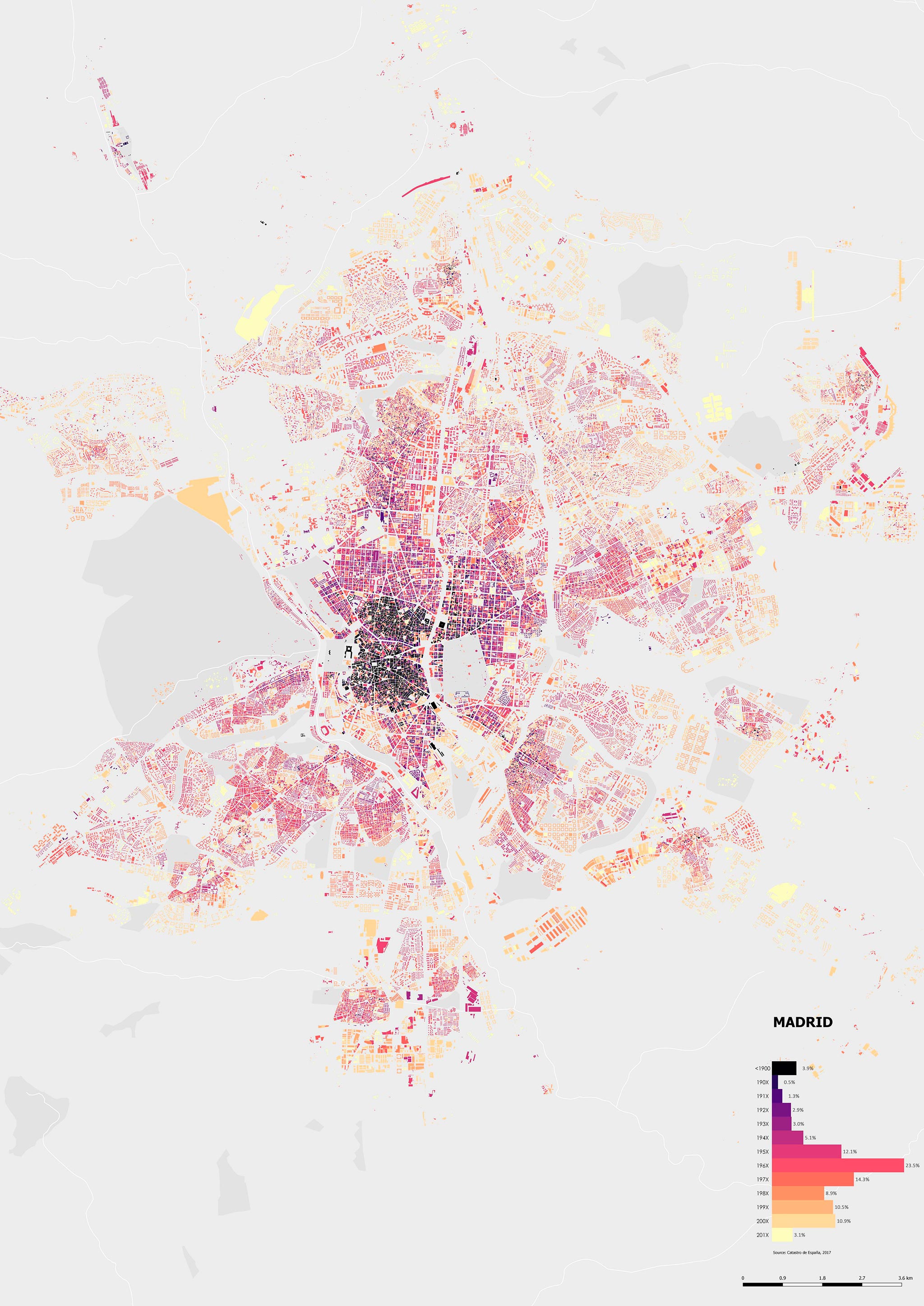
In Sydney any building with more than 100 years is considered heritage and building of special consideration. If the parameters are moved to Europe, the criteria change and the antiquity of the criteria to catalog are more restrictive parameters.

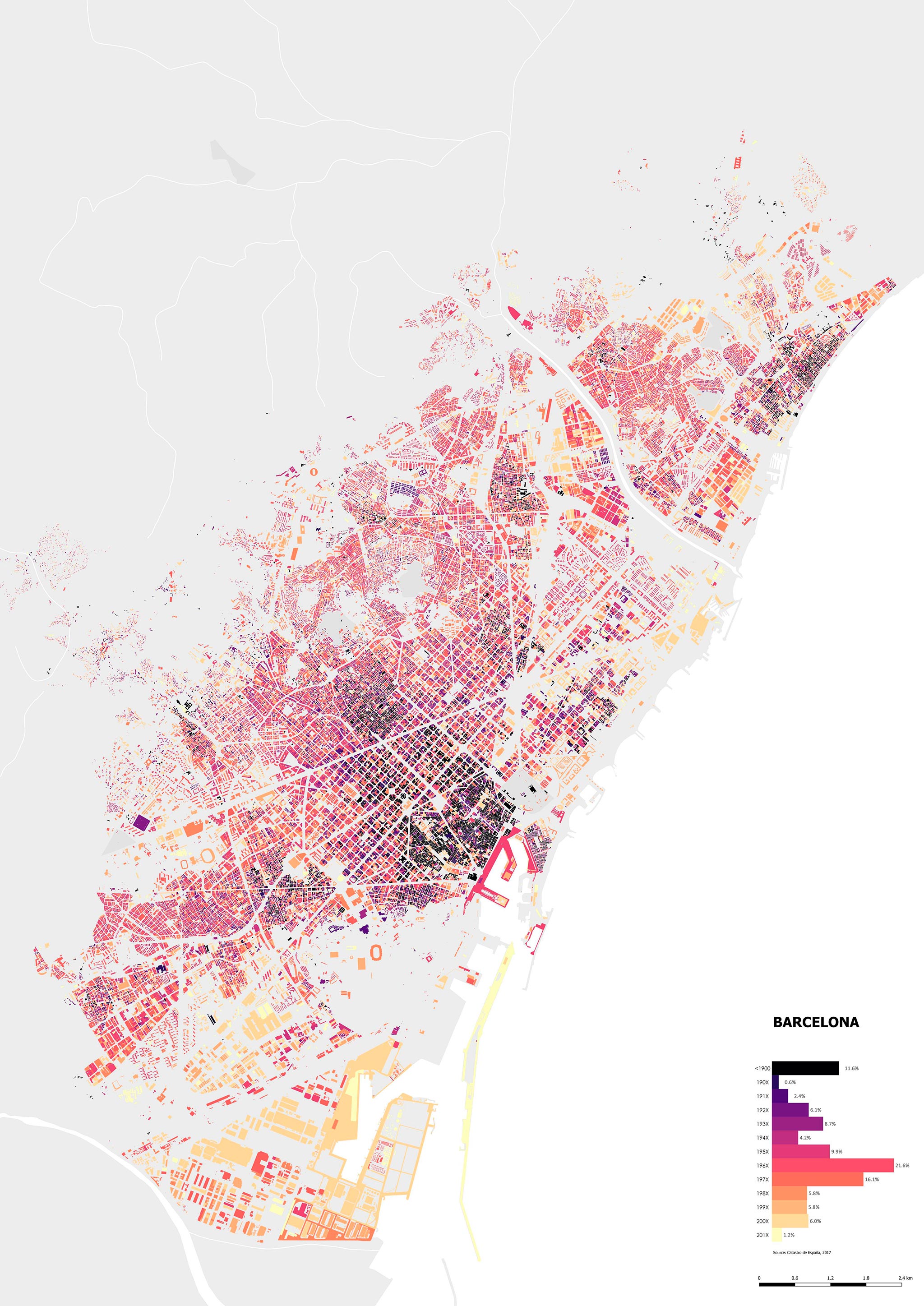
The aging of cities, that is, the recognition of their morphology, and not that of the populations that inhabit them, (which is also an extremely interesting aspect to know the vitality of a city) changes according to many factors, such as when it was founded the city, how quickly it grown, when it was renovation, destruction or maintenance shown by its buildings. Knowing the aging of a city is not always easy.


Today's merchandising processes have been creating in every city registration structures that are increasingly accurate, marking property data, property value, size, year of construction, year of ownership transfer, interventions ... Each country has been creating its own registry and if did not  (as in many countries of the old Iron Curtain), problems have arisen to identify owners, maintenance responsibilities, duties and charges.

One of the most developed tools for understanding our cities is the QGIS system. It is a Free and Open Source Geographic Information System.

In the Spanish case some computer tools available for free and relatively easy access help this system to generate interesting maps like the ones presented today, developed by Daniskarma, a Reddit user who has shared his work in r/DataIsBeautiful.

As explained in its Daniskarma entry, the QGIS has a plug-in called Spanish Inspire Catastral Downloader that allows you to choose a province and automatically download the data, drawing maps that help us in the knowledge of your analysis and diagno- sis before you start intervening in them.

Here, we leave your explanation and links that are quite illustrative:

Of course, for theses maps I used a shortcut. QGIS has a plugin named Spanish Inspire Catastral Downloader that let you choose a province and automatically download the data. In the building layer you have a field named "end" which is the end of construction date.

If you want to make a manual donwload, you'll have to go to the catastro main page https://www.sedecatastro.gob.es/ and select: "Descarga de datos y cartografía por municipio", then you have to donwload the shapefiles and the CAT files (which contain the age of construction data). But a electronic certificate is needed in order to download this data (It's free to make but it takes some paperwork to get one). I prefer to use the QGIS plugin.

All of this work for all Spain but Navarra and Euskadi, both of them have their own Catastro system. Althought the process is quite similar.

More information

José Juan Barba (1964). Architect from the Madrid School of Architecture (ETSAM) in 1991. He received his PhD in Architecture from ETSAM in 2004, graduating summa Cum laude with the doctoral thesis "Inventions: New York vs. Rem Koolhaas, Bernard Tschumi, Piranesi." In 1991, he received a Special Mention in the Spanish National Graduation Awards. Until 1997, he worked as an advisor to several NGOs. In 1992, he founded his architectural practice in Madrid (www.josejuanbarba.com). 

He is an architectural critic and, since 1998, Editor-in-Chief of the internationally acclaimed bilingual architecture journal METALOCUS (Spanish/English), recipient of several national and international awards.

Barba is an Associate Professor at the University of Alcalá and a member of several research groups. He has been invited to participate in numerous international forums on architecture and urbanism, including the II Forum of Mexican World Heritage Cities, Urban Development, History and Modernity, organized by the Pan-American Committee for Urban Development and Historical Heritage; the World Urban Development Forum (FMDU), held in Culiacán, Sinaloa, Mexico; and the International Conference on Architecture and Urbanism from the Perspective of Women Architects. He has also been invited as lecturer and guest critic at numerous national and international institutions, including the National Building Museum, Roma Tre University, Politecnico di Milano, University of Genoa, Université Pierre Mendès France Grenoble, the Madrid and Barcelona Schools of Architecture, National Autonomous University of Mexico, the Faculty of Architecture in Montevideo, the Schools of Architecture of Medellín and Ecuador, Universidad Iberoamericana, IE University, as well as the Schools of Architecture of Zaragoza, Valladolid, Málaga, Granada, Seville, and A Coruña, among others.

He has extensive professional experience in architecture, urbanism, landscape intervention, and territorial regeneration. His work has received numerous awards, including First Prize in the “Gran Vía Posible” competition for Delirious Gran Vía, Madrid; recognition for the Rivers Interpretation Centre in Zamora, awarded and exhibited at the World Architecture Festival 2008; and recognition for the Santa Bárbara Park project in Toledo. He was also awarded the Erich Degner Prize for Architecture (1995), promoted by the BBVA Foundation. His project for a Day Centre for the Elderly was included in Volume 3 of the Madrid Architecture Guide published by the Official College of Architects of Madrid (COAM) in 2007. His work has been widely published in national and international books and journals.

He served as Maître de Conférences at the Institut d’Urbanisme de Grenoble, Université Pierre Mendès France Grenoble, during the 2013–14 academic year, following his appointment through a European open competition. His work has been published internationally. He regularly serves on academic and professional juries, including the editorial competition jury for the journal Quaderns (2011), the selection committee for the European Union Prize for Contemporary Architecture – Mies van der Rohe Awards (2007–present), and the jury panels for EUROPAN 13 (2015–16) and TRANSFER, Zurich (2019). He was also invited to participate in the Biennale di Venezia 2016 as part of the exhibition Spaces of Exception / Spazi d’Eccezione.

He has authored several books, including "The Dark Line. michele&miquel, dA Vision Design" (2024), "CONGRESO ANYWAY. La ciudad de las ciudades" (2020), "#Positions" (2016), and "Inventions: New York vs. Rem Koolhaas, Bernard Tschumi, Piranesi" (2015). He has also contributed to publications such as "Espacio público Gran Vía. La Ciudad del Turismo" (2020), "Spaces of Exception / Spazi d’Eccezione" (2016), "La manzana de la discordia" (2015), and "Contemporary Japanese Architecture: New Territories" (2015), as well as chapters in numerous books, including "Women Architects: A Professional Challenge" (2009), "21st Century Architectures" (2007), "Ruta de la Plata, New Conquerors of Space" (2019), and "The City of Tourism" (2020).

Selected awards include:

•    “SANTIAGO AMÓN” AWARD, award for the promotion of architecture, COAM Madrid, 2000.
•    “PANAYIOTI MIXELI AWARD,” SADAS-PEA, award for the promotion of architecture, Athens, 2005.
•    “PIERRE VAGO” ICAC. International Committee of Art Critics Award, London, 2005.
•    FAD Award 07, Ephemeral Interventions, First Prize, M.C. Escher Exhibition, Arquin-FAD, Barcelona, 2007.
•    World Architecture Festival, Center for Research and Interpretation of the Rivers, Tera, Esla, and Órbigo, Finalist, Barcelona, 2008.
•    Gran Vía Posible, First Prize, Delirious Gran Vía, Madrid, 2010.
•    Reform of the Río Segura Surroundings, Award, Murcia, 2010.

Read more
Published on: October 29, 2017
Cite:
metalocus, JOSÉ JUAN BARBA
"Buildings by age in four Spanish cities. Madrid, Las Palmas, Barcelona and Valladolid" METALOCUS. Accessed
<https://www.metalocus.es/en/news/buildings-age-four-spanish-cities-madrid-las-palmas-barcelona-and-valladolid> ISSN 1139-6415
Loading content ...
Loading content ...
Loading content ...
Loading content ...
Loading content ...
Loading content ...
Loading content ...
Loading content ...
Loading content ...
Loading content ...
Loading content ...
Loading content ...
Loading content ...
Loading content ...
Loading content ...
Loading content ...
Loading content ...
Loading content ...
Loading content ...
Loading content ...
Loading content ...
Loading content ...
Loading content ...
Loading content ...
Loading content ...
Loading content ...
Loading content ...
Loading content ...
Loading content ...
Loading content ...
Loading content ...
Loading content ...
Loading content ...
Loading content ...
Loading content ...
Loading content ...
Loading content ...
Loading content ...
Loading content ...
Loading content ...
Loading content ...
Loading content ...
Loading content ...
Loading content ...
Loading content ...
Loading content ...
Loading content ...
Loading content ...
Loading content ...
Loading content ...
Loading content ...
Loading content ...
Loading content ...
Loading content ...