

"Casa Batlló Contemporary seeks to foster a dialogue between past and future, placing Antoni Gaudí's legacy in a contemporary setting. Through art and architecture, he explores his radical vision from the perspective of contemporary thinking, remaining faithful to his innovative and disruptive spirit, in connection with the dynamism of today's Barcelona art scene."
María Bernat, director of Casa Batlló Contemporary.
"Beyond the Façade": The Inaugural Exhibition
The exhibition space designed by Mesura will debut with "Beyond the Façade," an exhibition curated by United Visual Artists, the London-based art collective founded by Matt Clark. Exploring the multiple cycles of life through light and movement, the exhibition will invite visitors to interact with the work firsthand. The British artist's collaboration adds to the interventions that the home has hosted, such as the one carried out on the staircase by Japanese architect Kengo Kuma in 2021.
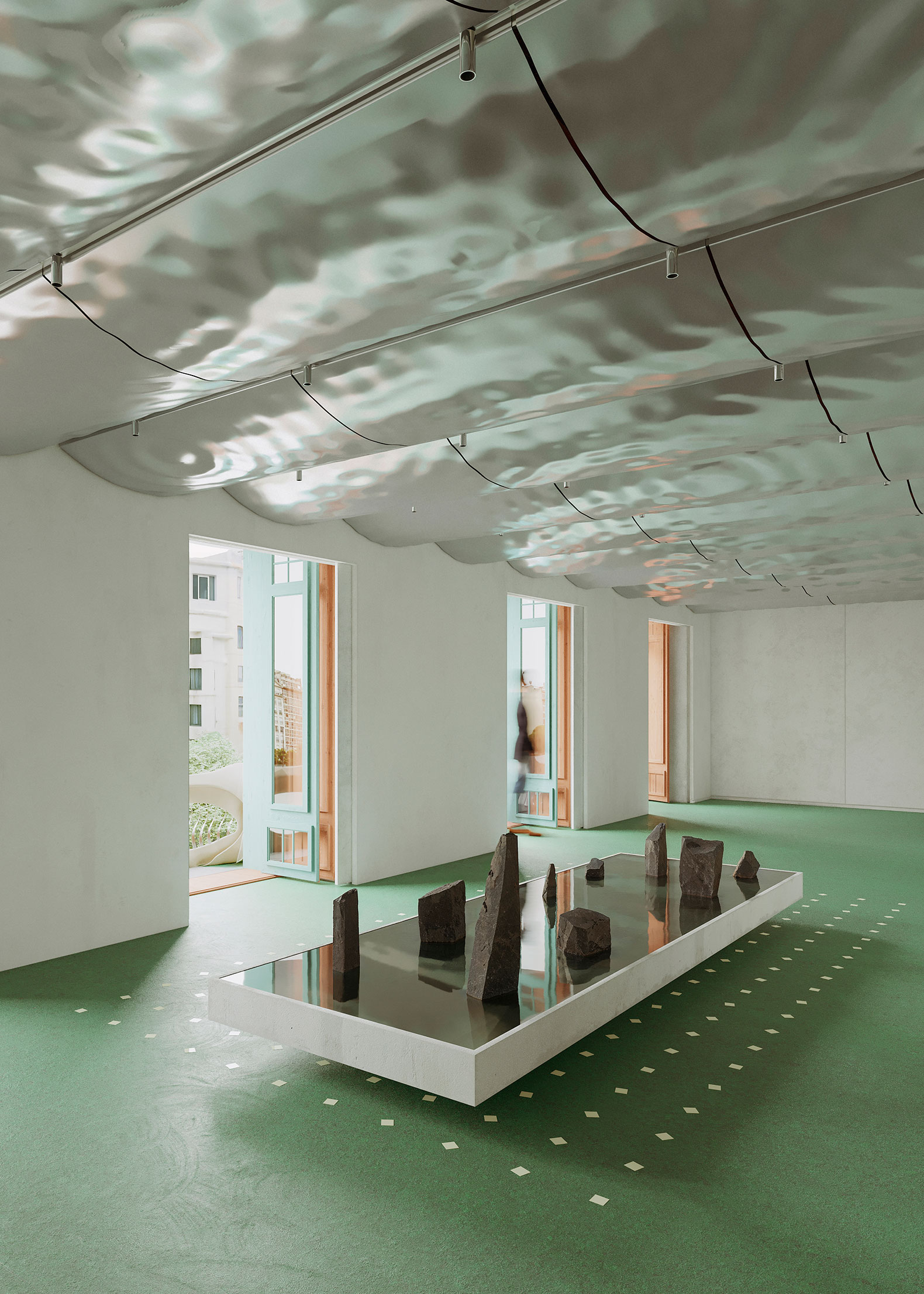
Second floor of Casa Batlló. Intervention by Mesura. Rendering by Ethandeclerk.
Architectural Dialogue with Architectural Memory
Without neglecting the essence of the iconic original building, the intervention preserves woodwork and stained glass, fusing architectural memory with a contemporary architectural language. The main element of the new gallery, a curved metal roof, gives the project its own identity while responding to its structural function. Created using robotic technology, the concentric waves evoke the fall of a drop of water into a calm lake.
Gaudí's Hidden Garden
Memoir of a Historic Restoration
In 2024, Casa Batlló, known as the House of Light and Color, carried out the first comprehensive restoration of its rear façade, uncovering the original colors of the wrought iron, wood, and stucco, sadly hidden beneath multiple layers of paint.
Originally conceived as an oasis of refuge from the chaos of the big city, the intimate space of the courtyard was transformed, recovering elements such as the railings, the paving, the rear wall, the planters, and a heather-covered pergola. Through a careful analysis of archival photographs, those missing elements of the courtyard have been faithfully reproduced.
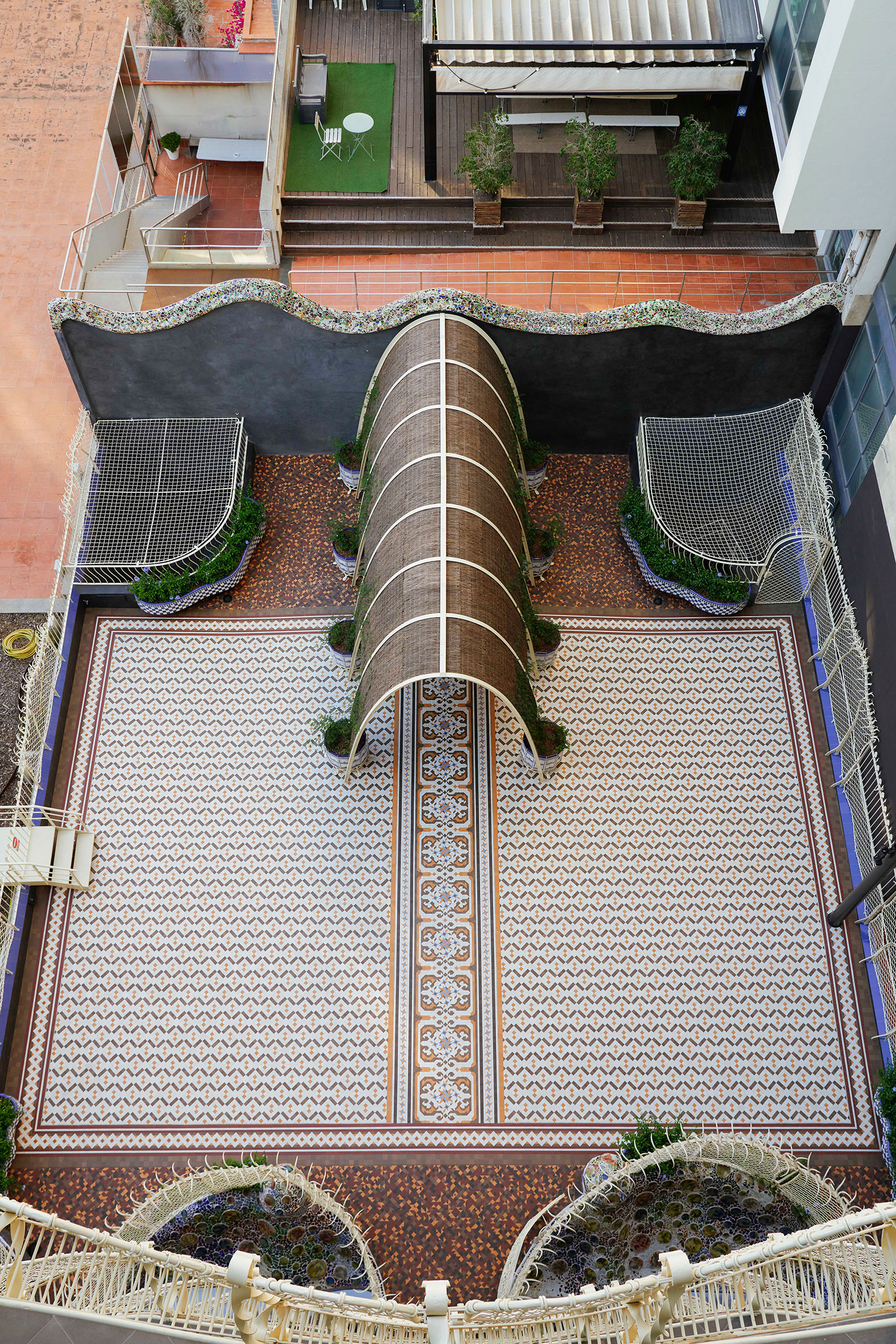
Courtyard after restoration. Photograph by Claudia Mauriño.
The artisanal expertise of Recop, Arcovaleno (restoration teams that collaborated in parallel on the project), and master craftsman Manel Diestre have highlighted materials such as the ceramic trencadís and glass characteristic of the heritage building.
The elements that were the focus of the transformation—the railings, planters, and uprights—followed strict UNESCO restoration standards, replacing only those elements that had lost more than 75% of their original material.
A collective work full of surprising discoveries
"When we discovered the original colors, we couldn't believe it. The current façade is like a photographic negative of the previous one."
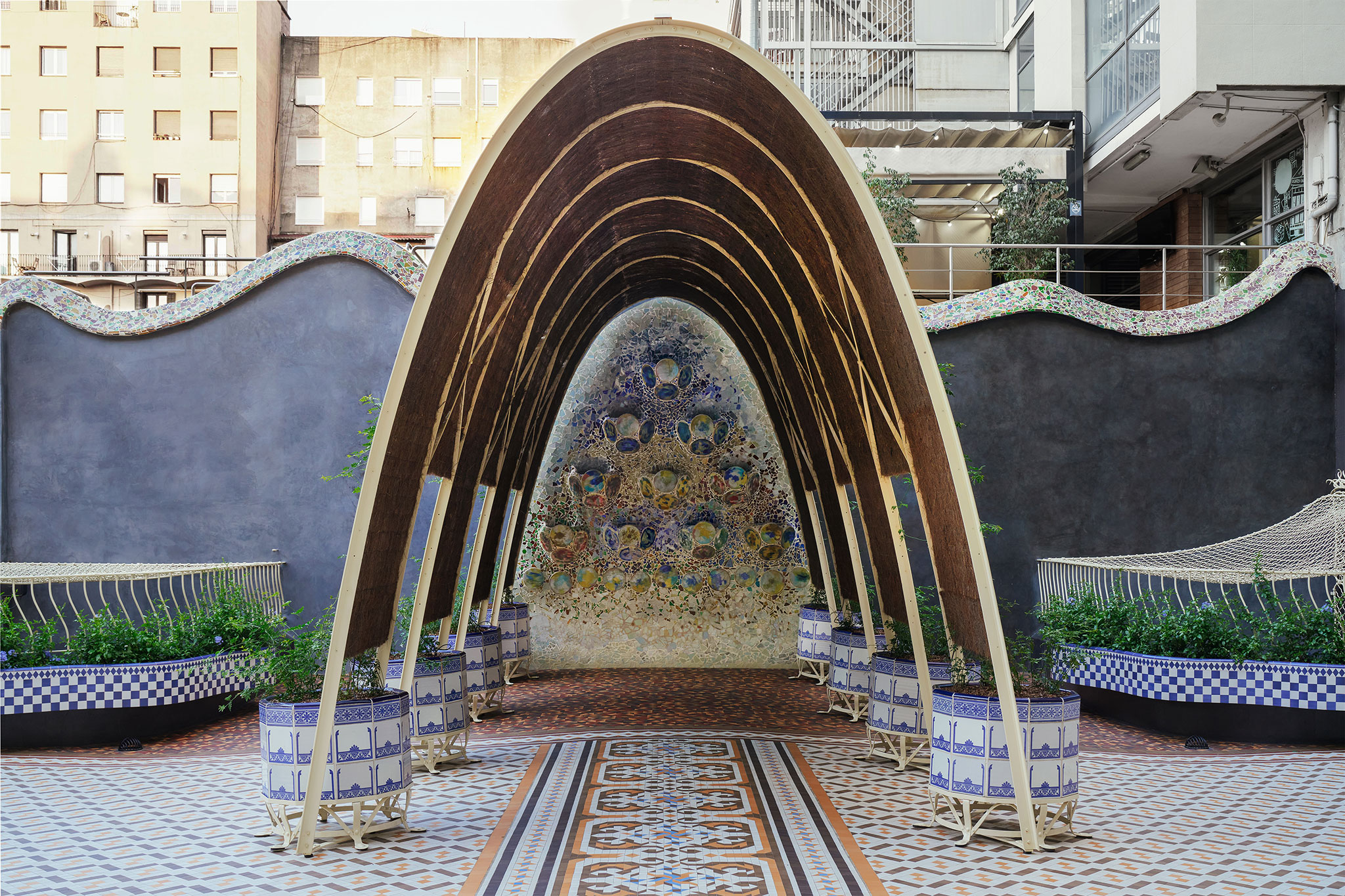
Pergola after restoration. Photograph by Claudia Mauriño.
This is how Xavier Villanueva, the architect in charge of the restoration, describes the excitement of receiving the results of the first stratigraphic tests during the pandemic, which analyzed the original colors hidden beneath multiple layers of paint on the wood, wrought iron, and stucco. In addition to the laboratory analyses, extensive documentary, photographic, and architectural research was carried out, using 3D scanning, photogrammetry, and other digital techniques to ensure the project's accuracy.
"The discoveries we have made are related in shapes, colors, and materials to the rest of Casa Batlló. As we restore, we reach the essence of Gaudí, and the entire house gains harmony," added Villanueva.
Gary Gautier, General Manager of Casa Batlló.


