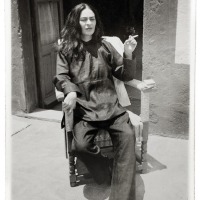
Lola Álvarez Bravo was born on April 3 in the Mexican state of Jalisco and died at the age of 90 in Mexico City on July 31, 1993. She was one of the most important photographers in Mexico, becoming the friend and photographer of Frida Kahlo and María Izquierdo.

Dolores Martínez de Anda, her maiden name, adopted the two surnames of her husband, also a photographer, Manuel Álvarez Bravo, whom she married in 1925 and from whom she would end up separating in 1934. It was through her marriage that Lola Á. Bravo discovered the world of photography and began her own learning path, where she also worked with her husband, with whom she opened her first photography revelation workshop.

Early years
Lola Álvarez Bravo seemed unsure what to do; however, she clearly wanted to develop outside the parameters established by Mexican society at the time. The death of her mother, followed by the death of her father when she was 13 years old, seemed to have truncated her destiny, moving her together with her brother Miguel to their uncles' house. Her education was surrounded by a religious environment, having been interned for two years in a school run by the Teresian nuns.

"Since I was little, with my father, I thought that I had to do something that was not common and ordinary, although they educated me very badly, they educated me for everything useless, because what I hated most in my life is that they ordered me and limited my freedom."

Lola Álvarez Bravo1

She met who would be her husband once she finished high school, since he was a friend of her brother. She began as an assistant to her husband (Manuel Álvarez Bravo), and later they married. Lola Á. Bravo took up photography professionally when her husband fell ill, and she had to finish a project. It was from this moment that he could begin to develop the knowledge that he had previously acquired in a self-taught way.

Beginning of his photographic career
In 1927, in Mexico City, she and her husband created an art gallery in addition to inaugurating what would be her first professional photographic studio: Álvarez Bravo Photography Studio. In this studio, she not only worked with her husband but also with other artists such as Rufino Tamayo and María Izquierdo (both painters), with whom she directed her first collective exhibition, including works by Diego Rivera and Agustín Lazo (political muralist and painter, respectively).

Although Lola Á. Bravo began to become known among Mexican artists, it was not until the forced deportation of her friend and photographer Tina Modotti that she was able to get her first camera of her own. Tina Modotti sold her two cameras to the Álvarez Bravo couple in order to raise enough money and leave the country. One of the cameras was kept by Manuel and the other, a Graflex, was kept by Lola.

Development and stardom
With the subsequent divorce between Lola and Manuel, she did not eliminate the surnames she had adopted from her ex-husband, since artists and colleagues knew her by that name. The friendships established and a series of fortuitous events, thanks to her dedication and work, led her to a profitable development in her photographic work. One of her greatest clients and friends is the well-known Frida Kahlo, with whom she worked and for whom she was the first person to show the artist's pictorial work. Through a personal effort driven by her own determination, she presented her work to various personalities who supported her and was able to present her first personal exhibition in 1944, at the Palacio de Bellas Artes in Mexico City.

"When Frida spoke, when she walked, when she painted, when she expressed herself, she already inspired something. To me, it was like birds and flowers and knitted bedspreads; a Mexican style that concentrated an era and poured through it. Frida was that."

Lola Álvarez Bravo2

Her modernist style showed the daily life of people while playing with the lights and shadows of the moment he portrayed. Her recognition came in different moments; however, her appointment as Director of Photography at the National Institute of Fine Arts was one of the most memorable. Lola Álvarez Bravo continued with her personal exhibitions until, at 86 years of age, she lost her sight. Finally, his death on July 31, 1993, left an artistic legacy that is collected at the Center for Creative Photography (CCP) at the University of Arizona, in Tucson. For the photographer, her photographs "represent a Mexico that once existed." 3

NOTES.-

1. Alberto López. «Lola Álvarez Bravo, la retratista del modernismo cotidiano». Spain: El País, 04/04/2020.
2. Javier  Aranda Luna. «La memoria de Lola Álvarez Bravo». México: La Jornada, 26/04/2017.
3. Ibidem, (1).

More information

Lola Álvarez Bravo (Dolores Martínez de Anda) was a Mexican photographer, a pioneer of the modernist style that reflected the daily life of the country. He was born on April 3, 1903, in Jalisco and died on July 31, 1993, in Mexico City.

Her photographic career began with her marriage to the photographer Manuel Álvarez Bravo, from whom she adopted her surnames, giving rise to her artistic name. The friendly relations that she maintained with different contemporary artists of her time and the exhibition of her work in different art galleries, led her to receive various recognitions, many of which resulted in nationally recognized jobs, as a teacher. of photography at the Academia de San Carlos in Mexico City or worked in the Art Laboratory of the Institute of Aesthetic Research at UNAM.

Her greatest peak was witnessed in the '50s and' 60s, in which, thanks to his good understanding with Frida Khalo, María Izquierdo, Julio Castellanos and Emilio Amero, he exhibited his photographs both individually and collectively.
Read more

Frida Kahlo (Coyoacán, Mexico City, July 6, 1907–Coyoacán, Mexico City, July 13, 1954). Magdalena Carmen Frida Kahlo Calderón, born Magdalena Carmen Frida Kahlo Calderón, was a Mexican painter whose work developed one of the most distinctive explorations of identity, the body, and Mexican culture in twentieth-century art. Although her career was closely connected to Diego Rivera and to the artistic environment that emerged after the Mexican Revolution, her painting maintained an independent position, far removed from the monumental scale and predominantly public character of muralism.

The daughter of photographer Guillermo Kahlo and Matilde Calderón, she grew up in the Casa Azul in Coyoacán, later converted into the Frida Kahlo Museum. Photography was deeply present in her family environment and played a constant role in the construction of her own image. The photographic archive she preserved throughout her life, also addressed by METALOCUS on the occasion of the exhibition Frida Kahlo – Her Photos, includes works by figures such as Tina Modotti, Edward Weston, Man Ray, Brassaï, Lola and Manuel Álvarez Bravo, and Nickolas Muray.

At the age of six, she contracted polio, which affected her right leg. She later studied at the National Preparatory School in Mexico City. On September 17, 1925, at the age of eighteen, she suffered a serious accident when the bus in which she was travelling collided with a streetcar. The numerous injuries and the prolonged period of immobility that followed had a profound impact on her life, and during her convalescence she began to paint systematically.

From then on, the body became one of the main territories of investigation in her work. Kahlo repeatedly turned to self-portraiture to address identity, illness, physical pain, sexuality, frustrated motherhood, and her relationship with the social and political environment. However, her painting cannot be reduced to autobiographical transcription. Her images incorporate elements from Mexican ex-votos, colonial portraiture, popular traditions, pre-Hispanic art, and modern visual culture, articulated through a deeply personal iconography.

By the end of the 1920s, she had entered the artistic and political circles that included, among others, Tina Modotti and Diego Rivera. Kahlo and Rivera married on August 21, 1929. During the following years, they lived in different places in Mexico and the United States, coinciding with Rivera’s major mural commissions in San Francisco, Detroit, and New York. They divorced in 1939 and remarried in San Francisco on December 8, 1940.

Her stays in the United States were also decisive for Kahlo’s independent career. While Rivera was producing his large mural cycles, she continued working on small- and medium-scale paintings that differed radically from muralism’s monumentality. Works such as Henry Ford Hospital (1932), My Birth (1932), and My Dress Hangs There (1933) combined personal experience with a critical view of American society and industrialisation.

Her international recognition consolidated during the second half of the 1930s. In 1938 André Breton visited Mexico, encountered her work, and attempted to place it within Surrealism. That same year, Julien Levy organised Kahlo’s first solo exhibition in New York. In 1939 she travelled to Paris at Breton’s invitation and participated in the exhibition Mexique, organised with Marcel Duchamp’s collaboration at Galerie Renou et Colle. In that context, the French state acquired The Frame (1938), now held by the Centre Pompidou. Kahlo, however, repeatedly rejected the idea that her painting should be understood as a representation of dreams, insisting instead that she painted her own reality.

Mexican identity occupies a central position within that pictorial reality. Kahlo incorporated plants, animals, domestic objects, traditional clothing, and references to Indigenous cultures and popular art into her work. This visual construction also extended to her public presence: traditional dress, pre-Hispanic jewellery, and the deliberate construction of her photographic portraits formed part of a visual identity inseparable from her painting.

Among her best-known works are The Two Fridas (1939), Self-Portrait with Cropped Hair (1940), The Broken Column (1944), and The Wounded Deer (1946). In these works, self-portraiture ceased to function simply as physical representation and became an instrument through which she explored questions of gender, cultural identity, politics, and bodily experience.

Her political commitment was equally constant. Kahlo was closely linked to Mexican communism and actively participated in the left-wing political circles of her time. Together with Rivera, she was involved in the efforts that enabled Leon Trotsky to settle in Mexico in 1937; Trotsky and Natalia Sedova initially lived at the Casa Azul. Her political militancy remained present until the final years of her life.

During the 1940s, Kahlo gained an increasing presence in international institutions and exhibitions and also developed a teaching activity. Her deteriorating physical condition required numerous operations and long periods of hospitalisation, although she continued painting and participating in Mexican artistic life.

In 1953, Lola Álvarez Bravo organised at her Galería de Arte Contemporáneo in Mexico City the only solo exhibition of Kahlo’s work held in Mexico during the artist’s lifetime. Her health was already extremely poor, but Kahlo attended the opening lying in a bed.

Frida Kahlo died on July 13, 1954, at the Casa Azul in Coyoacán, a few days after her forty-seventh birthday. The house opened as a museum in 1958, preserving a fundamental part of her works, objects, documents, and domestic spaces.

In the decades following her death, appreciation of her work grew until she became one of the central figures of twentieth-century art. Beyond the extraordinary popular circulation of her image, her historical significance lies in the development of a highly individual pictorial language in which body, identity, Mexican culture, biographical experience, and politics are integrated without being subordinated to any of the artistic movements with which she was associated.

Read more
Published on: March 8, 2021
Cite:
metalocus, KRYSSTELL MARÍN
"Lola Álvarez Bravo: prolific Mexican photographer" METALOCUS. Accessed
<https://www.metalocus.es/en/news/lola-alvarez-bravo-prolific-mexican-photographer> ISSN 1139-6415
Loading content ...
Loading content ...
Loading content ...
Loading content ...
Loading content ...
Loading content ...
Loading content ...
Loading content ...
Loading content ...
Loading content ...
Loading content ...
Loading content ...
Loading content ...
Loading content ...
Loading content ...
Loading content ...
Loading content ...
Loading content ...
Loading content ...
Loading content ...
Loading content ...
Loading content ...
Loading content ...
Loading content ...
Loading content ...
Loading content ...
Loading content ...
Loading content ...
Loading content ...
Loading content ...
Loading content ...
Loading content ...
Loading content ...
Loading content ...
Loading content ...
Loading content ...
Loading content ...
Loading content ...
Loading content ...
Loading content ...
Loading content ...
Loading content ...
Loading content ...
Loading content ...
Loading content ...
Loading content ...
Loading content ...
Loading content ...
Loading content ...
Loading content ...
Loading content ...
Loading content ...
Loading content ...
Loading content ...