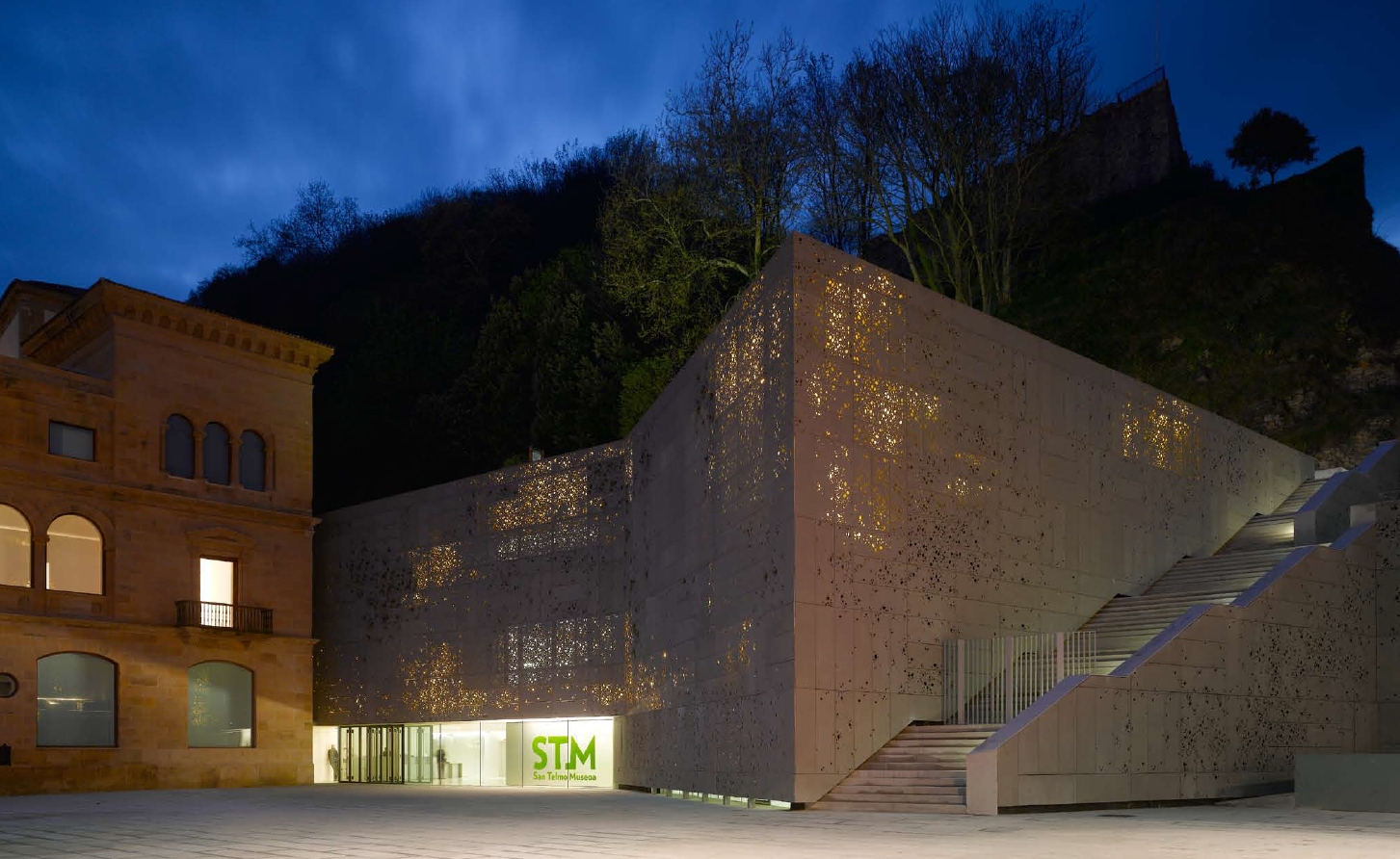
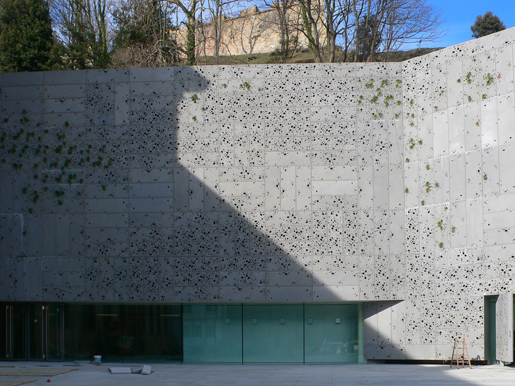
Today opens at the Gallery Raquel Ponce and with METALOCUS collaboration, the Museum of San Telmo in San Sebastian rehabilitation and expansion project, by architects Fuensanta Nieto and Enrique Sobejano and artists Leopoldo Ferrán and Agustina Otero, who have made the building's skin. In the gallery you can see, at 1:1, the pieces of the facade designed by the artists, in two configurations: with partial vegetation and light permeability. The pieces of the facade have been made ​​in cast aluminum.

You can see models of this exceptional project, photographs and videos of the building and contents. A recommended visit since the opening of this afternoon. METALOCUS readers are invited to the inauguration.

"At the heart of all architectural project, is the recognized of limit as a concept that determines the spatial and formal settings. That the realization of this limit is manifested in a sharp or diffuse, with hardness or softness, expressing lightness or weight, it is a decision without importance, since it reflects itself taking a stance against the multiple discontinuities facing contemporary cities. In a few cases, these discontinuities are juxtaposed so clearly and yet harmonious as in the meeting area between Urgull Mount and the Downtown of San Sebastian: between nature and city, and the horizontal plane and topographic elevation, land and sea, historic buildings and existing buildings. Perhaps this is why the rehabilitation project and expansion of San Telmo Museum, located at the confluence of nature and the urban landscape, require a conscious response of the boundary condition of the site itself, represented by the image of a long wall broken as a manifestation of nature / artifice, beating in the project.

A facade or lattice, developed from a combinatorial game of aluminum castings specifically for this occasion, is thus transformed into an unusual intervention that recognizes the role of architecture in relation to public art. The new extension of the San Telmo Museum change its appearance over the course of the seasons, joining in the vegetation of Mount Urgull or expressing their autonomy in a long, unfinished wall broken: unexpected metaphor of vague boundary where the architecture and the city are with the landscape."

Venue.- Galería Raquel Ponce. C/ Alameda, 5. MADRID.
Date.- 19-28/05/2011

Read more
Read less

More information

Nieto Sobejano is an architectural studio founded in 1985 in Madrid by Fuensanta Nieto and Enrique Sobejano.

Fuensanta Nieto (Madrid 1957) and Enrique Sobejano (Madrid 1957), are graduated architects by the Escuela Técnica Superior de Arquitectura de Madrid (ETSAM) and Master of Science in Building Design por la Graduate School of Architecture and Planning (GSAPP), Columbia University, New York (USA). Are partners of the office Nieto Sobejano Arquitectos, with headquarters in Madrid and Berlín.

Enrique Sobejano is Design Professor at the Universität der Künste Berlin (Germany) and Fuensanta Nieto is an Design Associate Professor in the School of Architecture at the Universidad Europea de Madrid. Both have been guest professors and lecturers at various universities and institutions within and outside Spain. From 1986 to 1991 was Director of ARQUITECTURA magazine, of Official College of Architects of Madrid.

Sobejano Nieto's work has been published in numerous magazines and books in Spanish and international, such as Casabella, METALOCUS, The Sketch, Architectural Review, Domus, Architectural Record, Detail, A + U, etc, and has been exhibited, among other places, Venice Biennale (2000, 2002, 2006) and the Museum of Modern Art (MoMA) in New York (2006). They have received the National Award for Restoration of the Ministry of Culture (2008), the Nike Prize BDA (Bund Deutscher Architekten) (2010) and the Aga Khan Award for Architecture (2010).

Among his recent works include Madinat al Zahra Museum (Córdoba), Moritzburg (Germany), Colegio de San Gregorio (Valladolid) and the Conference Centres of Mérida and Zaragoza.

Read more

Leopoldo Ferrán (Irun, Guipúzcoa, 1963) and Agustin Otero (San Adrián del Valle, León, 1960). After an initial training period in the Basque Country, two years in Florence, two in Paris and stayed in the south of Senegal, this pair of artists has established his studio in northern Spain, first in Hondarribia (Guipúzcoa) and after in Ituren (Navarra) in a privileged sanctuary at the foot of Mount Mendaur, where they project their latest and most ambitious sculptural-architectural works. In 1994 They decided to join our common Interests Generating with the purpose of installation works in order to Thoroughly Investigate and study the language of art. They Set Out from the idea of places Inhabited by questions in Which to create answers Able to generate a new creative universe.

Their work have been exhibited recently among others by:

Museo ARTIUM, Vitoria. Museo Guggenheim, Bilbao. Koldo Mitxelena San Sebastián. Bienal de la Imagen en Movimiento, Ginebra. The White Box. New York, EEUU. Monasterio de Prado, Valladolid. Museo Zuloaga, Segovia. Chapelle Saint-Louis, Hôpital de la Pitié-Salpêtrière, Paris. Bienal de Venecia, Mostra de Arquitectura, Venecia 2002 - 2006. VII Bienal de El Cairo, Egipto. Espai 13, Fundació Joan Miró, Barcelona. Spazio Temporaneo d’Arte, Rovereto, Italia. Centre d'Art  La  Panera. Lérida. MARCO, Vigo. Galería dels Ángels, Barcelona. Galería Raquel Ponce. Madrid. Galería Moisés Pérez de Albeniz, Pamplona. Galería Salvador Díaz, Madrid

LEOPOLDO FERRÁN Y AGUSTINA OTERO http://www.euskalnet.net/al.la/

Read more

José Juan Barba (1964). Architect from the Madrid School of Architecture (ETSAM) in 1991. He received his PhD in Architecture from ETSAM in 2004, graduating summa Cum laude with the doctoral thesis "Inventions: New York vs. Rem Koolhaas, Bernard Tschumi, Piranesi." In 1991, he received a Special Mention in the Spanish National Graduation Awards. Until 1997, he worked as an advisor to several NGOs. In 1992, he founded his architectural practice in Madrid (www.josejuanbarba.com). 

He is an architectural critic and, since 1998, Editor-in-Chief of the internationally acclaimed bilingual architecture journal METALOCUS (Spanish/English), recipient of several national and international awards.

Barba is an Associate Professor at the University of Alcalá and a member of several research groups. He has been invited to participate in numerous international forums on architecture and urbanism, including the II Forum of Mexican World Heritage Cities, Urban Development, History and Modernity, organized by the Pan-American Committee for Urban Development and Historical Heritage; the World Urban Development Forum (FMDU), held in Culiacán, Sinaloa, Mexico; and the International Conference on Architecture and Urbanism from the Perspective of Women Architects. He has also been invited as lecturer and guest critic at numerous national and international institutions, including the National Building Museum, Roma Tre University, Politecnico di Milano, University of Genoa, Université Pierre Mendès France Grenoble, the Madrid and Barcelona Schools of Architecture, National Autonomous University of Mexico, the Faculty of Architecture in Montevideo, the Schools of Architecture of Medellín and Ecuador, Universidad Iberoamericana, IE University, as well as the Schools of Architecture of Zaragoza, Valladolid, Málaga, Granada, Seville, and A Coruña, among others.

He has extensive professional experience in architecture, urbanism, landscape intervention, and territorial regeneration. His work has received numerous awards, including First Prize in the “Gran Vía Posible” competition for Delirious Gran Vía, Madrid; recognition for the Rivers Interpretation Centre in Zamora, awarded and exhibited at the World Architecture Festival 2008; and recognition for the Santa Bárbara Park project in Toledo. He was also awarded the Erich Degner Prize for Architecture (1995), promoted by the BBVA Foundation. His project for a Day Centre for the Elderly was included in Volume 3 of the Madrid Architecture Guide published by the Official College of Architects of Madrid (COAM) in 2007. His work has been widely published in national and international books and journals.

He served as Maître de Conférences at the Institut d’Urbanisme de Grenoble, Université Pierre Mendès France Grenoble, during the 2013–14 academic year, following his appointment through a European open competition. His work has been published internationally. He regularly serves on academic and professional juries, including the editorial competition jury for the journal Quaderns (2011), the selection committee for the European Union Prize for Contemporary Architecture – Mies van der Rohe Awards (2007–present), and the jury panels for EUROPAN 13 (2015–16) and TRANSFER, Zurich (2019). He was also invited to participate in the Biennale di Venezia 2016 as part of the exhibition Spaces of Exception / Spazi d’Eccezione.

He has authored several books, including "The Dark Line. michele&miquel, dA Vision Design" (2024), "CONGRESO ANYWAY. La ciudad de las ciudades" (2020), "#Positions" (2016), and "Inventions: New York vs. Rem Koolhaas, Bernard Tschumi, Piranesi" (2015). He has also contributed to publications such as "Espacio público Gran Vía. La Ciudad del Turismo" (2020), "Spaces of Exception / Spazi d’Eccezione" (2016), "La manzana de la discordia" (2015), and "Contemporary Japanese Architecture: New Territories" (2015), as well as chapters in numerous books, including "Women Architects: A Professional Challenge" (2009), "21st Century Architectures" (2007), "Ruta de la Plata, New Conquerors of Space" (2019), and "The City of Tourism" (2020).

Selected awards include:

•    “SANTIAGO AMÓN” AWARD, award for the promotion of architecture, COAM Madrid, 2000.
•    “PANAYIOTI MIXELI AWARD,” SADAS-PEA, award for the promotion of architecture, Athens, 2005.
•    “PIERRE VAGO” ICAC. International Committee of Art Critics Award, London, 2005.
•    FAD Award 07, Ephemeral Interventions, First Prize, M.C. Escher Exhibition, Arquin-FAD, Barcelona, 2007.
•    World Architecture Festival, Center for Research and Interpretation of the Rivers, Tera, Esla, and Órbigo, Finalist, Barcelona, 2008.
•    Gran Vía Posible, First Prize, Delirious Gran Vía, Madrid, 2010.
•    Reform of the Río Segura Surroundings, Award, Murcia, 2010.

Read more
Published on: May 19, 2011
Cite:
metalocus, JOSÉ JUAN BARBA
"MUGARRIA. Límite natural y urbano" METALOCUS. Accessed
<https://www.metalocus.es/en/news/mugarria-limite-natural-y-urbano> ISSN 1139-6415
Loading content ...
Loading content ...
Loading content ...
Loading content ...
Loading content ...
Loading content ...
Loading content ...
Loading content ...
Loading content ...
Loading content ...
Loading content ...
Loading content ...
Loading content ...
Loading content ...
Loading content ...
Loading content ...
Loading content ...
Loading content ...
Loading content ...
Loading content ...
Loading content ...
Loading content ...
Loading content ...
Loading content ...
Loading content ...
Loading content ...
Loading content ...
Loading content ...
Loading content ...
Loading content ...
Loading content ...
Loading content ...
Loading content ...
Loading content ...
Loading content ...
Loading content ...
Loading content ...
Loading content ...
Loading content ...
Loading content ...
Loading content ...
Loading content ...
Loading content ...
Loading content ...
Loading content ...
Loading content ...
Loading content ...
Loading content ...
Loading content ...
Loading content ...
Loading content ...
Loading content ...
Loading content ...
Loading content ...