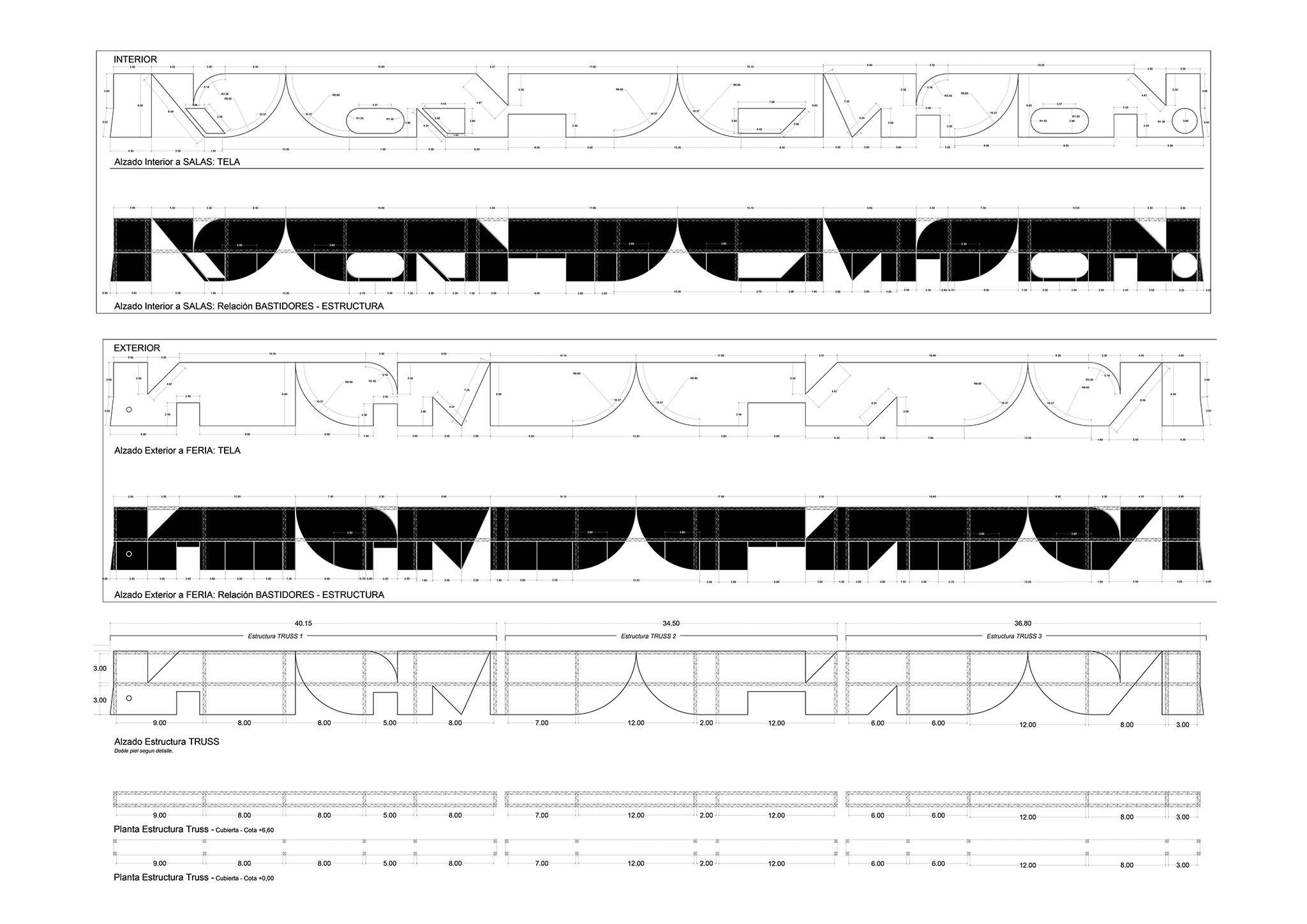
Pedro Pitarch architectures & urbanisms' proposal for ARCO 45: The Form of the Event, Object-Oriented Urbanism Volume III, is materialized through this continuous plane and the juxtaposition of large blocks of galleries with compact public spaces. This organization eliminates the traditional hierarchy to homogenize the flow of people, guaranteeing equal conditions and visibility for all exhibitors.
The "Wall" constructs a coherent "Artificial Ecology" using reusable, industrialized systems. Given the high resource consumption typical of art fairs, the project is conceived as a "Circular Synthetic Ecosystem" where lighting, structures, and technical systems not only provide logistical support but also construct the spatial experience of the event.

The Form of the Event, ARCO 45 by Pedro Pitarch. Photograph by Imagen Subliminal.
Project description by Pedro Pitarch
The project for the 45th edition of the contemporary art fair ARCOmadrid exclusively employs fair-specific materials, construction systems, and ecologies to develop a new iteration of Object-Oriented Urbanism. In this edition, the proposal is articulated around the construction of a Wall: an architectural device that operates simultaneously as boundary, façade, and urban plane, formalizing a Circular Synthetic Ecosystem derived from a strictly fair-based Artificial Ecology.
This Wall separates two differentiated yet interdependent spatial conditions: on the one hand, the domestic urbanism of the fair, composed of galleries, public programs, and cultural infrastructures; on the other, the urban domesticity of public spaces, understood as places of transit, dwelling, and social interaction. The Wall does not function as an opaque barrier, but as an active plane that constructs the architectural event of the fair and situates it in direct relation to the city.
Architecture of the Event
The fair’s urban design juxtaposes large gallery blocks with more compact, specifically designed public pieces, generating between them a constellation of multi-scalar spaces that oscillate between fair and city, domestic and urban, architecture and event. In this edition, the special 45th anniversary section is integrated at the heart of the fair, divided into two parts—one in each pavilion—acting as a transversal activation element that reactivates the lateral edges of the fair. This layout reinforces programmatic transversality between Pavilions 7 and 9 at IFEMA and consolidates a unified reading of ARCOmadrid as an architecture of the event: an ephemeral metropolis that appears for five days each year and subsequently dissolves, reintegrating into a circular fair economy.
The distribution of public programs throughout the fair responds to a strategy of radical homogenization of flows, eliminating the traditional hierarchy between central and peripheral aisles. By dissolving these differences, equal conditions are guaranteed for all galleries, ensuring that visitor flows and points of attraction are distributed evenly across the entire venue.
In this context, the Wall becomes the elevation of the event: an architectural plane that does not represent the fair, but constructs it. It does not function as a support for messages, images, or content, but as a surface that organizes spatial relationships, sequences of use, and gradients of domesticity. The fair is not staged; it is architecturally materialized through this continuous plane.

Artificial Ecology
Conventionally, fair architecture produces obsolete ecosystems, importing materials, architectures, and processes alien to the fair context and generating high levels of material and energy waste. This project proposes a radically opposed strategy: to work explicitly with the construction systems, materials, agents, and economies endemic to the fair sphere in order to construct a coherent and self-sufficient Artificial Ecology.
The Wall is built from reusable industrialized systems—such as stage trusses, recycled panels, and infrastructural elements typical of fair assembly—used in unconventional ways. These materials acquire a second life within the fair ecosystem at three scales: permanent (integrated into the architecture of IFEMA), ephemeral (reused in other fairs), and infrastructural (incorporated into the logistical processes of galleries).

Circular Synthetic Ecosystem
The fair is one of the architectural typologies with the highest resource consumption and waste production relative to its short duration. ARCOmadrid Vol. 3 continues to develop the concept of Object-Oriented Urbanism, conceiving the fair as a Circular Synthetic Ecosystem in which materials, systems, human and non-human agents cohabit simultaneously.
Suspended trusses, uncut recycled rigid panels, reused fair carpeting, organic textiles, rented stage lighting, fastening systems, art packaging products, and ecological waterproofing materials constitute the project. These elements do not act as an ex-novo support to be covered or concealed; rather, they reveal their constructive processes, technologies, and life cycles. Integrated into the Wall and the architectures it articulates, they claim their emancipation as objects within a circular system in which, once the fair concludes, all materials are fully reintegrated.

Anti-Billboard
The Wall functions as an Anti-Billboard: an architectural plane deliberately devoid of content. In contrast to the conventional billboard format defined by the need to display, communicate, or represent, this plane renounces all image, text, or message. In doing so, the billboard ceases to be a communicative support and becomes, ontologically, architecture.
This gesture is not an absence but a critical position. By emptying the plane of content, the Wall questions the mechanisms of visibility, representation, and visual consumption associated both with the fair and with contemporary urban space. The Anti-Billboard constructs a façade without image, an elevation without representation, shifting attention from message to materiality, scale, and spatial experience.

Divided Domesticities
The spatial design of the fair deliberately renounces the traditional distinction between urbanism and architecture, producing a multi-scalar organization in which domestic and urban scales overlap and separate simultaneously. Beneath and alongside the Wall, public spaces and fair programs are arranged in a sequence of environments oscillating between living room, gallery, and urban space.
Fair infrastructure—lighting, structures, technical systems—not only provides logistical support but constructs the spatial experience of the event. The result is a fair understood as an architectural event in which objects, systems, users, and synthetic natures configure a complex multi-scalar context, where architecture does not represent the event, but is the event itself.