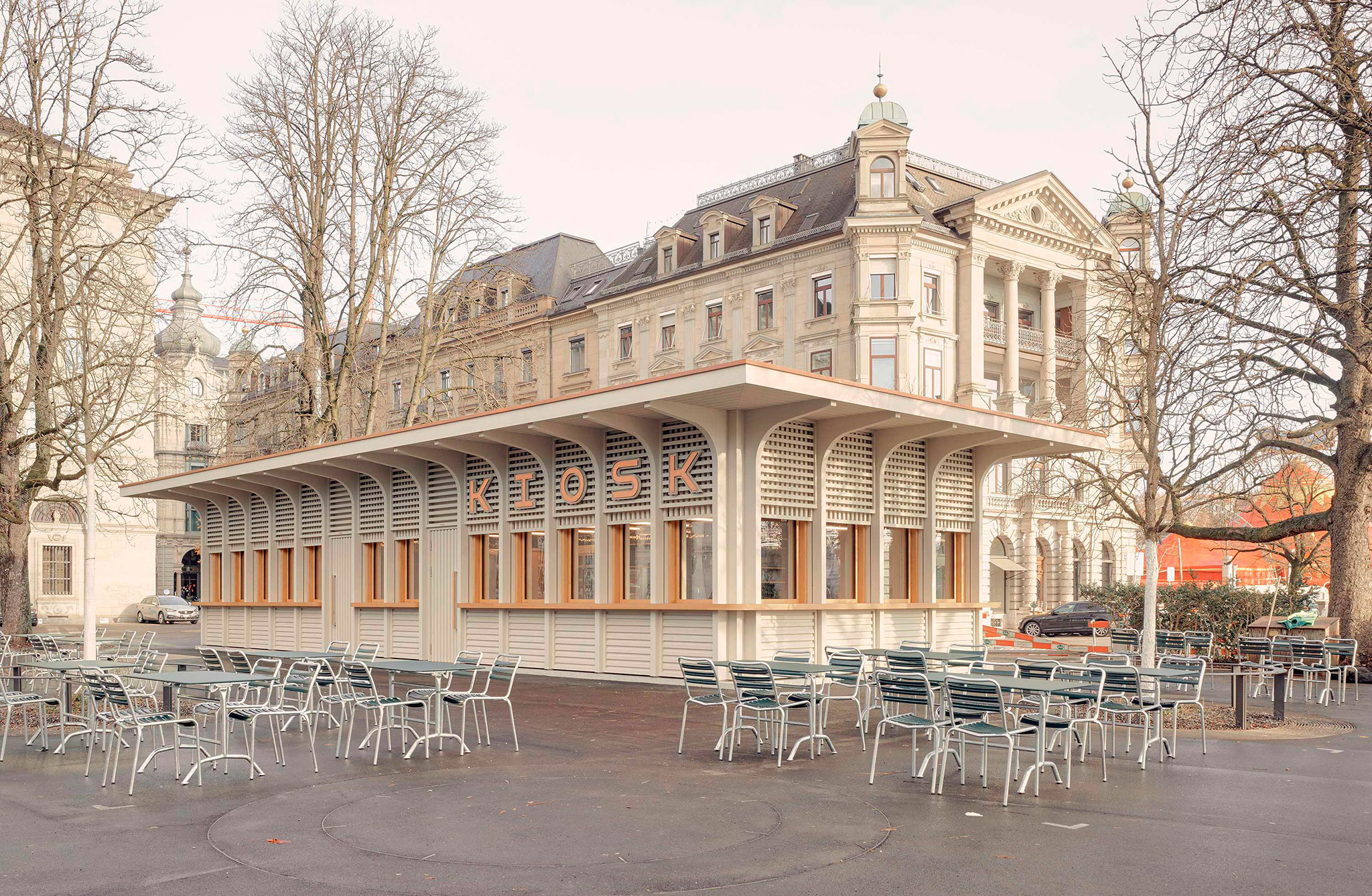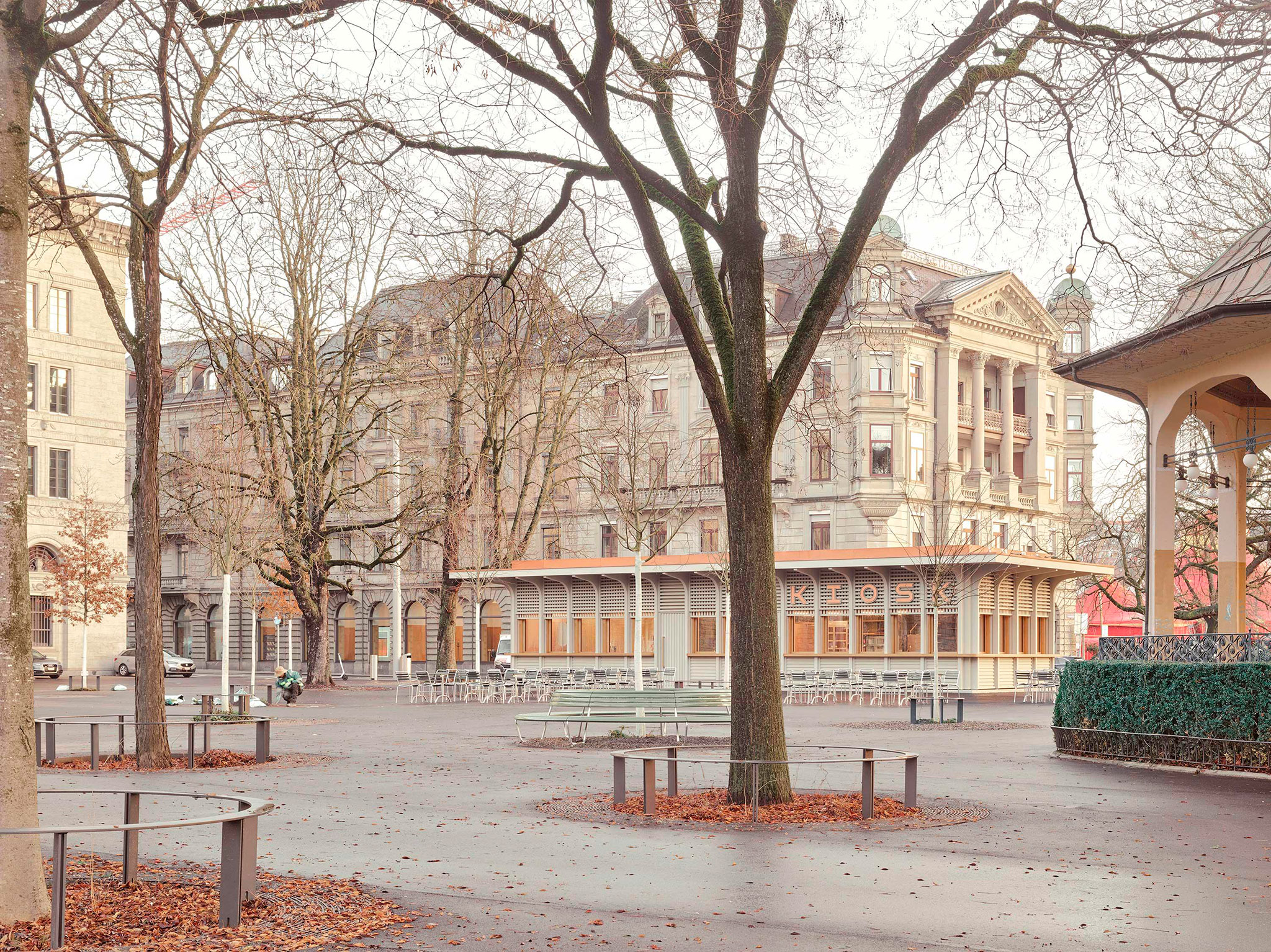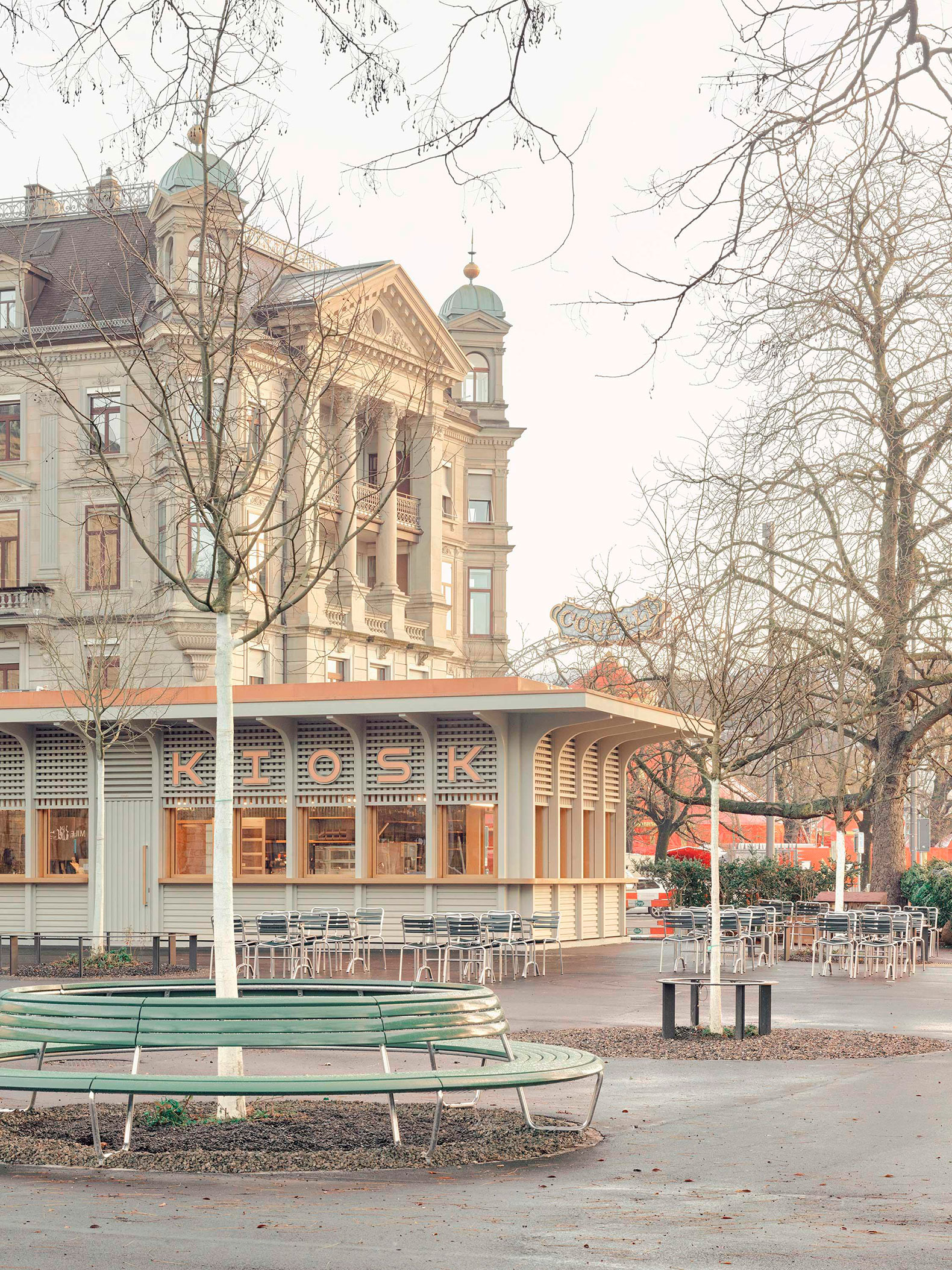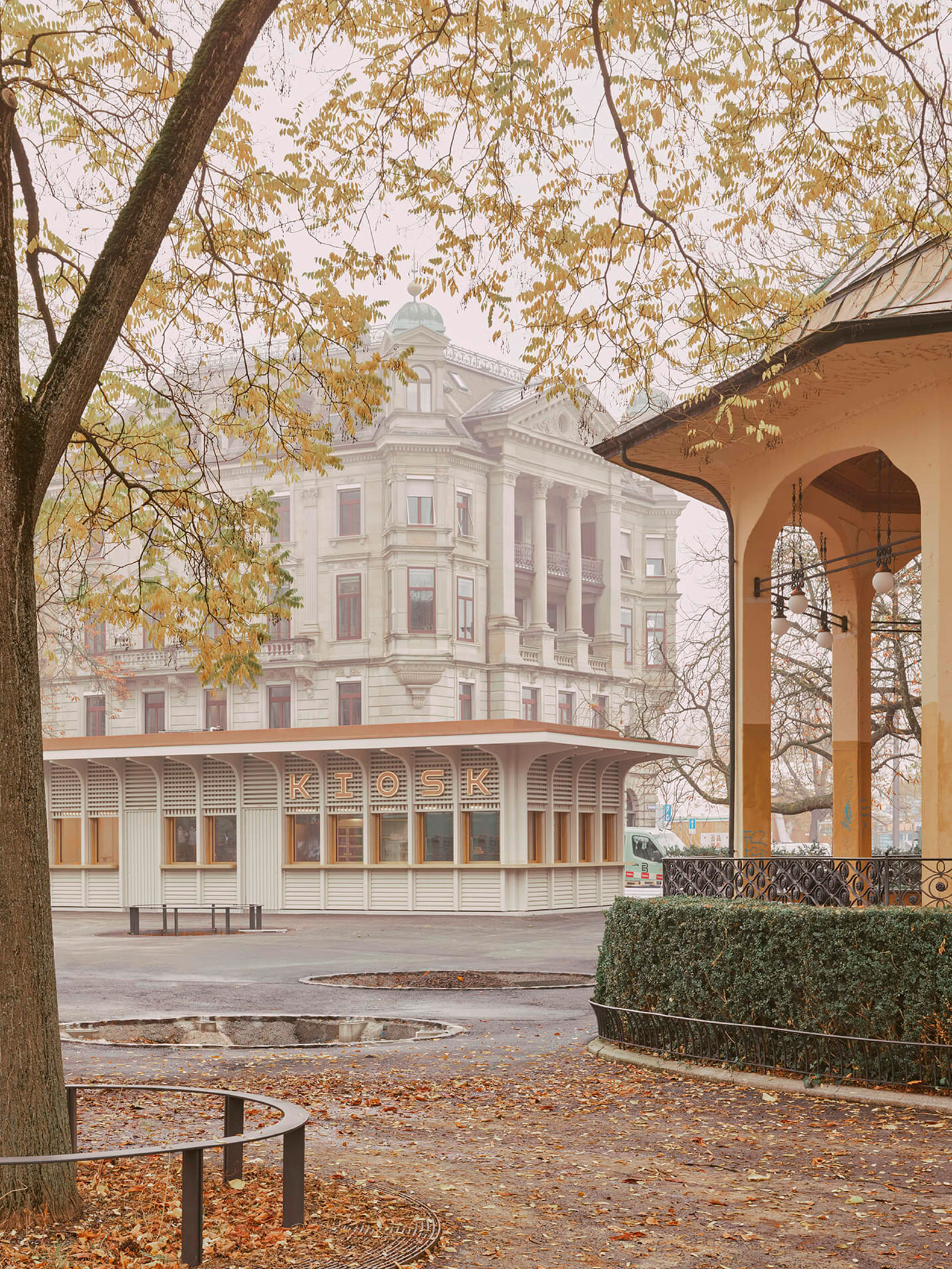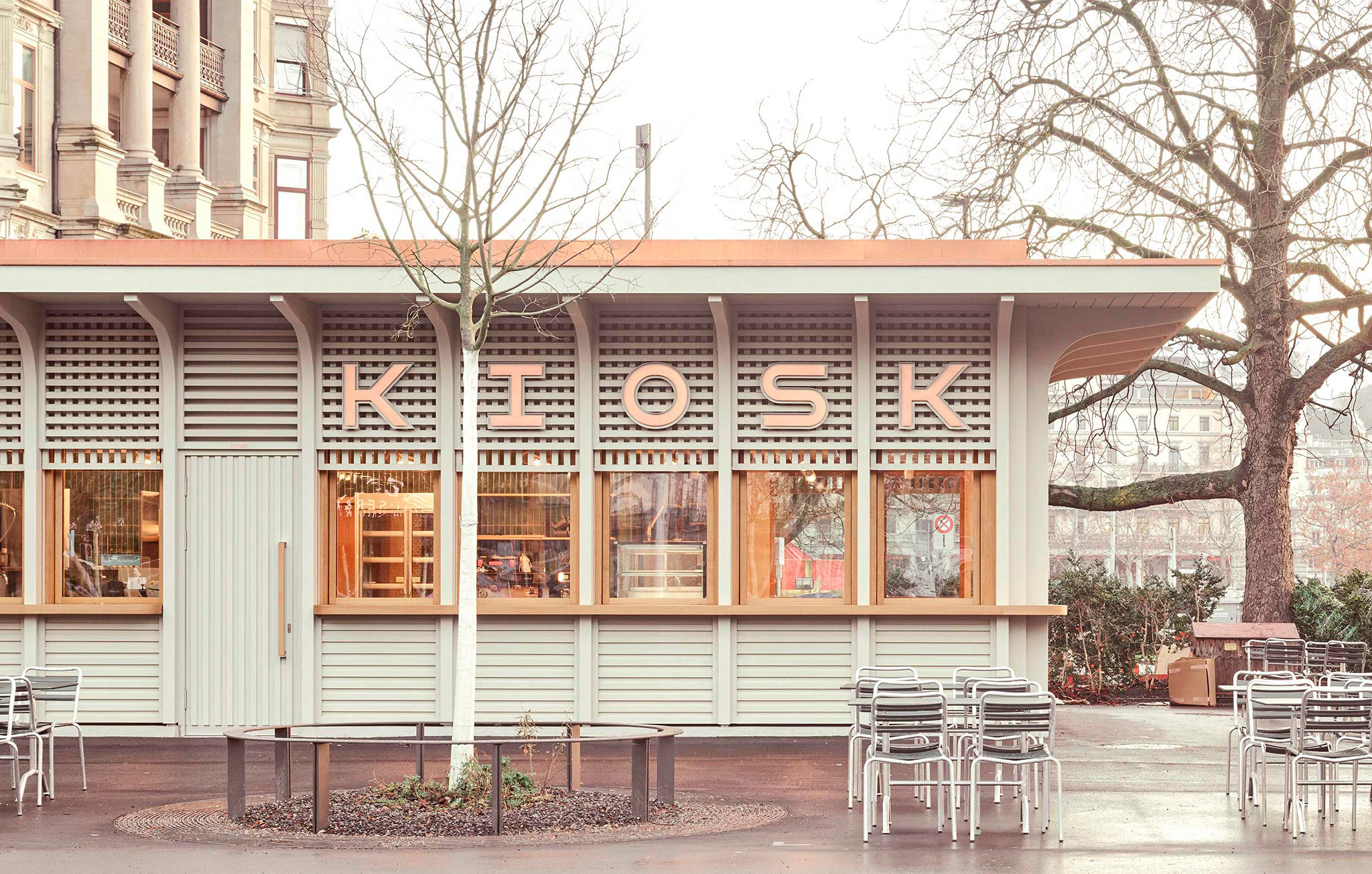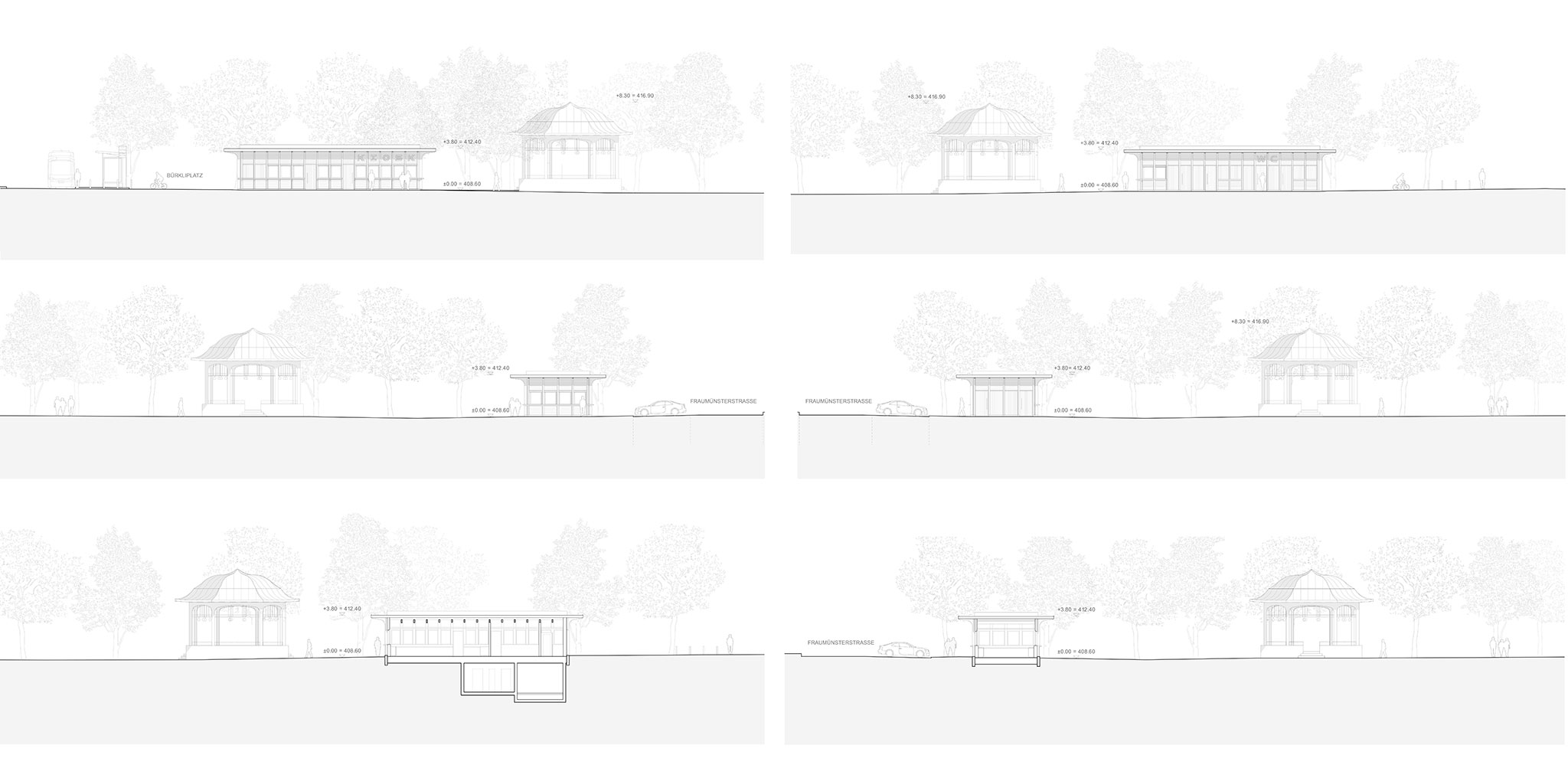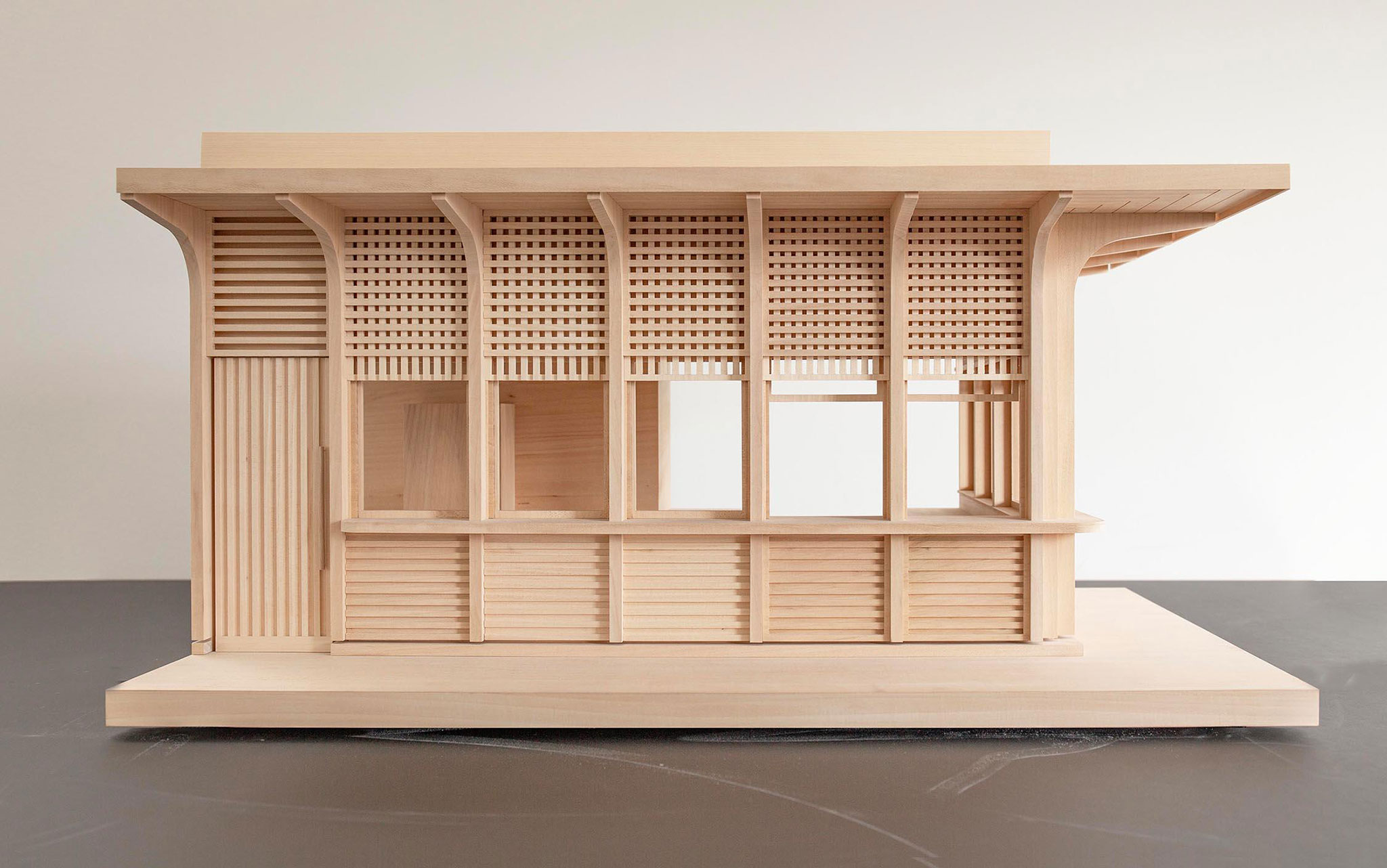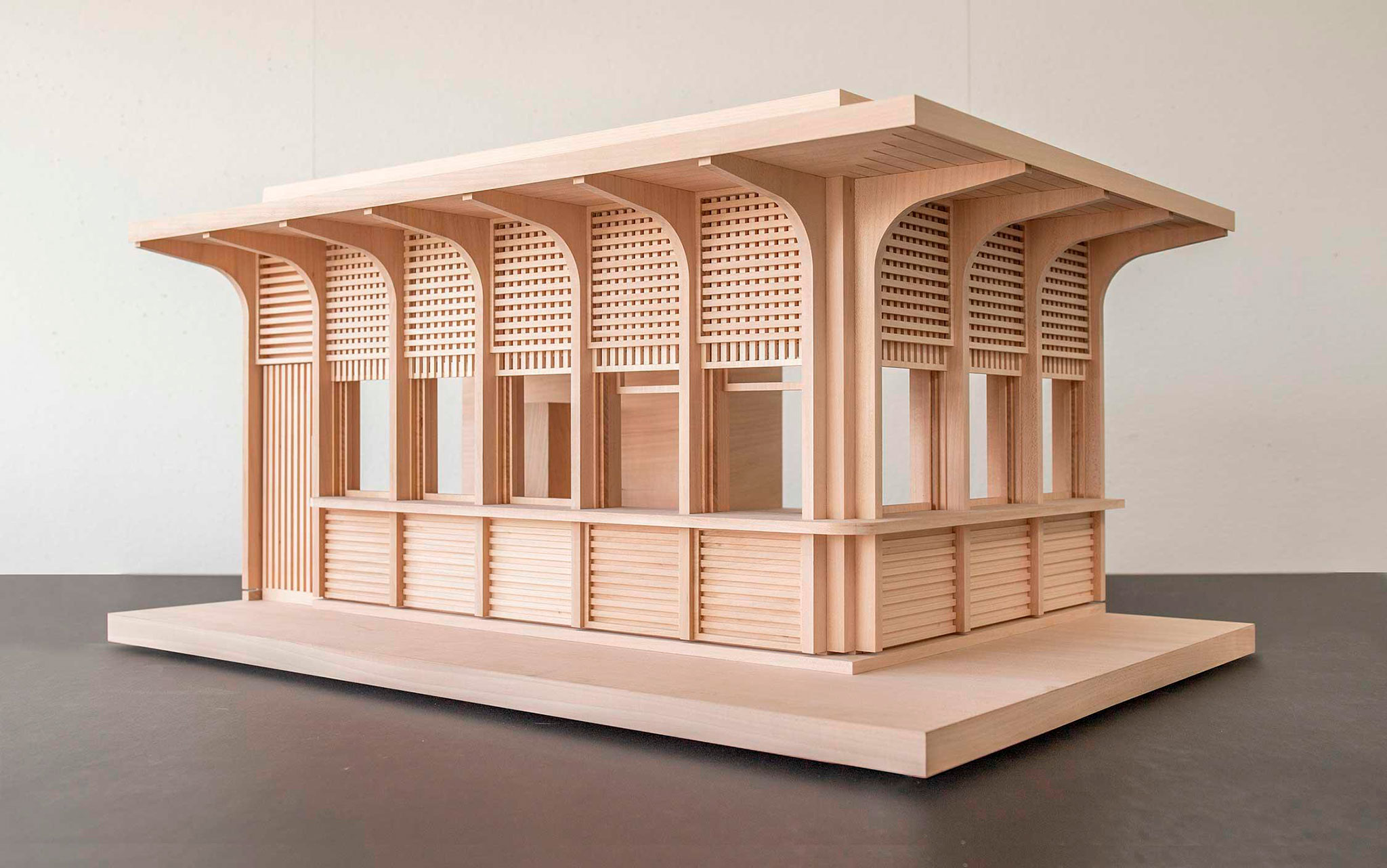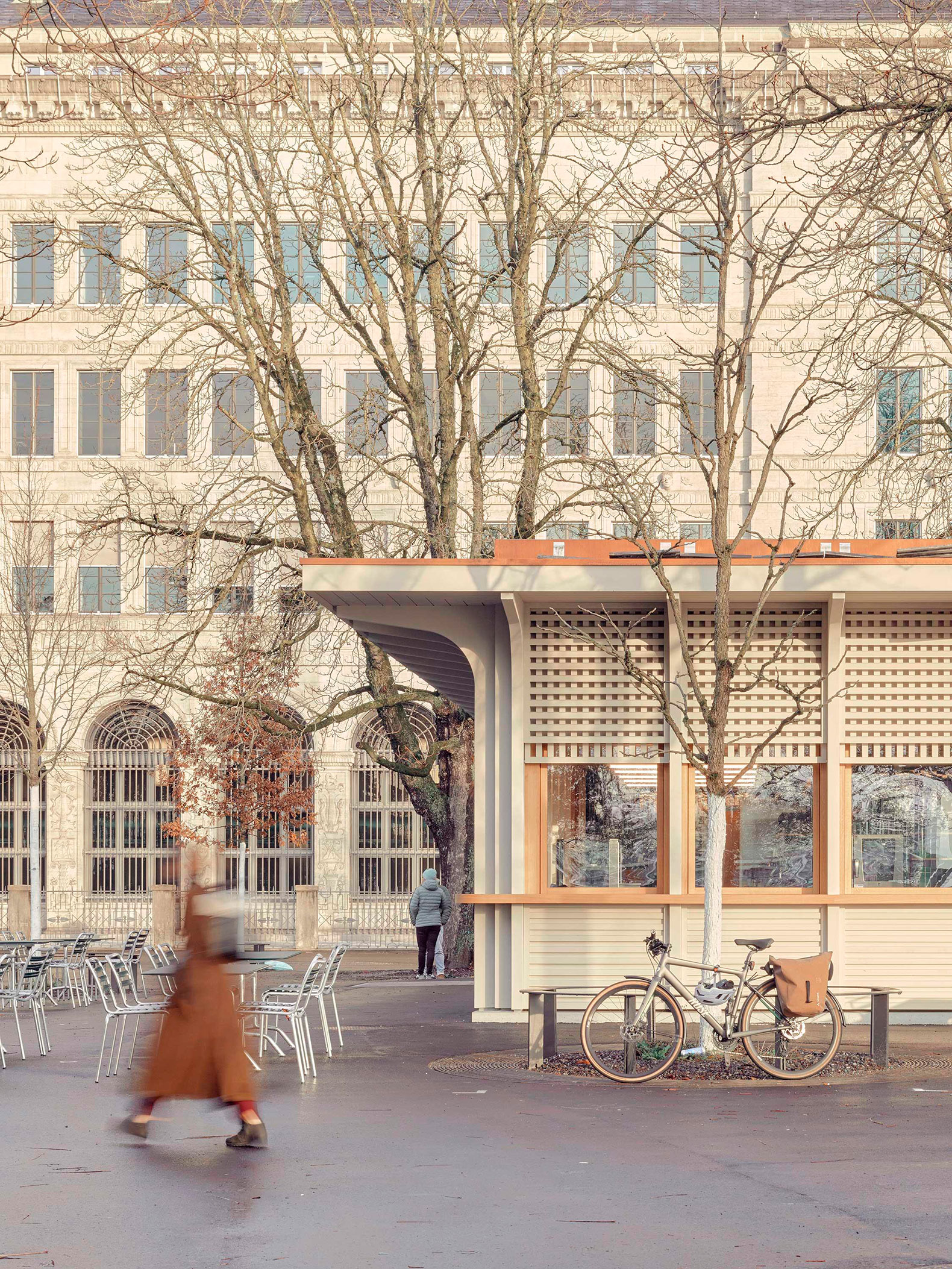
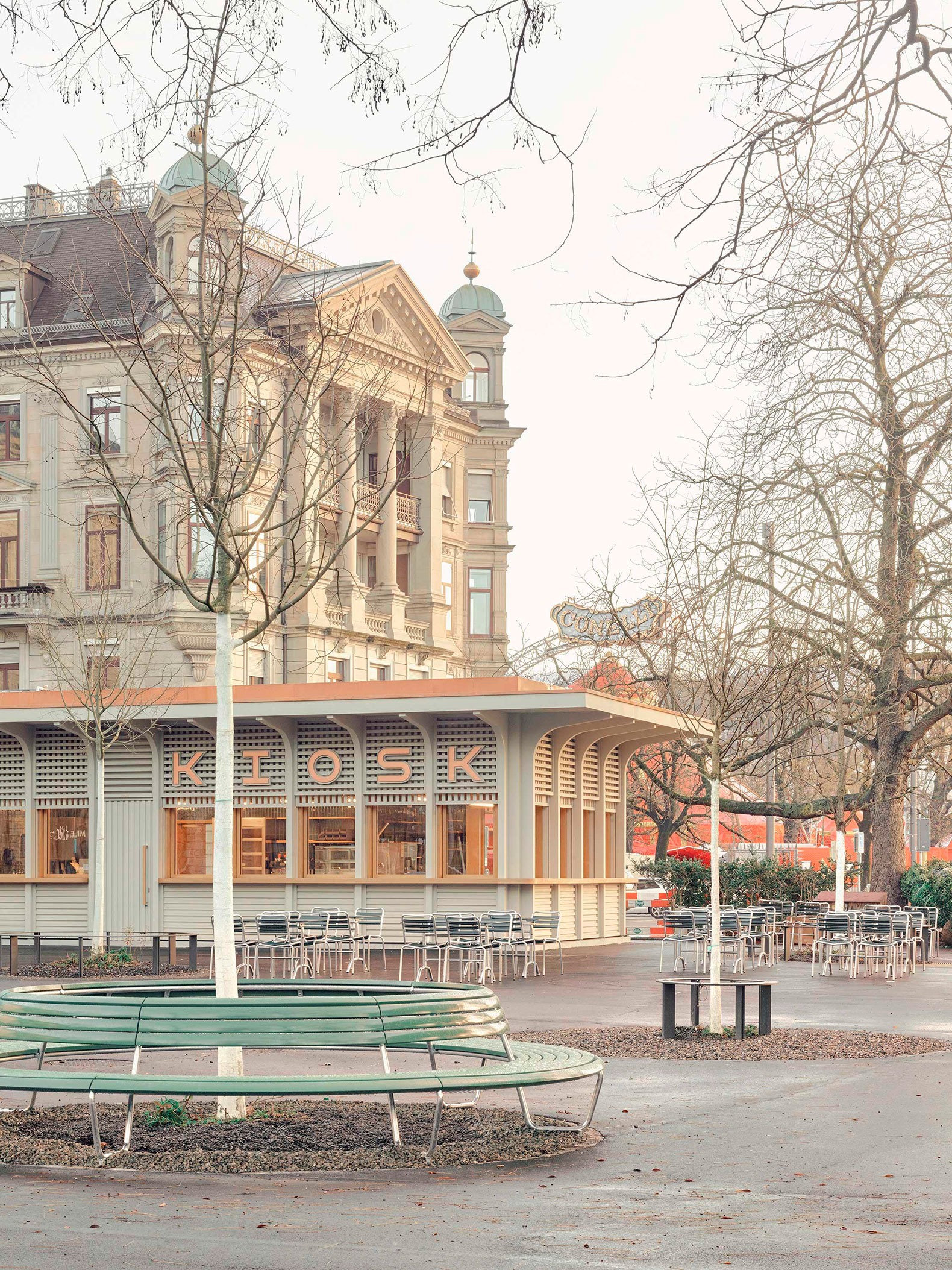
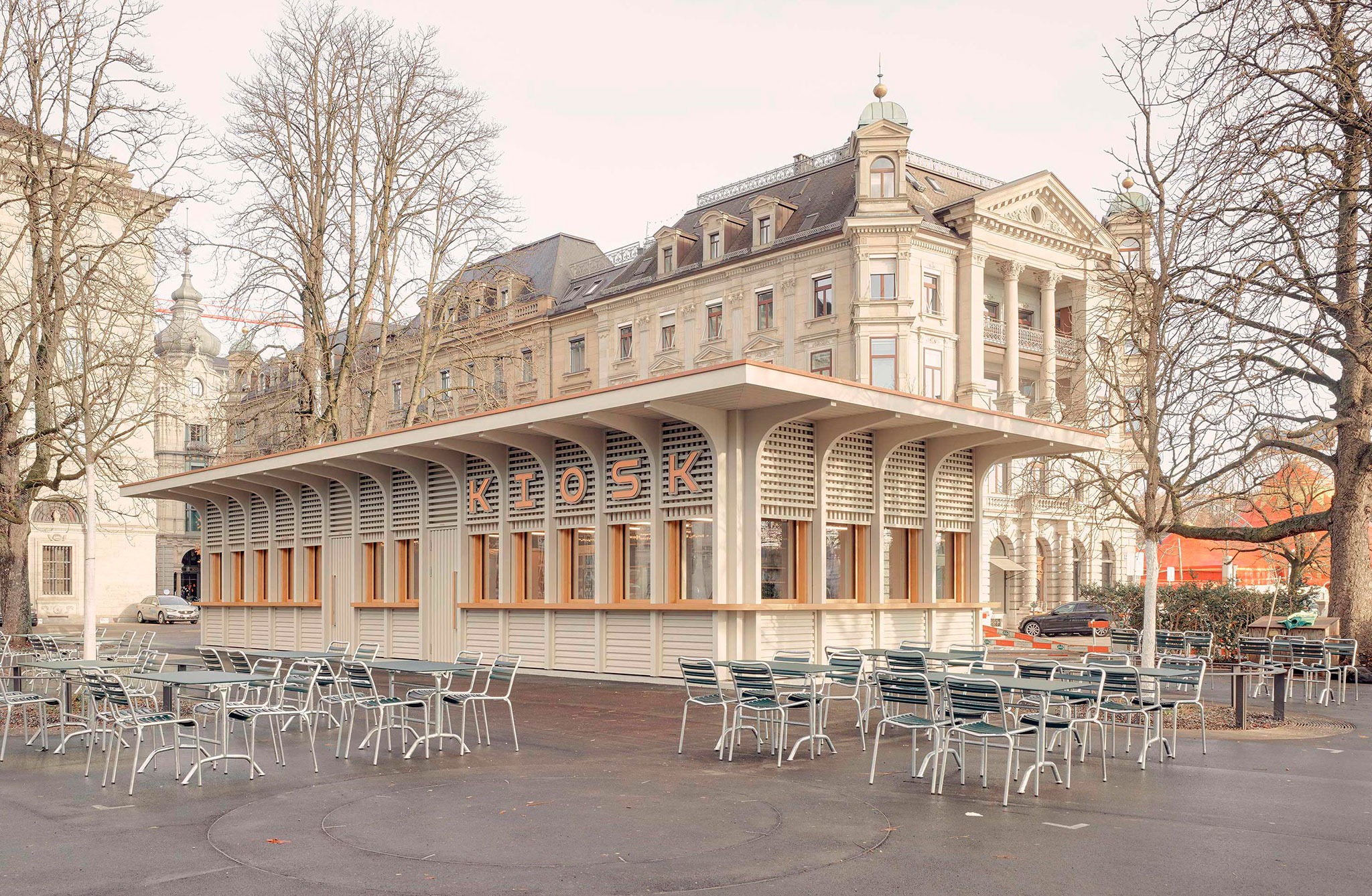
The kiosk in Bürkliplatz, designed by Schmid Ziörjen Architects, is a compact, elongated, single-story volume with a basement, located parallel to Fraumünsterstrasse along its eastern perimeter. The spaces are utilized under a cantilevered roof that encircles the building, while the basement houses storage areas, cold storage rooms, staff changing rooms, and technical rooms.
The kiosk was constructed with a load-bearing structure and features a warm gray color scheme. The basement was built with cast-in-place concrete, and a continuous exposed concrete plinth on the exterior supports the upper timber structure. This timber structure is articulated longitudinally by a system of posts and beams arranged on a 1.15 m grid.
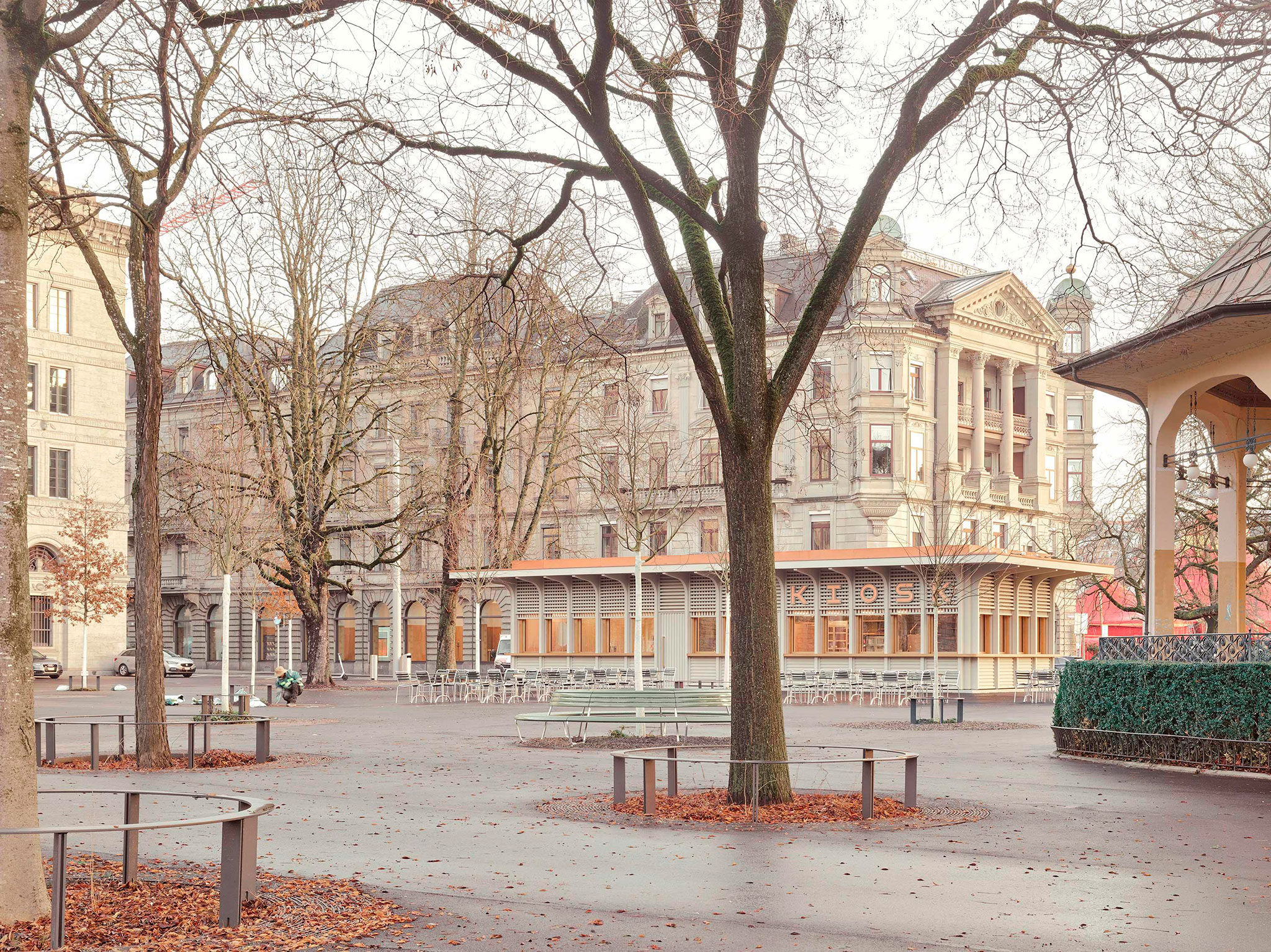
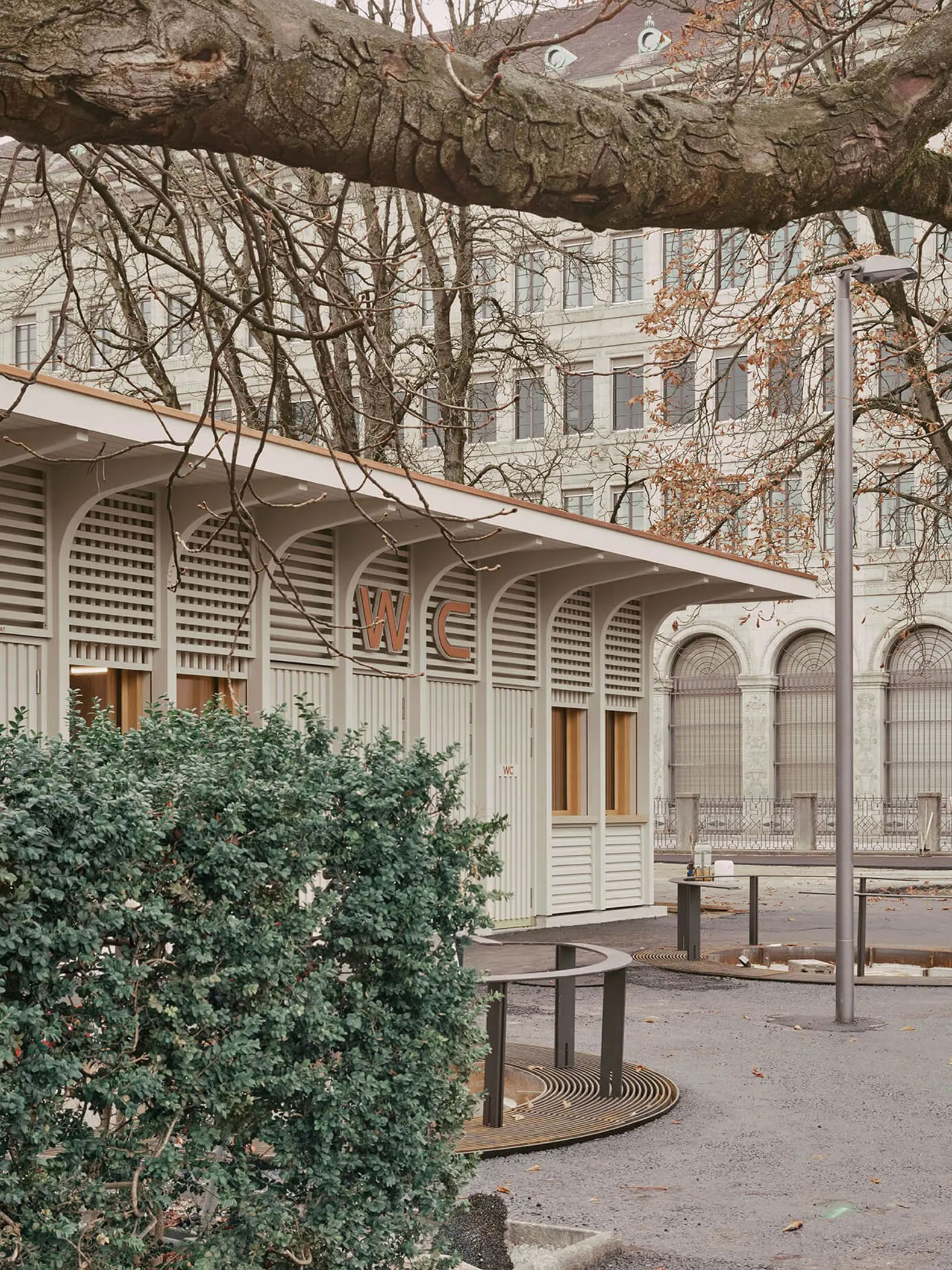
Kiosk in Bürkliplatz by Schmid Ziörjen Architects. Photograph by Lukas Murer.
Project description by Schmid Ziörjen Architects
The axially symmetrical townhouse complex is located centrally and prominently in the city of Zurich. The historic place has been redesigned in several stages. The tree-covered square acts as a link and creates the transition between the city and the lake.
Context - Urban Design - Volumetry
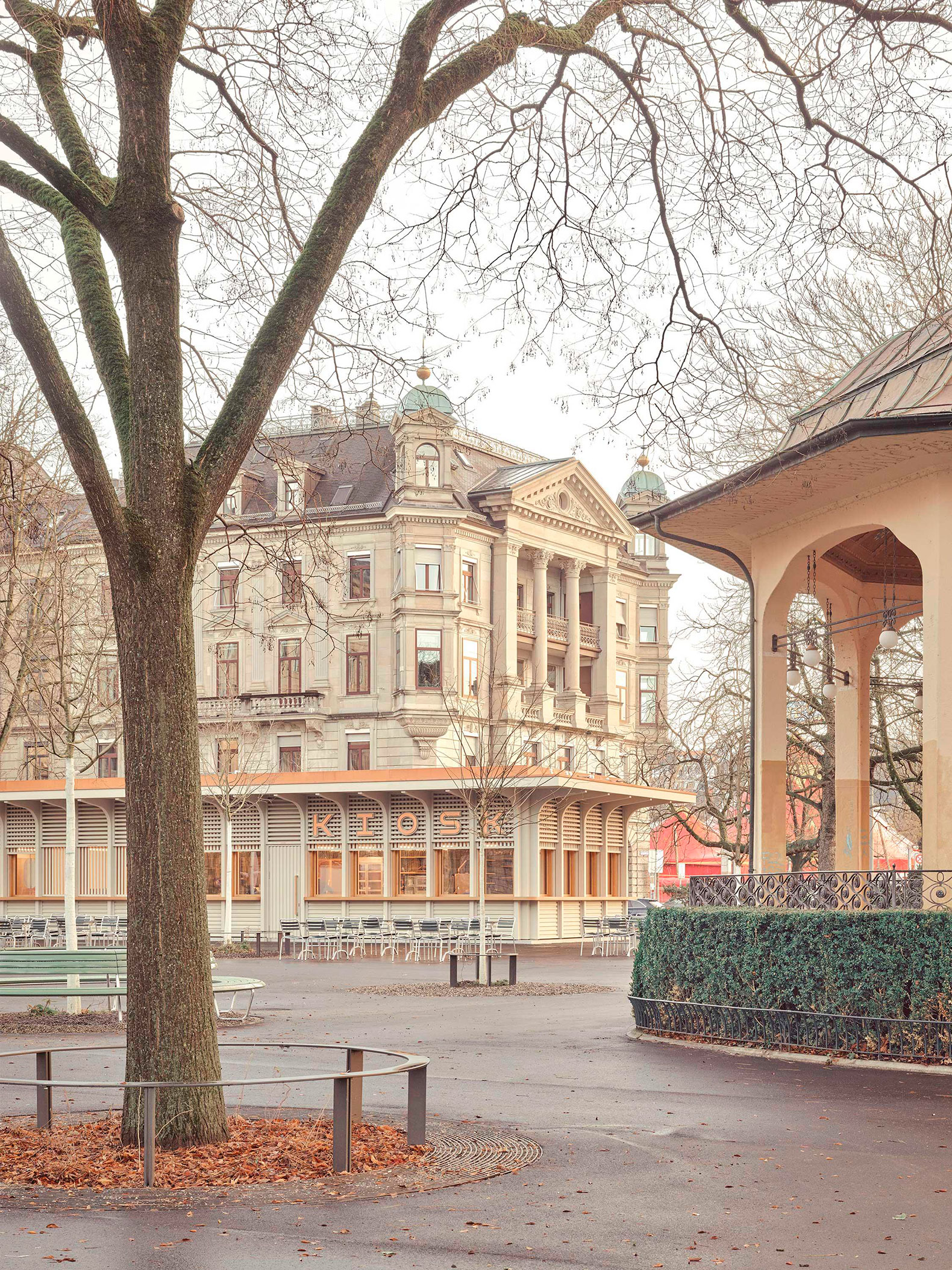
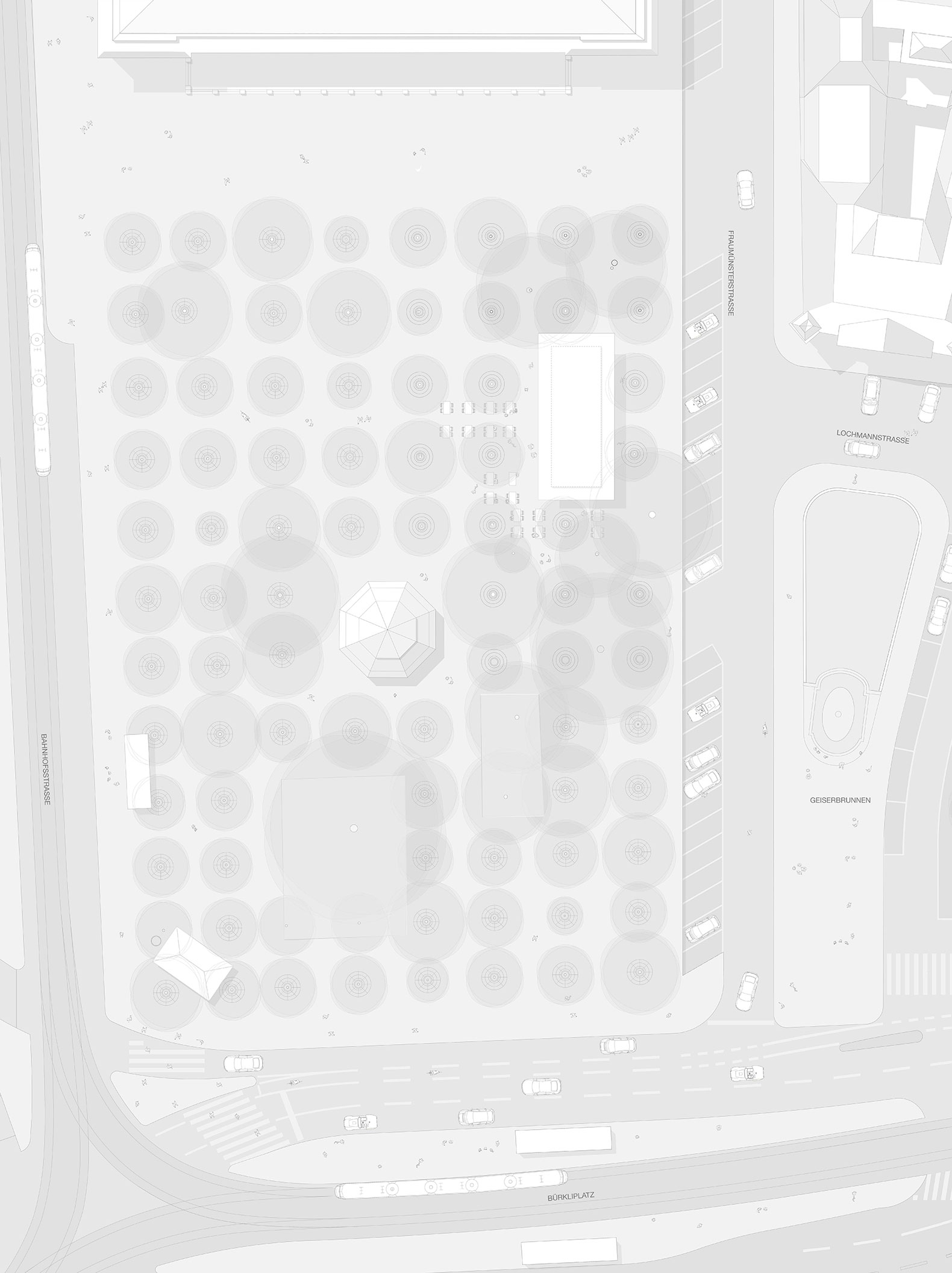
To the south, the site connects to Bürkliplatz with its quay facilities and boat landing stage; to the west, Bahnhofstrasse defines the boundary of the area, while the quieter Fraumünsterstrasse runs along the eastern edge. Positioned between these is the listed Swiss National Bank, which forms the spatial backbone of the ensemble and clearly delineates the transition between the dense urban fabric and the open green space.
As part of the realisation of the kiosk, the Stadthausanlage was also reworked in terms of landscape architecture. The existing tree population was supplemented and densified, growth conditions were improved, and the layout was oriented towards a long-term, continuous tree canopy that provides shade for the square and contributes to the reduction of local heat.
At the centre of the site stands the listed Maillard Pavilion, which forms the heart of the ensemble. Dia- gonal pedestrian routes cross the park, creating attractive transversal connections between Bürkliplatz, Bahnhofstrasse and Fraumünsterstrasse.
Along the perimeter, various small-scale structures are arranged – including public toilets, a bus stop and the existing kiosk – deliberately positioned outside the strict symmetry of the overall layout. The new kiosk naturally joins this sequence of peripheral small buildings.
The volumetry of the new building presents itself as a compact, single-storey structure. The elongated volume is positioned parallel to Fraumünsterstrasse along the eastern perimeter. Its placement responds both to the existing and the further developed planting concept, enabling a calm integration into the overall ensemble. At the same time, an appropriate distance to the Maillard Pavilion is maintained, and a balanced distribution of density within the park is achieved. The new kiosk enhances the quality of stay at the site without impairing the diagonal pedestrian connections.
Organisation - Floor Plan
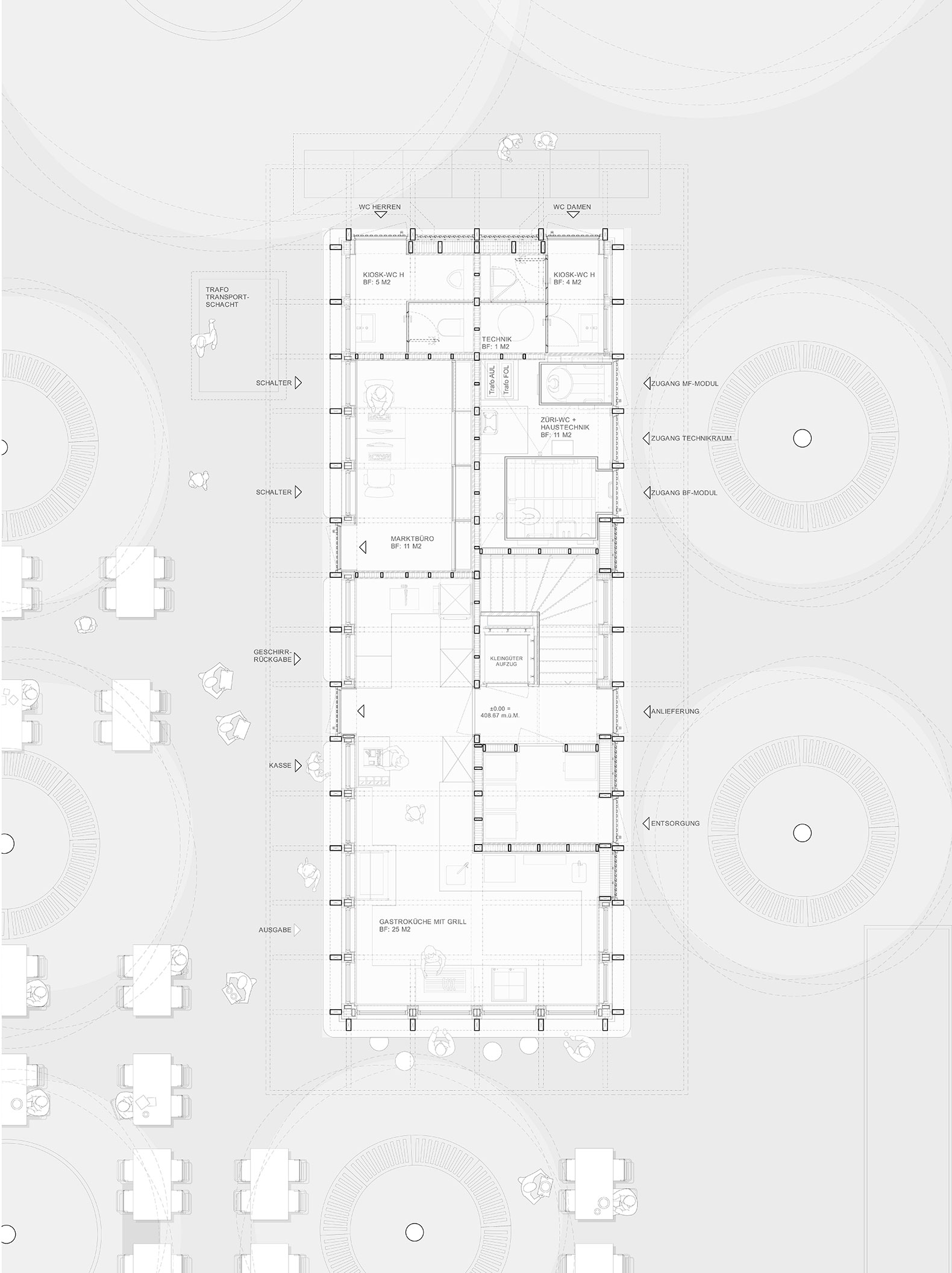
The floor plan organisation of the kiosk is designed for a high degree of functional density with a minimal building footprint. All uses are combined beneath an all-around cantilevering roof. The roof forms a continuous transitional zone between the building and the park space. This welcoming gesture invites visitors in and provides shelter in adverse weather conditions.
A clearly defined structural grid forms the organisational basis of the building. It arranges the individual uses in a clear and logical manner and minimises circulation areas. This results in an efficient operational layout in which public and operational processes are clearly separated yet spatially closely interlinked.
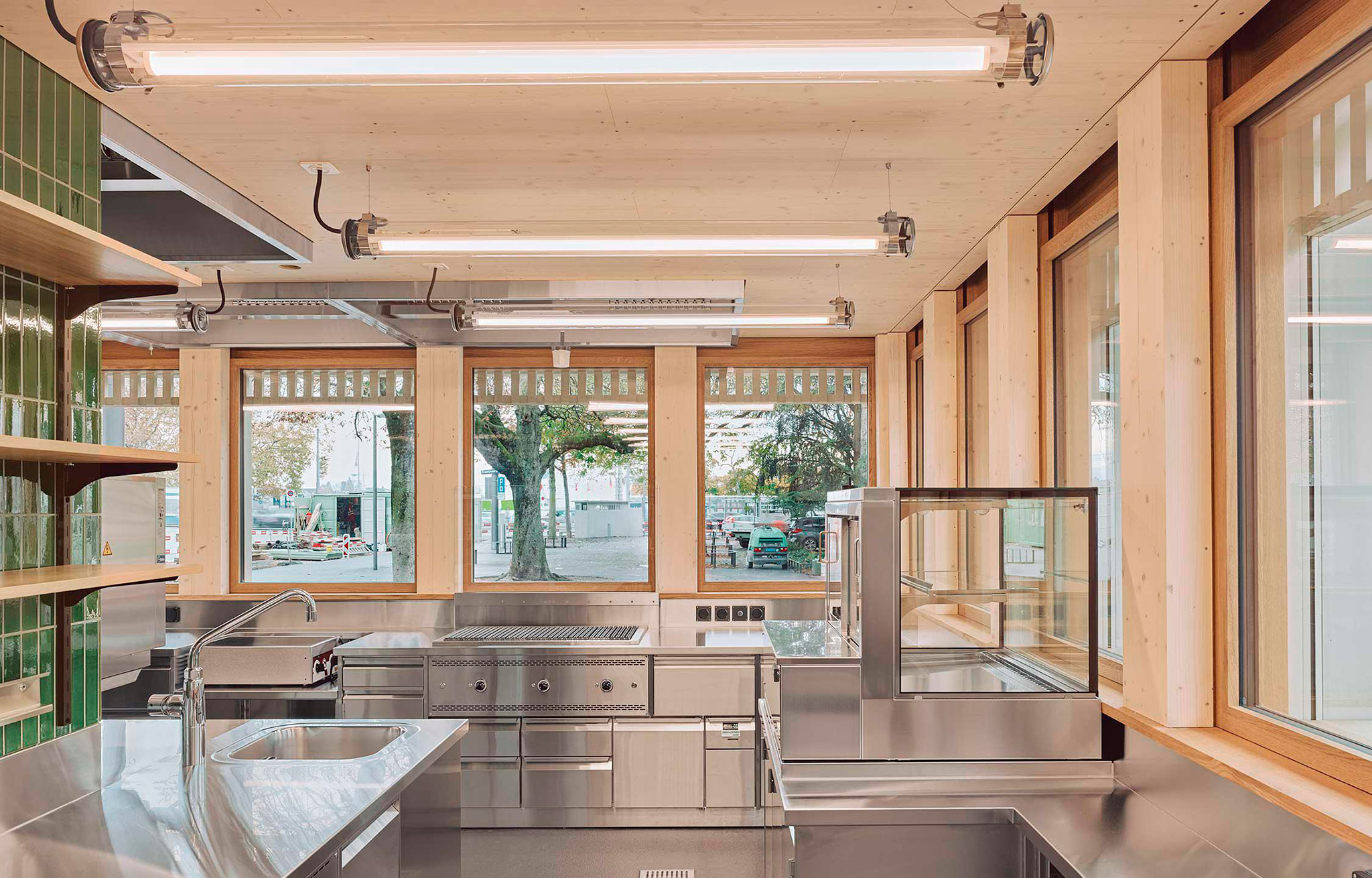
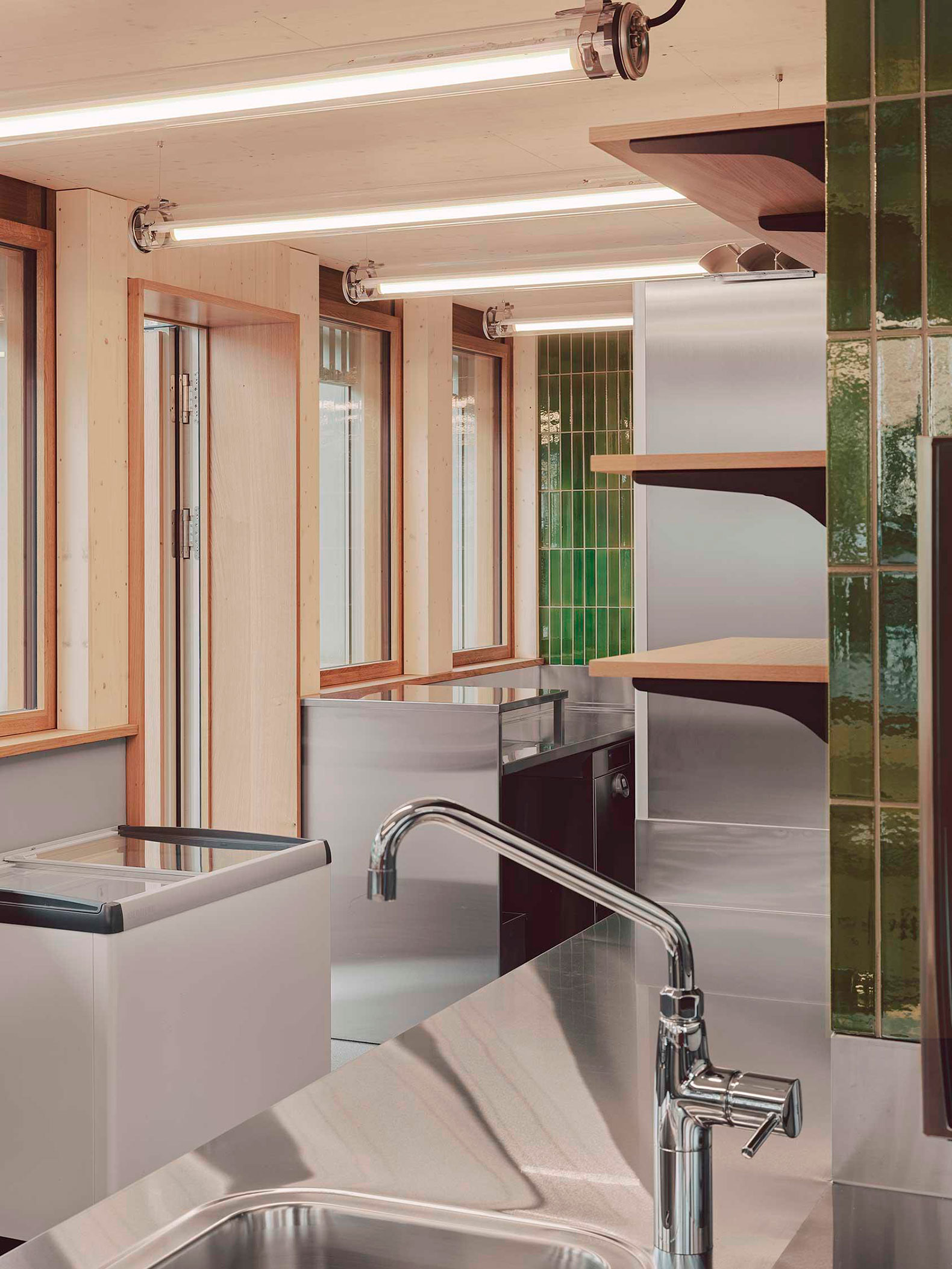
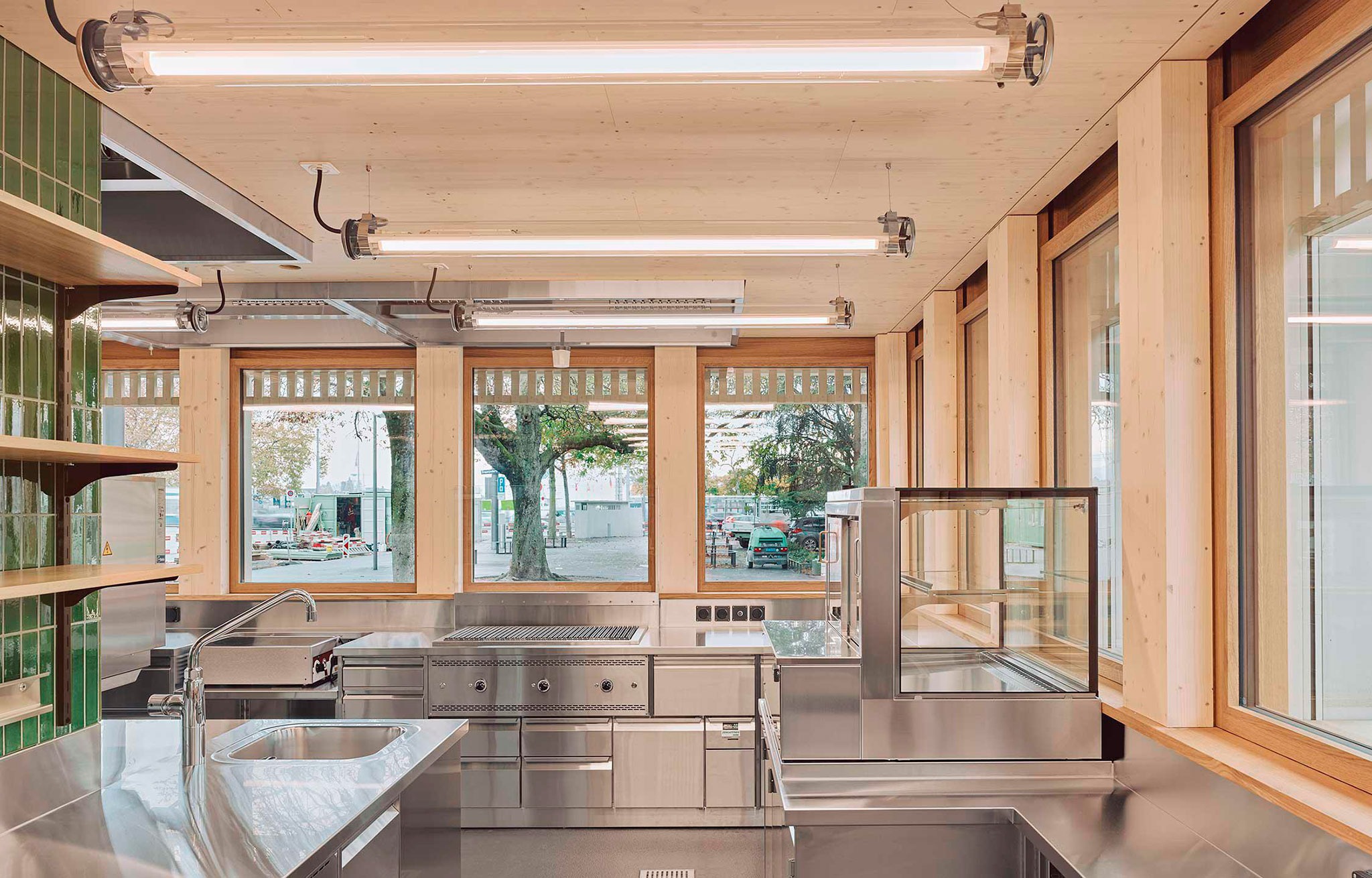
The catering area is oriented towards the south-west, facing the Stadthausanlage and the lake. The three-sided opening anchors the kiosk within the park, increases its visibility and reinforces the public character of the building. Kitchen, service counter and outdoor seating areas are in direct spatial and visual relationship, allowing the operation to extend seamlessly into the outdoor space. Deliveries take place from Fraumünsterstrasse and are consistently separated from the guest areas.
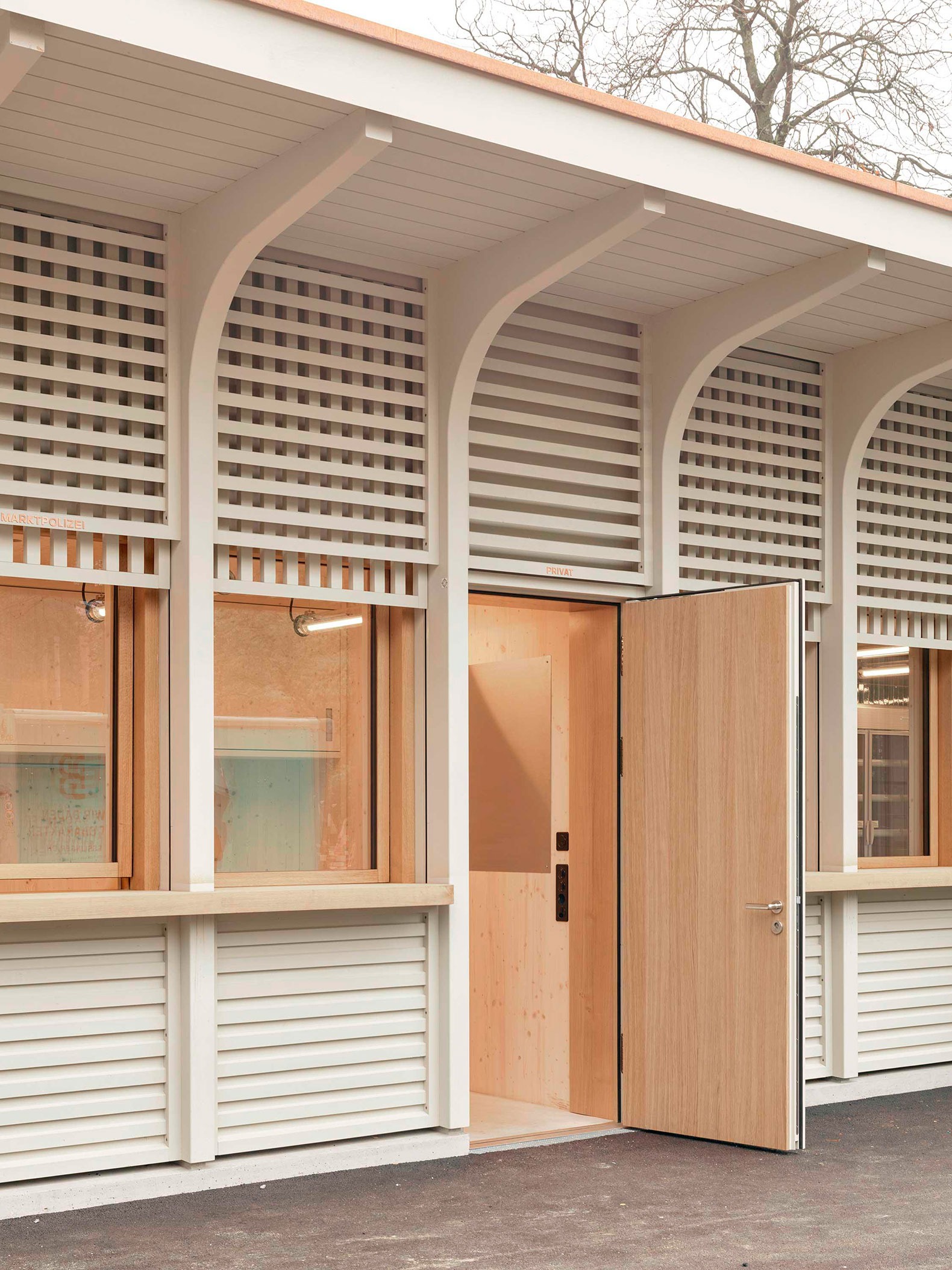
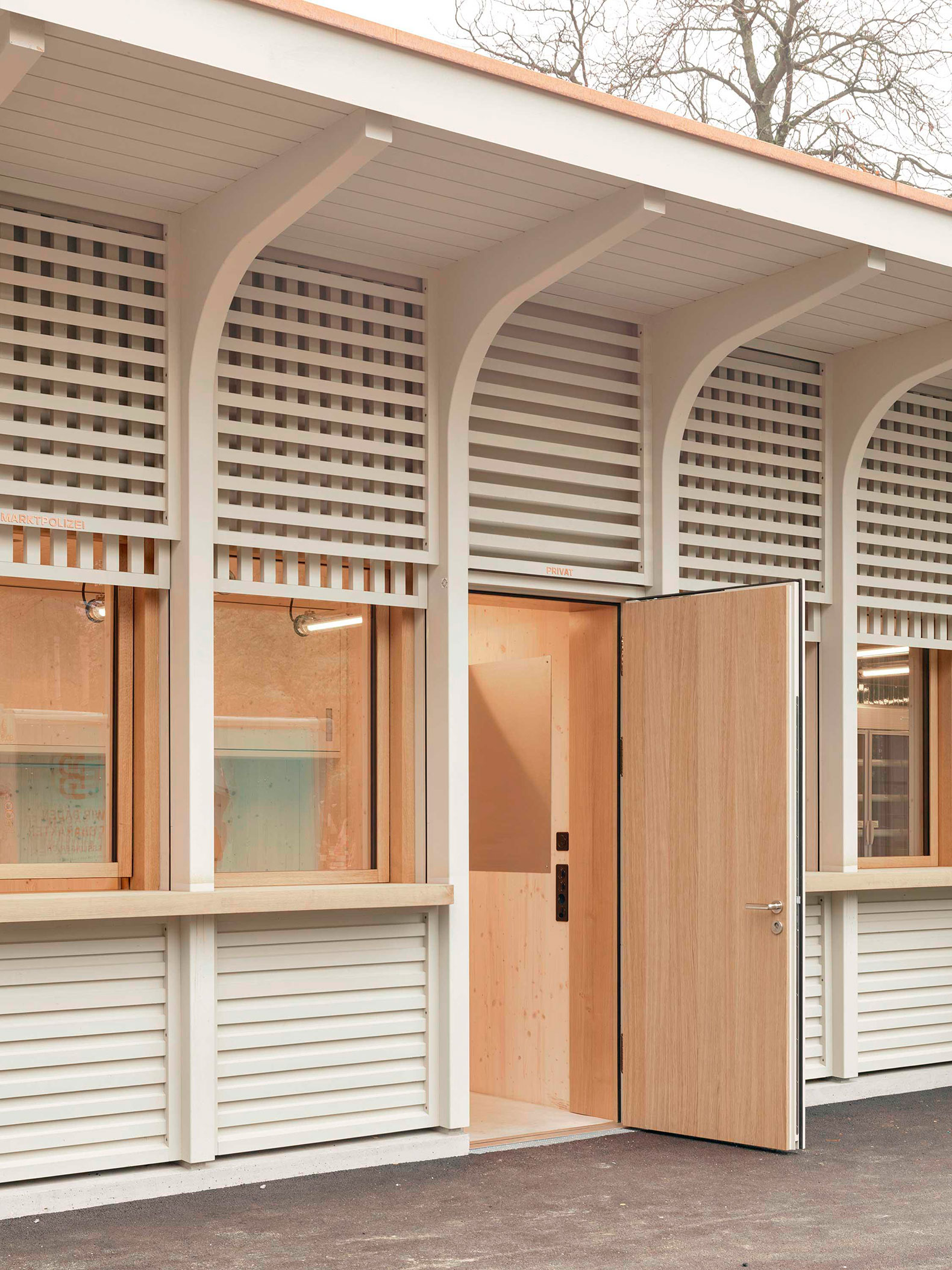
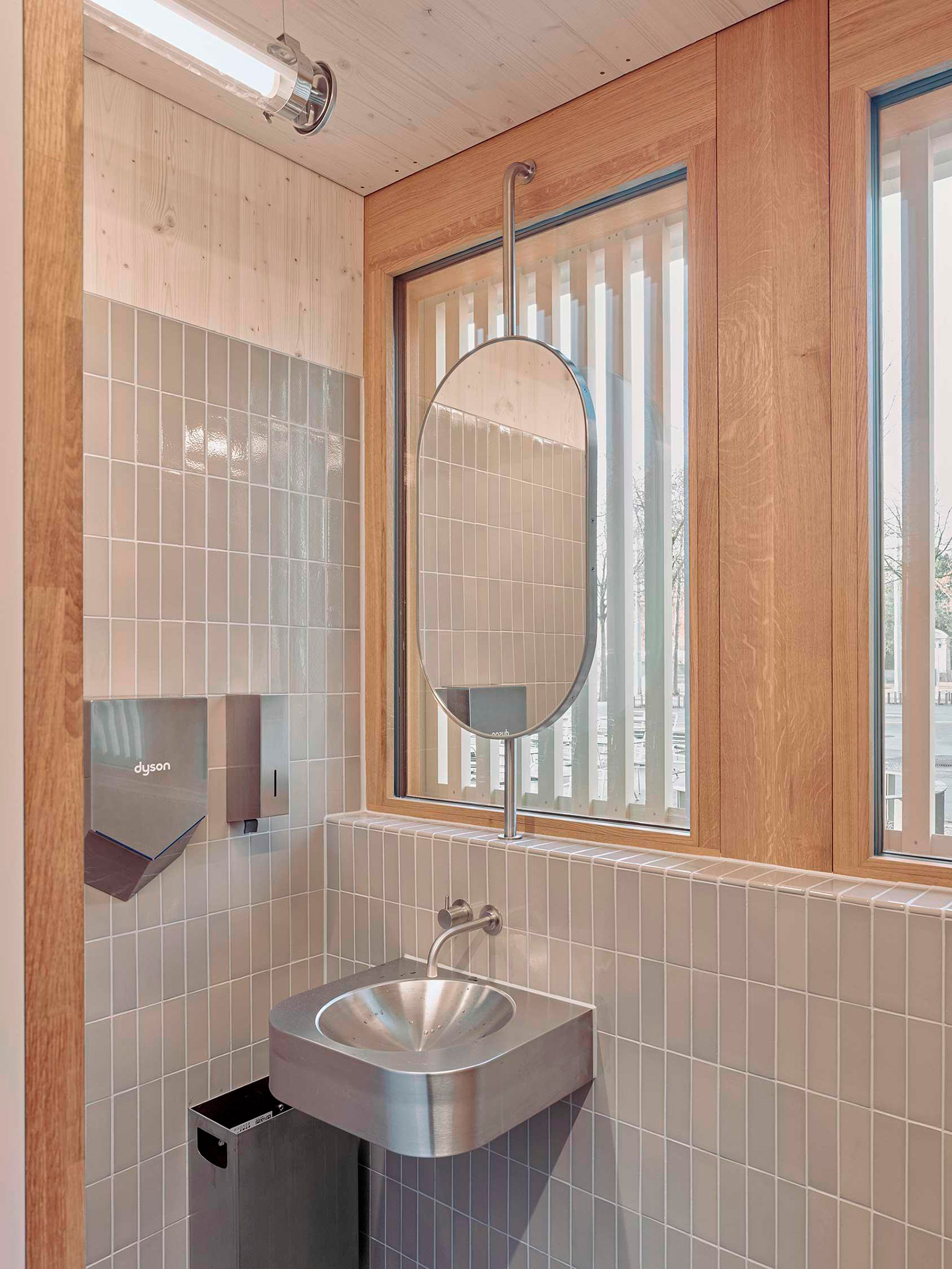
Adjacent to the catering area is the office of the market police, with direct external access. Its western orientation allows full visual oversight of the square. The publicly accessible toilet facilities are deliberately oriented away from the Stadthausanlage.
In the basement, in addition to storage and cold rooms, staff changing facilities and technical rooms are accommodated. In addition, a transformer station with associated EWZ distribution systems is integrated, supporting the electrical supply of the Stadthausanlage for temporary uses such as markets or events.
Expression - Façade Articulation - Appearance
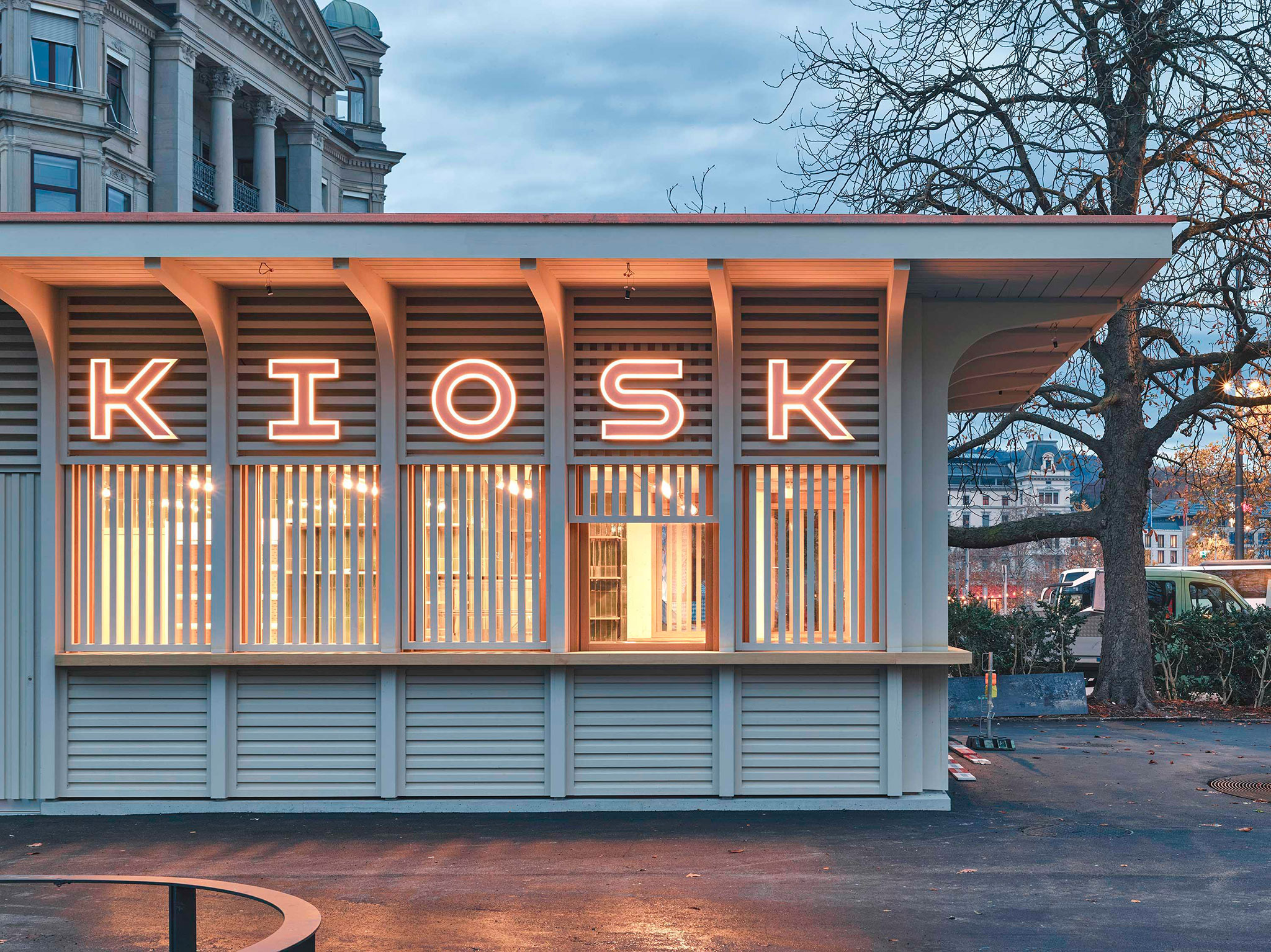
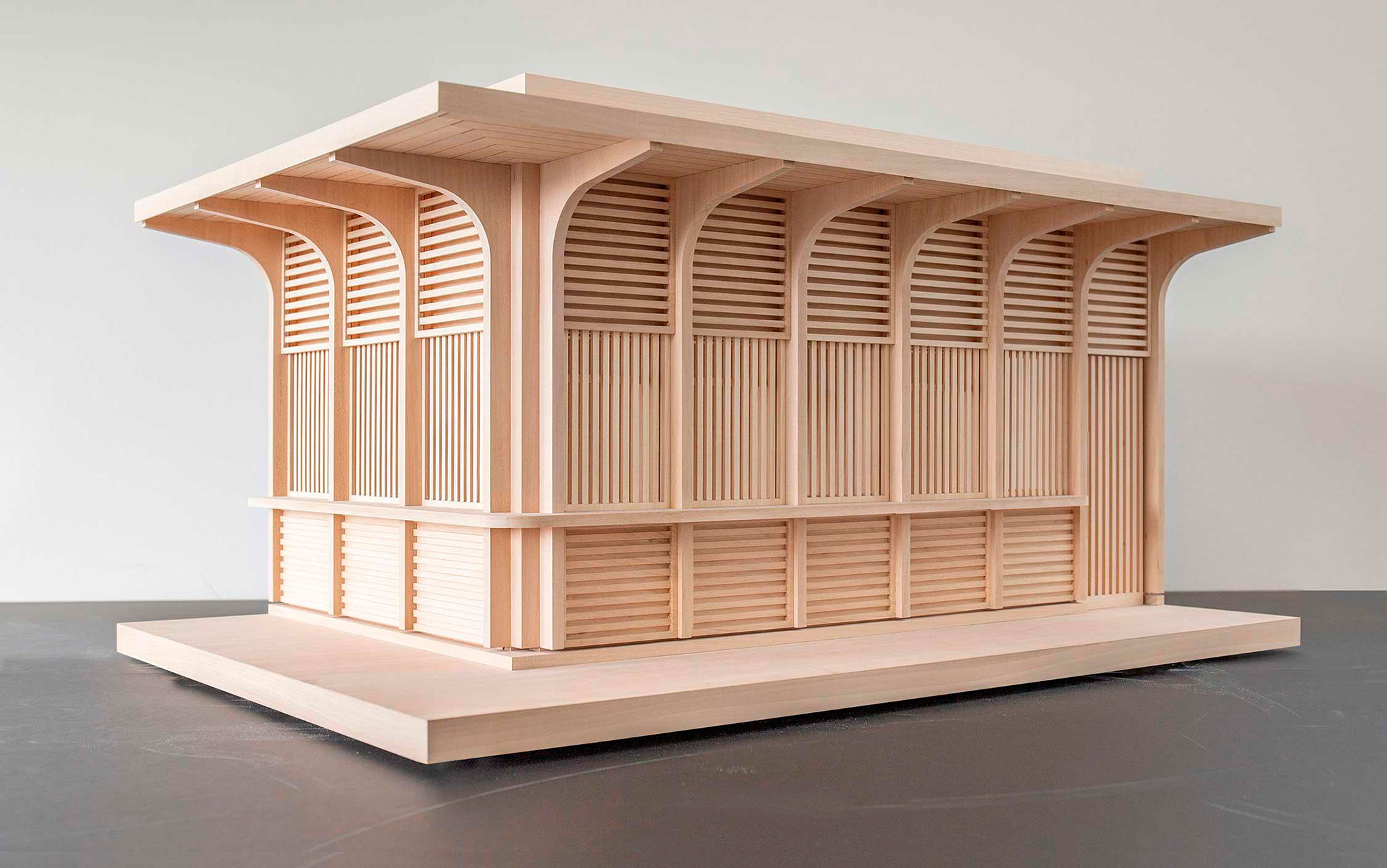
The new kiosk building appears as a restrained, clearly defined structure. Its external appearance is characterised by a faceted, relief-like building envelope, the articulation of which is directly derived from the structural and functional order.
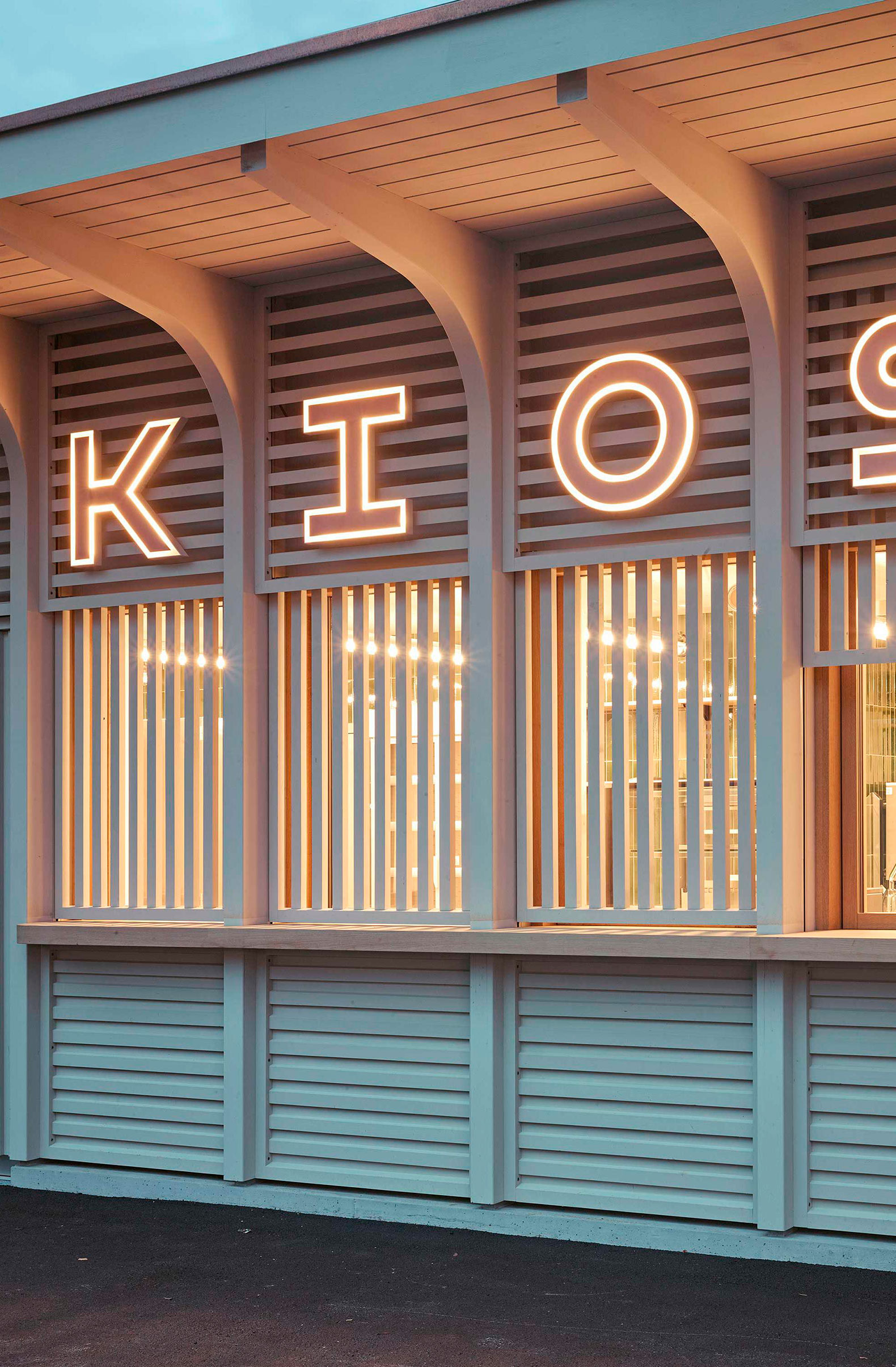
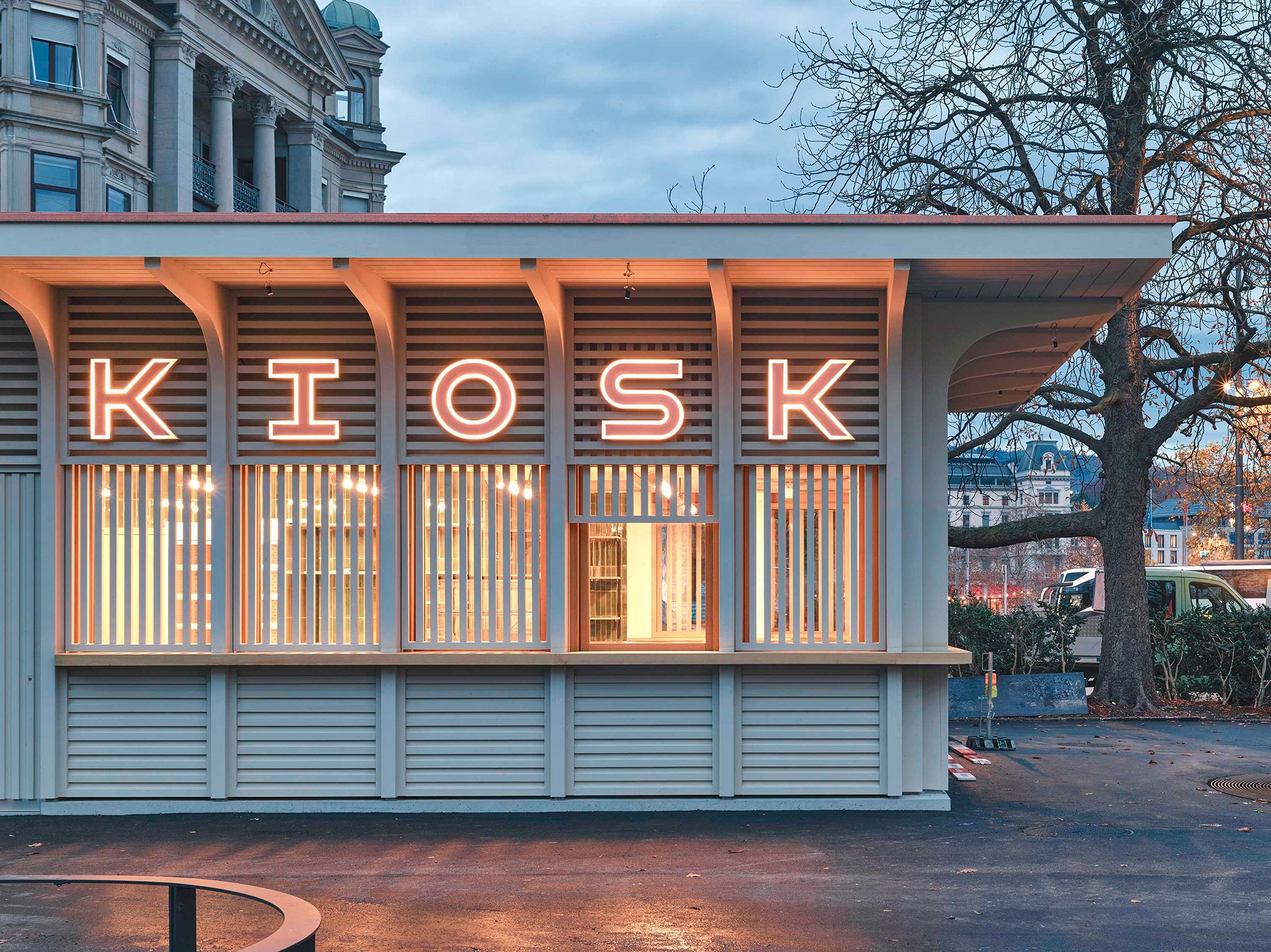
The defining elements of the façade are the vertically arranged, structurally active façade columns. They articulate the building volume along its length and unify the various uses and openings into a coherent overall appearance. Their rounded form characterises the external expression and establishes a subtle formal relationship with the listed existing buildings of the Stadthausanlage, without imitating them.
The intermediate zones are infilled with horizontally arranged wooden slats at the balustrade and lintel level. In front of the window plane, additional vertical wooden slats are installed, designed as vertically guided sliding shutters. During operating hours, these are raised behind the horizontal slat structure in the lintel zone, creating a decorative, relief-like wooden lattice.
In terms of colour, the building envelope is deliberately understated. The warm grey tone of the façade references the colour palette of the surrounding buildings and supports the integration of the new structure into the existing ensemble of the Stadthausanlage.
Construction - Sustainability
The replacement kiosk building is conceived as a compact, single-storey timber structure with a base- ment. The construction follows a clear, material-appropriate logic and derives its architectural expression directly from the load-bearing structure.
The basement is constructed in in-situ concrete; an externally continuous exposed concrete plinth forms a precise bearing for the timber structure above. The timber superstructure is articulated longitudinally by serially arranged post-and-beam systems at a grid of 1.15 m.
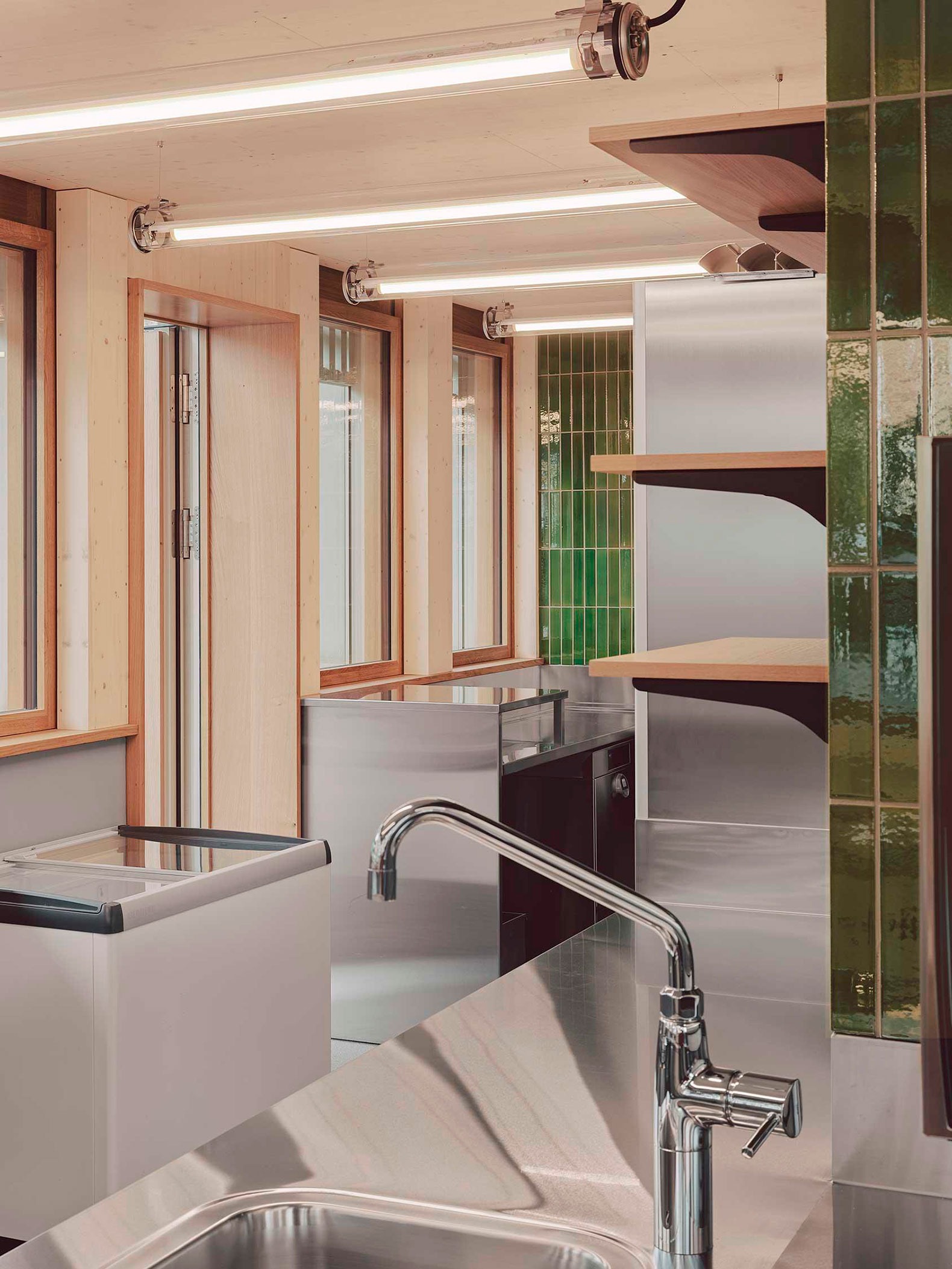
The structurally active façade columns are rigidly connected to the ceiling beams and carry the vertical loads of the roof structure. Behind the columns, prefabricated, insulated timber frame elements form the thermal building envelope. The internal partition walls are also designed as timber frame constructions and contribute to the overall bracing of the building.
The construction deliberately employs a high proportion of solid timber elements in order to minimise the use of glued wood products. This material-appropriate approach follows both structural and ecological considerations and enables a simple, legible load-bearing system as well as good deconstructability. The timber used originates from the Zurich municipal forest on the Zürichberg and was specifically harvested for the new building. In this way, the kiosk is closely connected to its local context not only structurally, but also materially.