Spanish Pavilion at FILBo 2025 is a proposal by Lluís Alexandre Casanovas Blanco, Paula Chalkho Rozenblum, Enrique Espinosa Pérez, and Santiago Pradilla Hosie, conceived as a network of interconnected landscapes inspired by ​​mobile libraries. 

Understood as essential cultural infrastructures for accessing knowledge in rural contexts, these institutions have historically functioned—in both Colombia and Spain—as a bridge between communities and reading. By symbolically linking text, weaving, and narrative, the pavilion proposes a dialogue between written knowledge and traditional craftsmanship.

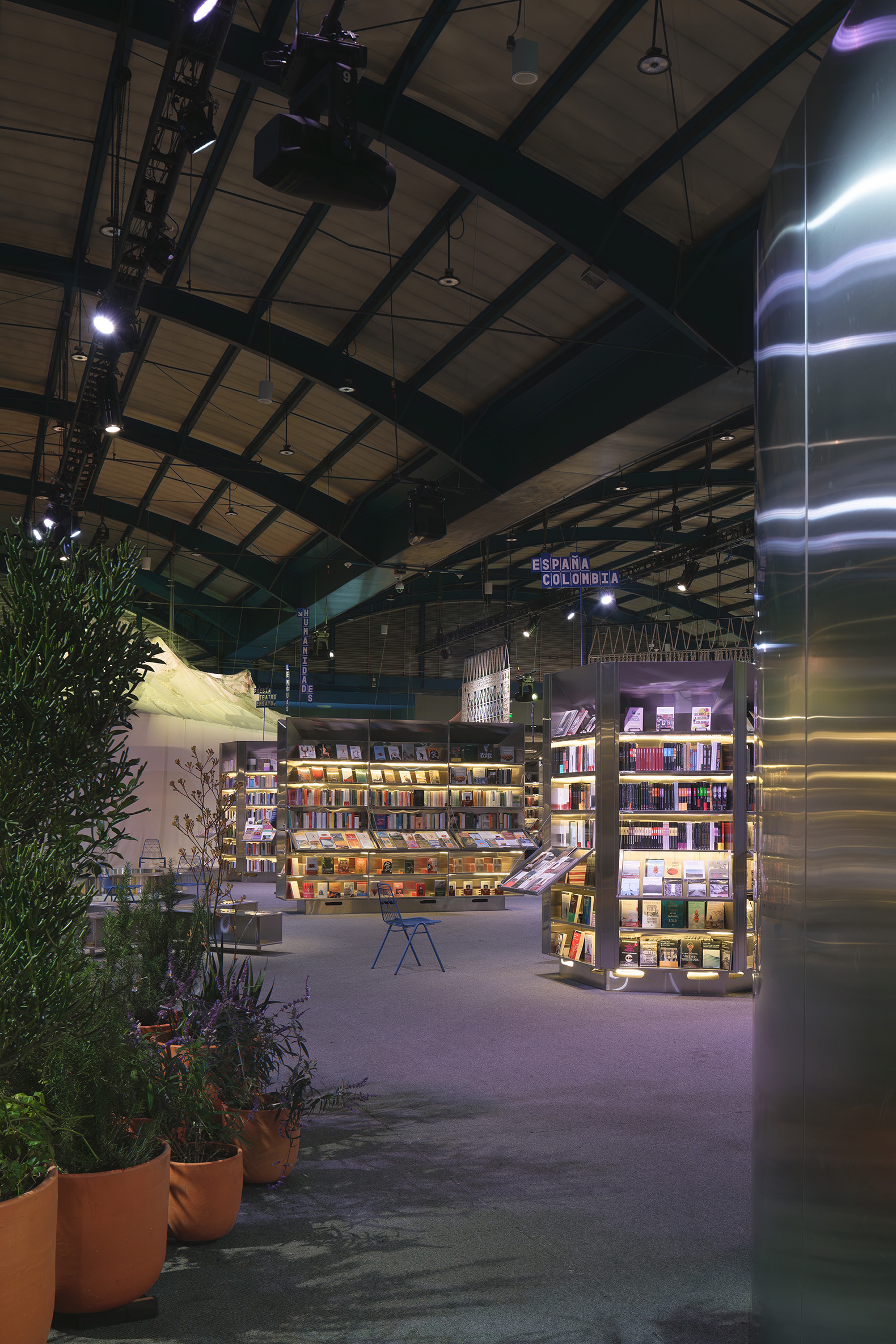
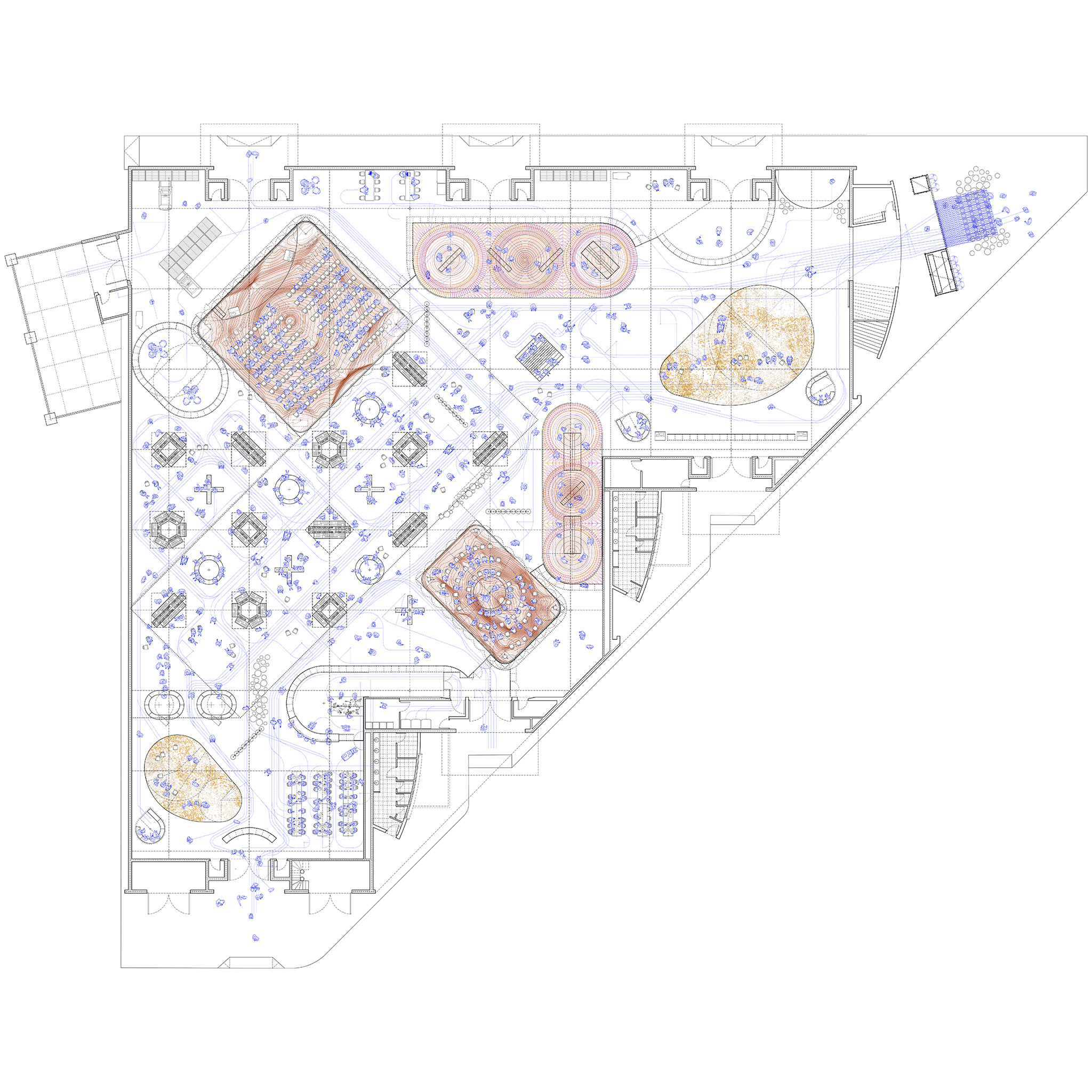
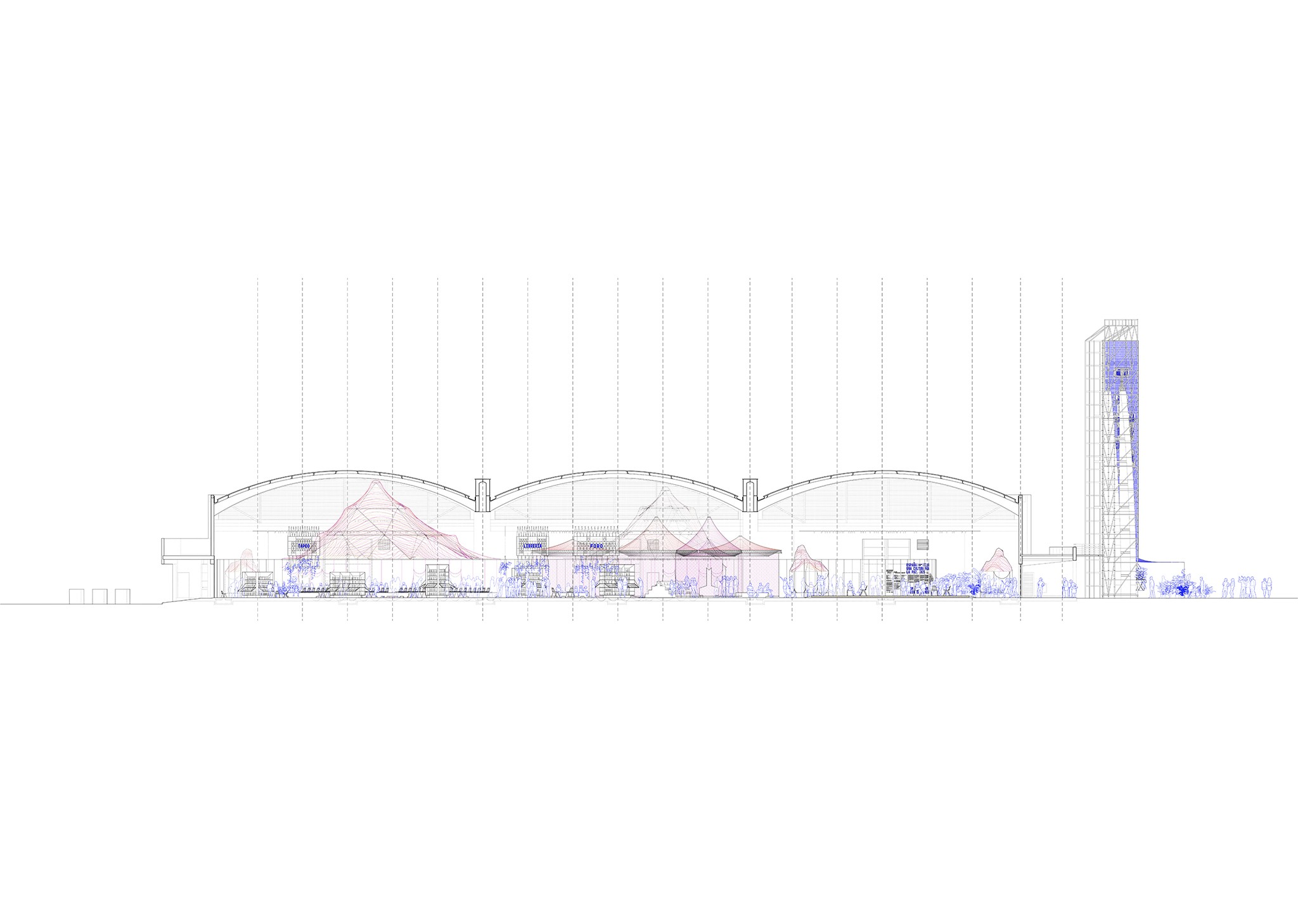
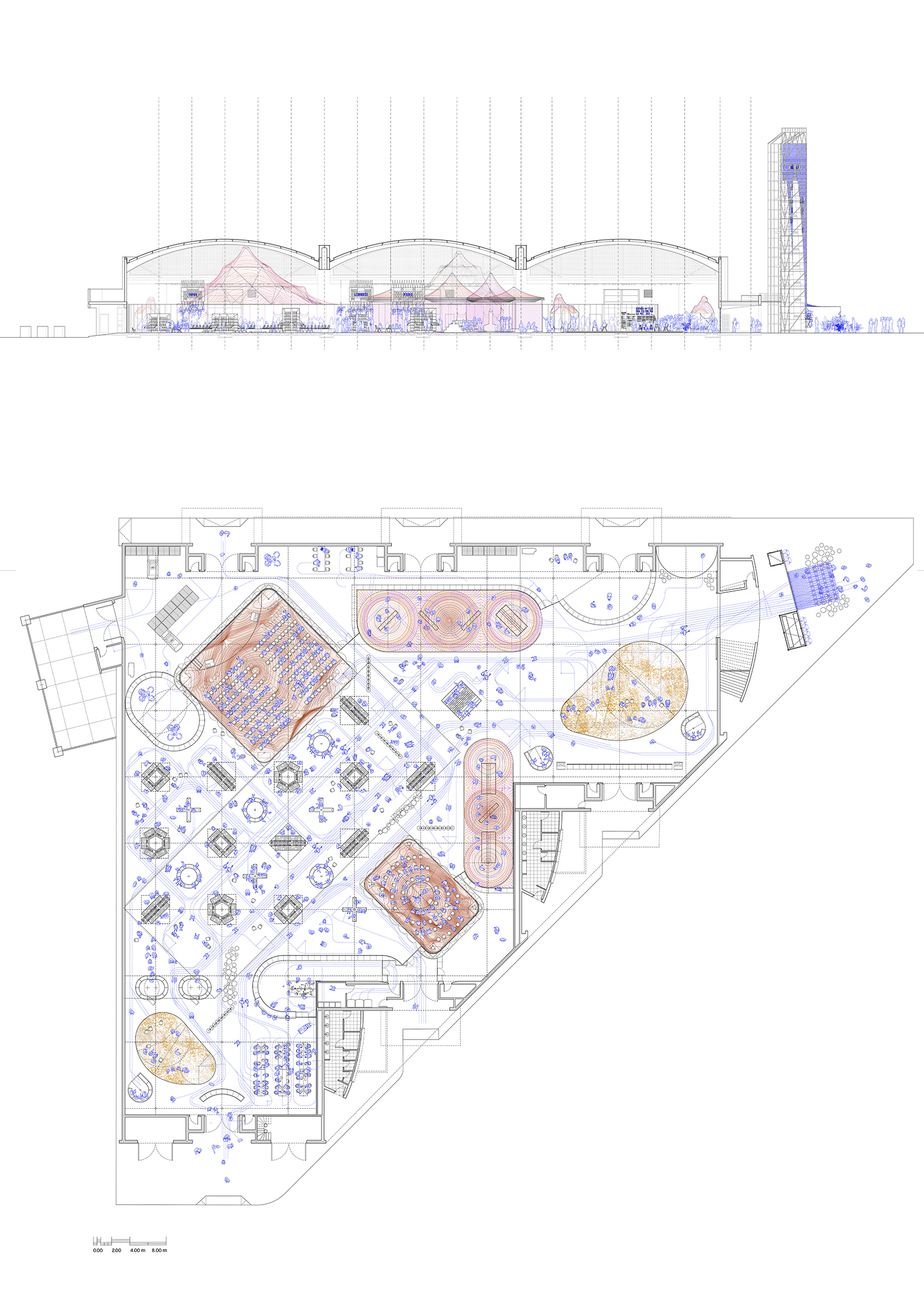
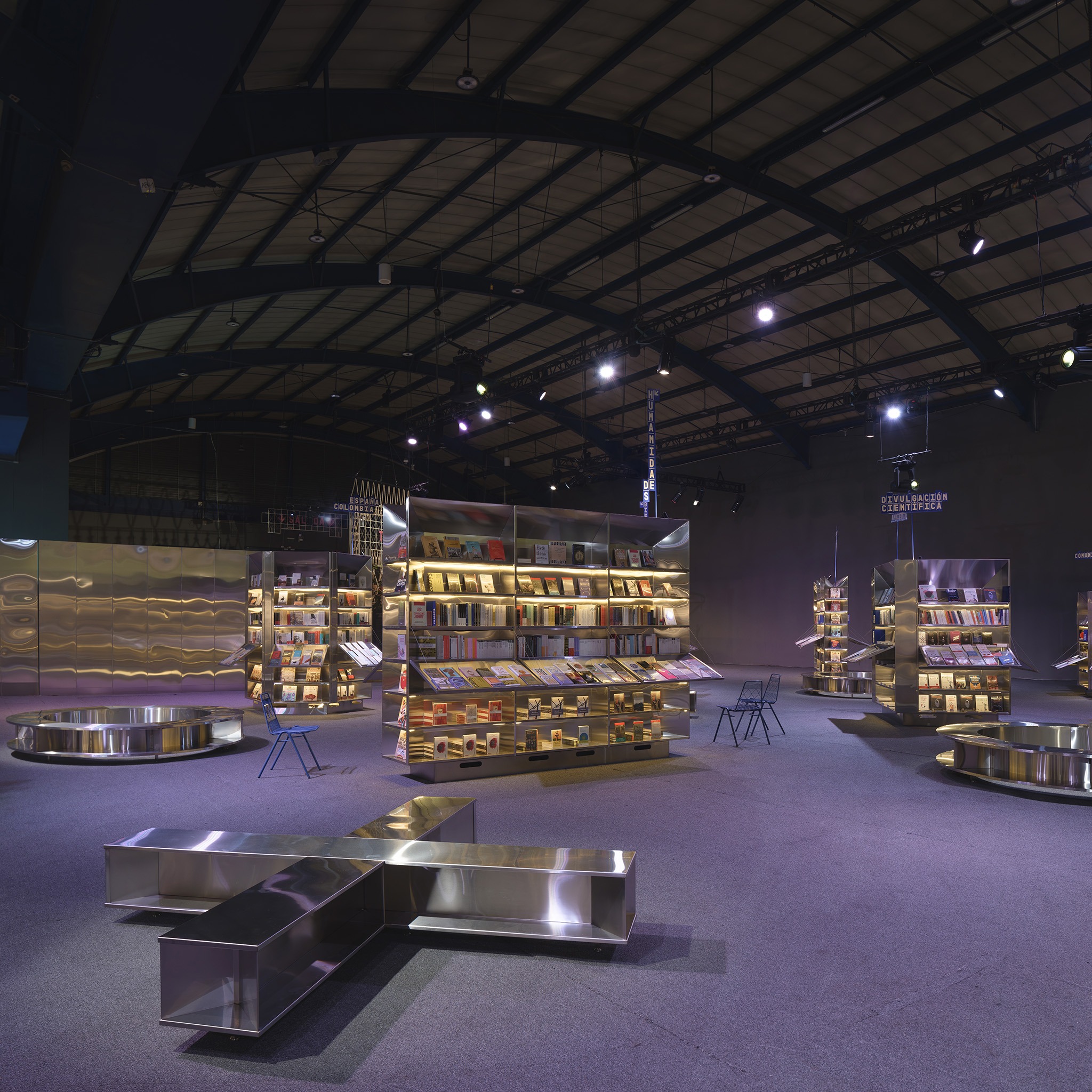
The spatial organization is structured as a sequence of welcome, encounter, and farewell. From an entrance plaza, visitors embark on a journey that includes exhibition spaces, an auditorium, a forum, and a large central bookstore conceived as the project's core. This perimeter arrangement creates an active interior void, where the bookstore functions as a place of transit and gathering, reinforcing the collective dimension of knowledge.

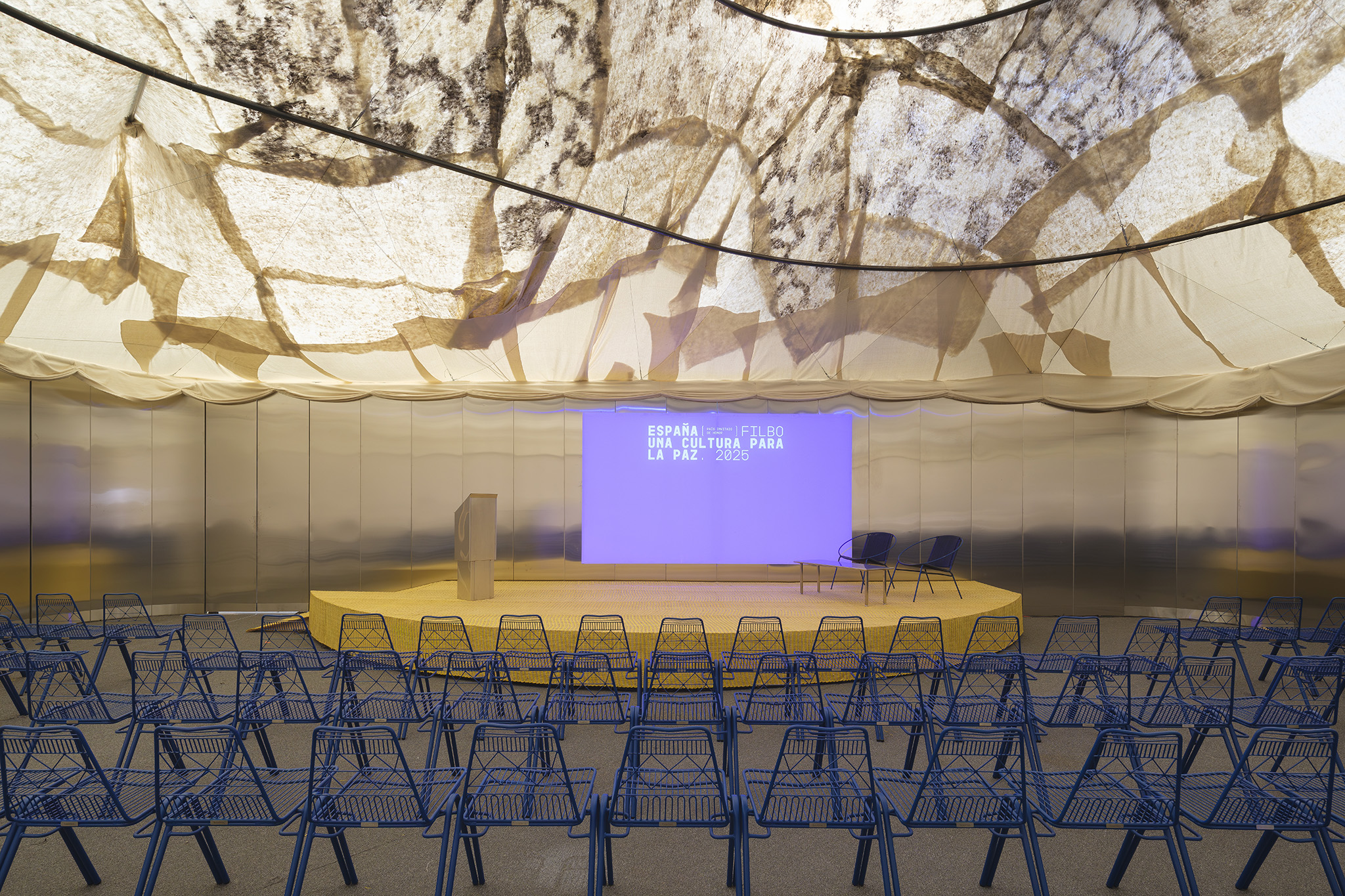
The materials chosen for the Pavilion, designed by Lluís Alexandre Casanovas Blanco, Paula Chalkho Rozenblum, Enrique Espinosa Pérez, and Santiago Pradilla Hosie, take center stage through the use of artisanal techniques and materials—such as macramé, wool felt, fique, and fishing nets—which not only shape the spatial atmosphere but also incorporate layers of cultural meaning. In contrast, stainless steel introduces reflective surfaces that articulate the intermediate spaces. Overall, the intervention establishes a dialogue between tradition and contemporaneity, between the handmade and the industrial.

Beyond its ephemeral nature, the pavilion makes a clear statement: to highlight the value of mobile libraries as relevant tools for democratizing access to culture. Far from a nostalgic perspective, the project advocates for their continuity through the reuse of their elements in different communities, extending their lifespan and reinforcing their social commitment in contexts linked to peace processes and cultural development.
The Spanish Pavilion at Filbo by Lluís Alexandre Casanovas Blanco, Paula Chalkho Rozenblum, Enrique Espinosa Pérez and Santiago Pradilla Hosie. Photograph by Javier Agustín Rojas

The Spanish Pavilion at Filbo by Lluís Alexandre Casanovas Blanco, Paula Chalkho Rozenblum, Enrique Espinosa Pérez and Santiago Pradilla Hosie. Photograph by Javier Agustín Rojas.

Project description by Lluís Alexandre Casanovas Blanco, Paula Chalkho Rozenblum, Enrique Espinosa Pérez and Santiago Pradilla Hosie

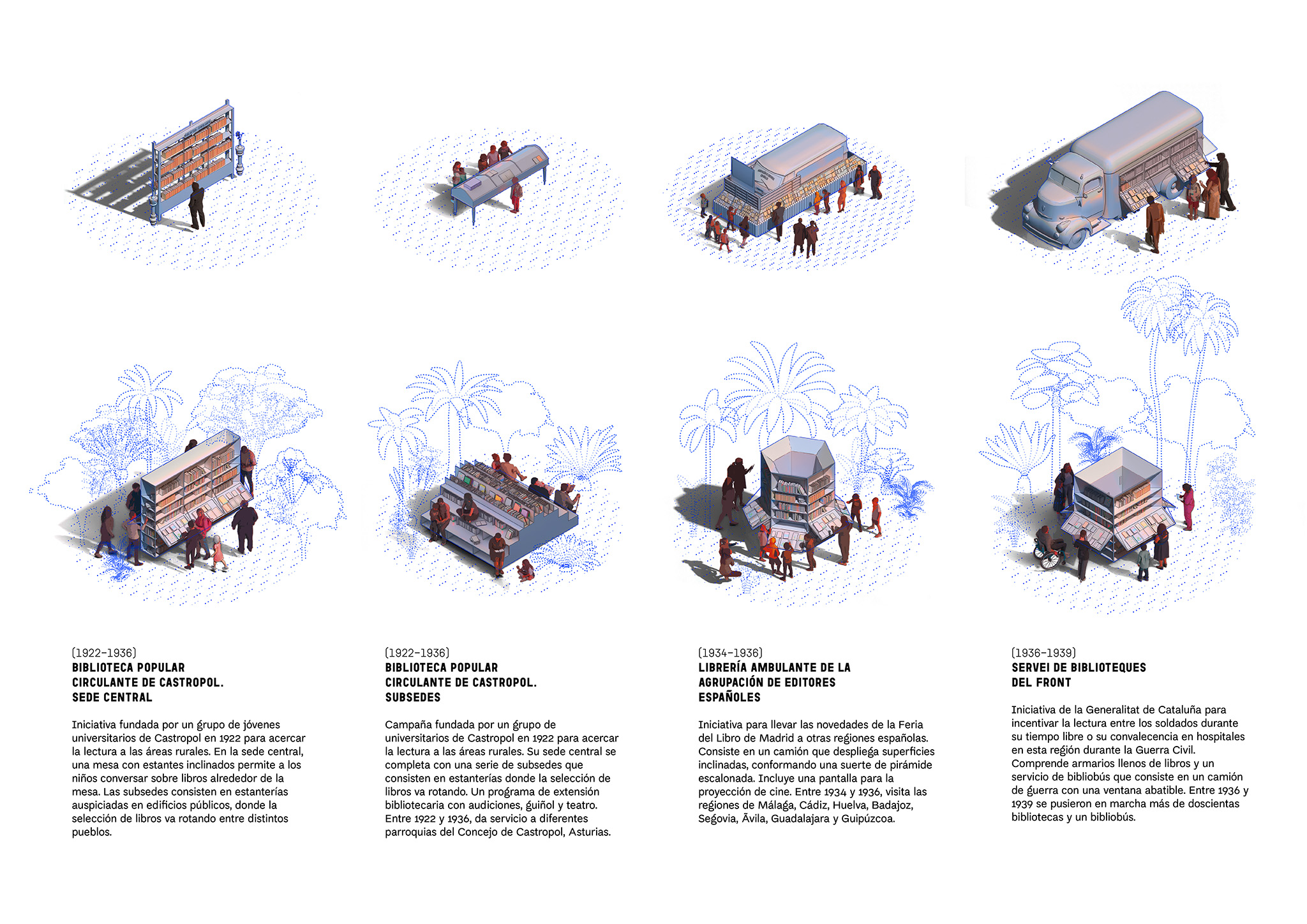
The Spanish Pavilion at FilBo 2025 is conceived as a series of landscapes connected by the movement of mobile libraries. Common in rural areas, these institutions constitute essential infrastructure for universal access to knowledge. Modest in scale and materially austere, they operate outside the logic of economic profit, linking readers in peripheral communities through their circulation. Historically, mobile libraries have played a vital role in both Colombia and Spain, providing access to books for broad segments of the population and often serving as a first point of contact with reading.

The Pavilion understands the mobile library as a form of architecture that links two kinds of knowledge: the written word, inscribed on the pages of books, and orally transmitted craft knowledge, embodied in materials such as handmade felt, macrame, netting, or fique. This dual condition resonates with universal semantic connections between words like text, textile, and tale—coincidences that appear in Latin (textum) as well as in Amerindian languages spoken in Colombia, like Wayúu (süchi).

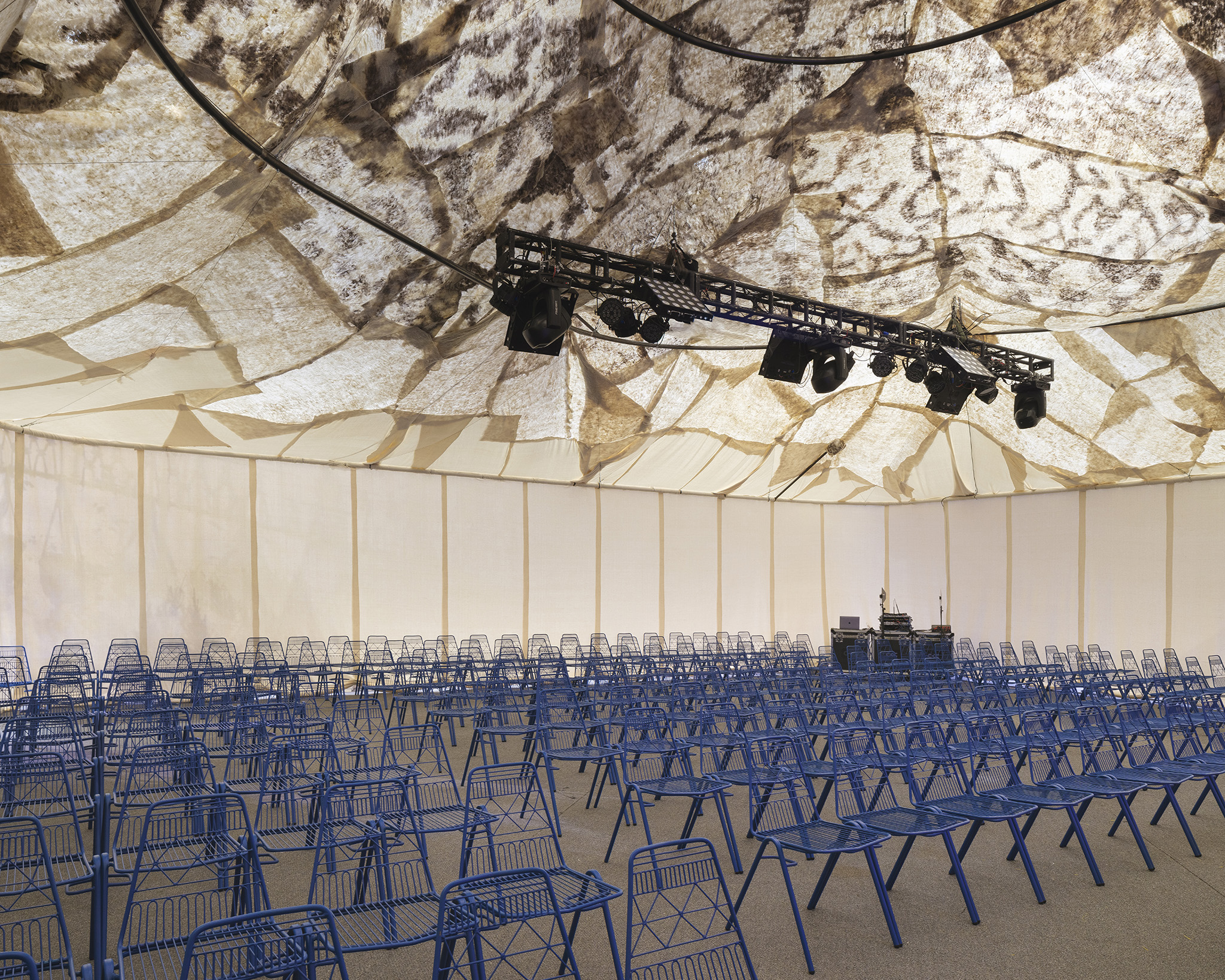
The visit to the Pavilion unfolds as a sequence of welcome, gathering, and farewell, articulated through different program elements. A large entry plaza introduces visitors to the curatorial proposal. From there, they access a series of spaces: an exhibition of Spanish photobooks; another on historical memory and graphic novels; a 240-seat auditorium; an 80-seat forum; and a large bookstore-reading area. Visitors exit through a second plaza that opens onto a terrace-canteen.

The Spanish Pavilion at Filbo by Lluís Alexandre Casanovas Blanco, Paula Chalkho Rozenblum, Enrique Espinosa Pérez and Santiago Pradilla Hosie. Photograph by Javier Agustín Rojas
The Spanish Pavilion at Filbo by Lluís Alexandre Casanovas Blanco, Paula Chalkho Rozenblum, Enrique Espinosa Pérez and Santiago Pradilla Hosie. Photograph by Javier Agustín Rojas.

Craft Know-How
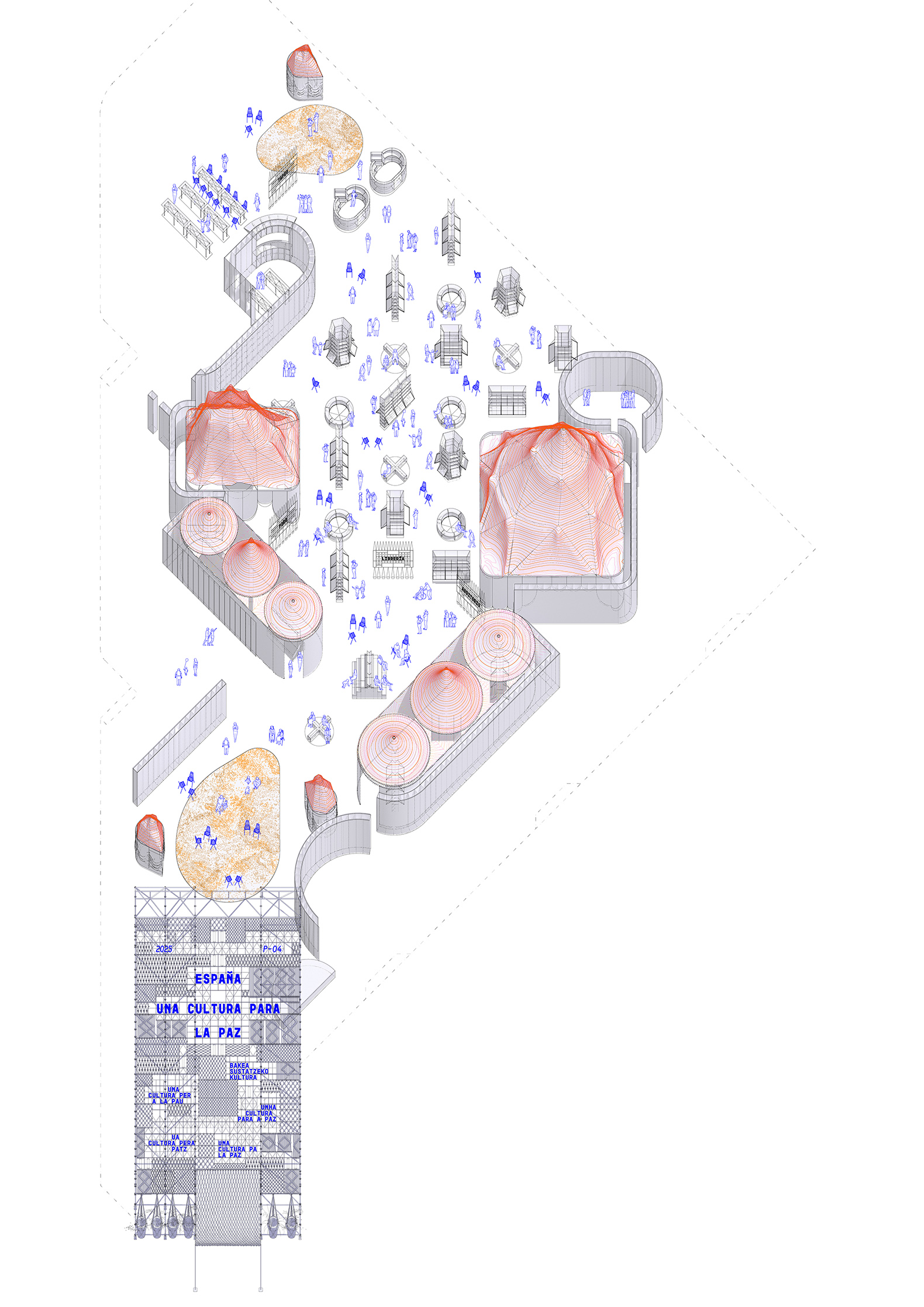
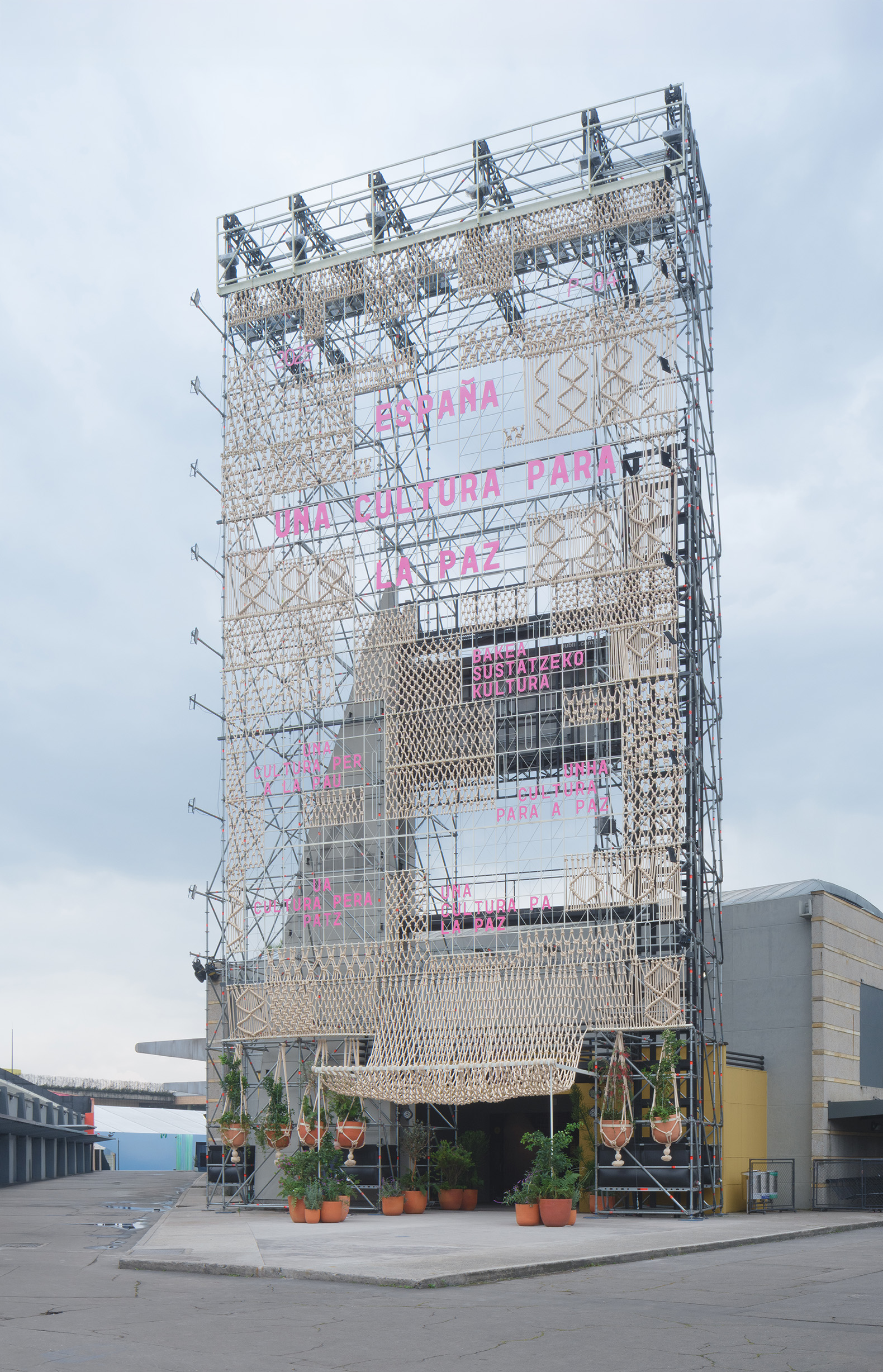
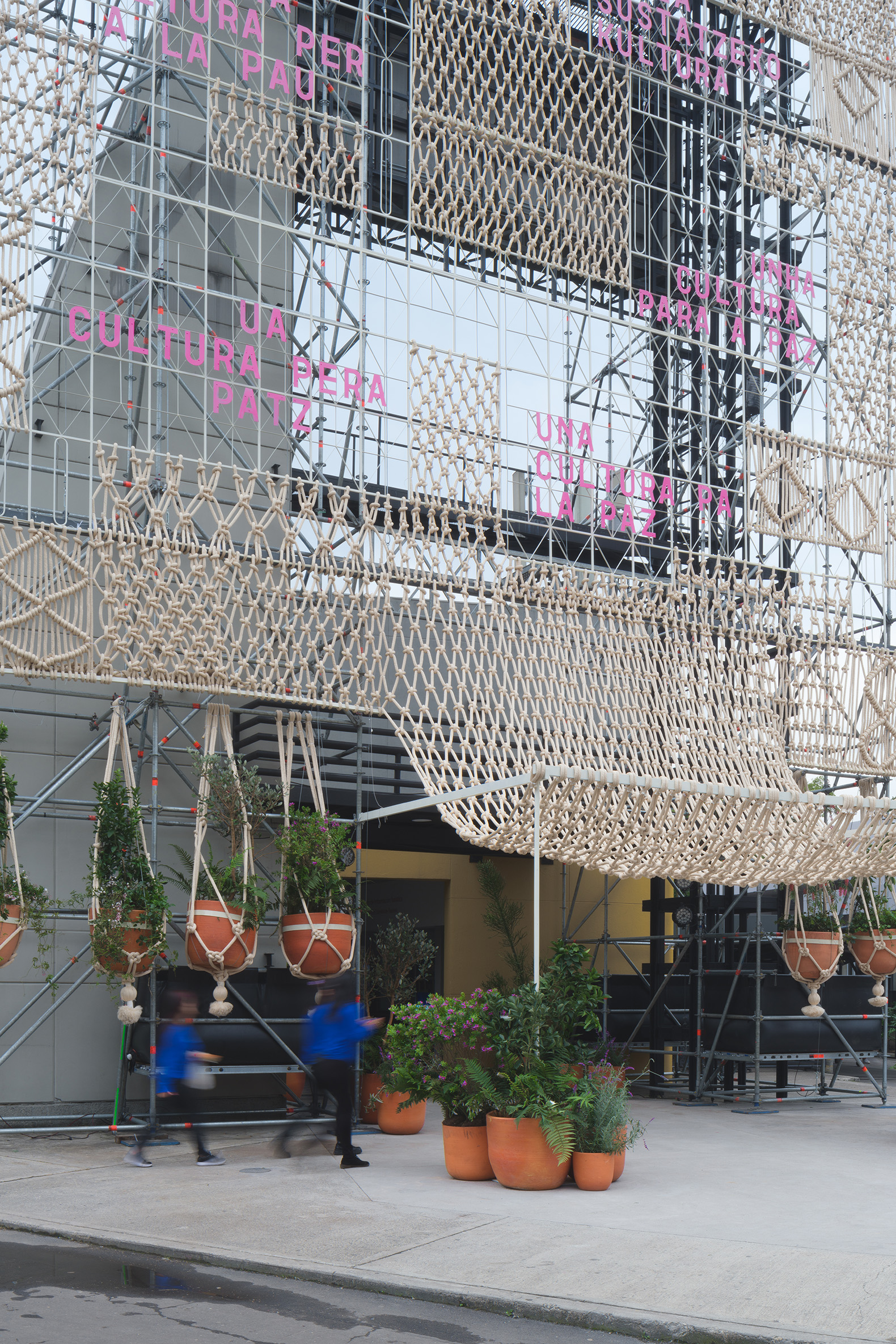
The Pavilion’s façade is formed by a monumental macramé tapestry nearly 20 meters tall, created by the Macramé Artisans’ Association of Cogua (Cundinamarca), which was revitalized thanks to this project. Interwoven with climbing vegetation, the tapestry evokes Iberian cliffs and Amazonian tepuis, offering a preview of the textile landscapes found inside. The tapestry folds to form a canopy at the entrance to the Pavilion.

Originating in the Arab world, macramé spread globally from the 8th century onward. As it expanded, it encountered local knotting techniques in nearly every culture. In the 15th century, the Spanish conquest brought macramé to the Americas, where it evolved into new forms through contact with pre-Columbian traditions. On the Pavilion’s façade, macramé becomes text: its knotted cords, sometimes reinforced with metal rods, serve as a base for lettering that welcomes visitors. Transcending its usual classification as decorative art, this textile piece takes on a quasi-infrastructural dimension—its scale and production process challenge the historically marginal status of textiles and their association with women’s labor.

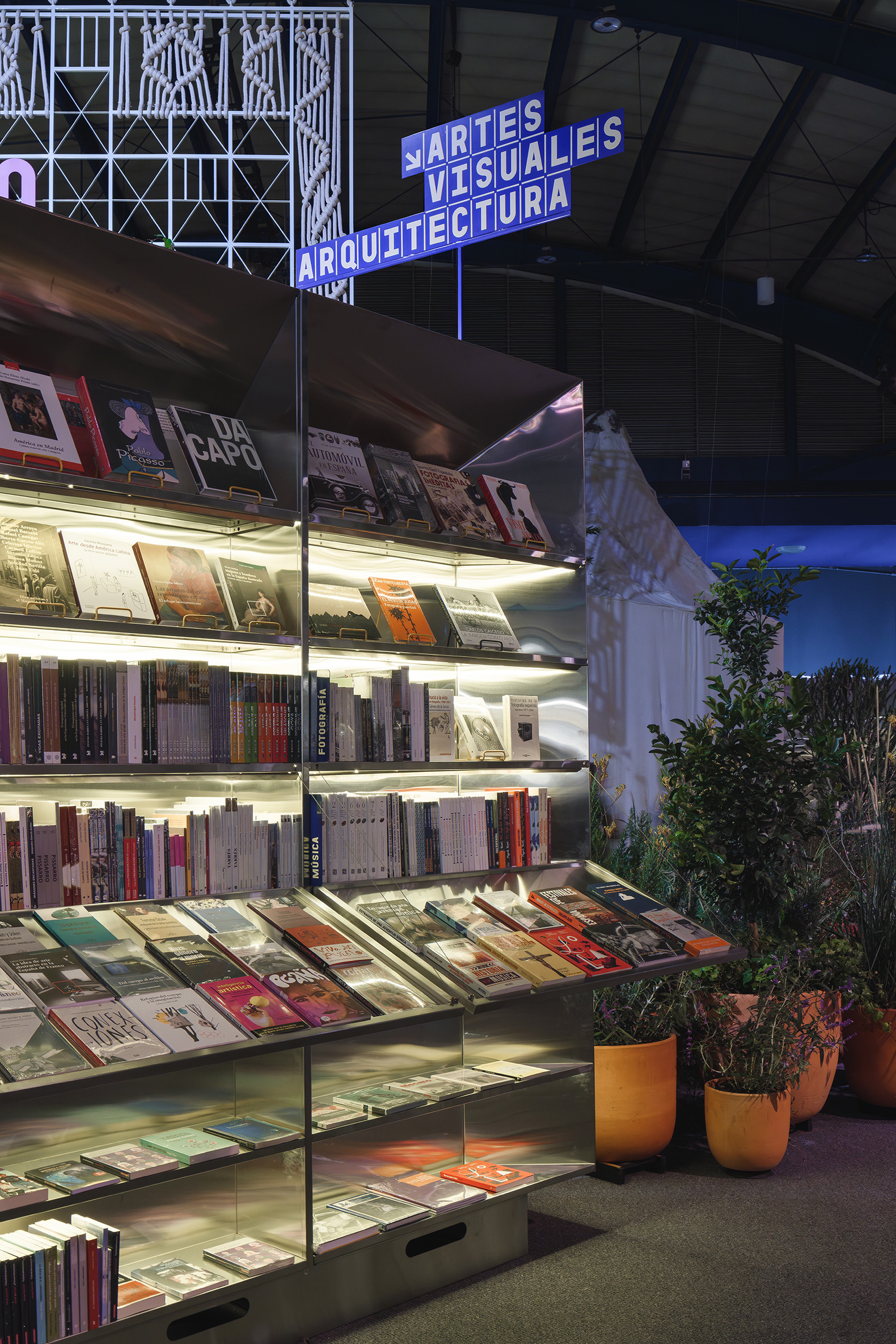
Macramé also appears in the Pavilion’s interior signage, with large woven panels held in place by pots containing native plant species.
The Spanish Pavilion at Filbo by Lluís Alexandre Casanovas Blanco, Paula Chalkho Rozenblum, Enrique Espinosa Pérez and Santiago Pradilla Hosie. Photograph by Javier Agustín Rojas
The Spanish Pavilion at Filbo by Lluís Alexandre Casanovas Blanco, Paula Chalkho Rozenblum, Enrique Espinosa Pérez and Santiago Pradilla Hosie. Photograph by Javier Agustín Rojas.

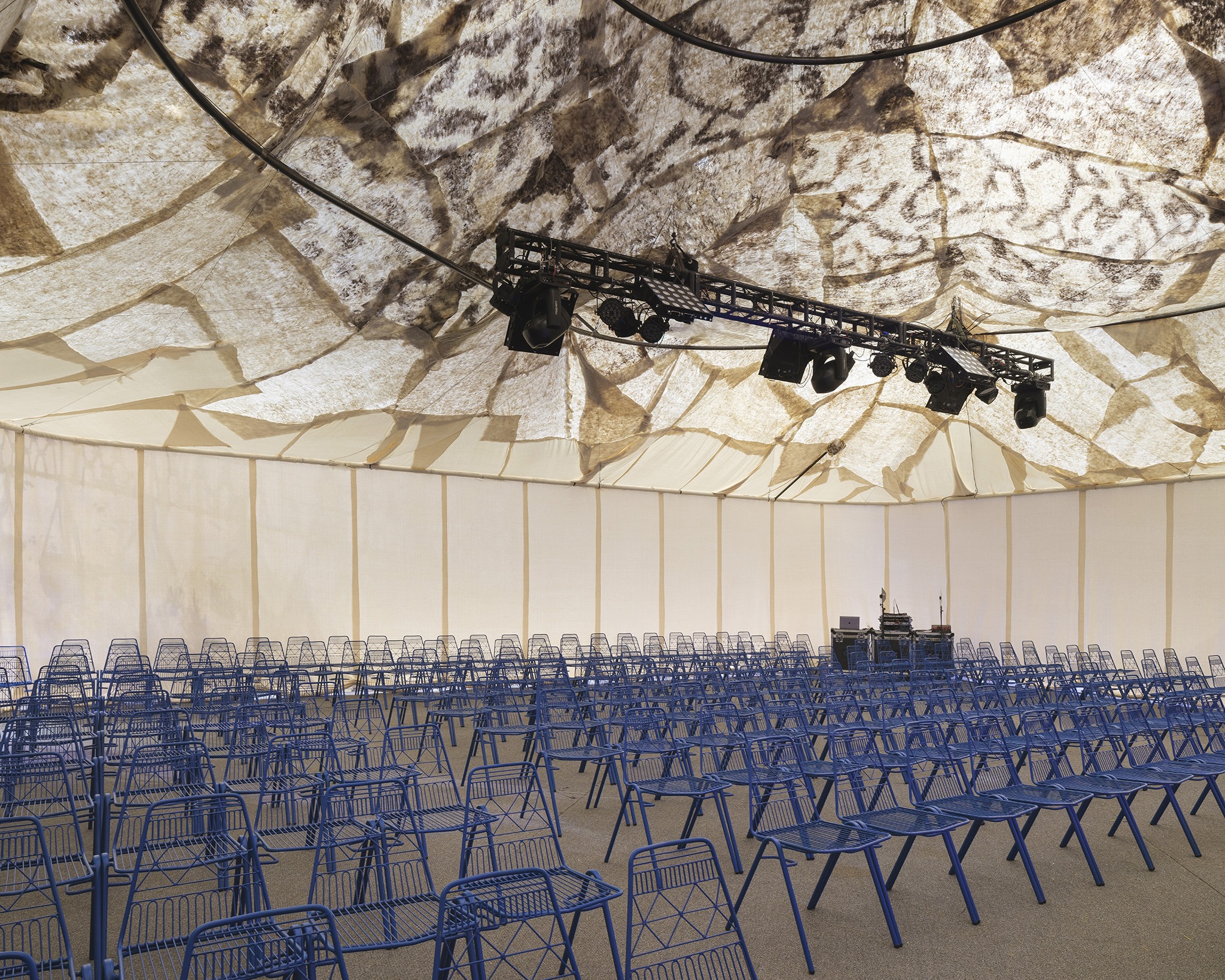
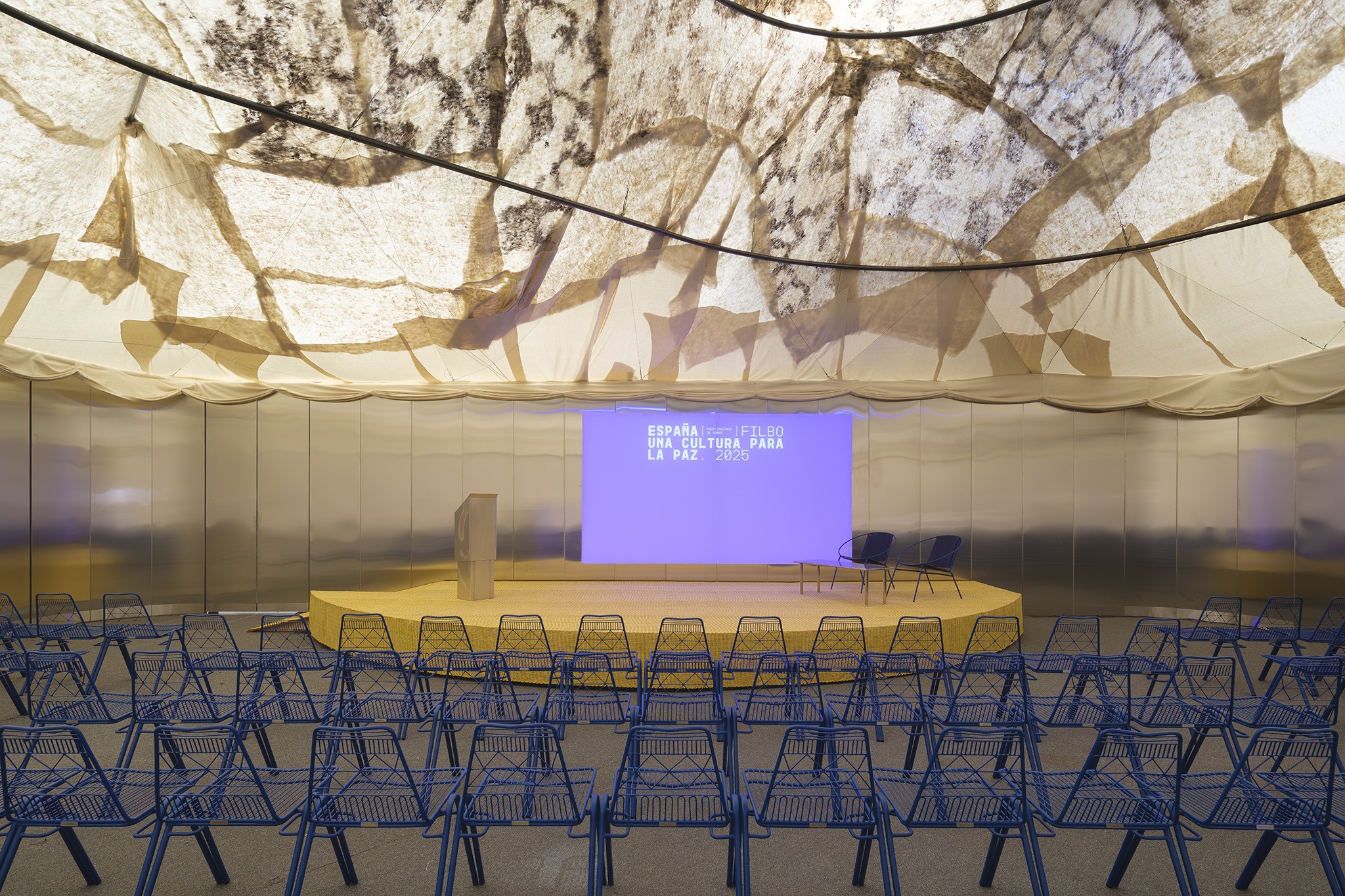
The auditorium, forum, and videopoetry spaces are conceived as mountainous forms, made from suspended sheep’s wool felt. This material offers acoustic and visual insulation, adapting the spaces for talks, readings, and concerts. The felt pieces, produced by an artisan community in Sutatausa (Cundinamarca), reference the transformation of textile practices after the arrival of sheep farming in Colombia in the 16th century, when communities such as the Muisca began to replace cotton with wool to make ruanas—traditional sleeveless Colombian ponchos.

To focus attention on the stages, their platforms are covered with fique, a plant fiber native to Colombia commonly used in flooring. The material used here was crafted by artisans from Curití (Santander).

The exhibition areas are enclosed with fishing nets that help control visitor flow without interrupting visual connections to the rest of the Pavilion. Produced in Lorica (Córdoba), these nets reference the cultural importance of fishing in both Colombia and Spain. In Spain, this tradition is rooted in 1,491 kilometers of Mediterranean coastline and 6,409 kilometers of Atlantic coast. In Colombia, beyond its 1,760 kilometers of Caribbean and 1,448 kilometers of Pacific coast, fishing also plays a central role in the lives of riverine communities along the Amazon and other waterways.
The Spanish Pavilion at Filbo by Lluís Alexandre Casanovas Blanco, Paula Chalkho Rozenblum, Enrique Espinosa Pérez and Santiago Pradilla Hosie. Photograph by Javier Agustín Rojas
The Spanish Pavilion at Filbo by Lluís Alexandre Casanovas Blanco, Paula Chalkho Rozenblum, Enrique Espinosa Pérez and Santiago Pradilla Hosie. Photograph by Javier Agustín Rojas.

Written Knowledge
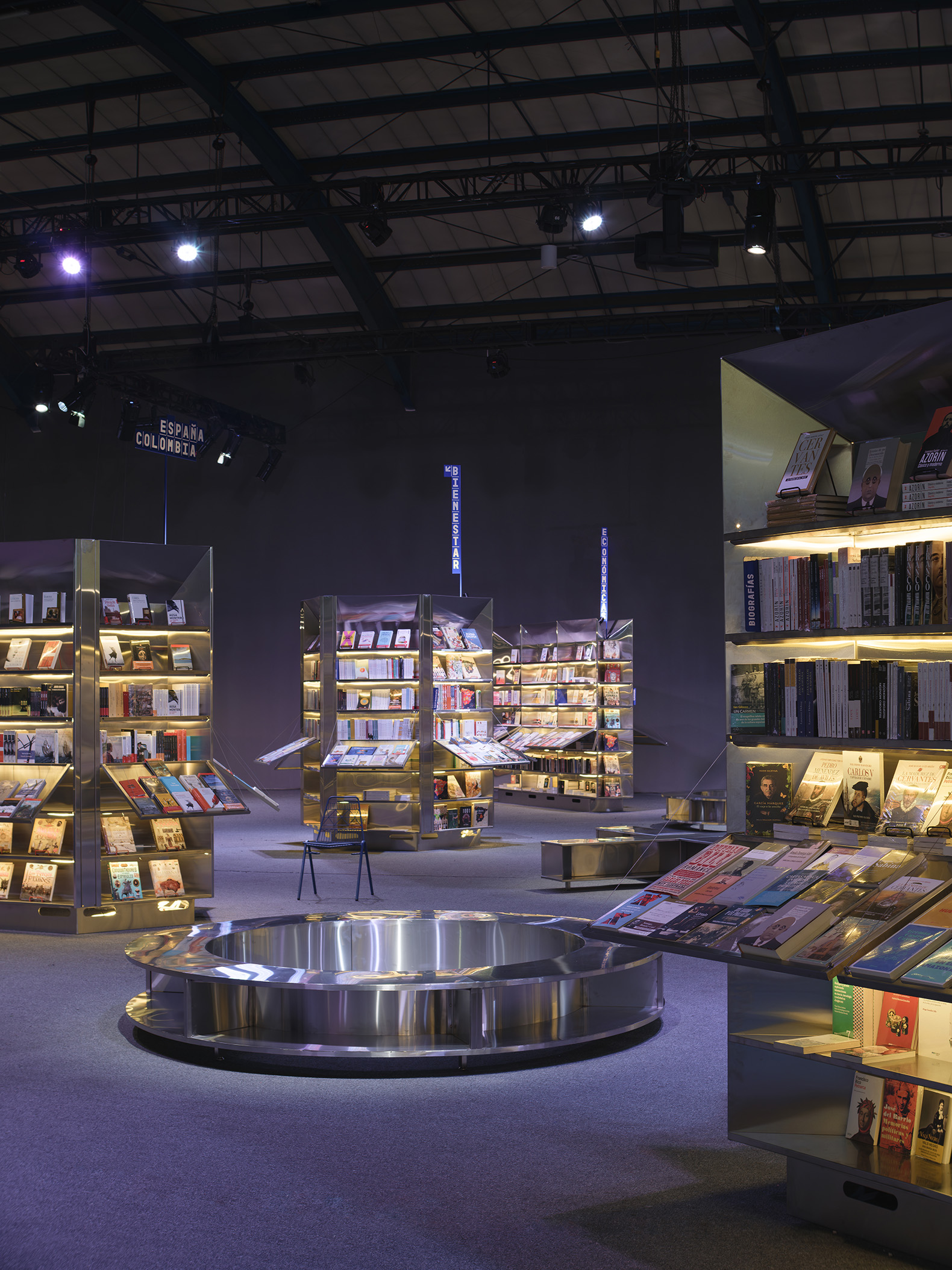
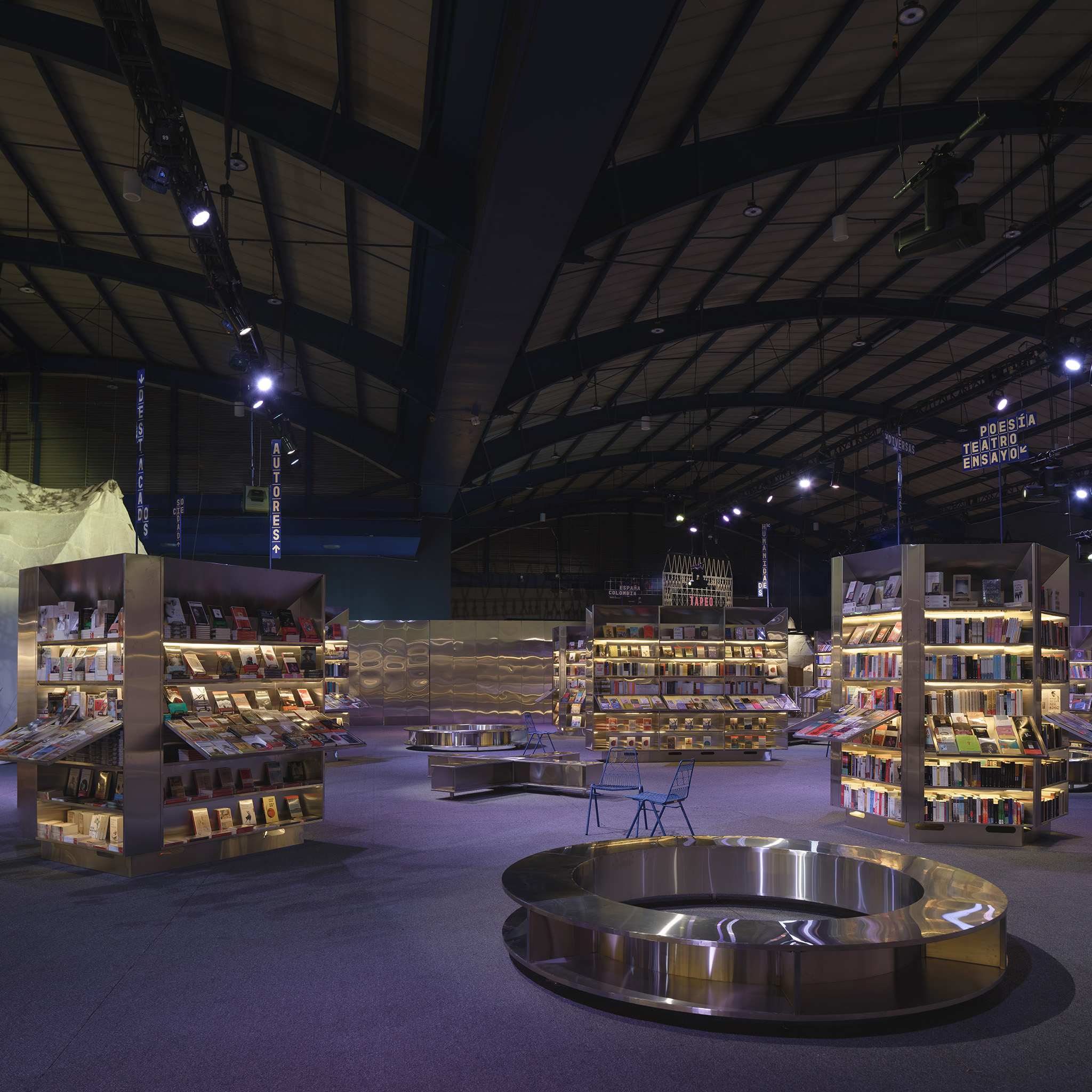
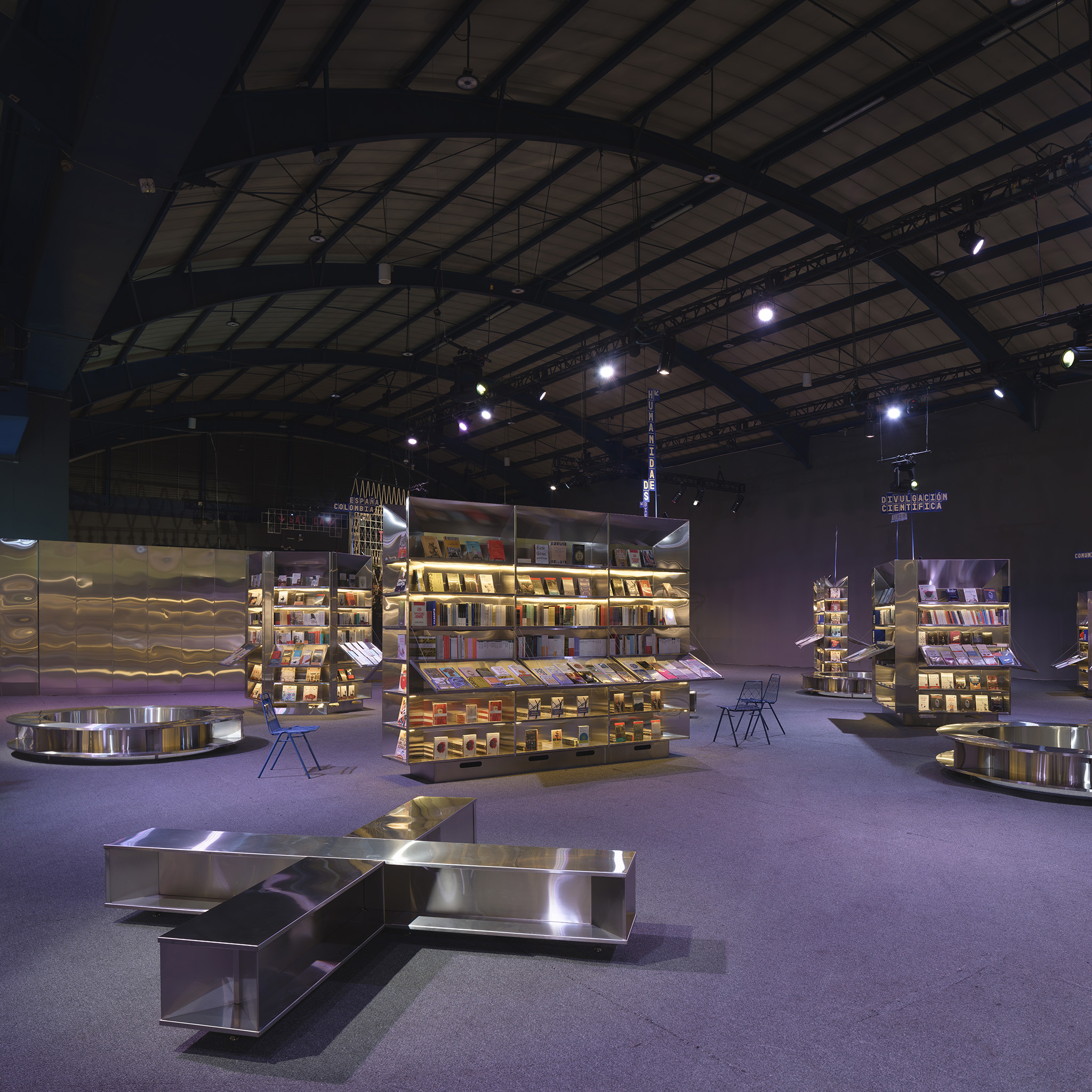
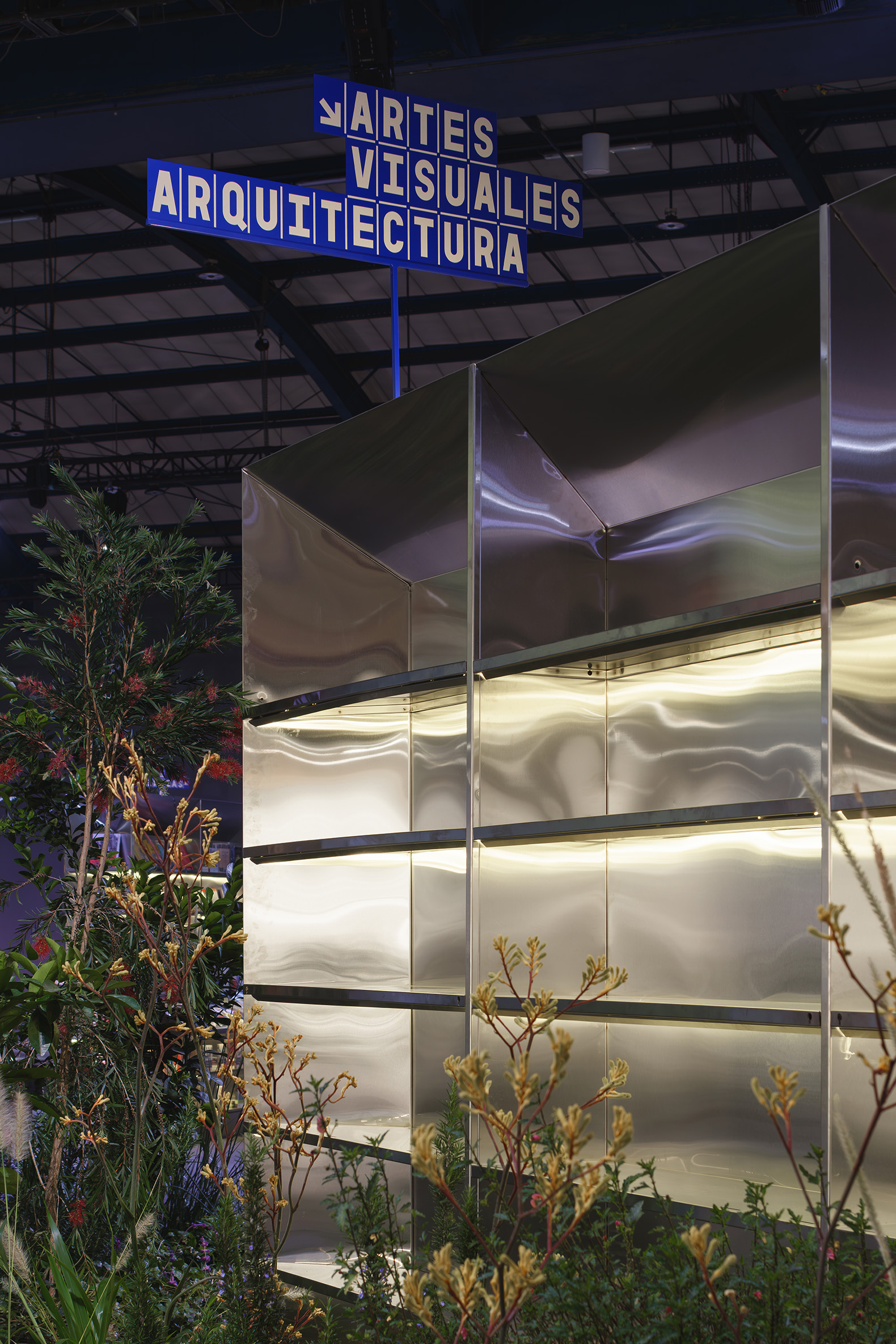
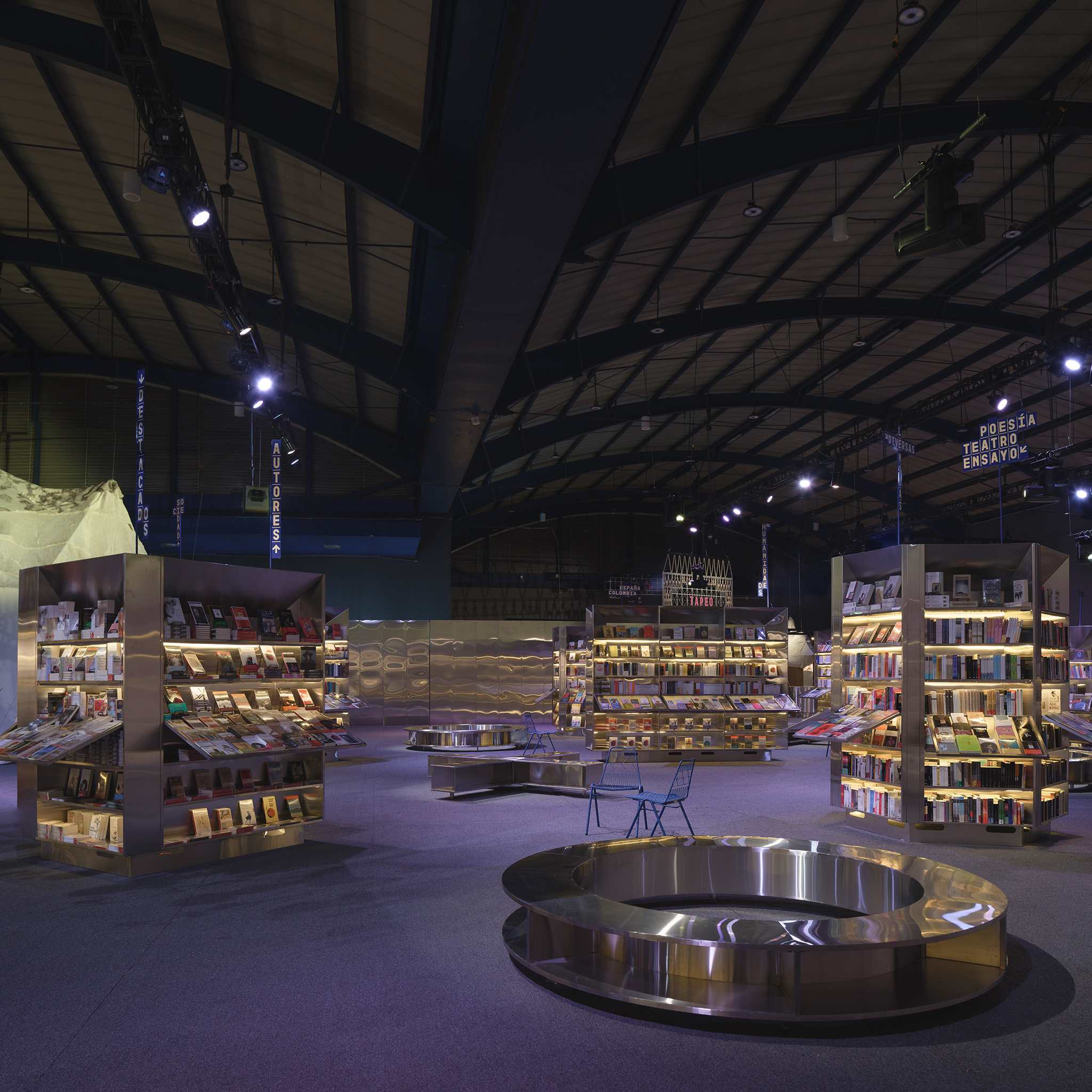
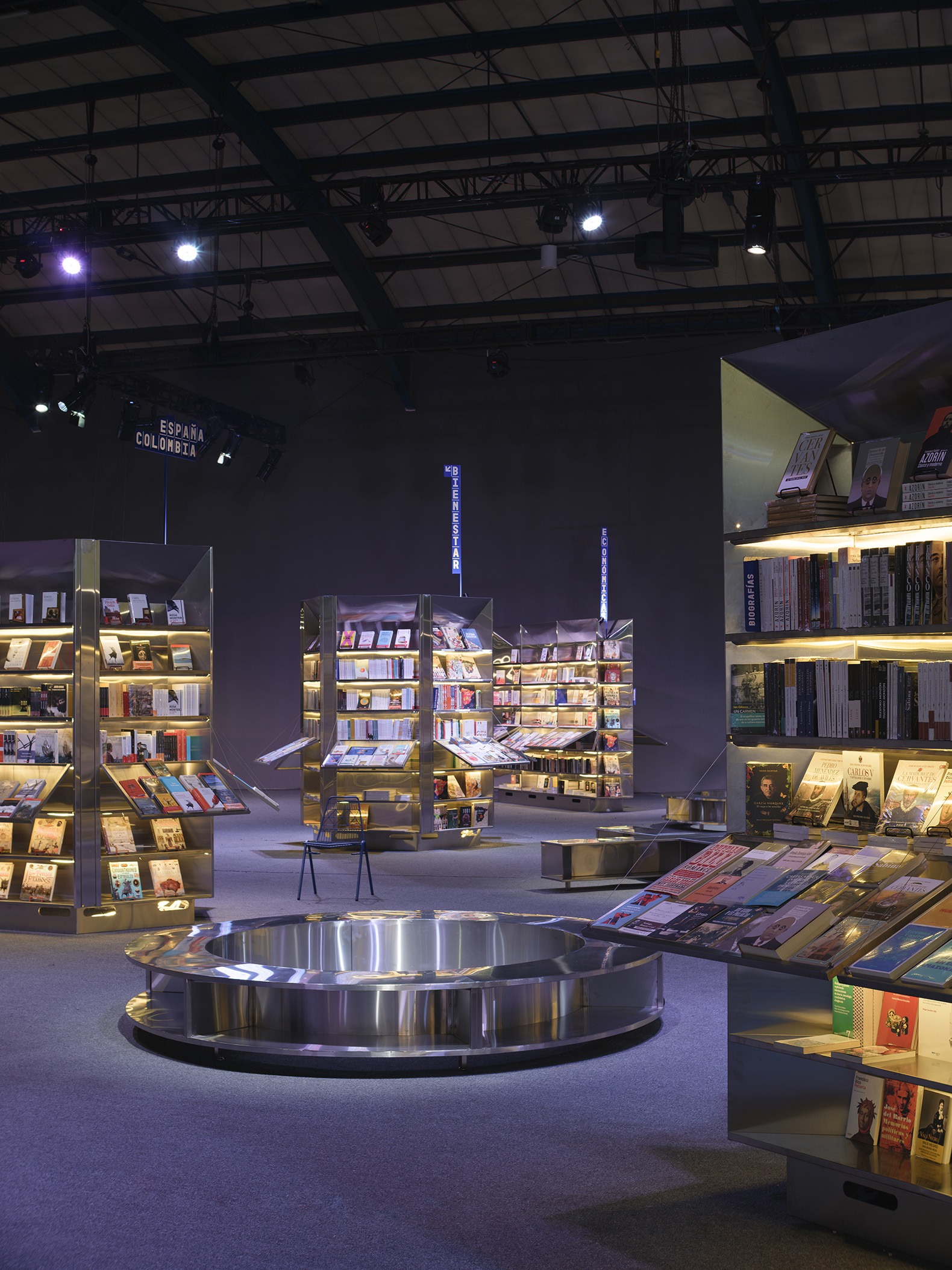
The central void formed by the peripheral arrangement of all these elements is occupied by the bookstore. A space through which all visitors must pass, it holds around 15,000 volumes distributed among 12 small-scale modules. These stainless steel units are inspired by four historic itinerant rural libraries in Spain. Conceived as a meeting space, the bookstore integrates two types of benches between its shelves, along with a scattering of movable chairs that readers can rearrange freely.

The diversity of handmade textiles throughout the Pavilion contrasts with its stainless steel surfaces, which generate interstitial spaces between the constructed landscapes and the Pavilion’s original architecture. These in-between areas house private entrances, service functions, and storage.

Second Lives
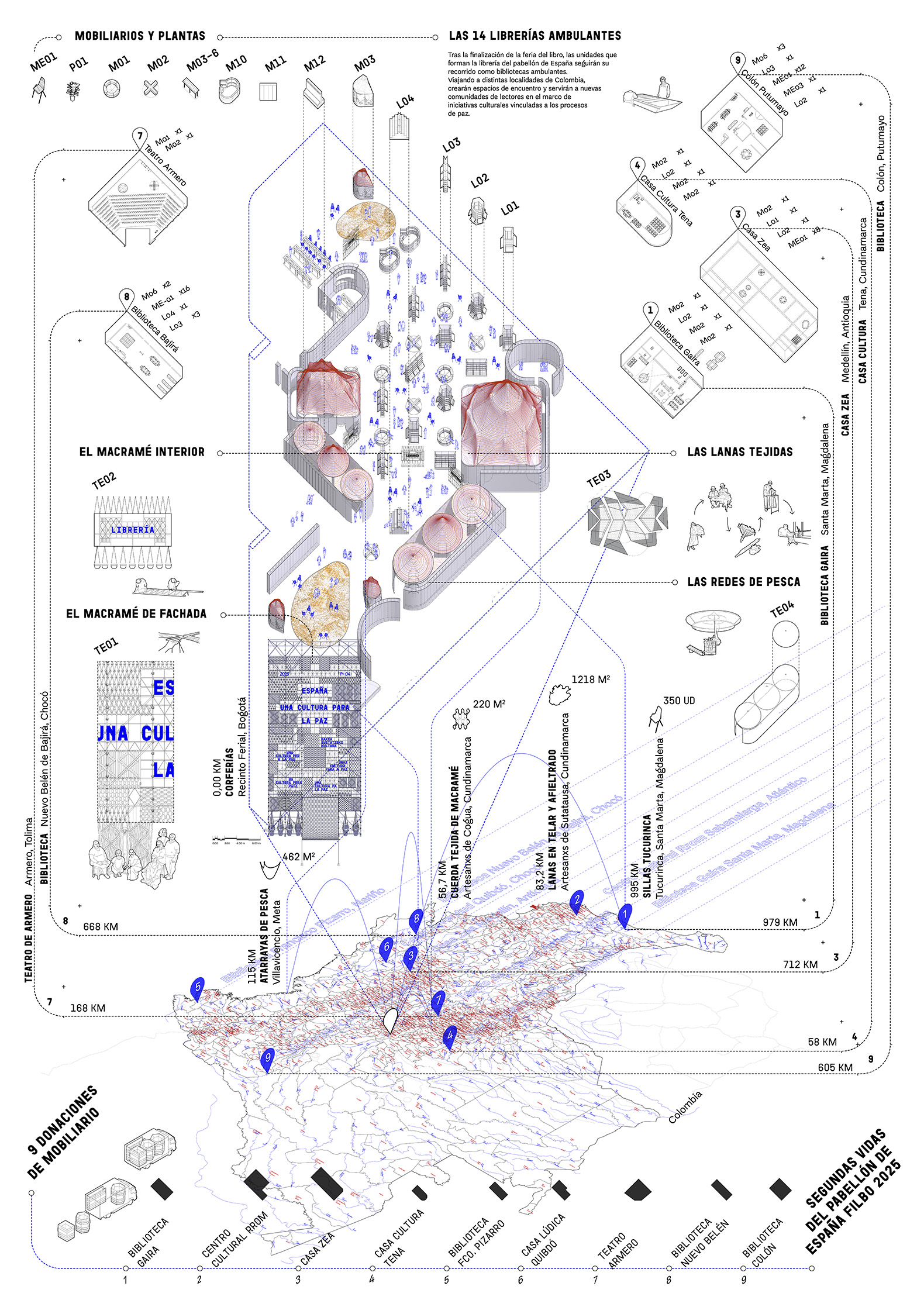
The Pavilion’s embrace of mobile libraries is not an exercise in nostalgia—it is a proposition for the present and the future. In the framework of the Peace Agreement between the Colombian government and the FARC, Colombia has launched more than 600 mobile libraries as part of its National Network of Public Libraries. In Spain, 82 bookmobiles currently operate, serving over 10 million people in areas with limited access to cultural infrastructure. This system stands as a sustainable and democratic model for cultural access across national territories.
The Spanish Pavilion at Filbo by Lluís Alexandre Casanovas Blanco, Paula Chalkho Rozenblum, Enrique Espinosa Pérez and Santiago Pradilla Hosie. Photograph by Javier Agustín Rojas.

Nearly all elements of the Pavilion will be reused in cultural initiatives linked to peacebuilding in Colombia. To reduce waste and material loss, the bookstore units, furniture, textiles, and even the Pavilion’s walls have been designed for transport and adaptation in challenging contexts. These components will travel to various parts of the country, extending their lifespan as itinerant institutions supporting emerging reading communities. They will help strengthen public libraries and cultural centers in places such as Gaira (Magdalena), the corregimiento of Colón (Putumayo), and La Modelo prison in Bogotá.
More information

+ + copy Created with Sketch.
- + copy Created with Sketch.
Label
Project team
Text

Irene Domínguez, Sofía Marciel, Jaime de la Torre.

+ + copy Created with Sketch.
- + copy Created with Sketch.
Label
Collaborators
Text

Spanish Pavilion curator.- Antonio Monegal.
Technical advice.- Yetta Aguado Arnold.
Production and comprehensive operation of the pavilion.- DIEZ Colombia + Alexander Gümbel, Manuel Villa, Vecinas Chicoteras.
Crafts.- Manuela Álvarez + Association of Cogua Artisans (macramé), Constanza Téllez + Sutatausa Artisans (wool), Cooperativa Ecofibras (fique), Emilio Doria, Amaury Rodríguez (cast nets), Edilson Rodríguez and Rusbel Rodríguez (wrought iron).

+ + copy Created with Sketch.
- + copy Created with Sketch.
Label
Client
Text

Spanish Cultural Action (AC/E). Ministry of Culture of Spain. General Directorate of Books, Comics and Reading.

+ + copy Created with Sketch.
- + copy Created with Sketch.
Label
Area
Text

3,023sqm.

+ + copy Created with Sketch.
- + copy Created with Sketch.
Label
Typography
Text

Thomas Huot-Marchand's garage. 205TF.

+ + copy Created with Sketch.
- + copy Created with Sketch.
Label
Dates
Text

April 2025.

+ + copy Created with Sketch.
- + copy Created with Sketch.
Label
Venue / Location
Text

Bogotá, Colombia.

+ + copy Created with Sketch.
- + copy Created with Sketch.
Label
Photography
Text

Pavilion.- Javier Agustín Rojas.
Craftsmanship Processes.- Alexander Gümbel.

+ + copy Created with Sketch.
- + copy Created with Sketch.
Lluís Alexandre Casanovas Blanco (1986) is a New York and Barcelona-based architect, curator and scholar. He was the chief curator of the Oslo Architecture Triennale 2016 together with the After Belonging Agency, and he is currently a PhD Candidate at Princeton University, and a Critical Studies Helena Rubinstein Fellow 2017-18 at the Whitney ISP.

Casanovas was trained as an architect at ETSABarcelona and the Edinburgh College of Art, and graduated from the MSc in Advanced Architectural Design at Columbia Graduate School of Architecture, Planning and Preservation.

His writings have appeared in several publications such as Volume, ARPA Journal, and Plot. Casanovas is a recipient of several grants, such as the La Caixa Fellowship for Postgraduate Studies or the Graham Foundation for Advanced Studies in the Fine Arts Grant. He has collaborated with different design offices and research institutions, such as the Buell Center or the GSAPP Global Africa Lab, and has taught studios at Barnard College, Princeton University, and ETSA Barcelona, and has lectured in different venues such as ZKM Karlsruhe or the University of Sydney.
Read more
Santiago Pradilla Arquitectos is an architecture studio founded by Santiago Pradilla Hosie, an architect from the Javeriana University and a Master in Habitat and Housing from the National University of Colombia, Bogotá.

Santiago is the winner of the 2019 National Architecture Award - Colombian Society of Architects. and winner of the National Architecture Biennial in 2018 and 2014. He has received other important international recognitions such as the Cemex Award in Mexico, Final Selection in 2019 from the Arquia-Spain Foundation. and the 2018 nomination for the Mies Crown Americas Prize in Chicago.

He has rehabilitated various buildings of the modern movement in Bogotá and is also the author of the books: "Emotional cartographies, an approach to Housing of cultural interest" 2010, published by the National University and "Cupica" published by the Javeriana University in 2005.

Co-founding partner of El taller de Santiago y Sebastián and Estudio Palafito. He currently teaches at Javeriana University and at the Universidad de los Andes in Bogotá.
Read more
Enrique Espinosa is a co-founder architect of PKMN architectures (2006-2016), director of Eeestudio since 2016 and professor and researcher at the Madrid School of Architecture (ETSAM) since 2015 within the CoLaboratorio teaching unit.

Her practice revolves around collaborative production and learning processes, working in open networks.

He has participated in other contexts, such as the Venice Biennale 2016 and 2018, or as a guest editor in the magazine Arquitectura 375 of the COAM.
Read more

Paula Chalkho Rozenblum is a designer at Murray Branding & Design, a small, independent design agency based in Madrid. We offer solutions in brand identity, visual storytelling, creative direction, graphic design, packaging, websites and digital experiences, exhibitions, and installations.

They have participated in a wide range of projects for local and international clients across various platforms and disciplines.

Read more
Published on: April 22, 2026
Cite:
metalocus, SARA GENT
"Shared knowledge. Spanish Pavilion at Filbo by Casanovas, Chalkho, Espinosa and Pradilla" METALOCUS. Accessed
<https://www.metalocus.es/en/news/shared-knowledge-spanish-pavilion-filbo-casanovas-chalkho-espinosa-and-pradilla> ISSN 1139-6415
Loading content ...
Loading content ...
Loading content ...
Loading content ...
Loading content ...
Loading content ...
Loading content ...
Loading content ...
Loading content ...
Loading content ...
Loading content ...
Loading content ...
Loading content ...
Loading content ...
Loading content ...
Loading content ...
Loading content ...
Loading content ...
Loading content ...
Loading content ...
Loading content ...
Loading content ...
Loading content ...
Loading content ...
Loading content ...
Loading content ...
Loading content ...
Loading content ...
Loading content ...
Loading content ...
Loading content ...
Loading content ...
Loading content ...
Loading content ...
Loading content ...
Loading content ...
Loading content ...
Loading content ...
Loading content ...
Loading content ...
Loading content ...
Loading content ...
Loading content ...
Loading content ...
Loading content ...
Loading content ...
Loading content ...
Loading content ...
Loading content ...
Loading content ...
Loading content ...
Loading content ...
Loading content ...
Loading content ...