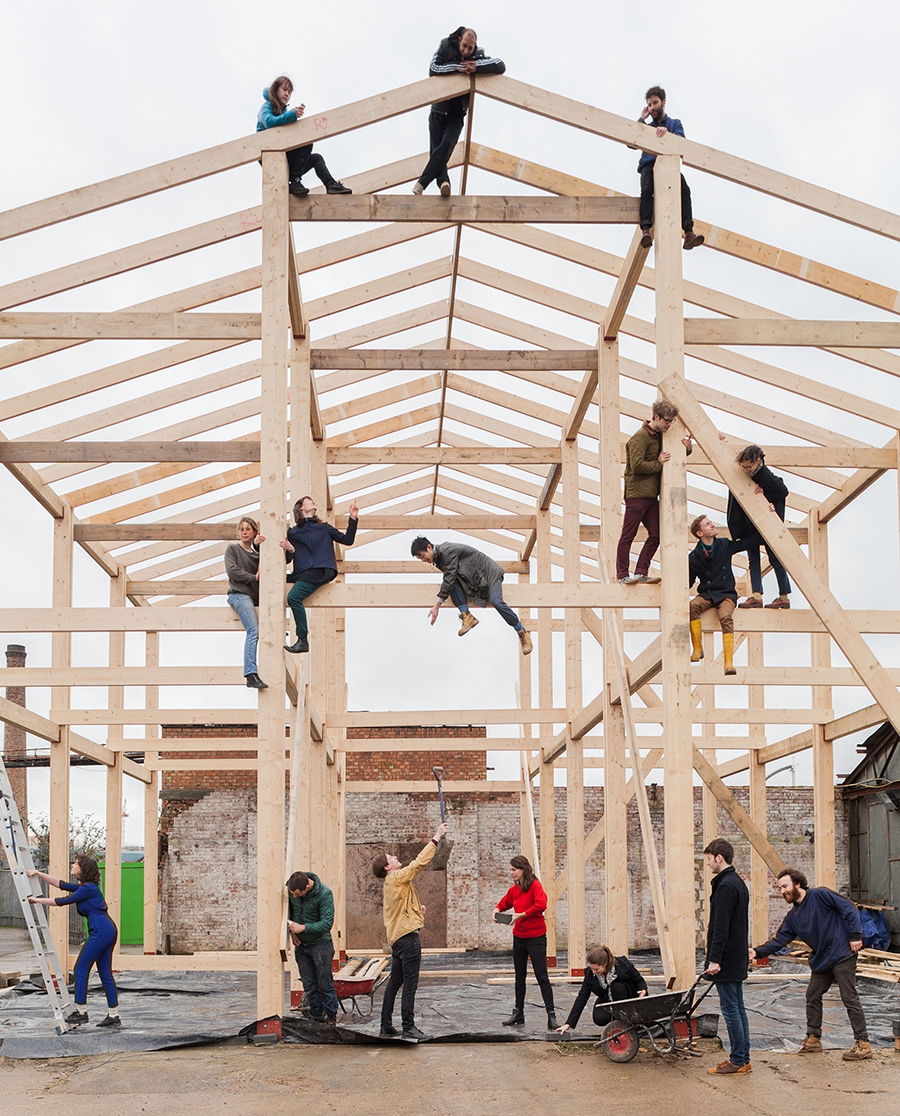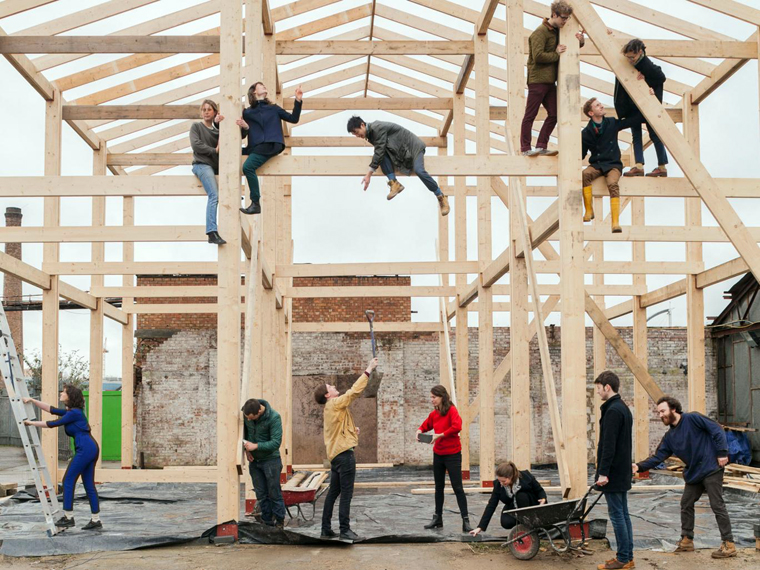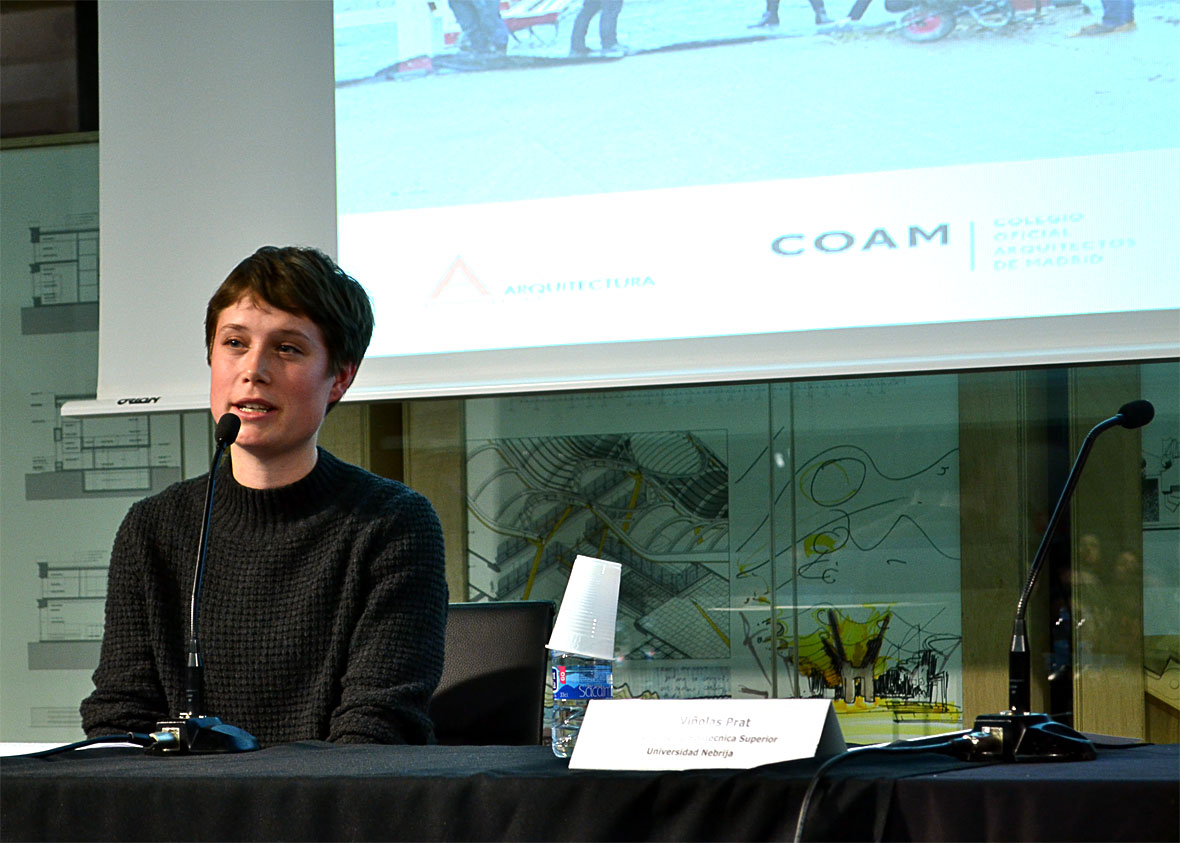
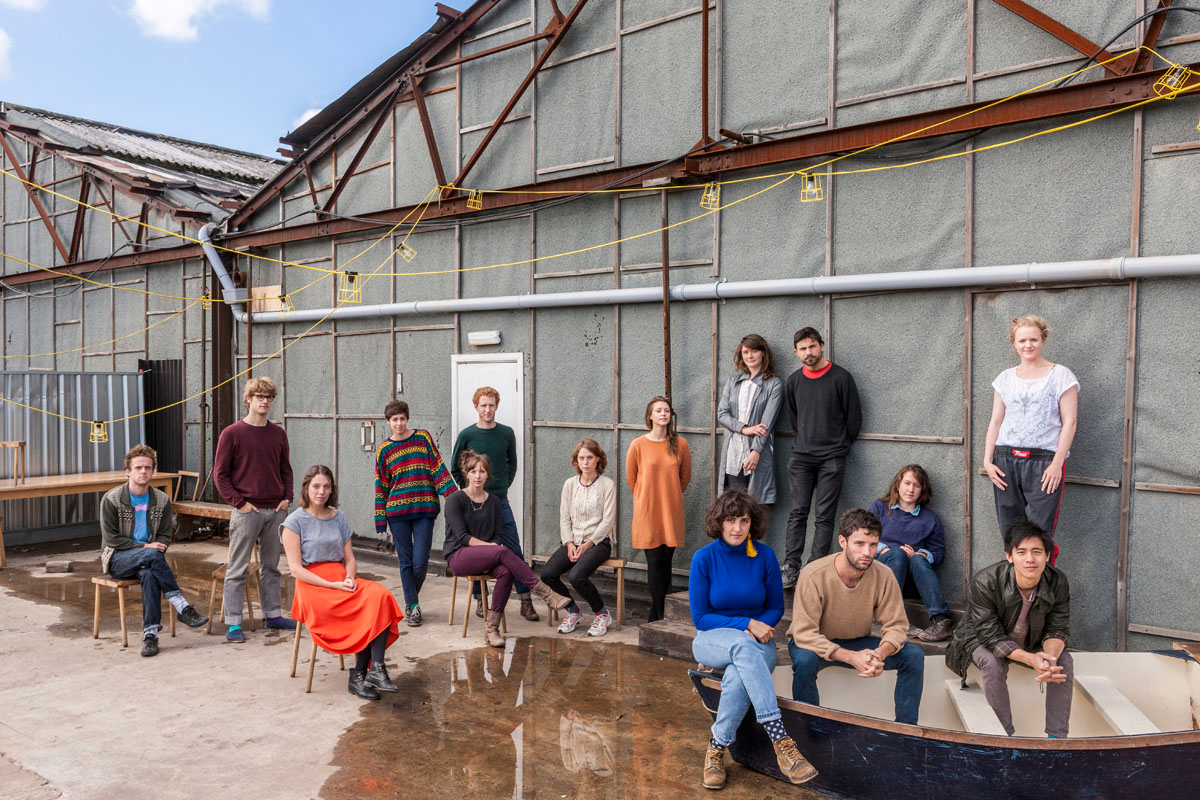
Assemble collective presented their work yesterday through Alice Edgerley, one of the youngest members of the group, whose average age is, as Edgerley said, around 28 years old.

The auditorium on the second floor was full and, although the guest was British, the act began with Spanish punctuality, i.e. twenty minutes late. After the corresponding institutional presentations from the Deans of the Association of Architects and Nebrija University, Alice Edgerley took the floor.

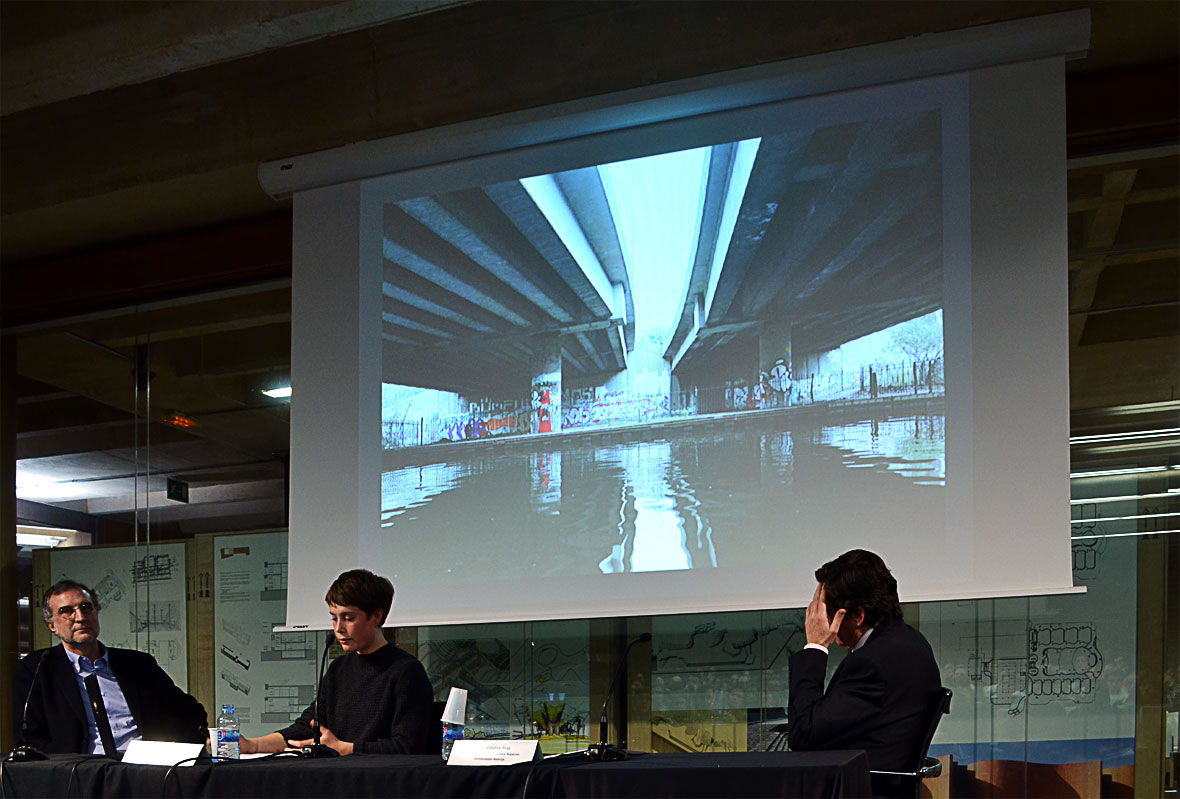
The lecture was equally read and commented by Alice Edgerley who spelt out for us the last projects developed by the collective. The projects, widely broadcasted since receiving the Turner Prize in December 2015, are a series of interventions in which have in common that they are made with the people, often without a previous plan, without a previous budget, or as Edgerley said "often without much money but with many working hands."

The representative from Assemble talked about experimentation, social participation, scheduling activities as a way to reactive parts of the city and began presenting a proposal to turn an old gas station into a temporary cinema, The Cineroleum. An idea which could be applied for the ​​conversion of thousands of gas stations in the UK. A simple but richly iconographic and interesting project, in which the show starts when the curtain drops.

The rest of the projects, which always involve large groups of people, were introduced starting with the execution, the workshops, the handmade work. Especially the work made by hand, as in the cladding of the Yardhouse where the enclosure, which seems to have a skin of fish scales, is made by coloured clay tiles that were shaped by hand.

The talk continued with different interventions in poor neighborhoods which included playgrounds for children - she spoke to us about smiles, freedom and playing with the children. With her refreshing speech, she went on to explain the renovation of Granby Four Streets in Toxteth, Liverpool - one of the most depressed workers' housing areas in the UK. After being almost completely abandoned, it was heading towards disappearance and demolition. The neighbours' response received the collective's support and collaboration and, after a plan for citizen participation, the neighborhood was radically transformed. Only simple operations for revitalization, "very domestic operations" such as cleaning, painting, planting... radically changed the neighborhood. An intervention that was recognized with the Turner Prize. I would like to emphasize the following sentence from the jury.

"In an age in which everything can be art why not consider itself a complex of social housing?".

The intervention ended with the recovery project of Cairns Street in Toxteth, transformed with the help of Assemble after decades of constant decline. Alice Edgerley never lost control of the situation and spoke with honesty, enthusiasm and strength about the dynamics on the relationships between the different profiles that make up the group – many artists, not so many architects, and local people -, which might sometimes prove not to be easy. Edgerley spoke about the actual need for this type of action as a response to the exorbitant land prices in cities like London, even if they sometimes exist during a short period of time, due to their importance in creating a common identity with citizens, occupants and inhabitants of the city. These small scale renovations have the capability to change the life of people thanks to their transformative power, although they may be considered urban graffiti by some. These actions have only recently met general recognition, even if they are not new at all, similar interventions were proposed, for example, by Bernard Tschumi with his "exemplary actions" and "counterdesign" to his students forty years ago at the Architectural Association.

The event made a good impression on the assistants to its end. I only want to remember the tens of Spanish groups which have done the same and more, while being virtually ignored in our country, even when some years ago the MoMA got interested in recognizing the fertile, diverse and immense work of all those groups of architects, artists and people, many of them working in our country. The British have been quick to recognize such brilliantly works with the Turner prize.

Things might be possibly changing, as the Dean of the Architect's Association said in his initial presentation, and Alice Edgerley's lecture might be not only a coincidence in a large group of ​​activities. In any case, and as it was widely commented yesterday, choosing Assemble for this event was a great success, which can help to highlight and recognize the actions carried out by our brilliant intervention groups.
More information

Assemble are a collective based in London who work across the fields of art, architecture and design. They began working together in 2010 and are comprised of 18 members. Assemble’s working practice seeks to address the typical disconnection between the public and the process by which places are made. Assemble champion a working practice that is interdependent and collaborative, seeking to actively involve the public as both participant and collaborator in the on-going realization of the work.

Read more

José Juan Barba (1964). Architect from the Madrid School of Architecture (ETSAM) in 1991. He received his PhD in Architecture from ETSAM in 2004, graduating summa Cum laude with the doctoral thesis "Inventions: New York vs. Rem Koolhaas, Bernard Tschumi, Piranesi." In 1991, he received a Special Mention in the Spanish National Graduation Awards. Until 1997, he worked as an advisor to several NGOs. In 1992, he founded his architectural practice in Madrid (www.josejuanbarba.com). 

He is an architectural critic and, since 1998, Editor-in-Chief of the internationally acclaimed bilingual architecture journal METALOCUS (Spanish/English), recipient of several national and international awards.

Barba is an Associate Professor at the University of Alcalá and a member of several research groups. He has been invited to participate in numerous international forums on architecture and urbanism, including the II Forum of Mexican World Heritage Cities, Urban Development, History and Modernity, organized by the Pan-American Committee for Urban Development and Historical Heritage; the World Urban Development Forum (FMDU), held in Culiacán, Sinaloa, Mexico; and the International Conference on Architecture and Urbanism from the Perspective of Women Architects. He has also been invited as lecturer and guest critic at numerous national and international institutions, including the National Building Museum, Roma Tre University, Politecnico di Milano, University of Genoa, Université Pierre Mendès France Grenoble, the Madrid and Barcelona Schools of Architecture, National Autonomous University of Mexico, the Faculty of Architecture in Montevideo, the Schools of Architecture of Medellín and Ecuador, Universidad Iberoamericana, IE University, as well as the Schools of Architecture of Zaragoza, Valladolid, Málaga, Granada, Seville, and A Coruña, among others.

He has extensive professional experience in architecture, urbanism, landscape intervention, and territorial regeneration. His work has received numerous awards, including First Prize in the “Gran Vía Posible” competition for Delirious Gran Vía, Madrid; recognition for the Rivers Interpretation Centre in Zamora, awarded and exhibited at the World Architecture Festival 2008; and recognition for the Santa Bárbara Park project in Toledo. He was also awarded the Erich Degner Prize for Architecture (1995), promoted by the BBVA Foundation. His project for a Day Centre for the Elderly was included in Volume 3 of the Madrid Architecture Guide published by the Official College of Architects of Madrid (COAM) in 2007. His work has been widely published in national and international books and journals.

He served as Maître de Conférences at the Institut d’Urbanisme de Grenoble, Université Pierre Mendès France Grenoble, during the 2013–14 academic year, following his appointment through a European open competition. His work has been published internationally. He regularly serves on academic and professional juries, including the editorial competition jury for the journal Quaderns (2011), the selection committee for the European Union Prize for Contemporary Architecture – Mies van der Rohe Awards (2007–present), and the jury panels for EUROPAN 13 (2015–16) and TRANSFER, Zurich (2019). He was also invited to participate in the Biennale di Venezia 2016 as part of the exhibition Spaces of Exception / Spazi d’Eccezione.

He has authored several books, including "The Dark Line. michele&miquel, dA Vision Design" (2024), "CONGRESO ANYWAY. La ciudad de las ciudades" (2020), "#Positions" (2016), and "Inventions: New York vs. Rem Koolhaas, Bernard Tschumi, Piranesi" (2015). He has also contributed to publications such as "Espacio público Gran Vía. La Ciudad del Turismo" (2020), "Spaces of Exception / Spazi d’Eccezione" (2016), "La manzana de la discordia" (2015), and "Contemporary Japanese Architecture: New Territories" (2015), as well as chapters in numerous books, including "Women Architects: A Professional Challenge" (2009), "21st Century Architectures" (2007), "Ruta de la Plata, New Conquerors of Space" (2019), and "The City of Tourism" (2020).

Selected awards include:

•    “SANTIAGO AMÓN” AWARD, award for the promotion of architecture, COAM Madrid, 2000.
•    “PANAYIOTI MIXELI AWARD,” SADAS-PEA, award for the promotion of architecture, Athens, 2005.
•    “PIERRE VAGO” ICAC. International Committee of Art Critics Award, London, 2005.
•    FAD Award 07, Ephemeral Interventions, First Prize, M.C. Escher Exhibition, Arquin-FAD, Barcelona, 2007.
•    World Architecture Festival, Center for Research and Interpretation of the Rivers, Tera, Esla, and Órbigo, Finalist, Barcelona, 2008.
•    Gran Vía Posible, First Prize, Delirious Gran Vía, Madrid, 2010.
•    Reform of the Río Segura Surroundings, Award, Murcia, 2010.

Read more
Published on: February 25, 2016
Cite:
metalocus, JOSÉ JUAN BARBA
"Learning through Making. Another way of making architecture" METALOCUS. Accessed
<https://www.metalocus.es/en/news/learning-through-making-another-way-making-architecture> ISSN 1139-6415
Loading content ...
Loading content ...
Loading content ...
Loading content ...
Loading content ...
Loading content ...
Loading content ...
Loading content ...
Loading content ...
Loading content ...
Loading content ...
Loading content ...
Loading content ...
Loading content ...
Loading content ...
Loading content ...
Loading content ...
Loading content ...
Loading content ...
Loading content ...
Loading content ...
Loading content ...
Loading content ...
Loading content ...
Loading content ...
Loading content ...
Loading content ...
Loading content ...
Loading content ...
Loading content ...
Loading content ...
Loading content ...
Loading content ...
Loading content ...
Loading content ...
Loading content ...
Loading content ...
Loading content ...
Loading content ...
Loading content ...
Loading content ...
Loading content ...
Loading content ...
Loading content ...
Loading content ...
Loading content ...
Loading content ...
Loading content ...
Loading content ...
Loading content ...
Loading content ...
Loading content ...
Loading content ...
Loading content ...