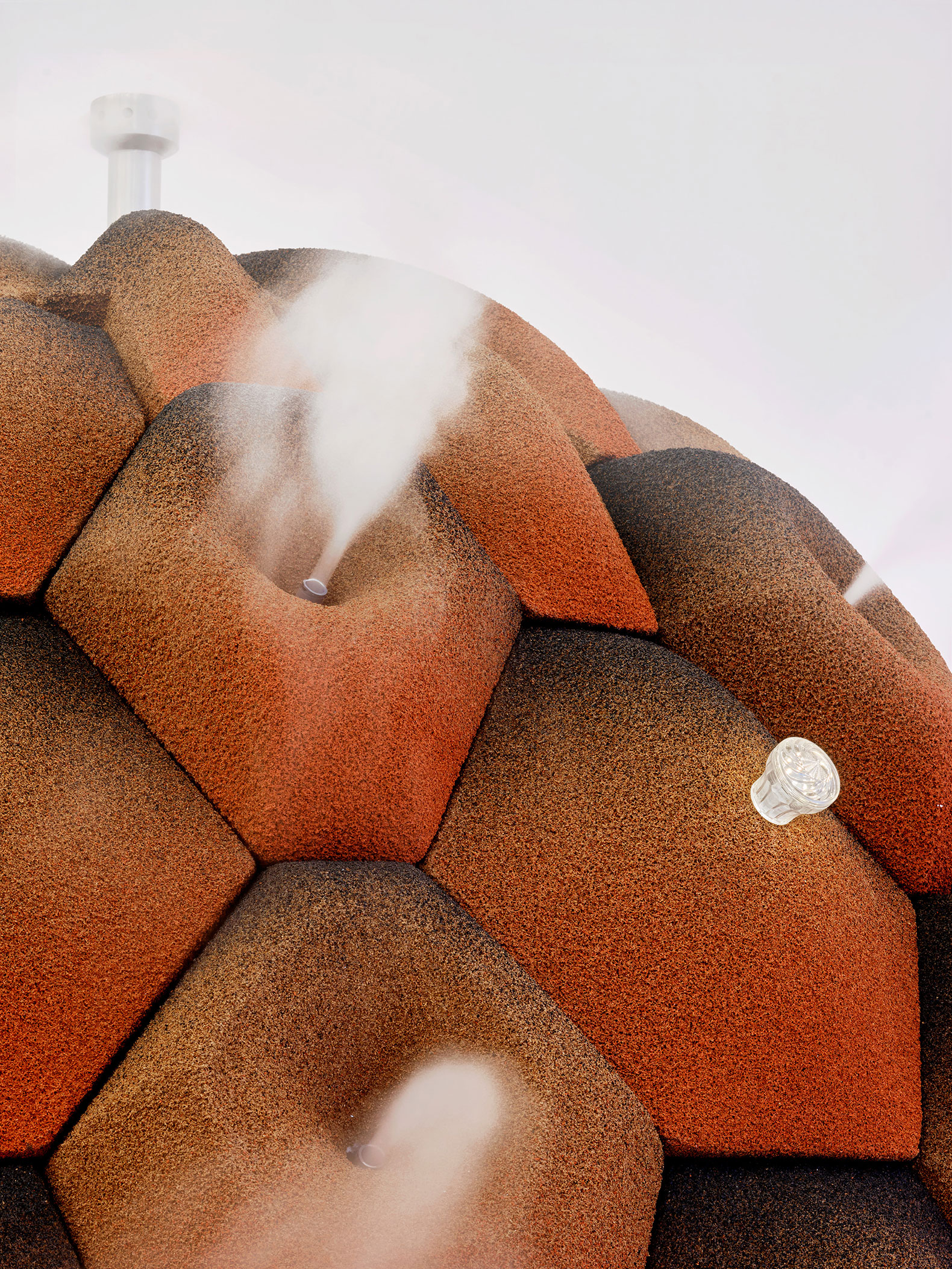
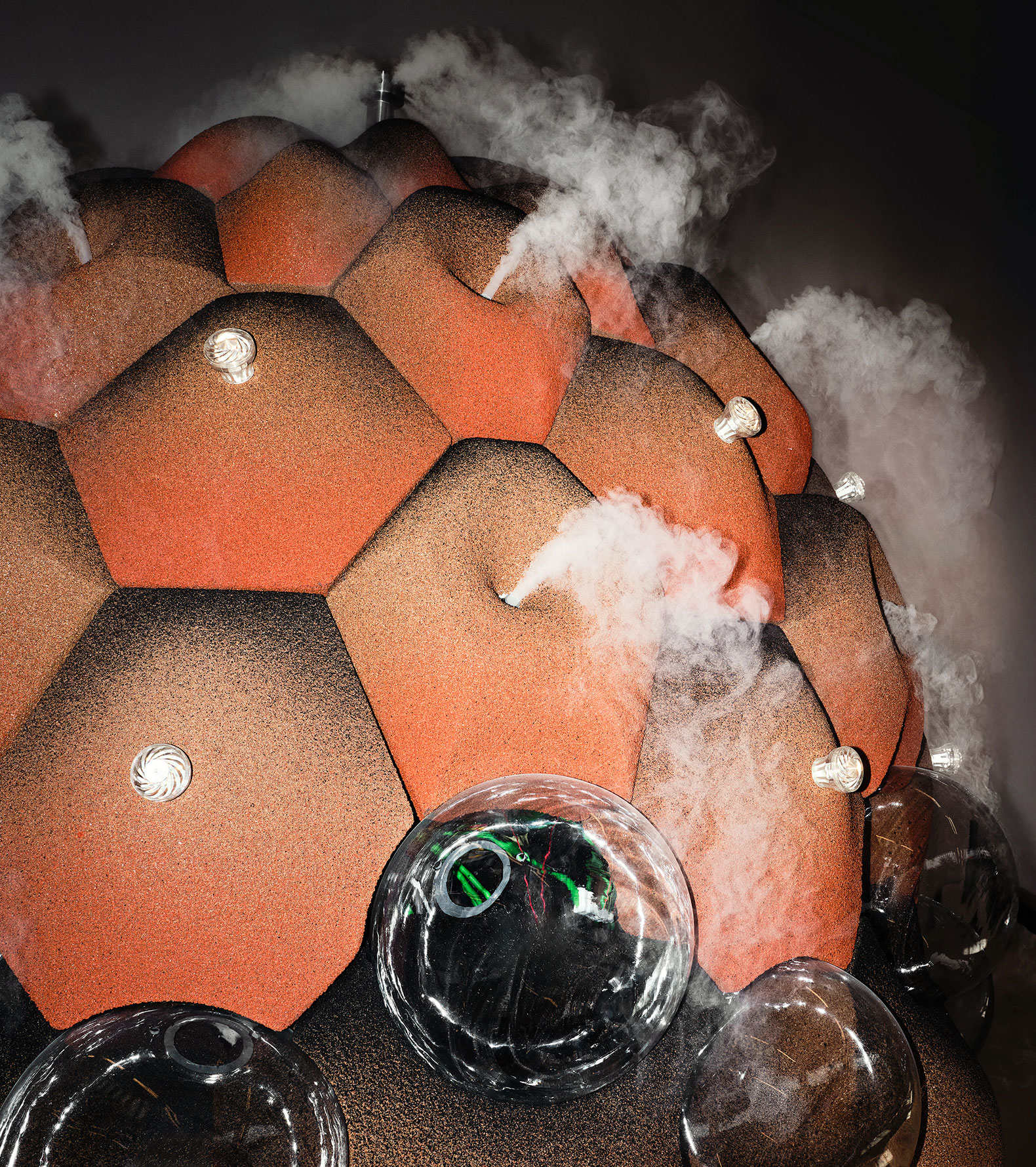
The Transspecies Palace is the prototype created by Andrés Jaque, with OFFPOLINN, for the exhibition "We The Bacteria. Notes Toward Biotic Architecture," curated by Beatriz Colomina and Mark Wigley for the 24th International Exhibition of the Milan Triennale.

The proposal is part of a trilogy developed in different exhibitions since 2019 by Beatriz Colomina and Mark Wigley. According to the curators, this investigation began by addressing sustainability in a "broken nature" and concludes with the present exhibition, addressing the growing inequality that characterises our world.

Understanding the exhibition space not as an isolated hygienic enclosure, but as an environment that vibrates with diverse, interacting microbial ecologies, Andrés Jaque's proposal is the result of an investigation into how the materiality of architecture can transition from "anthropocentric extractivism to a more symmetrical ecological alliance," or what the potential of architecture is to be part of ecological repair.

For this exhibition, Andrés Jaque / OFFPOLINN presents the Transspecies Palace with the mechanical and hydrothermal conditions necessary to multiply the diversity and density of a community of aerobic and anaerobic organisms. In other words, it presents a microbial community with the ability to mitigate the toxicity of damaged environments and aid in their ecological repair.

This prototype is formed by a thick bark of various types of cork that captures and retains mineral, saccharose, and lipid particles thanks to the cavities within its porous structure. This facilitates and accelerates the settlement of bacteria in the cork. Under the right conditions, bacteria form an exopolysaccharide matrix that provides the genetic and physical structure where carbon is retained and oxygen is produced.

The Transspecies Palace demonstrates how human life and social relations expand beyond bodies, where these elements are distributed and transscalar representations. In turn, it marks a transition from an architecture of carbonization and exploitation to an architecture of mutual care.

The Transspecies Palace by Andrés Jaque / OFFPOLINN. Photograph by José Hevia.The Transspecies Palace by Andrés Jaque / OFFPOLINN. Photograph by José Hevia.

Project description by Andrés Jaque / OFFPOLINN

The Transspecies Palace provides the mechanical and hydrothermal conditions to multiply the diversity and density of a microbial community of aerobic and anaerobic life, including cyanobacteria, phylum proteobacteria, firmicutes, photoautotrophic bacteria, chemoautotrophic bacteria, azotobacter, beijerinckia, clostridium and rhizobium. Together, this microbial community has the capacity to metabolize the toxicity of damaged environments and contribute to their ecological reparation.

Its thick cork crust, developed by a multidisciplinary team led by OFFPOLINN and first tested in the facade of Reggio School in Madrid. It captures and retains mineral, sucrose and lipid particles in the irregularity of the cork mass. The types of cork selected provide a spectrum of cavities within the porous cork structure that facilitate and accelerate the growth of fungi hyphae, which are later used as a system of fungi highways, that allows bacteria to settle inside the cork.

The Transspecies Palace by Andrés Jaque / OFFPOLINN. Photograph by José Hevia.

In conditions of sustained humidity, and anchored to the interior of hypha walls, a diversity of bacteria collaborate to build an exopolysaccharide matrix. These are sophisticated informational and material systems that provide the genetic and physical armature where processes of carbon sequestration and oxygen production can be intensified by the planting of DNA fragments of selected microbes.

For OFFPOLINN, the Transspecies Palace affirms how human life and social relationships expand beyond bodies, in an alliance with more-than-human life. Life and societal interaction are distributed and transscalar enactments, where the microbial, the bodily and the planetary co-produce each other. It also marks a transition from an architecture of carbonization, non-human sacrificability and extractivism; to one of mutual care.

More information

Label
Architects
+ + copy Created with Sketch.
- + copy Created with Sketch.
Label
Curators
Text

Beatriz Colomina, Mark Wigley.

+ + copy Created with Sketch.
- + copy Created with Sketch.
Label
Design team
Text

Design and Coordination Team.- Roberto González García, Gema Marín.

+ + copy Created with Sketch.
- + copy Created with Sketch.
Label
Collaborators
Text

Scientific Research.- Asunción de los Ríos (Museo Nacional de Ciencias Naturales of Madrid, Centro Superior de Investigaciones Científicas CSIC).
Production.- VIPEQ (Mouad Kheffache, Adrián del Río), 18 piés de altura (José María Miñarro), Elena Águila García.

+ + copy Created with Sketch.
- + copy Created with Sketch.
Label
Dates
Text

May 13 to November 9, 2025.

+ + copy Created with Sketch.
- + copy Created with Sketch.
Label
Location
Text

24th International Exhibition of the Milan Triennale. Viale Emilio Alemagna, 6, 20121 Milano MI, Italy.

+ + copy Created with Sketch.
- + copy Created with Sketch.
Label
Photography
Text

José Hevia.

+ + copy Created with Sketch.
- + copy Created with Sketch.

Office for Political Innovation (OFFPOLINN) es un estudio de arquitectura internacional, con sede en Nueva York y Madrid, que trabaja en la intersección del diseño, la investigación y las prácticas ambientales críticas. La oficina desarrolla proyectos que transcurren a través de escalas y medios, con el objetivo de integrar la inclusividad en el entorno construido.

Actualmente, la oficina trabaja en proyectos para Thyssen Bornemisza Art Contemporary, CA2M, Real Madrid, Colegio Reggio y Grupo La Musa; y entre sus clientes se incluyen Lafayette Anticipations, Victoria & Albert Museum, Museum of Modern Art MoMA, Art Institute of Chicago, Fundación Cisneros, Empresa Municipal de la Vivienda y Suelo de Madrid, Matadero-Madrid, Obispado de Plasencia, Feria ARCO, London Design Museum, Power Station of Art (Shanghai), Fundació Mies van der Rohe y MAK Vienna.

En 2016, OFFPOLINN recibió el Premio Frederick Kiesler de Arquitectura y Artes de la Ciudad de Viena. El estudio también ha sido galardonado con el LEÓN DE PLATA al Mejor Proyecto de Investigación en la 14.ª Bienal de Venecia y con el Premio Dionisio Hernández Gil.

La obra de OFFPOLINN forma parte de las colecciones del MoMA y del Instituto de Arte de Chicago, entre muchas otras, y ha sido objeto de exposiciones individuales en el MoMA, el MoMA PS1, el MAK de Viena, la Universidad de Princeton, el Centro de Arte Contemporáneo RED CAT Cal Arts de Los Ángeles, la Cité de l’Architecture et du Patrimoine de París y Tabacalera de Madrid. También se ha exhibido en el Instituto de Arte de Chicago, el Zentrum für Kunst und Medien ZKM (Karlsruhe), el Museo de Diseño de Londres, la Whitechapel Gallery (Londres), el Z33 (Hasselt), el Museo Suizo de Arquitectura (Basilea), las trienales de arquitectura de Lisboa y Oslo, y las bienales de arquitectura de Venecia, Chicago, Gwanju, São Paulo, Santiago de Chile y Seúl.

Andrés Jaque, holds a Ph.D. in architecture. He is the founder of the Office for Political Innovation, an international architectural practice, based in New York and Madrid, working at the intersection of design, research, and critical environmental practices.. He is also the Dean of the Graduate School of Architecture, Planning, and Preservation at Columbia University, New York.

In 2014 he received the Silver Lion at the 14th Mostra Internazionale di Architettura, Biennale di Venezia.

He is the author of award-winning projects such as Plasencia Clergy House (Dionisio Hernández Gil Prize), House in Never Never Land (Mies Van der Rohe European Union Award's finalist), TUPPER HOME (X Bienal Española de Arquitectura y Urbanismo), or ESCARAVOX (COAM Award 2013). He has also developed architectural performances as well as installations that question political frameworks through architectural practice; including IKEA Disobedients (MoMA Collection, 2011); PHANTOM. Mies as Rendered Society (Mies Barcelona Pavilion, 2012) or Superpowers of Ten (Lisbon Triennale, 2014).

Andrés Jaque is a Professor of Advanced Design at Columbia University's Graduate School of Architecture, Planning, and Preservation (GSAPP) and Visiting Professor at Princeton University's School of Architecture.

Read more
Published on: May 17, 2025
Cite:
metalocus, SARA GENT
"Mutual care. The Transspecies Palace by Andrés Jaque / OFFPOLINN" METALOCUS. Accessed
<https://www.metalocus.es/en/news/mutual-care-transspecies-palace-andres-jaque-offpolinn> ISSN 1139-6415
Loading content ...
Loading content ...
Loading content ...
Loading content ...
Loading content ...
Loading content ...
Loading content ...
Loading content ...
Loading content ...
Loading content ...
Loading content ...
Loading content ...
Loading content ...
Loading content ...
Loading content ...
Loading content ...
Loading content ...
Loading content ...
Loading content ...
Loading content ...
Loading content ...
Loading content ...
Loading content ...
Loading content ...
Loading content ...
Loading content ...
Loading content ...
Loading content ...
Loading content ...
Loading content ...
Loading content ...
Loading content ...
Loading content ...
Loading content ...
Loading content ...
Loading content ...
Loading content ...
Loading content ...
Loading content ...
Loading content ...
Loading content ...
Loading content ...
Loading content ...
Loading content ...
Loading content ...
Loading content ...
Loading content ...
Loading content ...
Loading content ...
Loading content ...
Loading content ...
Loading content ...
Loading content ...
Loading content ...