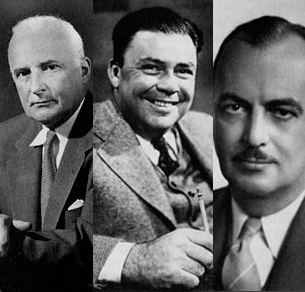
The Beinecke Rare Book and Manuscript Library contains the principal rare books and literary manuscripts of Yale University and serves as a center for research by students, faculty, and other scholars, whether affiliated with Yale or not. Materials do not circulate, but may be used in the Reading Room on the court level after researchers register with the Beinecke.

Established in 1963, Yale’s Beinecke Library celebrated its 50th anniversary in 2013. In the late 1950s, interest in rare books, the philanthropy of the Beineckes, the University’s pressing need for a special collections library, and the design by the architect Gordon Bunshaft, created the Beinecke Library.

One of the largest buildings in the world devoted entirely to rare books and manuscripts, the library has room in the central tower for 180,000 volumes and in the underground book stacks for over 600,000 volumes; it now contains about 500,000 volumes and several million manuscripts. Temperature and humidity controls ensure that stored materials are protected for future generations.

Building Design.
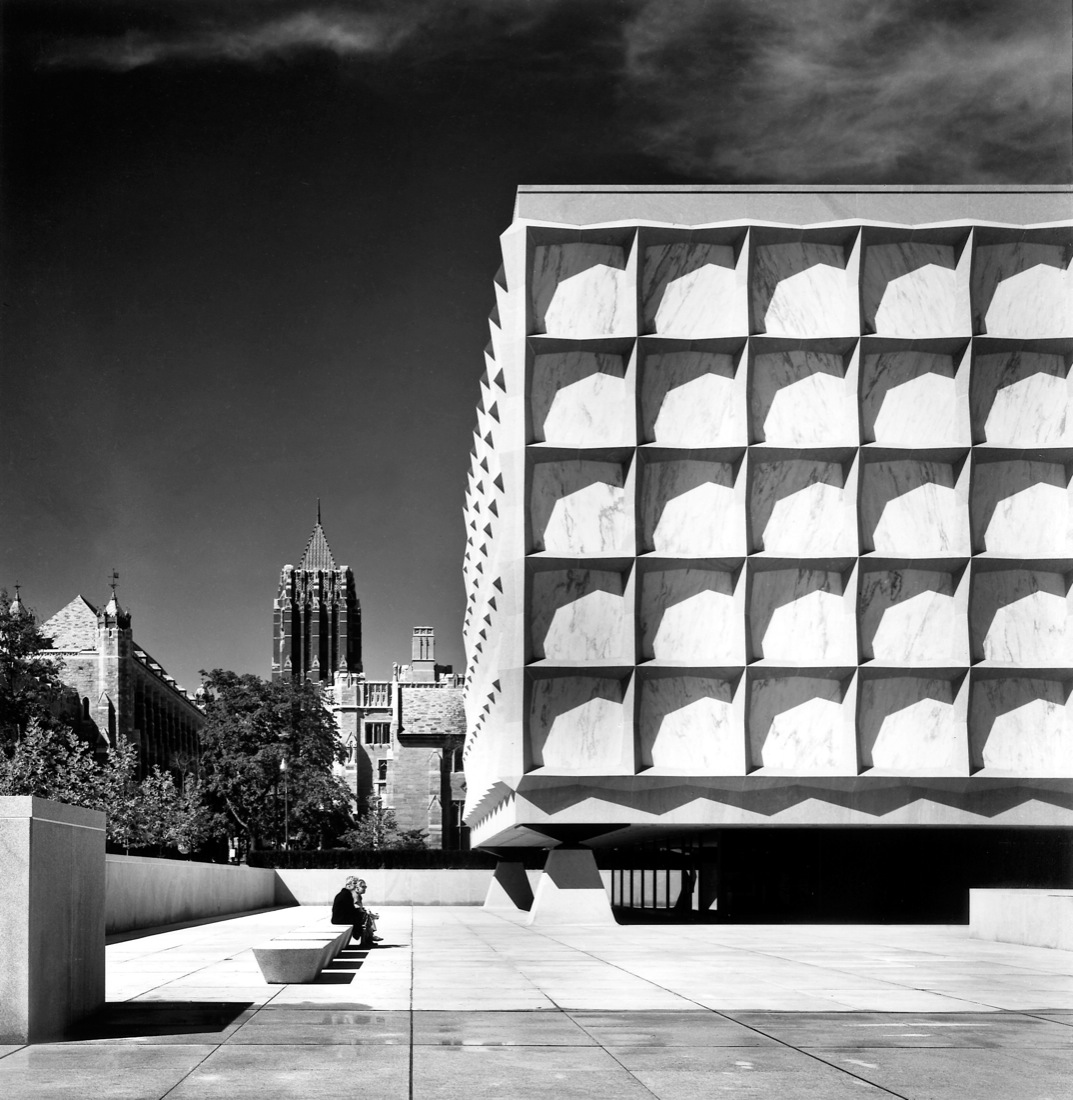
The building, of Vermont marble and granite, bronze and glass, was designed by Gordon Bunshaft, of the firm of Skidmore, Owings and Merrill; the George A. Fuller Construction Company was the general contractor. Work began on the building in 1960 and was completed in 1963. The white, grey-veined exterior marble panes are one-quarter inches thick and are framed by shaped light grey Vermont Woodbury granite. These marble panels filter light so that rare materials can be displayed without damage. From the exterior, however, the building's powerful stone geometry serves to dominate the space it occupies in Hewitt University Quadrangle, amidst neo-Classical and neo-Gothic neighbors. Also visible across the plaza is Alexander Calder's "Gallows and Lollipops".exterior marble panes are

A revolving glass door provides a public entrance to the Beinecke Library. Upon entering, visitors see the glass tower of books that rises through the core of the building. Two stairways ascend on either side to the mezzanine level. Along with the entrance level, the mezzanine is a showcase for rotating exhibits that highlight Beinecke's rich collections. The Gutenberg Bible, the first Western book printed from movable type, and Audubon's Birds of America are on permanent exhibition.

General Description.
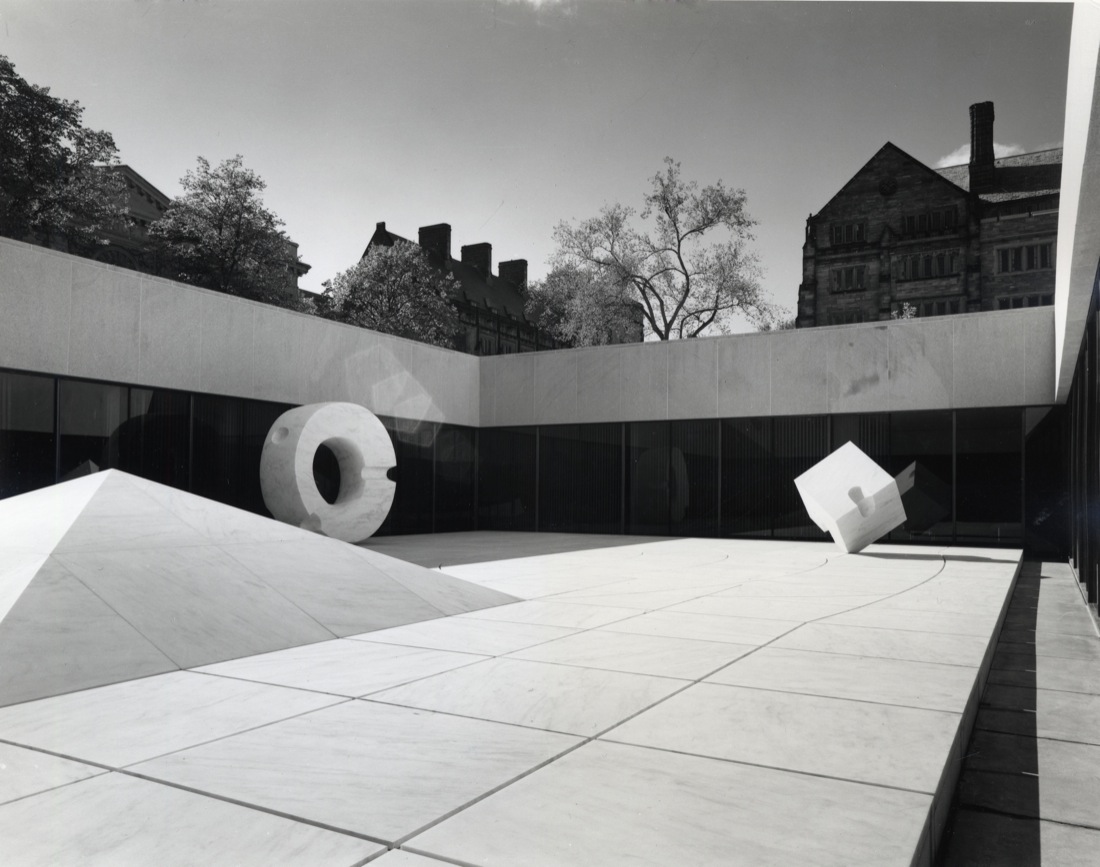
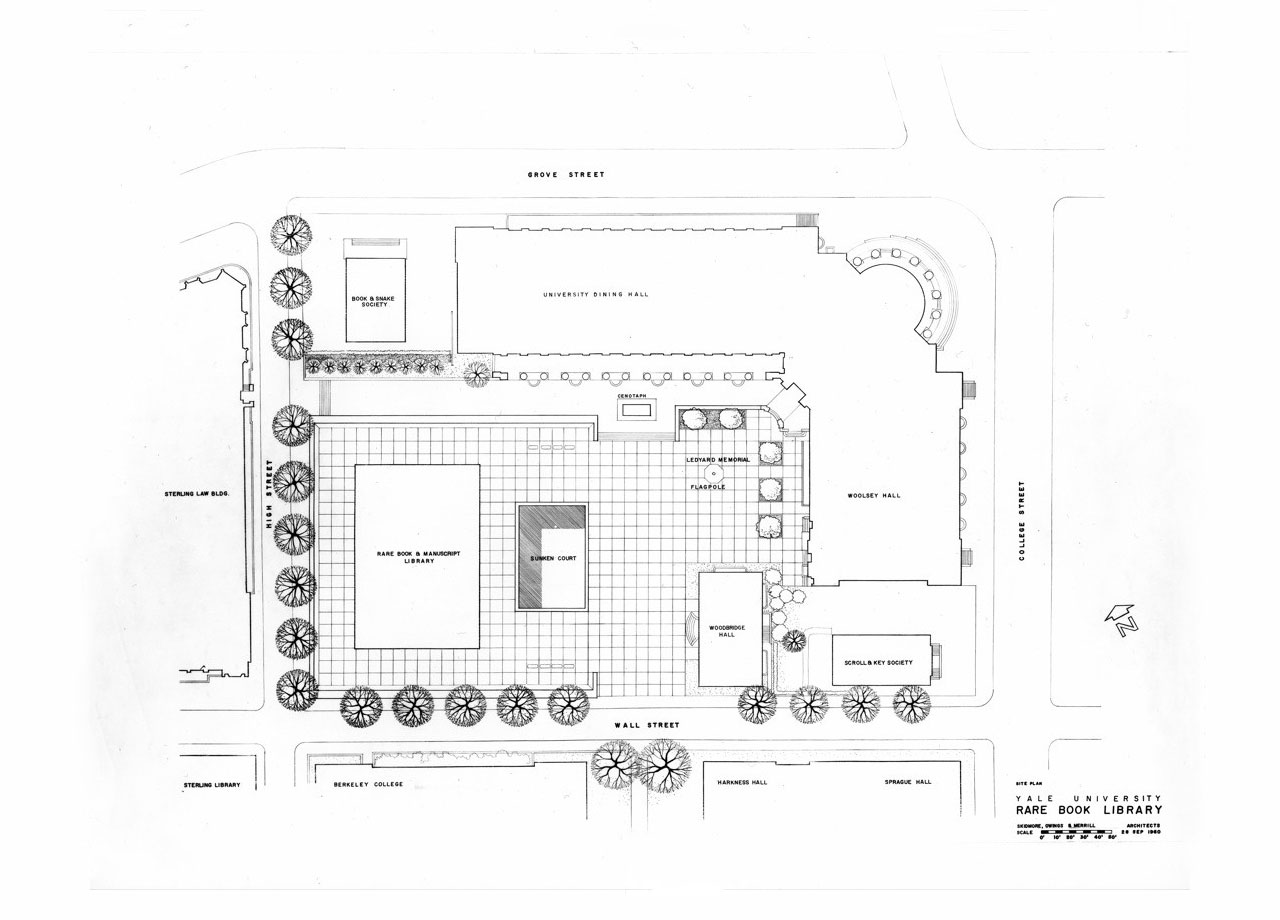
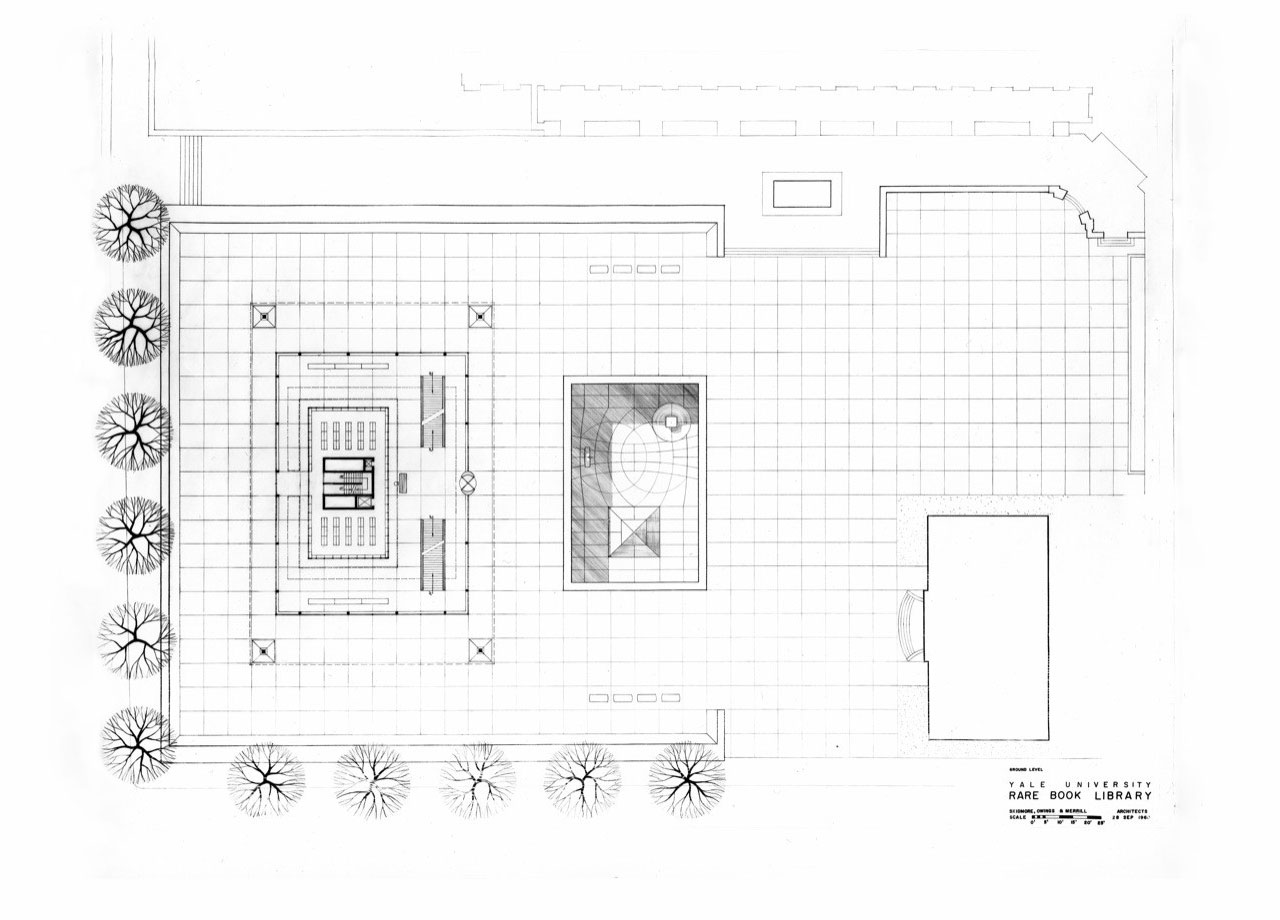
Bunshaft designed the Beinecke as a two-component structure on a 200’-0” x 350’-0” site plan. The largest and most visible component is the six-story above-ground structure (86'-0” x 130'-0” x 58'-0”), which is a fully open space containing an interior glass-curtain-wall enclosed temperature-controlled tower (35'-0” x 60'-0”) to house books. The smaller component is a below-ground research centre that contains stacks, office space, classrooms, a study area, and a garden courtyard designed by Isamu Noguchi. The library’s total square footage is 88,347. The roof of the subterranean area serves as the plaza, which is a central social landmark on the Yale campus. The above-ground structure sits in the heart of the Yale campus and can best be described as a giant marble cube. It is a stark contrast to the older surrounding buildings that are more evocative of collegiate scholarship. Many have described the Beinecke as a “jewel box,” which is not surprising given the warm glow the illuminated marble exudes after the sun has set. The original interior appointments were lush and dark: bronze, black leather upholstery, wood panelling, teak tables and desks, and carpeted and granite floors. The mid-1990s retrofit replaced much of the textile elements with more contemporary furnishings and materials. The sculpture garden, which was sunk into the centre of the plaza, contains three large marble sculptures from Japanese-American artist Isamu Noguchi. The three sculptures are in the shape of a pyramid, a globe, and a cube.

Previously in METALOCUS

METALOCUS, 04. 2000. Beinecke rare book and manuscript library | Patricia Bracco.
published in: M-04 | p. 72

More information

Label
Architects
Text

Gordon Bunshaft of Skidmore, Owings, & Merrill
Sculpture Garden.- Isamu Noguchi.

+ + copy Created with Sketch.
- + copy Created with Sketch.
Label
Collaborators
Text

Structural Engineer: Paul Weidlinger; Mechanical Engineers: Jaros, Baum, & Bolles.
Others associated with Building/Site.- 
Partner in Charge of Coordination.- David H. Hughes. 
Design Assistant.- Sherwood A. Smith. 
Job Captain.- Morris Zelkowitz. 
Interior Design.- Davis. B. Allen. 
Lighting.- Edison Price.Sherwood

+ + copy Created with Sketch.
- + copy Created with Sketch.
Label
Client
Text

Yale University.

+ + copy Created with Sketch.
- + copy Created with Sketch.
Label
Contractor
Text

George A. Fuller.

+ + copy Created with Sketch.
- + copy Created with Sketch.
Label
Area
Text

Project Area.- 125,262 ft2.

+ + copy Created with Sketch.
- + copy Created with Sketch.
Label
Dates
Text

Project Year.- Commission. October 1959 / Completion. October 1963.

+ + copy Created with Sketch.
- + copy Created with Sketch.
Label
Location
Text

New Haven, Connecticut, USA.

+ + copy Created with Sketch.
- + copy Created with Sketch.
Label
Photography
Text

Courtesy of Ezra Stoller of Esto Photographics.

+ + copy Created with Sketch.
- + copy Created with Sketch.
Label
References
Text

Beinecke Rare Book and Manuscript Library and Skidmore, Owings, & Merrill.

+ + copy Created with Sketch.
- + copy Created with Sketch.
Label
Awards
Text

2001.International Architecture in Stone AwardVeronafiere.
1967.First Honor Scholarship AwardAIA and Marble Institute of American.
1967.National Honor AwardAIA.
1964.First Honor AwardAIA, American Library Association and the National Book Committee.

+ + copy Created with Sketch.
- + copy Created with Sketch.

José Juan Barba (1964). Architect from the Madrid School of Architecture (ETSAM) in 1991. He received his PhD in Architecture from ETSAM in 2004, graduating summa Cum laude with the doctoral thesis "Inventions: New York vs. Rem Koolhaas, Bernard Tschumi, Piranesi." In 1991, he received a Special Mention in the Spanish National Graduation Awards. Until 1997, he worked as an advisor to several NGOs. In 1992, he founded his architectural practice in Madrid (www.josejuanbarba.com). 

He is an architectural critic and, since 1998, Editor-in-Chief of the internationally acclaimed bilingual architecture journal METALOCUS (Spanish/English), recipient of several national and international awards.

Barba is an Associate Professor at the University of Alcalá and a member of several research groups. He has been invited to participate in numerous international forums on architecture and urbanism, including the II Forum of Mexican World Heritage Cities, Urban Development, History and Modernity, organized by the Pan-American Committee for Urban Development and Historical Heritage; the World Urban Development Forum (FMDU), held in Culiacán, Sinaloa, Mexico; and the International Conference on Architecture and Urbanism from the Perspective of Women Architects. He has also been invited as lecturer and guest critic at numerous national and international institutions, including the National Building Museum, Roma Tre University, Politecnico di Milano, University of Genoa, Université Pierre Mendès France Grenoble, the Madrid and Barcelona Schools of Architecture, National Autonomous University of Mexico, the Faculty of Architecture in Montevideo, the Schools of Architecture of Medellín and Ecuador, Universidad Iberoamericana, IE University, as well as the Schools of Architecture of Zaragoza, Valladolid, Málaga, Granada, Seville, and A Coruña, among others.

He has extensive professional experience in architecture, urbanism, landscape intervention, and territorial regeneration. His work has received numerous awards, including First Prize in the “Gran Vía Posible” competition for Delirious Gran Vía, Madrid; recognition for the Rivers Interpretation Centre in Zamora, awarded and exhibited at the World Architecture Festival 2008; and recognition for the Santa Bárbara Park project in Toledo. He was also awarded the Erich Degner Prize for Architecture (1995), promoted by the BBVA Foundation. His project for a Day Centre for the Elderly was included in Volume 3 of the Madrid Architecture Guide published by the Official College of Architects of Madrid (COAM) in 2007. His work has been widely published in national and international books and journals.

He served as Maître de Conférences at the Institut d’Urbanisme de Grenoble, Université Pierre Mendès France Grenoble, during the 2013–14 academic year, following his appointment through a European open competition. His work has been published internationally. He regularly serves on academic and professional juries, including the editorial competition jury for the journal Quaderns (2011), the selection committee for the European Union Prize for Contemporary Architecture – Mies van der Rohe Awards (2007–present), and the jury panels for EUROPAN 13 (2015–16) and TRANSFER, Zurich (2019). He was also invited to participate in the Biennale di Venezia 2016 as part of the exhibition Spaces of Exception / Spazi d’Eccezione.

He has authored several books, including "The Dark Line. michele&miquel, dA Vision Design" (2024), "CONGRESO ANYWAY. La ciudad de las ciudades" (2020), "#Positions" (2016), and "Inventions: New York vs. Rem Koolhaas, Bernard Tschumi, Piranesi" (2015). He has also contributed to publications such as "Espacio público Gran Vía. La Ciudad del Turismo" (2020), "Spaces of Exception / Spazi d’Eccezione" (2016), "La manzana de la discordia" (2015), and "Contemporary Japanese Architecture: New Territories" (2015), as well as chapters in numerous books, including "Women Architects: A Professional Challenge" (2009), "21st Century Architectures" (2007), "Ruta de la Plata, New Conquerors of Space" (2019), and "The City of Tourism" (2020).

Selected awards include:

•    “SANTIAGO AMÓN” AWARD, award for the promotion of architecture, COAM Madrid, 2000.
•    “PANAYIOTI MIXELI AWARD,” SADAS-PEA, award for the promotion of architecture, Athens, 2005.
•    “PIERRE VAGO” ICAC. International Committee of Art Critics Award, London, 2005.
•    FAD Award 07, Ephemeral Interventions, First Prize, M.C. Escher Exhibition, Arquin-FAD, Barcelona, 2007.
•    World Architecture Festival, Center for Research and Interpretation of the Rivers, Tera, Esla, and Órbigo, Finalist, Barcelona, 2008.
•    Gran Vía Posible, First Prize, Delirious Gran Vía, Madrid, 2010.
•    Reform of the Río Segura Surroundings, Award, Murcia, 2010.

Read more
Gordon Bunshaft was born in Buffalo, New York, in 1909, educated at the Massachusetts Institute of Technology, where he earned a BA and MA in architecture and came under the influence of Lawrence B. Anderson, who fostered an appreciation of modernist design.

Bunshaft worked briefly for Edward Durrell Stone and Raymond Loewy before beginning his forty-two-year career at Skidmore, Owings & Merrill. In his early years at the firm, he designed buildings for the 1939-40 New York World's Fair and Hostess House, a cadet hospitality center at the Great Lakes Naval Training Center in Illinois (1941-42). After serving in the Corps of Engineers during World War II, Bunshaft rejoined SOM in 1947. Later that year he moved to the firm's New York office; he became a full partner in 1949. As Lever House's chief designer (1950-1952), Bunshaft was recognized for the first time. In the words of architecture critic Paul Goldberger, this twenty-four-story office tower was "New York's first major commercial structure with a glass curtain wall (preceded only by the United Nations Secretariat), obscuring the solid wall of stonework on Park Avenue, like a vision of a new world.

After Lever House, Bunshaft was involved in the design of several prominent buildings, including the Connecticut General Life Insurance Company headquarters (1957) in Bloomfield, Connecticut; the Pepsi-Cola Building (1958-60) on Park Avenue; the United States Air Force Academy (1959) in Colorado Springs; Chase Manhattan Bank Headquarters and Plaza (1960-61) and 140 Broadway (1964-67) in lower Manhattan; the Beinecke Rare Book and Manuscript Library (1963) at Yale University; the W.R. Grace Building (1973) at West 42nd Street; the Lyndon Baines Johnson Library (1971) at the University of Texas, Austin; the Hirshhom Museum and Sculpture Garden (1974) in Washington, DC; and the National Commercial Bank (1983) in Jeddah, Saudi Arabia.

He was also awarded the Brunner Prize from the American Academy and Institute of Arts and Letters in 1955, and his gold medal in 1984. He received the Medal of Honor from the New York Chapter of the American Institute of Architects. He was awarded the Pritzker Prize, often called the architectural equivalent of the Nobel Prize, in 1988, two years before his death.
Read more

Skidmore, Owings & Merrill LLP (SOM) is one of the leading architecture, interior design, engineering, and urban planning firms in the world, with a 75-year reputation for design excellence and a portfolio that includes some of the most important architectural accomplishments of the 20th and 21st centuries.

Since its inception, SOM has been a leader in the research and development of specialized technologies, new processes and innovative ideas, many of which have had a palpable and lasting impact on the design profession and the physical environment.

The firm’s longstanding design and building technology leadership has been honoured with more than 1,700 awards for quality, innovation, and management. The American Institute of Architects has recognized SOM twice with its highest honour, the Architecture Firm Award—in 1962 and again in 1996. The firm maintains offices in New York, Chicago, San Francisco, Los Angeles, Washington, D.C., London, Hong Kong, Shanghai, Mumbai, and Abu Dhabi.

Skidmore, Owings & Merrill
Read more
Published on: April 2, 2014
Cite:
metalocus, JOSÉ JUAN BARBA
"Beinecke Rare Book & Manuscript Library" METALOCUS. Accessed
<https://www.metalocus.es/en/news/beinecke-rare-book-manuscript-library> ISSN 1139-6415
Loading content ...
Loading content ...
Loading content ...
Loading content ...
Loading content ...
Loading content ...
Loading content ...
Loading content ...
Loading content ...
Loading content ...
Loading content ...
Loading content ...
Loading content ...
Loading content ...
Loading content ...
Loading content ...
Loading content ...
Loading content ...
Loading content ...
Loading content ...
Loading content ...
Loading content ...
Loading content ...
Loading content ...
Loading content ...
Loading content ...
Loading content ...
Loading content ...
Loading content ...
Loading content ...
Loading content ...
Loading content ...
Loading content ...
Loading content ...
Loading content ...
Loading content ...
Loading content ...
Loading content ...
Loading content ...
Loading content ...
Loading content ...
Loading content ...
Loading content ...
Loading content ...
Loading content ...
Loading content ...
Loading content ...
Loading content ...
Loading content ...
Loading content ...
Loading content ...
Loading content ...
Loading content ...
Loading content ...