


In the "Casa Baroneza" designed by Sabella Arquitetura, the basement houses a 12-car garage and a sauna. The social areas are distributed on a single floor, and inside, the space is divided into two modules. On one side, the social core integrates the living room, kitchen, indoor gourmet area, and the terrace next to the infinity pool. In the private volume, five suites are distributed between concrete walls staggered relative to the social block.
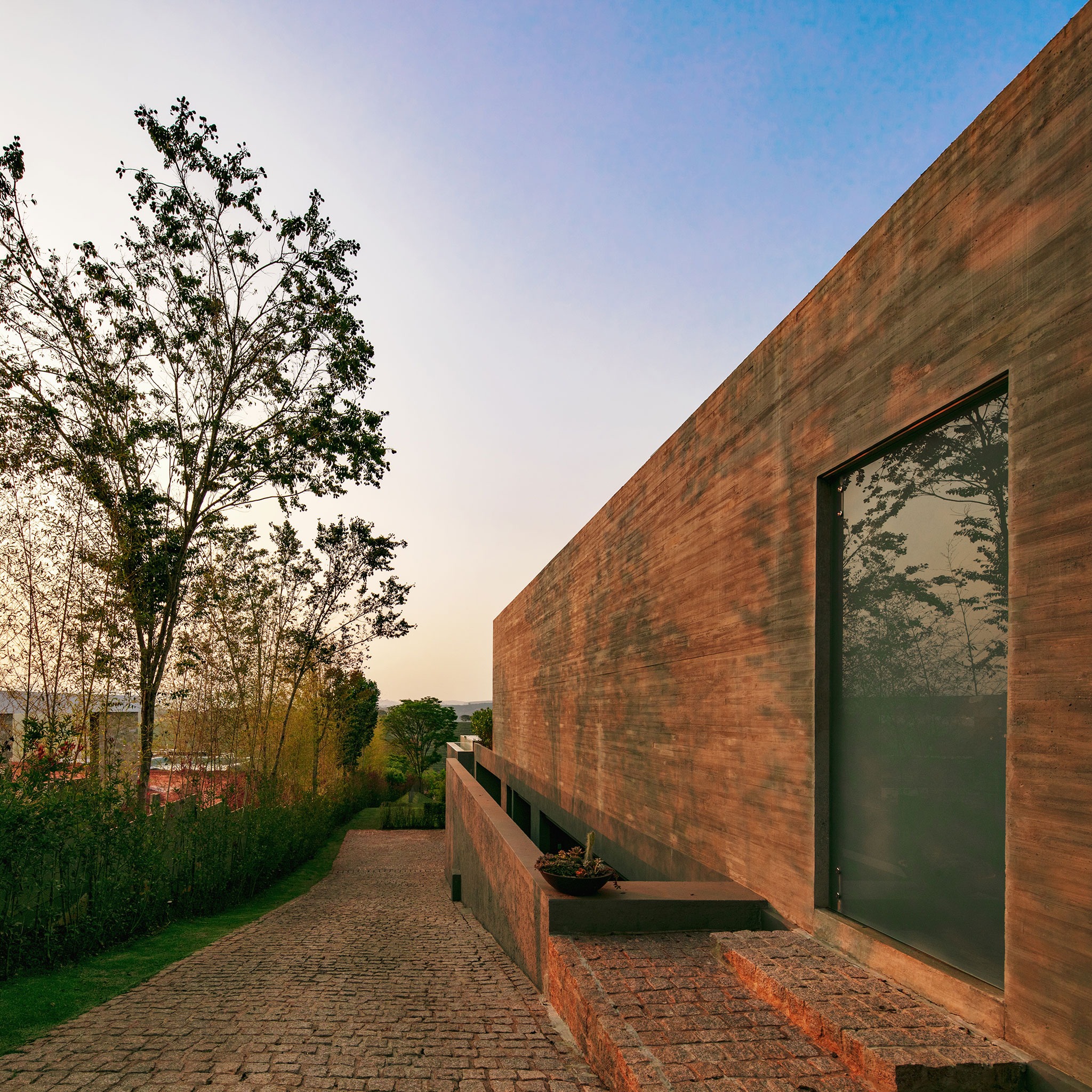
The façade is clad with vertical wooden sunshades, with variations in their angle and spacing depending on the different interior uses. Regarding its materiality, exposed concrete stands out, lending a sculptural character, while wood introduces texture and warmth. Furthermore, 3.20-meter-high glass panels allow the spaces to merge into a single, continuous environment, and a skylight located above the social area allows natural light to enter.

Baroneza House by Sabella Arquitetura. Photograph by Nelson Kon.
Project description by Sabella Arquitetura
Set on a site overlooking an orange grove at Quinta da Baroneza, in Bragança Paulista, Casa Baroneza emerged from the owner’s direct request: to create a spacious single-story residence closely connected to its surroundings. Designed by Sabella Arquitetura, the project was conceived as a weekend home capable of welcoming friends comfortably while maintaining a continuous relationship with the landscape and preserving privacy. The residence was designed to remain faithful to the original concept throughout construction, avoiding modifications that could impact cost, schedule or building quality.
The decision to position the house closer to the street was a strategy to preserve long views of the horizon and ensure sunlight in the leisure area throughout the day. The infinity-edge pool was placed at the same level as the living room, projecting over the sloped terrain. Even considering the possibility of future neighboring constructions, the solution guarantees visual continuity with the landscape. The basement accommodates a 12-car garage and a sauna.
The house is organized into two volumes. From the street, this separation is almost imperceptible: a linear façade clad with vertical wooden brise-soleils unifies the entire extension of the residence. Variations in the angle and spacing of the brises respond to different interior uses. In the social areas, they allow greater transparency and visual integration. In the private wing, they ensure privacy for the bedrooms without blocking the connection to the landscape.
The program was organized around a practical residence with minimal segmentation. The social areas are distributed across a single floor, reinforcing the sense of openness and spatial continuity. Cast-in-place concrete and wood define the project’s materiality. While the concrete takes on a sculptural character and reveals the construction itself, the wood introduces texture, warmth and visual control.

Upon crossing the pivoting entrance door, the division between the two modules becomes clear. On one side, the social core integrates the living room, kitchen, indoor gourmet area and poolside veranda. Glass panels measuring 3.20 meters in height allow the spaces to merge into a single continuous environment. Natural light enters through a skylight above the social area, while the slatted pattern applied to the concrete ceiling dialogues with the wood used on the flooring and the main wall.
In the private volume, five suites are distributed between offset concrete walls positioned in relation to the social block. This configuration protects the bedrooms from outside views without limiting their openness to the surroundings. The master suite cantilevers over the lawn, strengthening the relationship with the landscape.
The landscape design reinforces the proximity between architecture and nature. Between the two volumes, rosemary gardens spread fragrance throughout the house. Across the site, species such as olive trees, palm trees, plane trees, sibipiruna and monstera accompany the implantation of the residence. According to the owner, the house’s defining quality is its sense of lightness. Spatial integration, generous environments and the continuous connection with the exterior transform the perception of scale and everyday living.


