Architecture studio Mecanoo, led by Dutch architect Francine Houben, was responsible for the Doris Duke Theatre design for the Jacob's Pillow Dance Center, located in a natural setting in the town of Becket, Berkshire County, Massachusetts (USA). The project aims to be a contemporary reinterpretation of the connection between performing arts, community, and nature.

The incorporation of Indigenous principles into the project is not a superficial or merely decorative matter, but rather a structural one. Recognizing the four cardinal points and the philosophy of the seven generations, an essential aspect of Indigenous cultures, establishes an ethical and temporal relationship between the building and its context. This gesture places the theater within a tradition of thought that prioritizes sustainability, respect for place, and cultural memory.

Mecanoo envisions the theater as an architecture immersed in the landscape and aligned with an expanded idea of dance. Through this strategy of integration, the building is embedded into the terrain, articulating its access points and circulation with the paths that connect the studios and the Artist Quad of the campus. The project stands out for its ability to create a hybrid environment between the natural and the built, using elements such as a green roof, an open veranda, and retractable façade systems that allow the performance space to adapt to different types of shows. This programmatic flexibility enables a seamless transition from intimate settings to large-scale presentations.

Both the structure and the façade of the theater are resolved through a solid timber system, using thermally treated pine as the main material, not only for its durability, but also for its aesthetic behavior as it weathers over time. This decision reflects not only sustainability and low environmental impact criteria, but also incorporates time as a poetic element, where the wood oxidizes, changes color, and registers the passing of the seasons as part of the building’s identity.

Doris Duke Theatre by Mecanoo. Photograph by Iwan Baan, Courtesy by Jacob's Pillow.
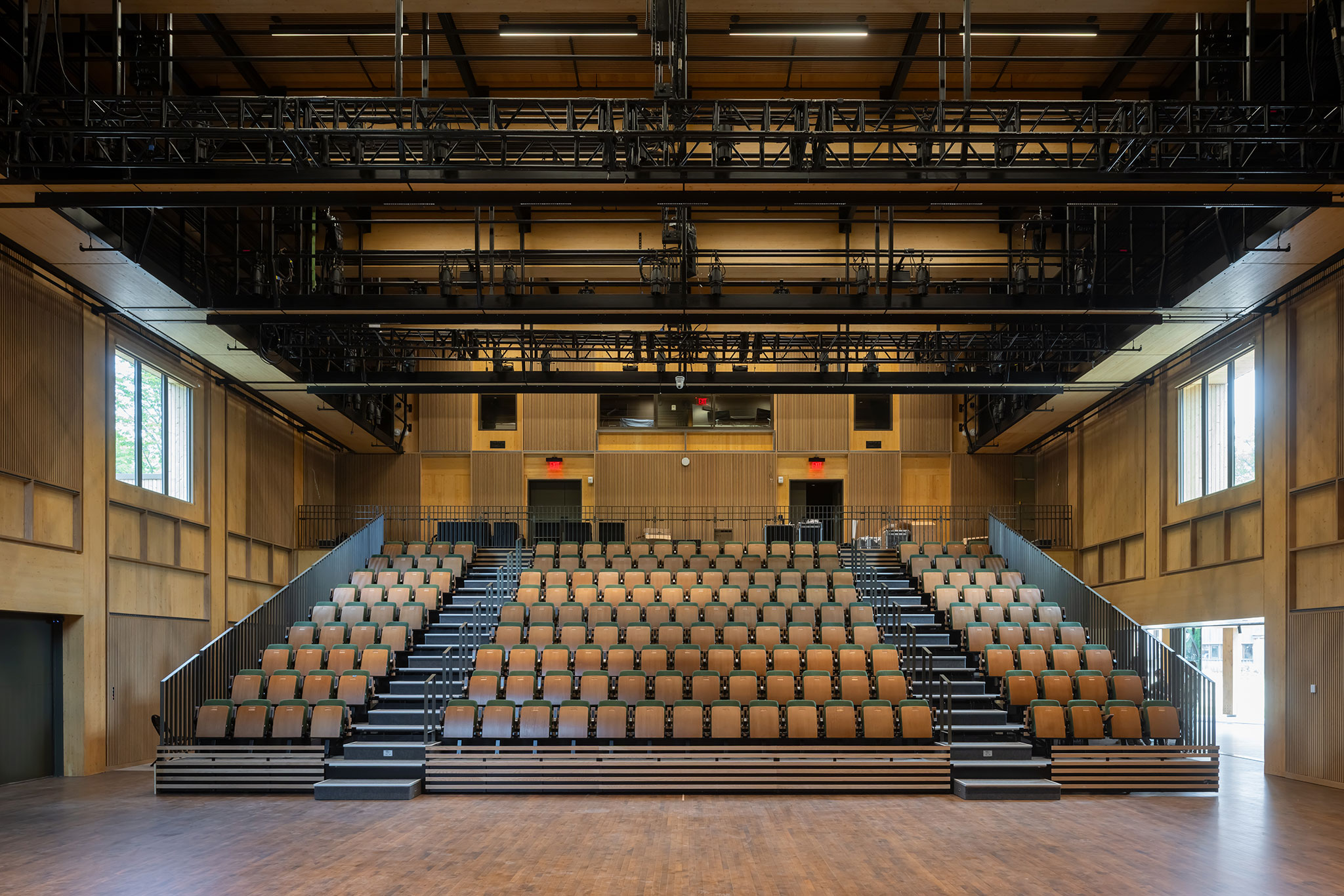
Doris Duke Theatre by Mecanoo. Photograph by Iwan Baan, Courtesy by Jacob's Pillow.

Doris Duke Theatre by Mecanoo. Photograph by Iwan Baan, Courtesy by Jacob's Pillow.

Description of project by Mecanoo

At the heart of the new Doris Duke Theatre lies a celebration of movement, space, and connection. Inspired by Mecanoo’s core values of "people, place, purpose, and poetry," the new theater captures the essence of dance, not only as an art form but as a deeply human experience intertwined with the landscape and community. Here, architecture becomes a partner in performance, a stage for expression where boundaries blur between the natural world and human creativity, offering a dynamic, living space that evolves with every step.

Rooted in the rolling hills of the Berkshires, the theater honors the rich heritage of Jacob’s Pillow while pushing the frontiers of the performing arts. Indigenous principles shape the orientation and form, grounding the design in an acknowledgment of the four directions, where North, South, East, and West hold deep meaning in Indigenous cultures. The organic, layered structure, divided into seven bands, honors the Indigenous philosophy of the “seven generations,” where environmental consciousness plays a crucial role in shaping the world for generations to come.

Doris Duke Theatre by Mecanoo. Photograph by Iwan Baan, Courtesy by Jacob's Pillow.

Doris Duke Theatre by Mecanoo. Photograph by Iwan Baan, Courtesy by Jacob's Pillow.

The design draws on the rhythms of nature, mirroring the fluidity and grace of dancers. Every element is crafted toward movement and transition, from the soft, sculptural forms that echo the land to the open, permeable spaces that invite light, air, and sound to flow effortlessly between interior and exterior. The building becomes a dance of its own, constantly shifting and adapting, much like the art it houses. The theater's flexible performance space embraces this ethos, offering configurations that adapt to a wide range of performances, creating spaces for both intimate gatherings and expansive digital presentations.

The connection to the landscape is more than just visual, it is tactile, spiritual, and ecological. Pathways weave through the campus, drawing visitors from the Artist Quad and studios into the heart of the theater. The performance space, with its green roof, steps gently into the landscape. The open-covered veranda, retractable walls, and glazing blur the lines between indoors and outdoors, creating a seamless transition that evokes the feeling of movement in space, light shifting across the timber facade, shadows dancing with the sun.

Doris Duke Theatre by Mecanoo. Photograph by Iwan Baan, Courtesy by Jacob's Pillow
Doris Duke Theatre by Mecanoo. Photograph by Iwan Baan, Courtesy by Jacob's Pillow.

In keeping with Jacob’s Pillow vernacular, the theater's mass timber structure is clad in thermally treated pine, designed to weather gracefully over time. The building transforms with the seasons, its natural materials telling a story of light and shadow, time, and change, an organic register of the dance of nature. Rainwater can be collected for future reuse, and the generous veranda provides natural shading, a quiet gesture of harmony between sustainability and design. Through its form, function, and connection to the land, the new Doris Duke Theatre embodies the poetry of place, an enduring testament to the power of dance, nature, and human creativity intertwined.

More information

Label
Architects
Text
+ + copy Created with Sketch.
- + copy Created with Sketch.
Label
Project team
Text

Lead Architect.- Mecanoo. 
USA-Based Architect.- Marvel.

+ + copy Created with Sketch.
- + copy Created with Sketch.
Label
Collaborators
Text

Landscape Architect.- Marvel.
Theatre & Acoustic Consultant.- Charcoalblue.
Structural Engineer.- TYLin.
MEP, IT, Security.- Altieri.
Lighting Consultant.- Fischer Marantz Stone.
Code Consulting.- CCI, New York.
Civil Engineering.- Foresight Land Services.
Indigenous Consultation.- Jeffrey Gibson and Heather Breugl.

+ + copy Created with Sketch.
- + copy Created with Sketch.
Label
Client
+ + copy Created with Sketch.
- + copy Created with Sketch.
Label
Builder
Text

Allegrone Companies.

+ + copy Created with Sketch.
- + copy Created with Sketch.
Label
Area
Text

1.858 sqm.

+ + copy Created with Sketch.
- + copy Created with Sketch.
Label
Dates
Text

Project design.- 2022-2023.
Project realization.- 2023-2025.
Public opening.- July 9, 2025.

+ + copy Created with Sketch.
- + copy Created with Sketch.
Label
Location
Text

Becket, Massachusetts, United States.

+ + copy Created with Sketch.
- + copy Created with Sketch.
Label
Budget
Text

$ 30,000,000.

+ + copy Created with Sketch.
- + copy Created with Sketch.
Label
Photography
+ + copy Created with Sketch.
- + copy Created with Sketch.

Francine Houben (Holland 1955) began formulating the three fundamentals of her lifelong architectural vision while studying at the Delft University of Technology. It was in this crucible of higher learning that she began an architectural practice with two fellow students with the design of a groundbreaking social housing development. As a result, she graduated as architect with cum laude honours in 1984 and officially founded Mecanoo architecten with these same partners.

Francine has remained true to her architectural vision, Composition, Contrast, Complexity throughout her career. Always looking for inspiration and the secret of a specific location, Francine bases her work on both analyses and intuition. She enjoys interweaving social, technical, playful and humane aspects together in order to form a unique solution to each situation. Francine Houben combines the disciplines of architecture, urban planning and landscape architecture in an untraditional way; with sensitivity for light and beauty.

Her use of material is expressive. She is known as one of the most prolific architects in Europe today. Her wide-ranging portfolio comprises an intimate chapel built on the foundations of a former 19th century chapel in Rotterdam (2001) to Europe’s largest library in Birmingham (2013). Francine Houben’s work reveals a sensory aspect determined by form and space, a lavish use or subtle combinations of the most diverse materials, as well as planes of saturated colour. Francine’s contribution to the profession of architecture is widely recognized. She was granted lifelong membership to the Akademie der Künste, Berlin in 2010.

In 2008, she received the Veuve Clicquot Business Woman of the Year Award. Honorary fellowships to the American Institute of Architects and the Royal Architectural Institute of Canada, and an international fellowship to the Royal Institute of British Architects were granted to her in previous years. The past three decades have seen her cumulative effect on the profession of architecture. Francine lectures all over the world and takes part as a jury member in prestigious competitions.

Her commitment to research and education is evidenced in her instatement as professor in Architecture, Chair of Aesthetics of Mobility at the Delft University of Technology (2000), her professorship at the Universitá della Svizzera Italiania, Accademia di architettura, Switzerland (2000) and her appointment as visiting professor at Harvard (2007). Dedication to her alma mater is reflected in generous sponsorship of the UfD-Mecanoo Award for the best graduating student of the Delft University of Technology.

Francine Houben lives in Rotterdam, a modern city where the skyline is dotted with buildings designed by world renowned architects; including her award winning Montevideo Skyscraper (2005). It was in this dynamic city that she directed and curated the First International Architecture Biennale Rotterdam (2003), with the theme, ‘Mobility, a room with a view’. She has realised numerous signature projects throughout the Netherlands and Europe including Philips Business Innovation Centre, FiftyTwoDegrees in Nijmegen, (2005-2006), La Llotja Theatre and Conference Centre in Lleida, Spain (2009) and the Delft University of Technology Library (1999). Currently, she is expanding her architectural vision to other continents with the design of Taiwan’s largest theatre complex, The Wei-Wu-Ying Center for the Arts in Kaohsiung (2014), Dudley Municipal Center in Boston (USA) and Shenzhen Cultural Center (China). In 2011 the book Dutch Mountains was released, a chronicle of Francine Houben and eight special projects in five different countries.

Francine maintains an active presence in academia and culture, regularly publishing and giving lectures worldwide. She has performed in many academic and professional capacities throughout her career, including Chair of Architecture and Aesthetics of Mobility at Delft University of Technology, visiting professor at Harvard Graduate School of Design, and as director of the First International Architecture Biennale in Rotterdam.

Francine has received honorary fellowships from the Royal Institute of British Architects, the American Institute of Architects and the Royal Architectural Institute of Canada. In 2014 Francine was named Woman Architect of the Year by the Architects’ Journal and in November 2015 Queen Máxima of The Netherlands presented Francine with the Prins Bernhard Cultuurfonds Prize for her wide-ranging career. Francine was awarded Honorary Doctorates from the Université de Mons, Belgium (2017) and the Utrecht University (2016).

“Architecture must appeal to all the senses. Architecture is never a purely intellectual, conceptual, or visual game alone. Architecture is about combining all the individual elements into a single concept. What counts in the end is the arrangement of form and emotion.”

Francine Houben, architect/creative director Mecanoo Architecten.

Read more
Published on: July 23, 2025
Cite:
metalocus, PABLO GARCÍA-BLANCO MANSILLA
"The form of rootedness. Doris Duke Theatre by Mecanoo" METALOCUS. Accessed
<https://www.metalocus.es/en/news/form-rootedness-doris-duke-theatre-mecanoo> ISSN 1139-6415
Loading content ...
Loading content ...
Loading content ...
Loading content ...
Loading content ...
Loading content ...
Loading content ...
Loading content ...
Loading content ...
Loading content ...
Loading content ...
Loading content ...
Loading content ...
Loading content ...
Loading content ...
Loading content ...
Loading content ...
Loading content ...
Loading content ...
Loading content ...
Loading content ...
Loading content ...
Loading content ...
Loading content ...
Loading content ...
Loading content ...
Loading content ...
Loading content ...
Loading content ...
Loading content ...
Loading content ...
Loading content ...
Loading content ...
Loading content ...
Loading content ...
Loading content ...
Loading content ...
Loading content ...
Loading content ...
Loading content ...
Loading content ...
Loading content ...
Loading content ...
Loading content ...
Loading content ...
Loading content ...
Loading content ...
Loading content ...
Loading content ...
Loading content ...
Loading content ...
Loading content ...
Loading content ...
Loading content ...