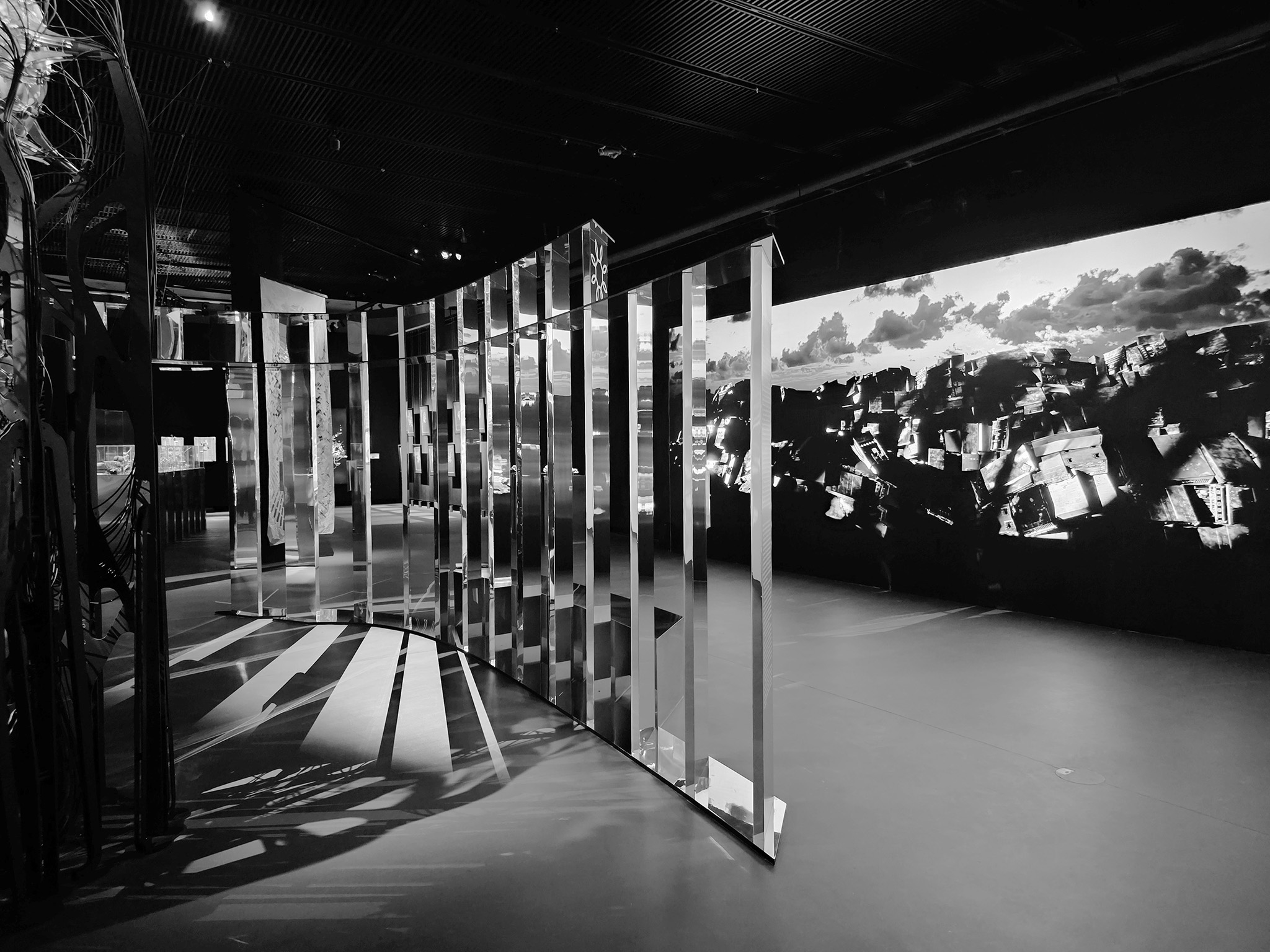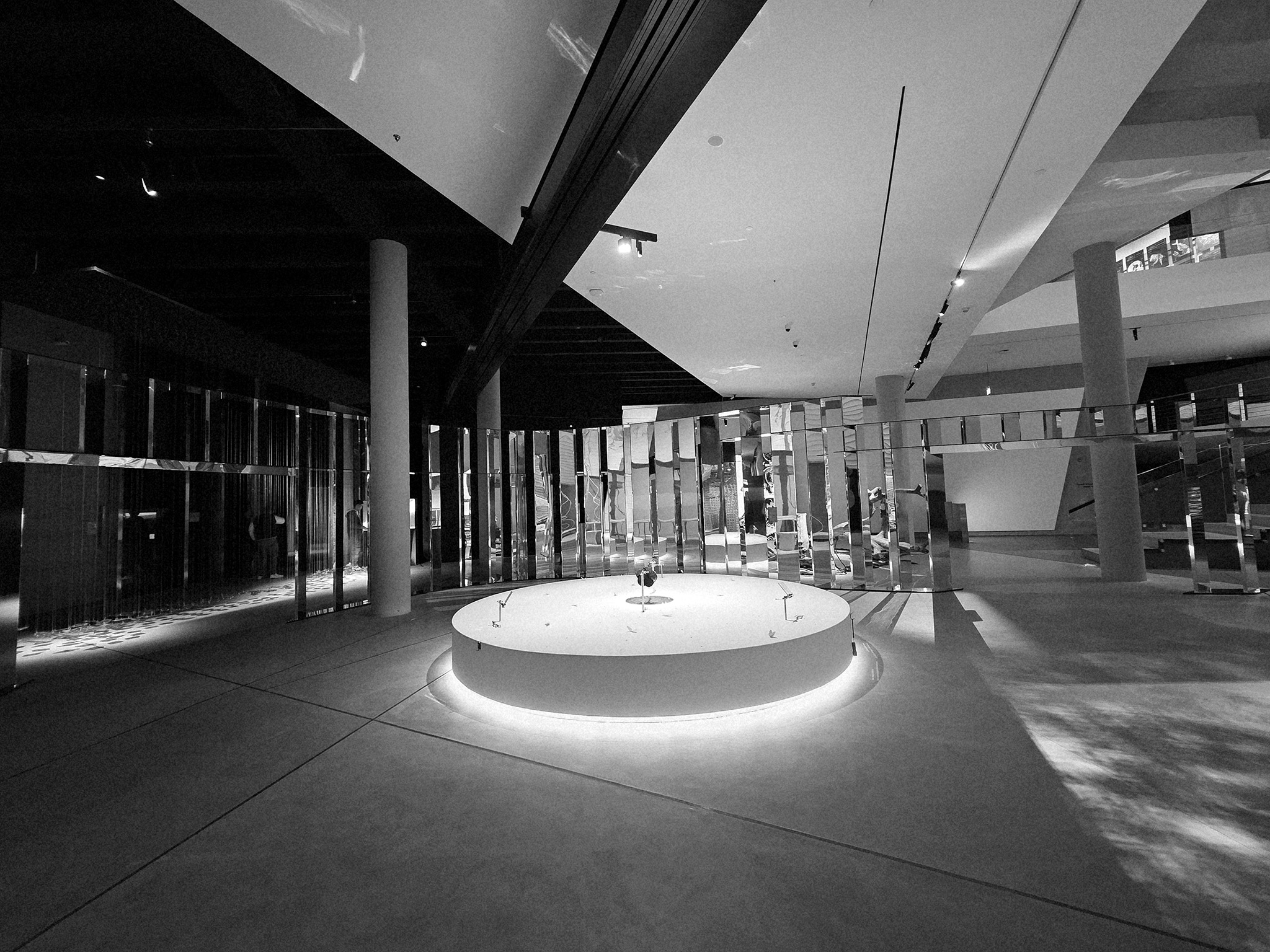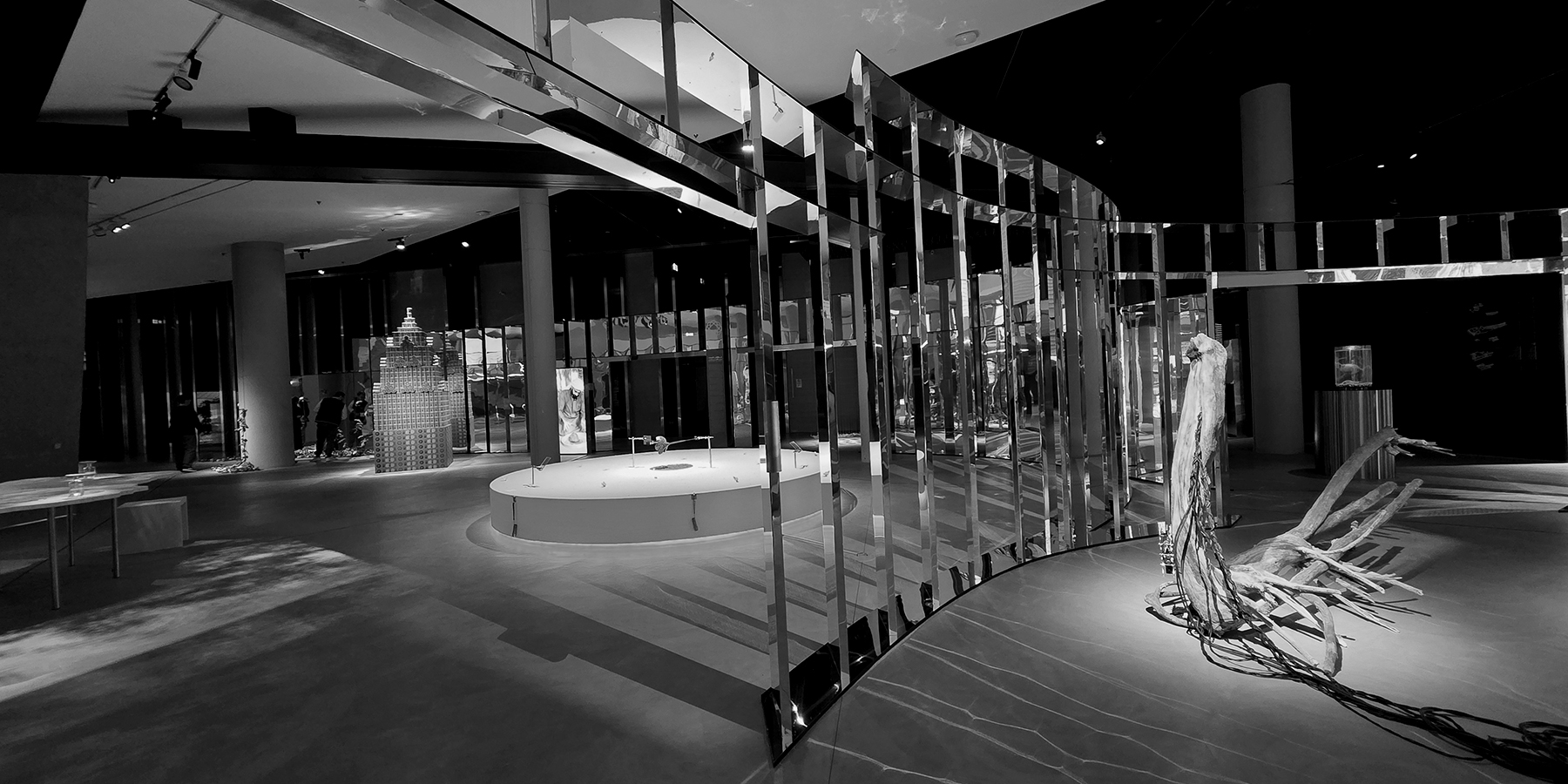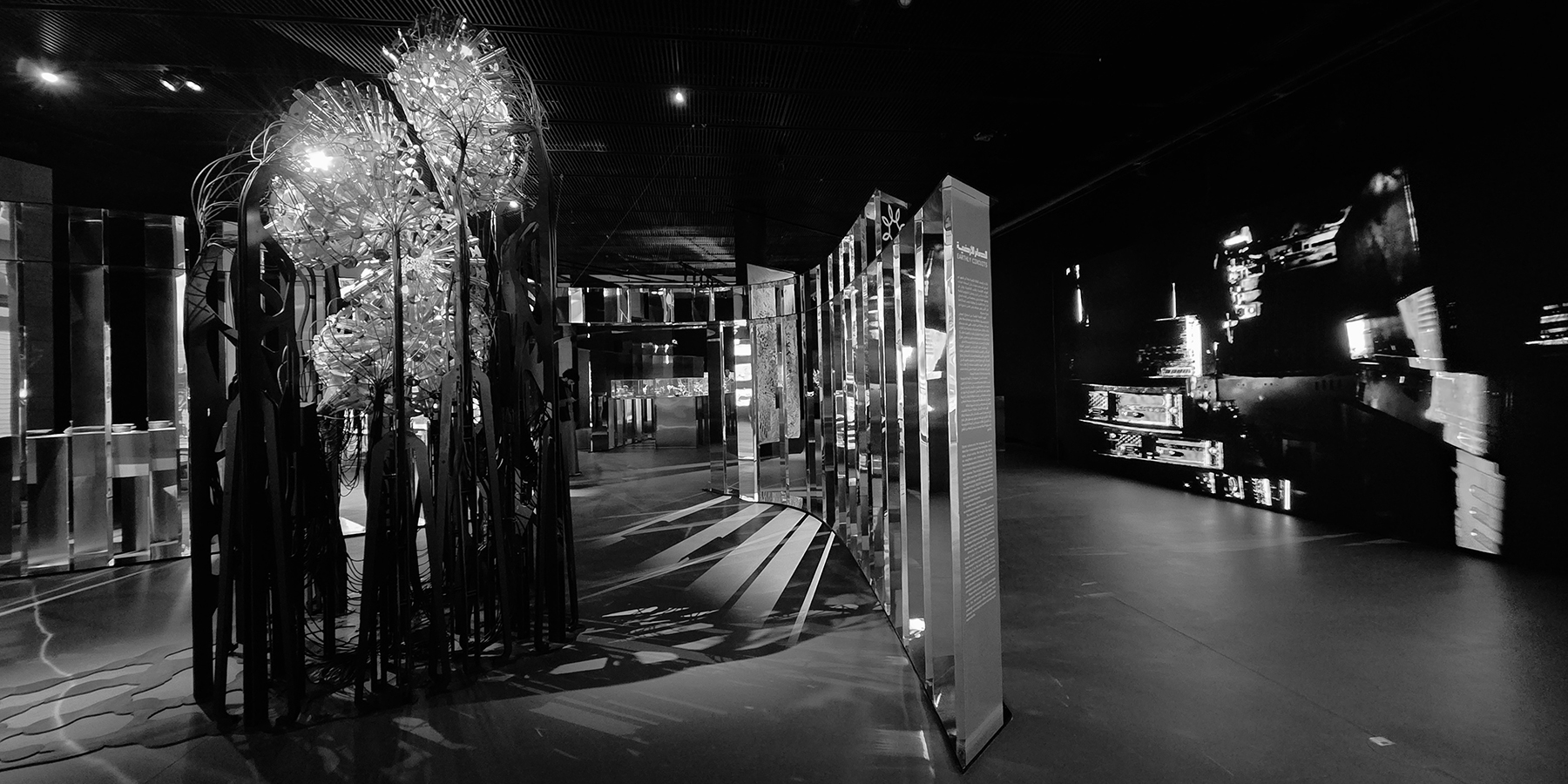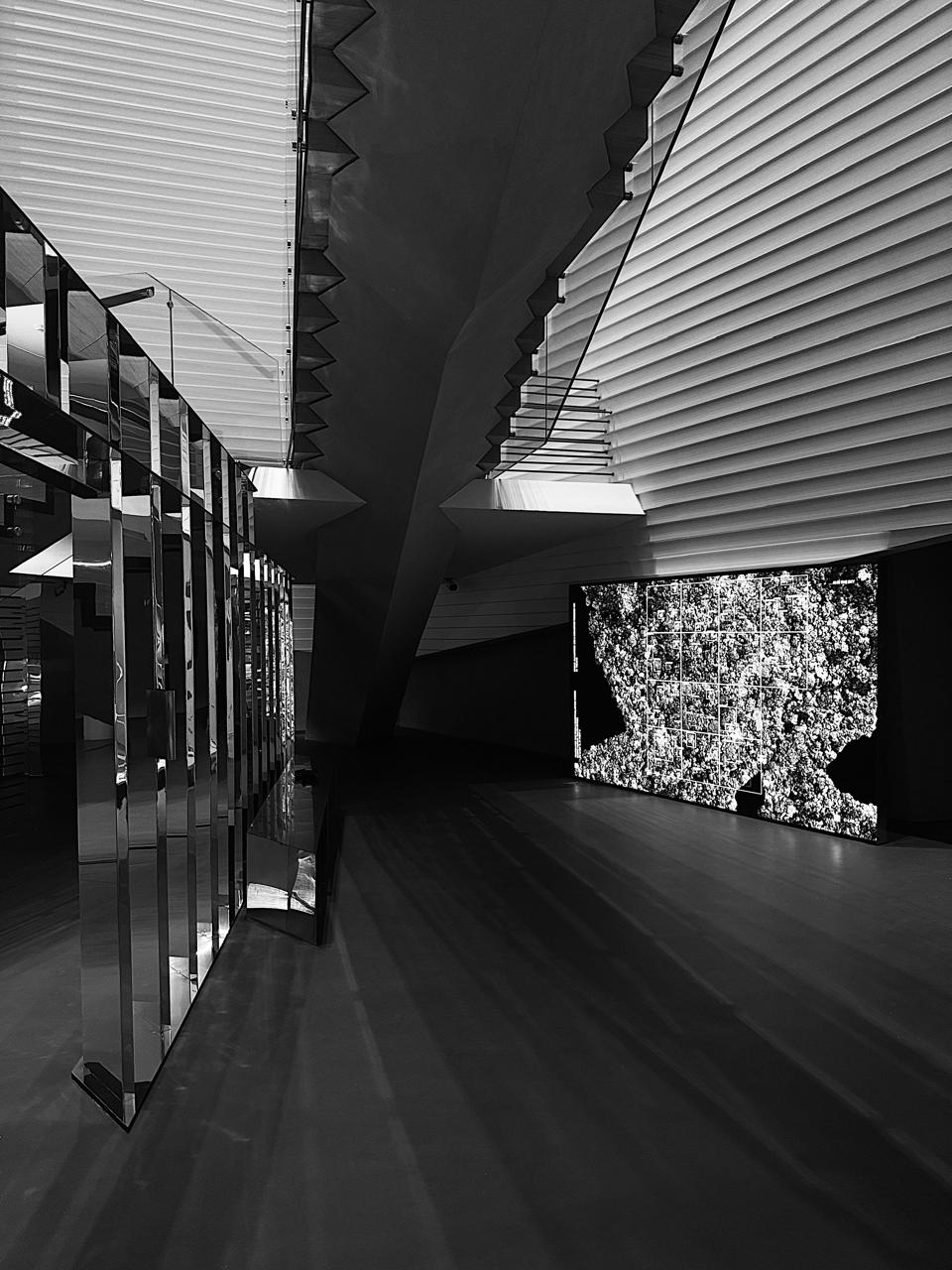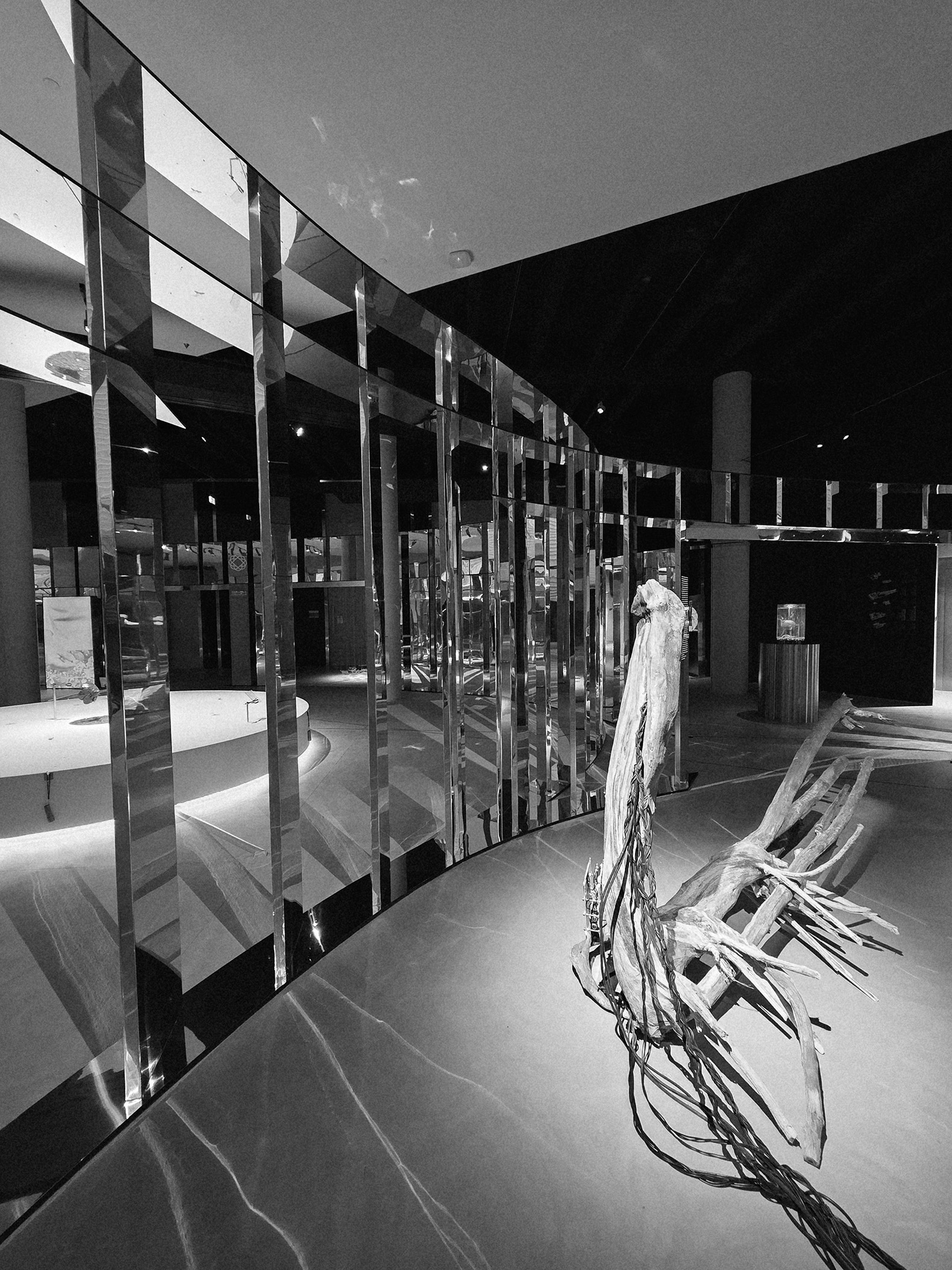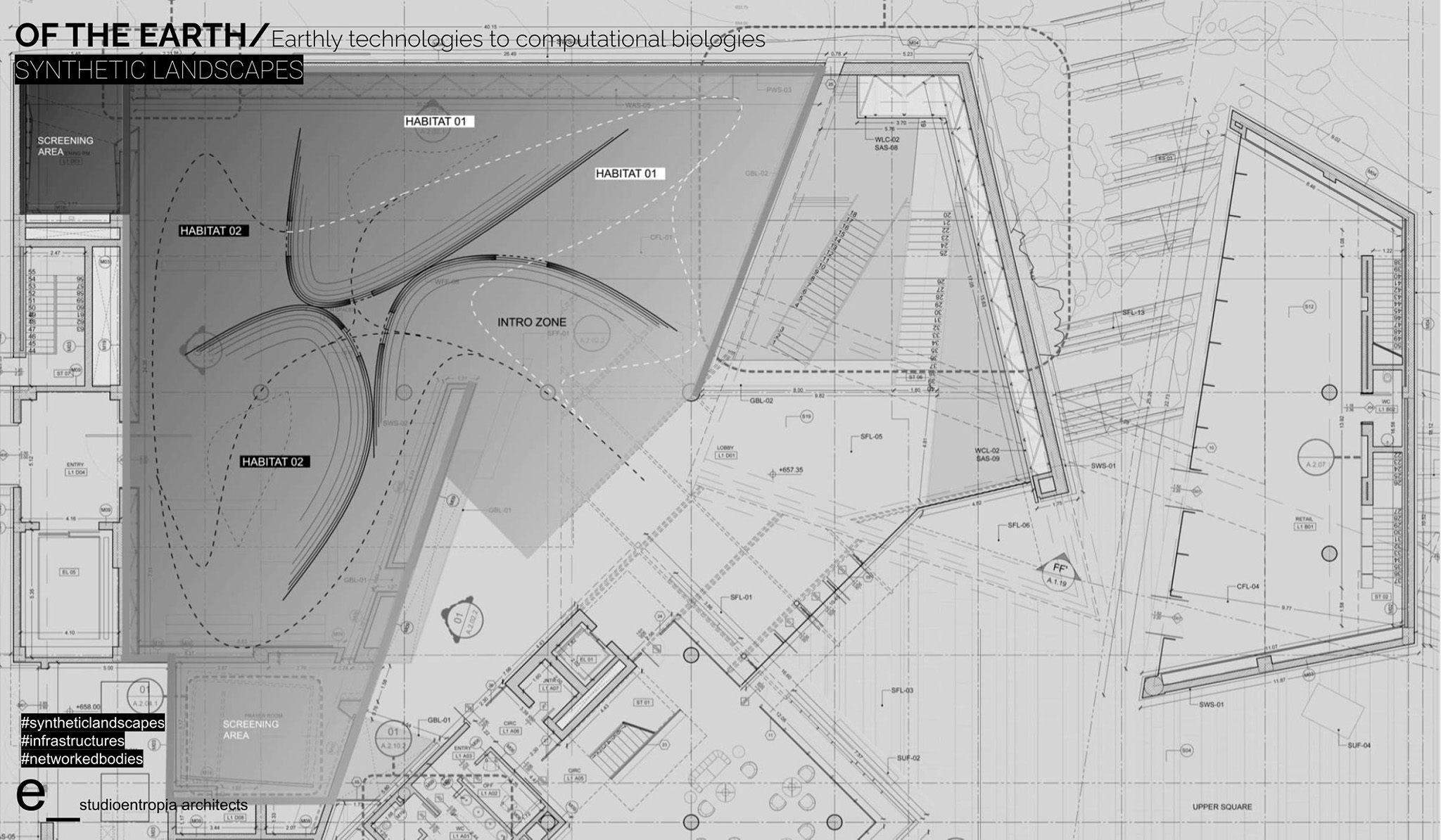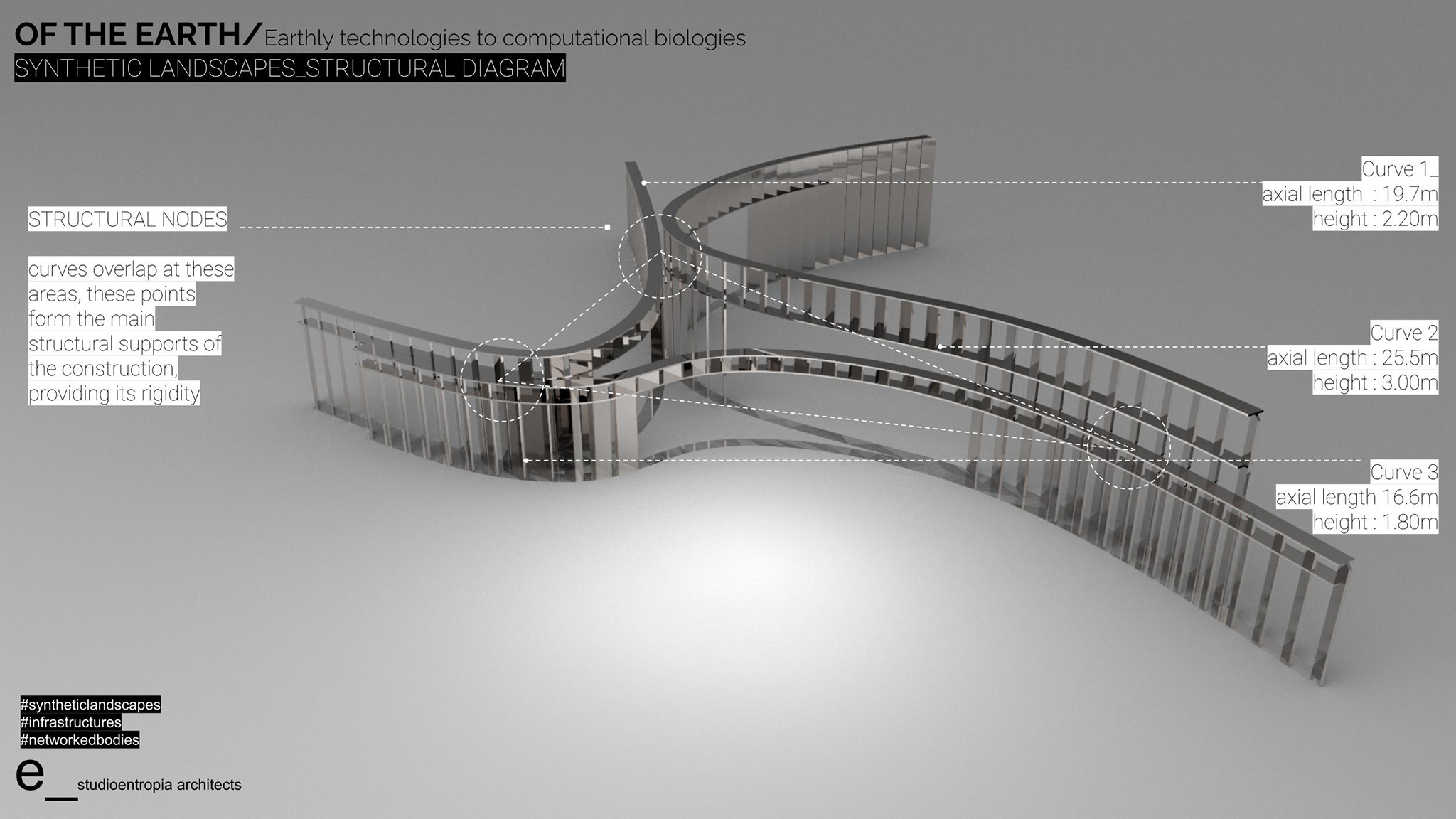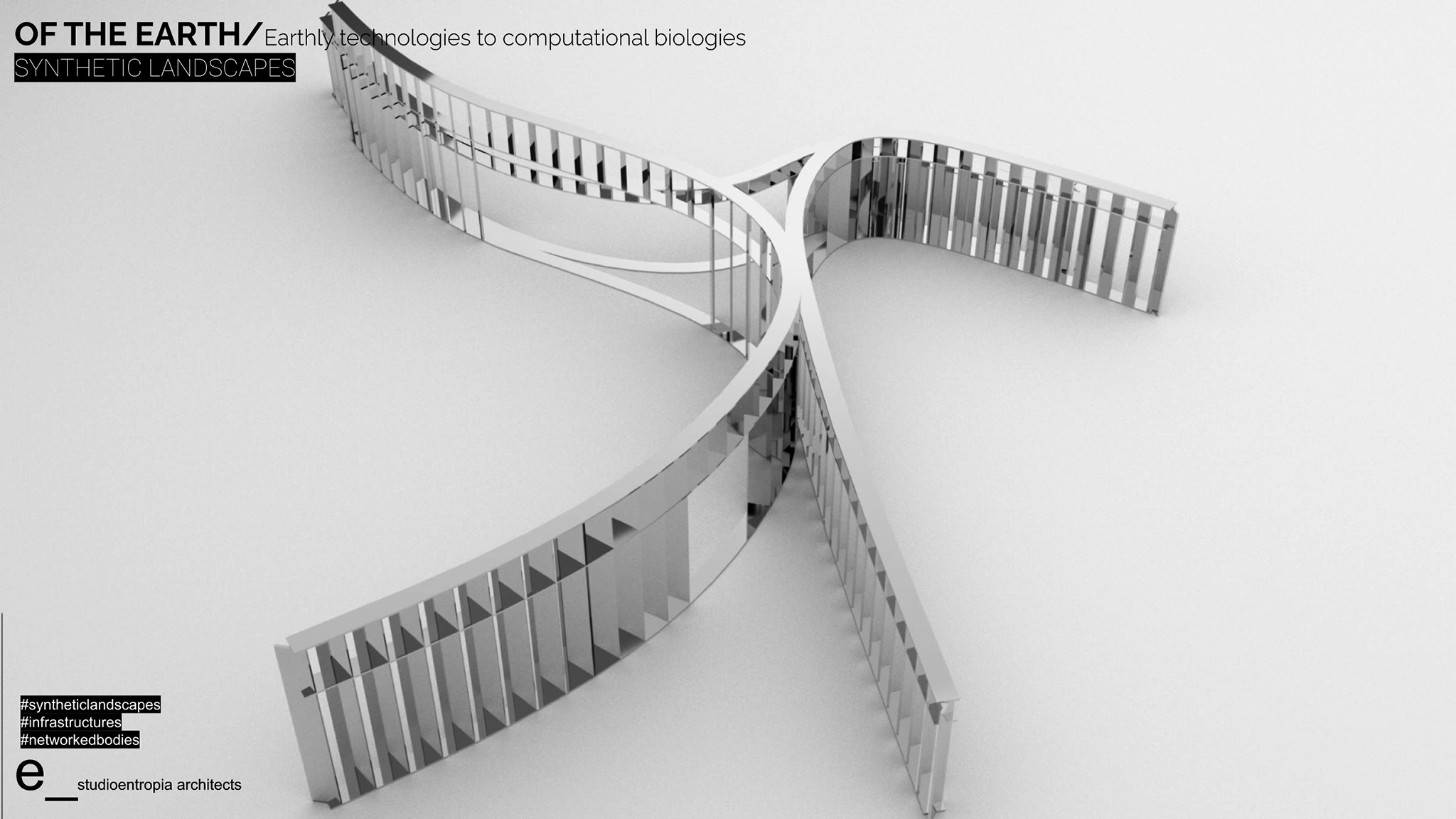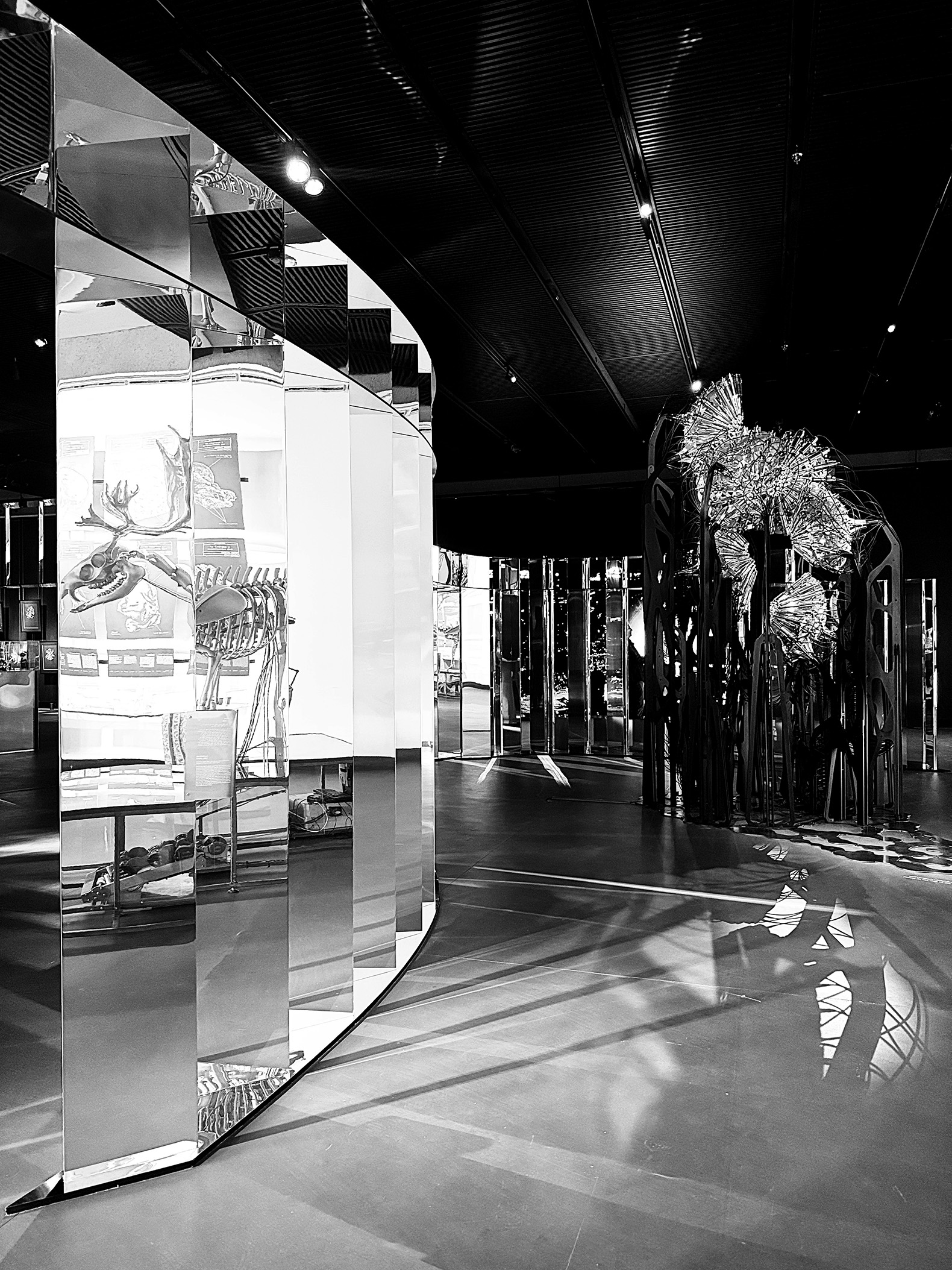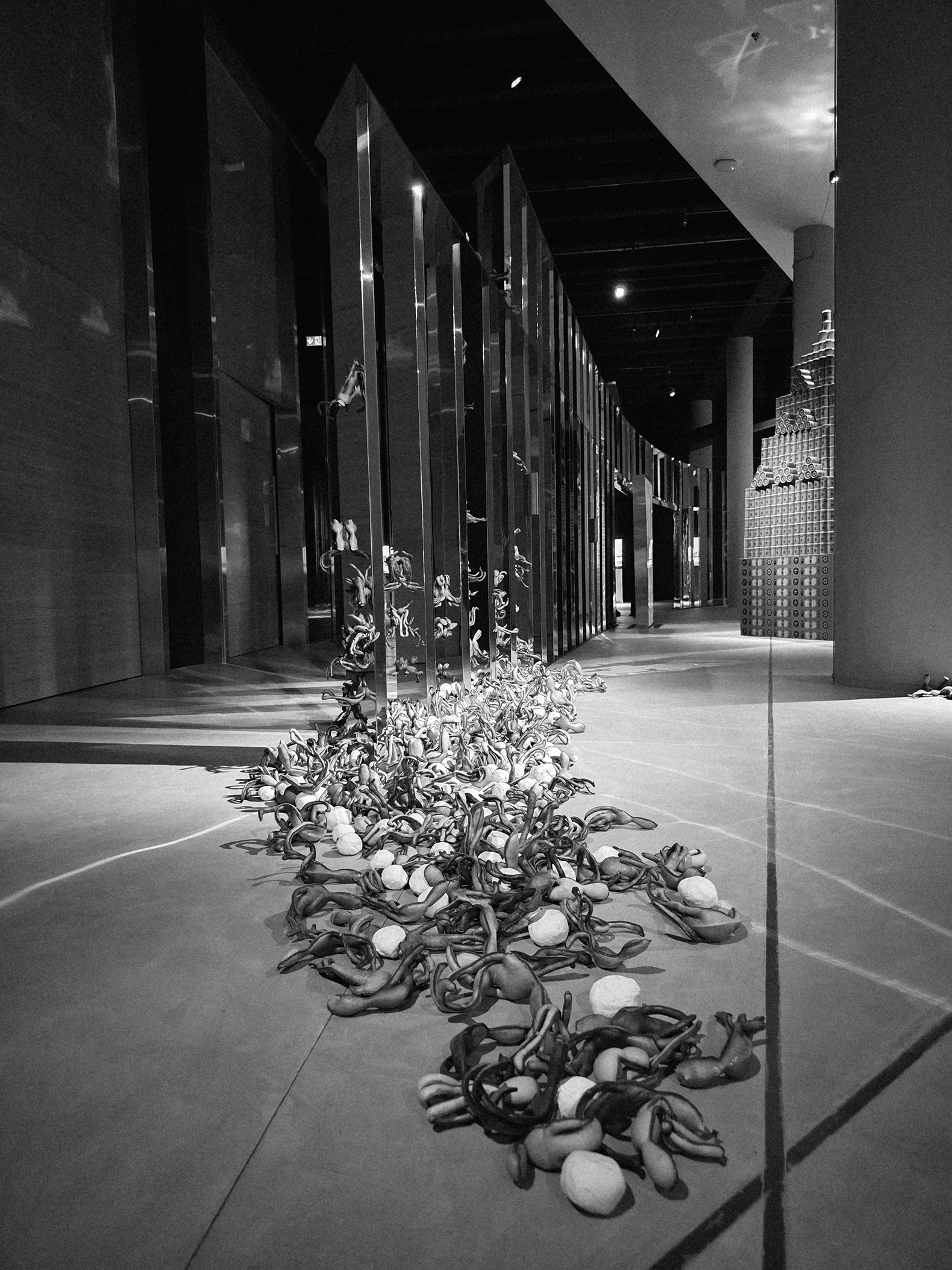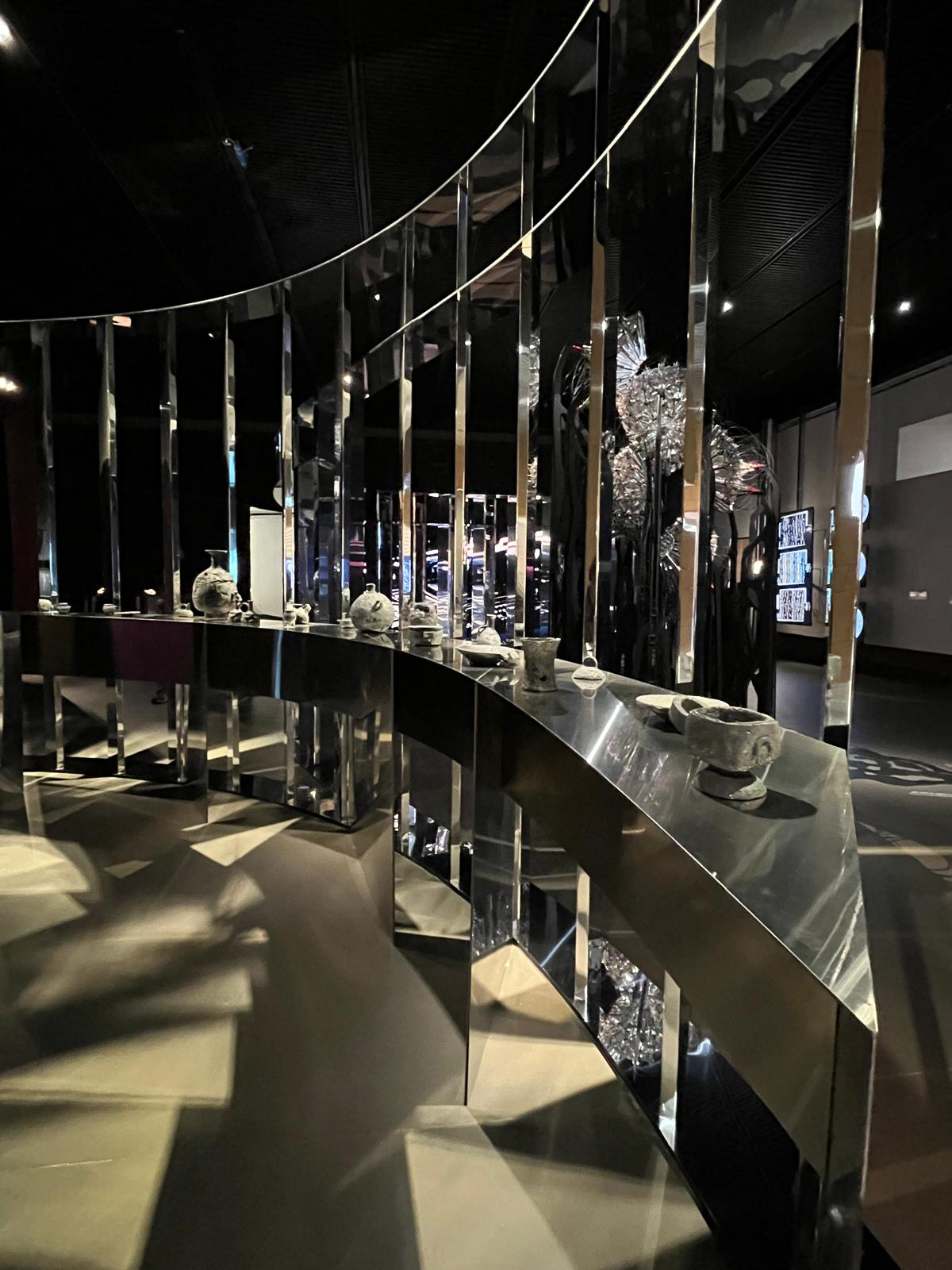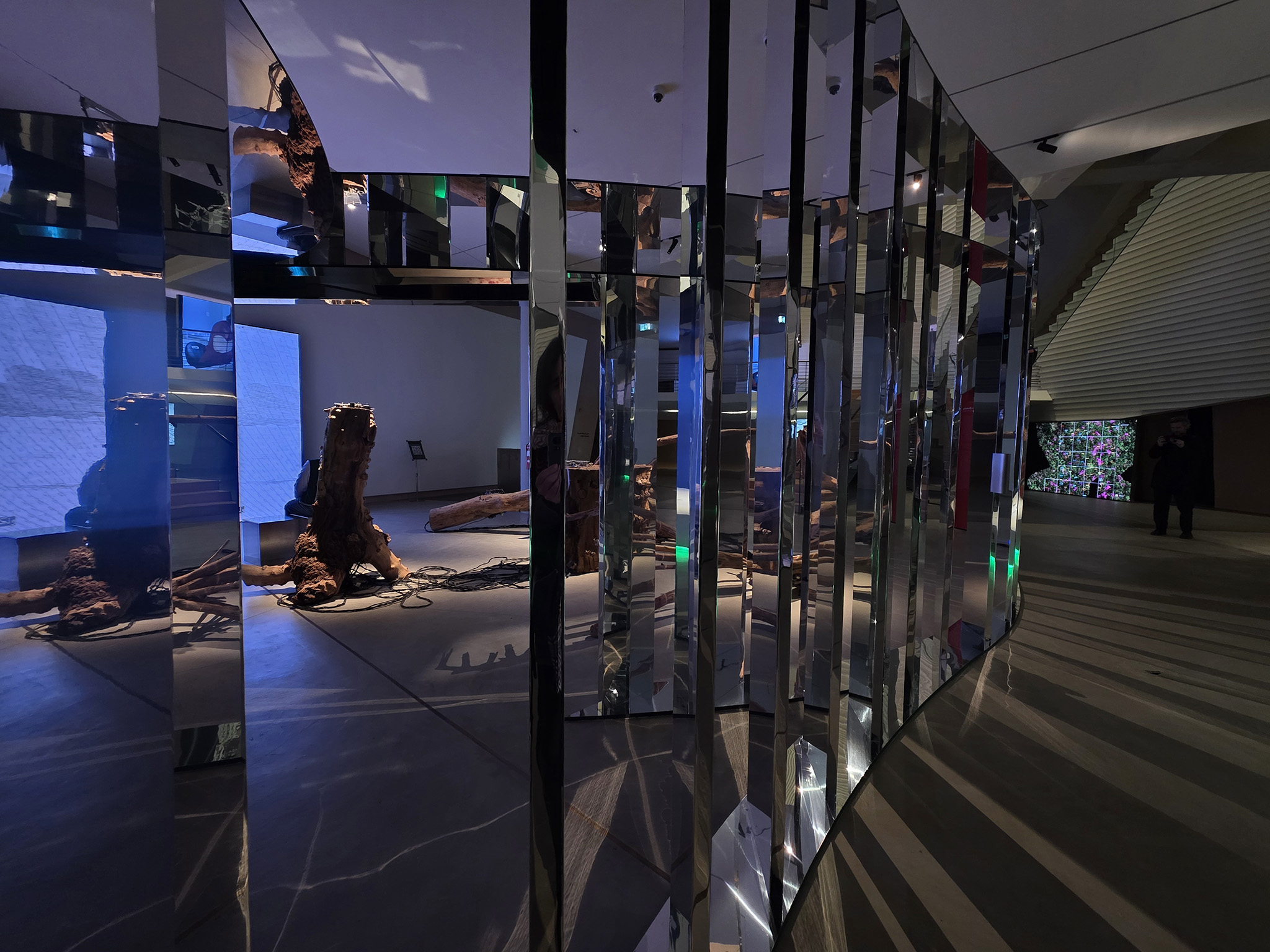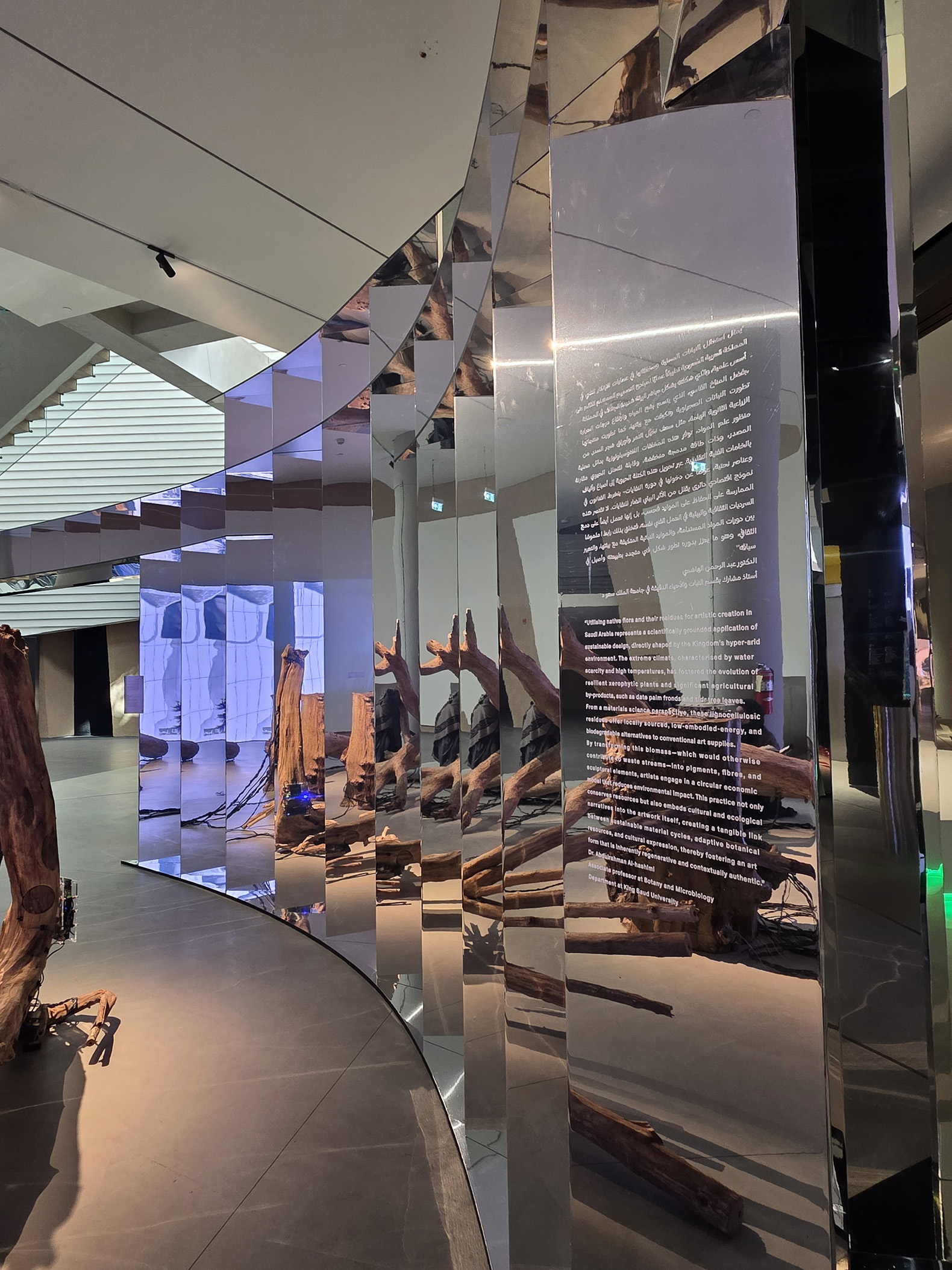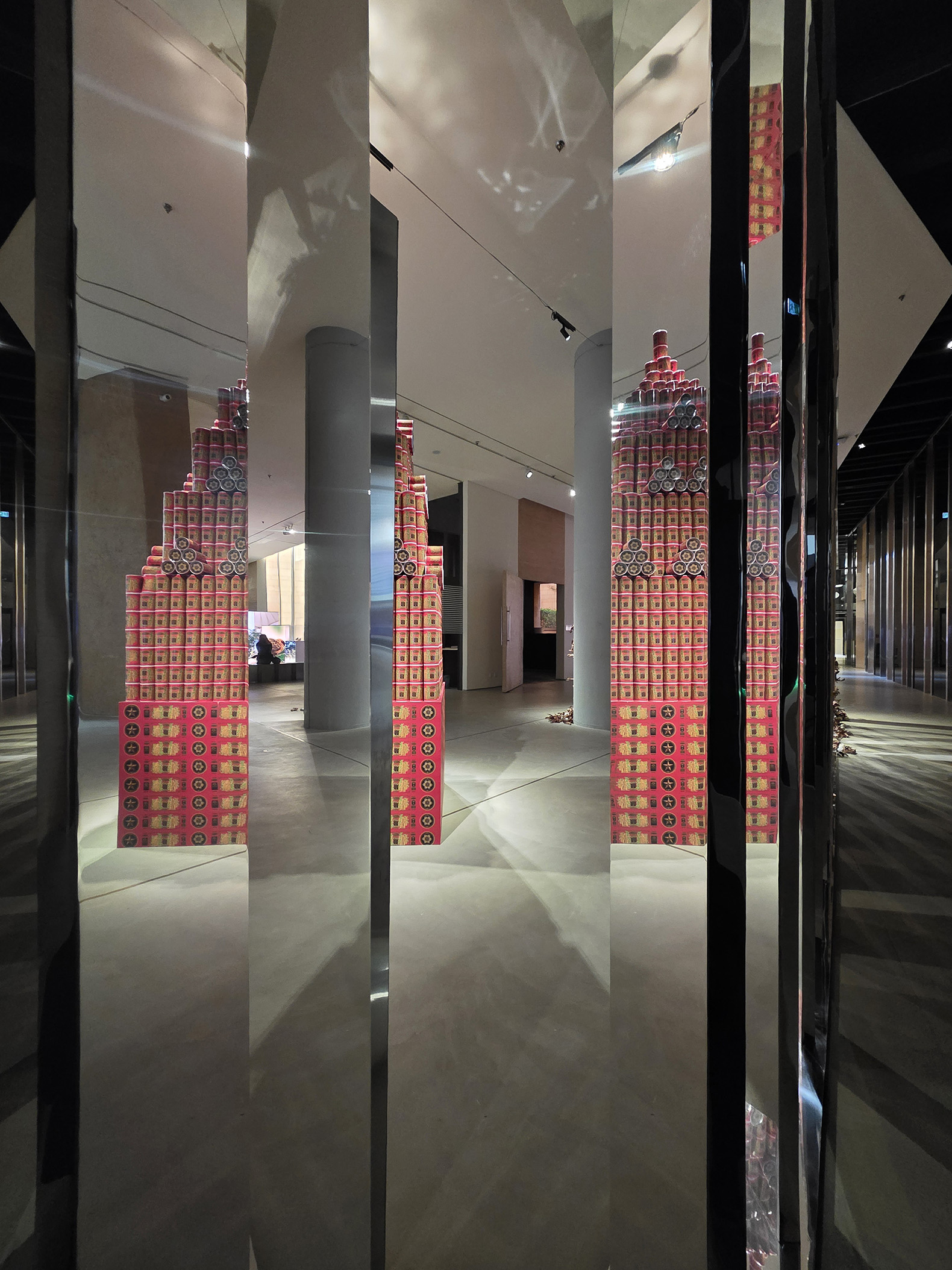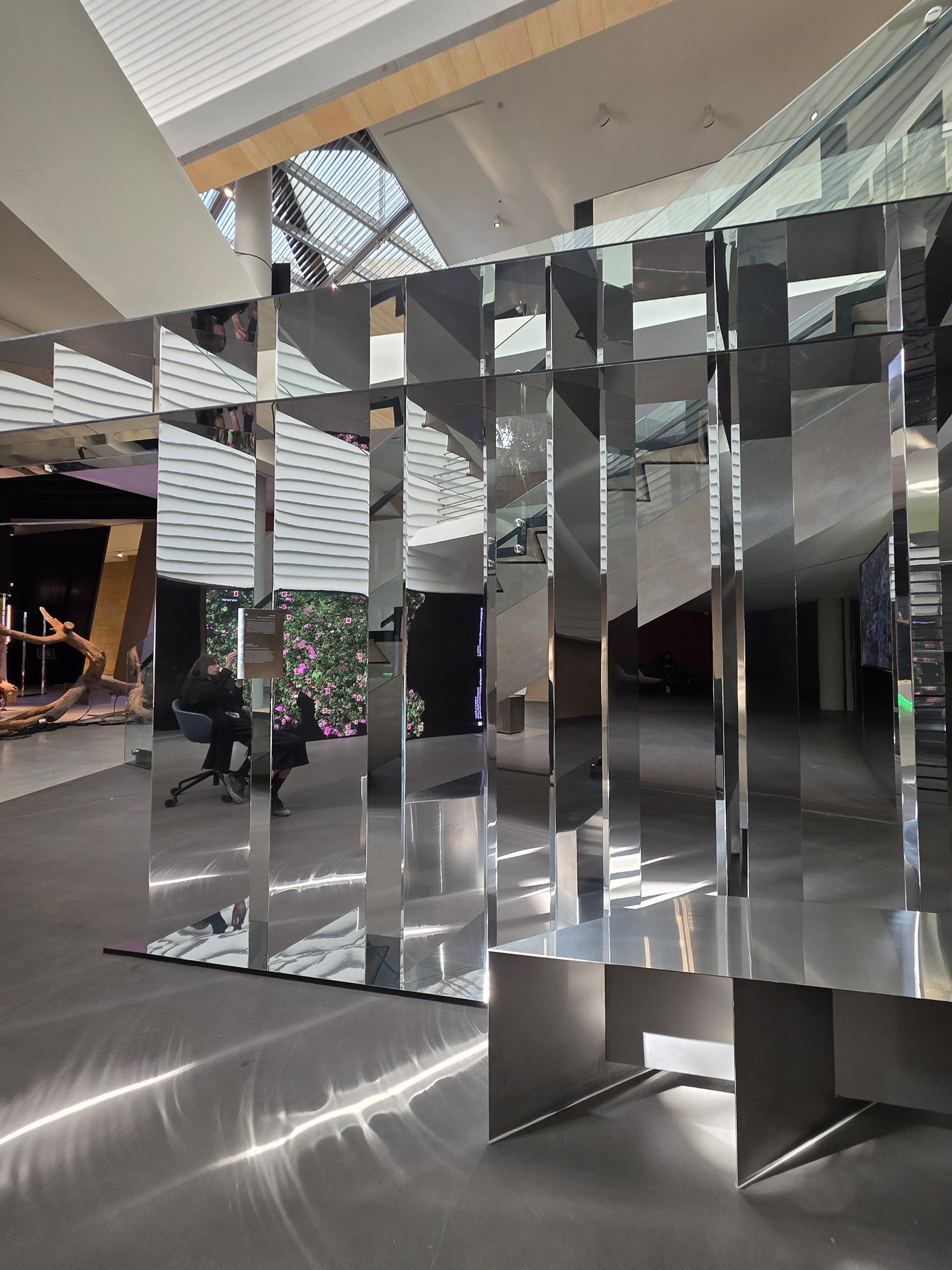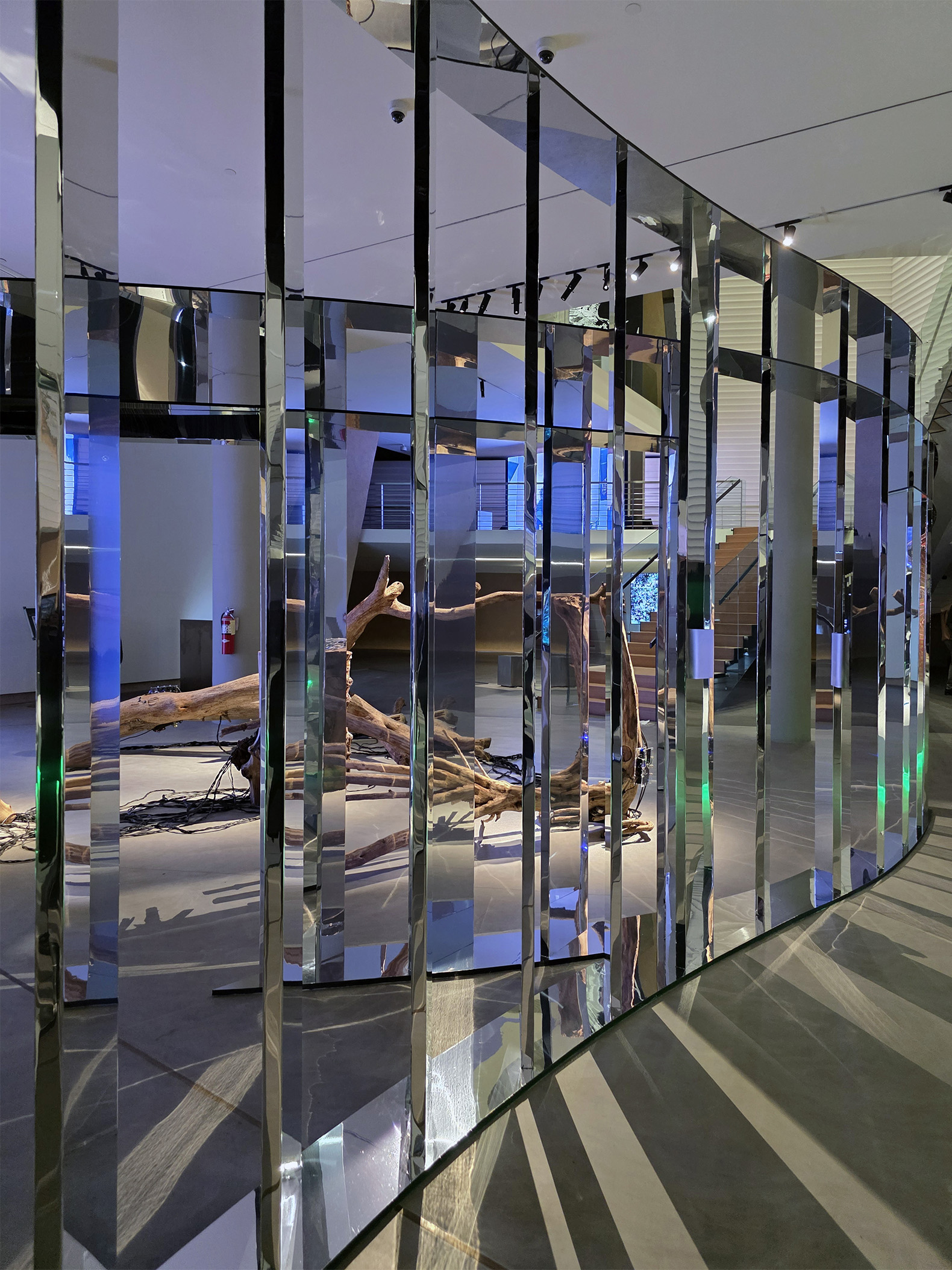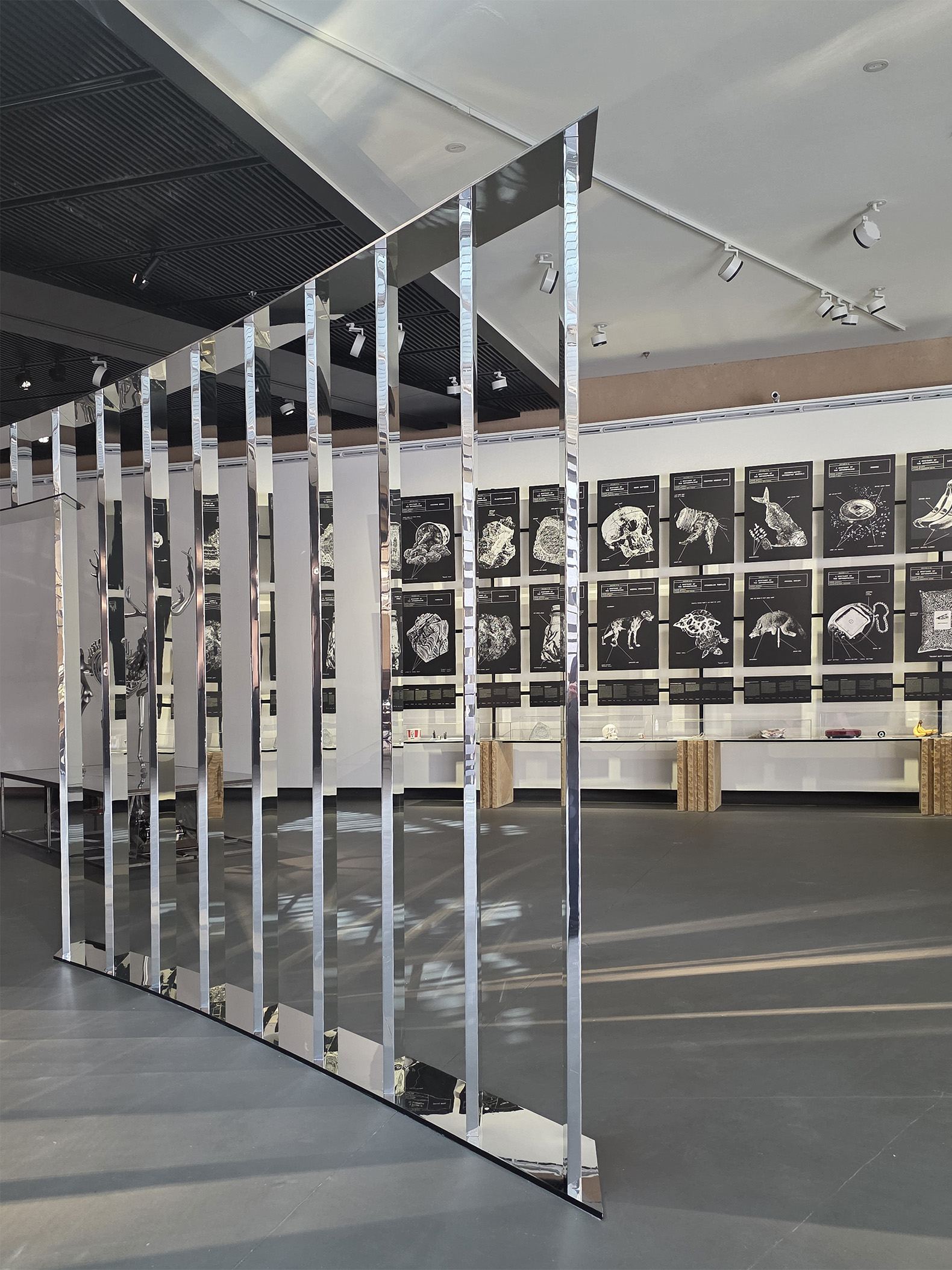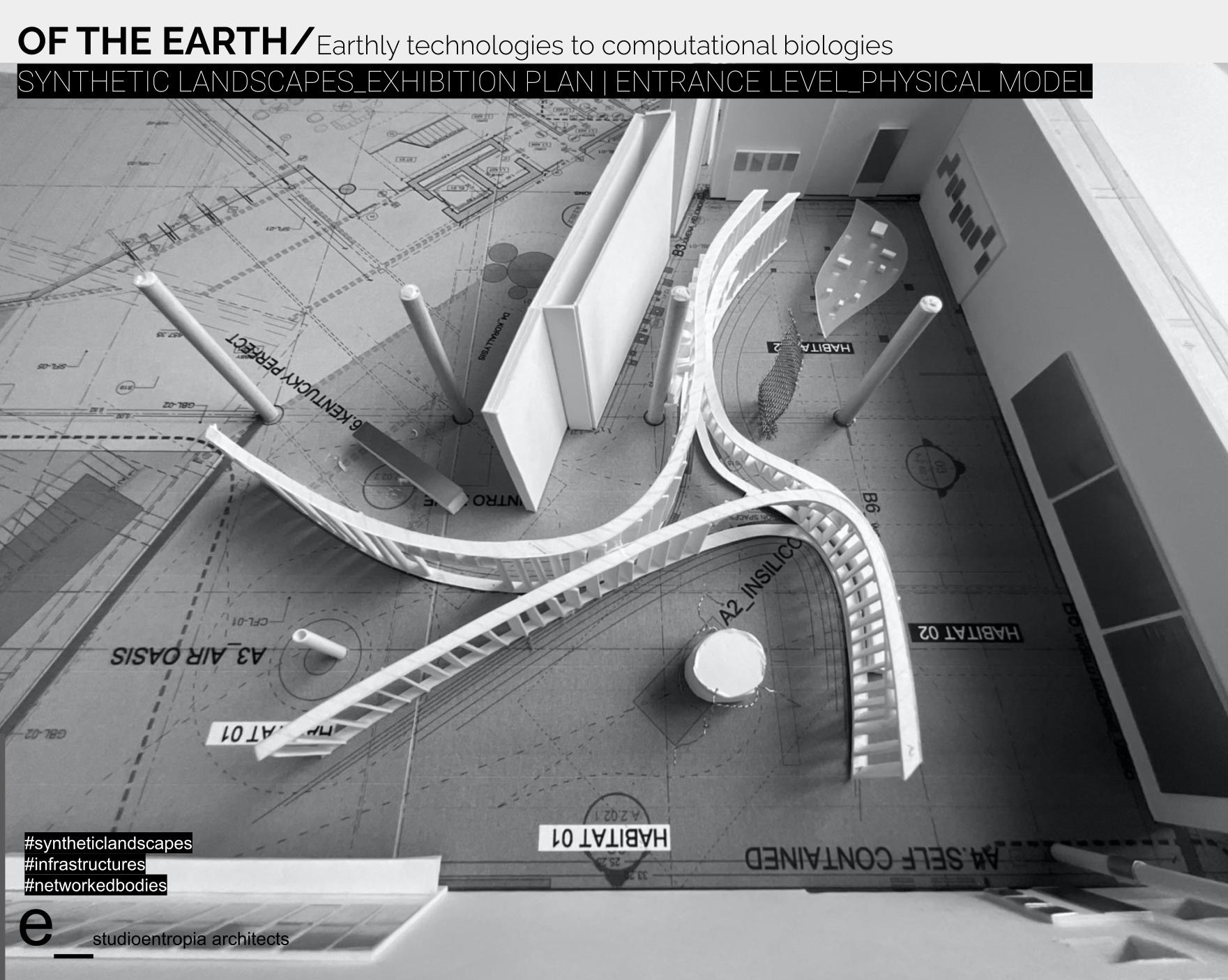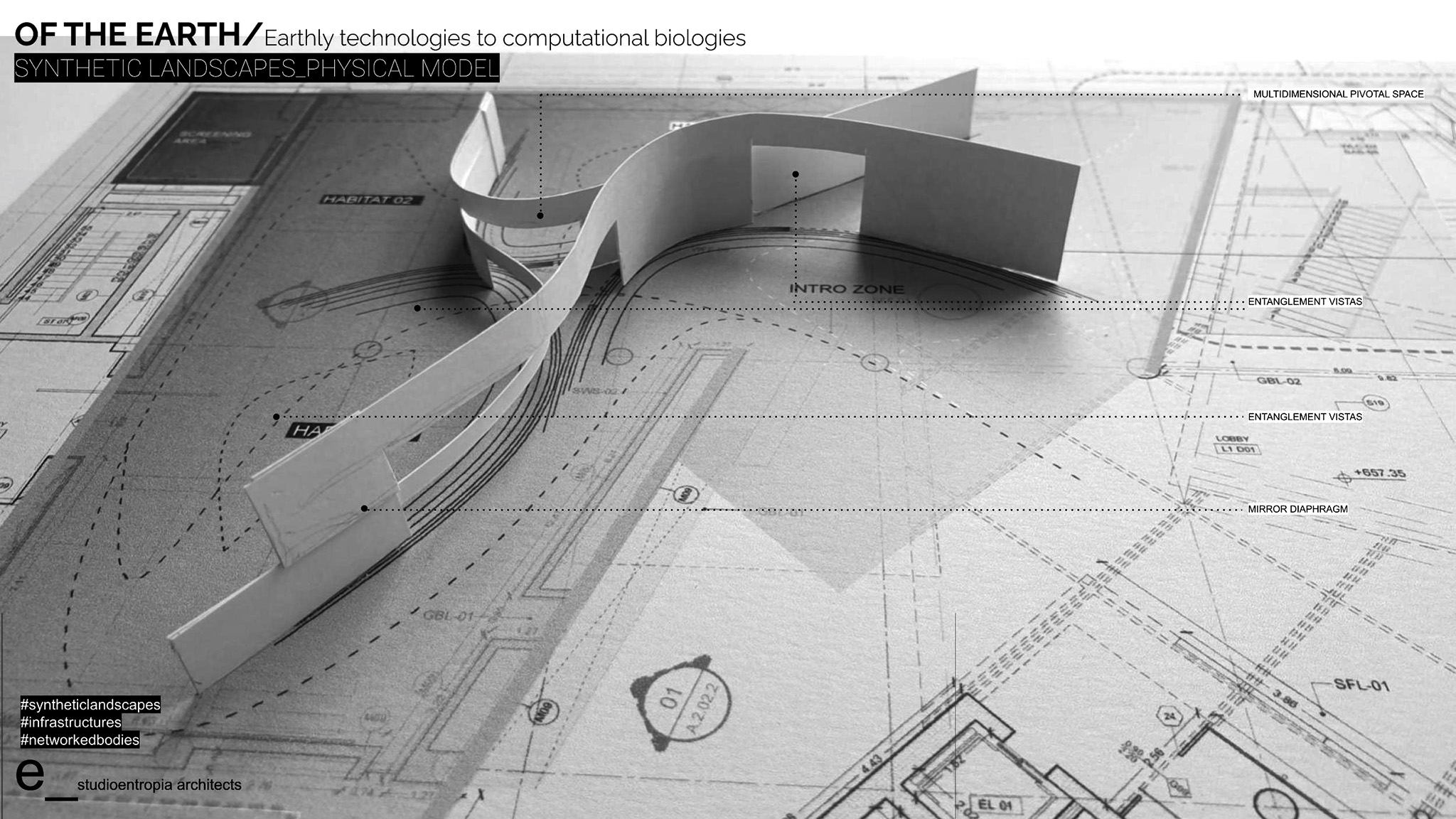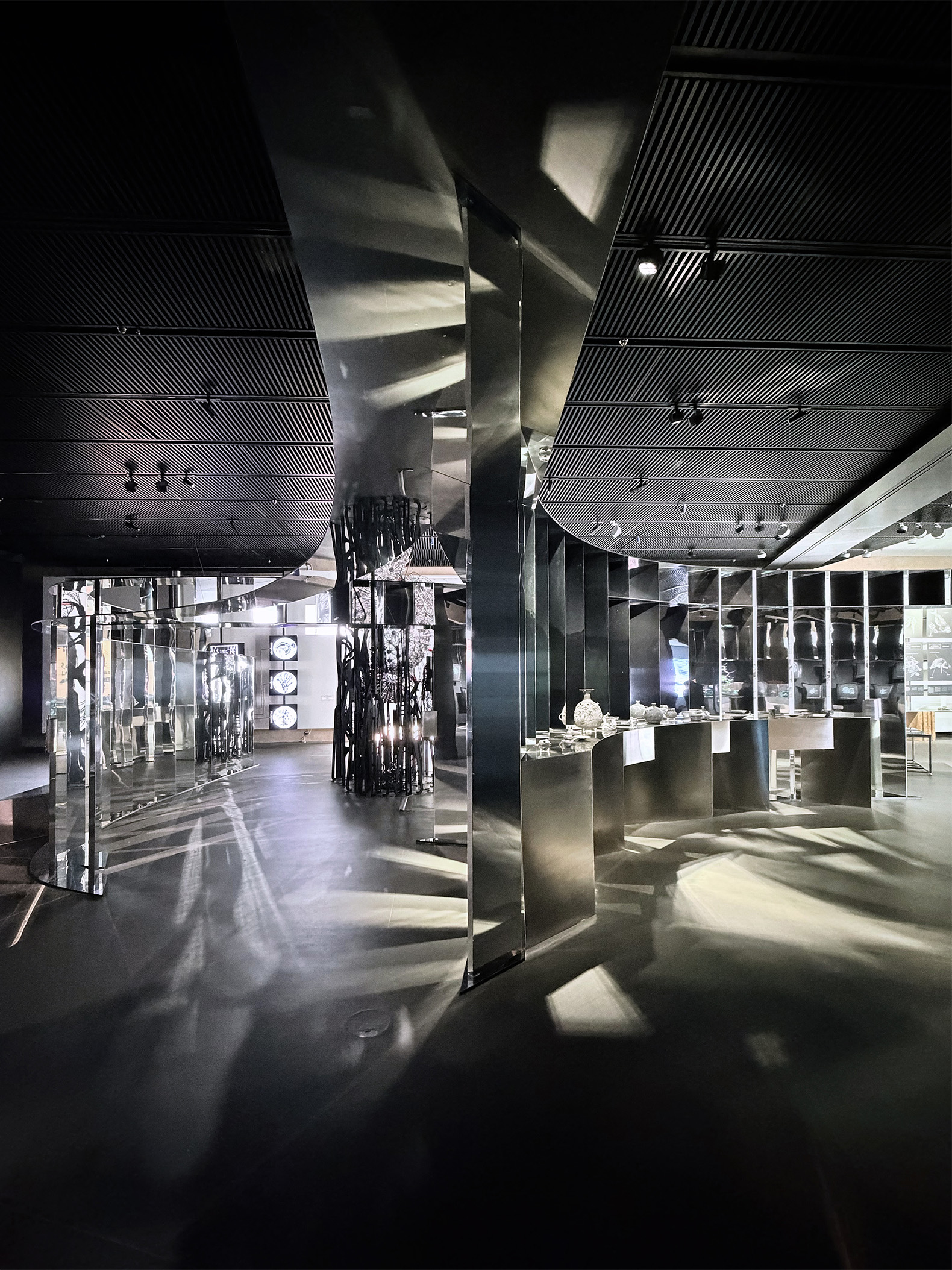
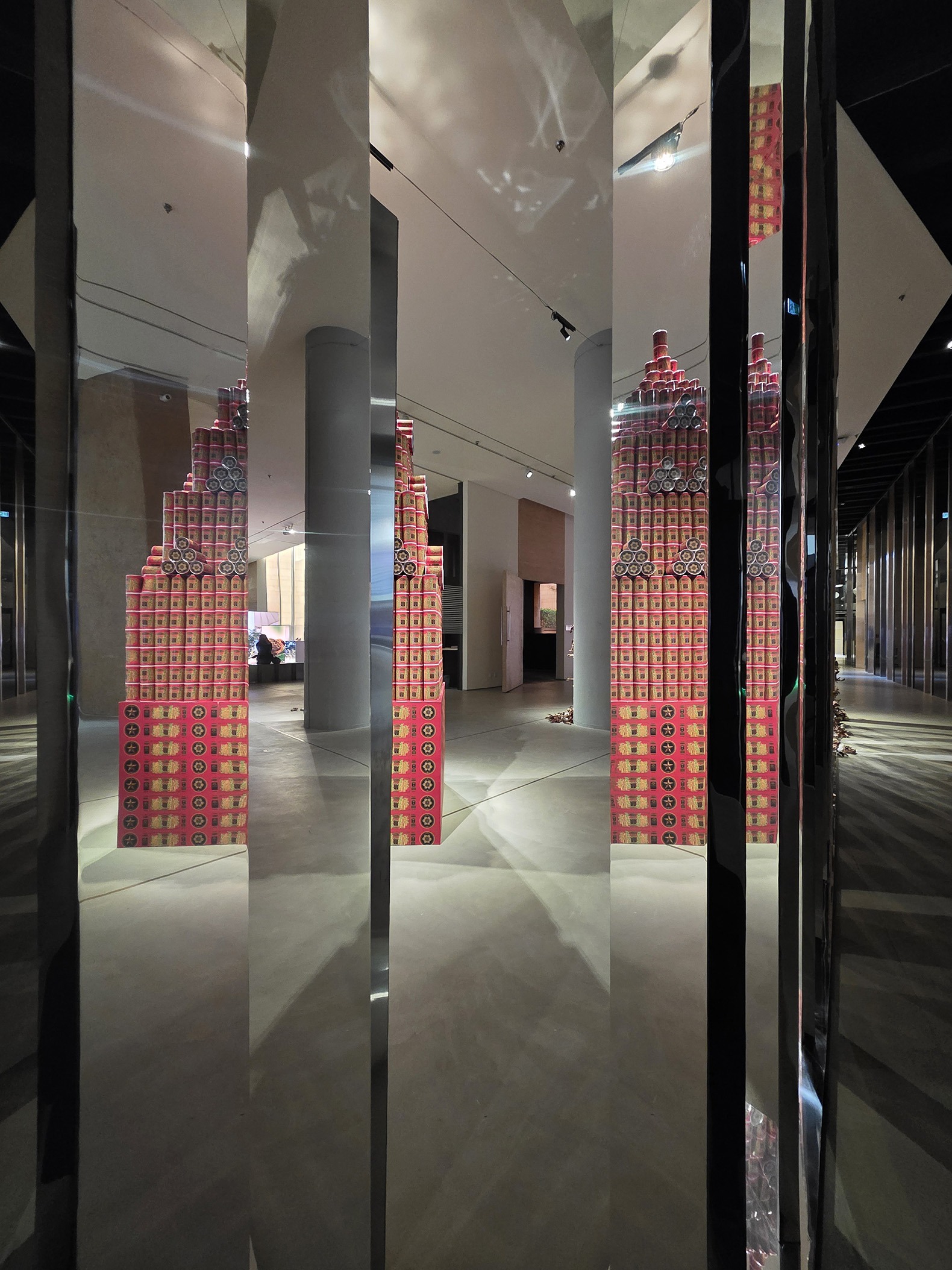
The spatial organization proposed by studioentropia is articulated as a dynamic system in which artwork, public, and architecture operate as a whole. A central device—composed of mirrored vertical fins arranged in a curvilinear pattern—defines a permeable boundary that generates reflections and multiple visual layers. This operation guides the visitor's path without establishing rigid hierarchies, maintaining a constant spatial ambiguity.
The exhibition aims to question the traditional separation between nature and technology, proposing an immersive experience where both dimensions merge. Through reflection, repetition, and formal continuity, the installation constructs a shifting perceptual field that invites the visitor to become an active participant in this constructed ecology, redefining their role within the exhibition space.
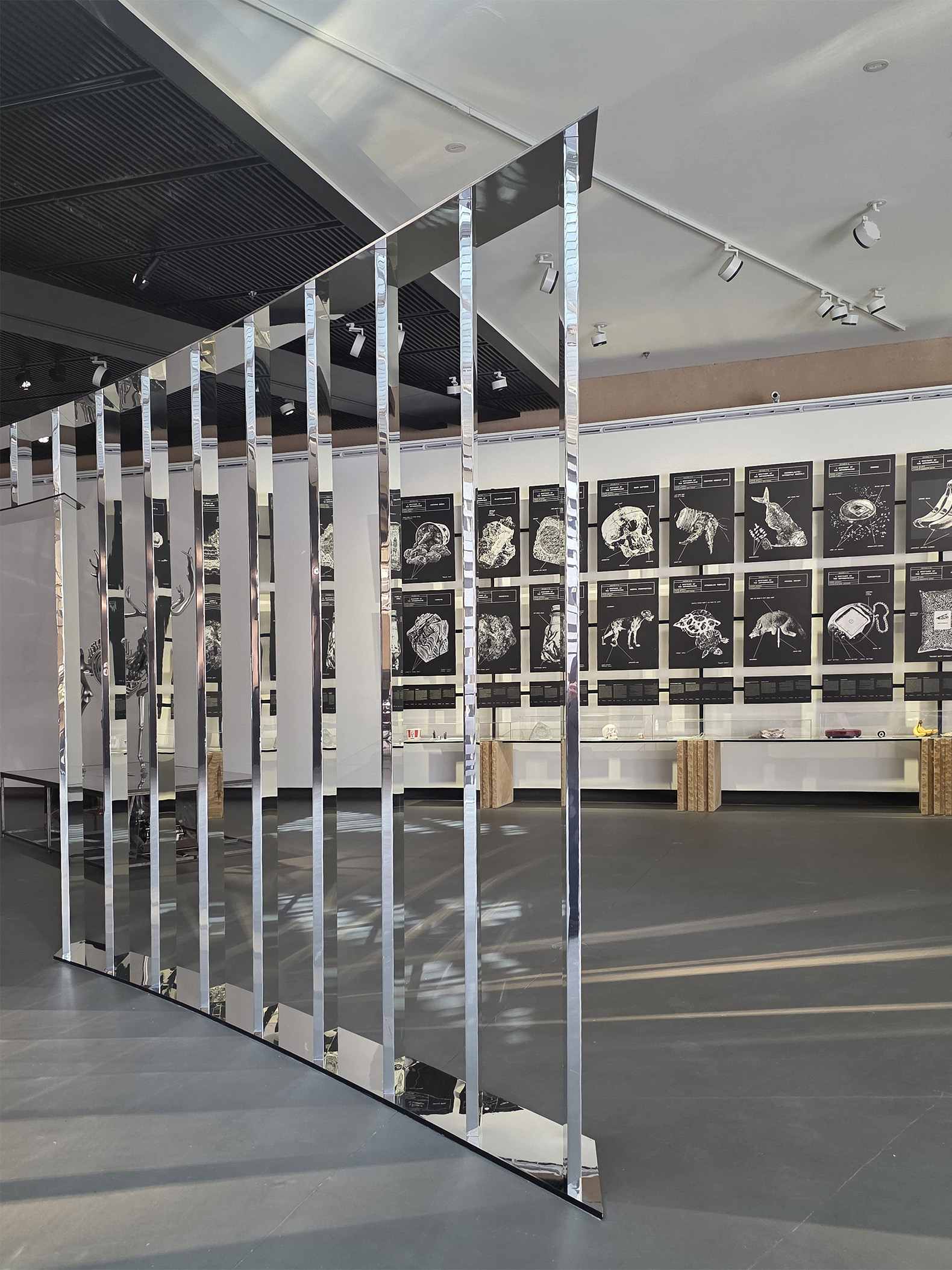
"Of The Earth" Exhibition by studioentropia. Photograph courtesy of studioentropia.
Project description by studioentropia
“Of The Earth: Earthly Technologies to Computational Biologies” is an exhibition commissioned by Diriyah Art Futures under the Ministry of Culture, Saudi Arabia, in Riyadh. The exhibition design and scenography by studioentropia architects investigates how artificial and organic systems co-evolve, entangle, and reconfigure our understanding of life, agency, and materiality.
Inspired by new materialist thinking and post-natural aesthetics, the project is conceived as a living installation—where machines breathe, exhibits compute, and visitors become part of a metabolic circuit. The entire exhibition space is conceived as a continuous, constructed landscape—not neutral, but active.
It is a terrain where natural and technological features co-exist, collapse, and recombine. Rather than referencing “nature” as something outside or external, the space becomes its own post-natural landscape—a constructed ecology shaped by reflections, entanglements, and contradictions.
The gallery is conceived as a spatial system in motion, where artwork, audience, and architecture operate as a continuous assemblage. A diaphragm of vertical mirrored fins, arranged in a curvilinear formation, acts as a permeable boundary, generating layered reflections and shifting visual fields that guide movement while maintaining spatial ambiguity.
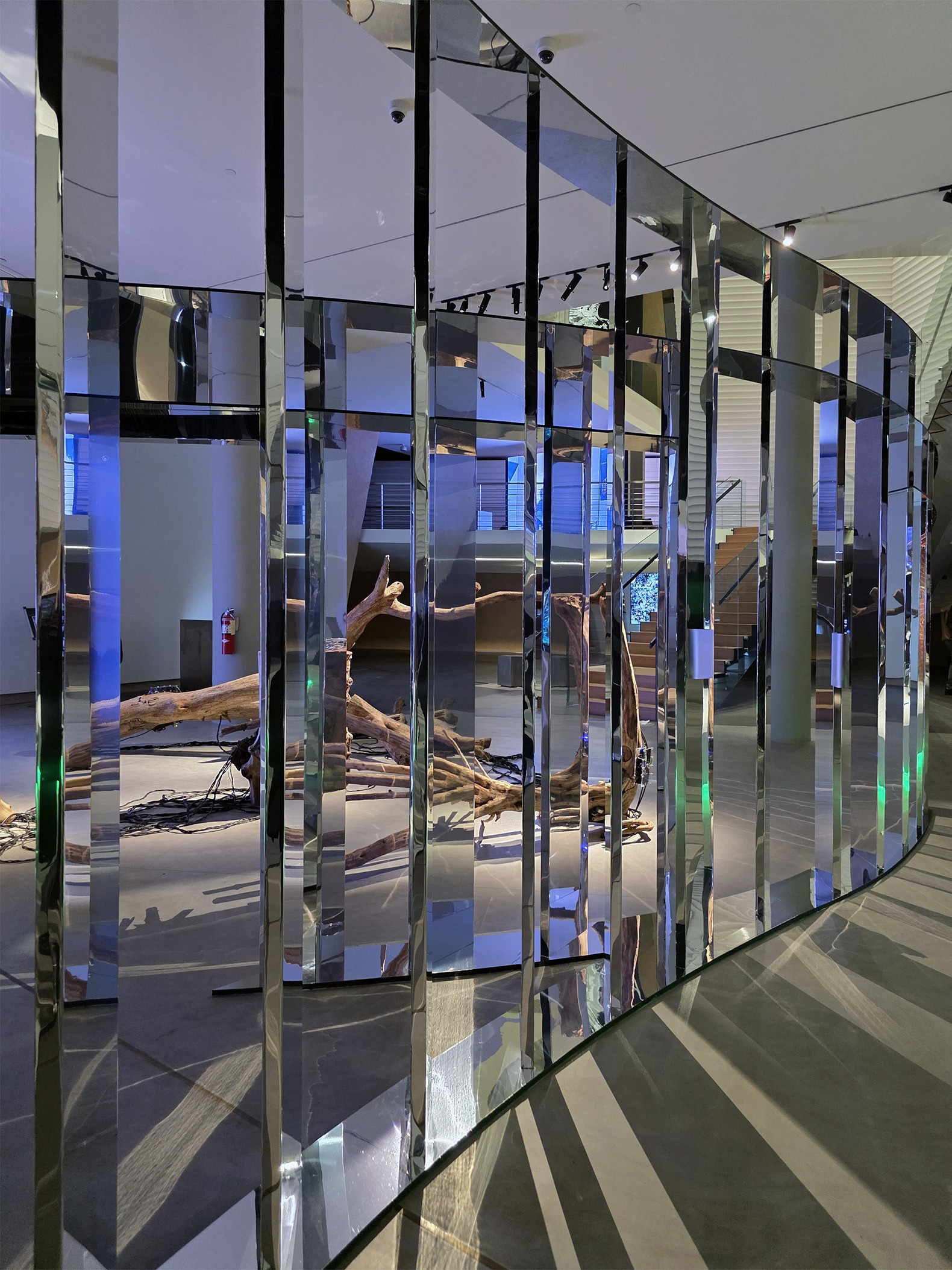
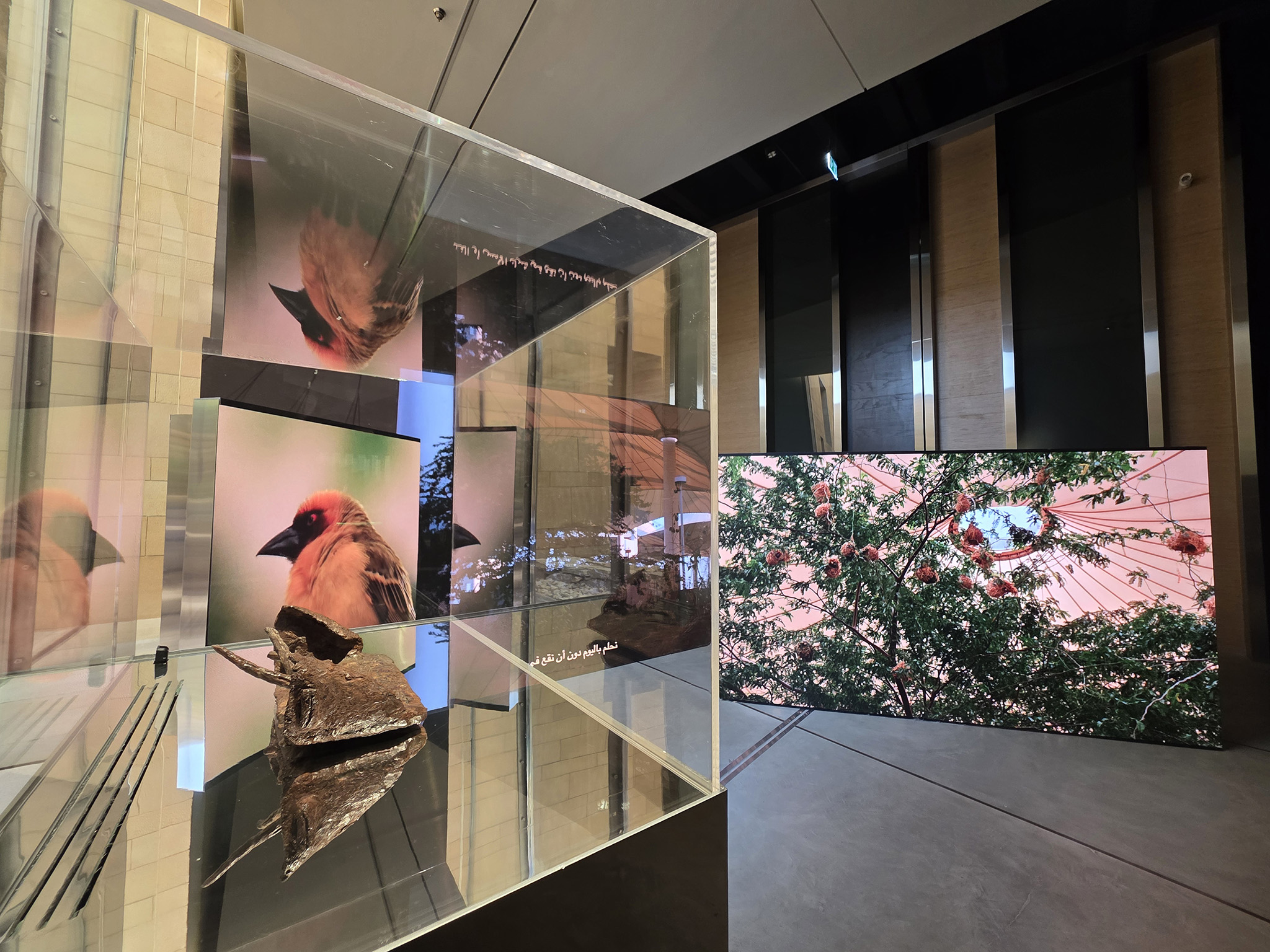
This geometry extends to bespoke scenographic elements, including plinths, counterweights, and display cases, whose formal rhythm and aesthetic language align with the central structure. Through reflection and repetition, the installation constructs a fluid perceptual field, where architecture transitions from a passive container into an active, mediating presence.