


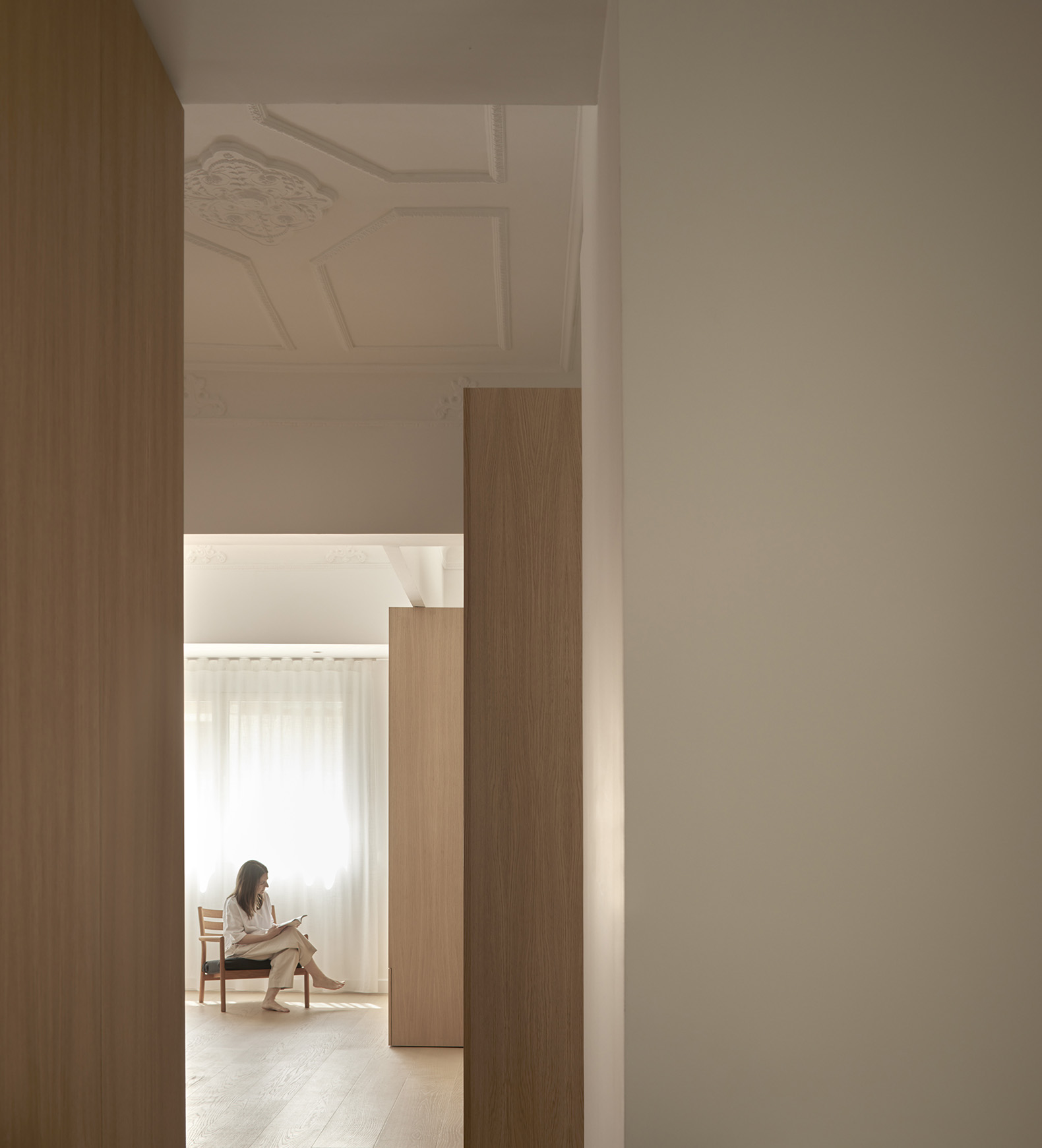
Far from being a dominant architectural feature, the project developed by DG Estudio is conceived as a discreet and serene intervention, capable of complementing daily life and allowing time and personal belongings to complete the space. The spatial distribution is articulated by three volumes of natural oak that organize the home without fragmenting it, arranging the different uses and lending warmth to the whole.
Each of these volumes assumes a specific role within the home, while the hallway acquires special significance by being understood not as a residual space, but as a habitable place. The circulation area is thus transformed into a generous and active space that can accommodate studying, playing, or everyday gatherings. The result is a luminous, understated, and timeless home that respects its architectural heritage and adapts to the present and future needs of its inhabitants.
Zam 12 House by DG Estudio. Photograph by Mariela Apollonio.
Project description by DG Estudio
The comprehensive renovation of this 135 m² apartment, built in 1952 and located in Valencia’s Petxina neighbourhood, next to the Túria Garden, stems from a young family’s desire to establish a permanent home after years of an itinerant lifestyle.
The project addresses the transformation of an excessively compartmentalized interior in which only a few original elements of value had survived. Among them, the carefully preserved ceiling mouldings become the conceptual starting point of the intervention and the guiding thread of the dialogue between past and present.
The proposal is based on a respectful attitude toward the building’s history and a commitment to sobriety and timelessness. Rather than pursuing a dominant architectural statement, the project opts for a discreet intervention that supports everyday life and allows time and personal objects to complete the domestic space. Tradition and contemporaneity thus coexist in balance through a serene, clear, and honest architecture.
The functional program is conceived with flexibility in mind, capable of adapting to the different stages of family life.
The spatial organization is articulated through three volumes of natural oak that structure the home without fragmenting it. These elements, strong yet restrained, organize the different uses and bring warmth to the whole, reinforced by the continuity of the same material in the flooring. The volumes dialogue with the original ceiling mouldings, while the white walls enhance natural light and emphasize the contrast between the existing and the new.

Each of these volumes takes on a specific role: the first defines the living and dining area while integrating the television support; the second, linked to the kitchen, separates the home’s entrance from the open kitchen connected to the common space; the third organizes the study area and articulates the main circulation space.
Particular importance is given to the circulation area itself, conceived not as a residual space but as a fully habitable one. Conventional corridors are eliminated in favour of a generous and active circulation zone, capable of accommodating study, play, or everyday encounters, and fully integrated into domestic life.

The result is a bright, sober, and timeless home that respects its architectural heritage and responds to the present and future needs of its inhabitants, leaving room for the home to evolve alongside them over time.


