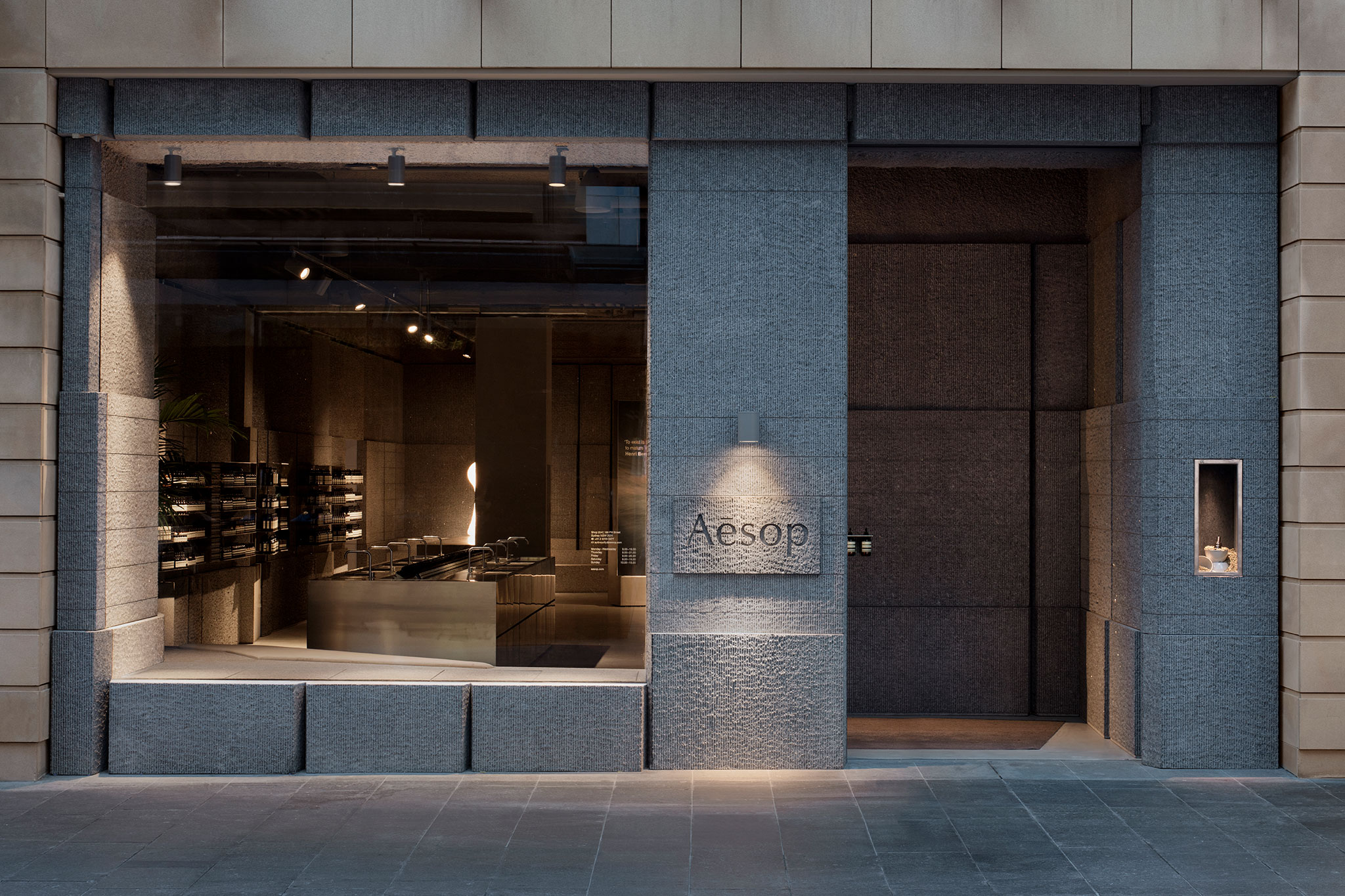
Located in the heart of Sydney’s central business district, Snøhetta has designed Aesop’s largest store to date. In the middle of this busy cosmopolitan shopping area, along the pedestrianized section of Pitt Street, the design of Aesop’s store intends to "slow down the pace of passersby".

Brass metal for furniture and Granite covering almost every concrete surface inside this Sydney Aesop store, which architecture firm Snøhetta has designed to encourage browsing, and draw attention to the contrasting textures and materials of the store.
Snøhetta uses a robust and durable material palette of stone, brass metal and concrete balances a sense of monumentality and intimacy. Inspired by the monolithic scale and texture of a stone quarry, the room appears to be composed of solid granite.

The large metal block sinks boast a clean profile and displays the products in a central zone dedicated to cleansing and testing. The sinks and counters are industrial and sleek, even while their finish reflects the dark and cool stone.
 

Project description by Snøhetta

Aesop Pitt Street is a result of the spirit of Sydney infused in the ambience and mission of Aesop, which includes creating honest products to be sold in shops which reflect the context of their locations, communities and environments. The interior space of Aesop Pitt Street is tranquil and peaceful, leaving visitors with a feeling of serenity and reassurance.

The design process began with understanding the relationships between the spirit of the coast and waterfront at Bondi Beach, and the vibrancy of the central business district. A monumental granite structure wraps the interior of the sandstone building, paying homage to Christo and Jeanne-Claude's 1968-9 Wrapped Coast, which rendered the sandstone cliffs of Little Bay a theatrical, lunar landscape. Aesop Sydney brings the greatness and tranquility of coastal cliffs to the bustling downtown environment.

Responding to the energy of the downtown area, the store’s entrance, clad in textured granite, is set back from the street and provides a moment to decompress and transition into the space, metaphorically bringing the coastal calm into the busy city center. The contrasting color and texture of the entrance, in contrast to the smooth sandstone features of the building, signals visitors to slow down, and create a moment of stillness upon entry, allowing space to think and relax. 

A robust and durable material palette of stone, brass metal and concrete balances a sense of monumentality and intimacy. Inspired by the monolithic scale and texture of a stone quarry, the room appears to be composed of solid granite. Despite sandstone being the prevailing local geology, granite, an igneous rock known for its strength and durability, lines the pavements of Sydney’s central business district, where Aesop Sydney is located, which resembles a strong connection between Sydney and Aesop. 

Carved grooves in the stone create the divisions where metal shelves have been inserted, integrating shaves into the cladding. Polished metal detailing reflects the stone, creating an almost invisible line and highlighting the products displayed around the perimeter of the space.

The large metal block sinks boast a clean profile and displays the products in a central zone dedicated to cleansing and testing. The sinks and counters are industrial and sleek, even while their finish reflects the dark and cool stone. 

The Aesop Pitt Street store consists of several areas that cater to the needs of each individual customer. The communal sinks at the front allow for staff demonstrations and user-friendly testing of the products, whereas the private sinks deeper within the space allow for more contemplative product exploration, creating a sense of “home” away from home, and encouraging mindful selections. 

Towards the back of the store, a small amphitheater allows for a moment of repose and relaxation where visitors can choose to observe the environment or watch a short film displayed on an in-built screen on the wall.

Aesop Pitt Street is the eighth Aesop store designed by Snøhetta. Other stores include Aesop Prinsens Gate (Oslo), Aesop Homansbyen (Oslo), Aesop Grabenstraße (Düsseldorf), Aesop Fasanenstraße (Berlin), Aesop ION (Singapore), and Aesop Raffles City (Singapore), and Aesop Duke of York Square (London).

Read more
Read less

More information

Label
Architects
+ + copy Created with Sketch.
- + copy Created with Sketch.
Label
Photography
+ + copy Created with Sketch.
- + copy Created with Sketch.

Snøhetta is an architecture, landscape, and interior design studio with offices in Oslo, Norway, and New York City, USA. Founded in 1989, it is led by Craig Dykers and Kjetil Thorsen. The studio, named in honour of Mount Snøhetta, the highest peak in the Dovrefjell mountains of Norway, has approximately 100 collaborators working on large-scale international projects across a wide range of typologies. Their approach is deeply collaborative and transdisciplinary, bringing together architects, designers, engineers, and landscape professionals to explore multiple perspectives depending on the nature of each project.

Snøhetta has completed a series of world-renowned cultural and landmark projects, including the Bibliotheca Alexandrina in Egypt, the Oslo Opera House and Ballet, and the Lillehammer Art Museum in Norway. Current projects include the National Pavilion of the September 11 Memorial Museum at the World Trade Center site in New York, as well as urban and landscape developments that aim to merge local identity, sustainability, and public experience.

In 2004, Snøhetta was awarded the Aga Khan Award for Architecture, and in 2009, the Mies van der Rohe Award. The studio is the only practice to have won the World Architecture Award for Best Cultural Building twice in consecutive years: in 2002 for the Bibliotheca Alexandrina and in 2008 for the Oslo Opera House and Ballet, consolidating its international prestige.

Kjetil Trædal Thorsen (born 1958 on the coastal island of Karmøy, Norway) is a co-founder of the studio and a multiple award-winning architect. He is a visionary and humanist designer who has redefined the boundaries of contemporary practice. Under his leadership, Snøhetta has produced iconic, sustainable structures that are highly sensitive to their cultural context, combining technological innovation with a profound environmental awareness. Thorsen’s work is recognized for its focus on social interaction, sustainability, and the creation of spaces that foster human connection and sensory experience, establishing a benchmark in contemporary global architecture.

Craig Dykers (born 1961 in Frankfurt, Germany) is also a co-founder of the studio and director of its New York office. Snøhetta has earned a reputation for maintaining a deep integration of landscape, architecture, and urban experience across all its projects. Key works include the Bibliotheca Alexandrina in Egypt, the Oslo Opera House and Ballet, the National Pavilion of the September 11 Memorial Museum in New York, and the redesign of Times Square. Professionally and academically active, Dykers has been a member of the Norwegian Association of Architects (NAL), the American Institute of Architects (AIA), and the Royal Society of Arts in England. He has served as a diploma juror at the Architectural College in Oslo and as a distinguished professor at City College, New York. He has delivered numerous lectures across Europe, Asia, and the Americas, and has undertaken public art installation projects, many of which explore the interplay between context, landscape, and human experience.

Read more
Published on: September 27, 2019
Cite:
metalocus, ÁNGEL VALDEZ
"Stone, brass metal and concrete. Snøhetta Completes Aesop Pitt Street in Sydney" METALOCUS. Accessed
<https://www.metalocus.es/en/news/stone-brass-metal-and-concrete-snohetta-completes-aesop-pitt-street-sydney> ISSN 1139-6415
Loading content ...
Loading content ...
Loading content ...
Loading content ...
Loading content ...
Loading content ...
Loading content ...
Loading content ...
Loading content ...
Loading content ...
Loading content ...
Loading content ...
Loading content ...
Loading content ...
Loading content ...
Loading content ...
Loading content ...
Loading content ...
Loading content ...
Loading content ...
Loading content ...
Loading content ...
Loading content ...
Loading content ...
Loading content ...
Loading content ...
Loading content ...
Loading content ...
Loading content ...
Loading content ...
Loading content ...
Loading content ...
Loading content ...
Loading content ...
Loading content ...
Loading content ...
Loading content ...
Loading content ...
Loading content ...
Loading content ...
Loading content ...
Loading content ...
Loading content ...
Loading content ...
Loading content ...
Loading content ...
Loading content ...
Loading content ...
Loading content ...
Loading content ...
Loading content ...
Loading content ...
Loading content ...
Loading content ...