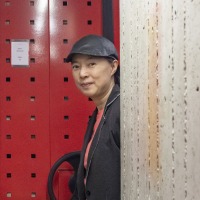
These the first exhibition of this Architect’s Studio series of Louisiana exhibitions focuses on Chinese architect Wang Shu (b. 1963), who in 2012 was awarded the Pritzker-Prize, dubbed the Nobel Prize for architecture. Wang Shu and his wife Lu Wenyu stand at the head of the Amateur Architecture Studio based in Hangzhou in China. The name of the studio underscores the vision of letting spontaneity, the available materials and local culture and building traditions form the basis for architecture which in Wang Shu’s own words should be “a house rather than a building”.

With the exhibition The Architect’s Studio. Wang Shu – Amateur Architecture Studio, Louisiana Museum of Modern Art introduces a new series of monographic architecture exhibitions offering the opportunity to get a closer look at the work process of an individual studio and gain a better understanding of how ideas become form. 

The exhibition series starts in China, more specifically Hangzhou, capital of the eastern Zhejiang province, where Wang Shu (b. 1963) and his wife Lu Wenyu established the Amateur Architecture Studio almost twenty years ago. Since 2007 he has also functioned as Dean of the Hangzhou department of the China Academy of Art, Xiangshan Campus. In 2012 Wang Shu was honoured with the world’s most prestigious architectural award, the Pritzker Prize, and since then he and Lu Wenyu have enjoyed growing international acclaim of their uncompromising persistence in combining the China of past and present in their architecture. Based on a manifesto for so-called amateur architecture, Wang Shu and Lu Wenyu work with architecture rooted in  the anonymous rural architecture and the available materials such as bamboo, local brick and rammed-earth walls. At the same time classic Chinese virtues like calligraphy, garden architecture and landscape painting  play a crucial role in the philosophy of Amateur Architecture Studio. 

Despite its culture-sustaining potential, Wang Shu’s architecture is at the same time characterized by trans-formation, development, the breaking-down of boundaries and disruptions of scale. The formal idiom can have an almost futuristic character, while the building materials may be hundreds of years old, and the construction techniques a hypermodern transformation of building traditions inherited and perfected over millennia. 

Themes of the exhibition
The exhibition, shown in the Hall Gallery and the Column Gallery on the lowest floor of the Louisiana museum, has been created in close collaboration with Amateur Architecture Studio and is built up around three main themes aiming to shape a comprehensive presentation of the ambitions, processes and inspirations of the studio. The exhibition includes models, video, photographs, material specimens, texts and filmed interviews with Wang Shu explaining and illustrating the studio’s processes and many complex building processes. 

The first theme, AMATEUR ARCHITECTURE, functions as a kind of introduction to and collage of the sources of inspiration and fundamental principles characteristic of Amateur Architecture Studio’s work. Wang Shu’s ‘own’ school, the immense Xiangshan Campus, plays a central role here, as an architectural work, but also as an example of the studio’s very literal effort to preserve and perpetuate China’s long, proud cultural traditions. 

The second theme of the exhibition, ARCHITECTURE AS RESISTANCE, presents a collection of material studies, almost all of which related to two of the studio’s most recent projects. As a condition for taking on the task of building a large cultural centre, museum and archive in Fuyang, Wang Shu insisted on being granted permis-sion to initiate a restoration project in the remote mountain village of Wencun. The village is an example of the widespread tendency of depopulating the rural areas as a consequence of China’s explosive urbanization, and Amateur Architecture Studio’s Fuyang/Wencun project illustrates their efforts to balance the relationship between the rural and the urban, while also maintaining local village culture and building traditions. The project thus becomes an architectural comment to the Chinese authorities’ relentless cycle of demolition and new construction. The material studies are accompanied by video and audio from the huge con¬struction project in Fuyang and the calm rural life of Wencun. 

Finally, the third theme, HISTORY RECONSTRUCTED, with the signature project Ningbo History Museum as a case, shows how the studio brings increasingly forgotten history back into modern architecture. The museum is of course primarily a spatial framing of the thousand-year-old history of the Ningbo area, but also an example of the material consciousness that has now become synonymous with Amateur Architecture Studio. Several villages in the area were demolished to make way for new building, but the materials from the destroyed villages have been gathered and re-used in the spectacular facade of the Ningbo History Museum. In this way, the architecture becomes a very tangible memory of the original houses and a monument to Amateur Architecture Studio’s idea of making the new building point back to history. 

More information

Label
Dates Fechas
Text

9 February - 30 April 2017

+ + copy Created with Sketch.
- + copy Created with Sketch.
Label
Venue Lugar
Text

LOUISIANAMUSEUM OF MODERN ART, Gammel Strandvej 13, 3050 Humlebæk, Dinamarca Denmark

+ + copy Created with Sketch.
- + copy Created with Sketch.

Wang Shu (architect and professor) was born in 1963 in Urumqi, a city in Xinjiang, the westernmost province of China. He received his first degree in architecture in 1985 and his Master's degree in 1988, both from the Nanjing Institute of Technology.

Wang Shu and his wife, Lu Wenyu, founded Amateur Architecture Studio in 1997 in Hangzhou, China. The office name references the approach an amateur builder takes—one based on spontaneity, craft skills and cultural traditions. Wang Shu spent a number of years working on building sites to learn traditional skills. The firm utilizes his knowledge of everyday techniques to adapt and transform materials for contemporary projects. This unique combination of traditional understanding, experimental building tactics, and intensive research defines the basis for the studio’s architectural projects. In 2012, Wang Shu became a Pritzker Architecture Prize Laureate, and in 2023, he was named a Member of the French Academy of Architecture. He and Lu Wenyu co-founded the Architecture Department at the China Academy of Art in 2003, followed by the establishment of the School of Architecture in 2007, where he served as its first dean.

The studio takes a critical view of the architecture profession’s part in the demolition and destruction of large urban areas. At the 2006 Venice Architecture Biennale, Amateur Architecture Studio expressed views of ongoing demolitions in “Tiled Garden,” an installation made from 66,000 recycled tiles salvaged from demolition sites. Rather than looking toward the West for inspiration, as many of Shu’s contemporaries do, his work is rooted in the context of Chinese history and culture. Together with Lu Wenyu, he maintains a sustained focus on existing materials, the traces of ordinary life and the craftsmanship found on construction sites. Their approach advocates a radical architectural experimentation rooted in the vernacular and the immediate context, combining recycled materials with modern engineering and merging memory with innovation as a response to the reality of large-scale urban demolition. Their work articulates a global perspective that transcends the dichotomies between city and countryside, and between the artificial and the natural.

Wang Shu has often explained in lectures and interviews that “to me, architecture is spontaneous for the simple reason that architecture is a matter of everyday life. When I say that I build a ‘house’ instead of a ‘building’, I am thinking of something that is closer to life, everyday life. When I named my studio ‘Amateur Architecture’, it was to emphasize the spontaneous and experimental aspects of my work, as opposed to being ‘official and monumental’."

Wang Shu is Professor and Head of the Architecture School at the China Academy of Art, Hangzhou. In 2011, he became the first Chinese Kenzo Tange Visiting Professor at the Harvard Graduate School of Design in Cambridge, Massachusetts. He has also been a visiting professor at MIT, UCL, Rice University, the University of Hong Kong and Tongji University, and has received honorary distinctions such as an Honorary Professorship from Southeast University, an Honorary Fellowship from RIBA, an Honorary Doctoral Degree from RISD, and an Honorary Doctoral Degree in Sociology from the Chinese University of Hong Kong.

He has exhibited individually and participated in several major international exhibitions including: the 2010 Venice Architecture Biennale at which he received a special mention for the “Decay of a Dome” installation – a project whose light, mobile and utterly simple structure can be speedily constructed or returned to nothingness; the 2009 “Architecture as a Resistance” solo exhibition at the BOZAR Centre for Fine Arts in Brussels; the 2007 Shenzhen & Hong Kong Bi-City Biennale of Urbanism\Architecture; the 2003 “Alors, La Chine?” exhibit at the Centre Pompidou, Paris; the 2002 Shanghai Biennale at the Shanghai Art Museum; the 2001 “TU MU-Young Architecture of China” exhibit at AEDES Gallery, Berlin; and the 1999 Chinese Young Architects’ Experimental Works Exhibition, UIA Congress, Beijing. His work has also been exhibited at the Museum of Modern Art in New York and has been the subject of solo exhibitions at the Louisiana Museum of Modern Art, at Arc en rêve in Bordeaux, and at BOZAR in Brussels. In 2021, the New York Times selected the Xiangshan Campus of the China Academy of Art as one of “The 25 Most Significant Works of Postwar Architecture” worldwide.

In 2011, Wang Shu received the Gold Medal of Architecture (grande médaille d’or) from the l'Académie d'Architecture of France. In 2010, Wang Shu and Lu Wenyu were awarded the Schelling Architecture Prize, which goes to individuals who have responsibly advanced architecture's development with significant designs, realized buildings or with profound contributions to architectural history and theory. The Vertical Courtyard Apartment, in Hangzhou, was nominated for the 2008 German-based International Highrise Award. In 2005, the project “Five Scattered Houses” in Ningbo received an acknowledgement from the Asia Pacific Holcim Awards for sustainable construction, and in 2003, the Wenzheng Library received the Architecture Art Award of China. He was named one of the 100 Most Influential People in the World by Time in 2013 and received the 2019 Gold Medal of Tau Sigma Delta. From 2018 to 2024, he served as a juror for the Pritzker Architecture Prize.

Wang Shu/Amateur Architecture Studio is known for the following built works: Library of Wenzheng College, Suzhou University, China (2000); Ningbo Contemporary Art Museum, Ningbo, China, (2005); Five Scattered Houses, Ningbo, China (2005); Xiangshan Campus, China Academy of Art (Phase I) Hangzhou, China (2004); Xiangshan Campus, China Academy of Art (Phase II) Hangzhou, China (2007); Ceramic House, Jinhua, China (2006); Vertical Courtyard Apartments, Hangzhou, China (2007); Ningbo History Museum, Ningbo, China (2008); and, Exhibition Hall of the Imperial Street of the Southern Song Dynasty, Hangzhou, China (2009). Additional significant projects include Tiles Hill in Hangzhou, the Renovation of Wencun Village, the Fuyang Cultural Complex, the National Archives of Publications and Culture in Hangzhou, Lin’an Historic Museum, the Museum of Ancient Animals in Baoding, the Jin Sha Traditional Chinese Academy in Xiamen, and the Xi’an Opera House and Concert Hall.

Read more

LU Wenyu (Hangzhou, 1966) is an architect and co-founded Amateur Architecture Studio with Wang Shu in 1997. Together, they founded the Architecture Department at China Academy of Art in 2003, initiating a new course of study that has profoundly influenced the teaching of architecture in China.

Lu is a member of the French Academy of Architecture for 2023 and was a visiting Professor at Harvard Graduate School of Design, Massachusetts Institute of Technology (MIT), University College London (UCL) and Rice University.

Together with Wang Shu, she maintains a sustained focus on existing materials, the traces of ordinary people's daily lives, the vitality of those unnamed, common structures, and the process and craftsmanship of artisans on the construction site. They advocate for a radical architectural experimentation that is rooted in the vernacular and the immediate context.

By combining recycled old building materials with modern engineering techniques and merging memory with innovation, they have offered a powerful response to the social reality of urban development that involves large-scale demolition and construction. Lu and Wang have consistently upheld a broad global perspective, expressing through their works an innovative vision that transcends the cultural conflict between city and countryside, and surpasses the traditions of the artificial and the natural, which is reflected in their built works such as Ningbo Historic Museum, Xiangshan Campus of China Academy of Art, The tiles hill in Hang Zhou, Renovation of Wencun Village, Fuyang Cultural Complex, The National Archives of Publications and Culture in Hangzhou, Preservation and Renovation of Southern Song Imperial Street, and Lin An Historic Museum, Museum of Ancient Animals in Baoding, Jin Sha Traditional Chinese Academy in Xia Men and Xi'an Opera House and Concert Hall.

Their works have been exhibited in prestigious international institutions, including La Biennale di Venezia, MOMA in New York and the Centre Pompidou in Paris, in addition to solo exhibitions at the Louisiana Museum of Modern Art, Arc en rêve centre d’architecture Bordeaux, and BOZAR art Centre for Fine Arts Brussels. Their work “Xiangshan Campus of China Academy of Art” was one of “The 25 Most Significant Works of Postwar Architecture” all over the world, selected by the New York Times in 2021.

Lu Wenyu was awarded the Schelling Architecture Prize in Germany, a Special Mention at the Biennale Architettura in 2010 for the project “Decay of a Dome”, and listed among the RIBA’s 2015 Fellowships. She was the recipient 2019 Gold Medal of Tau Sigma Delta. She was a juror of the UNESCO Asia-Pacific Awards for Cultural Heritage Conservation. Lu Wenyu was the Chair of the Jury members for the RIBA International Prize 2024.

As a form of dual contemplation—a critical resistance against reality and a challenge towards the future—Wang Shu and Lu Wenyu together established a new Department of Architecture at the China Academy of Art in Hangzhou in 2003. They launched a new model of architectural education that begins with the understanding of materials, manual labour, and the depiction of Chinese gardens. In an attempt to translate the studio's practical experience into an educational paradigm, the School of Architecture was founded in 2007. Wang Shu is its inaugural dean, and Lu Wenyu is the director of the Sustainable Construction Center.

Read more
Published on: February 22, 2017
Cite:
metalocus, INÉS LALUETA
"THE ARCHITECT'S STUDIO - WANG SHU, “I only design buildings, not architecture”" METALOCUS. Accessed
<https://www.metalocus.es/en/news/architects-studio-wang-shu-i-only-design-buildings-not-architecture> ISSN 1139-6415
Loading content ...
Loading content ...
Loading content ...
Loading content ...
Loading content ...
Loading content ...
Loading content ...
Loading content ...
Loading content ...
Loading content ...
Loading content ...
Loading content ...
Loading content ...
Loading content ...
Loading content ...
Loading content ...
Loading content ...
Loading content ...
Loading content ...
Loading content ...
Loading content ...
Loading content ...
Loading content ...
Loading content ...
Loading content ...
Loading content ...
Loading content ...
Loading content ...
Loading content ...
Loading content ...
Loading content ...
Loading content ...
Loading content ...
Loading content ...
Loading content ...
Loading content ...
Loading content ...
Loading content ...
Loading content ...
Loading content ...
Loading content ...
Loading content ...
Loading content ...
Loading content ...
Loading content ...
Loading content ...
Loading content ...
Loading content ...
Loading content ...
Loading content ...
Loading content ...
Loading content ...
Loading content ...
Loading content ...