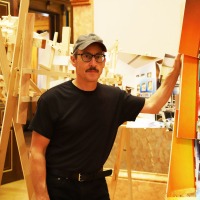
The No Place Like Home intervention by Isidro Blasco reminds us that a home is a safe place, a refuge and outer space can be perceived as dangerous, infected. The artist gathers images of the interiors of his house in New York, where he has not been able to pass the confinement. For this reason, the images are reconfigured as if they were a memory or a dream or almost a nightmare.
"The dislike, the fear, the crisis, the death, all of us have suffered great discomfort.
One tries to survive and not let themselves be defeated. I’ve spent a long time without anything to do, and I found myself looking at the corners of my house in a state of lurking depression. Before making a work of art or a body of work, you need to have experiences, walk the walk, and fill up your backpack."
One tries to survive and not let themselves be defeated. I’ve spent a long time without anything to do, and I found myself looking at the corners of my house in a state of lurking depression. Before making a work of art or a body of work, you need to have experiences, walk the walk, and fill up your backpack."
Isidro Blasco
Through the architectural accumulation of images and unstable support structure, Blasco questions himself on issues such as utopian disorder, natural architecture, anarchic potentiality, and the projection of thought and criticism.
"Isidro Blasco has always been concerned with his environment in order to establish emotional connections with the places he inhabits, experiences which he reflects in his work. Blasco reflects on our way of looking and contextualizing places, as well as the portrayed way that we often have to see things, fragmenting and rebuilding, recycling materials and sensations that help us to recreate the architectural space, which is reinterpreted and dependent on the subjective perception of the observer.
On this occasion he makes a construction of a house with an unstable appearance, with a wooden structure, mostly recycled and with some painted parts. It consists of an architecture that works as a monumental structure that pushes the spectator to walk through and around the polyhedric layout. Blasco goes deep into the babelic crevice which declines in a utopian disorder, as if it was a natural architecture, with a potential anarchy, but conceptually concentrated in his projection of thought and the criticism of sorts of a social demolition of the emotional."
On this occasion he makes a construction of a house with an unstable appearance, with a wooden structure, mostly recycled and with some painted parts. It consists of an architecture that works as a monumental structure that pushes the spectator to walk through and around the polyhedric layout. Blasco goes deep into the babelic crevice which declines in a utopian disorder, as if it was a natural architecture, with a potential anarchy, but conceptually concentrated in his projection of thought and the criticism of sorts of a social demolition of the emotional."
David Barro