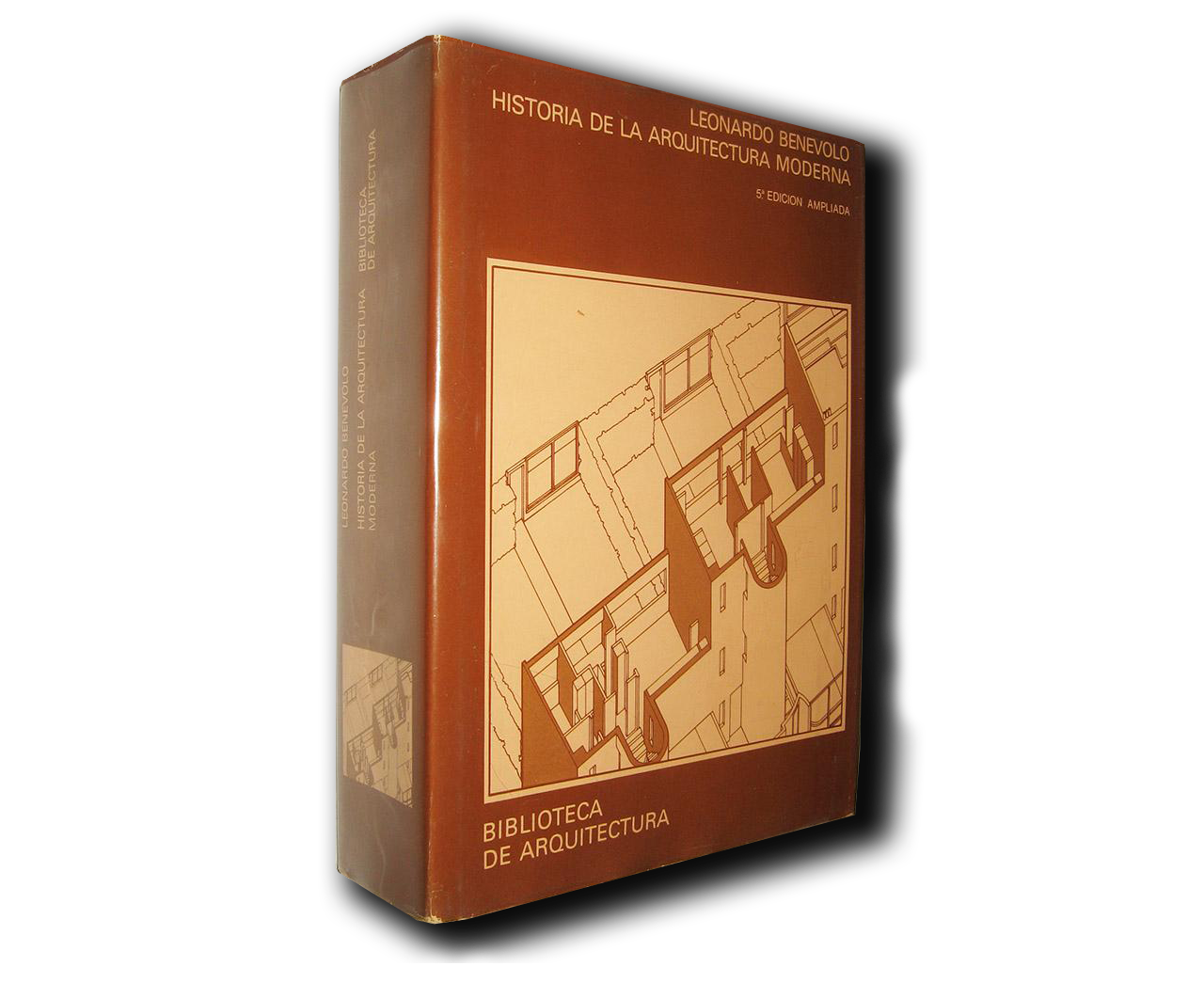
Historian, architect, urbanist, with a bibliography so vast that it is almost impossible to find any architect for generations that has not been formed or made research with the books of Leonardo Benevolo, which are translated into almost all languages. In particular, and among many others, it is worth remembering his book History of Modern Architecture, a book that remains a reference of 20th century architecture.
Leonardo Benevolo died at age 93 at his home in Cellatica near Brescia, Italy, on January 5, 2016. He was born in Orta San Giulio, in the province of Novara, Italy, on September 25 in 1923. He lived in Rome from the early forties, where he graduated as an architect in 1946, until he left the university in 1976. From then on he would choose the city of Brescia to live in, where he would create an office where he worked with his sons Alessandro and Luigi. Alli focused his efforts on research and the development of urban projects and ultimately even on political proposals.

In the forties, and after finishing his studies in Rome, he quickly excelled by his researches, and especially by the research by establishing the difference between the Roman and the Greek architecture that would give him access to the chair of "History and styles of the architecture I and II "in the faculty of Rome in 1956, with only 33 years. He taught history of architecture in the Ateneo and then in the universities of Florence, Venice, Palermo and Columbia.
 
"My work is architecture," he said, explaining his diverse approaches and the broad spectrum of his research and accomplishments, from teaching to lawmaking, from drawing to urban projects, from texts to books.

It is less well known that in parallel it never left its ideario compromised. Benevolo also engaged in seemingly distant adventures of architecture. In the fifties he was professor at Cepas, the School of Social Work founded by Guido Calogero and María. And there he met Paul Volponi and Angela Zucconi. With Zucconi and Manlio Rossi-Doria, he participated in the Abruzzo Project, an Olivetti initiative in countries destroyed by the bombings. The program focused on community development, community development, which was organizing the school for children and other imagined alternative forms of tourism.
 
Benevolo is part of an Italian generation without which the thought of contemporary architecture, together with Bruno Zevi, Manfredo Tafuri and Giulio Carlo Argan, can not be understood.
 
In addition to the teaching activity, Leonardo Benevolo developed an intense professional activity, projecting and building projects such as the new headquarters of the Bologna Fair, the regulatory plan of Ascoli Piceno, the plan of the historic center of Bologna, the plan regulator of Monza (1993 -97), or in Modena and Bergamo.

He is also the author of recent books, such as The Architecture of the New Millennium 2006, not forgetting some of his basic books such as "History of Renaissance Architecture, 1981", "The Origins of Modern Urbanism, 1967"

More information

José Juan Barba (1964). Architect from the Madrid School of Architecture (ETSAM) in 1991. He received his PhD in Architecture from ETSAM in 2004, graduating summa Cum laude with the doctoral thesis "Inventions: New York vs. Rem Koolhaas, Bernard Tschumi, Piranesi." In 1991, he received a Special Mention in the Spanish National Graduation Awards. Until 1997, he worked as an advisor to several NGOs. In 1992, he founded his architectural practice in Madrid (www.josejuanbarba.com). 

He is an architectural critic and, since 1998, Editor-in-Chief of the internationally acclaimed bilingual architecture journal METALOCUS (Spanish/English), recipient of several national and international awards.

Barba is an Associate Professor at the University of Alcalá and a member of several research groups. He has been invited to participate in numerous international forums on architecture and urbanism, including the II Forum of Mexican World Heritage Cities, Urban Development, History and Modernity, organized by the Pan-American Committee for Urban Development and Historical Heritage; the World Urban Development Forum (FMDU), held in Culiacán, Sinaloa, Mexico; and the International Conference on Architecture and Urbanism from the Perspective of Women Architects. He has also been invited as lecturer and guest critic at numerous national and international institutions, including the National Building Museum, Roma Tre University, Politecnico di Milano, University of Genoa, Université Pierre Mendès France Grenoble, the Madrid and Barcelona Schools of Architecture, National Autonomous University of Mexico, the Faculty of Architecture in Montevideo, the Schools of Architecture of Medellín and Ecuador, Universidad Iberoamericana, IE University, as well as the Schools of Architecture of Zaragoza, Valladolid, Málaga, Granada, Seville, and A Coruña, among others.

He has extensive professional experience in architecture, urbanism, landscape intervention, and territorial regeneration. His work has received numerous awards, including First Prize in the “Gran Vía Posible” competition for Delirious Gran Vía, Madrid; recognition for the Rivers Interpretation Centre in Zamora, awarded and exhibited at the World Architecture Festival 2008; and recognition for the Santa Bárbara Park project in Toledo. He was also awarded the Erich Degner Prize for Architecture (1995), promoted by the BBVA Foundation. His project for a Day Centre for the Elderly was included in Volume 3 of the Madrid Architecture Guide published by the Official College of Architects of Madrid (COAM) in 2007. His work has been widely published in national and international books and journals.

He served as Maître de Conférences at the Institut d’Urbanisme de Grenoble, Université Pierre Mendès France Grenoble, during the 2013–14 academic year, following his appointment through a European open competition. His work has been published internationally. He regularly serves on academic and professional juries, including the editorial competition jury for the journal Quaderns (2011), the selection committee for the European Union Prize for Contemporary Architecture – Mies van der Rohe Awards (2007–present), and the jury panels for EUROPAN 13 (2015–16) and TRANSFER, Zurich (2019). He was also invited to participate in the Biennale di Venezia 2016 as part of the exhibition Spaces of Exception / Spazi d’Eccezione.

He has authored several books, including "The Dark Line. michele&miquel, dA Vision Design" (2024), "CONGRESO ANYWAY. La ciudad de las ciudades" (2020), "#Positions" (2016), and "Inventions: New York vs. Rem Koolhaas, Bernard Tschumi, Piranesi" (2015). He has also contributed to publications such as "Espacio público Gran Vía. La Ciudad del Turismo" (2020), "Spaces of Exception / Spazi d’Eccezione" (2016), "La manzana de la discordia" (2015), and "Contemporary Japanese Architecture: New Territories" (2015), as well as chapters in numerous books, including "Women Architects: A Professional Challenge" (2009), "21st Century Architectures" (2007), "Ruta de la Plata, New Conquerors of Space" (2019), and "The City of Tourism" (2020).

Selected awards include:

•    “SANTIAGO AMÓN” AWARD, award for the promotion of architecture, COAM Madrid, 2000.
•    “PANAYIOTI MIXELI AWARD,” SADAS-PEA, award for the promotion of architecture, Athens, 2005.
•    “PIERRE VAGO” ICAC. International Committee of Art Critics Award, London, 2005.
•    FAD Award 07, Ephemeral Interventions, First Prize, M.C. Escher Exhibition, Arquin-FAD, Barcelona, 2007.
•    World Architecture Festival, Center for Research and Interpretation of the Rivers, Tera, Esla, and Órbigo, Finalist, Barcelona, 2008.
•    Gran Vía Posible, First Prize, Delirious Gran Vía, Madrid, 2010.
•    Reform of the Río Segura Surroundings, Award, Murcia, 2010.

Read more
Published on: January 6, 2017
Cite:
metalocus, JOSÉ JUAN BARBA
"Leonardo Benevolo dies at age 93" METALOCUS. Accessed
<https://www.metalocus.es/en/news/leonardo-benevolo-dies-age-93> ISSN 1139-6415
Loading content ...
Loading content ...
Loading content ...
Loading content ...
Loading content ...
Loading content ...
Loading content ...
Loading content ...
Loading content ...
Loading content ...
Loading content ...
Loading content ...
Loading content ...
Loading content ...
Loading content ...
Loading content ...
Loading content ...
Loading content ...
Loading content ...
Loading content ...
Loading content ...
Loading content ...
Loading content ...
Loading content ...
Loading content ...
Loading content ...
Loading content ...
Loading content ...
Loading content ...
Loading content ...
Loading content ...
Loading content ...
Loading content ...
Loading content ...
Loading content ...
Loading content ...
Loading content ...
Loading content ...
Loading content ...
Loading content ...
Loading content ...
Loading content ...
Loading content ...
Loading content ...
Loading content ...
Loading content ...
Loading content ...
Loading content ...
Loading content ...
Loading content ...
Loading content ...
Loading content ...
Loading content ...
Loading content ...