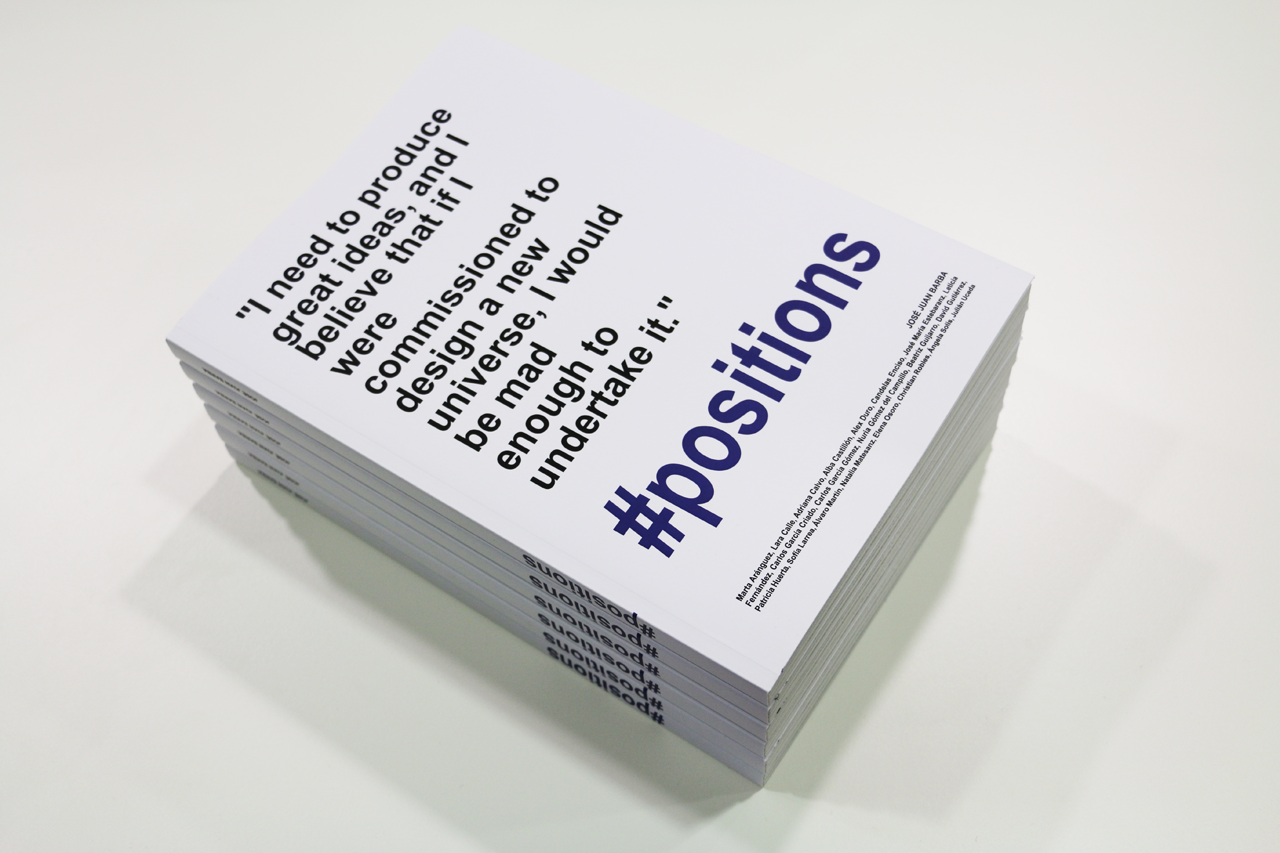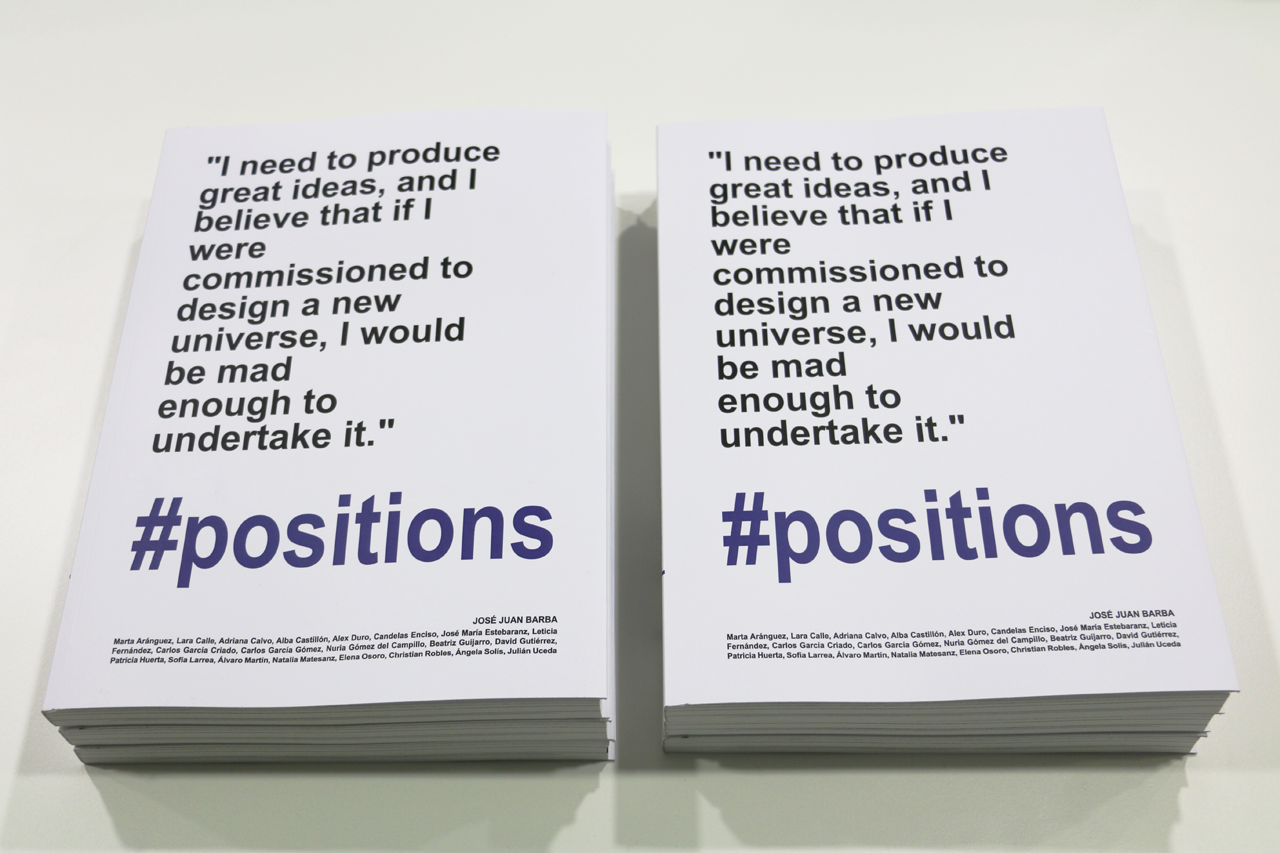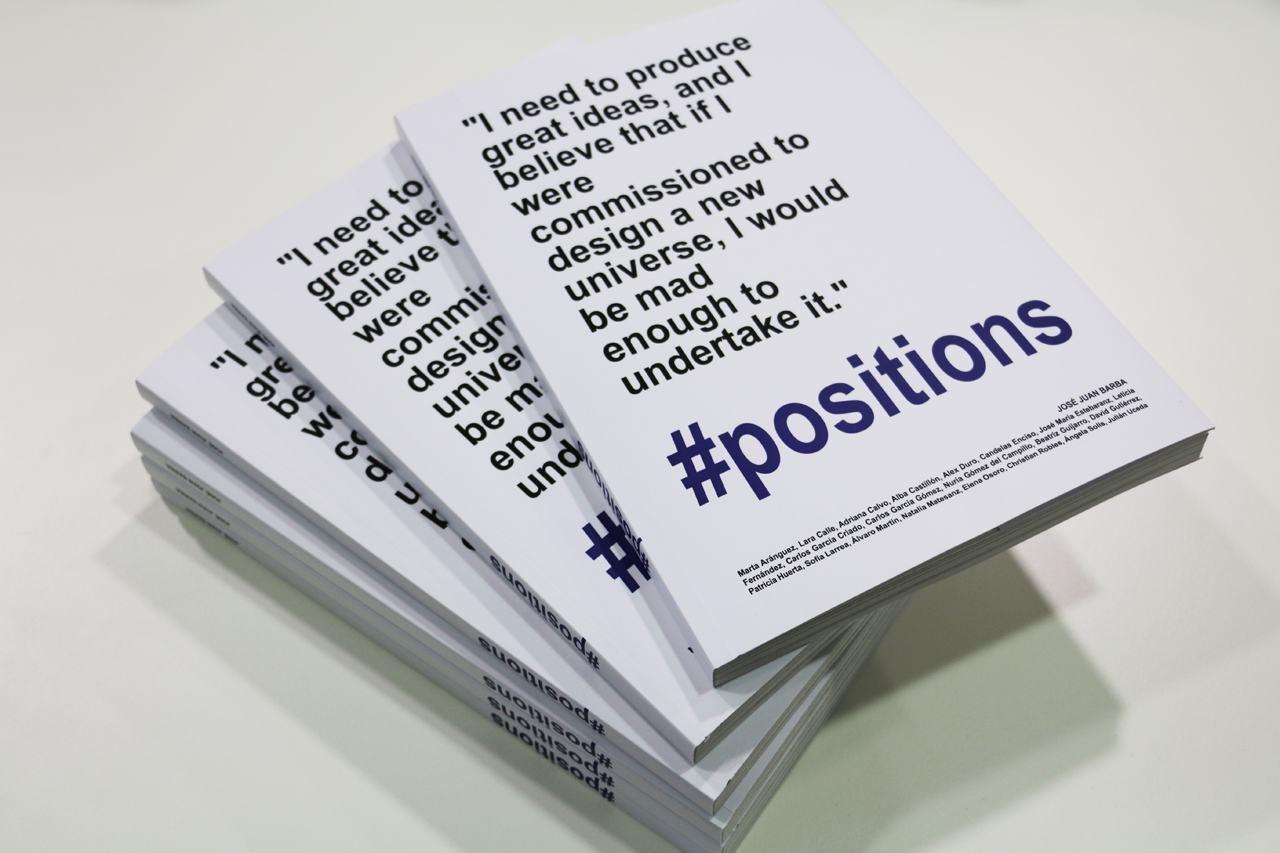
"I need to produce great ideas, and I believe that if I were commissioned to design a new universe, I would be mad enough to undertake it". With this ambitious saying of architect Giovanni Battista Piranesi as a guide, the book presents 21 projects by a generation of young Spanish architects with several common parameters: they all have shared academic formation and project director and they all present in all cases with their proposals a search to build architecture as a place.

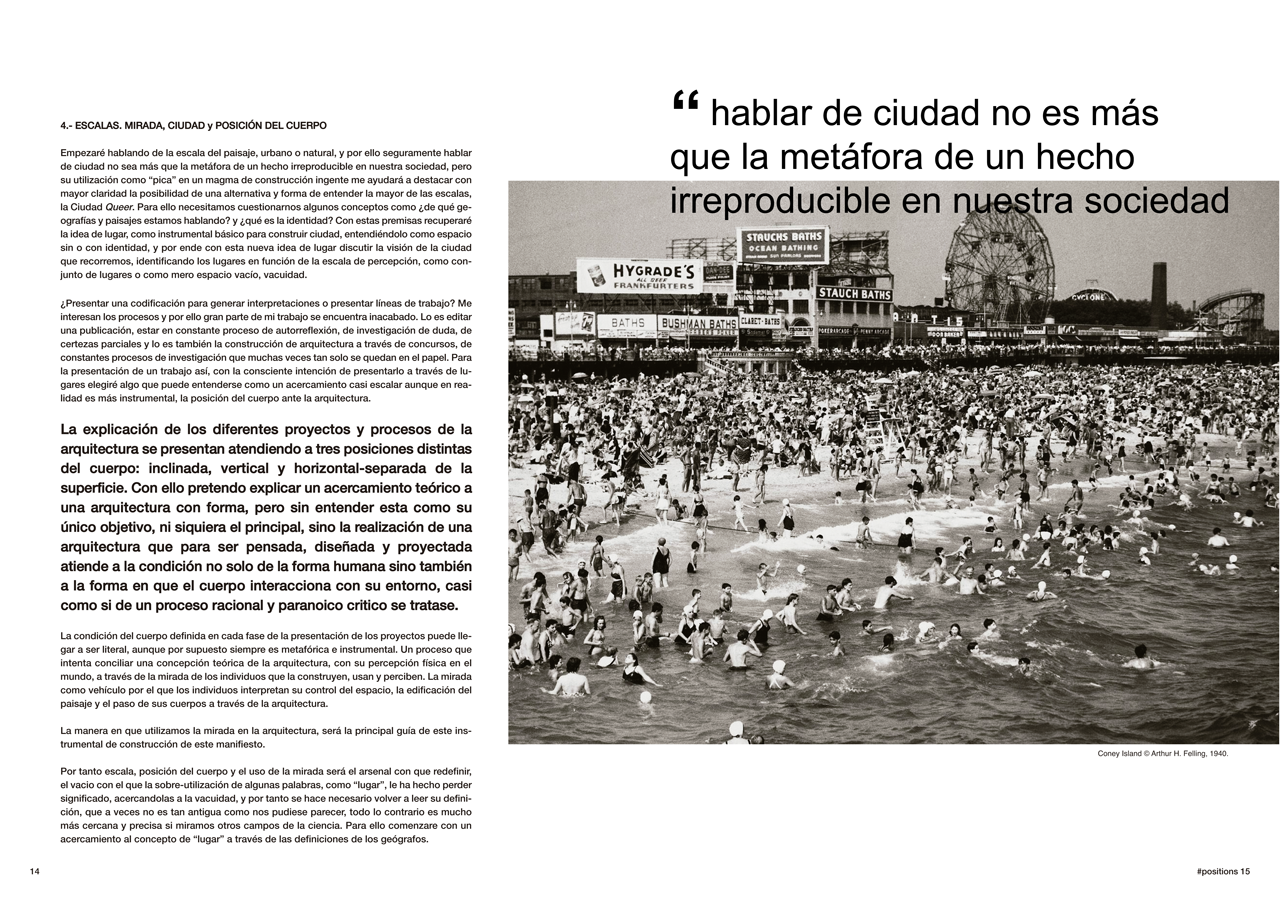
The book contains an extensive text by José Juan Barba, articulated in a speech of positioning defined by human body positions, proposing projects and ways of understanding architecture and relate to landscape, natural or antropic. Divided into three blocks, the book organizes the projects according to these positions: inclined, vertical and horizontal.

The three approaches are both literal and metaphorical, although its reading is presented figuratively, as an architectural approach whose initial derivative begins with Einfuhlung theory and the structural perception of buildings through the forces that pass through our bodies in any position.

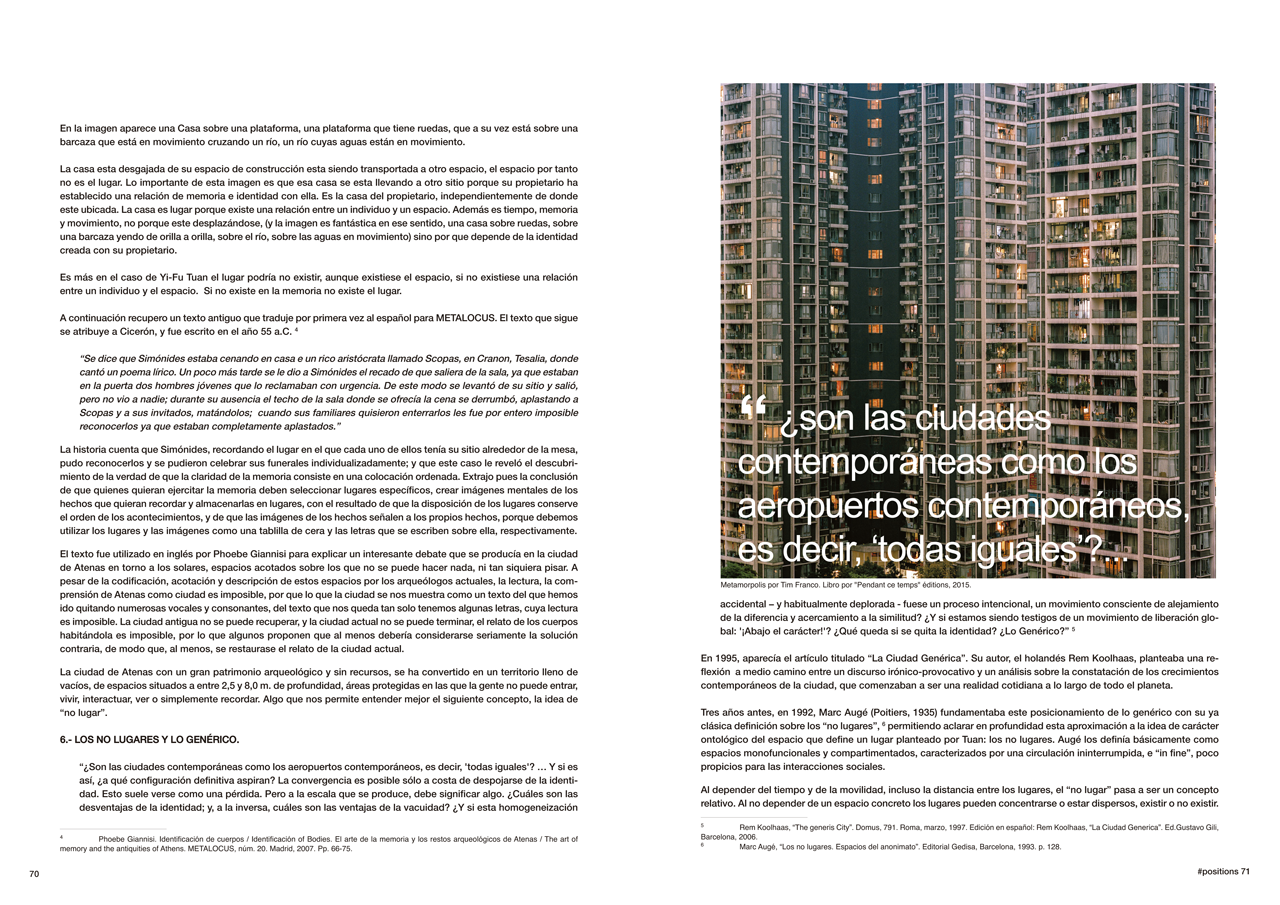
The book presents an ontological relationship of architecture with the space, creating places that reflect spaces with people, spaces that depend for their existence on memory, time, movement, those who use them, touch, live or remember them.

"Are the authors of the projects presented in this book mad enough?

It is possilbe, not only because they have tried to envision big ideas or a new universe, but also because the projects were designed with very limited means; the advisor and the students had to use their own resources. And because of where they were designed (in a young public university) and also because of the moment when they were presented, a time when crisis in architecture has hit harder than ever.

The twenty-one projects selected are a sample of a much wider group that for reasons of space are not included here, a group of brillant young architects that deserve to be singled out, work that deserved to be exhibited due to the brillance of its results (all the projects received a minimum grade of 'Very good' and the majority received a grade of 'Outstanding', Special Awards for End of Architectural Studies, or Spanish Architecture Biennial Awards, among others). All of them belong to a generation of young architects, with some common parameters, which gave them a common identity: the search to build architecture as a place."

The projects show utopias that are complemented by possible territories, where the proposal widens the scope of their ambition. It allows the authors to revisit the support on which they construct, rejecting or reaffirming it, delving into something more than a mere contextual relationship and focusing on the construction of a 'locus' of possibilities, a possible, future, utopian place, as their reality depends in turn on the architecture that is projected on it.

The books runs through projects that speak from the recognition of the land and its ruins to others who propose a new identity and identification on the landscape or those that are result of a search for responding to cultural or programatic conditions or new technological materializations.

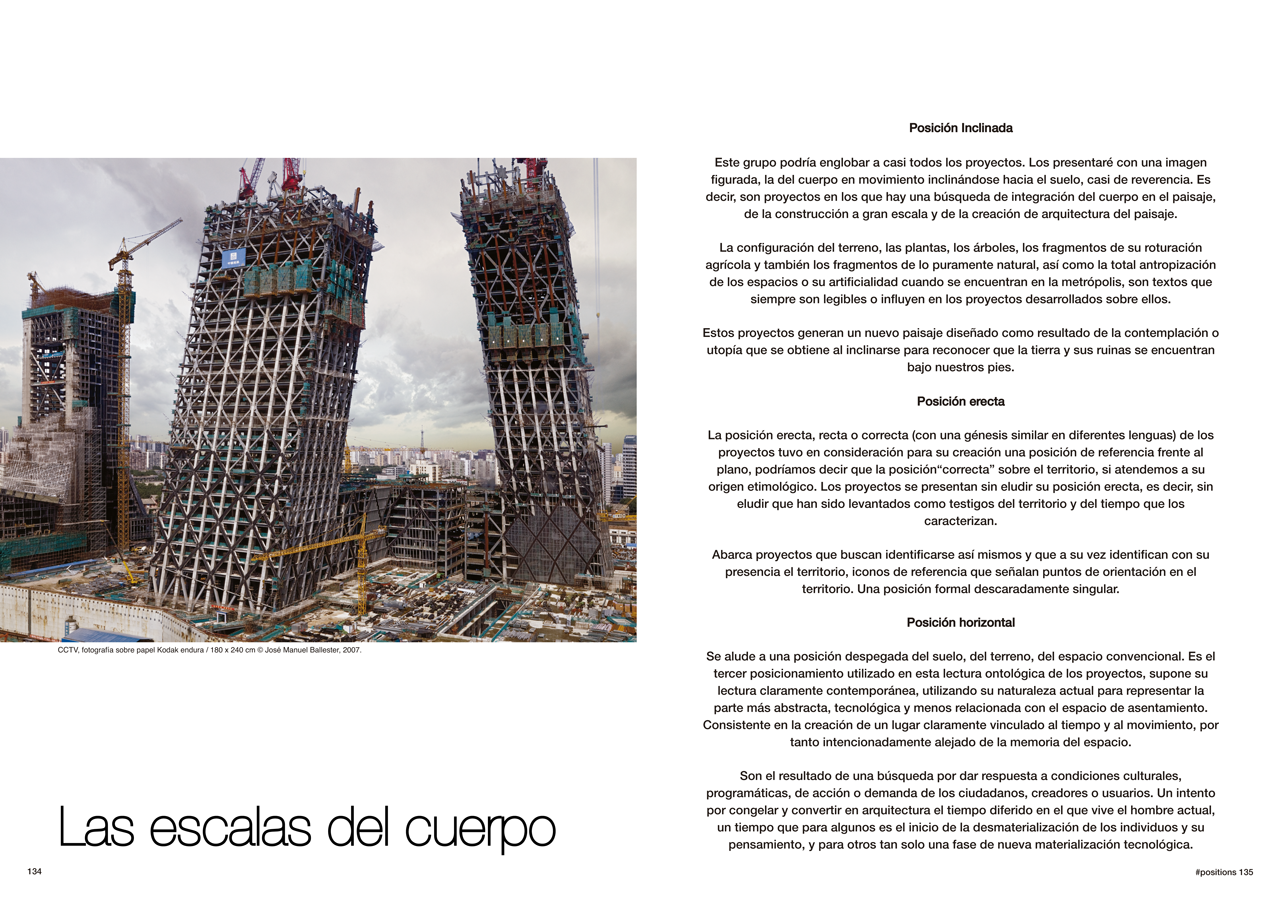
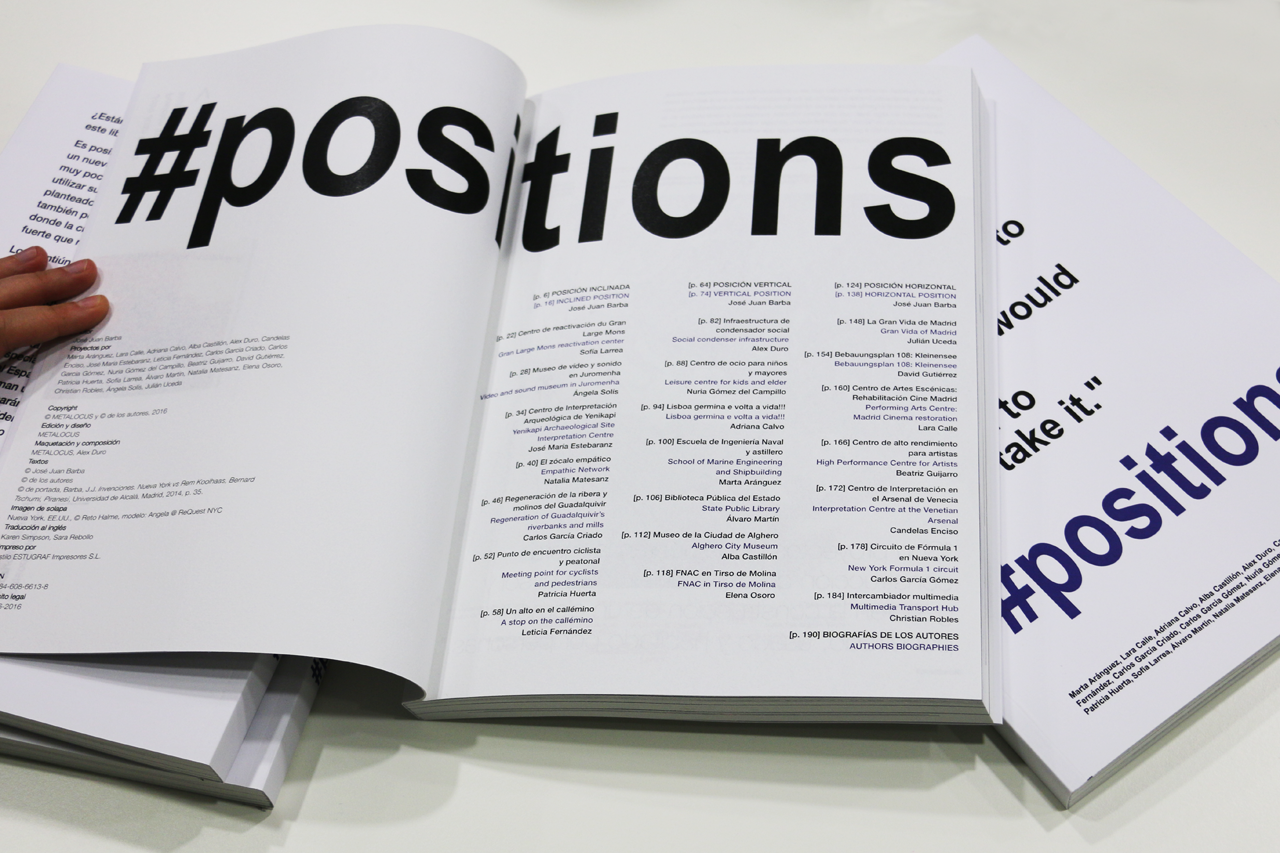
Inclined position

Gran Large Mons reactivation center.- Sofía Larrea.
Video and sound museum in Juromenha.- Ángela Solís.
Yenikapi Archaeological Site Interpretation Center.- José María Estebaranz.
Empathic Network.- Natalia Matesanz.
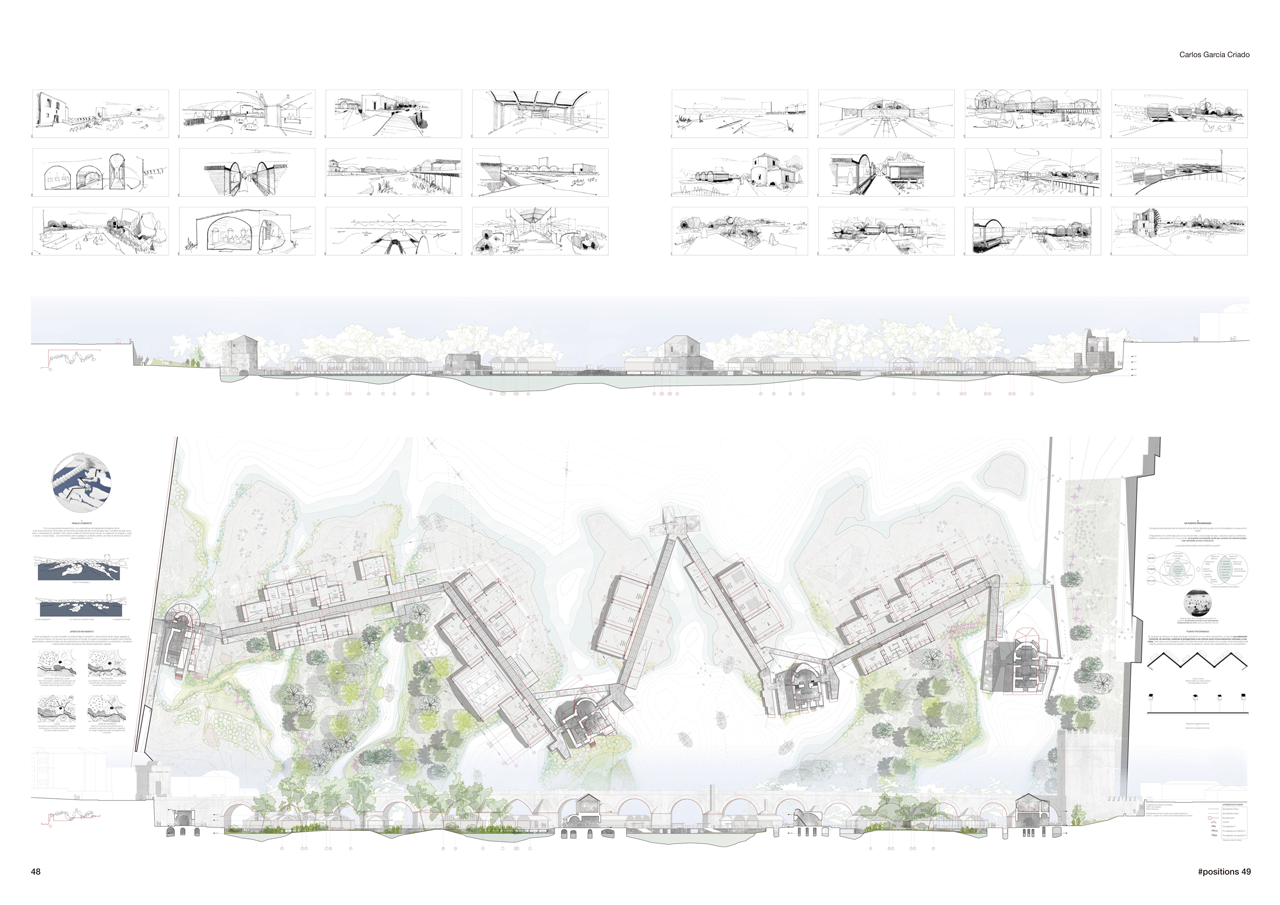
Regeneration of Guadalquivir's riverbanks and mills.- Carlos García Criado.
Meeting point for cyclists and pedestrians.- Patricia Huerta.
A stop on the callémino.- Leticia Fernández.

Vertical position

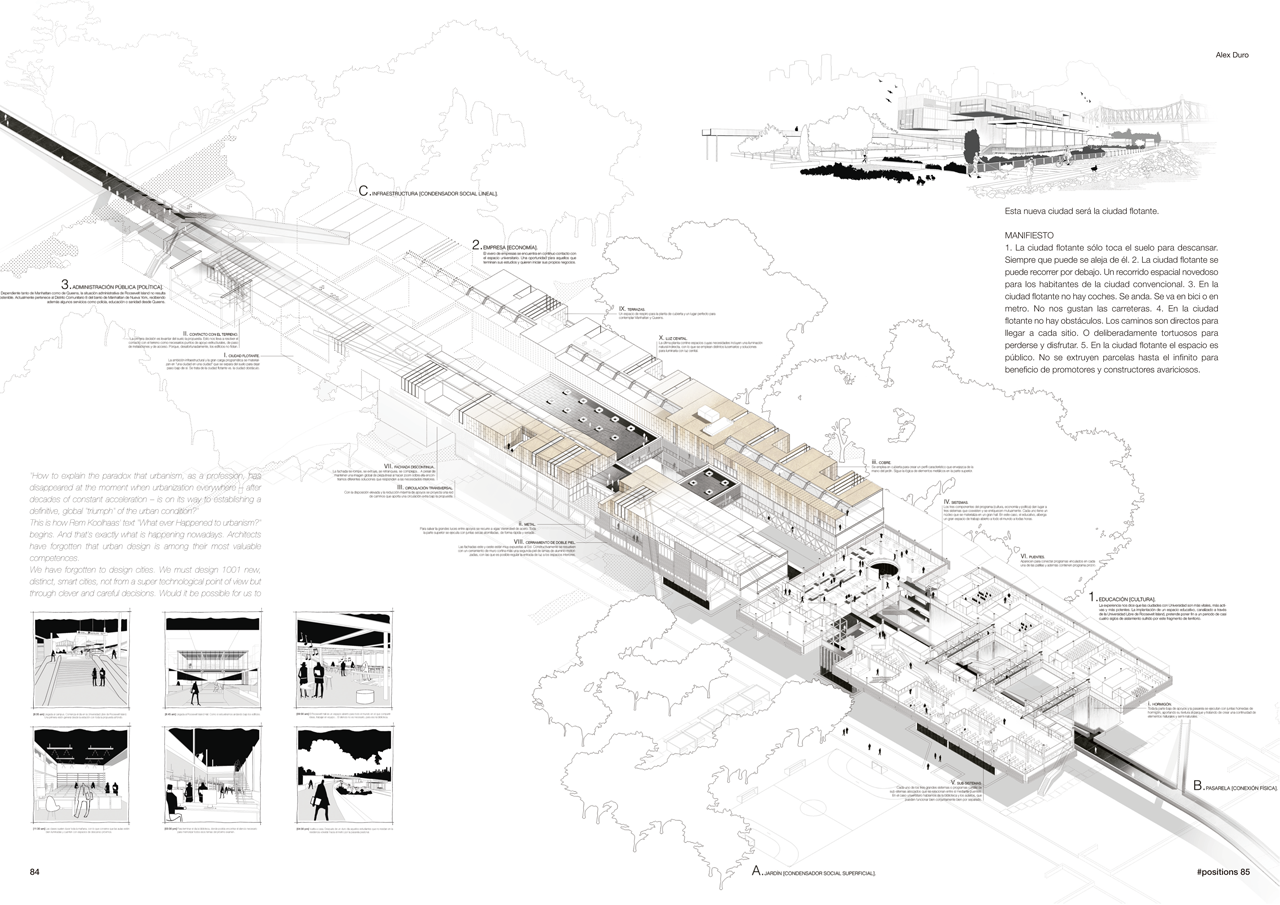
Social condenser infrastructure.- Alex Duro.
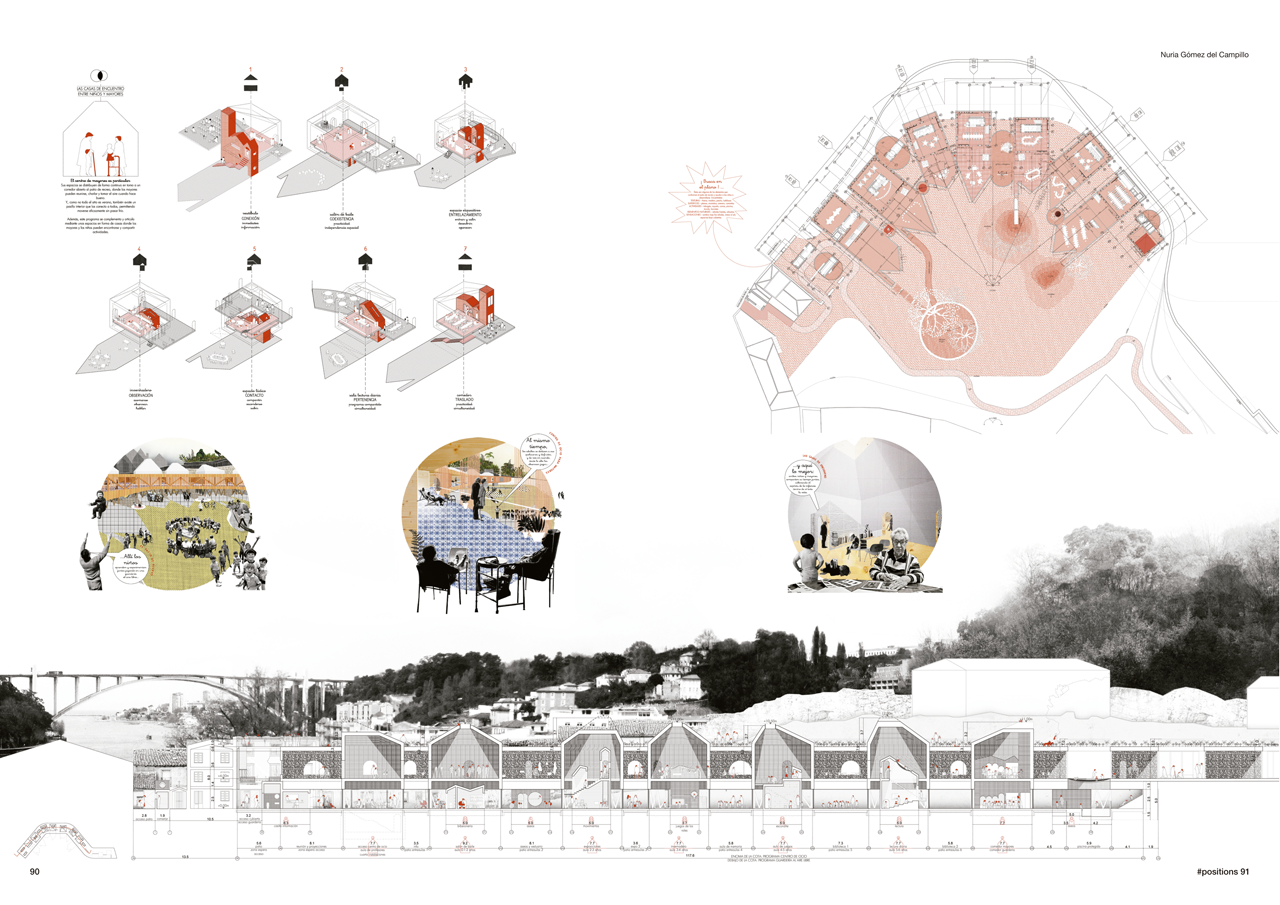
Leisure center for kids and elder.- Nuria Gómez del Campillo.
Lisboa germina e volta a la vida!!!.- Adriana Calvo.
School of Marine Engineering and Shipbuilding.- Marta Aránguez.
State Public Library.- Álvaro Martín.
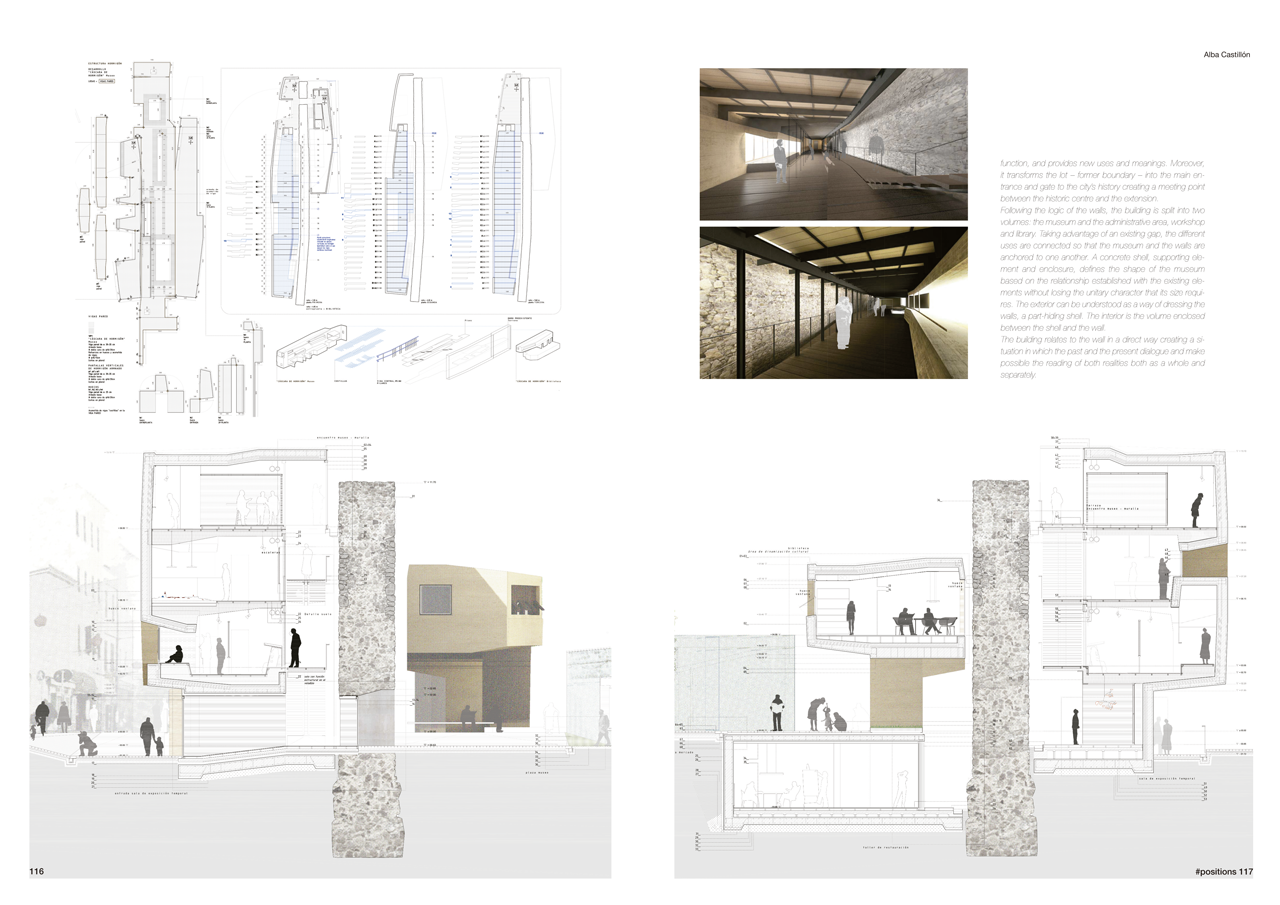
Alghero City Museum.- Alba Castillón.
FNAC in Tirso de Molina.- Elena Osoro.

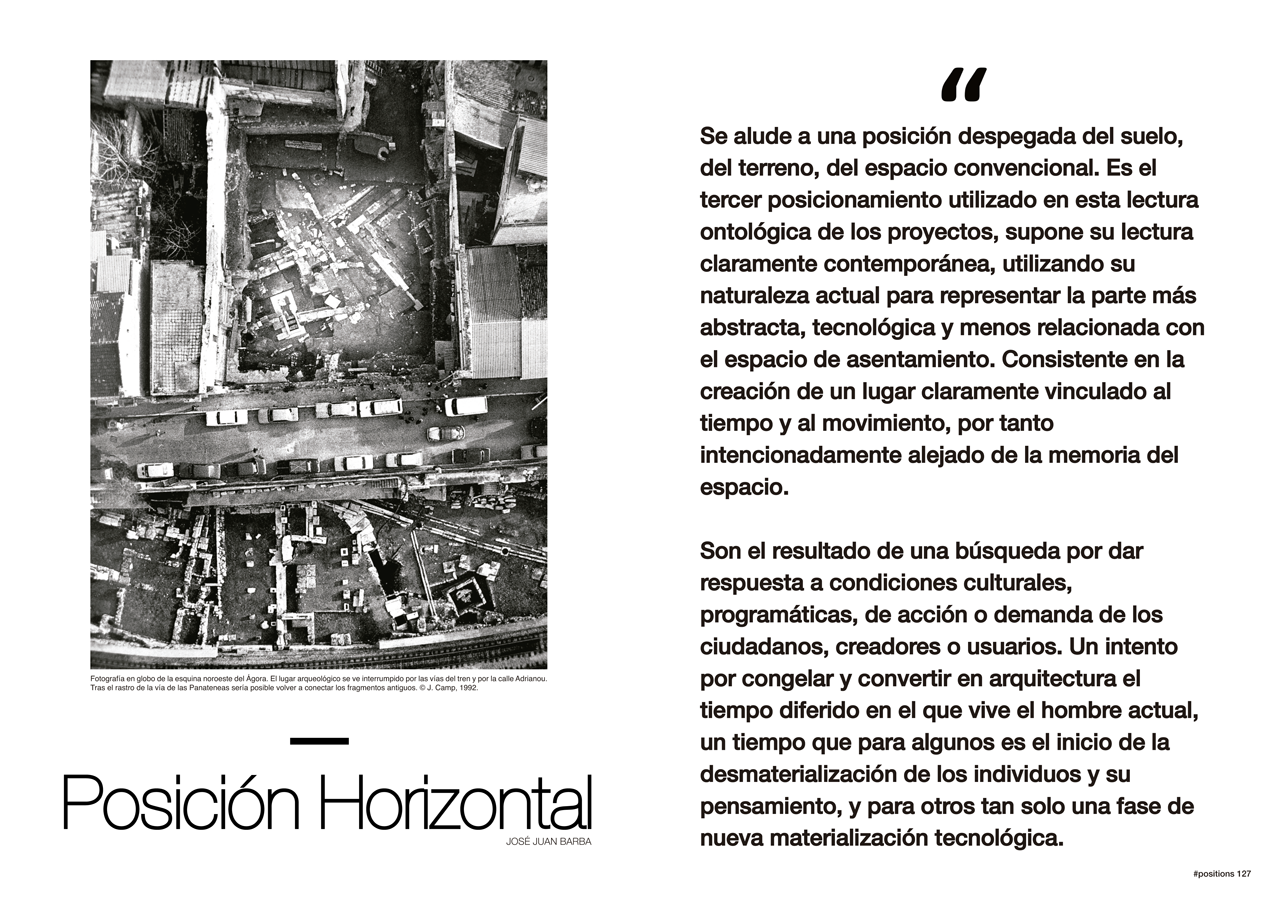
Horizontal position

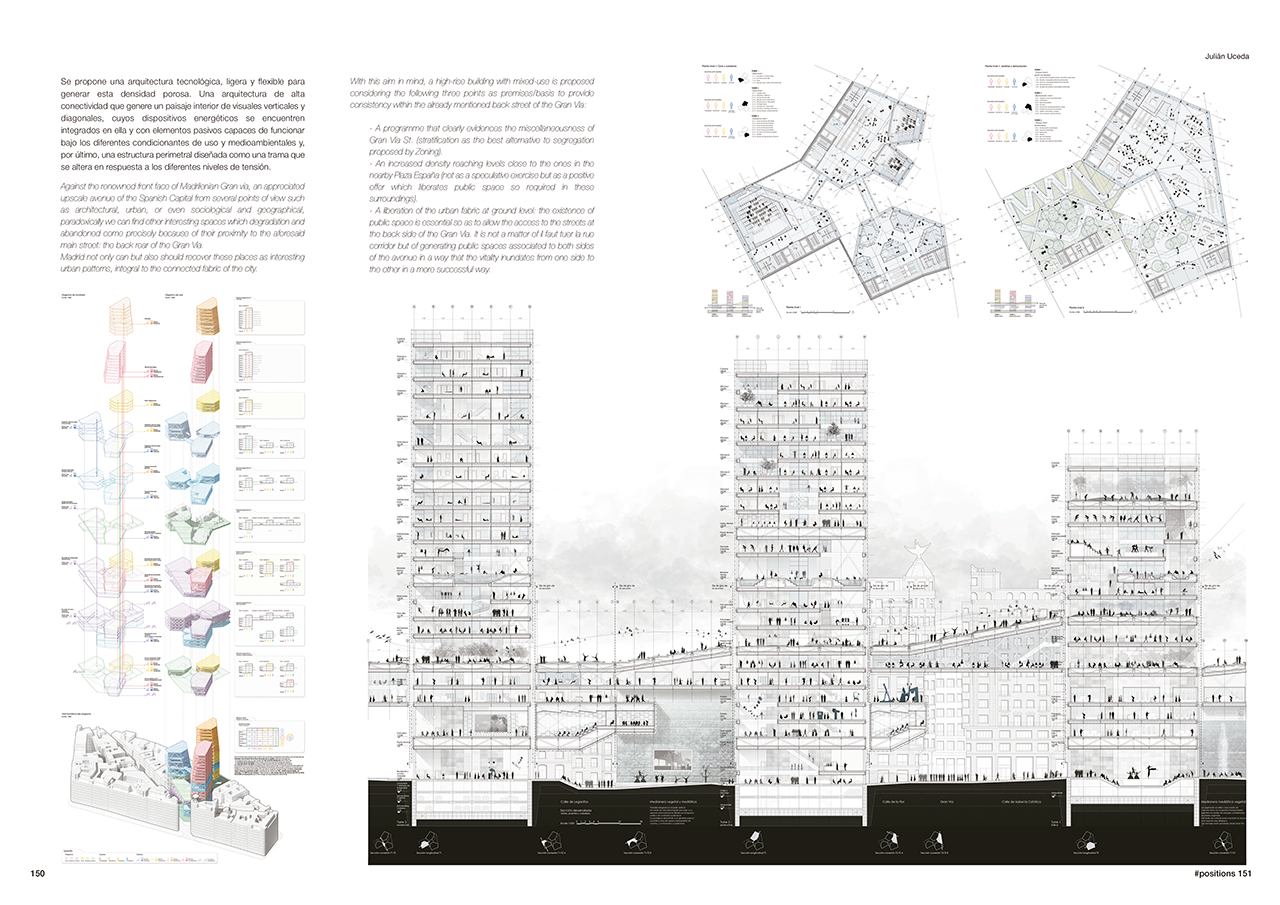
Gran Vida of Madrid.- Julián Uceda.
Bebauungsplan 108: Kleinensee.- David Gutiérrez.
Performing Arts Centre: Madrid cinema restoration.- Lara Calle.
High Performance Centre for Artist.- Beatriz Guijarro.
Interpretation Center at the Venetian Arsenal.- Candelas Enciso.
New York Formula 1 circuit.- Carlos García Gómez.
Multimedia Transport Hub.- Christian Robles.
More information

Label
Author
Text
José Juan Barba
+ + copy Created with Sketch.
- + copy Created with Sketch.
Label
Projects by
Text
Marta Aránguez, Lara Calle, Adriana Calvo, Alba Castillón, Alex Duro, Candelas Enciso, José María Estebaranz, Leticia Fernández, Carlos García Criado, Carlos García Gómez, Nuria Gómez del Campillo, Beatriz Guijarro, David Gutiérrez, Patricia Huerta, Sofía Larrea, Álvaro Martín, Natalia Matesanz, Elena Osoro, Christian Robles, Ángela Solís and Julián Uceda.
+ + copy Created with Sketch.
- + copy Created with Sketch.
Label
Edition and design
Text
METALOCUS.
+ + copy Created with Sketch.
- + copy Created with Sketch.
Label
Layout and composition
Text
METALOCUS, Alex Duro.
+ + copy Created with Sketch.
- + copy Created with Sketch.
Label
Language
Text
English - Spanish
+ + copy Created with Sketch.
- + copy Created with Sketch.
Label
English translation
Text
Karen Simpson (Main translator), Sara Rebollo.
+ + copy Created with Sketch.
- + copy Created with Sketch.
Label
Size
Text
29,7 x 21 cm.
+ + copy Created with Sketch.
- + copy Created with Sketch.
Label
Pages
Text
196.
+ + copy Created with Sketch.
- + copy Created with Sketch.
Label
ISBN
Text
978-84-608-6613-8
+ + copy Created with Sketch.
- + copy Created with Sketch.

José Juan Barba (1964). Architect from the Madrid School of Architecture (ETSAM) in 1991. He received his PhD in Architecture from ETSAM in 2004, graduating summa Cum laude with the doctoral thesis "Inventions: New York vs. Rem Koolhaas, Bernard Tschumi, Piranesi." In 1991, he received a Special Mention in the Spanish National Graduation Awards. Until 1997, he worked as an advisor to several NGOs. In 1992, he founded his architectural practice in Madrid (www.josejuanbarba.com). 

He is an architectural critic and, since 1998, Editor-in-Chief of the internationally acclaimed bilingual architecture journal METALOCUS (Spanish/English), recipient of several national and international awards.

Barba is an Associate Professor at the University of Alcalá and a member of several research groups. He has been invited to participate in numerous international forums on architecture and urbanism, including the II Forum of Mexican World Heritage Cities, Urban Development, History and Modernity, organized by the Pan-American Committee for Urban Development and Historical Heritage; the World Urban Development Forum (FMDU), held in Culiacán, Sinaloa, Mexico; and the International Conference on Architecture and Urbanism from the Perspective of Women Architects. He has also been invited as lecturer and guest critic at numerous national and international institutions, including the National Building Museum, Roma Tre University, Politecnico di Milano, University of Genoa, Université Pierre Mendès France Grenoble, the Madrid and Barcelona Schools of Architecture, National Autonomous University of Mexico, the Faculty of Architecture in Montevideo, the Schools of Architecture of Medellín and Ecuador, Universidad Iberoamericana, IE University, as well as the Schools of Architecture of Zaragoza, Valladolid, Málaga, Granada, Seville, and A Coruña, among others.

He has extensive professional experience in architecture, urbanism, landscape intervention, and territorial regeneration. His work has received numerous awards, including First Prize in the “Gran Vía Posible” competition for Delirious Gran Vía, Madrid; recognition for the Rivers Interpretation Centre in Zamora, awarded and exhibited at the World Architecture Festival 2008; and recognition for the Santa Bárbara Park project in Toledo. He was also awarded the Erich Degner Prize for Architecture (1995), promoted by the BBVA Foundation. His project for a Day Centre for the Elderly was included in Volume 3 of the Madrid Architecture Guide published by the Official College of Architects of Madrid (COAM) in 2007. His work has been widely published in national and international books and journals.

He served as Maître de Conférences at the Institut d’Urbanisme de Grenoble, Université Pierre Mendès France Grenoble, during the 2013–14 academic year, following his appointment through a European open competition. His work has been published internationally. He regularly serves on academic and professional juries, including the editorial competition jury for the journal Quaderns (2011), the selection committee for the European Union Prize for Contemporary Architecture – Mies van der Rohe Awards (2007–present), and the jury panels for EUROPAN 13 (2015–16) and TRANSFER, Zurich (2019). He was also invited to participate in the Biennale di Venezia 2016 as part of the exhibition Spaces of Exception / Spazi d’Eccezione.

He has authored several books, including "The Dark Line. michele&miquel, dA Vision Design" (2024), "CONGRESO ANYWAY. La ciudad de las ciudades" (2020), "#Positions" (2016), and "Inventions: New York vs. Rem Koolhaas, Bernard Tschumi, Piranesi" (2015). He has also contributed to publications such as "Espacio público Gran Vía. La Ciudad del Turismo" (2020), "Spaces of Exception / Spazi d’Eccezione" (2016), "La manzana de la discordia" (2015), and "Contemporary Japanese Architecture: New Territories" (2015), as well as chapters in numerous books, including "Women Architects: A Professional Challenge" (2009), "21st Century Architectures" (2007), "Ruta de la Plata, New Conquerors of Space" (2019), and "The City of Tourism" (2020).

Selected awards include:

•    “SANTIAGO AMÓN” AWARD, award for the promotion of architecture, COAM Madrid, 2000.
•    “PANAYIOTI MIXELI AWARD,” SADAS-PEA, award for the promotion of architecture, Athens, 2005.
•    “PIERRE VAGO” ICAC. International Committee of Art Critics Award, London, 2005.
•    FAD Award 07, Ephemeral Interventions, First Prize, M.C. Escher Exhibition, Arquin-FAD, Barcelona, 2007.
•    World Architecture Festival, Center for Research and Interpretation of the Rivers, Tera, Esla, and Órbigo, Finalist, Barcelona, 2008.
•    Gran Vía Posible, First Prize, Delirious Gran Vía, Madrid, 2010.
•    Reform of the Río Segura Surroundings, Award, Murcia, 2010.

Read more
Published on: April 23, 2016
Cite:
metalocus, SARA REBOLLO
"#positions, by José Juan Barba" METALOCUS. Accessed
<https://www.metalocus.es/en/news/positions-jose-juan-barba> ISSN 1139-6415
Loading content ...
Loading content ...
Loading content ...
Loading content ...
Loading content ...
Loading content ...
Loading content ...
Loading content ...
Loading content ...
Loading content ...
Loading content ...
Loading content ...
Loading content ...
Loading content ...
Loading content ...
Loading content ...
Loading content ...
Loading content ...
Loading content ...
Loading content ...
Loading content ...
Loading content ...
Loading content ...
Loading content ...
Loading content ...
Loading content ...
Loading content ...
Loading content ...
Loading content ...
Loading content ...
Loading content ...
Loading content ...
Loading content ...
Loading content ...
Loading content ...
Loading content ...
Loading content ...
Loading content ...
Loading content ...
Loading content ...
Loading content ...
Loading content ...
Loading content ...
Loading content ...
Loading content ...
Loading content ...
Loading content ...
Loading content ...
Loading content ...
Loading content ...
Loading content ...
Loading content ...
Loading content ...
Loading content ...