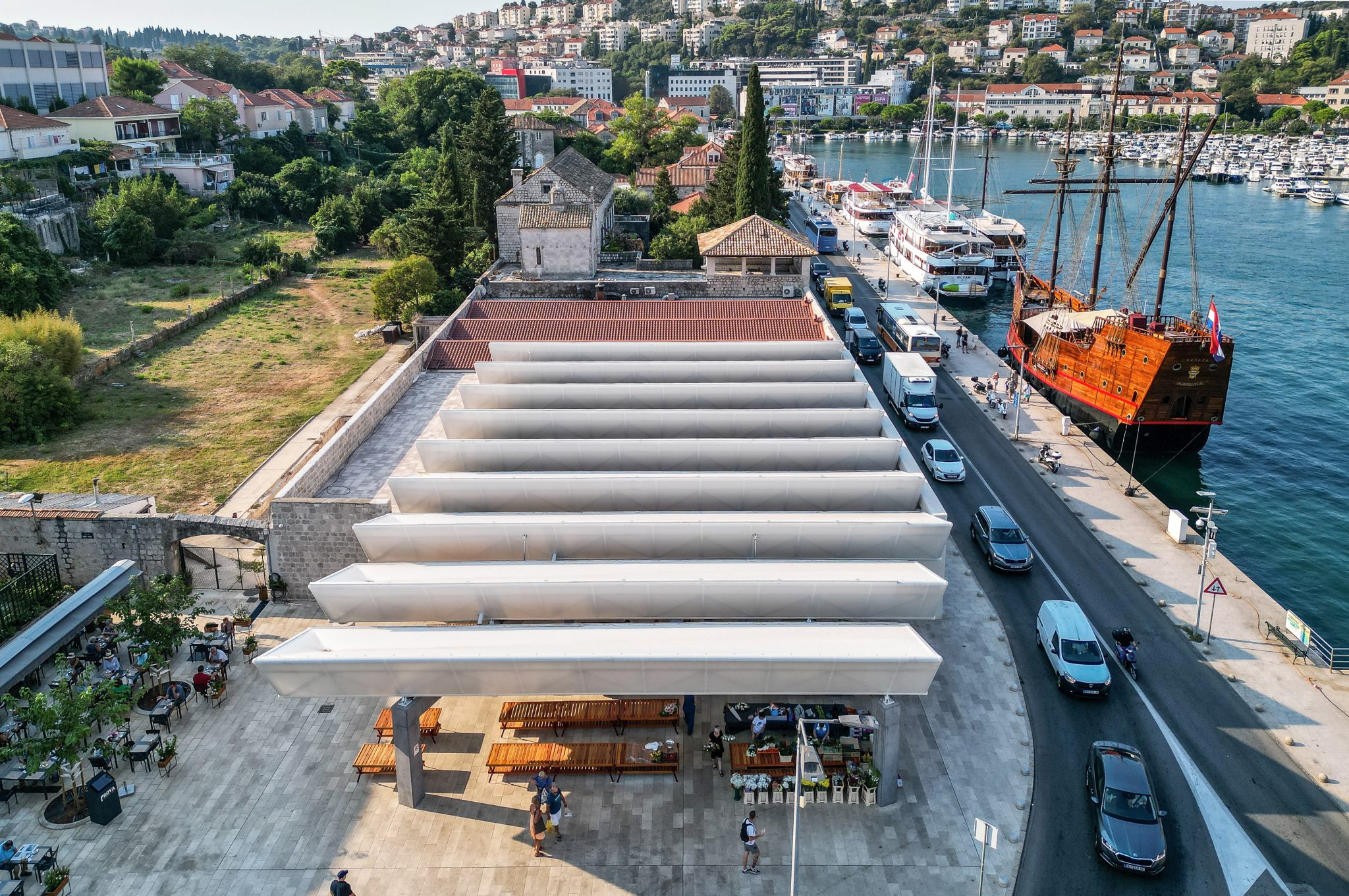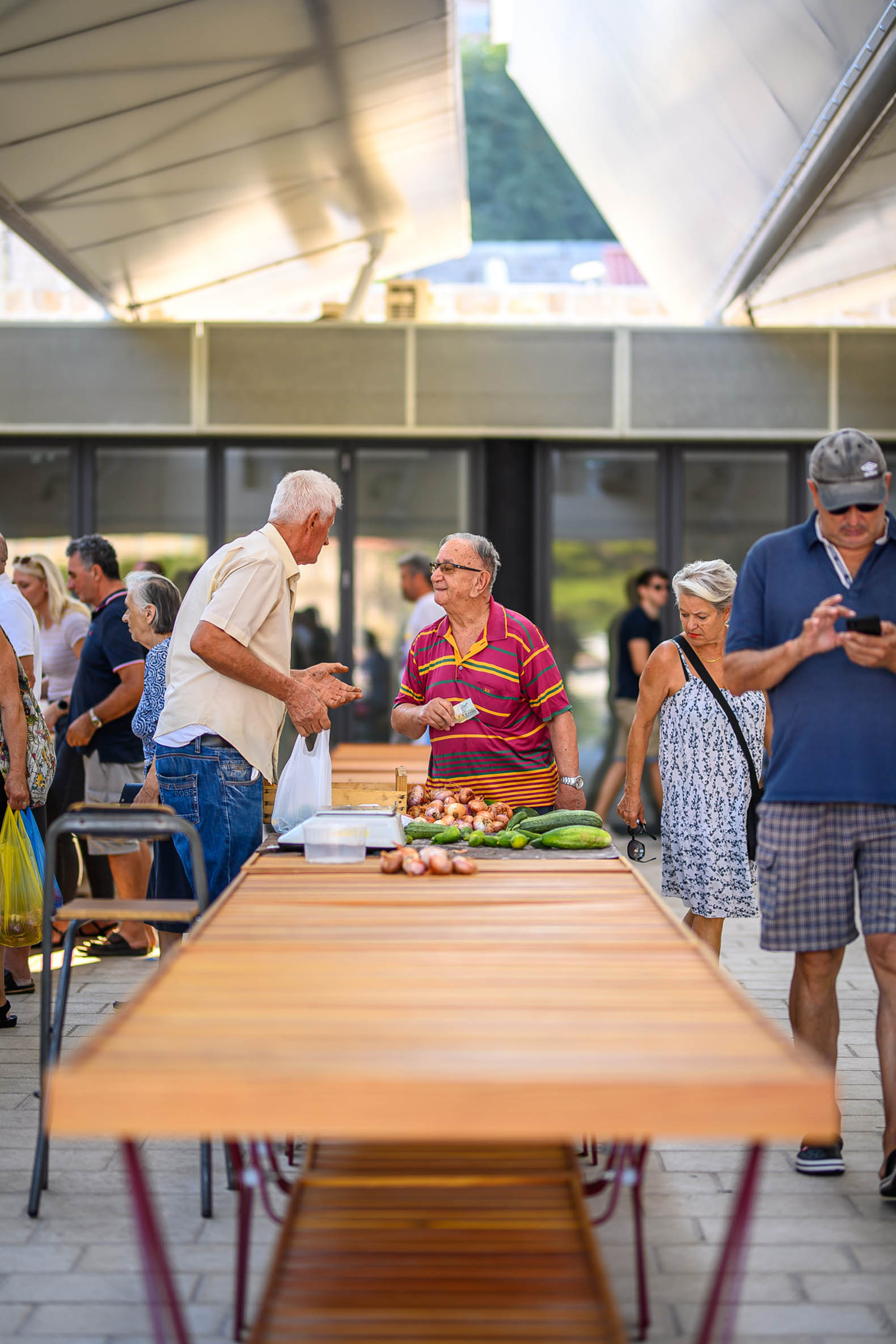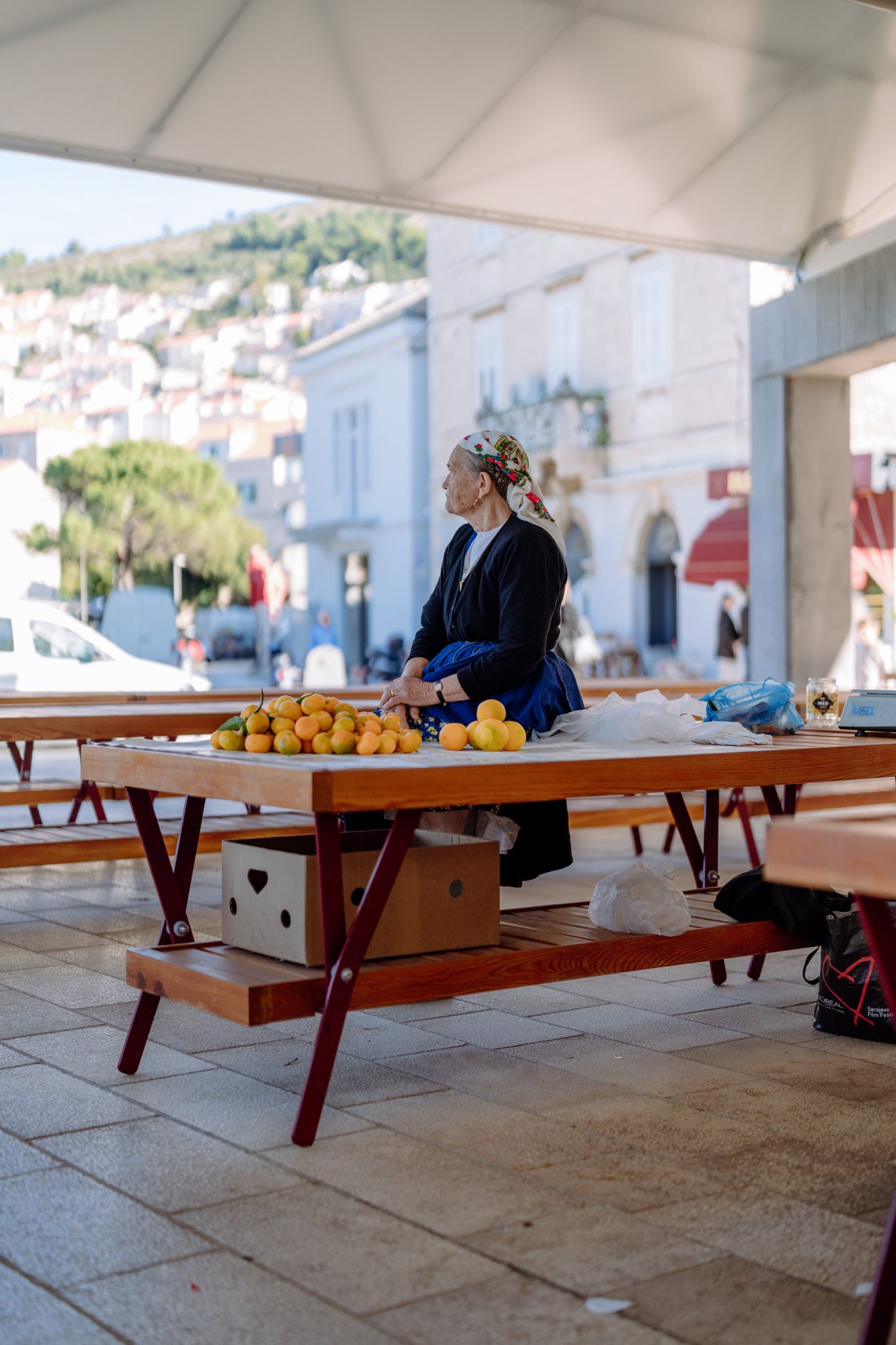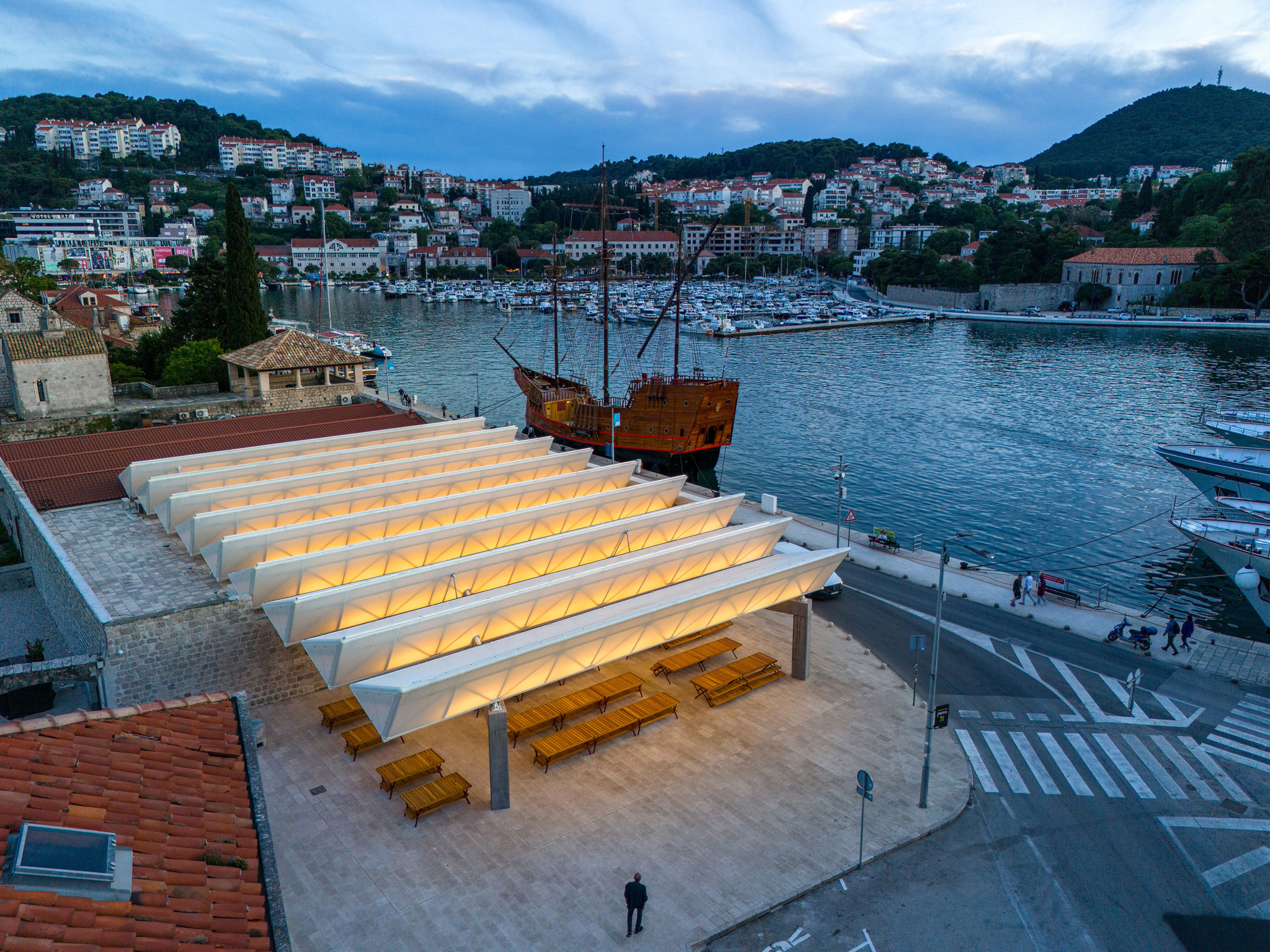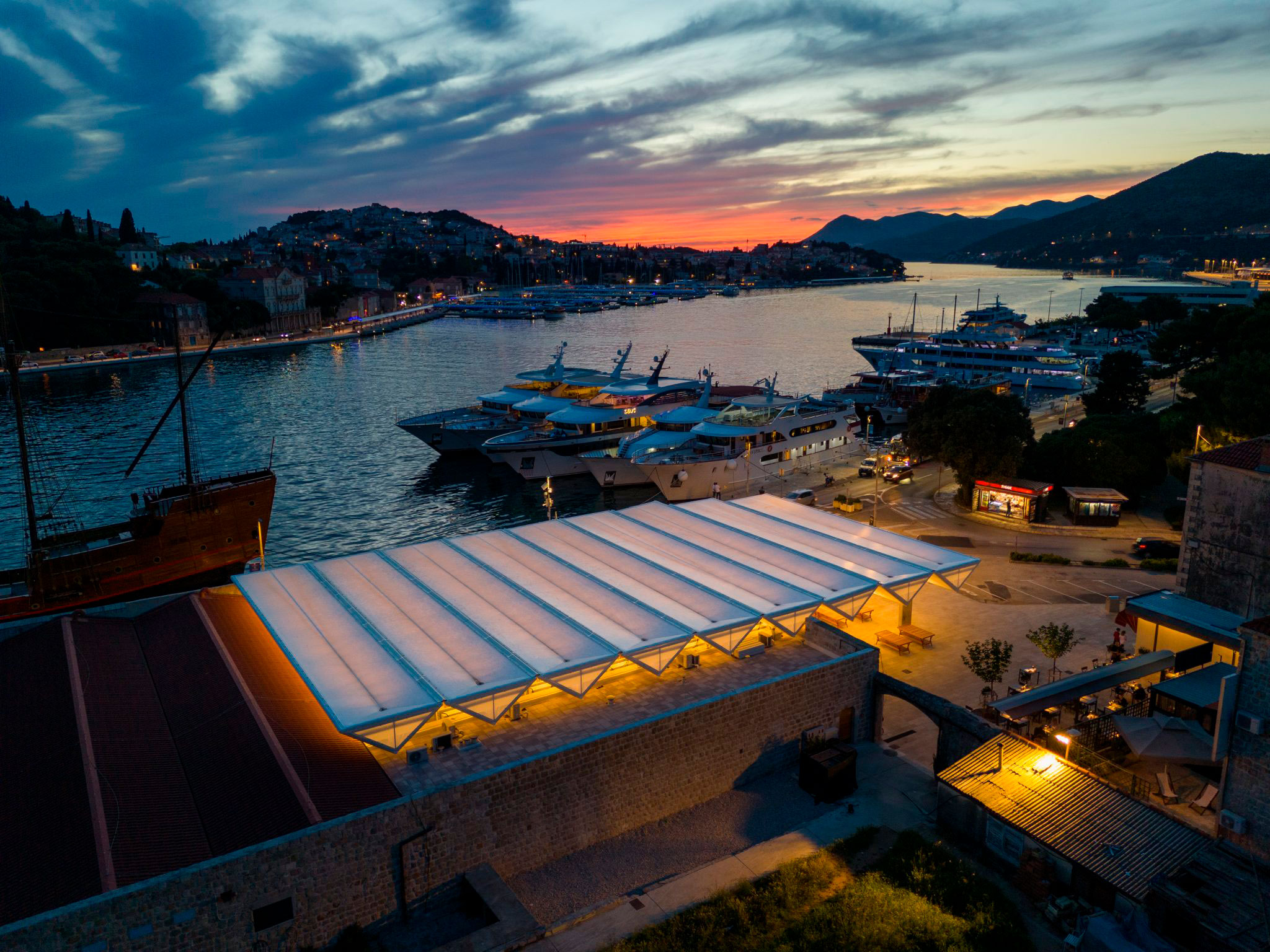
Set against the backdrop of the Croatian city of Dubrovnik on the Adriatic Sea, the Croatian architecture practice ARP / Peračić-Veljačić was commissioned in 2016 to design a canopy over the fruit section of the city's central market, located in a prime spot on Gruž Bay.

The history of the site dates back to the 16th century, when the noble merchant and diplomat Gundulić built a grand villa surrounded by gardens and high walls nearly 150 meters long. Over time, a promenade was built in front of the villa, and after various transformations and interior additions, the Gruž Market was constructed in 1938 over a pond in the northwest area. The project is one of the 40 selected for the EUmies / Mies van der Rohe Awards 2026.

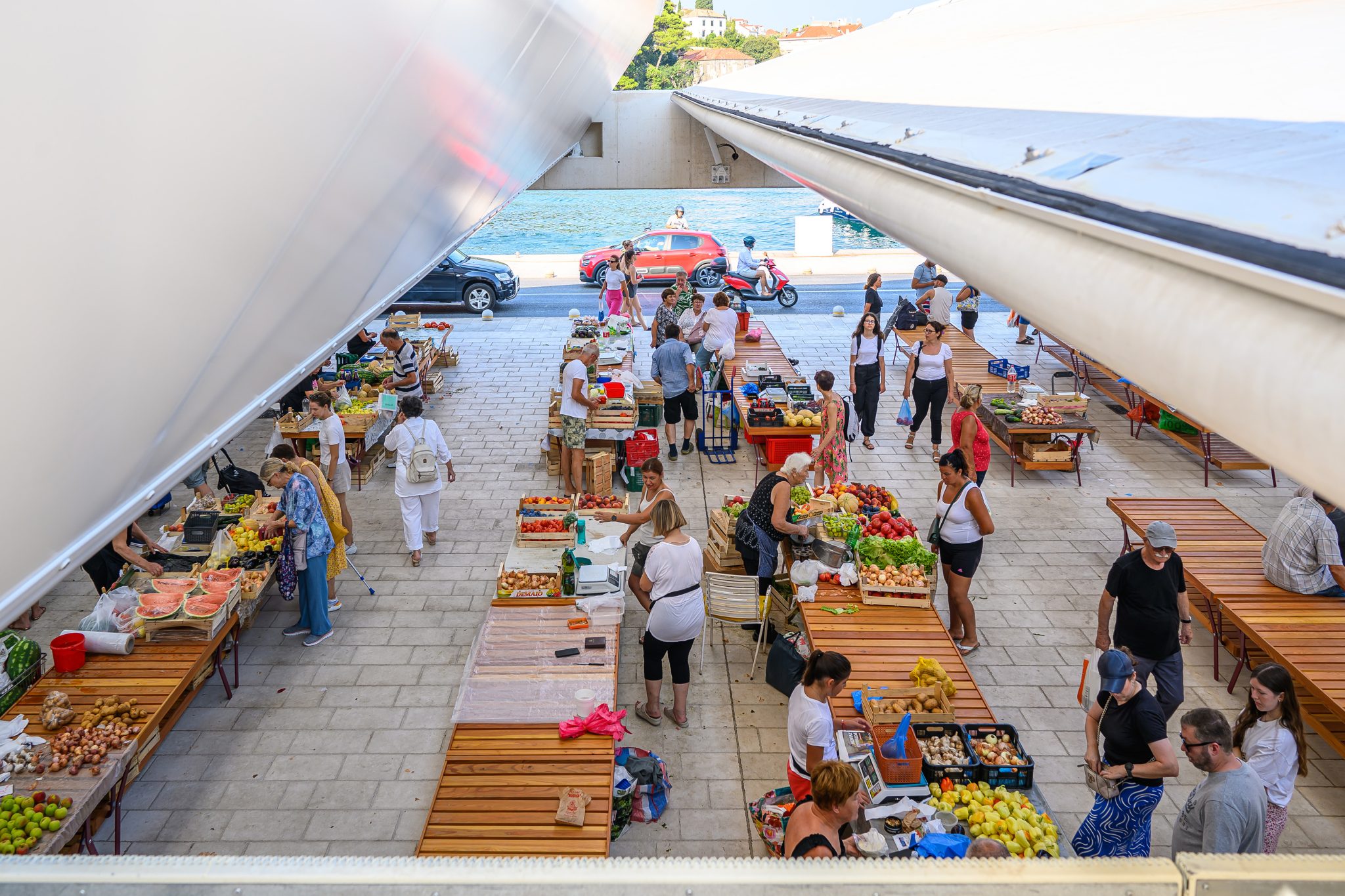
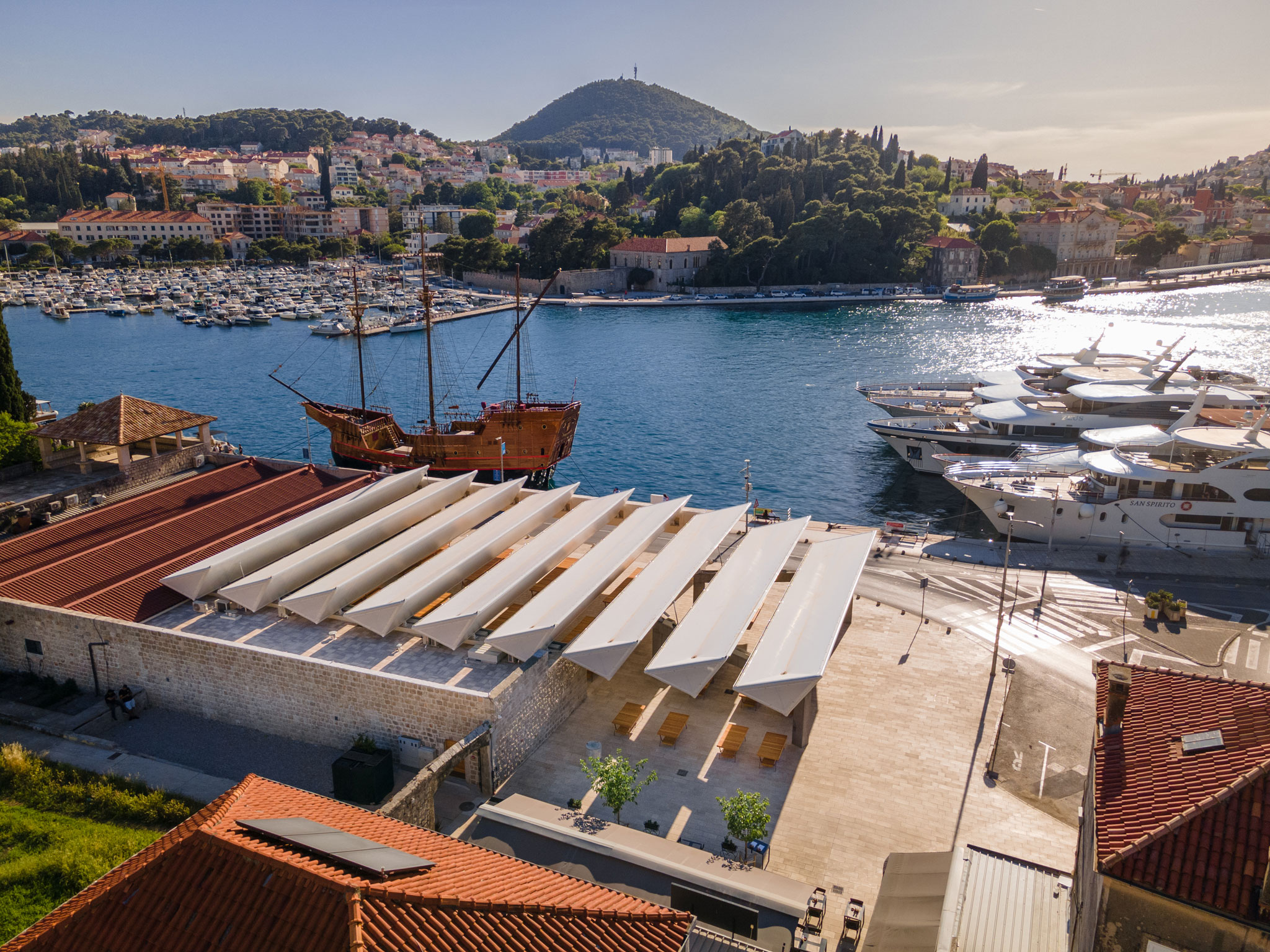
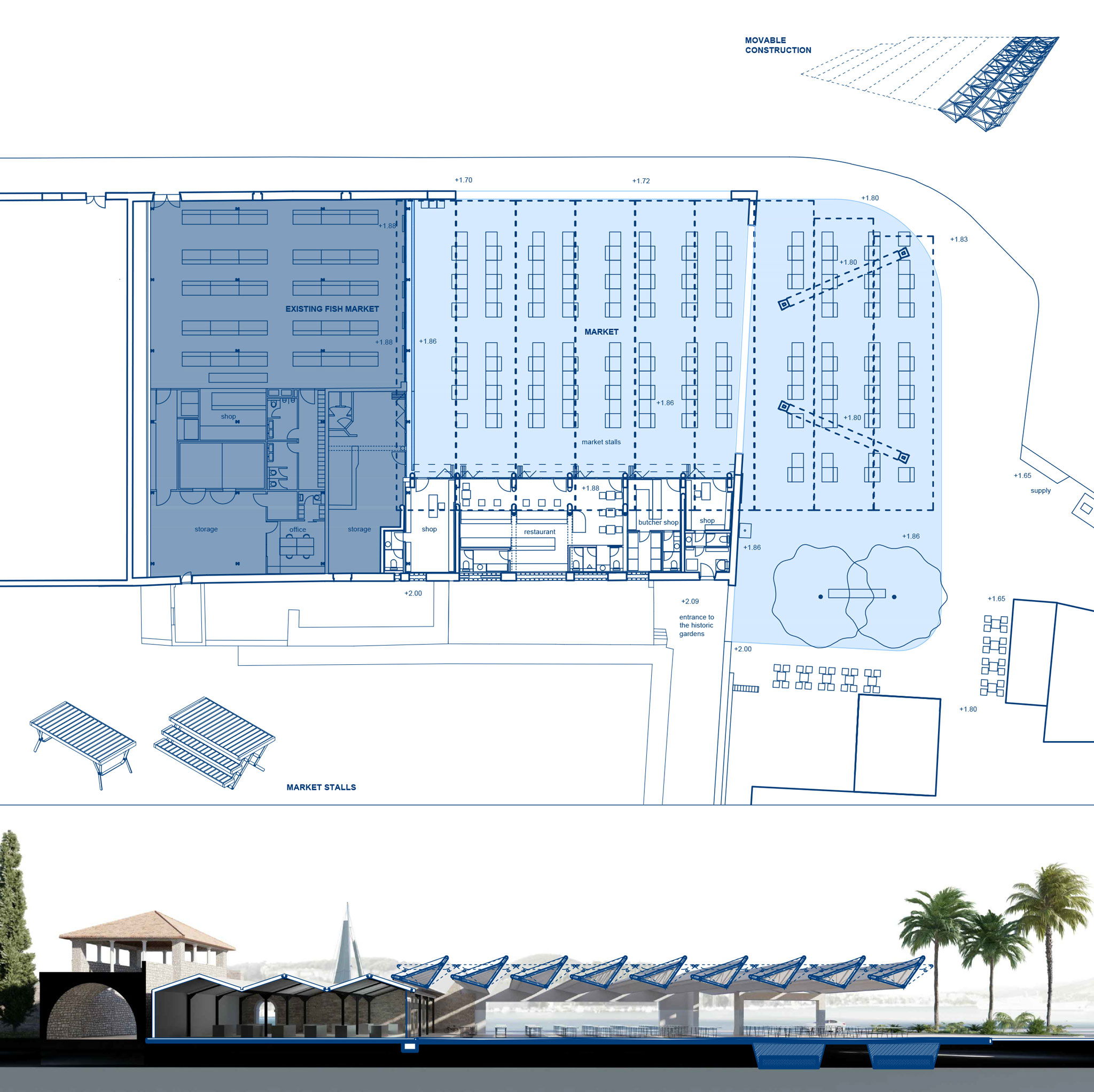
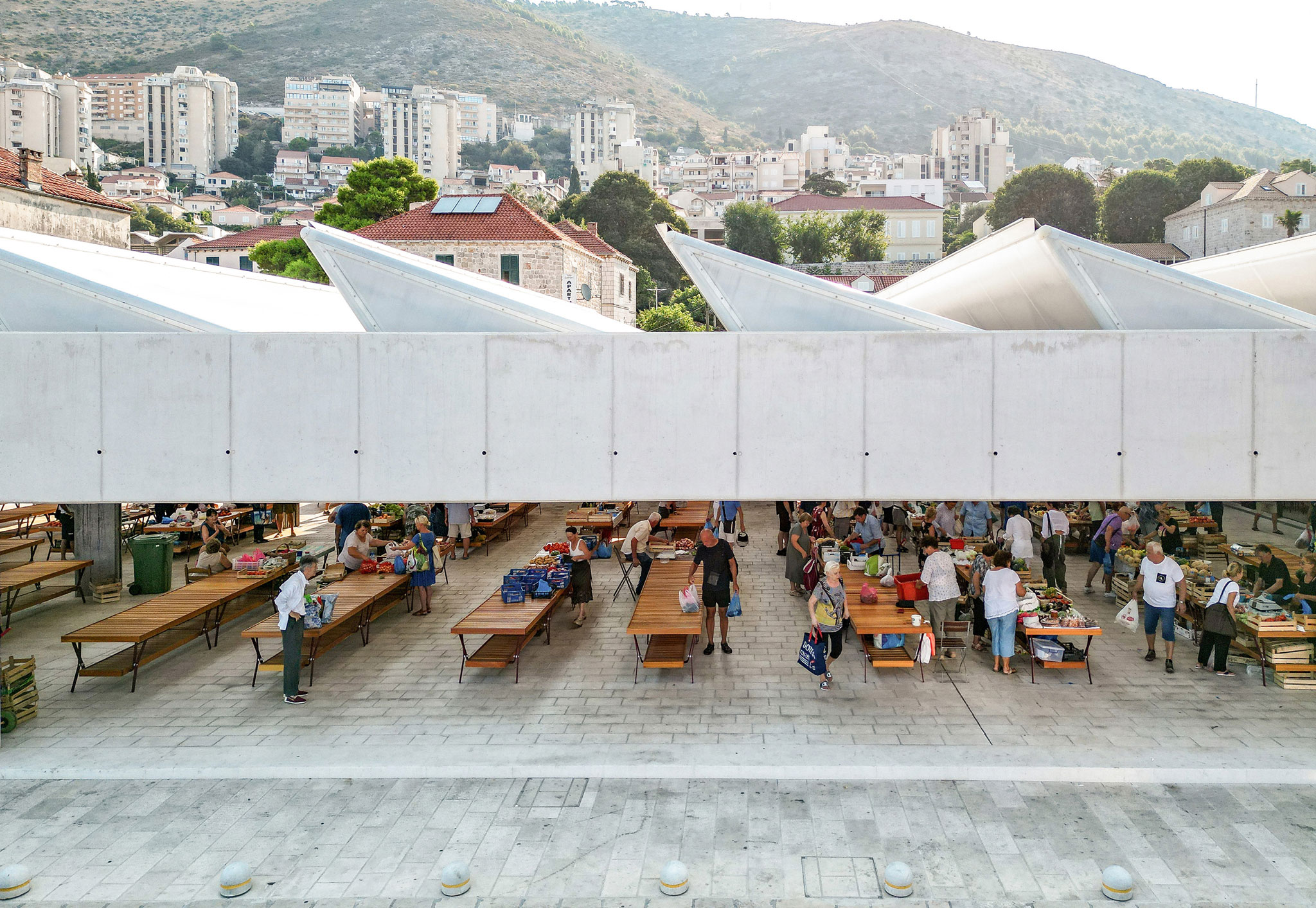
Peračić and Veljačić's proposal stemmed from a context with numerous constraints: it had to avoid obstructing views of the villa-palace, it had to be permeable to facilitate the flow of fresh air and natural light, and it had to create a flexible space capable of hosting different events.

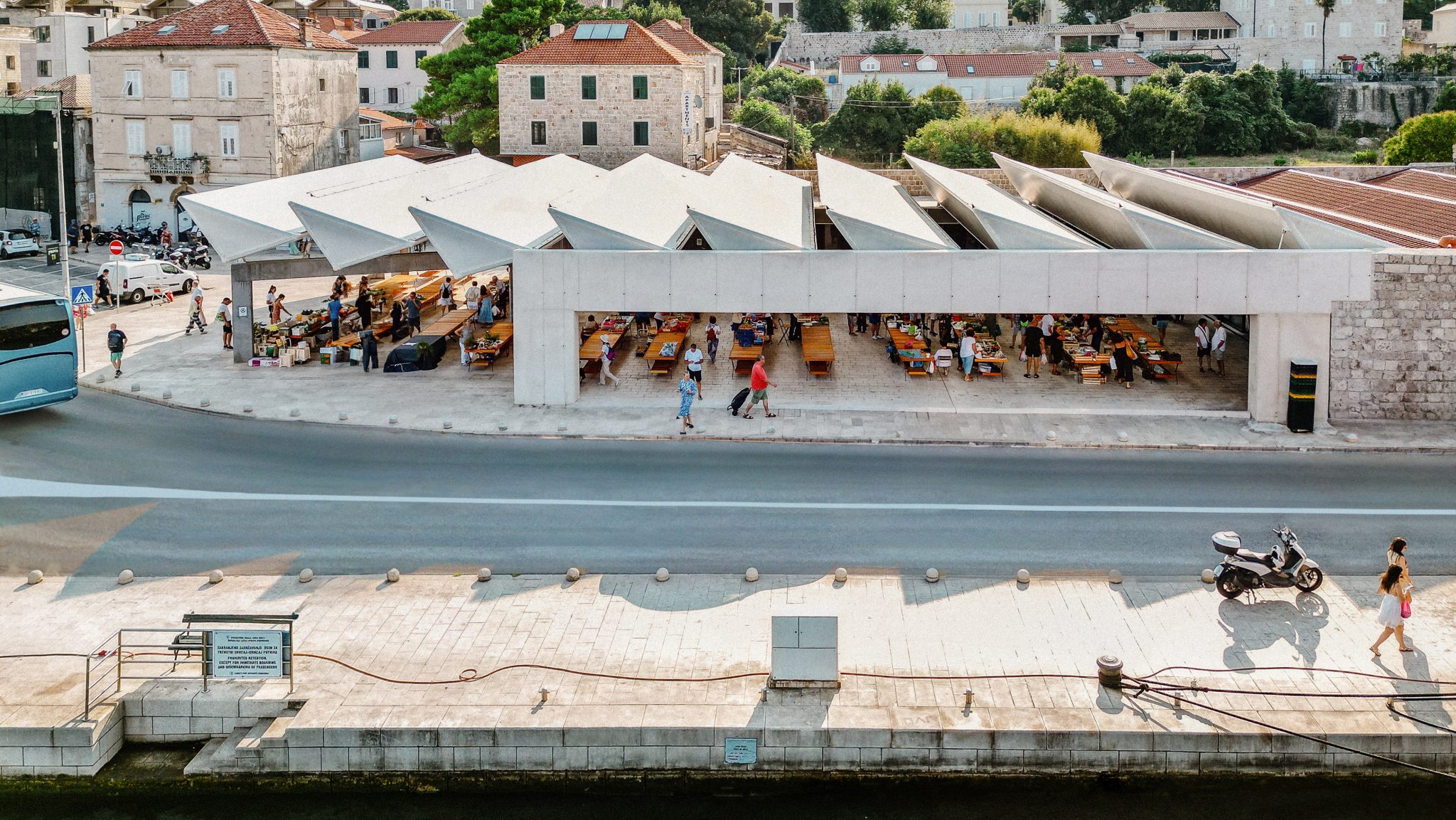
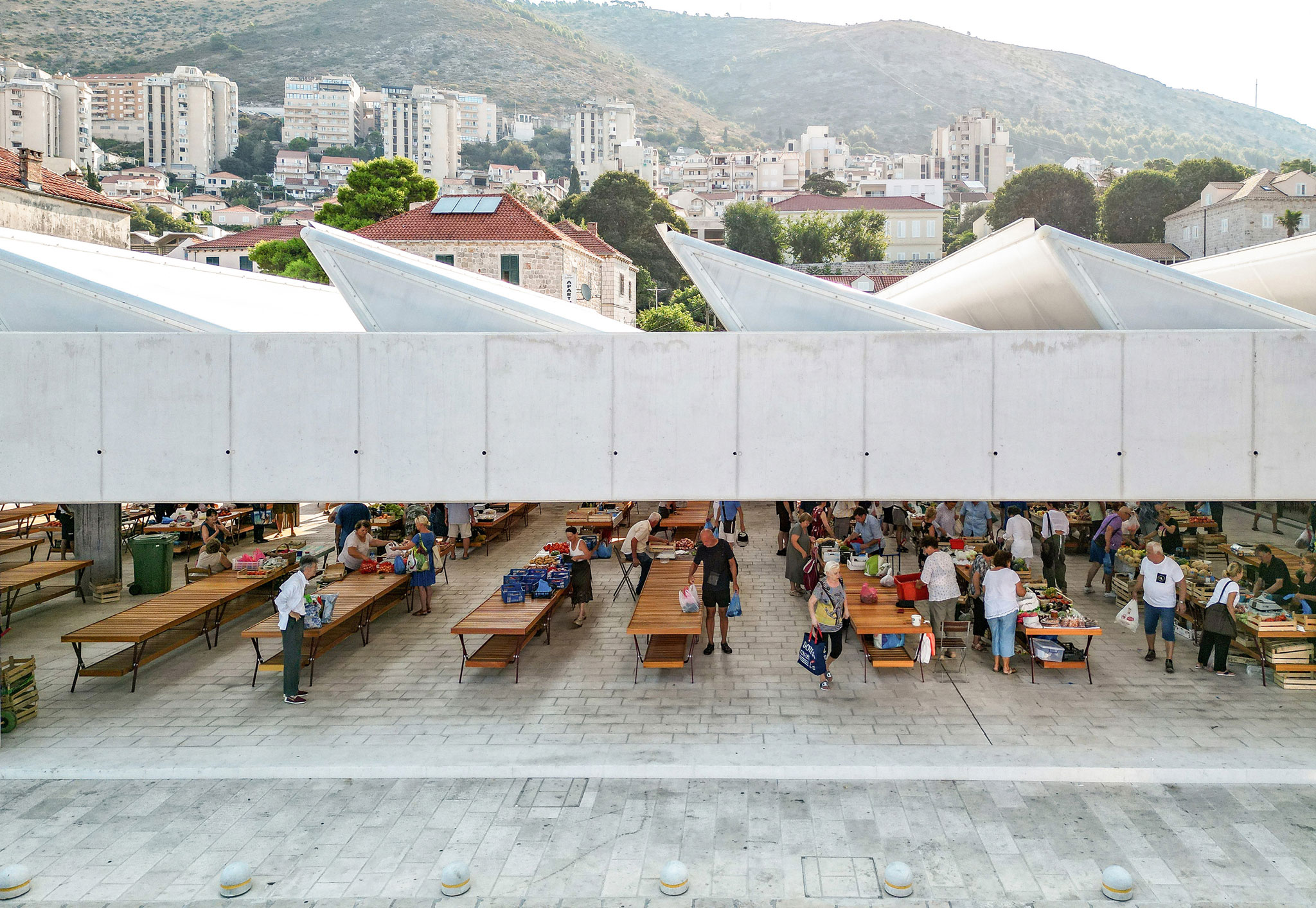
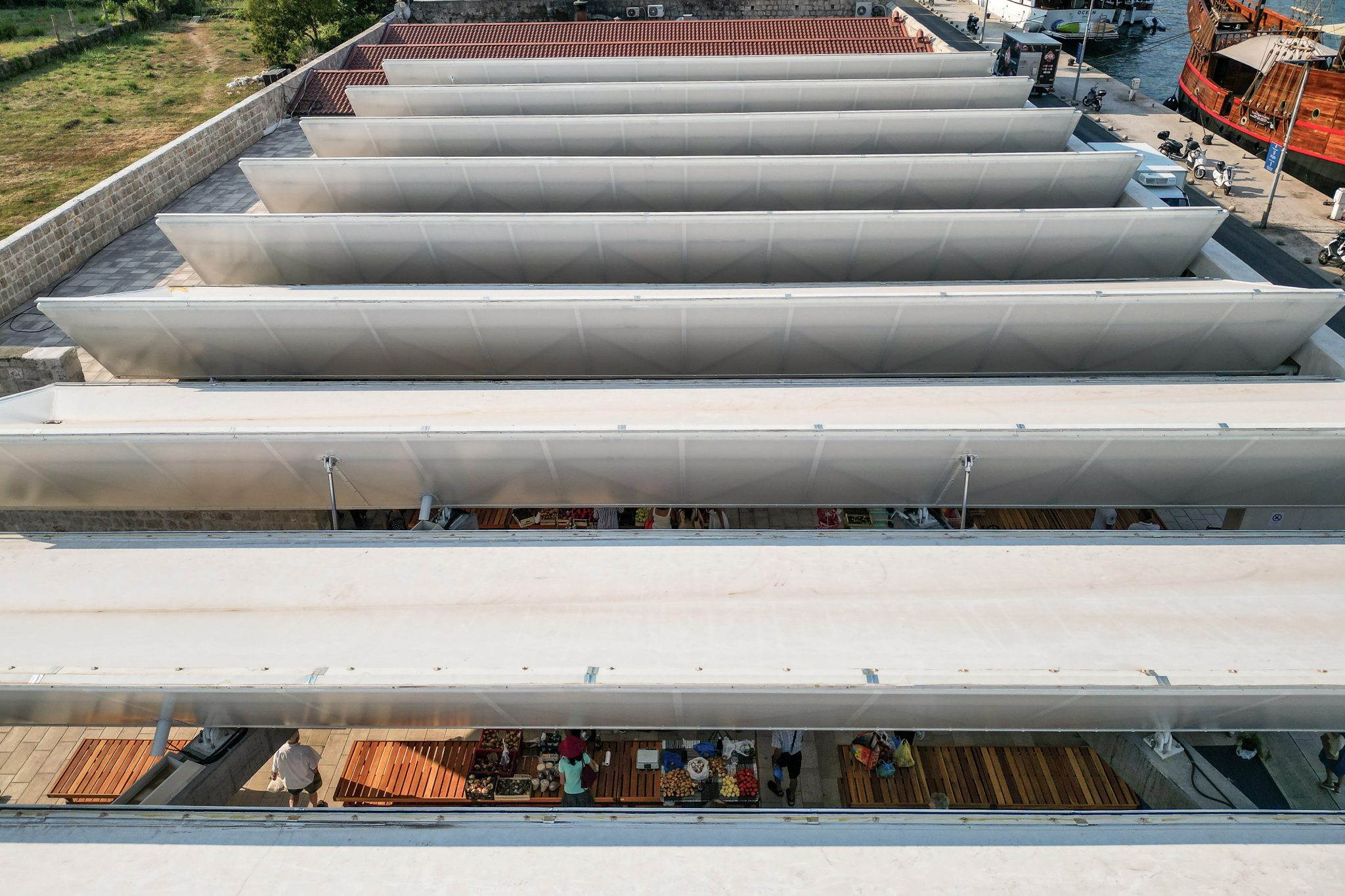
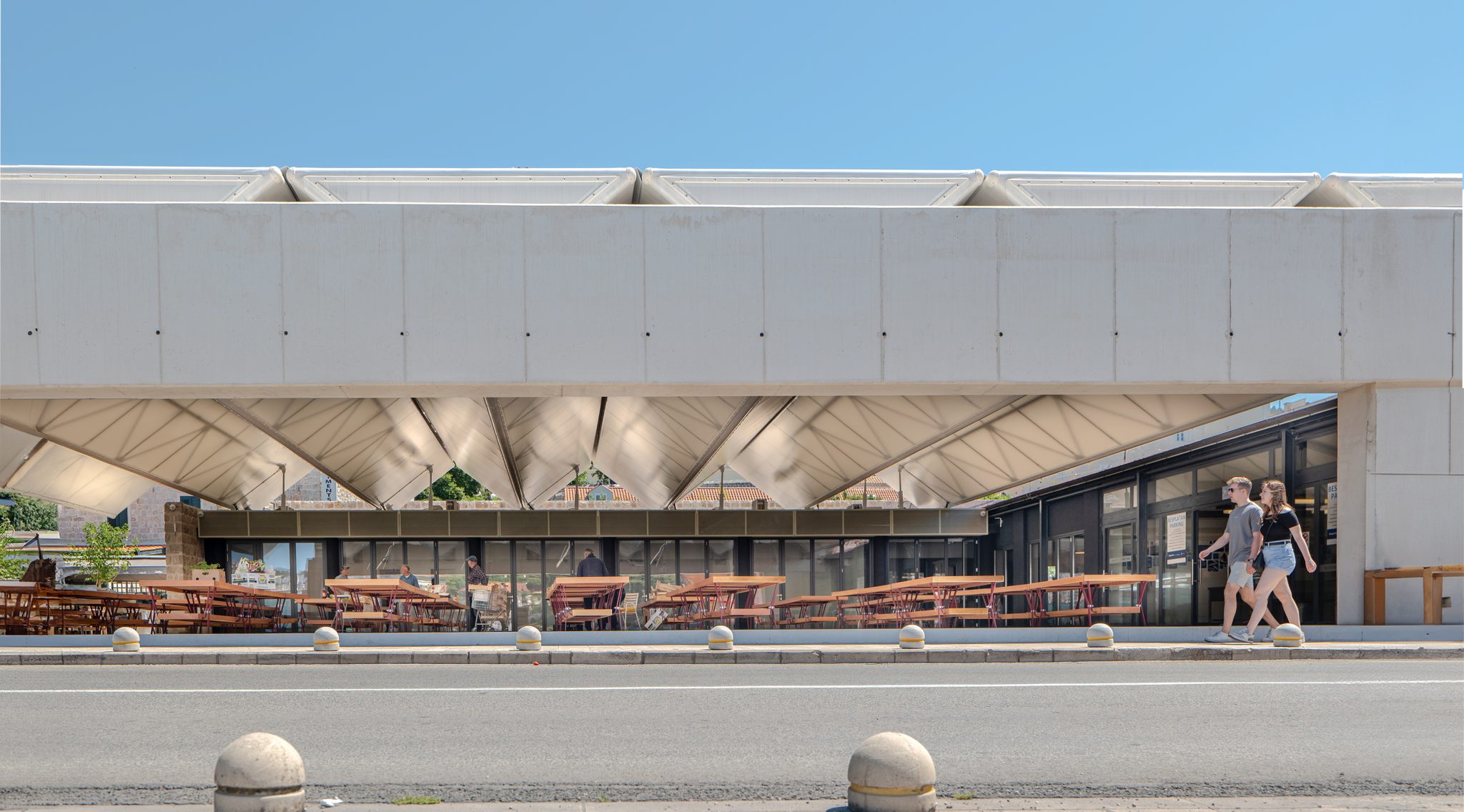
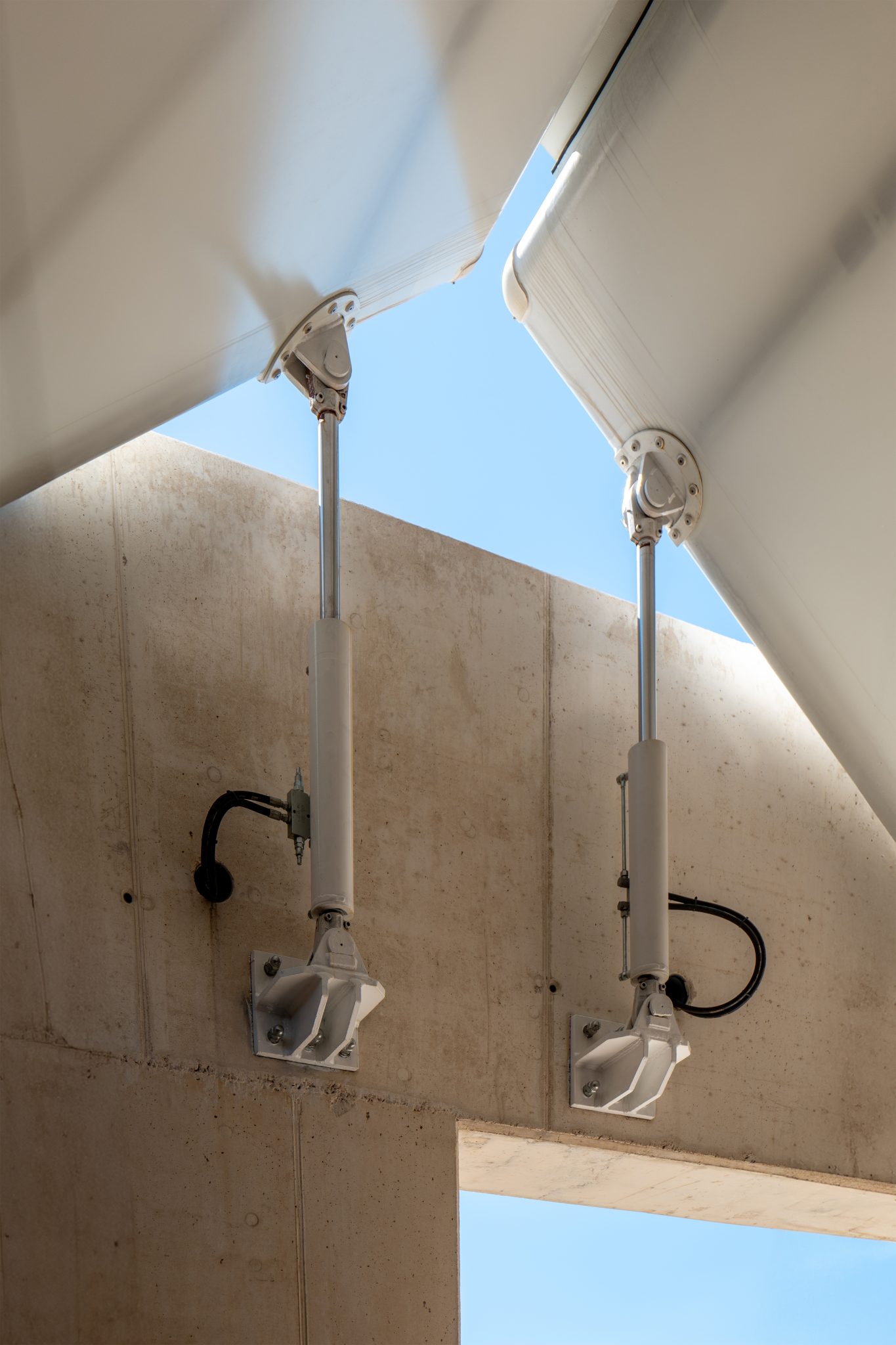
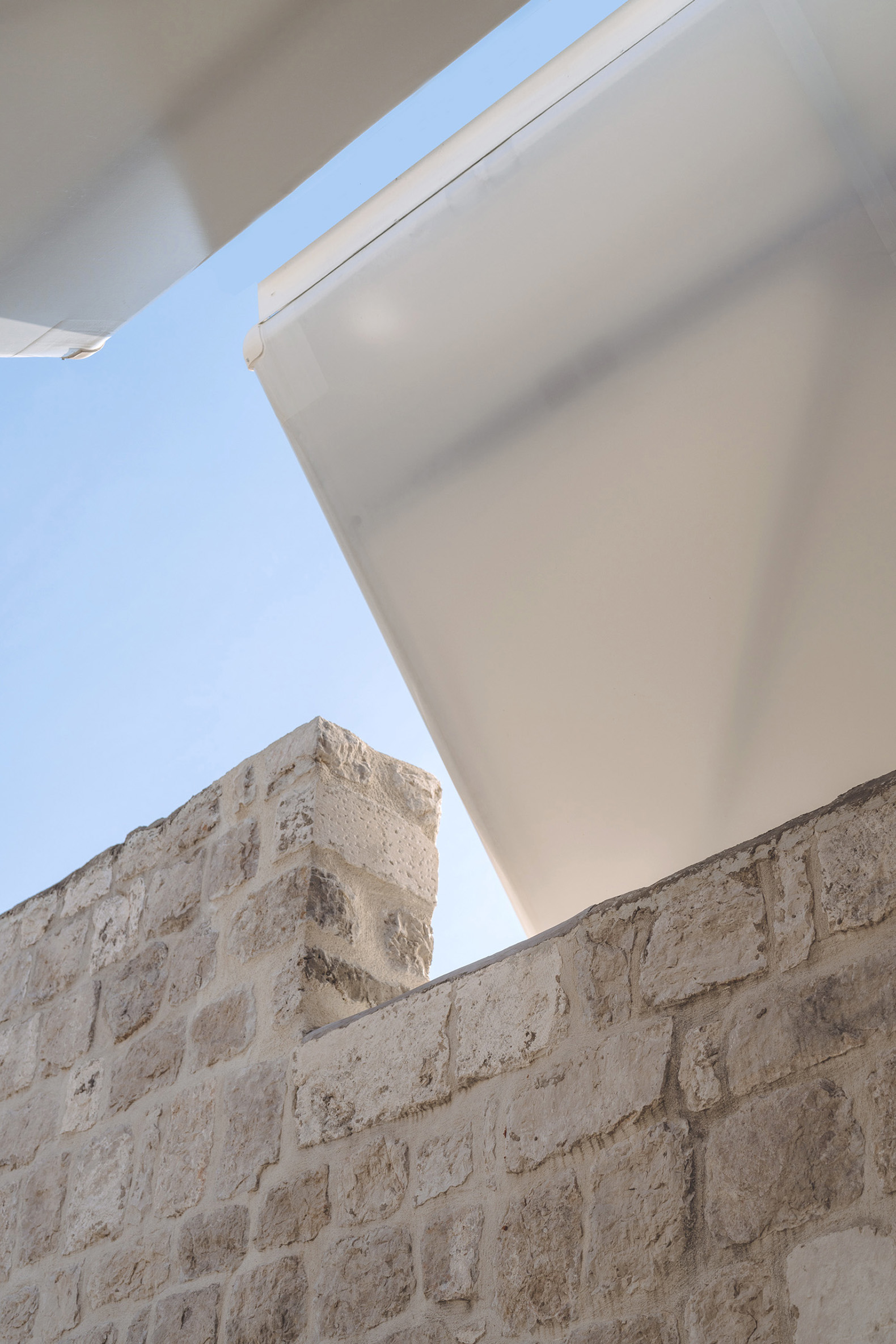
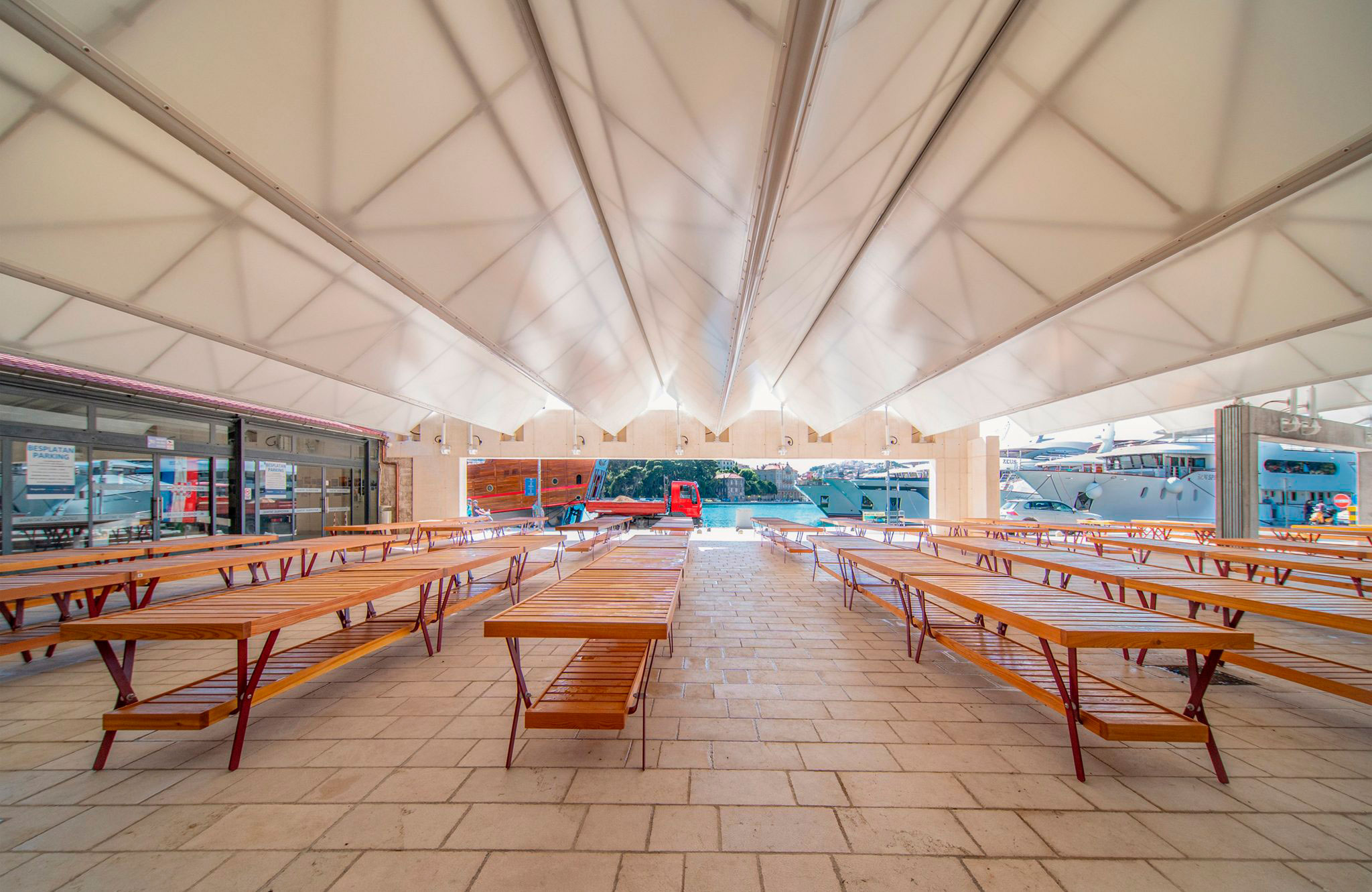
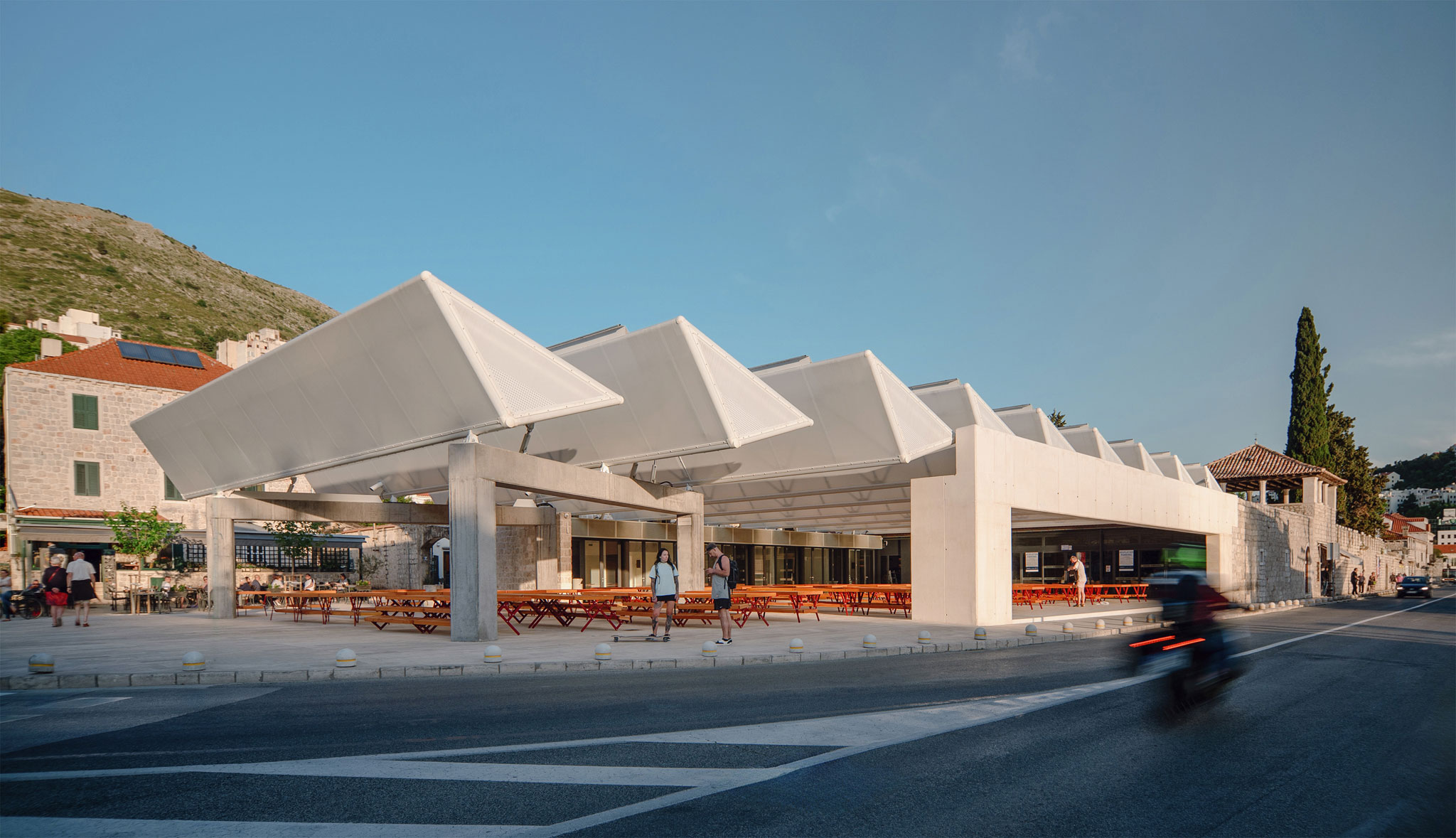
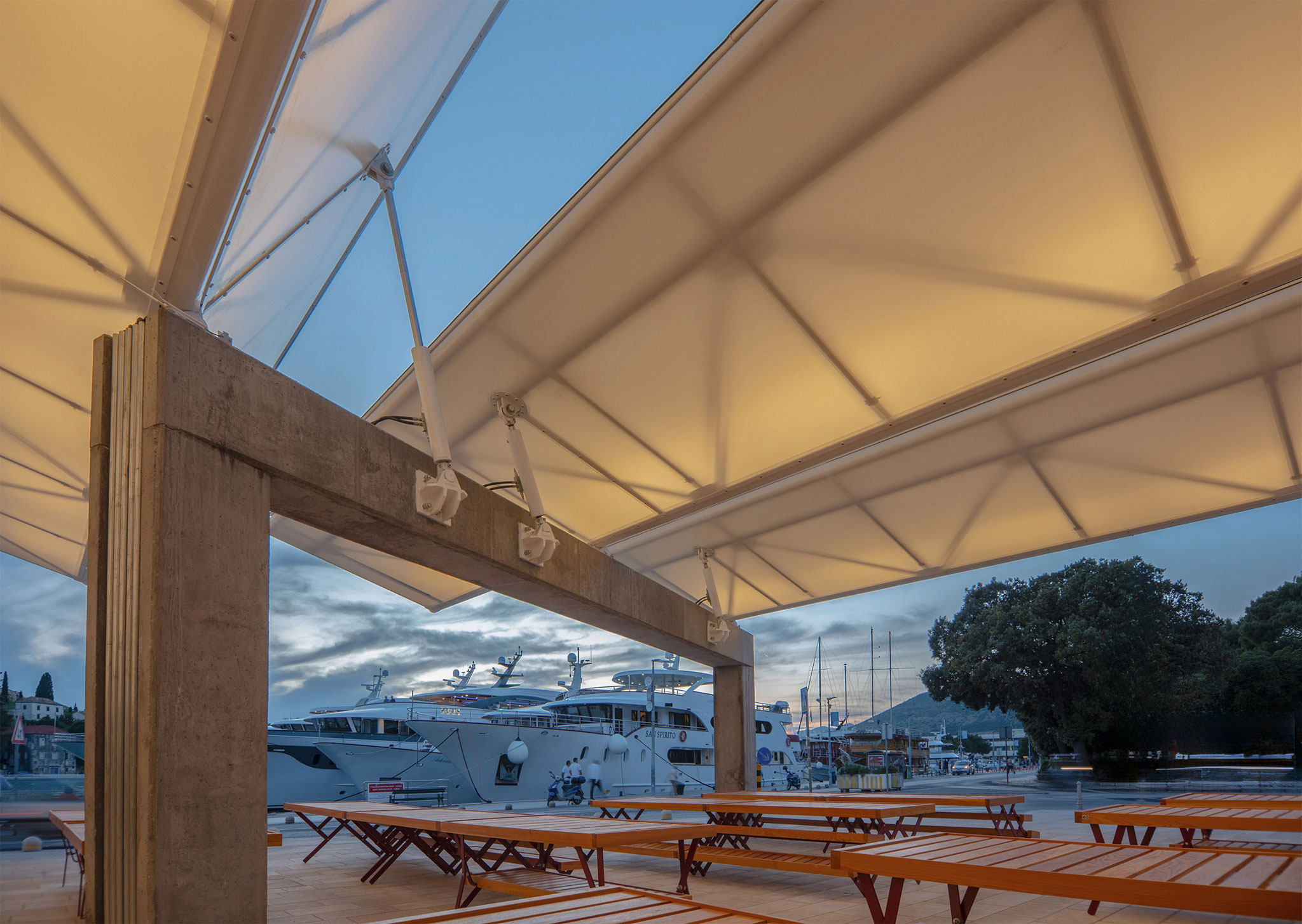
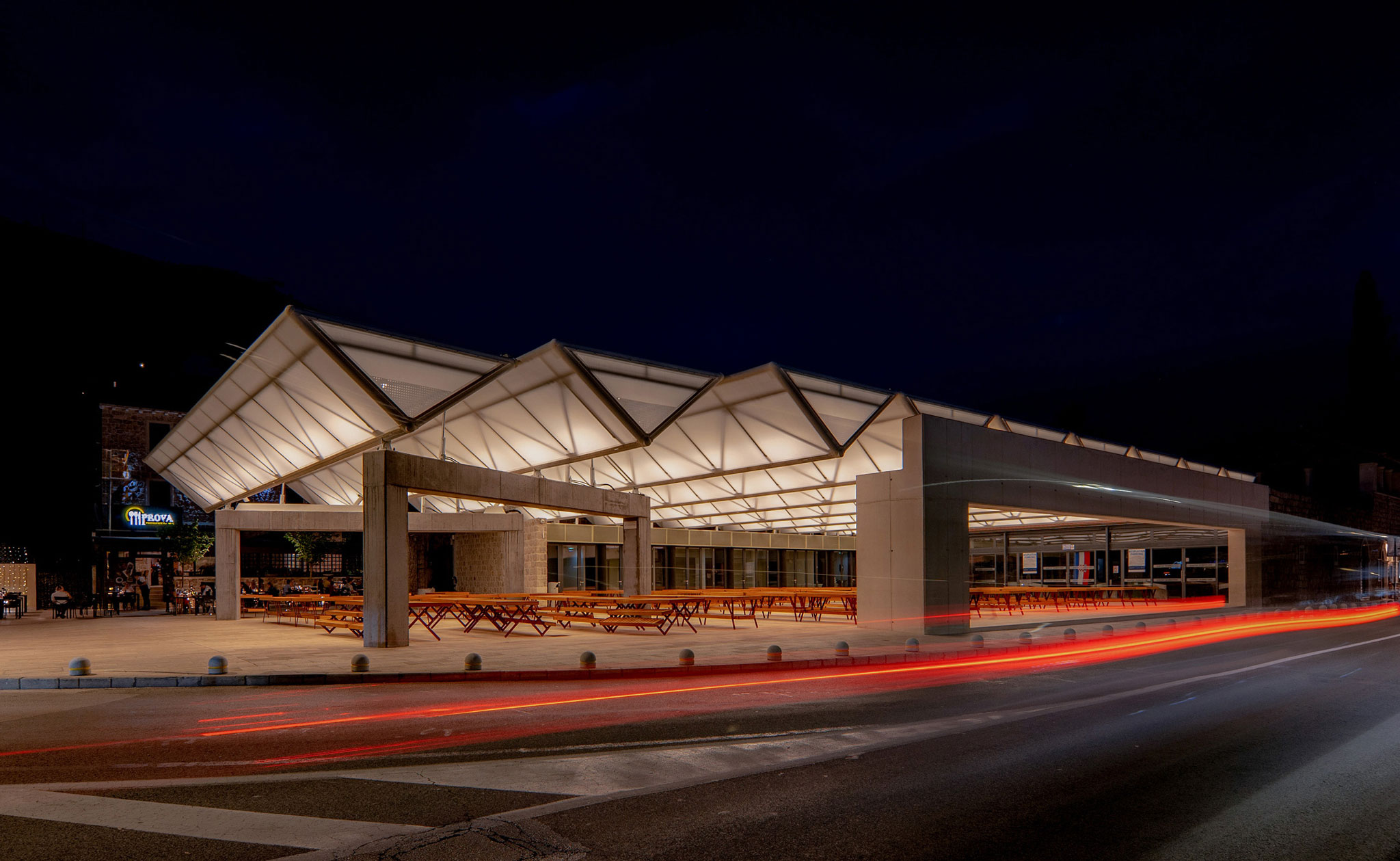
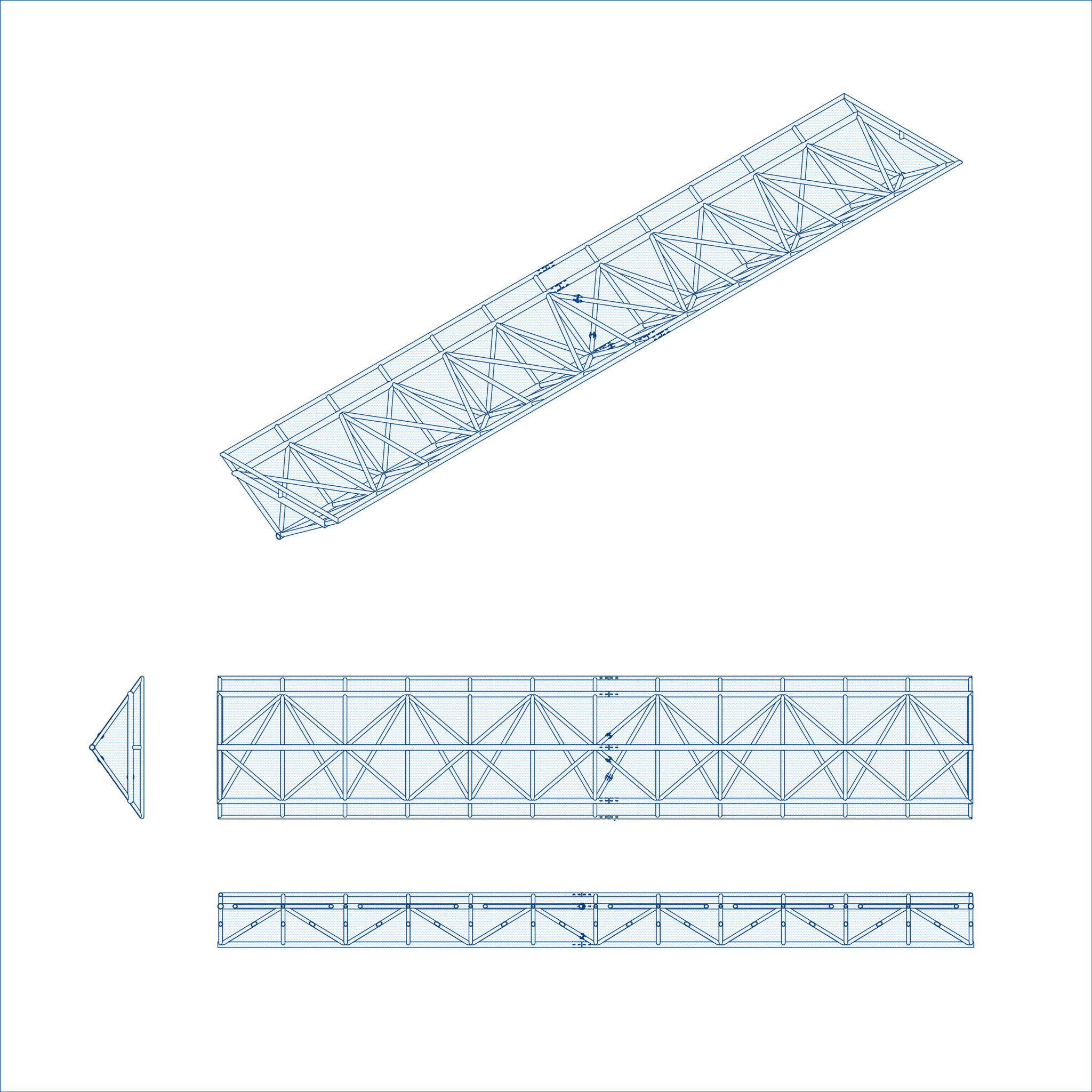
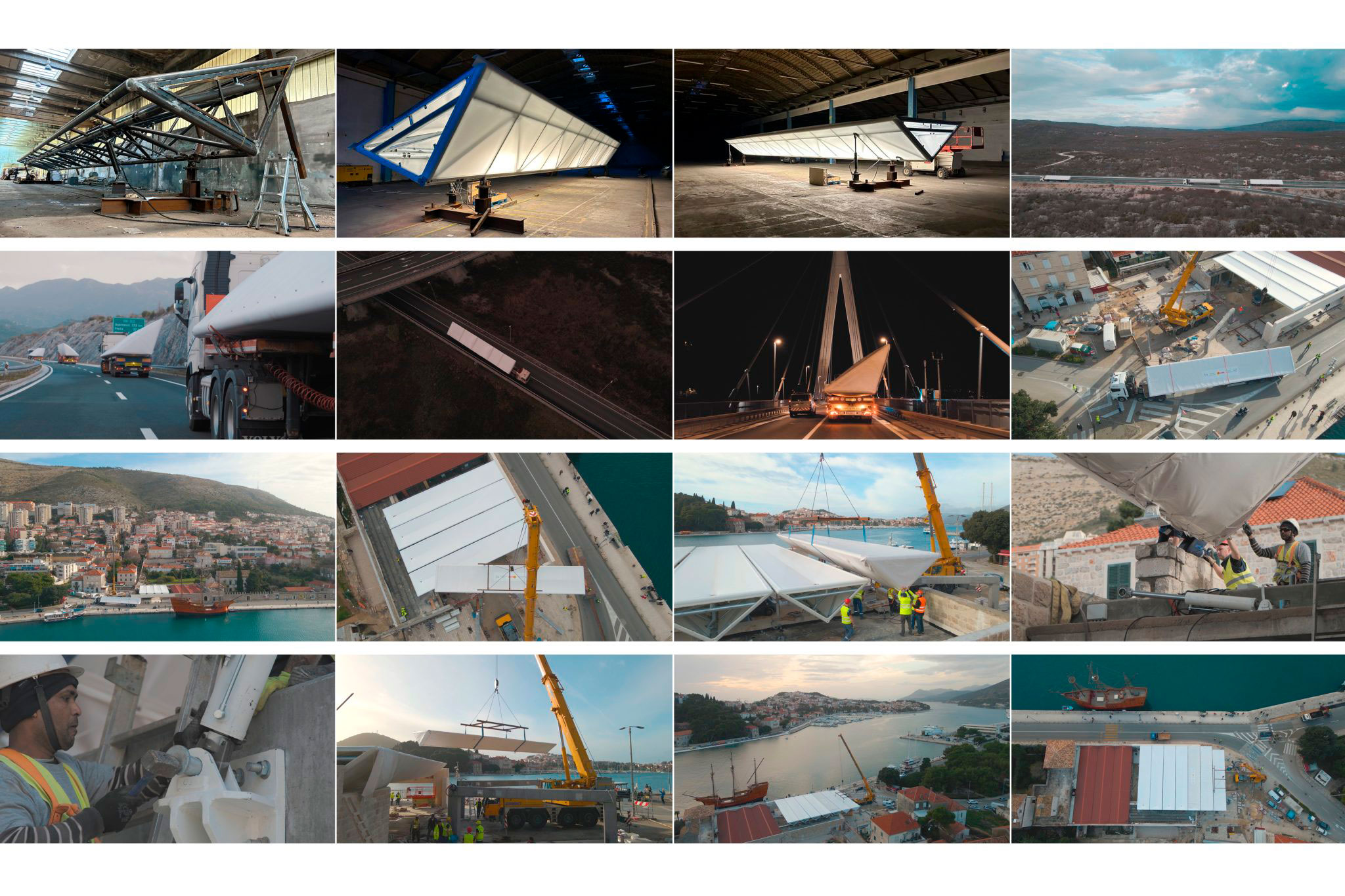
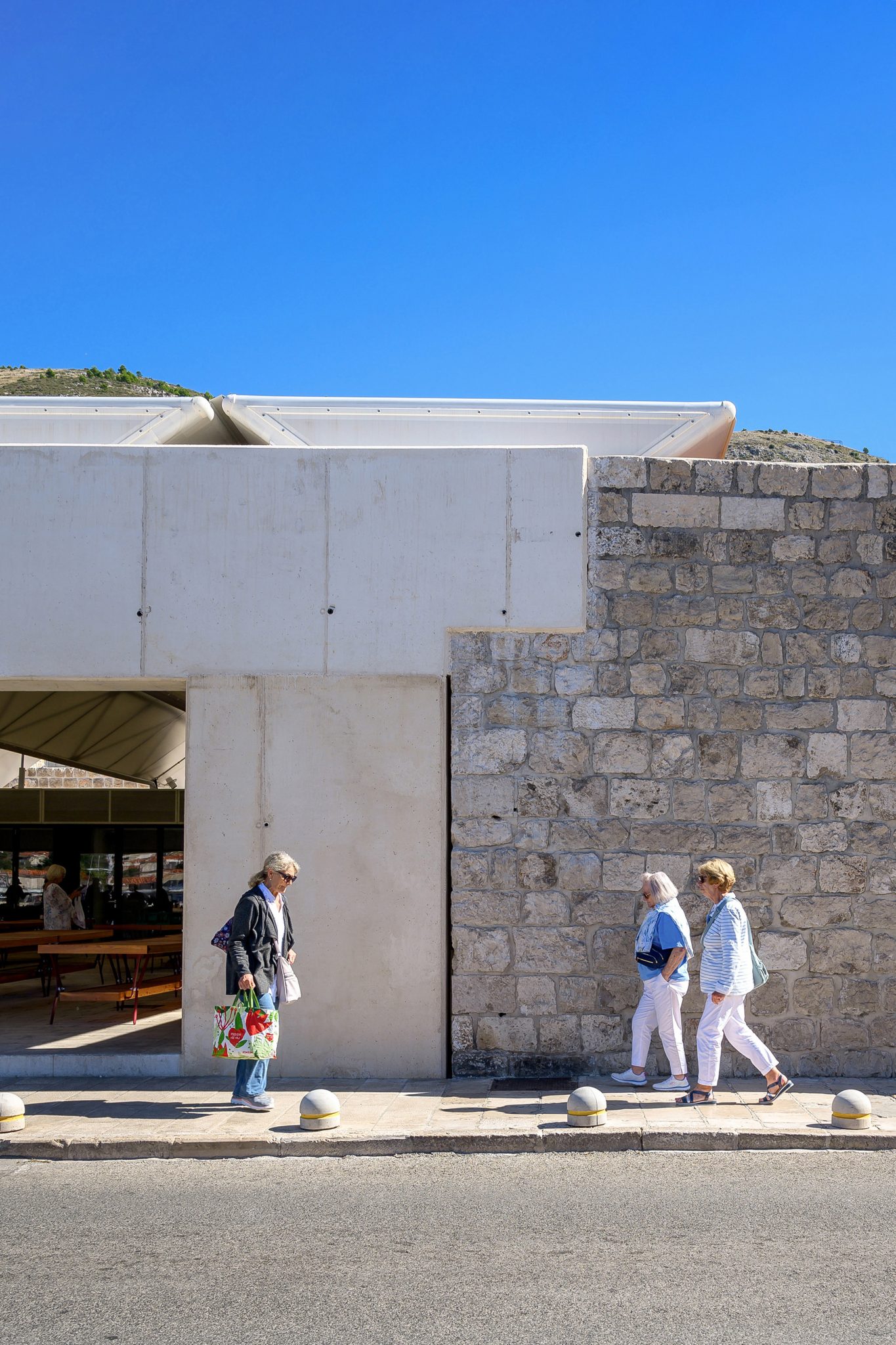
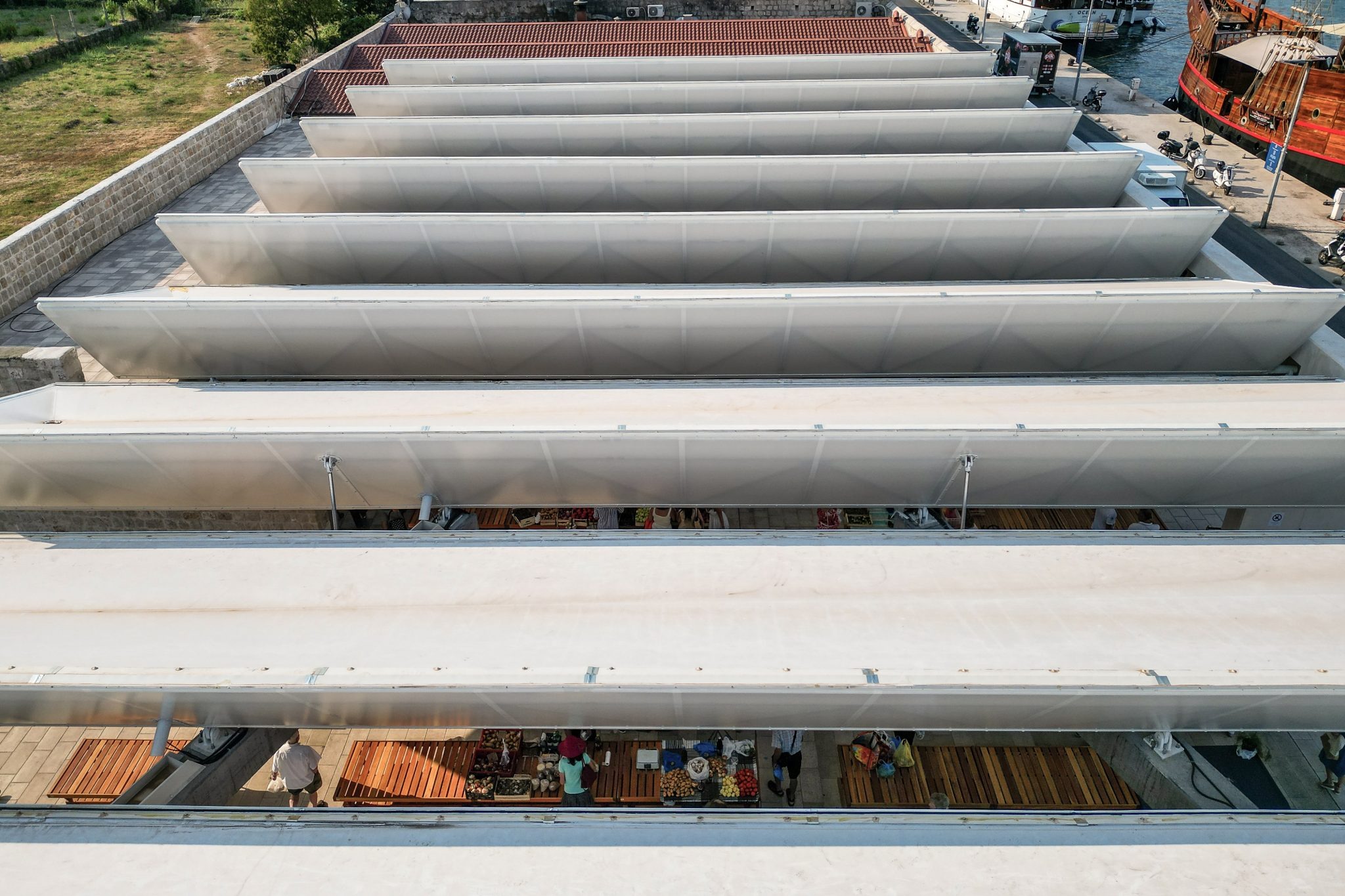
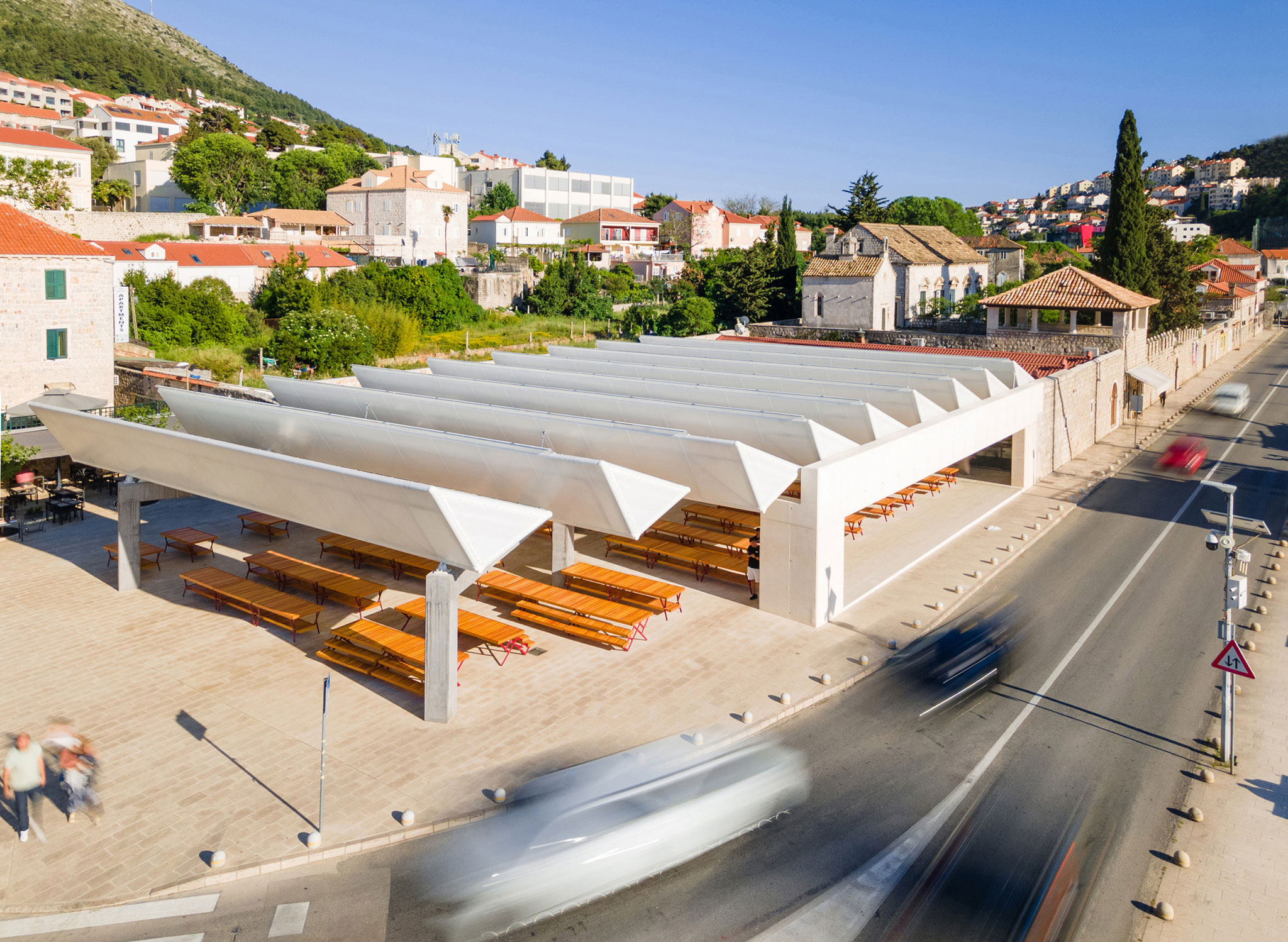
Peračić and Veljačić proposed a simple solution that would facilitate maintenance: a large exposed concrete portico that formally echoes and incorporates the villa's Renaissance façade, accompanied by two smaller structures. These structures, along with a small annexe, support nine triangular steel beams, rotated by hydraulic mechanisms, and clad with translucent, permeable textile membranes (only the top layer being waterproof).

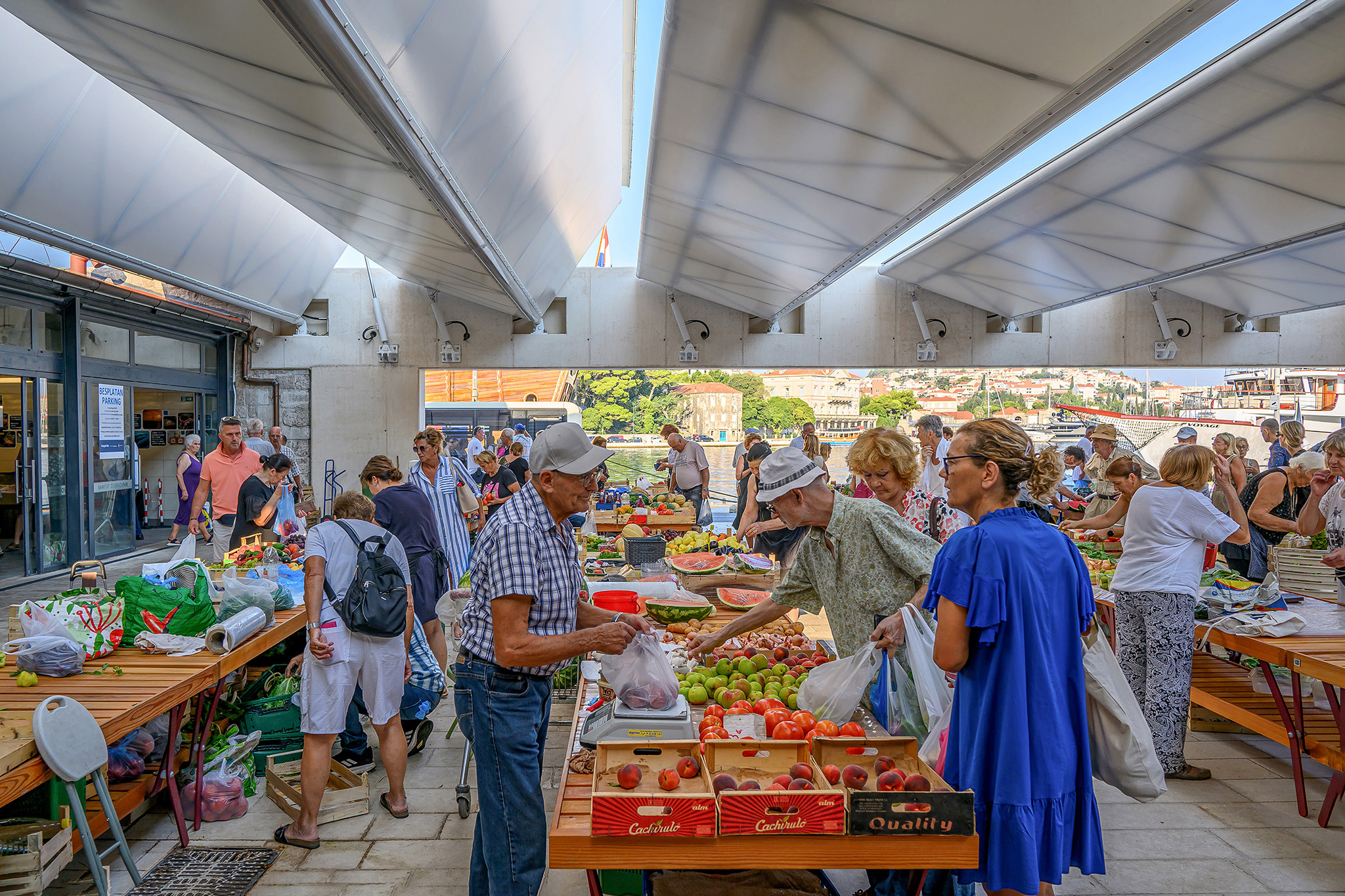
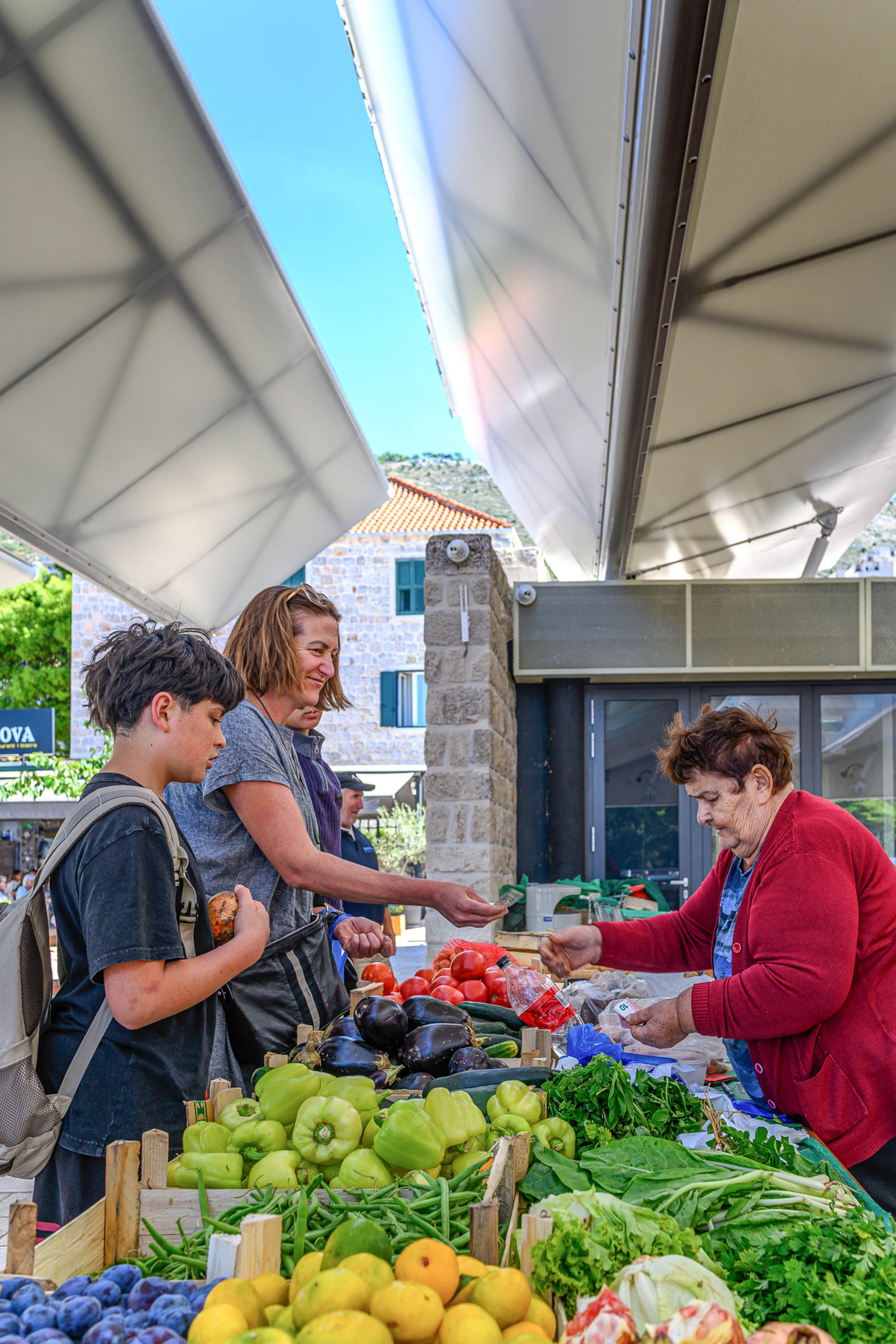
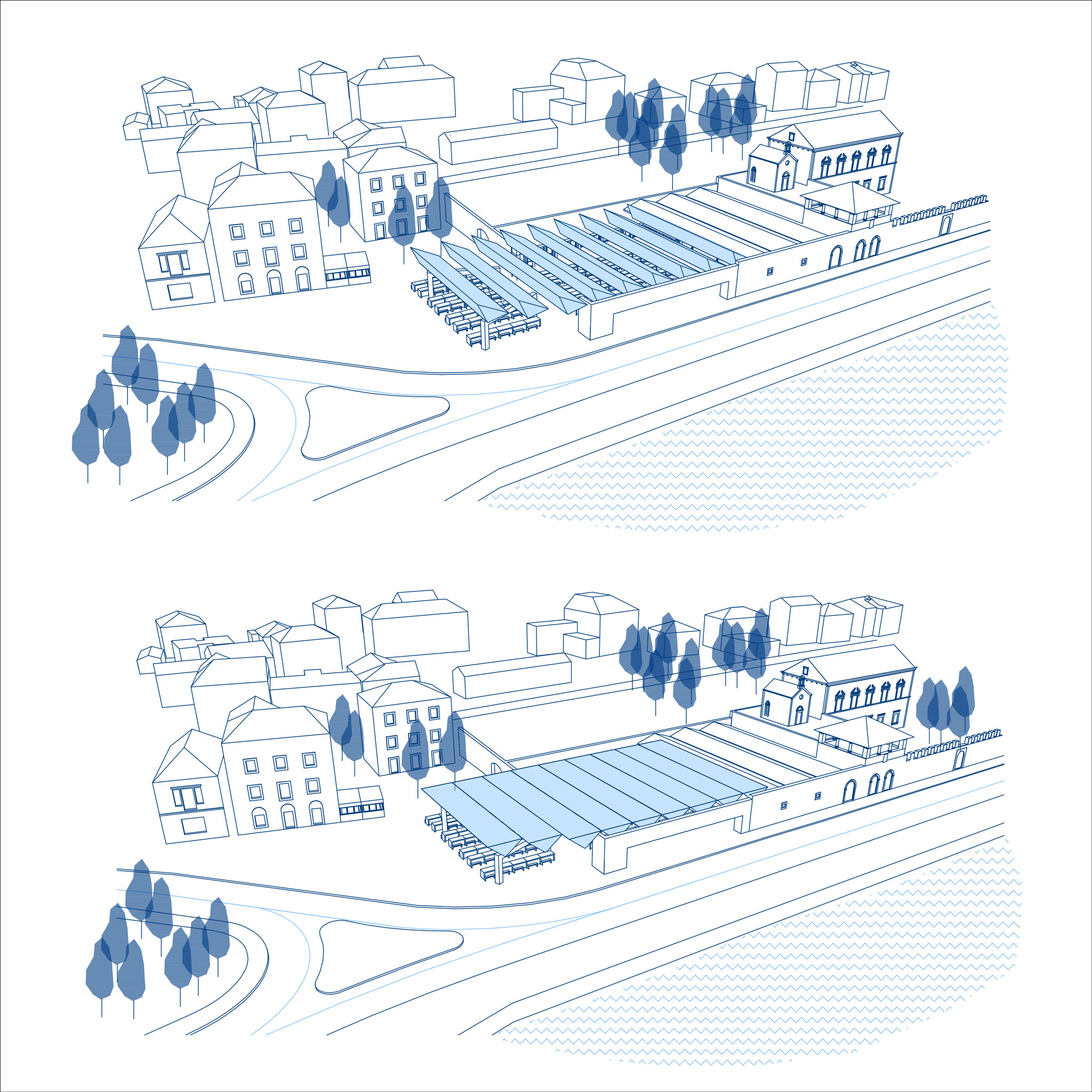
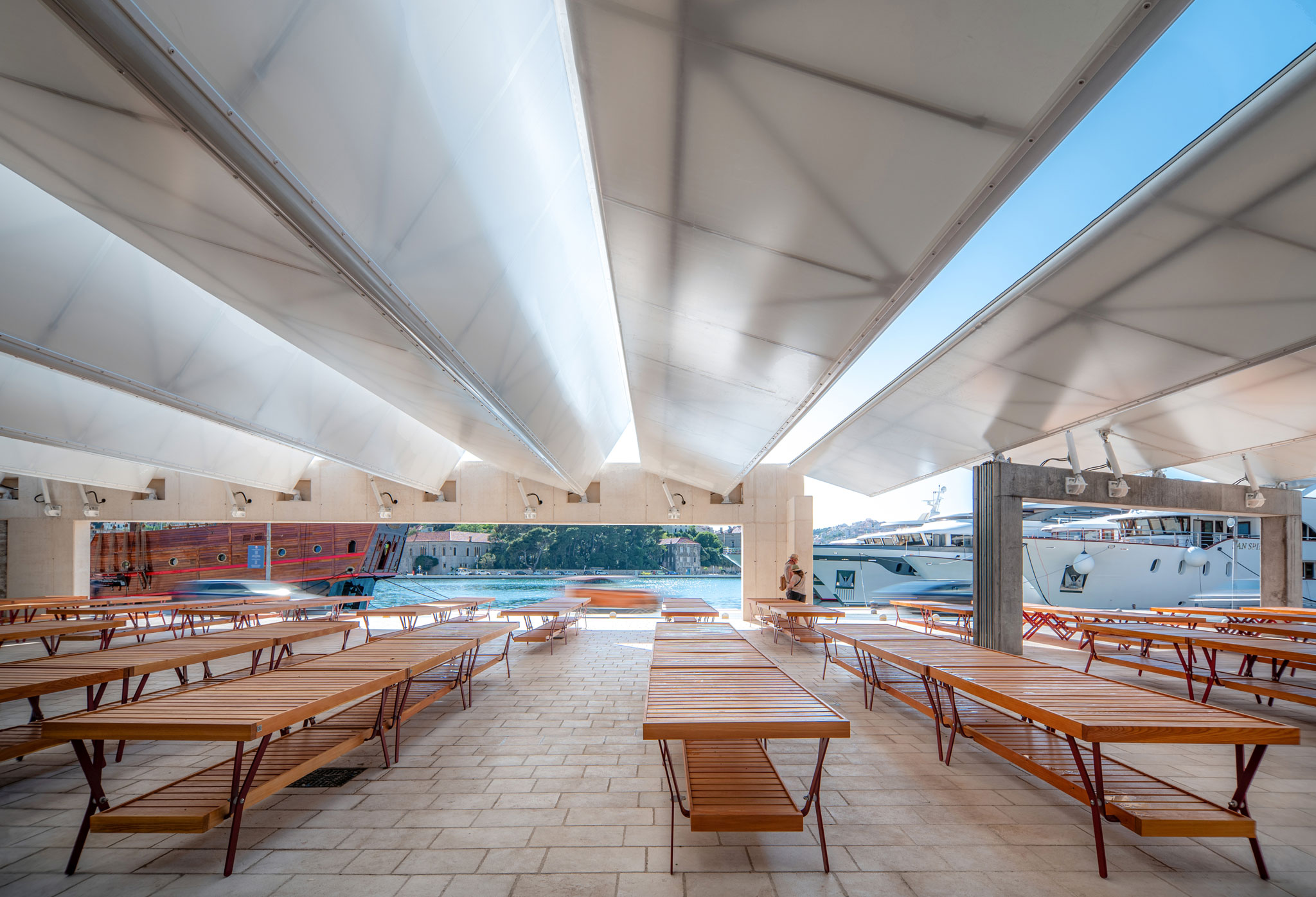
In its normal position, the roof opens, allowing airflow, and closes when it rains or there is strong wind. The resulting structure filters daylight and expands its illumination at night.
Market Gruž by ARP / Peračić-Veljačić. Photograph by Dragan Novaković / Pixel.
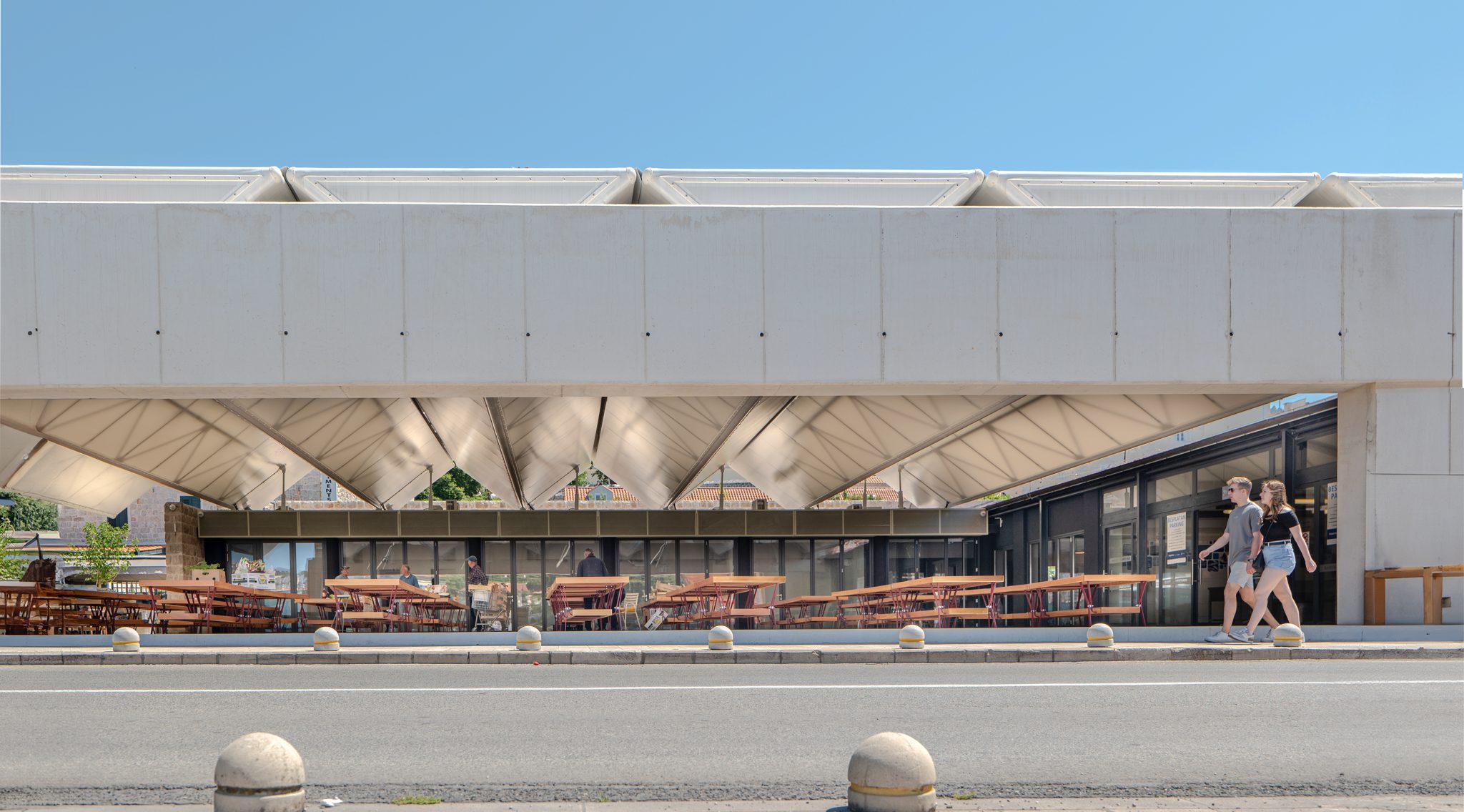
Market Gruž by ARP / Peračić-Veljačić. Photograph by Dragan Novaković / Pixel.

Mercado de Gruž por ARP / Peračić-Veljačić. Fotografía por Tonći Plazibat / Cropix.  Market Gruž by ARP / Peračić-Veljačić. Photograph by Tonći Plazibat / Cropix.

Market Gruž by ARP / Peračić-Veljačić. Photograph by Tonći Plazibat / Cropix.

Project description by ARP / Peračić-Veljačić

We gave our old town to tourists and were afraid to dream of the new one. Is this the moment when, once again, we can imagine the town that we want to live in? Can a new market on the waterfront be the beginning of a new town centre?

Standing on the shoulders of previous generations and the wings of a great past, we cannot be small. A dialogue with a grand Renaissance villa on the best part of the coast requires much respect, but even more character.

Nothing is as optimistic as the Mediterranean climate. Each and every one of our spaces is a plaything of the sun and the winds.

Market Gruž by ARP / Peračić-Veljačić. Photograph by Dragan Novaković / Pixel.  Mercado de Gruž por ARP / Peračić-Veljačić. Fotografía por Dragan Novaković / Pixel.
Market Gruž by ARP / Peračić-Veljačić. Photograph by Tonći Plazibat / Cropix.

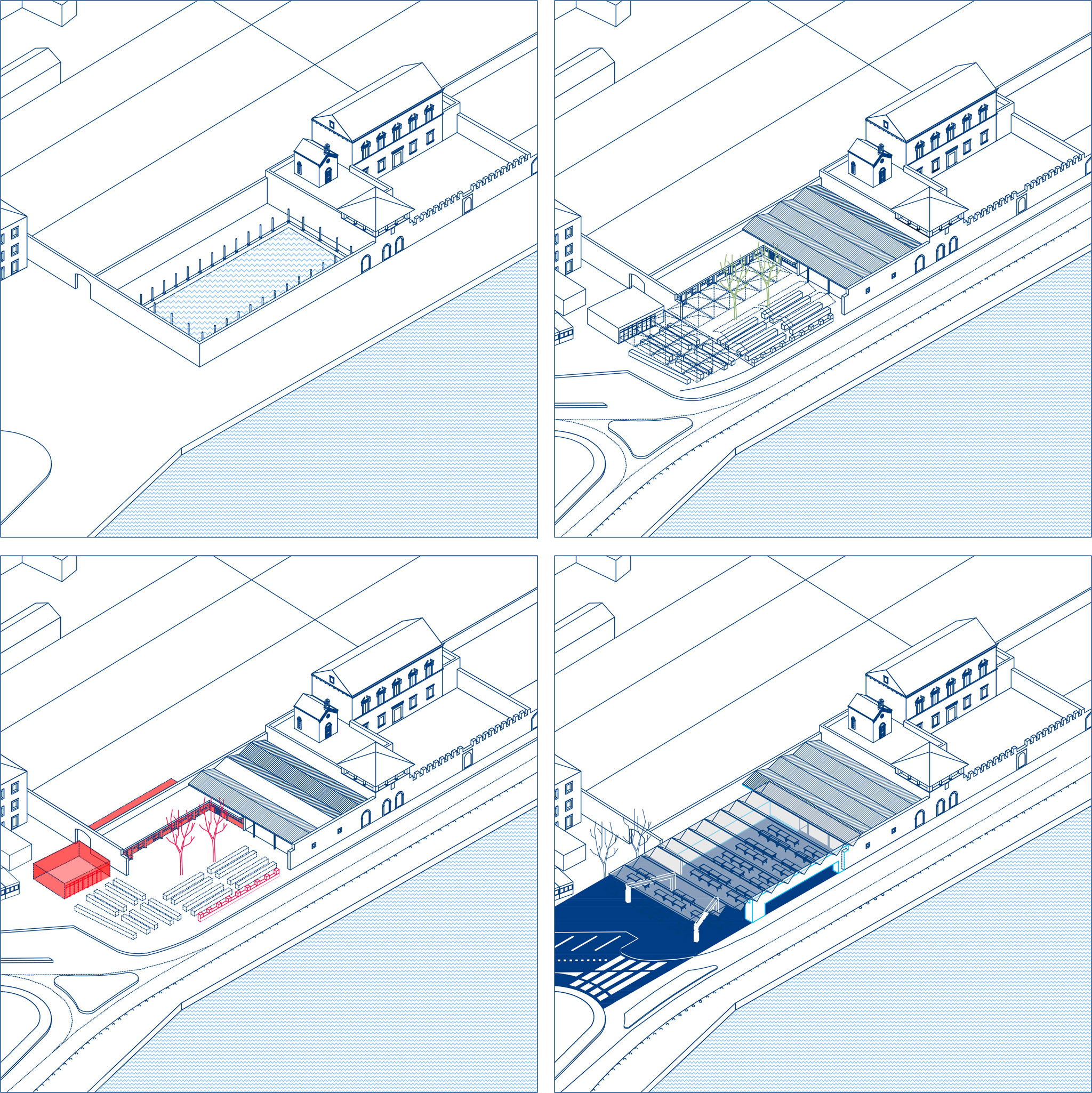
In the 16th century, Paladin Gundulić, a nobleman, tradesman and skilful diplomat from Dubrovnik, built a grand villa surrounded by gardens and enclosed by high walls in the best place in the Gruž Bay. The front wall on the very sea edge was almost 150 meters long. In later centuries, the waterfront was built in front of the villa. Within the walls, some houses were added for varied purposes that changed with time. 

In 1938, a market was built in the northwestern part, on the site of a fishpond, that later expanded into the surrounding public space. Since that time, it has been the central town market and fish market of Dubrovnik. The fish market has recently been renovated, but the area where fruit, vegetables and flowers are sold remained unchanged.
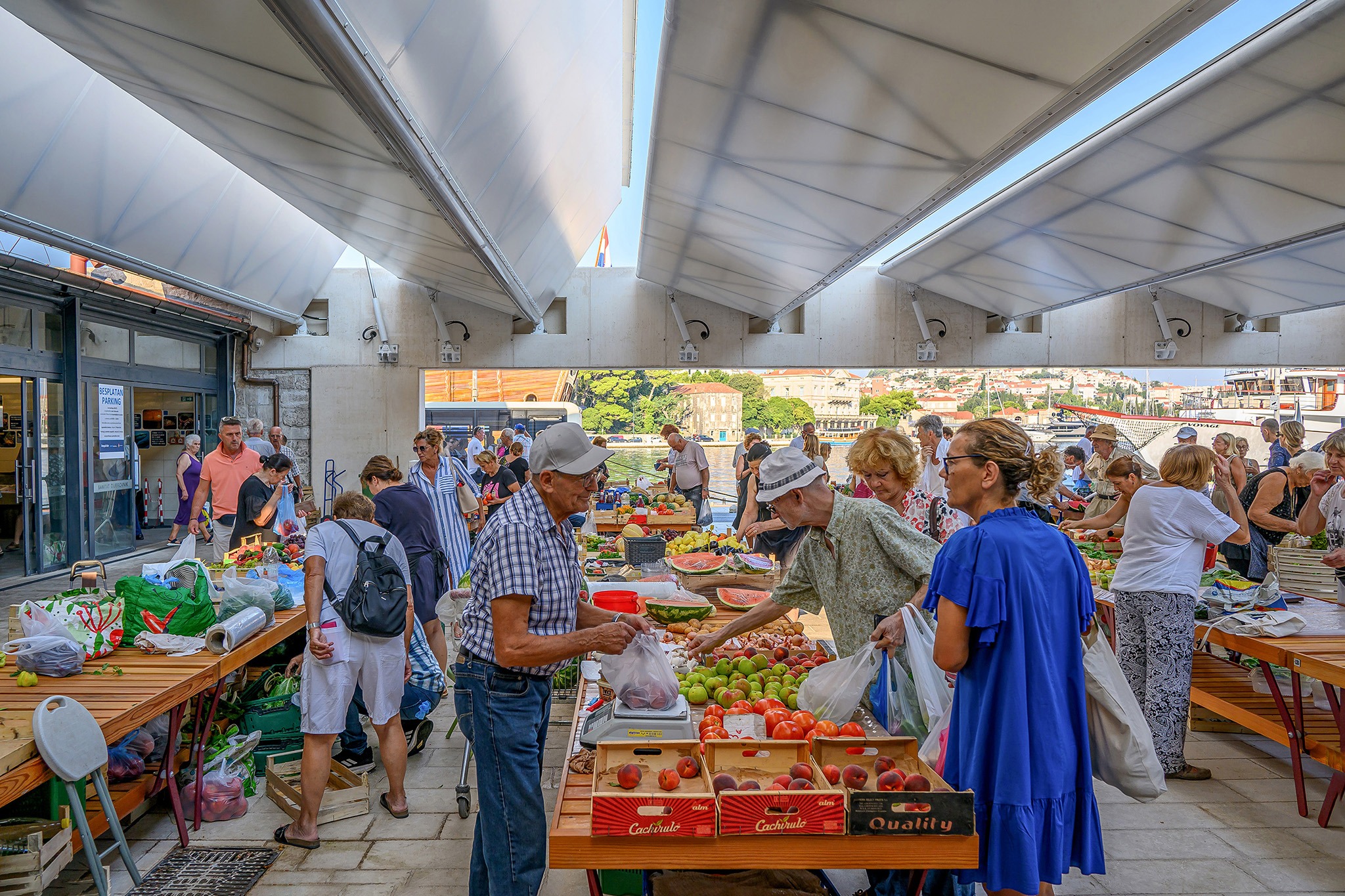
Market Gruž by ARP / Peračić-Veljačić. Photograph by Tonći Plazibat / Cropix.

An overhang was supposed to be built above the market as protection from the sun and rain. The construction of the overhang turned into a renovation of the entire urban complex. On one hand, the villa that had lost one of its corners because of the market was supposed to regain its monumental format and unobstructed views. On the other hand, the market, as a vital and relevant town feature, recognized by generations of Dubrovnik citizens as a part of their everyday life and urban identity, was supposed to be reconstructed as an important and complete public building. 

The covering of the market was meant to affirm and restore the heritage, organize the surrounding public spaces, and at the same time connect parts of the market both inside and outside of the historical walls into one spatial entity. The roof needed to remain low enough so that the elevated parts of the villa would be visible from the waterfront, while also being high enough to ensure the space was airy, naturally ventilated, and designed as a modern public space. The single roof needed to resolve all surrounding spatial relations and link together the historical layers of the square.
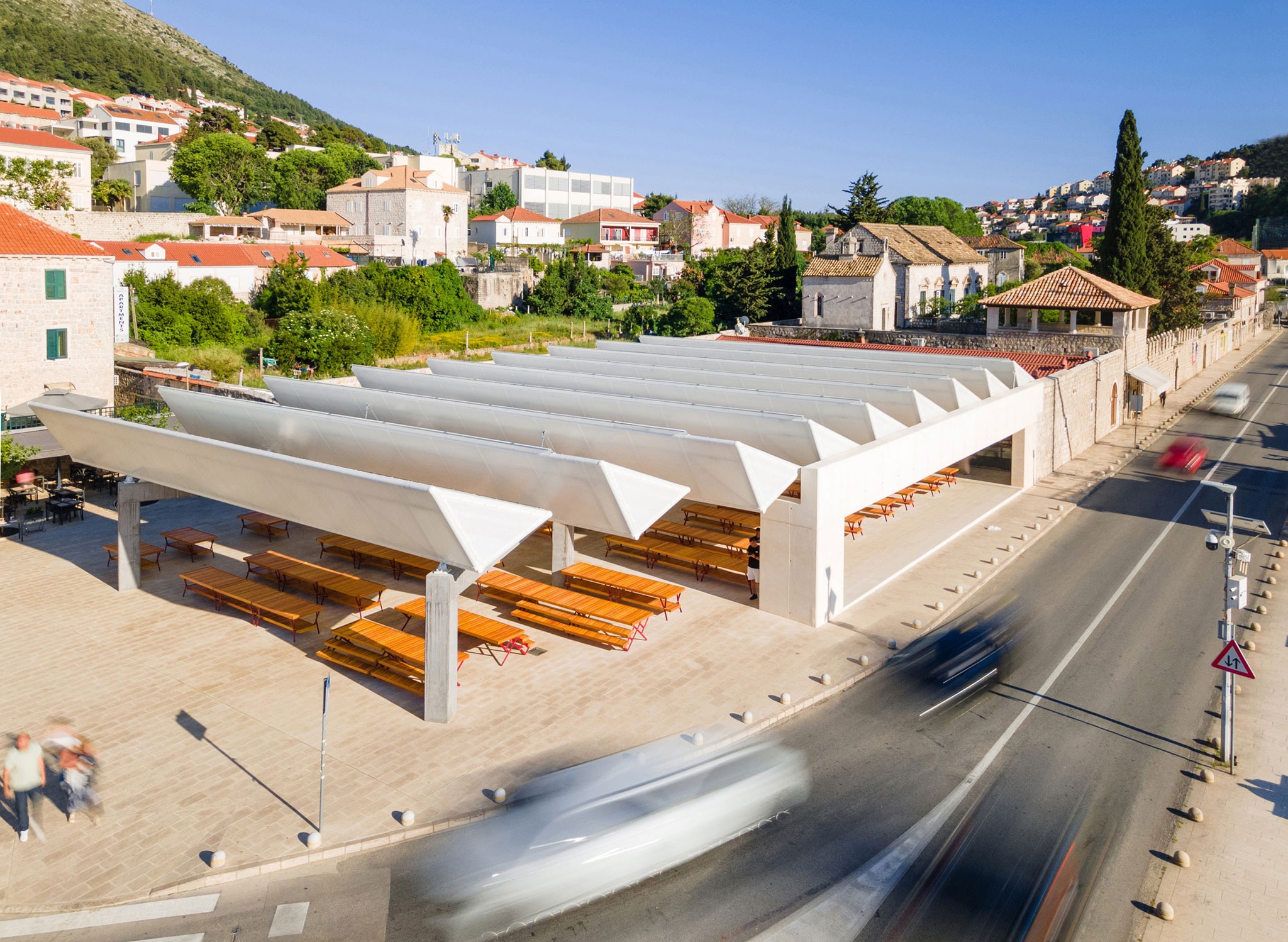
Mercado de Gruž por ARP / Peračić-Veljačić. Fotografía por Dragan Novaković / Pixel.
Market Gruž by ARP / Peračić-Veljačić. Photograph by Dragan Novaković / Pixel.

A series of large movable awnings resolved protection from sun, wind and rain. Ten identical triangular awnings, wrapped in fabric that enables light transmission, were installed within and outside of the villa's contours. In that way, the market space is a unified, compact public building. When opened, the awnings let light and air pass through without obstructing the view of the heritage building. If it rains, they can be closed by slow hydraulically driven rotation. The space under remains well-lit and airy, yet still protected from the weather conditions. Prismatic volumes of the awnings illuminated from within provide light for the entire market.
More information

Label
Architects
Text

ARP / Peračić-Veljačić. Architects.- Dinko Peračić - Miranda Veljačić.

+ + copy Created with Sketch.
- + copy Created with Sketch.
Label
Project team
Text

Ivan Begonja, Mia Vučić, Špiro Grubišić, Domagoj Bolanča, Ena Vladislavić, Emanuela Tomelić, Martin Sarić, Bruna Maslov, Dorotea Miličić, Dea Dragičević.

+ + copy Created with Sketch.
- + copy Created with Sketch.
Label
Collaborators
Text

Structure.- Tihomir Šimunović - Kuzmanić & Šimunović projekt.
Lighting.- Zoran Kovačić - Lightcom.
Market stalls.- Nikola Radeljković - Numen/For Use.
Installations.- TUB, EKP.
Fire Safety and Accessibility.- Termozop.
Building physics.- AdapTEH. 
Awning.- Belina. 
Construction management.- Magnum Supra. 
Project management.- Dimenzija projekt.

+ + copy Created with Sketch.
- + copy Created with Sketch.
Label
Client
Text

Sanitat Dubrovnik.

+ + copy Created with Sketch.
- + copy Created with Sketch.
Label
General Contractor
Text

Magnum Supra, Belina-awning

+ + copy Created with Sketch.
- + copy Created with Sketch.
Label
Builder
Text

Tihomir Šimunović / Kuzmanić & Šimunović projekt, Belina.

+ + copy Created with Sketch.
- + copy Created with Sketch.
Label
Area
Text

Site area.- 1,612.70 m².
GFA.- 692.70 m².

+ + copy Created with Sketch.
- + copy Created with Sketch.
Label
Dates
Text

Year designed.- 2016-2022. 
Year completed.- 2024.

+ + copy Created with Sketch.
- + copy Created with Sketch.
Label
Location
Text

Gruž. Obala Stjepana Radića, 21. 20000 - Dubrovnik, Croatia.

+ + copy Created with Sketch.
- + copy Created with Sketch.
Label
Cost
Text

2,830 €/m².

+ + copy Created with Sketch.
- + copy Created with Sketch.
Label
Photography
+ + copy Created with Sketch.
- + copy Created with Sketch.

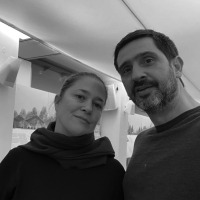
Dinko Peračić was born in Split in 1977, where he graduated from the Classical Gymnasium. He is an architect from the Faculty of Architecture, University of Zagreb (2001) and got his master’s degree at IAAC in Barcelona (2005). He is the founder of the Architects’ Collective Platforma 9.81 and a partner in Architects’ Office ARP. He has worked as an assistant at the Faculty of Civil Engineering, Architecture and Geodesy in Split since 2008, and in 2016, he was appointed an associate professor at the Architectural Design Department.

He is the author of a series of architectural projects, with a particular focus on public spaces and buildings, especially cultural facilities. Among the completed projects, notable ones include the Faculty of Civil Engineering building in Osijek, the Market and Fish Market in Vodice, and the Museum of Modern and Contemporary Art in Rijeka. Other projects, still unrealized, such as the Youth Center in Split, Pogon Jedinstvo in Zagreb, the Market in Dubrovnik, or the Olive House in Tisno, have been more prominently presented to the public.

In 2018, he was awarded the Grand Prix of the Zagreb Salon of Architecture; in 2023, he was awarded the Grand Prix of the Zagreb Salon of Applied Arts and design; and three times he was awarded the second prize of the Zagreb Salon (2006, 2009, 2015).   He was also awarded with Piranesi award in 2015, the Architecture Medal and Conceptual Design Medal by the Croatian Chamber of Architects (2016 and 2017). He was also awarded the Bernardo Bernardi Award by the Croatian Association of Architects in 2018 and the Grand Prix BIG SEE 2022.  His works were nominated for many other national and international awards.

He has extensive experience participating in architectural competitions and has won numerous awards. He has taken part in numerous domestic and international architectural and art exhibitions. Through the programs of the association Platforma 9,81, he is involved in various research and public activities related to spatial culture. He serves as a moderator at the Days of Oris symposium in Zagreb (alongside M. Mrduljaš). He was the curator of the Days of Architecture in Sarajevo in 2018. He actively contributes to the public discourse on space and architecture through frequent public lectures, discussions, workshops, actions, published texts, and by judging urban planning and architectural competitions. At the 15th Venice Architecture Biennale in 2016, he represented Croatia as part of a team with M. Veljačić, E. Višnić, and S. Tolj with the work "we need it – we do it". Together with Miranda Veljačić, he held a solo exhibition at the 56th Zagreb Salon of Architecture.

Miranda Veljačić (born 1976, Zagreb) is a Croatian architect (from the Faculty of Architecture, University of Zagreb 2002), researcher, and cultural worker. She is a co-founder, coordinator, and current president of Platforma 9,81, one of the longest-lasting NGOs focused on architectural research and practice related to alternative and youth culture, activism, urbanism, and the heritage of modernity.

Veljačić was an editor of Oris and Čovjek i prostor, two major Croatian architecture magazines. In 2016, she represented Croatia at the Venice Biennale of Architecture together with Dinko Peračić, Emina Višnić, and Slaven Tolj.

In 1999, while still a student, Veljačić co-founded the architectural research association Platforma 9,81 in Zagreb with Dinko Peračić and Marko Sančanin, following their involvement with the European Architecture Students Assembly. She graduated from the Faculty of Architecture in Zagreb in 2002.

Since 2003, she has lived and worked in Split with her husband, Dinko Peračić, and their two children.

Platforma 9,81 is a Croatian collective of architects, theorists, designers, and urban planners operating as a non-governmental organisation that stimulates interdisciplinary debate on urban spaces, globalisation, and architectural practices. In addition to being documented online, its research was published in the 2004 book Superprivate. In 2011, the collective participated in the exhibition program Contemporary Art Archipelago, a series of site-specific works in the Turku archipelago in Finland.

Veljačić became a member of the presidency of the Association of Architects of Split in 2006 and a member of the programming committee of the Multimedia Cultural Center in Split. Her work focuses on research and elaboration for the preservation, protection, and promotion of modernist architecture, including the Senatorium in Krvavica by Rikard Marasović. In 2009, her collaborative work with Dinko Peračić on the revitalisation of the Youth Centre in Split won the Salon of Architecture Prize. This project completed work on the monumental building originally started in the 1970s by architect Frane Grgurević and left unfinished due to halted cultural funding. Over the course of 12 years, the architects reconfigured the structure, which had been squatted by various groups, to make it functional and give it a new purpose. She also co-developed, with Dinko Peračić, a project for the reconstruction of Tvornica Jedinstvo, a former factory in Zagreb, into the Regional Multifunctional Cultural Center Jedinstvo, which is still awaiting reconstruction.

At the 2016 Venice Biennale of Architecture, their collective project We Need – We Do It was documented in the catalogue Reporting from the Front, including the contribution “We need it – we do it: policy pragmatics and utopias,” as well as in the publication We Need It – We Do It, commissioned by the Ministry of Culture of the Republic of Croatia. The publication also discusses several other projects by Veljačić and her collaborators. In 2018, the project received the Grand Prize of the 53rd Zagreb Salon of Architecture.

Veljačić frequently speaks at international and local art events, presenting her architectural practice, most often in collaboration with Dinko Peračić, and advocating for public–civil partnerships and urban commons.

Read more
Published on: January 11, 2026
Cite:
metalocus, SARA GENT
"Permeable, flexible and elegant. Market Gruž by ARP / Peračić-Veljačić" METALOCUS. Accessed
<https://www.metalocus.es/en/news/permeable-flexible-and-elegant-market-gruz-arp-peracic-veljacic> ISSN 1139-6415
Loading content ...
Loading content ...
Loading content ...
Loading content ...
Loading content ...
Loading content ...
Loading content ...
Loading content ...
Loading content ...
Loading content ...
Loading content ...
Loading content ...
Loading content ...
Loading content ...
Loading content ...
Loading content ...
Loading content ...
Loading content ...
Loading content ...
Loading content ...
Loading content ...
Loading content ...
Loading content ...
Loading content ...
Loading content ...
Loading content ...
Loading content ...
Loading content ...
Loading content ...
Loading content ...
Loading content ...
Loading content ...
Loading content ...
Loading content ...
Loading content ...
Loading content ...
Loading content ...
Loading content ...
Loading content ...
Loading content ...
Loading content ...
Loading content ...
Loading content ...
Loading content ...
Loading content ...
Loading content ...
Loading content ...
Loading content ...
Loading content ...
Loading content ...
Loading content ...
Loading content ...
Loading content ...
Loading content ...