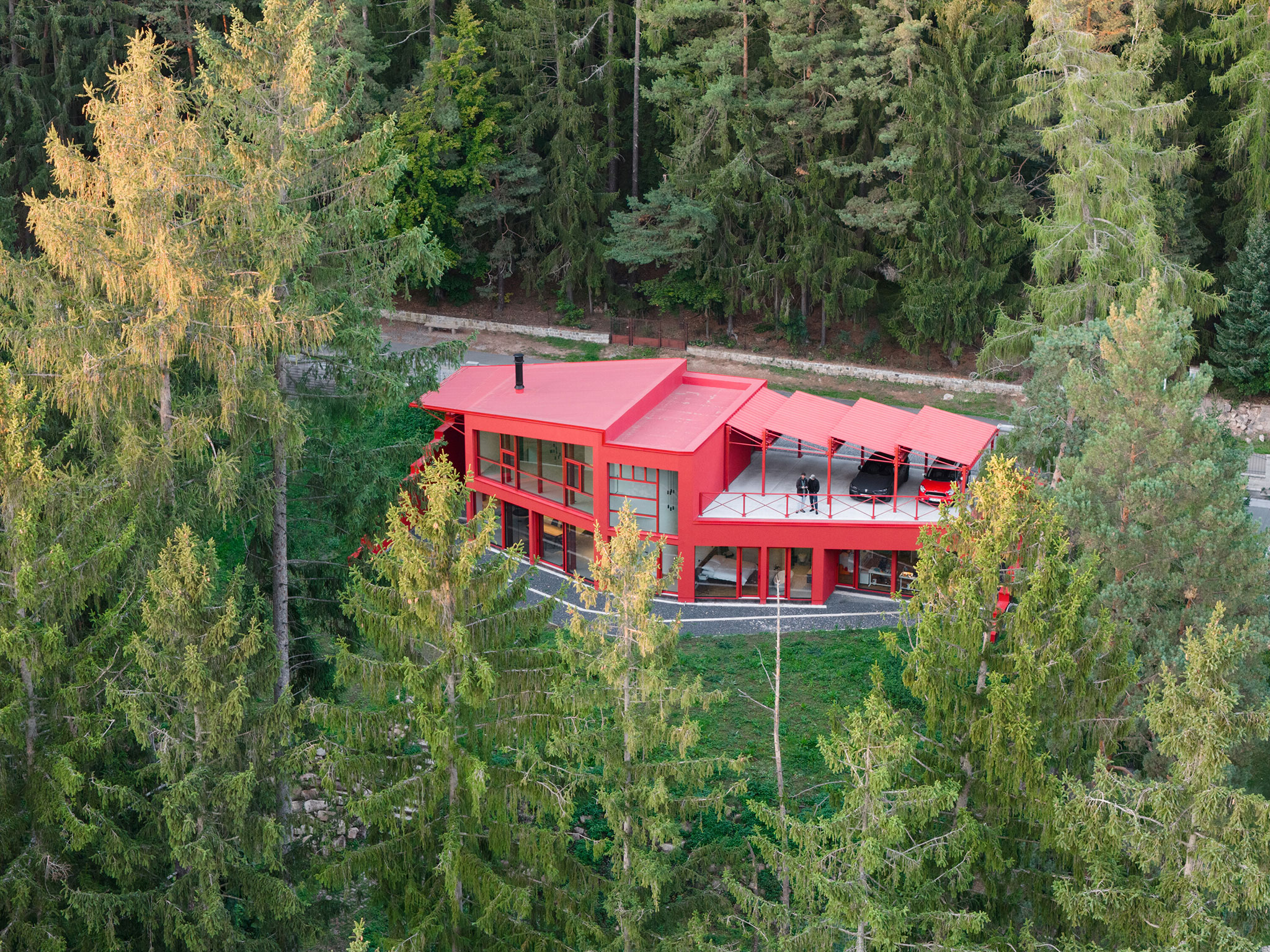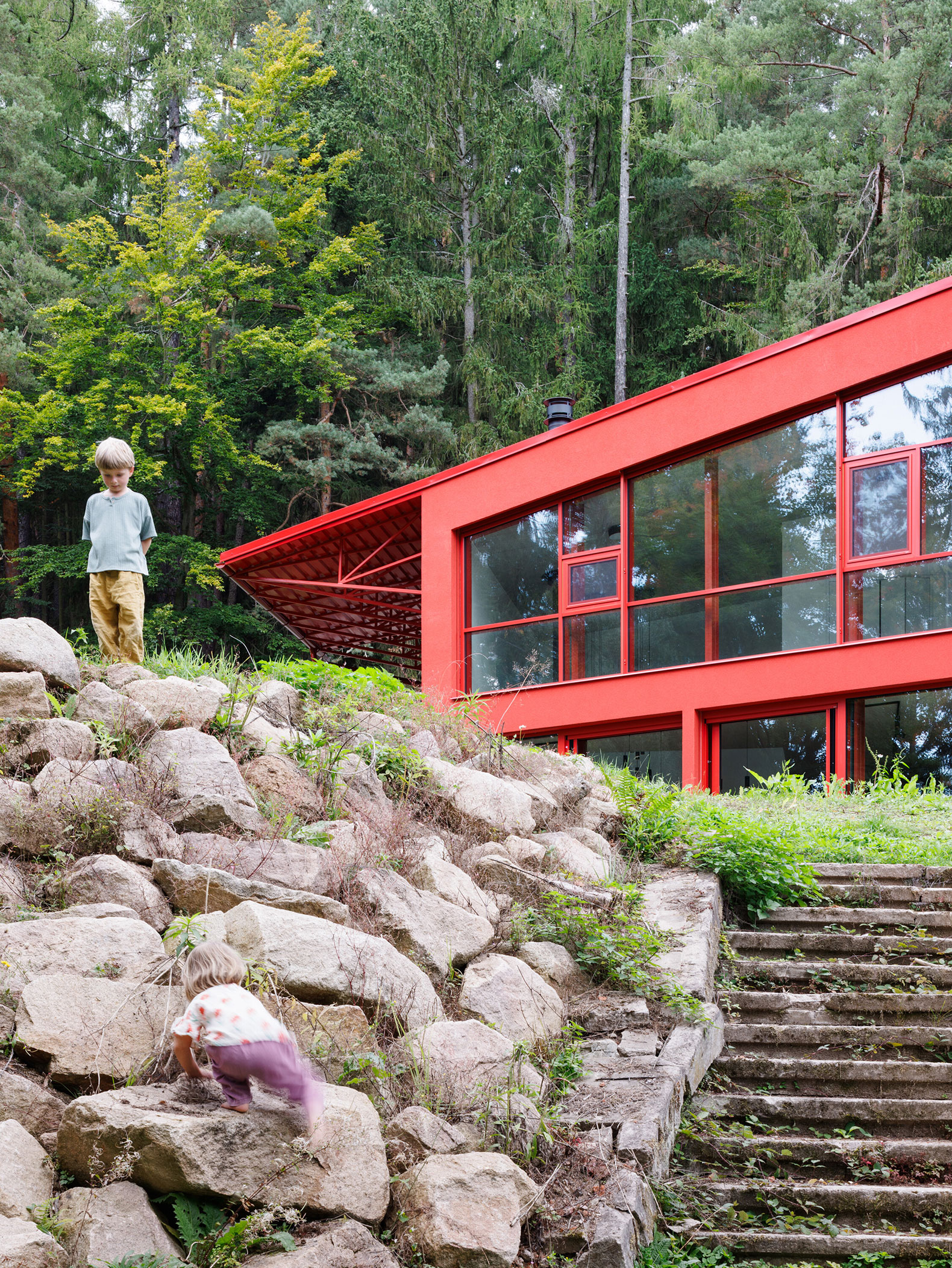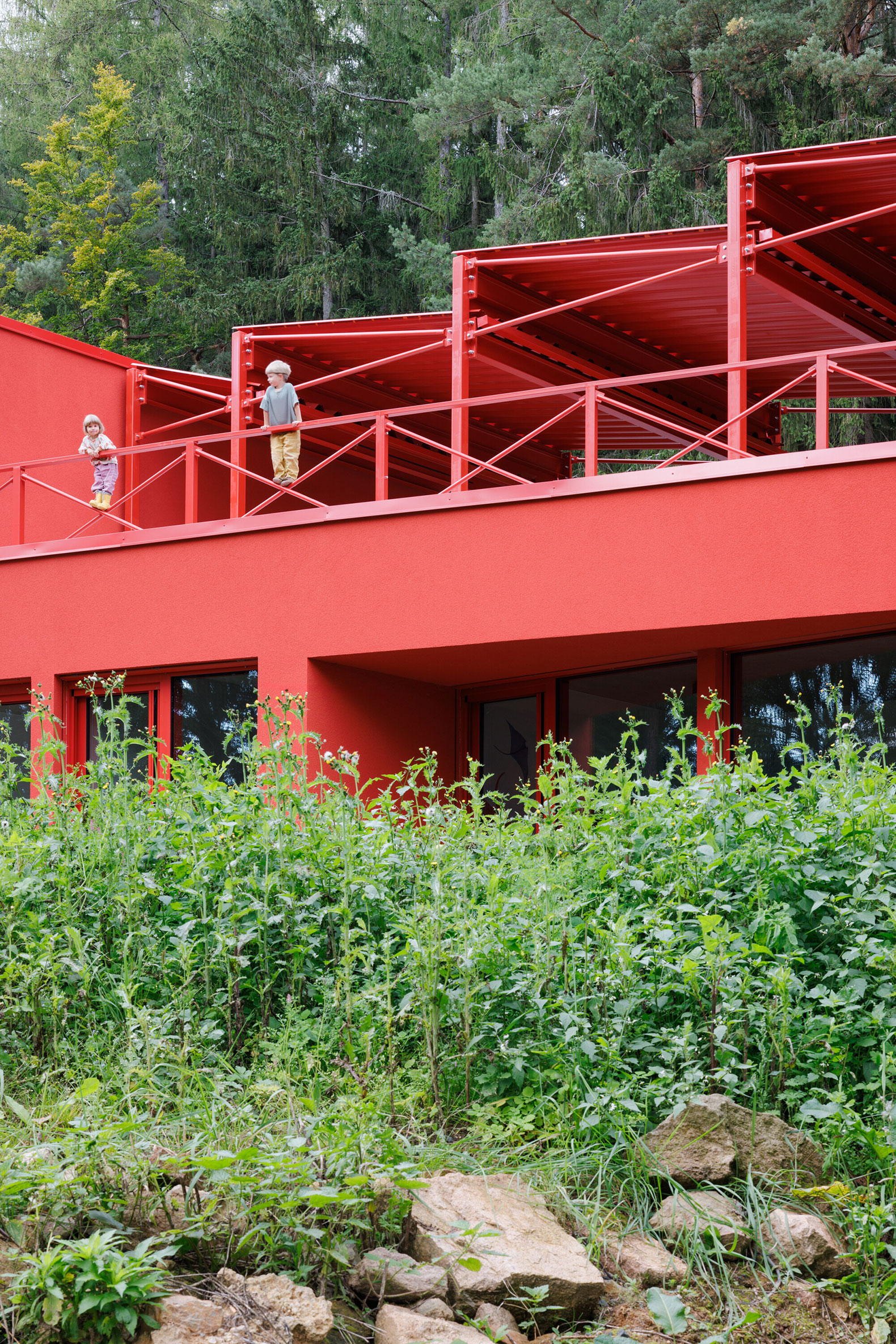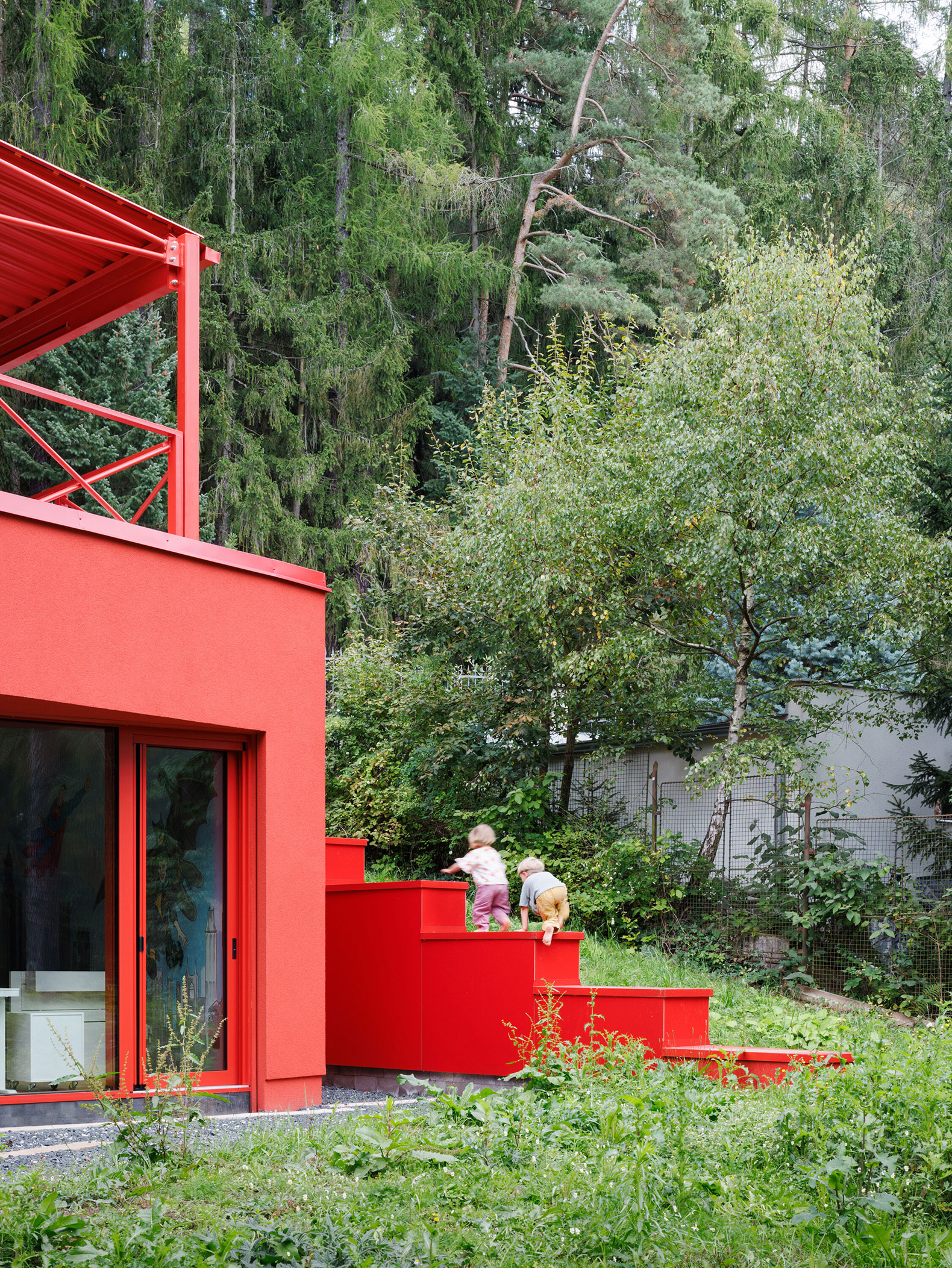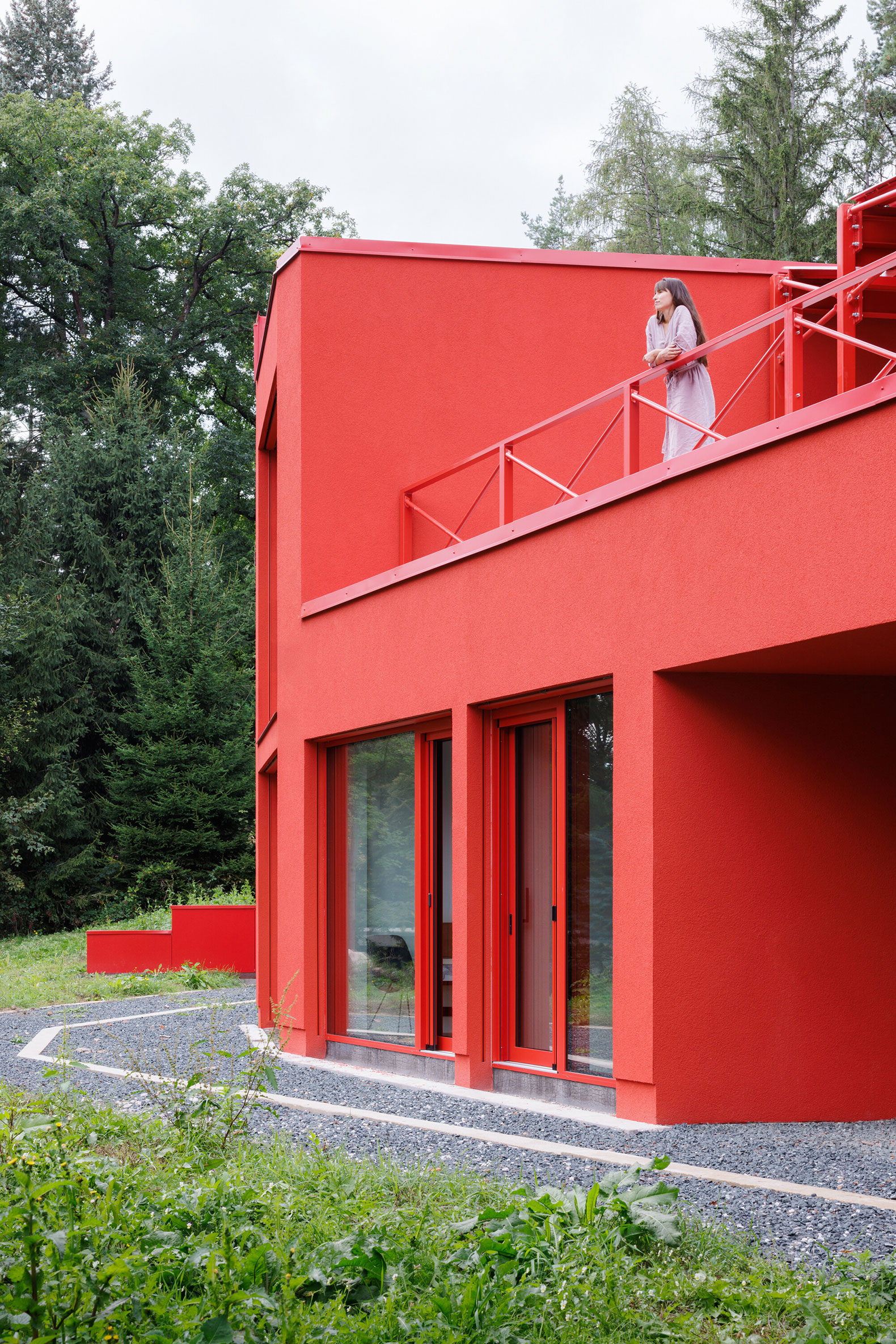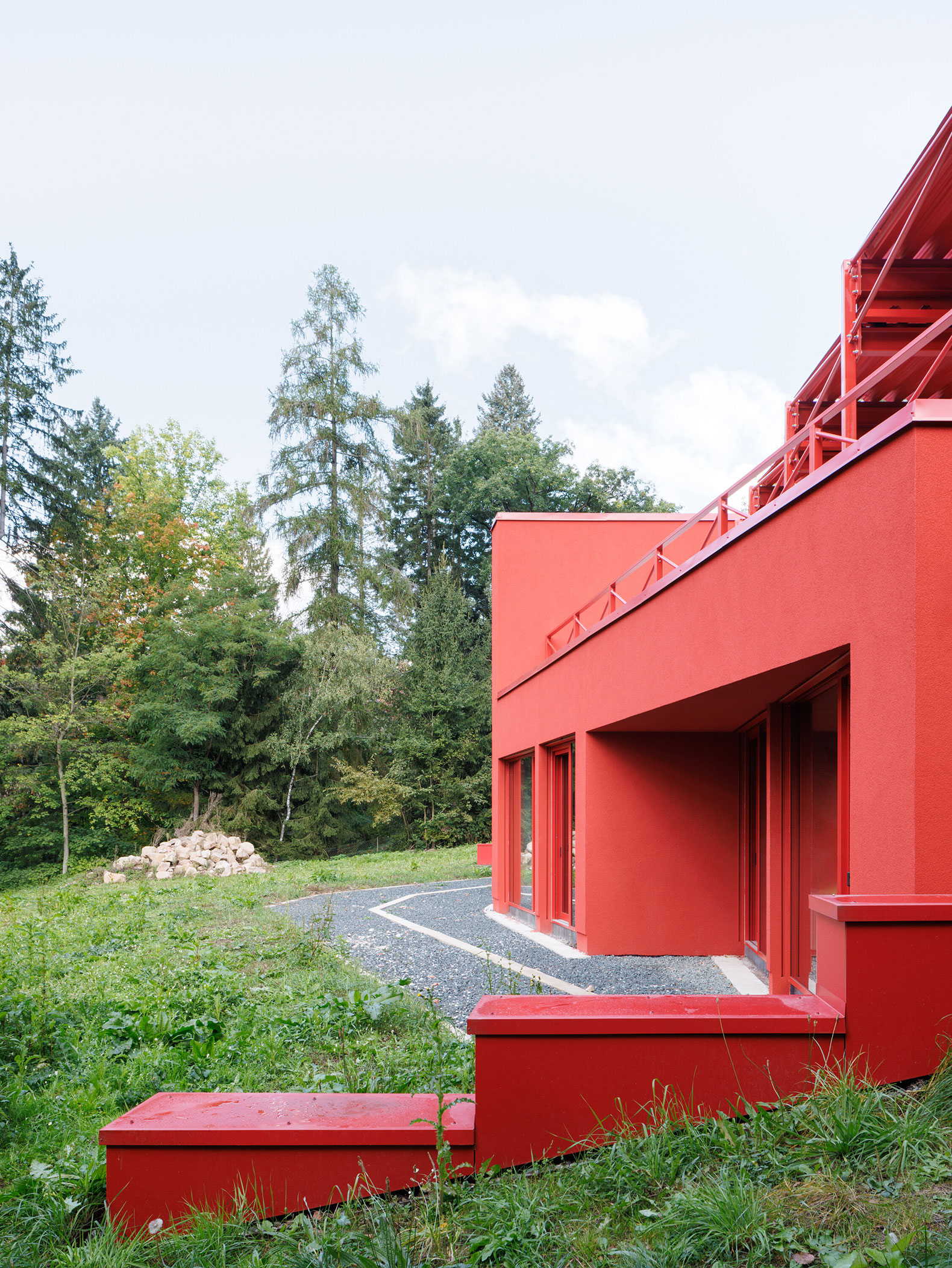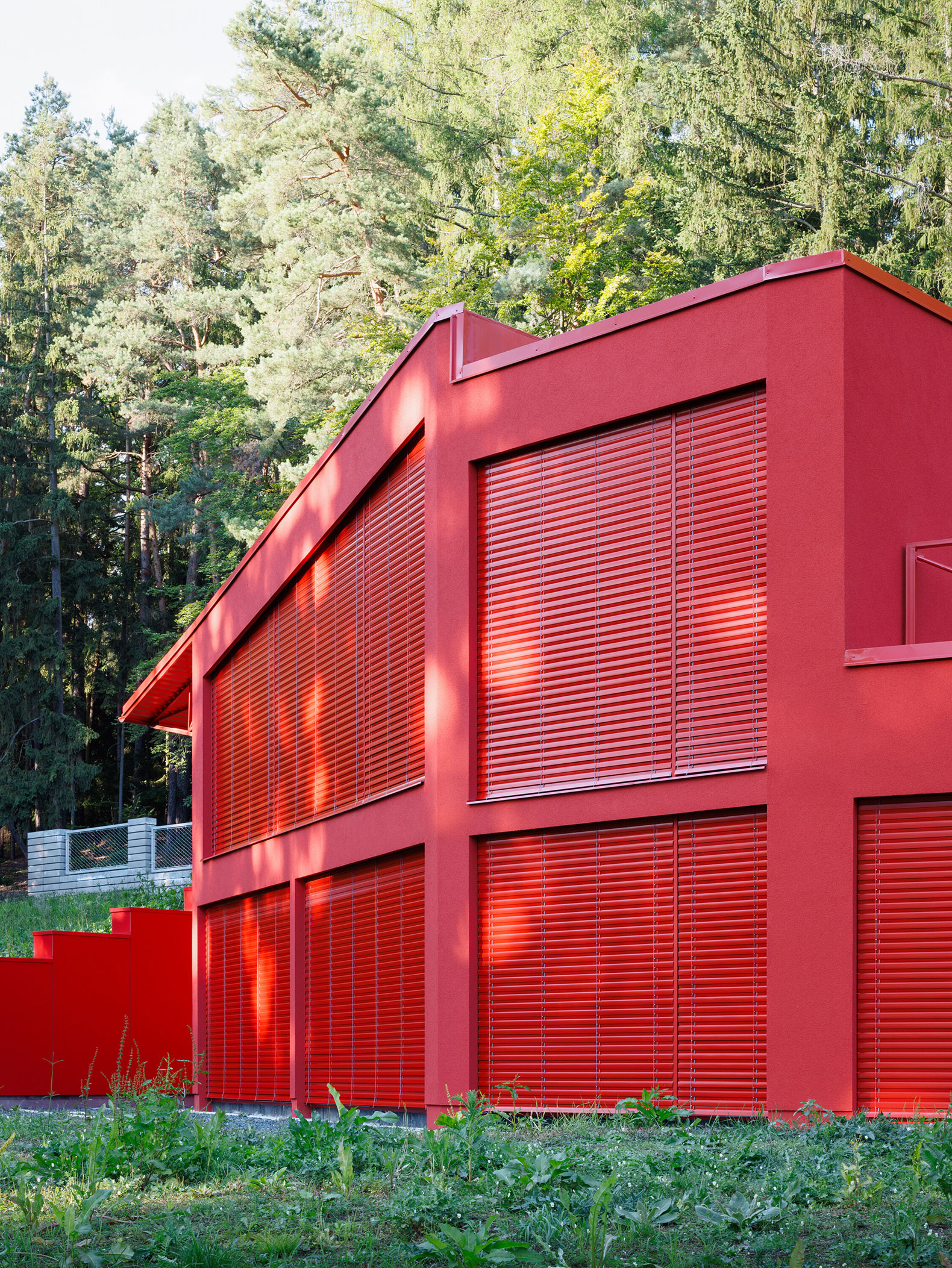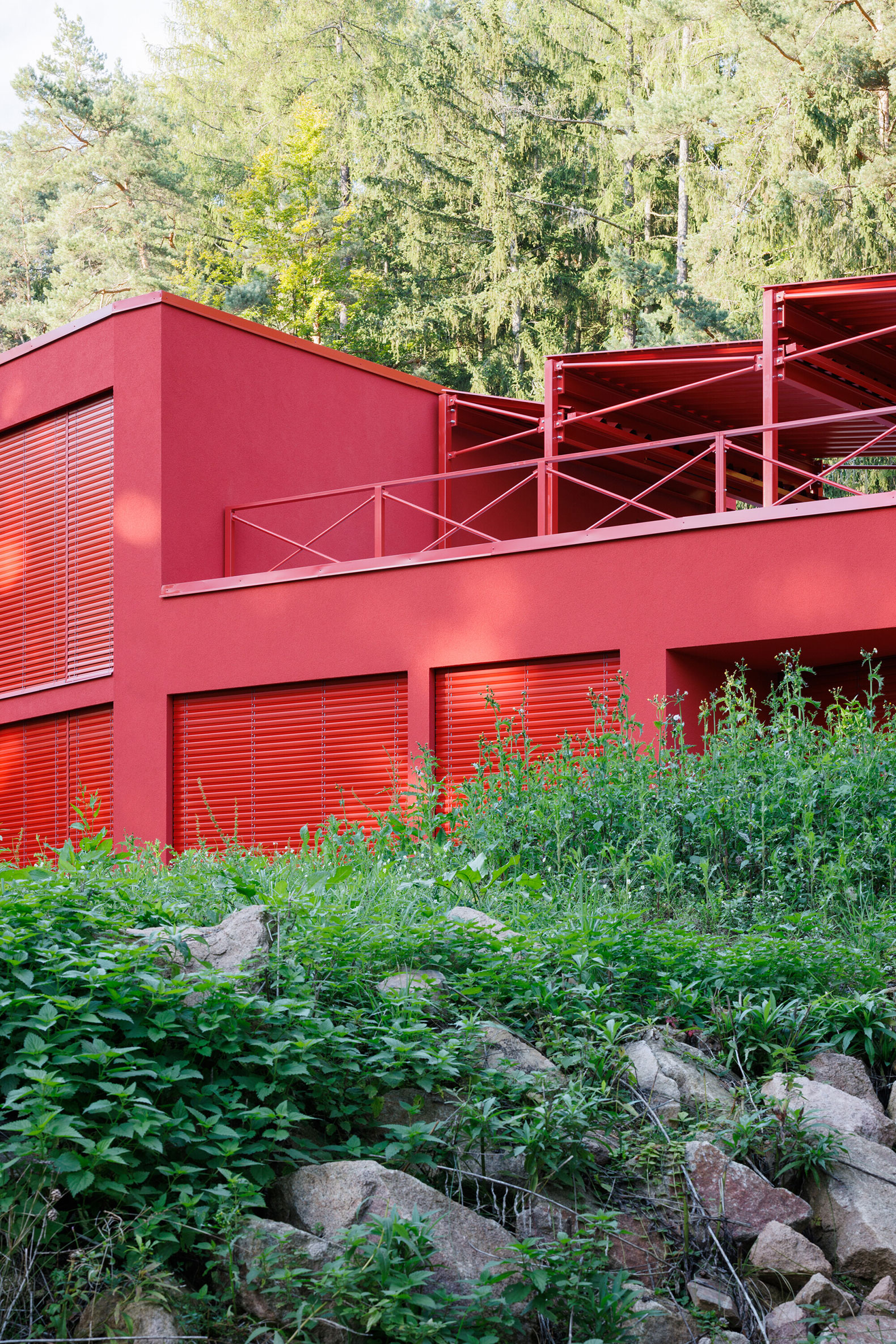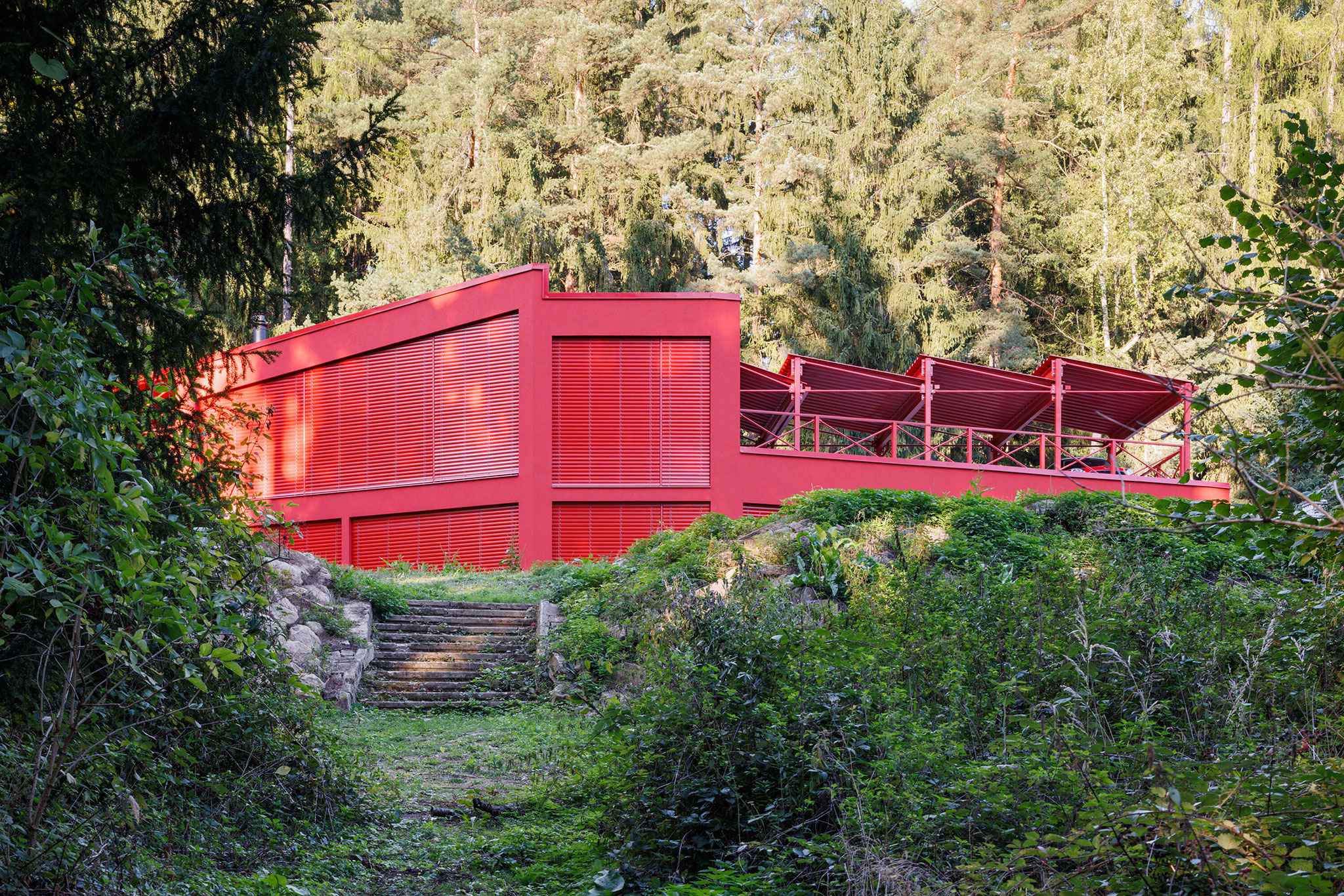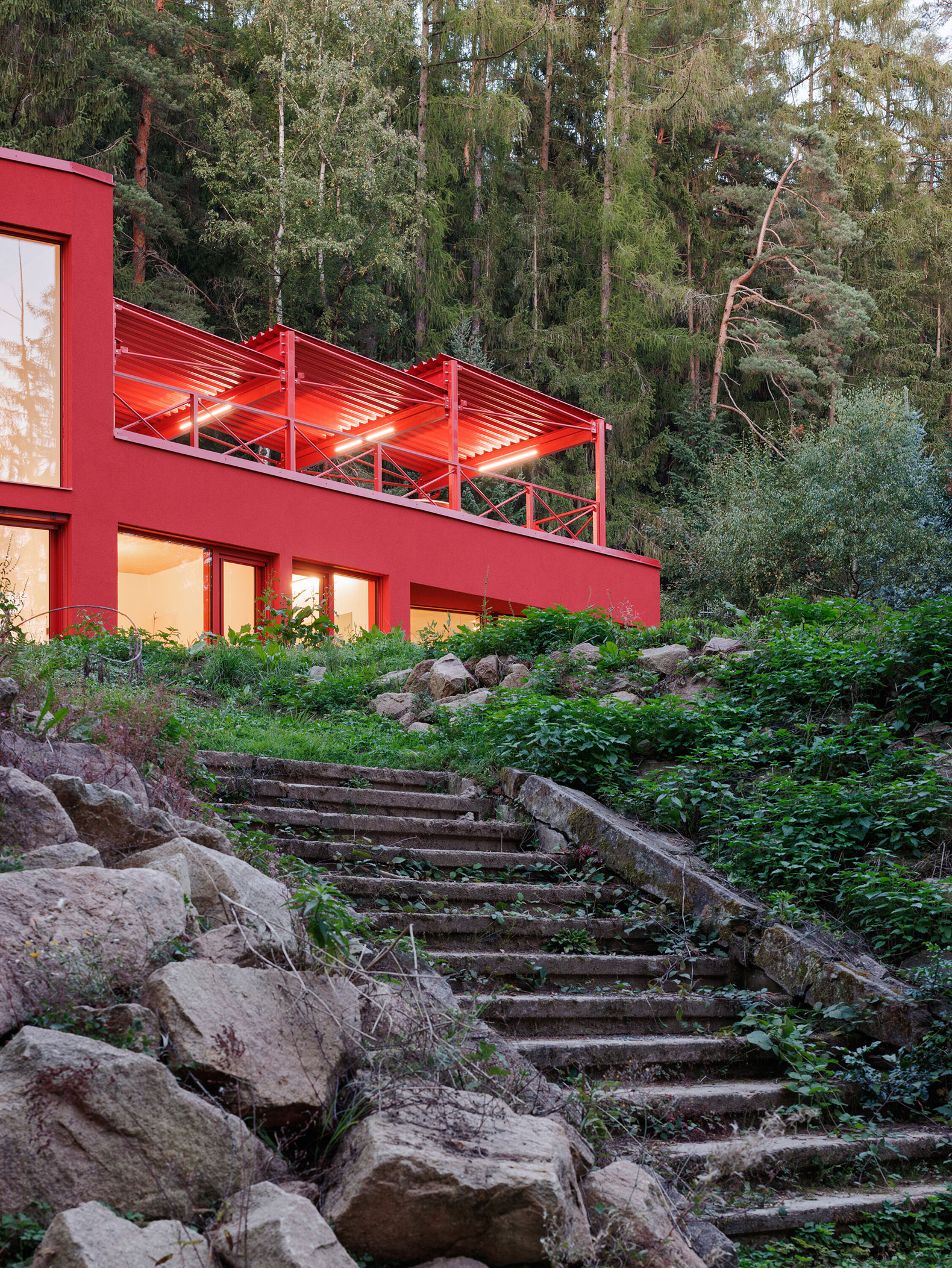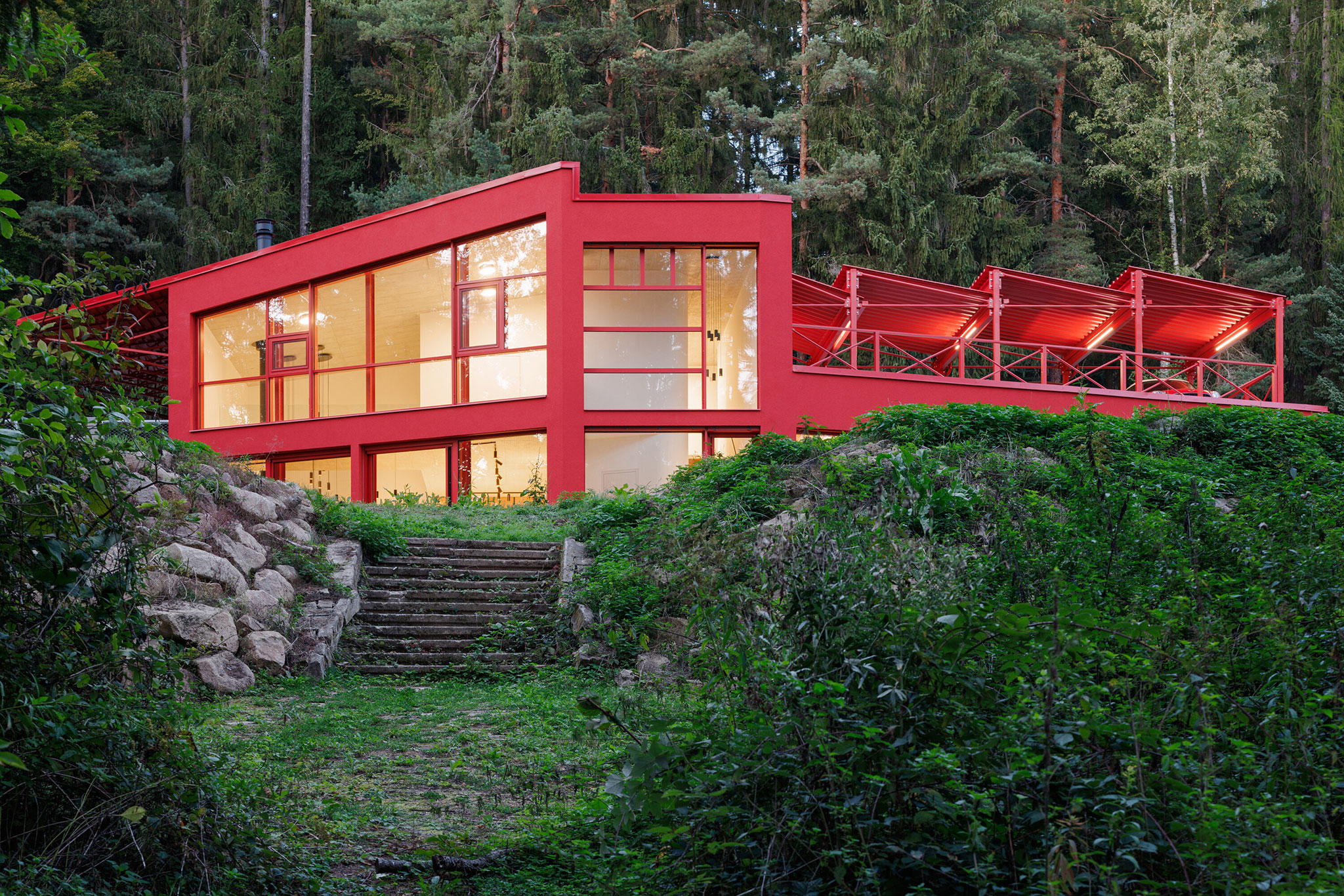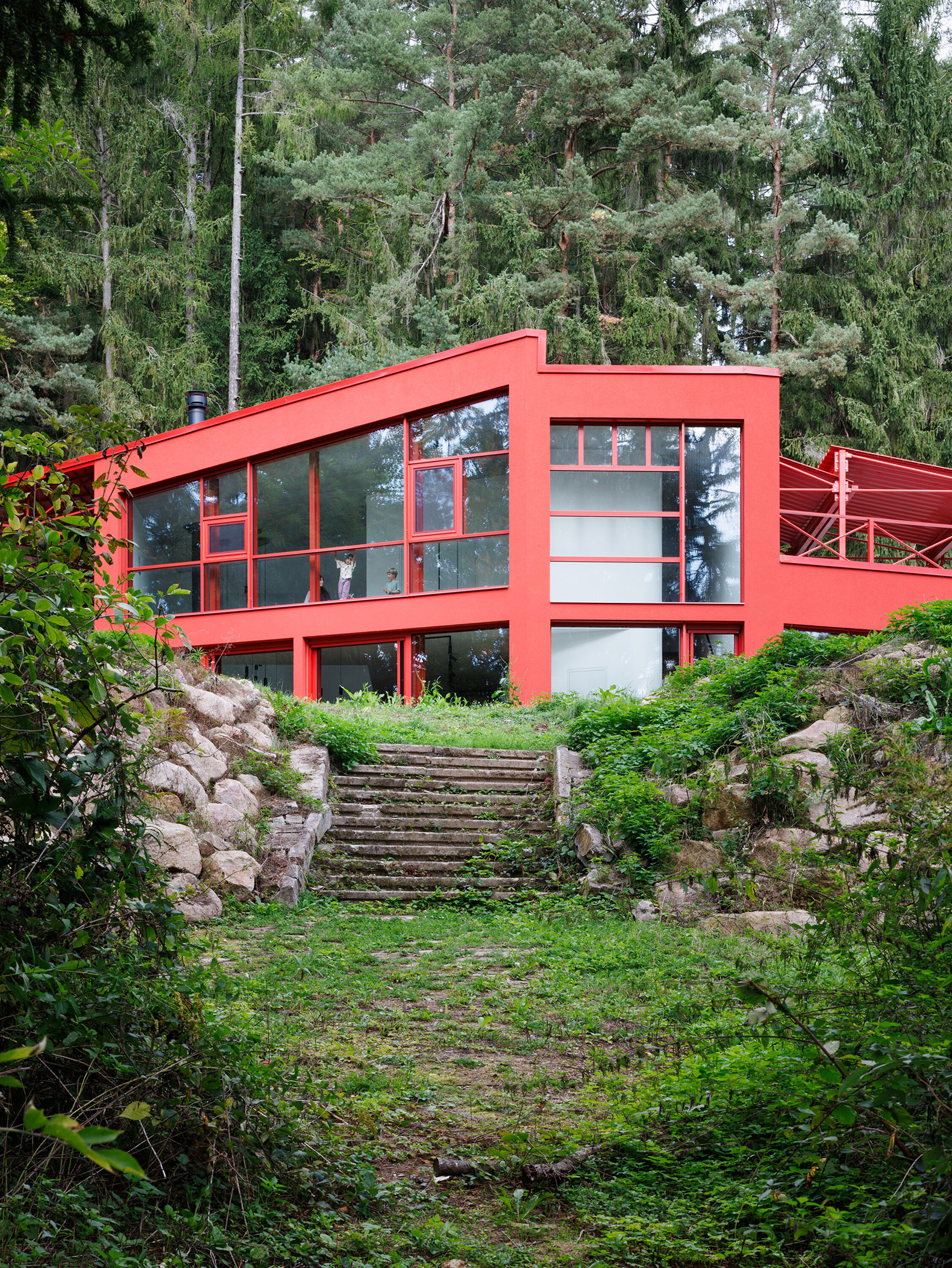
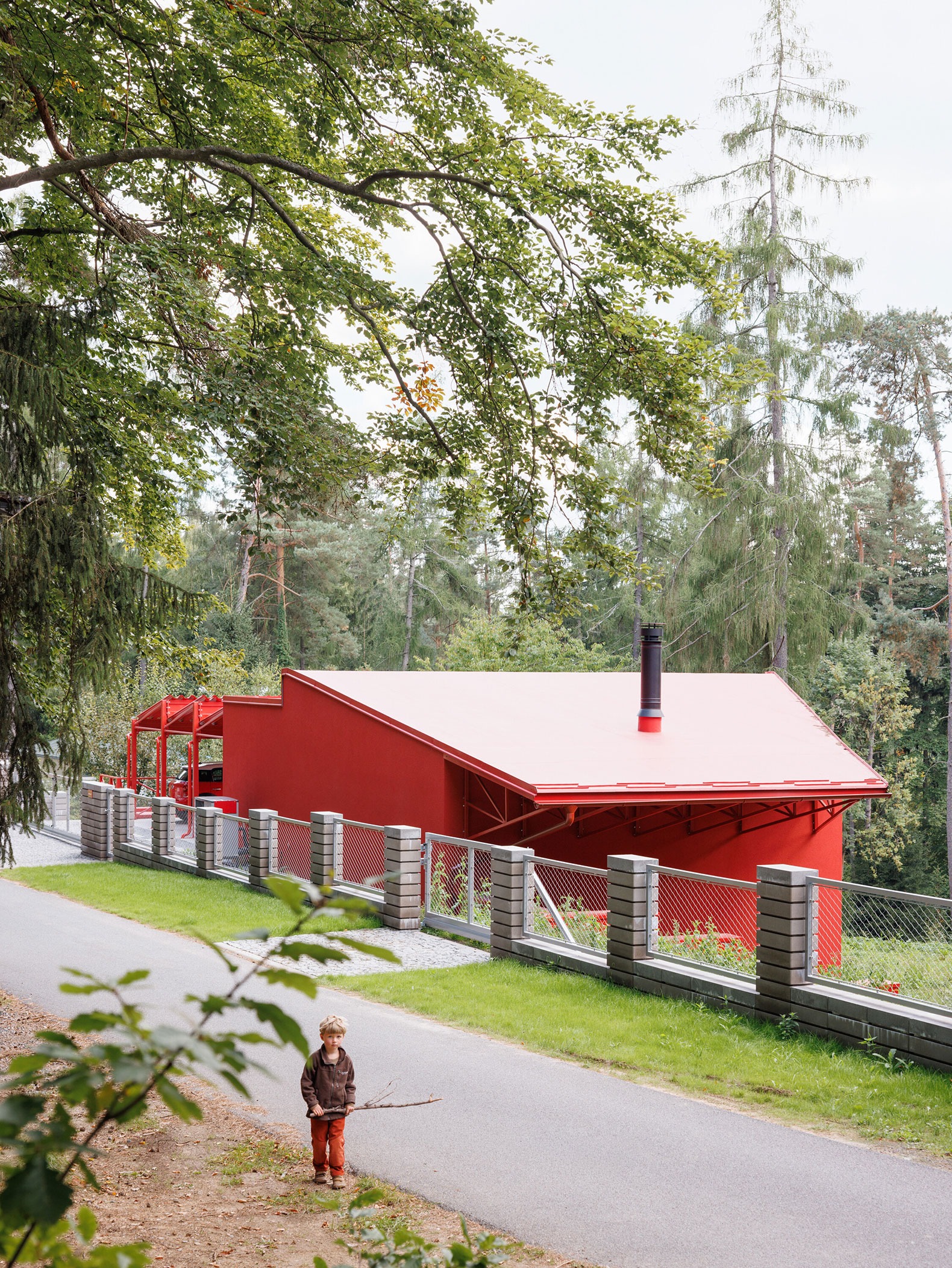
Adapting to the natural terrain, the views, and the presence of the trees, the architecture studio Architektura, led by David Kraus, has designed "Jevany Villa," a contemporary single-family home with an industrial feel, nestled in a dense fir forest in Jevany, a town in the Prague-East district of the Central Bohemian Region, Czech Republic.

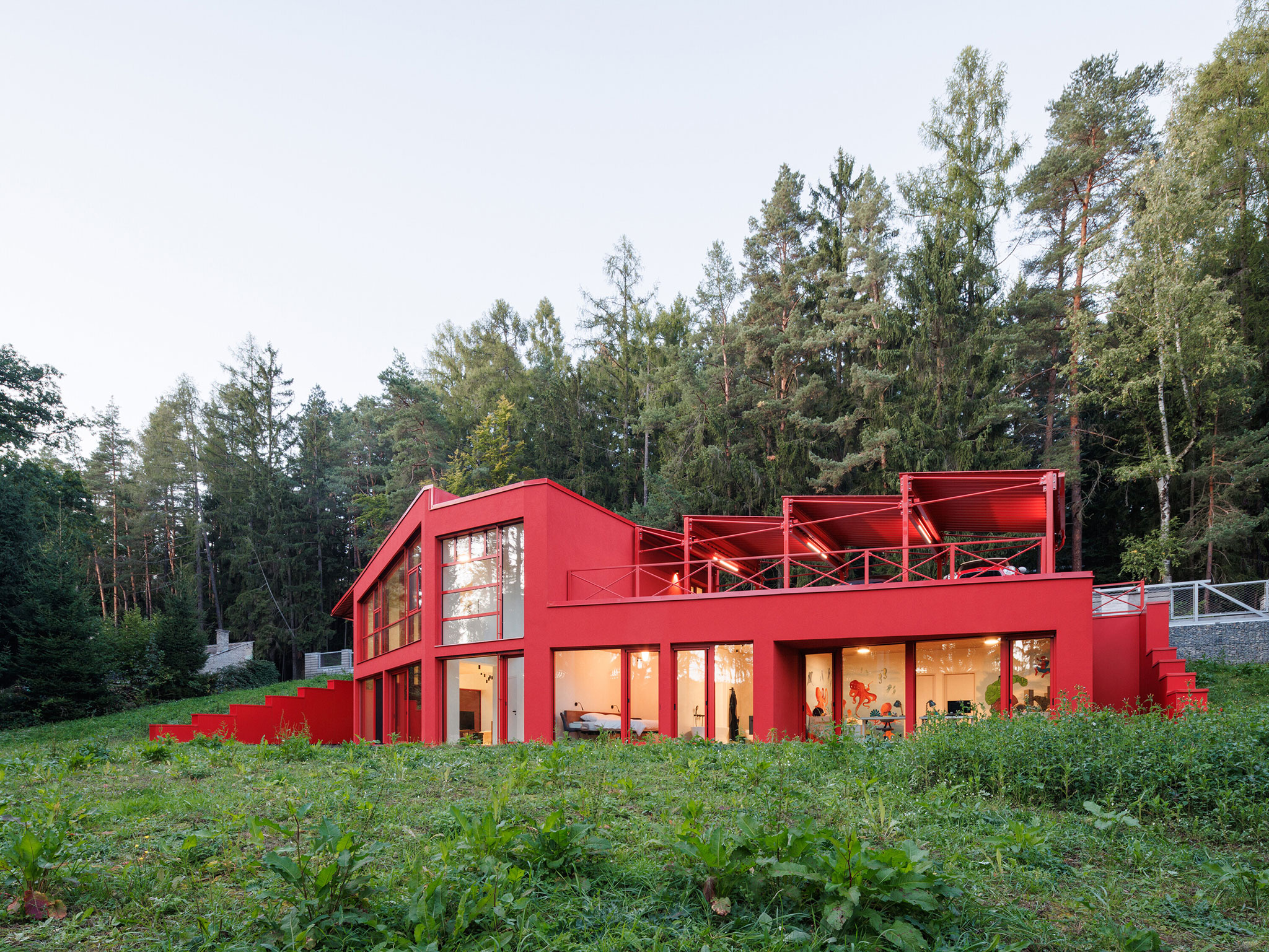
The house, conceived around the spatial needs of its inhabitants, is presented as a tall, glazed, and spacious volume integrated into the slope of a forested landscape, maintaining the main concept of a visual axis descending towards the forest.

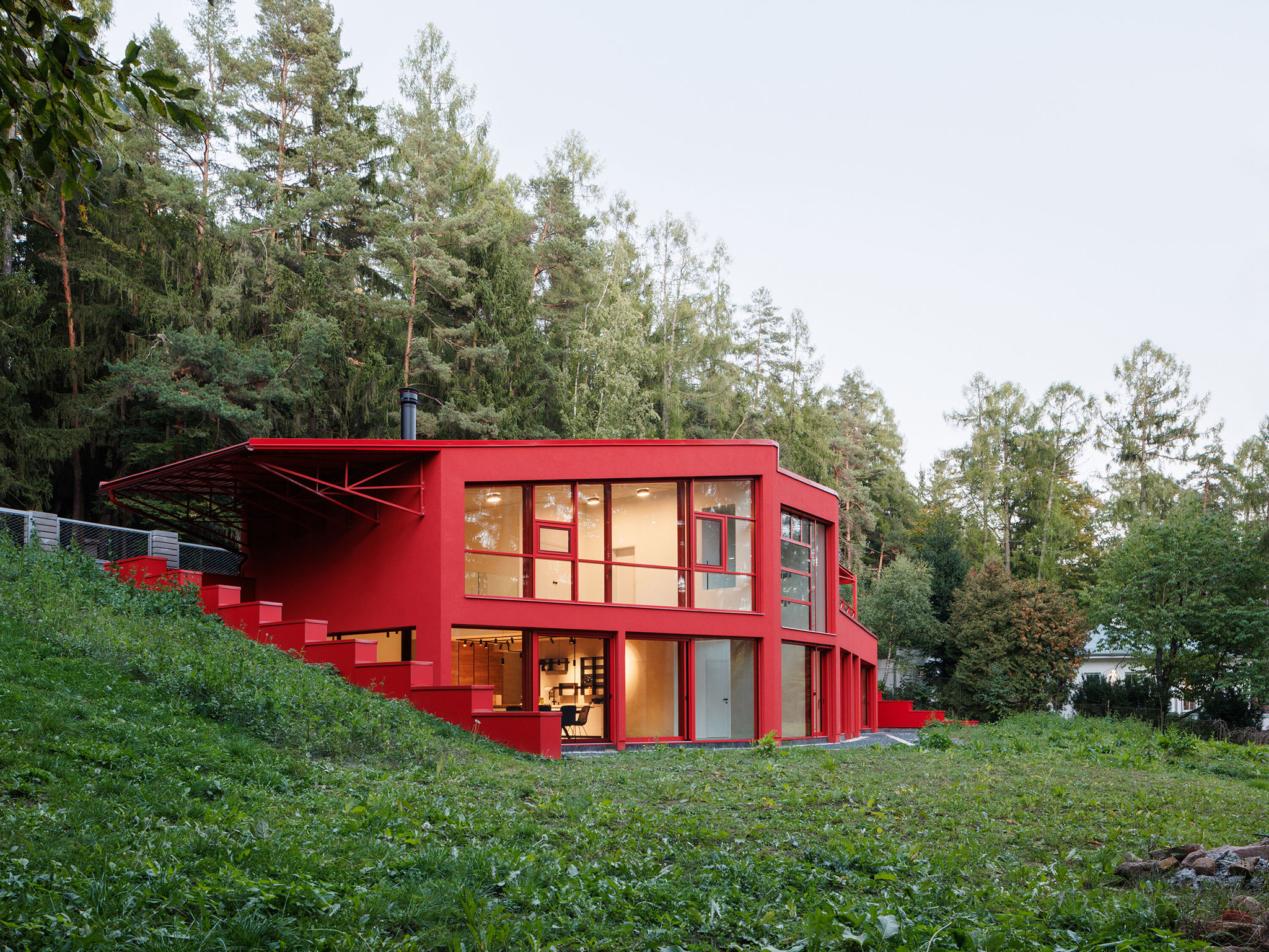
“Jevany Villa,” designed by Architektura, is conceived as a two-story structure. At street level, there is a covered parking area, a studio, and a central foyer connecting the west and east wings. At forest level, the living room, kitchen, and two bedrooms with direct access to the outdoors are located.

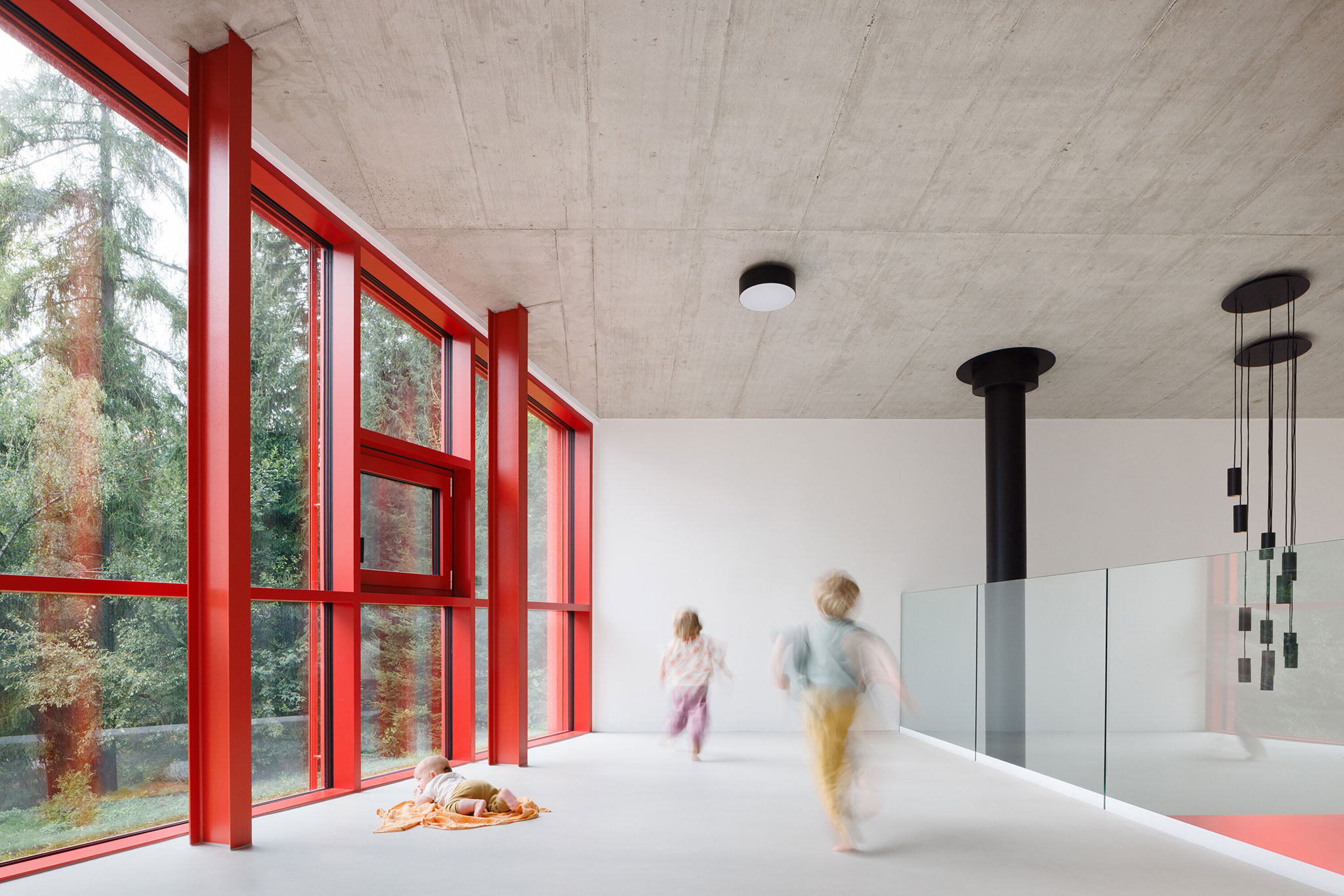
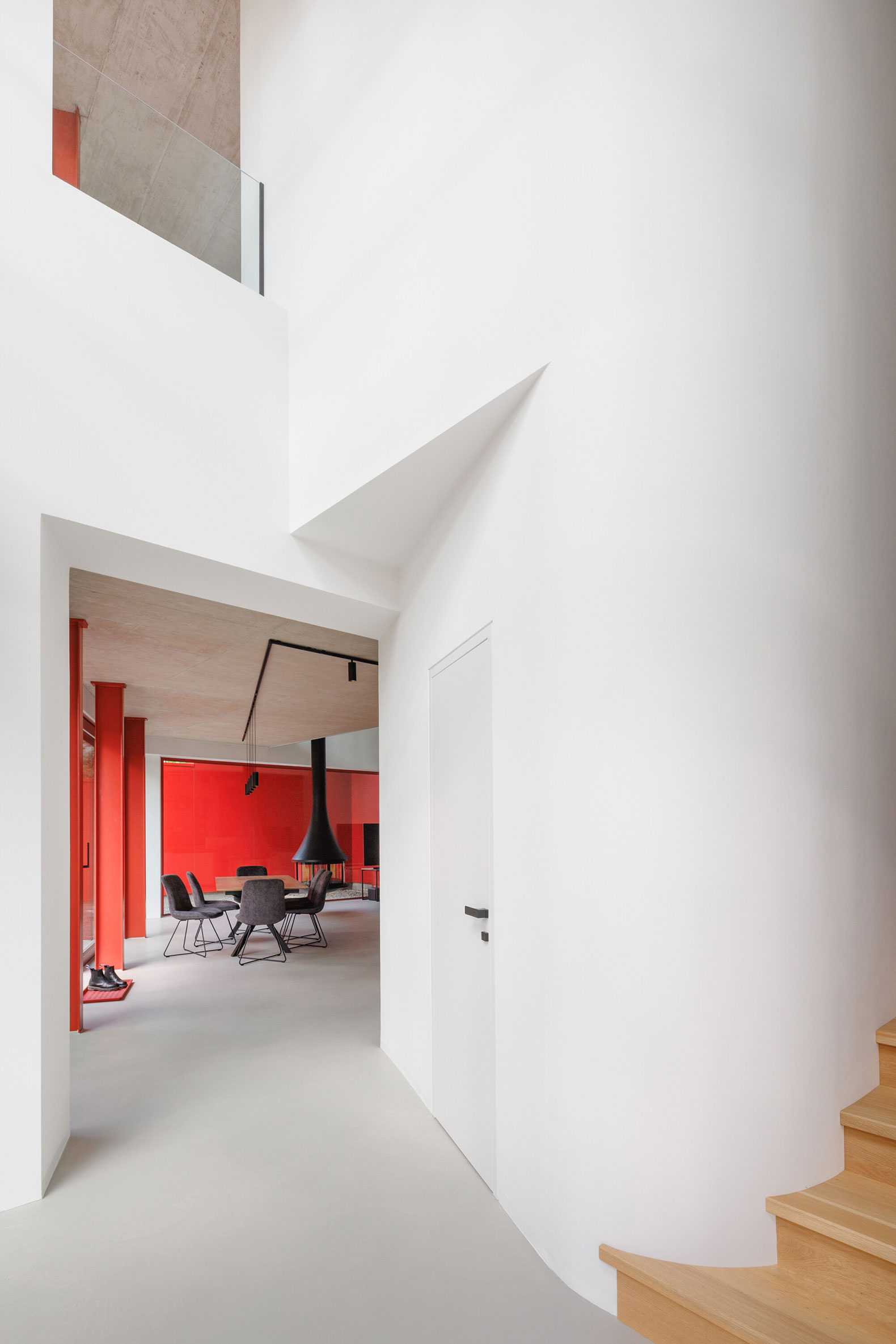
In terms of materials, the design is notable for its use of red steel structures, white walls, and black accents. The interior was developed in collaboration with Jan Waltr. The kitchen features a rich use of color, incorporating reddish stone that contrasts with black shelves, white doors, and a steel fireplace suspended in mid-air.
Jevany Villa por Architektura. Fotografía por Matej Hakár.

Jevany Villa by Architektura. Photograph by Matej Hakár.

Project description by Architektura

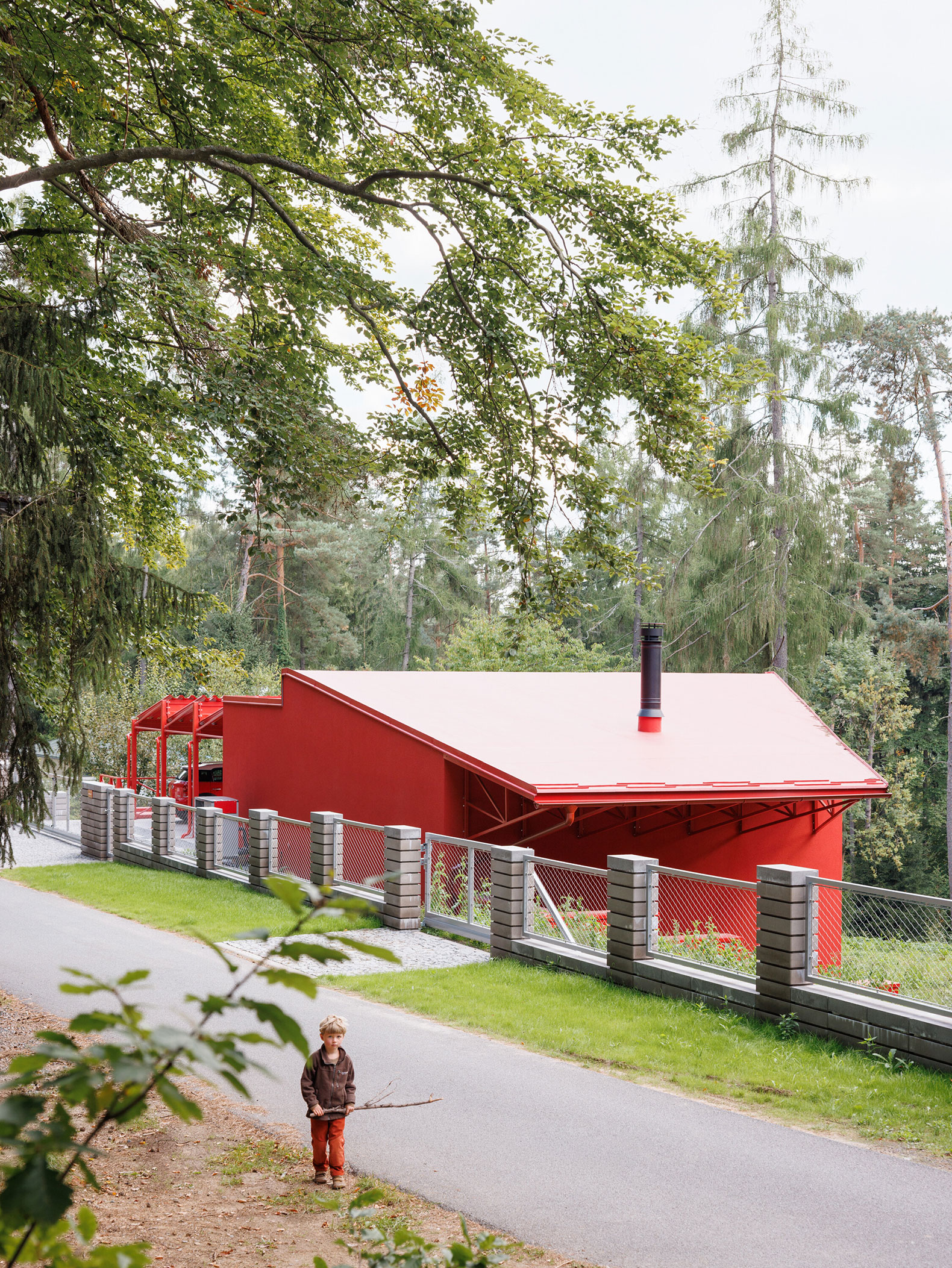
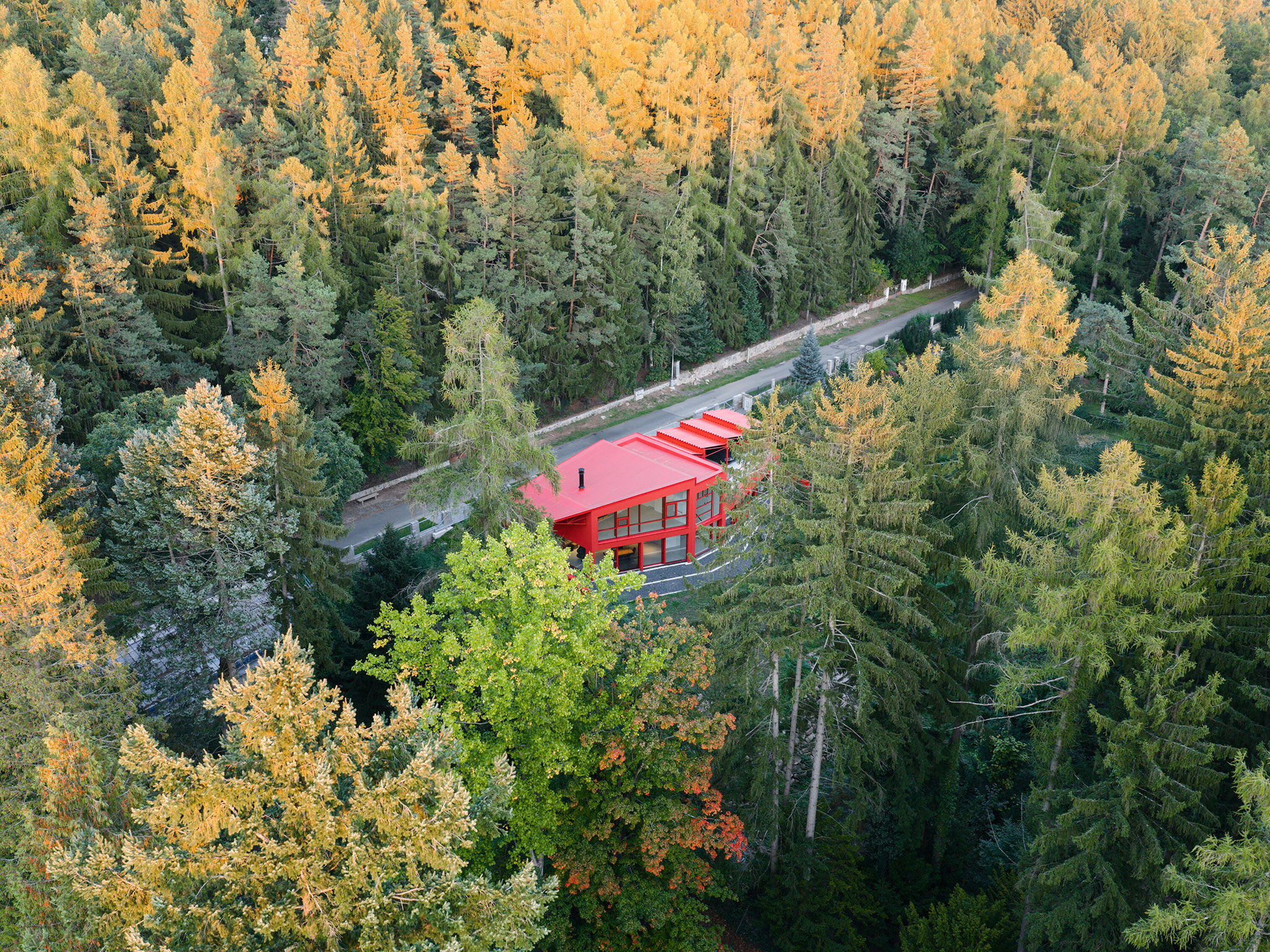
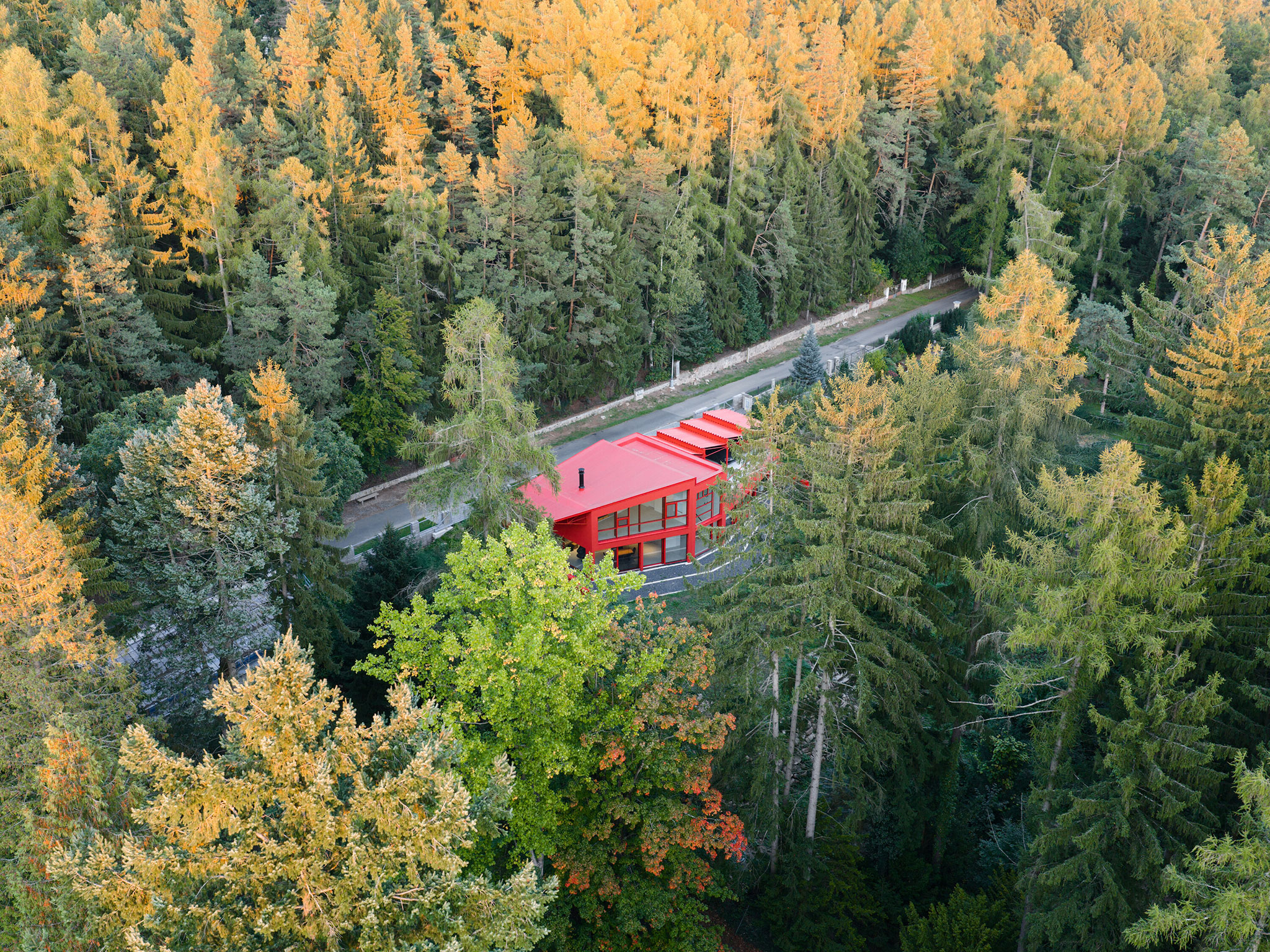
A spruce forest, a slope, views of giant tree trunks, a pit left after an old building, birds, deer, and flickering sun rays. Below, the surface of a lake. The access road lies at the upper edge of the plot. From the street, the house appears single-storey — invisible and small; from the garden, it becomes two-storey — open and large. Cars park on the roof. The massing of the house follows the slope of the terrain and the client’s spatial requirements. The central staircase space (the “torso”) connects the western and eastern wings — the day and night zone. The main concept is a visual axis and descent into the forest landscape. Green and red as complementary colors. The house — an organism — becomes part of the forest.

Jevany Villa is located in a densely wooded part of the village with solitary family houses. Originally forest plots are long, bordered by an upper forest road used mostly by locals, and a lower path running along the ponds, visually shielded by mature trees. For one of these exceptional sites, the brief called for a modern house with an industrial expression. The investor chose architect David Kraus based on his earlier project a few streets further.

Jevany Villa por Architektura. Fotografía por Matej Hakár.
Jevany Villa by Architektura. Photograph by Matej Hakár.

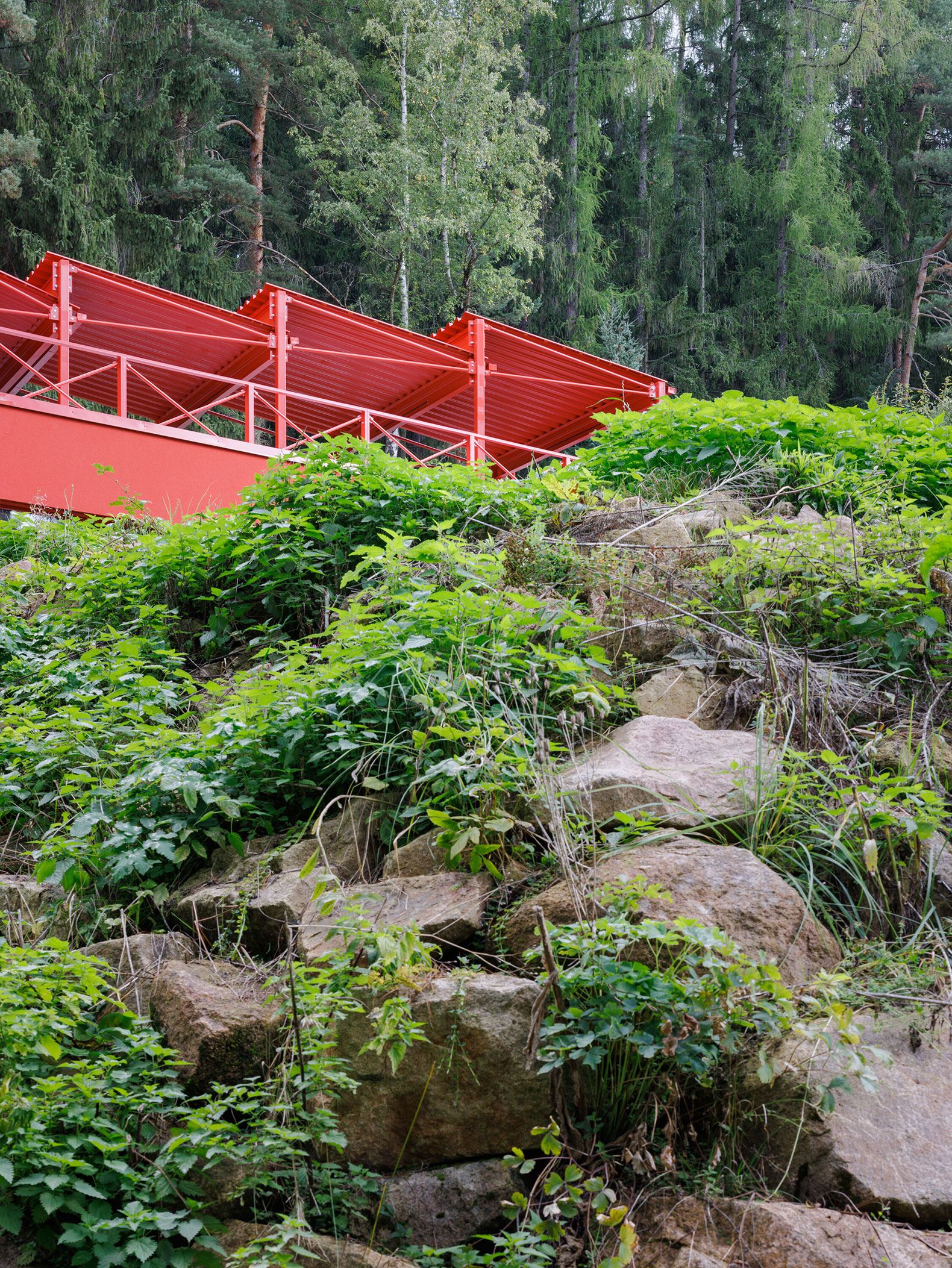
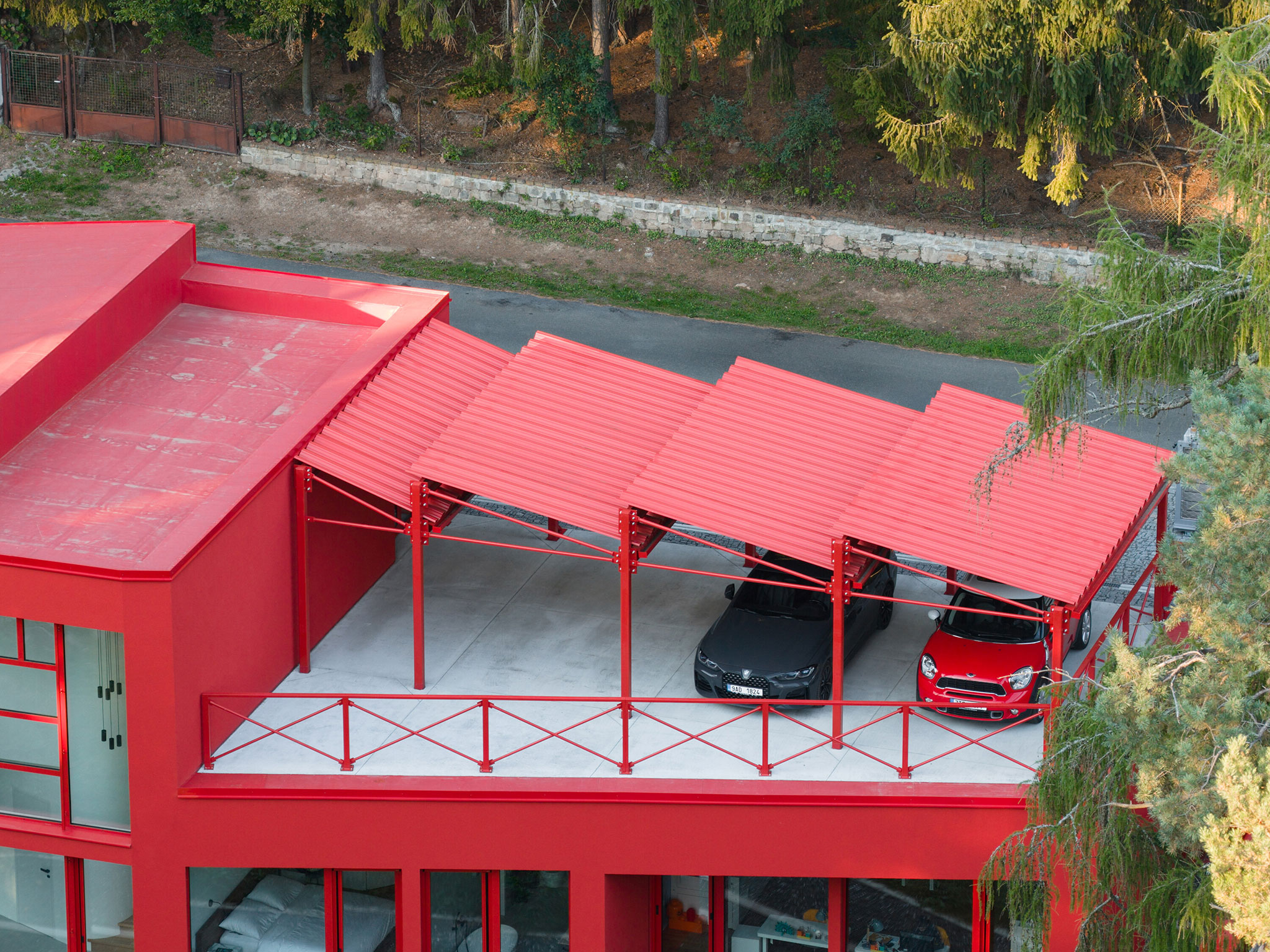
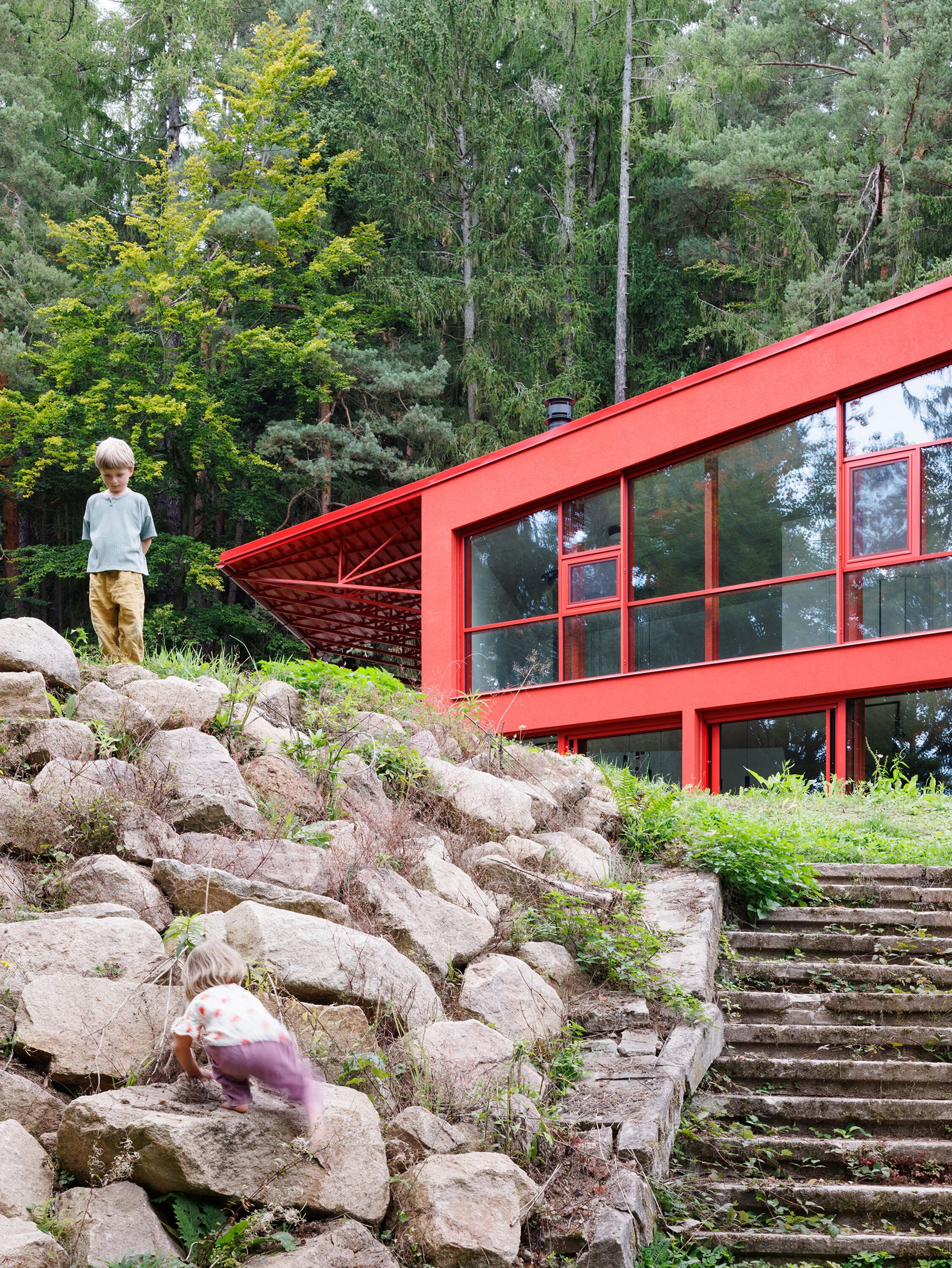
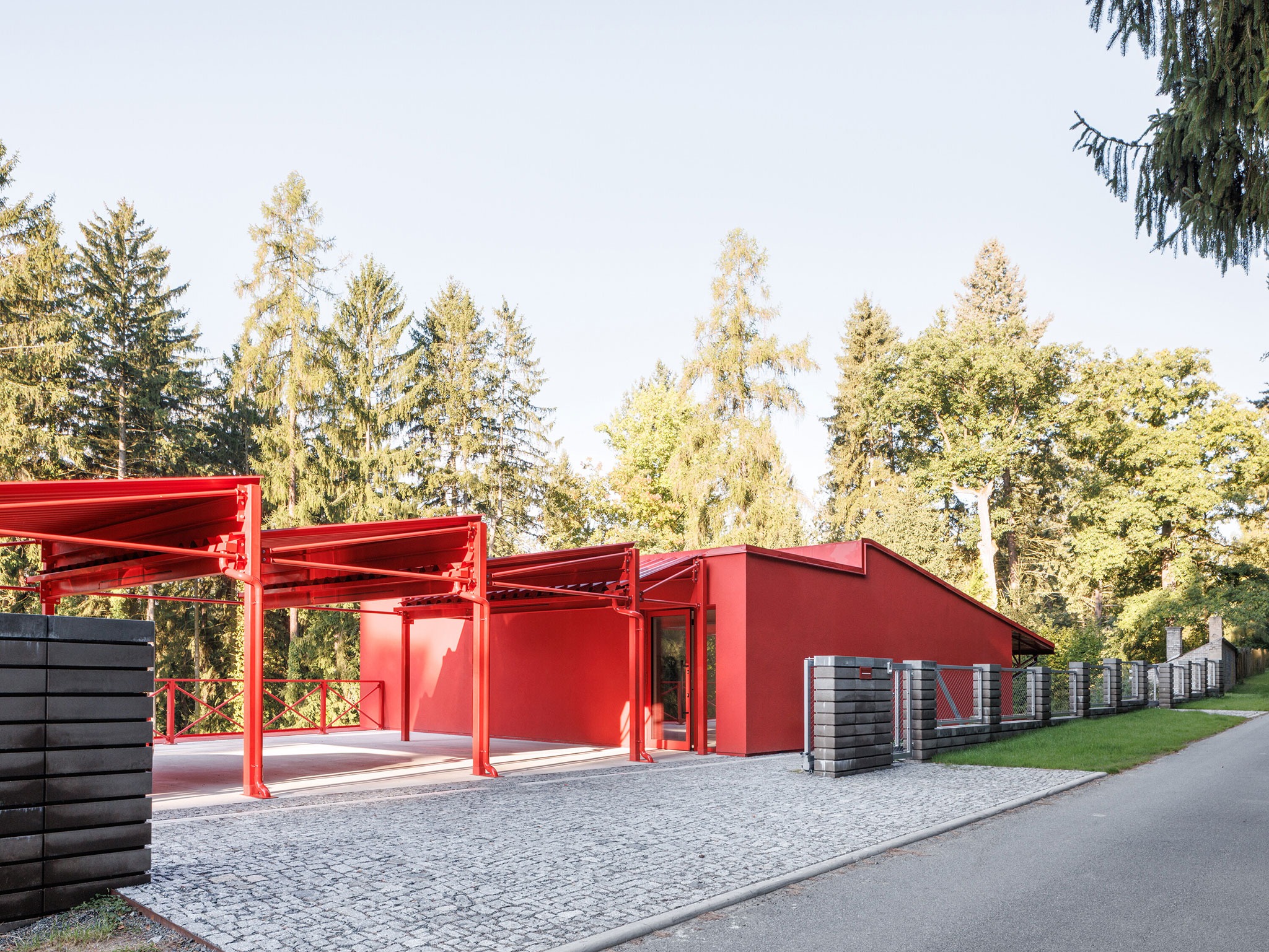
The sloping terrain descending from north to south, with access from above, was crucial for the design. One of the key decisions was the precise placement of the building on the plot, which is relatively large. Remnants of the original house were removed, leaving a pit with a height difference of about 3.6 meters from the road. Mature trees stand up to ten meters below the building site and form a striking phenomenon — they rustle, move, and rise like sculptures toward the sky. A setback of nearly five meters from the adjacent semi-street creates a generous entrance area and parking on the roof terrace.

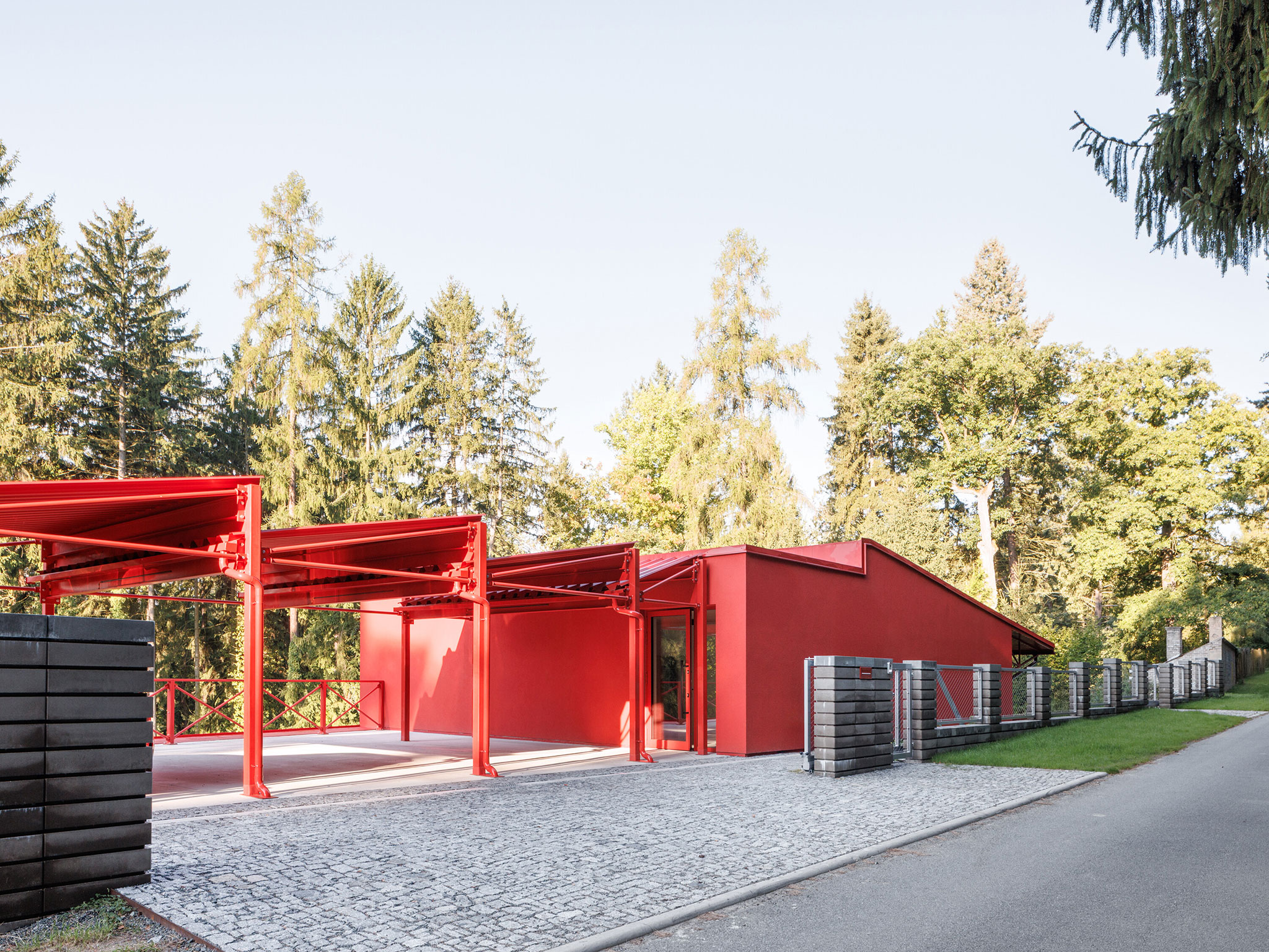
The orientation of the house responds to cardinal directions and views. It opens to the south and toward the forest, while remaining closed to the north and the street.

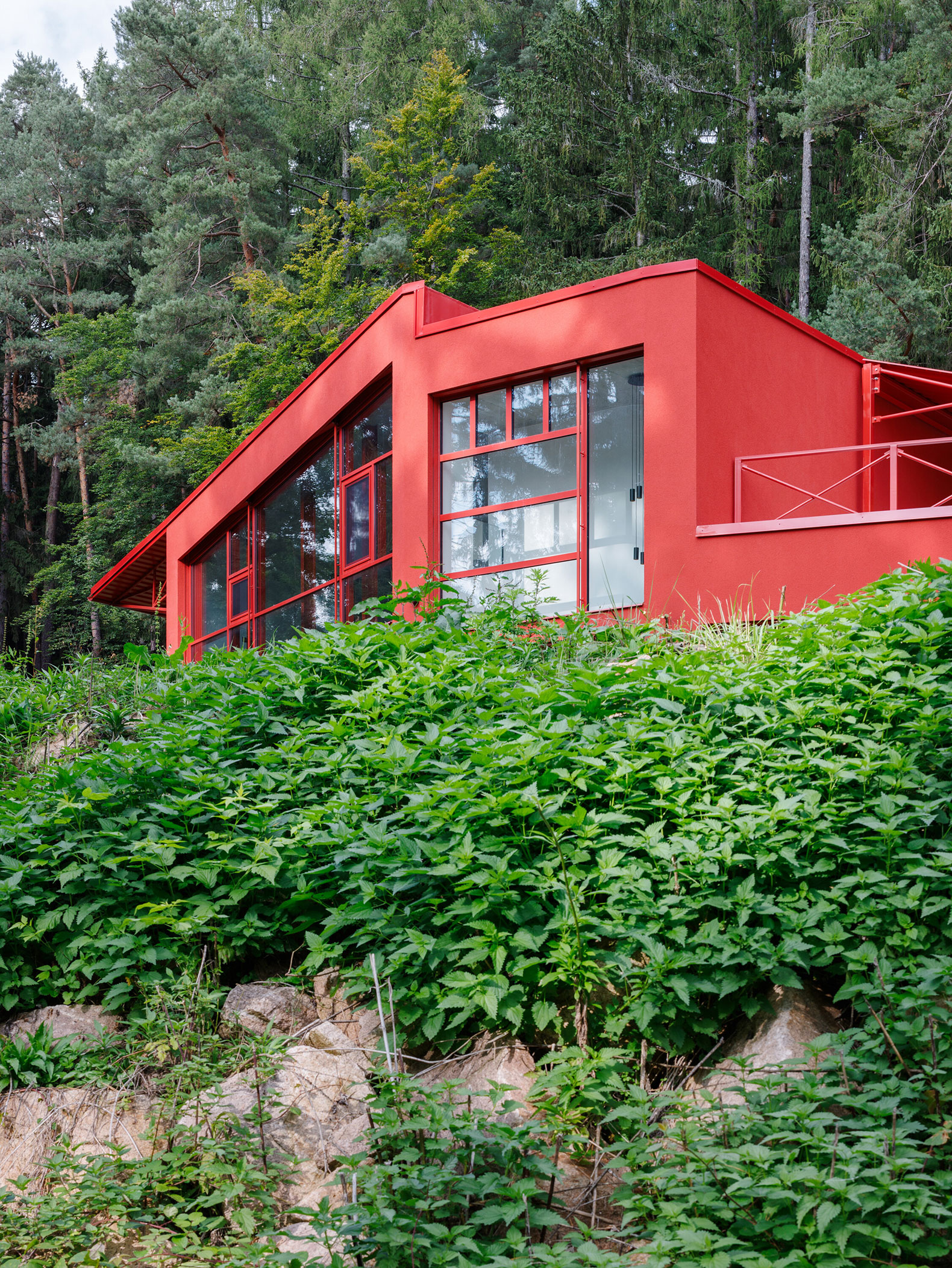
From the northern upper side, the house is embedded into the slope. From the street, it appears single-storey and almost invisible; from the garden, it is entirely different — tall, glazed, generous. The core idea is the visual axis and descent into the forest landscape, as if stepping from the carport into another world.
Jevany Villa por Architektura. Fotografía por Matej Hakár.
Jevany Villa by Architektura. Photograph by Matej Hakár.

The central staircase hall (a kind of solid backbone of the creature) connects the western and eastern wings.

The house can be read in five basic operational levels: at street level, the covered parking, central entrance space, and a bright area with a study; at forest level, the day and night zones.

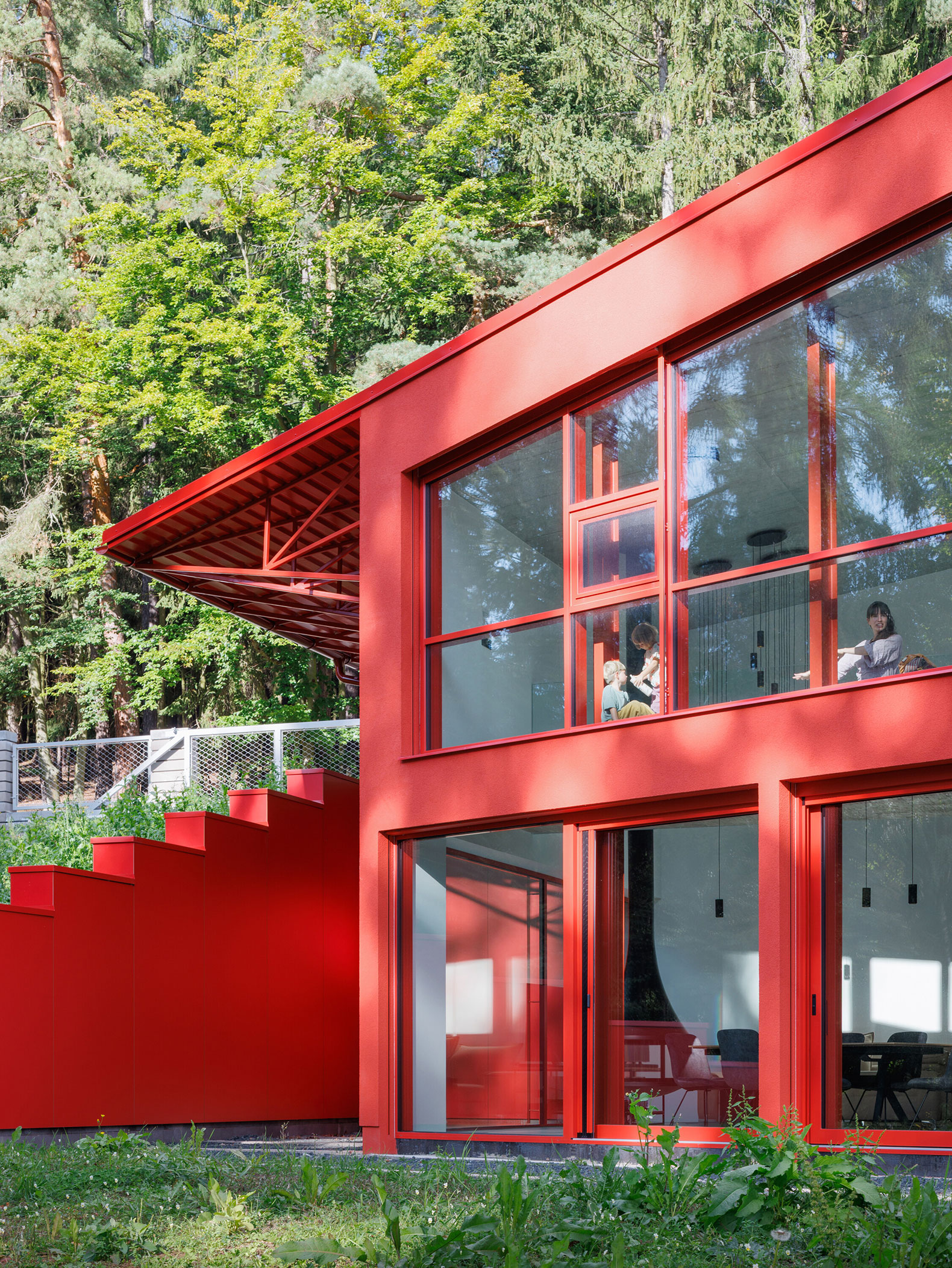
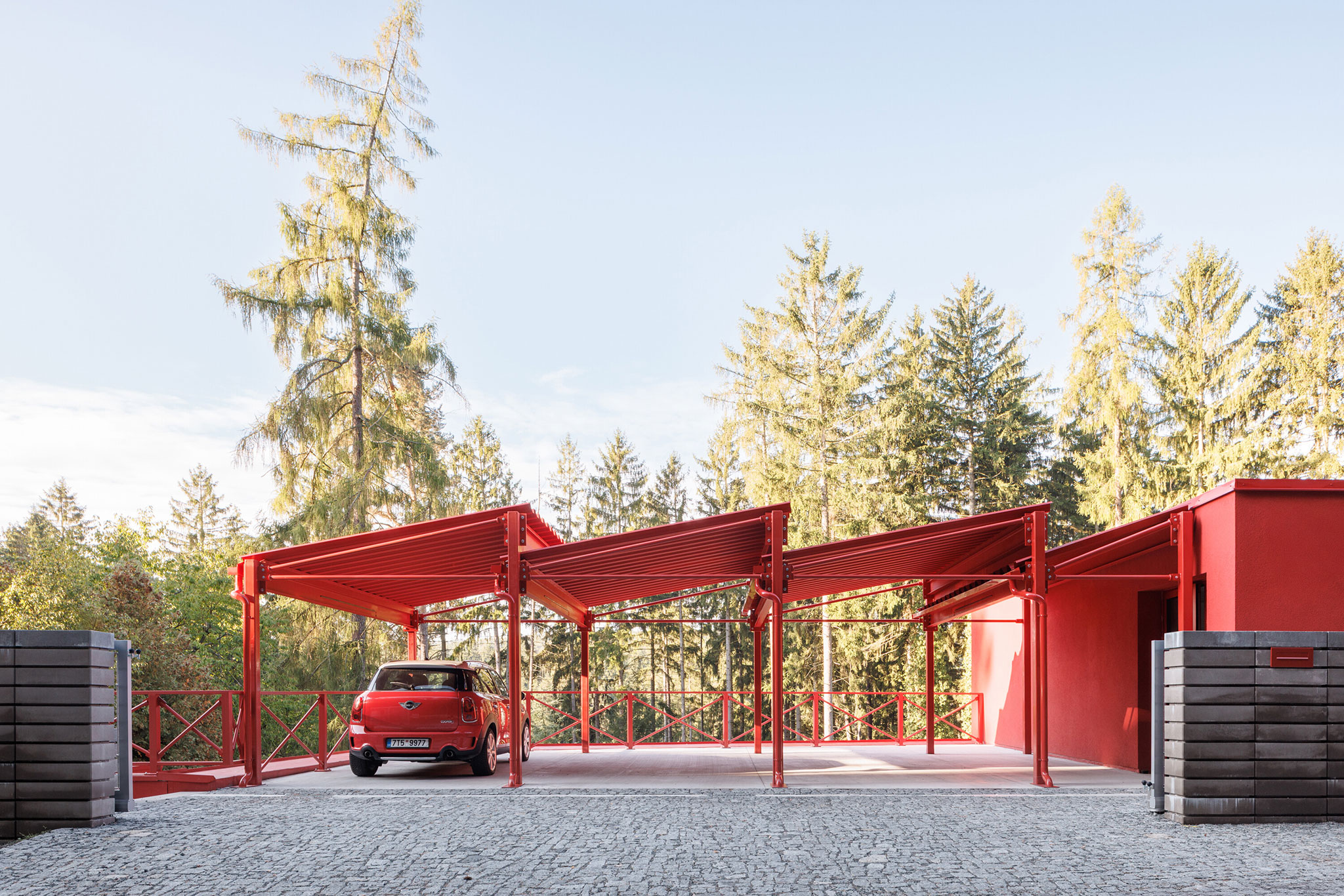
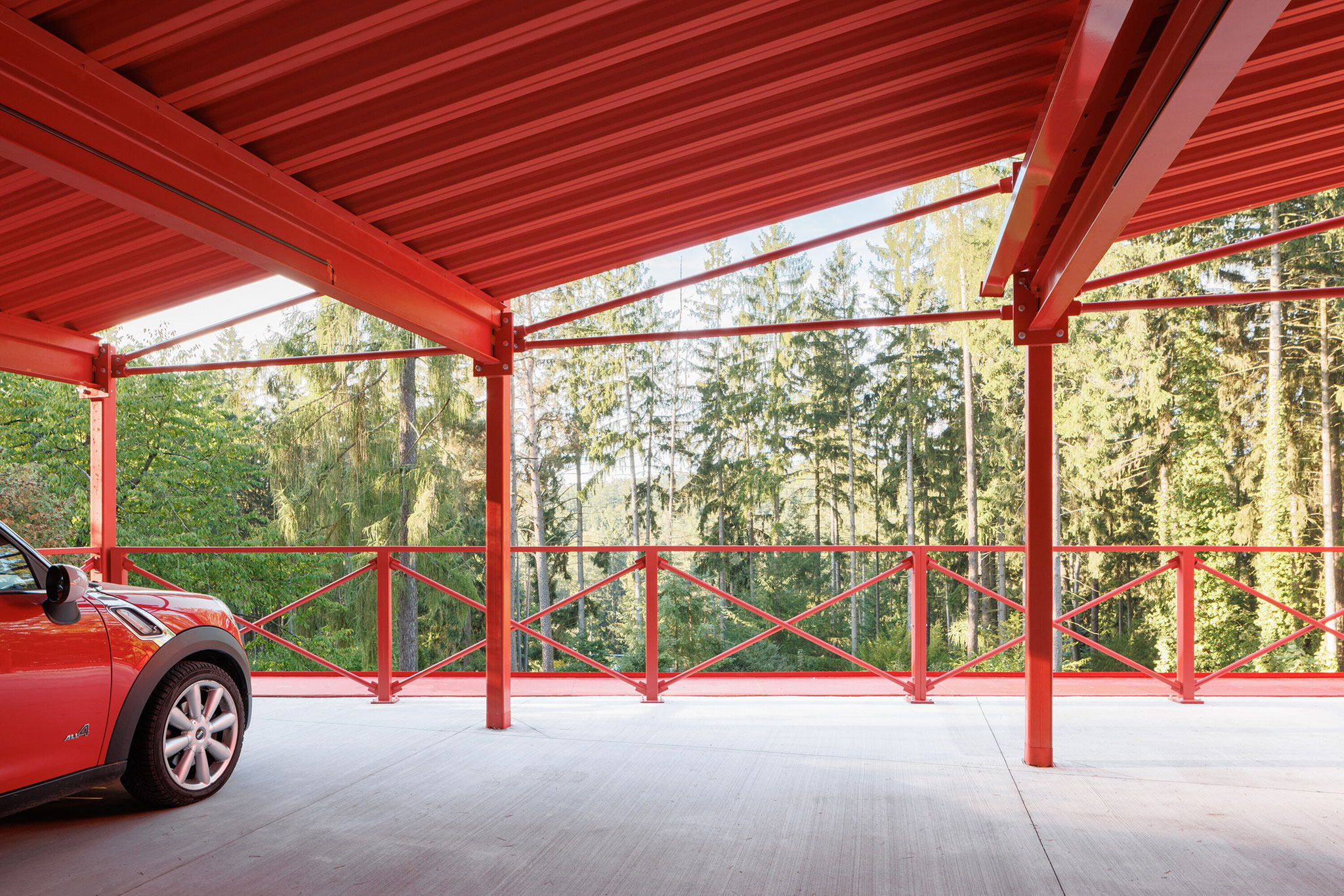
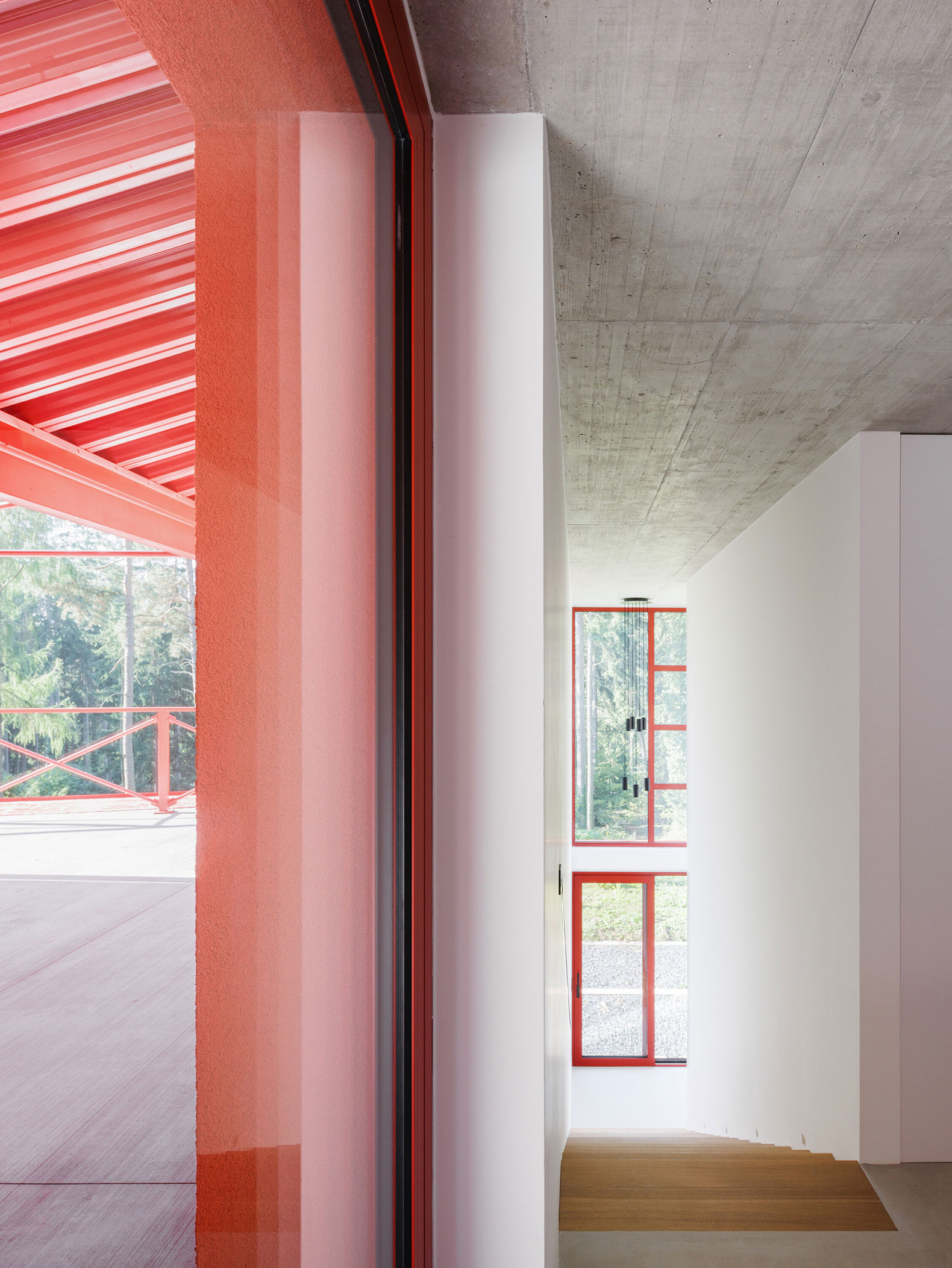
The entrance leads across the roof parking — a terrace covered by a sawtooth roof that immediately evokes the industrial character of the house. Three “teeth” represent parking spaces and one the object´s main entrance. The roof is formed by a raw red steel structure under which cars of various colors stand. The interplay of these colors lightens the otherwise serious theme of family living. Cars park differently each time, making the visual effect always unique.
Jevany Villa por Architektura. Fotografía por Matej Hakár.
Jevany Villa by Architektura. Photograph by Matej Hakár.

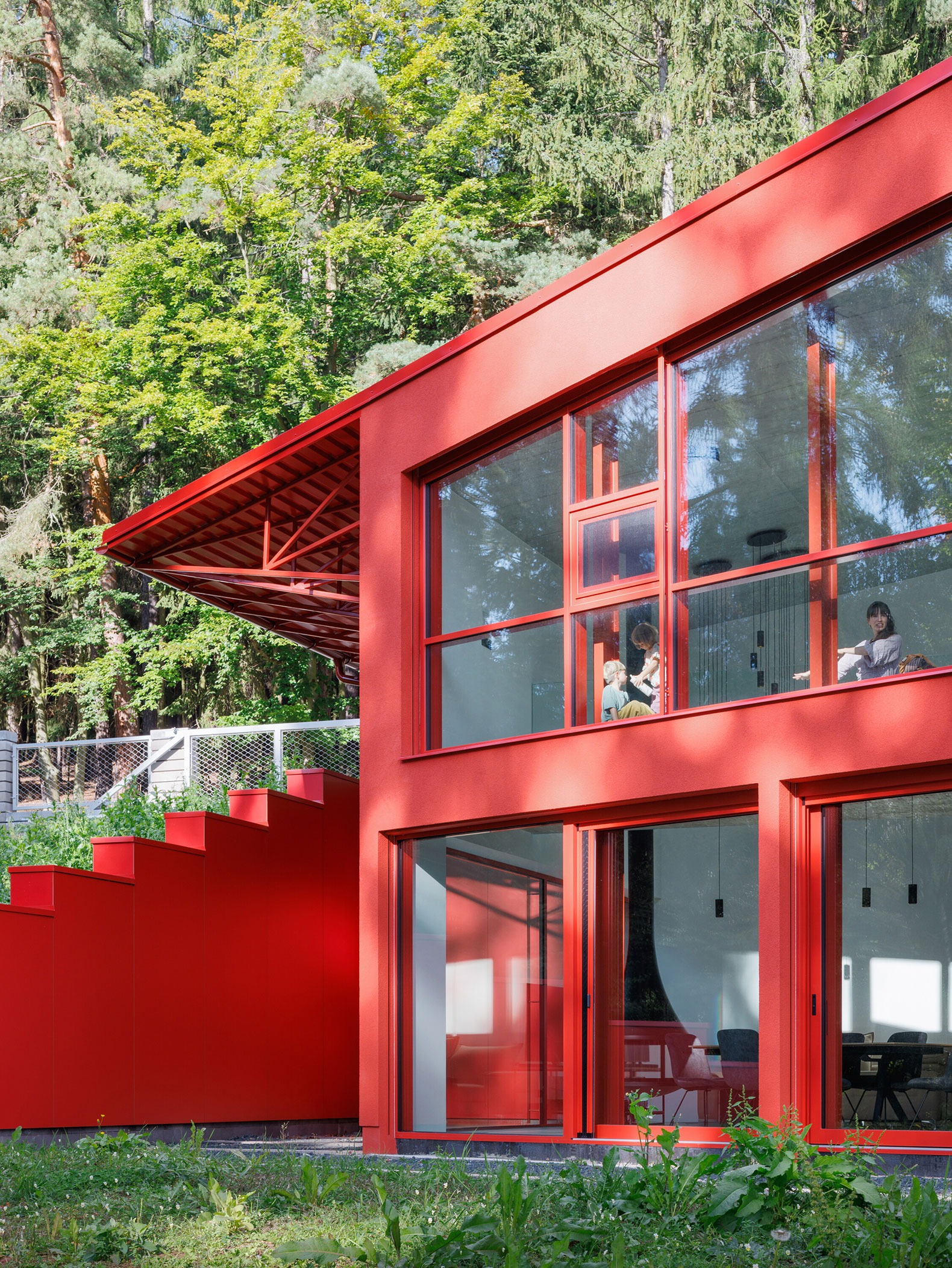
The entrance space is the central part connecting the house’s levels. Immediately upon entering, the forest appears — tall trees, silhouettes that sometimes move, changing colors throughout the year. The glazing is irregularly divided, reminiscent of Mondrian’s compositions. The straight staircase is dominant, accompanied by a recessed illuminated railing. One descends through a 3.5-meter-high space, passing a curved wall that guides movement into the living area. From the outside, the curve introduces a sense of something different within the otherwise angular silhouette of the house.

Still at street level, just a few steps lower, is a bright study that can also serve as a guest room or gym, open both to the forest and down into the living zone.

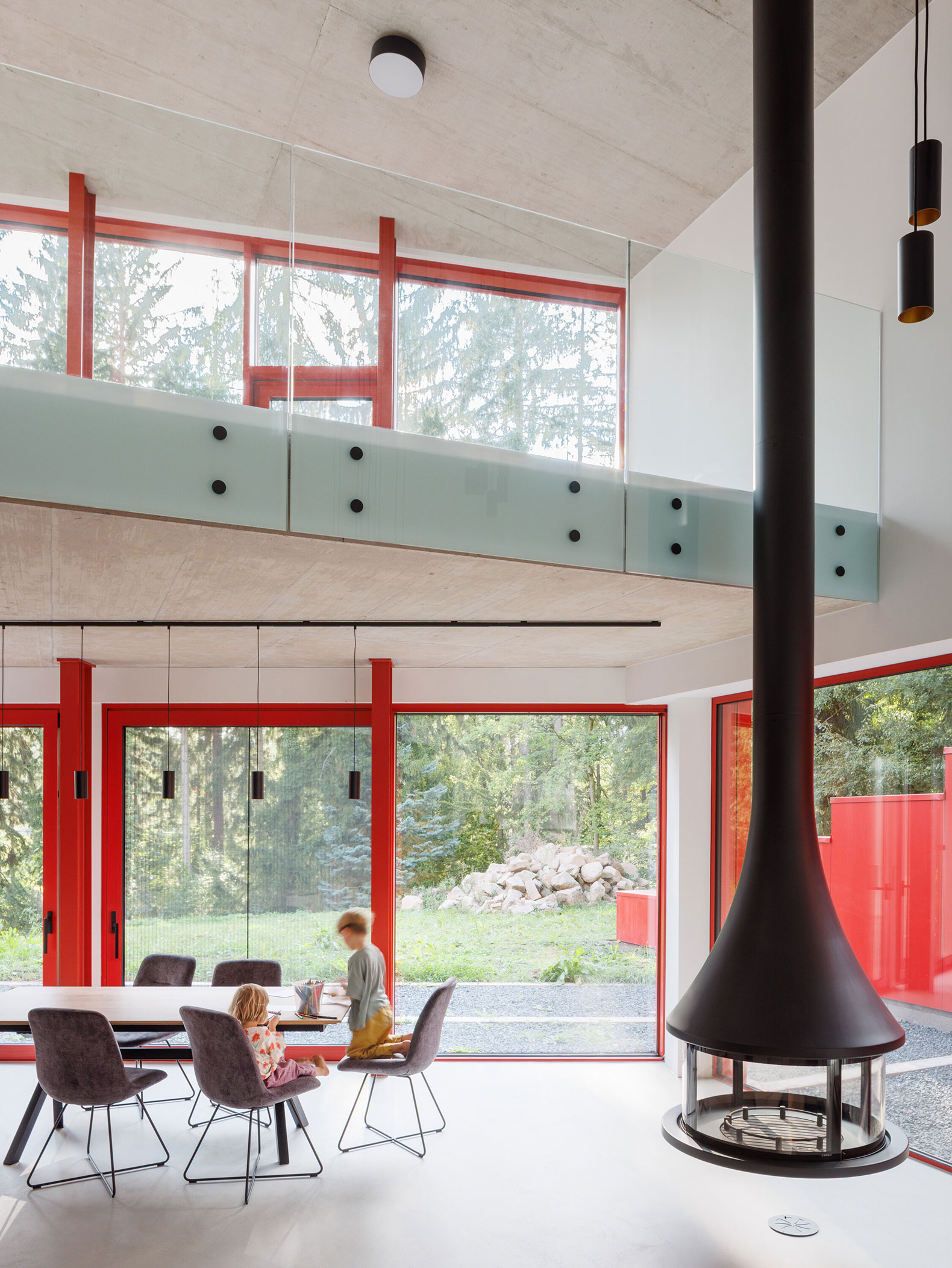
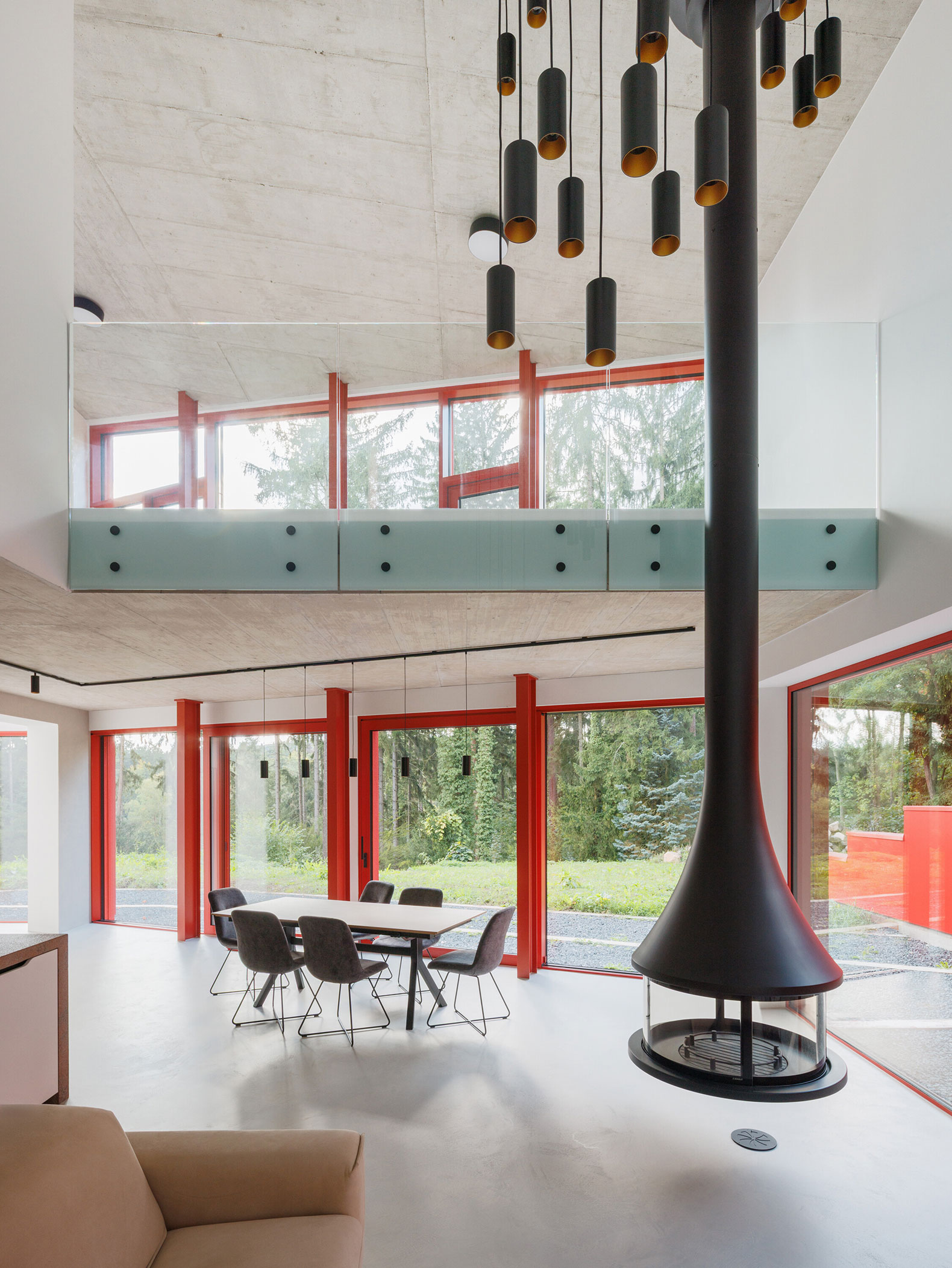
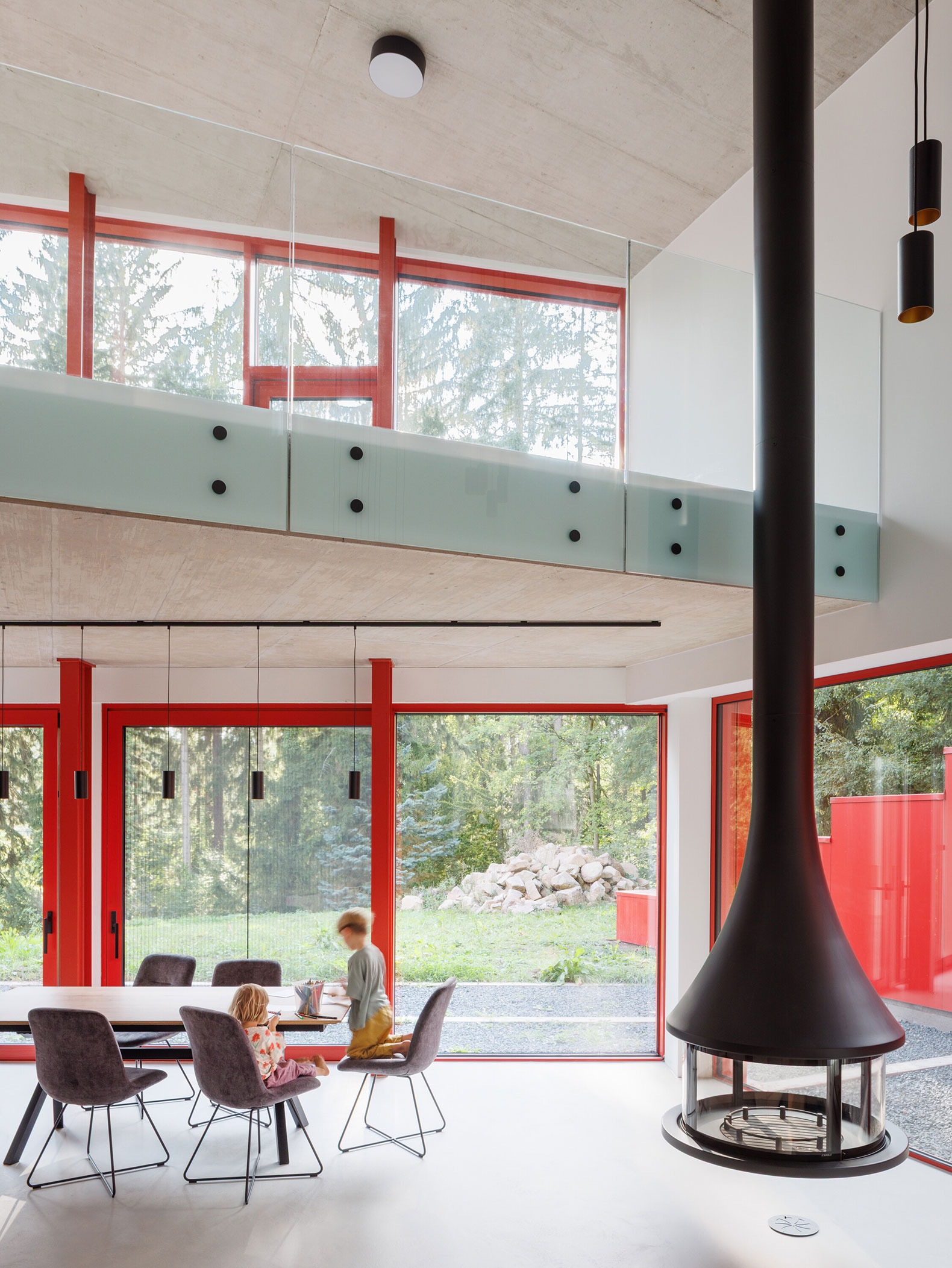
The day zone is a large central space for living, cooking, and relaxing with views. The generous space is fully connected to the surroundings; red steel window structures form a strong element contrasting with the irregular green silhouettes of the trees. The living area spans two floors; looking up, one sees raw concrete ceiling structures with formwork imprints and suspended black lights.
Jevany Villa por Architektura. Fotografía por Matej Hakár.
Jevany Villa by Architektura. Photograph by Matej Hakár.

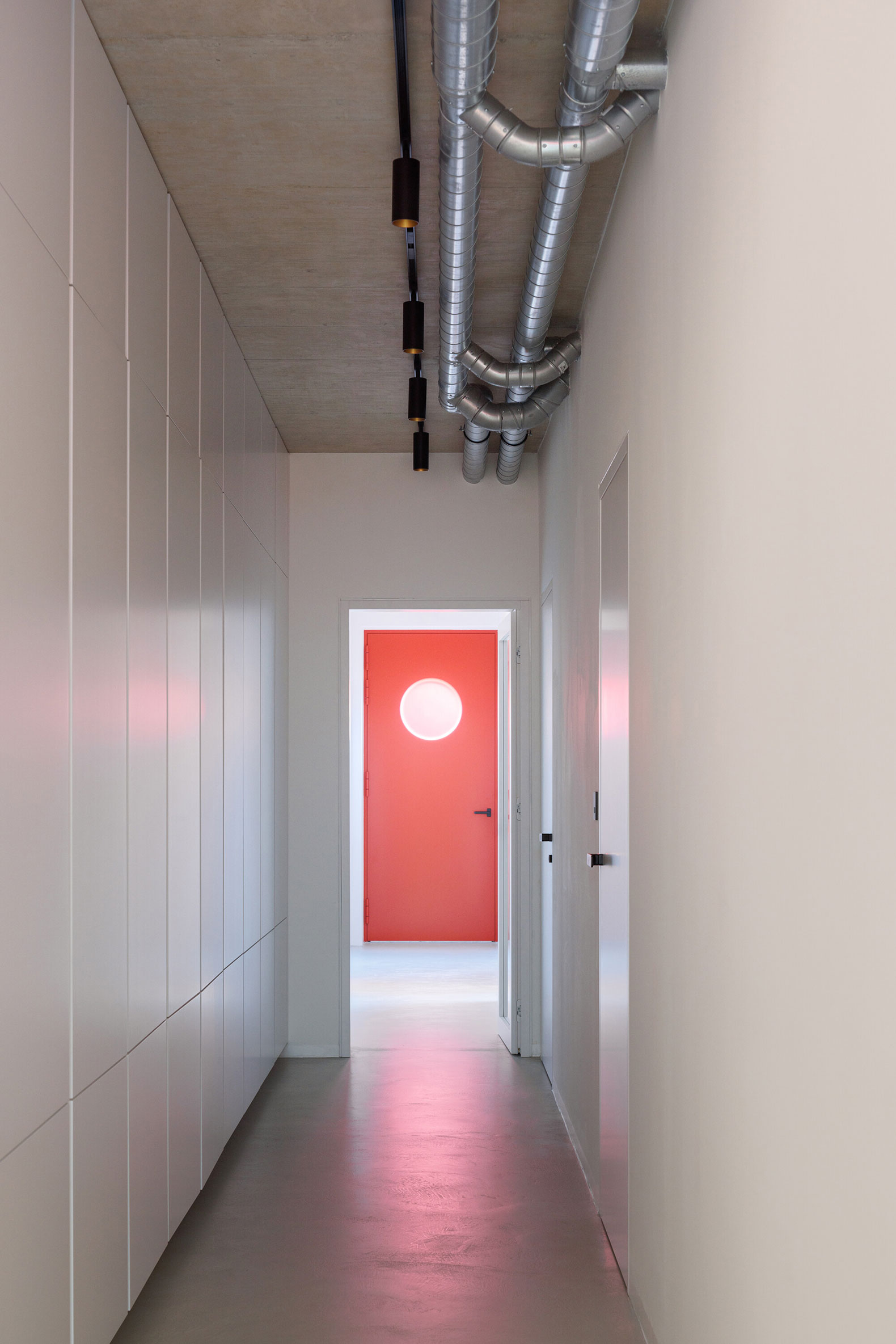
The quiet zone is connected to the day zone by a long residential corridor with built-in white cabinets on one side. The parents’ bedroom with a large walk-in closet and bathroom, as well as the children’s rooms, are connected to the exterior and forest views. The corridor ends with an exit to the garden, which may later serve older children as an independent entrance.

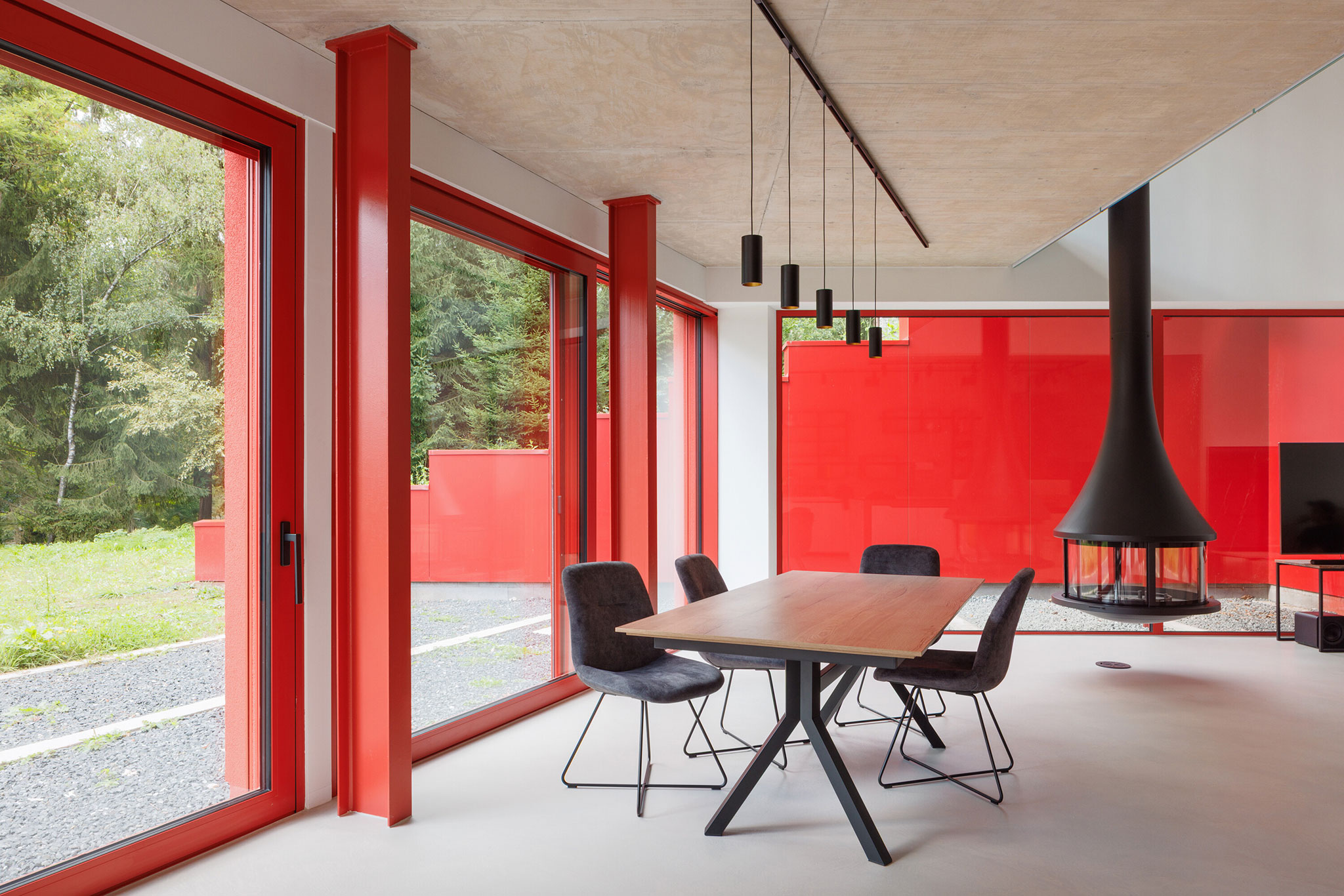
Material-wise, this is a raw house full of red steel structures, white walls, and black accents. The kitchen is multicolored; its reddish stone surfaces contrast with black shelves, white doors, and a steel fireplace floating above the floor. Interior design was developed with Jan Waltr, who shared the architects’ understanding of what the house needed.
Jevany Villa por Architektura. Fotografía por Matej Hakár.
Jevany Villa by Architektura. Photograph by Matej Hakár.

The garden is created by nature itself. Interventions were limited to the immediate surroundings — the terrace, upper entrance area, and side staircase. A striking feature is the giant stones found on the plot after removing the original building, left and placed beside the new structure as a natural part of the environment.

The plot remains visually shielded by mature trees and open toward the forest and ponds below. The forest environment is monumental, dynamic, and alive — it forms the main framework of living and the house’s direct connection to the landscape. The house-organism is part of the forest.

“The house is the result of the clients’ open, almost artistically tuned minds, mutual trust, constructive cooperation that both sides enjoyed, and the exceptional meticulousness of contractor Radek Trojánek during construction.” 

David Kraus
More information

Label
Architects
Text

Architektura. Lead architects.- David Kraus, Miroslav Styk.

+ + copy Created with Sketch.
- + copy Created with Sketch.
Label
Collaborators
Text

Structural project.- KR projekt (Kateřina Ryvolová).
Interior design.- Jan Waltr. 

+ + copy Created with Sketch.
- + copy Created with Sketch.
Label
Contractor
Text

Radek Trojánek.

+ + copy Created with Sketch.
- + copy Created with Sketch.
Label
Area
Text

Built-up area.- 218 sqm.
Usable floor area.- 338 sqm.
Plot size.- 3027 sqm. 

+ + copy Created with Sketch.
- + copy Created with Sketch.
Label
Dates
Text

Project year.- 2021.
Completion year.- 2025.

+ + copy Created with Sketch.
- + copy Created with Sketch.
Label
Location
Text

Jevany, Czech Republic.

+ + copy Created with Sketch.
- + copy Created with Sketch.
Label
Photography
+ + copy Created with Sketch.
- + copy Created with Sketch.

Architektura is an architecture studio founded by David Kraus in 2002 and based in Záběhlice, Czech Republic. The studio is defined by its search for information, inspiration, and motivation outside of architecture itself: in music, martial arts, fine arts, and writing. They aspire to human versatility, defiance of categorization, and the absence of stylistic conventions, while continuously searching for the essence of Czech identity.
David Kraus is an architect, publicist, professor, and artist. A graduate of the Faculty of Architecture at the Czech Technical University (1989–1996), he trained in the studio of Miroslav Šik, was a member of the New Czech Work movement, and received his diploma in 1996 (from the industrial architecture studio of Emil Hlaváček).
His work, which encompasses diverse typologies, is characterized by creativity and an existential undercurrent. Among the most famous projects are the Strančice concrete plant (Czech Architecture Award 2018 - main prize, National Grand Prize for Architecture, New Construction Award), the Větrník kindergarten in Říčany (Central Bohemian Region Building of the Year 2023, Municipality-funded construction award, German Design Awards nomination 2024) or the Josefův Důl glass factory (Liberec Region Building of the Year 2023, Governor's Prize, Public Prize and Reconstruction Prize). In addition, he has received dozens of other awards: Grand Prix d'Architecture (2012, 2013), Top 100 Architects+ (2019–2025), Real Estate Project of the Year (2017, 2018), House of the Year (2004, 2009, 2010, 2012, 2015), was nominated twice for Architect of the Year (2021 and 2025), was a finalist for the BigMat International Architecture Award in 2013, and was nominated for the CBRE Art of Space Award in 2019.

He is the author of more than 250 projects and has exhibited at the Jaroslav Fragner Gallery in Berlin, Moscow, Budapest, Zlín, and the House of Arts in Brno. He has given dozens of lectures, for example, at ETH Zurich, and repeatedly at Pecha Kucha Night, VŠUP, FA CTU, AVU, and others. TUL Liberec, Roxy, FOR ARCH, Days of Architecture, and in 2024 for the Croatian platform Koho.

The studio's clients include, for example, Prague Airport, the Prague City Fire and Rescue Department, the Czech Republic's General Directorate of Police, Prague City Hall, the Embassy of Lithuania, Europapier, Wurth, Ikem, Thomayer Hospital, Bulovka, numerous cities, municipalities, and private investors. The studio's projects can be found in the Czech Republic, Germany, the United States, Slovakia, and Oman.

She serves on juries for Czech and international competitions. Between 2000 and 2001, she was a member of the editorial board of Stavba magazine; in 1999/2000, of the Mánes association; and in 2000, of the Forum for the Restoration of the Vítkov Monument. and in 2000/2001, on the board of the Czech Architecture Foundation.

Some of her paintings from the VIZE exhibition were acquired by the National Gallery in 1997, and her work has been featured on radio programs and television reports (ČT Art, Události komentáře, the ČT 2 documentary Bílé vrány, Wave radio, Radio 1, R-plus, Vltava). Her studio's work has been published in approximately 400 articles and reports in the Czech Republic and abroad (in 2023, the Větrník kindergarten was named by the Czech media as the most featured Czech building abroad).

As an educator, he led the workshop at the Faculty of Arts of the Czech Technical University, was a visiting professor at the Academy of Fine Arts (2013) and the University of Applied Sciences (2021-2022), and collaborates with BUT Brno, VŠVÚ, AVU, FFUK, and Archipem. During his time at the Faculty of Architecture of the Czech Technical University (2015-2018), his workshop received two awards: one for best workshop and another for best project (2016 and 2017). In 2021, he was nominated for Dean of the Faculty of Architecture of the Czech Technical University, in 2023 he was invited to run for Dean of the Czech Technical University, and in 2025 for Dean of the Technical University of Brno.

David Kraus draws inspiration from martial arts, percussion, and everyday objects, and remains firmly committed to finding a distinct Czech identity in architecture.

Miroslav Styk is an architect and a member of the Architektura team. He holds a Bachelor of Architecture degree from the Slovak Technical University (2010-2014). He participated in the Erasmus program at ISCTE – University Institute of Lisbon – Architecture (2014-2015). He earned a Master of Architecture degree from the Czech Technical University (2015-2018).

In 2017, he completed an internship at the ENSAMBLE studio in Madrid. Together with Martin Želiar and David Lašek, he won the

In 2017, she completed an internship at the ENSAMBLE studio in Madrid. Together with Martin Želiar and David Lašek, she won the jury prize in the Olovený Dušan competition for the project Most medzi a bytový dům (2017) at the Císler & Pazder studio. She wrote her undergraduate thesis under the supervision of architect David Kraus.

After graduating in 2018, she began working at the Architektura studio, where she participated in projects such as an administrative building for the Prague Fire and Rescue Service, the Czech Republic Police Headquarters building in Cheb, a single-family home in Jevany, the interior of the Würth company offices, the conversion of a glass factory in Josefův Důl, the observation tower in Dolný Slivno, the youth park at the Riegrova quarry in Úvaly, the completion of the Hálkova Primary School in Humpolec, and the design of a warehouse for the Europapier company.

Read more
Published on: March 25, 2026
Cite:
metalocus, CAMILA DOYLET
"Red dot in the forest landscape. Jevany Villa by Architektura" METALOCUS. Accessed
<https://www.metalocus.es/en/news/red-dot-forest-landscape-jevany-villa-architektura> ISSN 1139-6415
Loading content ...
Loading content ...
Loading content ...
Loading content ...
Loading content ...
Loading content ...
Loading content ...
Loading content ...
Loading content ...
Loading content ...
Loading content ...
Loading content ...
Loading content ...
Loading content ...
Loading content ...
Loading content ...
Loading content ...
Loading content ...
Loading content ...
Loading content ...
Loading content ...
Loading content ...
Loading content ...
Loading content ...
Loading content ...
Loading content ...
Loading content ...
Loading content ...
Loading content ...
Loading content ...
Loading content ...
Loading content ...
Loading content ...
Loading content ...
Loading content ...
Loading content ...
Loading content ...
Loading content ...
Loading content ...
Loading content ...
Loading content ...
Loading content ...
Loading content ...
Loading content ...
Loading content ...
Loading content ...
Loading content ...
Loading content ...
Loading content ...
Loading content ...
Loading content ...
Loading content ...
Loading content ...
Loading content ...