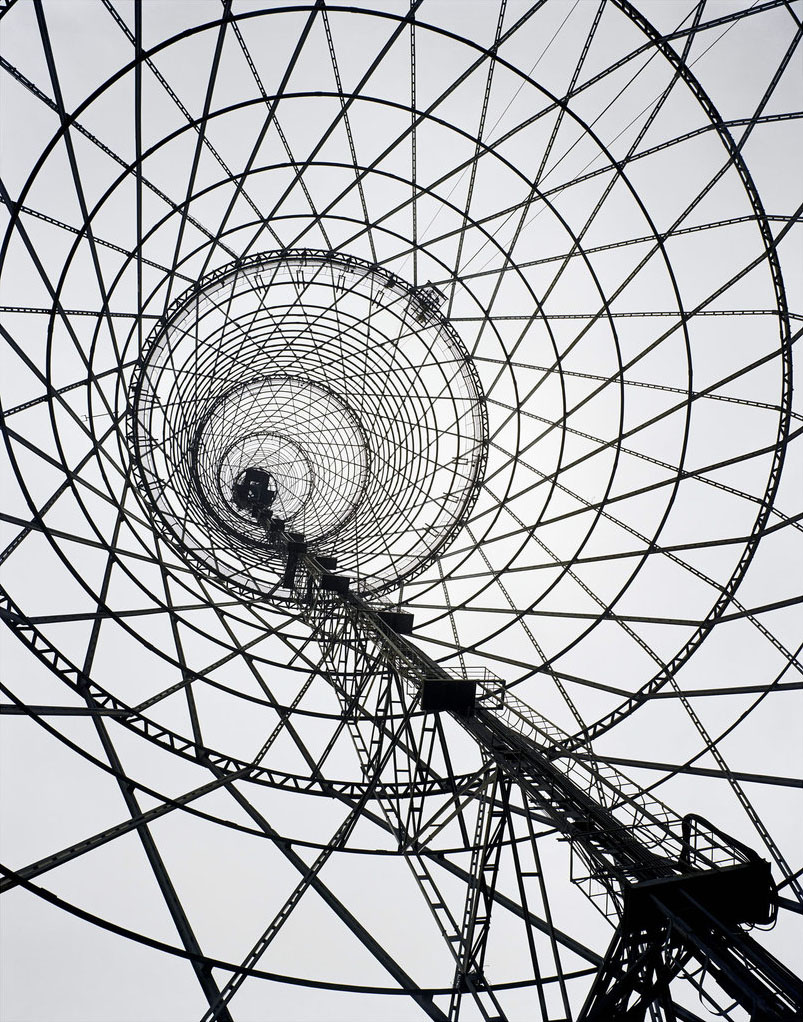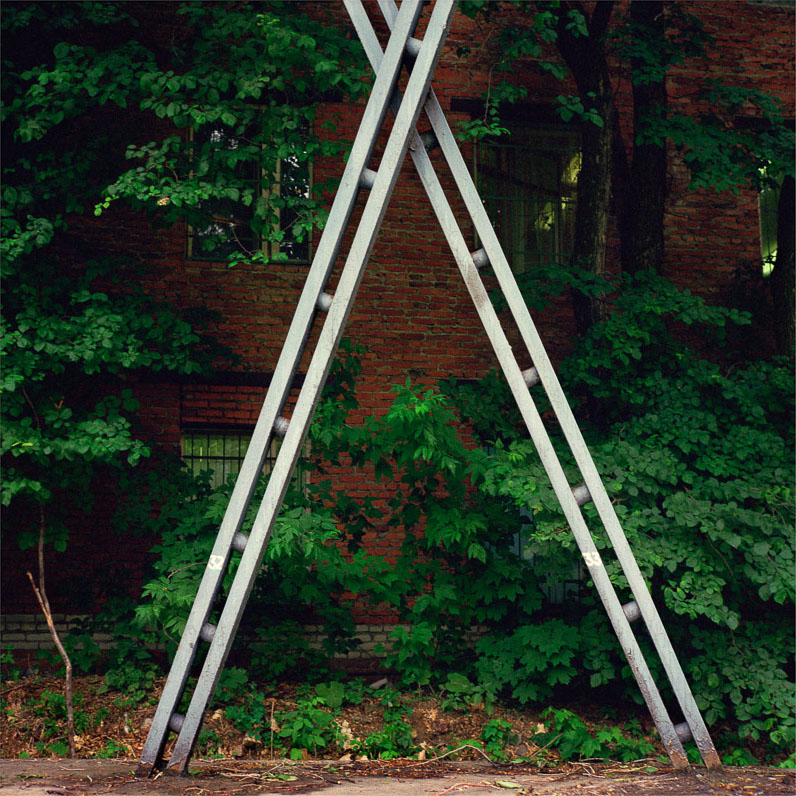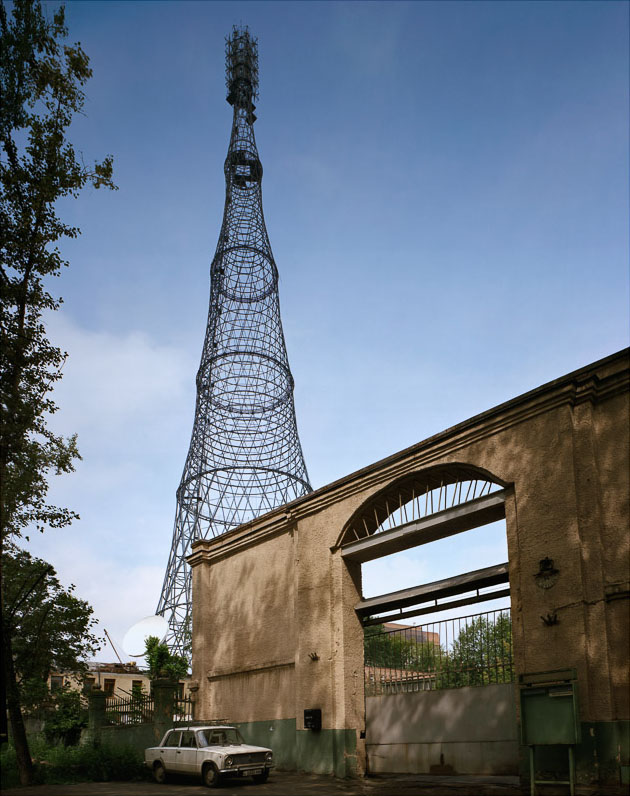
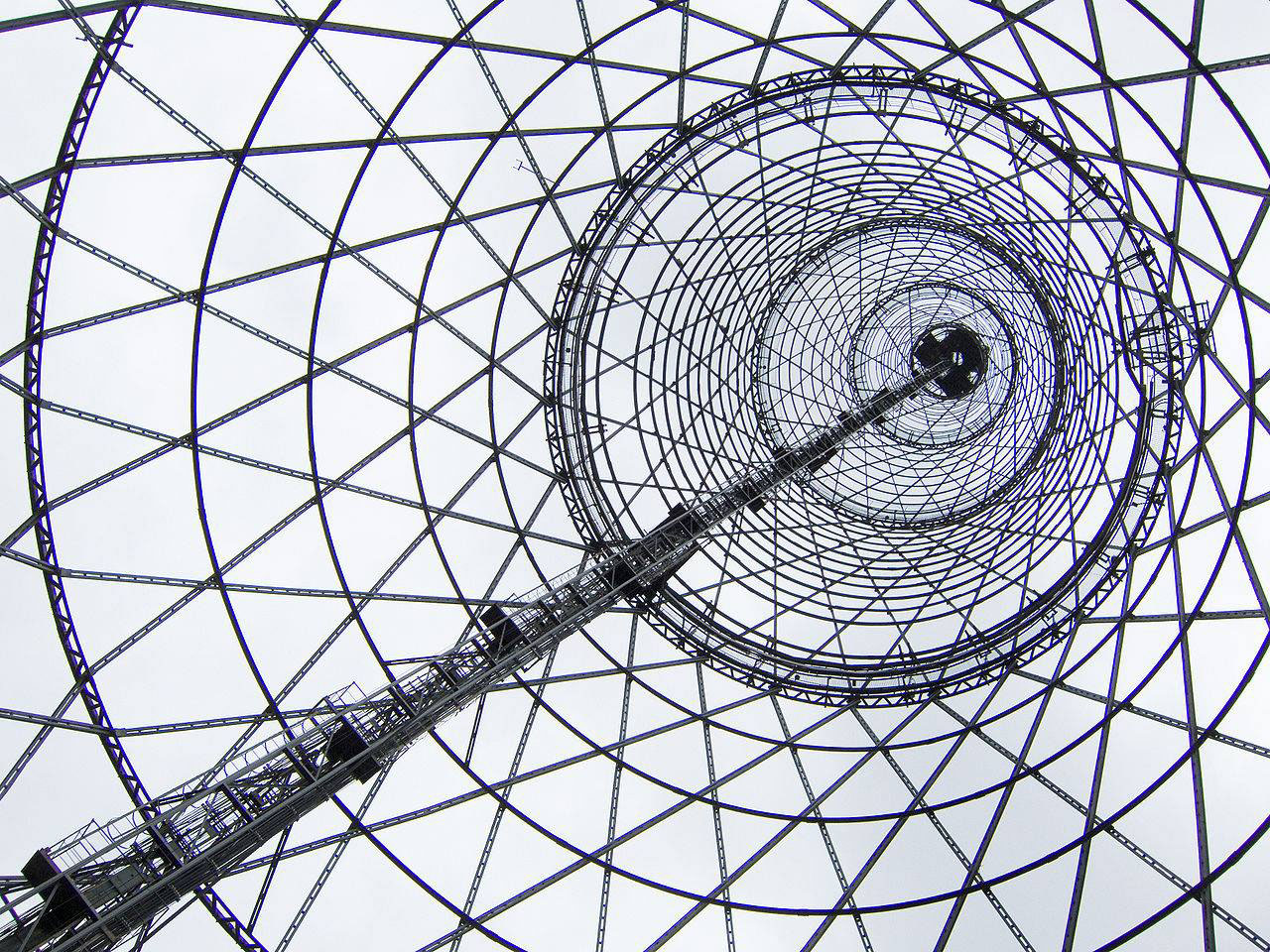
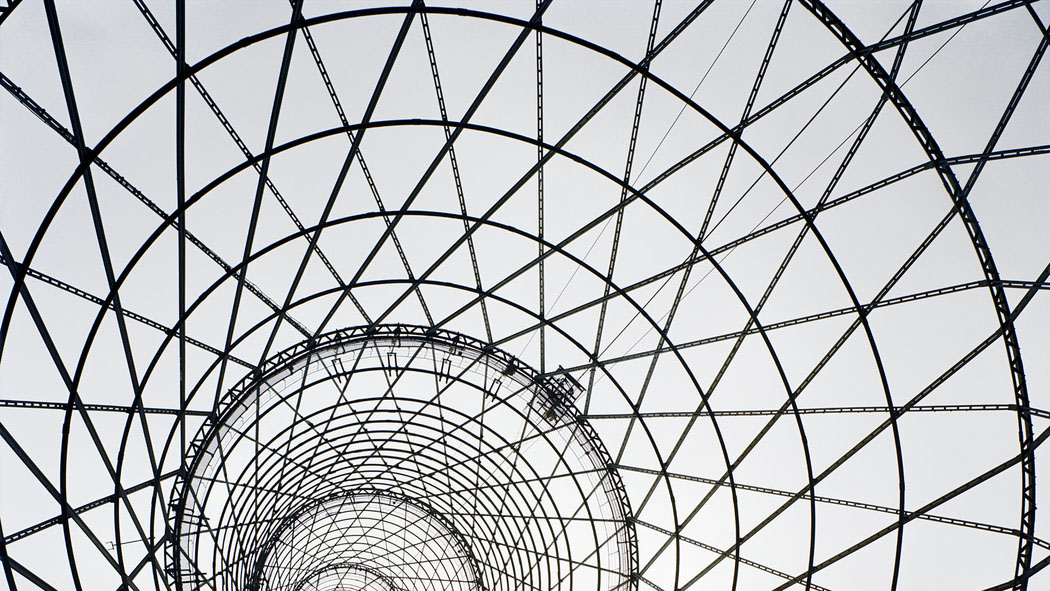
The Shabolovka radio tower in Moscow, designed by the engineer Vladimir Shukhov (1853-1939), and one of the great feats of 20th-century engineering, a landmark of constructivist architecture is facing demolition. Late last month, the Russian State Committee for Television and Radio Broadcasting agreed to the dismantling of the Shabolovka radio tower in Moscow.

The tower is a stunning example of the ambition and spectacle that marked this era of Soviet architecture. The building, a display of the desire for a cutting-edge social movement, is fittingly located near the Moscow Kremlin. This Eiffel Tower of the new Russia, a 50-story hyperboloid in structure of steel mesh, was built under commission by Lenin and completed in 1922.

The Moscow Times is reporting that the more than 90-year-old Shukhov Radio and Television Tower is "likely to be dismantled." They quote the Communications and Press Ministry's call for immediately dismantling the tower that has been in a state of disrepair for some time: "The only possible option for  a solution to  the problem is a two-stage reconstruction and  renovation of  the radio tower, which stipulates in  the first stage its dismantling for  the conservation and  preservation of  elements for  later restoration."

The tower was intended to spread the word of Communism through the new radio technology, and its pyramidal, mesh design suggests the architect’s desire to perpetuate the sense of daring and excitement that characterized the time during which it was built, and also a revolutionary ambition. Supported on a shallow ring of concrete, the tower is a diaphanous web rising into the sky. Only a shortage of materials thwarted plans to make it more than twice as tall — higher than Gustave Eiffel’s earlier creation in Paris. Even at that greater height, Shukhov’s construction was so efficient and elegant that his tower would have been a quarter of the Eiffel Tower’s weight.

“The impression when you stand beneath it is unforgettable,” said Richard Pare. Vladimir V. Putin expressed, in 2009, support for restoring the tower and making it a tourist attraction, but nothing came of that. Far from tourist routes, the radio tower has been allowed to deteriorate for years, corroding while government authorities in Moscow debated its fate. In 2010, the British architect Norman Foster joined a campaign to save the tower, which he called “a structure of dazzling brilliance and great historical importance.” Shukhov’s work is said to have partly inspired Norman Foster’s so-called Gherkin in London.

The news comes two years after Vladimir Shukhov called for restoration work to begin immediately on the tower, lest "it would be simpler to order that the tower be demolished, so that it shames neither my ancestors nor our country," as he said in a news conference at the time.

An array of international architects, engineers, academics and cultural leaders has signed a petition pleading with President Putin to override the committee’s decision and spare the tower.
Read more
Read less

More information

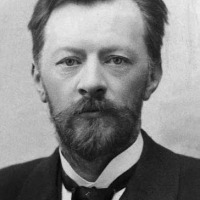
Vladímir Grigórievich Shújov (Grayvoron, Russian Empire, 28 August 1853 – Moscow, Soviet Union, 2 February 1939) was a Russian engineer, inventor and architect. He studied at the Imperial Technical School in Moscow, now Bauman Moscow State Technical University, graduating in mechanical engineering with a gold medal in 1876. That same year, he travelled to the United States as part of a Russian scientific delegation to visit the Centennial Exhibition in Philadelphia, where he met engineer and entrepreneur Alexander Bari.

Upon returning to Russia, he worked at the technical office of the Warsaw–Vienna Railway in Saint Petersburg. In 1878, he began collaborating with Bari on the development of facilities for the oil industry in Baku. In 1880, he became chief engineer at the technical office Bari had established in Moscow, where he carried out much of his professional work. During this period, he designed oil pipelines, steel storage tanks, oil transport vessels, steam boilers and industrial fuel-processing systems. In 1891, together with engineer Sergei Gavrilov, he patented a continuous thermal cracking process for petroleum.

Alongside his industrial work, Shukhov began researching steel structural systems for buildings, large-span roofs and towers. His early projects included the roof structures of the Upper Trading Rows in Moscow, now known as GUM (1889–1893). In 1896, he presented several pavilions with lattice and suspended roofs at the All-Russian Industrial and Art Exhibition in Nizhny Novgorod, together with a water tower constructed from straight steel members forming a hyperboloid surface. He filed a patent application for this structural system in 1896, which was granted in 1899. It was subsequently used in water towers, lighthouses and other industrial structures.

In the late nineteenth and early twentieth centuries, he developed steel structures for buildings and infrastructure, including the roofs of Petrovsky Passage and the Pushkin Museum of Fine Arts in Moscow, as well as numerous railway and industrial facilities. He also contributed to the design and construction of hundreds of bridges and developed lattice structures for factories and large-scale buildings.

Between 1911 and 1912, he designed the Adziogol hyperboloid lighthouses near Kherson, in present-day Ukraine. Following the Russian Revolution of 1917, he continued working on industrial and communications infrastructure. Between 1919 and 1922, he designed and built the Shabolovka radio broadcasting tower in Moscow, known as the Shukhov Tower, a 160-metre-high steel structure composed of six superimposed hyperboloid sections.

During the 1920s, he collaborated with architect Konstantin Melnikov on the structural development of several buildings for Moscow's public transport system, including the Bakhmetevsky Bus Garage (1926–1927) and the Novoryazanskaya Street Garage (1926–1929). He also designed steel towers for electrical transmission lines, including the hyperboloid structures built between 1927 and 1929 for the crossing of the Oka River near Nizhny Novgorod, and participated in the development of industrial facilities and oil pipelines across the Soviet Union.

In 1927, he was elected a corresponding member of the Academy of Sciences of the Soviet Union and became an honorary member in 1929. He received the title of Hero of Labour in 1928 and the Lenin Prize in 1929, as well as recognition as an Honoured Worker of Science and Technology.

Vladimir Shukhov died in Moscow on 2 February 1939.

Read more
Published on: March 17, 2014
Cite:
metalocus, JOSÉ JUAN BARBA
"The Shabolovka radio tower faces demolition" METALOCUS. Accessed
<https://www.metalocus.es/en/news/shabolovka-radio-tower-faces-demolition> ISSN 1139-6415
Loading content ...
Loading content ...
Loading content ...
Loading content ...
Loading content ...
Loading content ...
Loading content ...
Loading content ...
Loading content ...
Loading content ...
Loading content ...
Loading content ...
Loading content ...
Loading content ...
Loading content ...
Loading content ...
Loading content ...
Loading content ...
Loading content ...
Loading content ...
Loading content ...
Loading content ...
Loading content ...
Loading content ...
Loading content ...
Loading content ...
Loading content ...
Loading content ...
Loading content ...
Loading content ...
Loading content ...
Loading content ...
Loading content ...
Loading content ...
Loading content ...
Loading content ...
Loading content ...
Loading content ...
Loading content ...
Loading content ...
Loading content ...
Loading content ...
Loading content ...
Loading content ...
Loading content ...
Loading content ...
Loading content ...
Loading content ...
Loading content ...
Loading content ...
Loading content ...
Loading content ...
Loading content ...
Loading content ...