This summer I stayed in a field house nearby ... we arrived tired from Madrid, ... we had visited friends in Barcelona, ​​... all day traveling. In midfield, a place to start our holiday near Ullastret, so the recommendation for dinner was obvious. We were told that all sites were good, I do not remember where we ended up having dinner but all places were good. After dinner we went for a walk in the center (ie cross the street) we wandered and wandered, with a cat that made ​​friends and there was no way to mislead. It was night and I did not realize that it was the work of Josep Lluis Mateo, but no matter, the walk was great around the streets that had remodeled an architect, one from Barcelona.

Text  by José Juan Barba

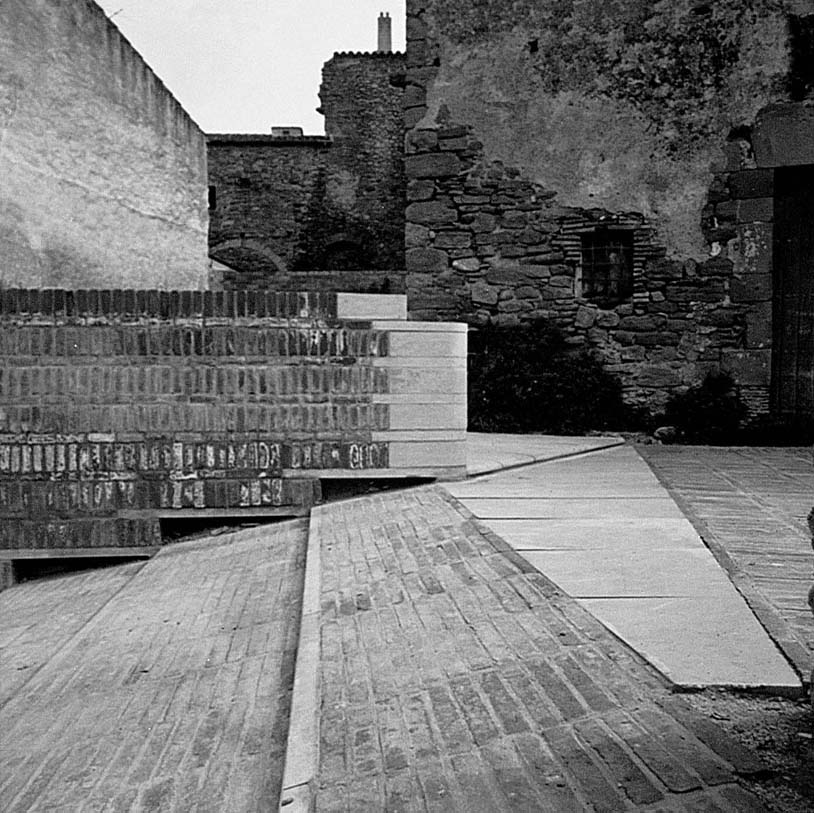
One of my first works, paving a medieval village, completed many years ago.

Through Bernadó’s eyes, it reappears new, colourful and vibrant.

I recall the view of the path (which Bernadó picks up), built to highlight the continuous line of movement.

Stones that remain and new features that highlight the transformation. Though the ground shows its base, as geometry and support, it persists undaunted.

Text by Josep Lluís Mateo

CREDITS

AutHor.- Josep Lluís Mateo – Mateo Arquitectura.
Project.- 1982.
Construction.- 1983 - 1985.
Location.- Pueblo de Ullastret, Baix Empordà, Girona (Spain).

Photography.- Jordi Bernadó.

More information about project, here.

Read more
Read less

More information

Josep Lluís Mateo was born in Barcelona (1949) and graduated in Architecture in 1974 from the ETSAB, later obtaining his PhD (cum laude) from the Polytechnic University of Catalonia in 1994. He is also Professor Emeritus, Doctor of Architecture and Design at ETH Zurich (Swiss Federal Institute of Technology). He has taught and lectured at major academic institutions worldwide, including the Getty Foundation in Los Angeles (Scholar), the Berlin Sommer Akademie, and Harvard Graduate School of Design (Guest Professor), among others.

In 1991, he founded mateoarquitectura, a practice based in Barcelona that has developed a broad range of projects—office buildings, urban planning, public spaces, housing—always with a strong international focus. Mateo’s practice is currently involved in a number of local and international projects such as the new Film Theatre of Catalonia in Barcelona, the new headquarters for PGGM Pension Fund Company in Zeist, Holland, and the office building on the former site of Renault factories in Boulogne-Billancourt, Paris, among others.

With each of his projects, Mateo seeks to connect the practice of construction with research and development in both intellectual and programmatic terms. His work lies at the intersection between conceptual thinking and built reality, combining technical rigor with ongoing inquiry. His architecture has been widely published and exhibited globally, receiving numerous awards and honors. In 2011, he received the Aplus Award for Best Career Achievement; in 2019, DOMUS named him among the 100 best architecture studios worldwide; and in 2021, he was named Author of the Year by the Juanzong Archive Awards (China).

Among his most significant projects in Spain are the Toni Catany International Photography Center in Mallorca, the Barcelona International Convention Center (CCIB), the Filmoteca de Catalunya, the renovation and extension of the Mercat del Ninot in Barcelona, and the paving of the historic center of Ullastret. Internationally, his work includes the headquarters for PGGM in Zeist (Netherlands), La Factory office building in Boulogne-Billancourt, the ESMA School in Montpellier, and the Castelo Branco Cultural Center.

Academic collaborations and teaching:
Josep Lluís Mateo has been Professor of the Architecture Department at the Swiss Federal Polytechnic in Zurich (ETH-Z) since 2002. He has also taught and lectured at numerous institutions around the world, including Princeton, Columbia University in New York, the Harvard Graduate School of Design, ABK Stuttgart, UP8 Paris, OAF Oslo and ITESM Mexico. He was Visiting Scholar at the Jean P. Getty Center in Los Angeles from 1991 to 1992. Josep Lluís Mateo is President since 2009 of the Board of Directors of the Barcelona Institute of Architecture. He has been a member of a number of juries and expert committees, including the Quality Committee of Barcelona City Council (2000-2008), and for prizes such as the European Landscape Award and the Thyssen Award.

Recent exhibitions and prizes:
The practice’s work has been exhibited on numerous occasions thanks to its international influence. New York’s MoMA devoted a space in the exhibition “Spain: On Site” (2006) to its apartment building in Valencia for the Sociopolis Project. Individual exhibitions include those at Ras Gallery (Barcelona, 2009), Architekturgalerie Aedes (Berlin, 2004), Architekturzentrum Wien (Vienna, 1998), Col•legi d’Arquitectes de Catalunya (Barcelona, 1998),Galerie Fragner (Prague, 1998), Galerie Aedes (Berlin, 1994), Architekturgalerie Luzern (Luzern, 1992) and Architekturgalerie Munich (Munich, 1991).

The work of Josep Lluís Mateo has been awarded many prizes, including:
- Top International Purpose-Built Venue 2008, First Prize. Best International Convention Centre category.
Organized by C&IT magazine, London. Project: CCIB-Barcelona International Convention Centre
- 2008 Archizinc Award, First Prize. Collective Housing category. Project: Sant Jordi Students’ Hall of Residence, Barcelona
- European Union Prize for Contemporary Architecture - Mies van der Rohe Award 2005, Runner-up. Project: CCIB- Barcelona International Convention Centre
- 15th Award of Grupo Dragados de Arquitectura.

Read more

Jordi Bernadó (Lérida, 1966). The artist understands photography as a way of conceiving the world. He understands the discipline as a form of knowledge and a tool to see the city, architecture and the artistic activity from another perspective. He has published over 20 books and many of his works have been acquired by public and private collections worldwide.

His photographs have been acquired for major public and private collections, such as those of Fundació “La Caixa”, Fundación Telefónica, Bibliothèque Nationale de France, Deutsche Bank Collection, Artium, MUSAC, Fundación Vila Casas, and Banc Sabadell among others. They have also been shown in many solo and collective exhibitions in Spain and abroad, at venues such as Artist Space in New York, la galerie VU' in Paris, Galería Senda in Barcelona, Filter Space in Hamburg, Museo Civico Riva del Garda in Italy, Fundación Telefónica in Madrid, in Fotografie Forum International in Frankfurt and the MAXXI museum in Rome.

He has published more than 20 books focusing on contemporary architecture and landscape, such as Good News* always read the fine print (winner of Laus award, 1999), Very very bad news (winner of the best photography book in Photoespaña 02 and best art book prize from Spanish Ministry of Culture in 2003), True Loving and other tales (selected as one of the best photography books in Photoespaña 07), Lucky Looks published in 2008 (for Banc Sabadell), Welcome to Espaiñ in 2009 and Europa in 2010.

Among others he is the winner of the following awards:

Fotopres Scholarship (1993), Endesa Scholarship (2007), PhotoEspaña best photography book award (2002), the Ministry of Culture Award for best art book of the year (2003), he was granted by Beca Endesa X in 2007 and the award for best experimental film “Hello Ms. Hock” in the Architecture Film Festival of Santiago de Chile (2013).

Jordi Bernadó en el Pabellón presentando su intervención el 13 de marzo de 2014. Fotografía © Pietro Milici.

Read more

José Juan Barba (1964). Architect from the Madrid School of Architecture (ETSAM) in 1991. He received his PhD in Architecture from ETSAM in 2004, graduating summa Cum laude with the doctoral thesis "Inventions: New York vs. Rem Koolhaas, Bernard Tschumi, Piranesi." In 1991, he received a Special Mention in the Spanish National Graduation Awards. Until 1997, he worked as an advisor to several NGOs. In 1992, he founded his architectural practice in Madrid (www.josejuanbarba.com). 

He is an architectural critic and, since 1998, Editor-in-Chief of the internationally acclaimed bilingual architecture journal METALOCUS (Spanish/English), recipient of several national and international awards.

Barba is an Associate Professor at the University of Alcalá and a member of several research groups. He has been invited to participate in numerous international forums on architecture and urbanism, including the II Forum of Mexican World Heritage Cities, Urban Development, History and Modernity, organized by the Pan-American Committee for Urban Development and Historical Heritage; the World Urban Development Forum (FMDU), held in Culiacán, Sinaloa, Mexico; and the International Conference on Architecture and Urbanism from the Perspective of Women Architects. He has also been invited as lecturer and guest critic at numerous national and international institutions, including the National Building Museum, Roma Tre University, Politecnico di Milano, University of Genoa, Université Pierre Mendès France Grenoble, the Madrid and Barcelona Schools of Architecture, National Autonomous University of Mexico, the Faculty of Architecture in Montevideo, the Schools of Architecture of Medellín and Ecuador, Universidad Iberoamericana, IE University, as well as the Schools of Architecture of Zaragoza, Valladolid, Málaga, Granada, Seville, and A Coruña, among others.

He has extensive professional experience in architecture, urbanism, landscape intervention, and territorial regeneration. His work has received numerous awards, including First Prize in the “Gran Vía Posible” competition for Delirious Gran Vía, Madrid; recognition for the Rivers Interpretation Centre in Zamora, awarded and exhibited at the World Architecture Festival 2008; and recognition for the Santa Bárbara Park project in Toledo. He was also awarded the Erich Degner Prize for Architecture (1995), promoted by the BBVA Foundation. His project for a Day Centre for the Elderly was included in Volume 3 of the Madrid Architecture Guide published by the Official College of Architects of Madrid (COAM) in 2007. His work has been widely published in national and international books and journals.

He served as Maître de Conférences at the Institut d’Urbanisme de Grenoble, Université Pierre Mendès France Grenoble, during the 2013–14 academic year, following his appointment through a European open competition. His work has been published internationally. He regularly serves on academic and professional juries, including the editorial competition jury for the journal Quaderns (2011), the selection committee for the European Union Prize for Contemporary Architecture – Mies van der Rohe Awards (2007–present), and the jury panels for EUROPAN 13 (2015–16) and TRANSFER, Zurich (2019). He was also invited to participate in the Biennale di Venezia 2016 as part of the exhibition Spaces of Exception / Spazi d’Eccezione.

He has authored several books, including "The Dark Line. michele&miquel, dA Vision Design" (2024), "CONGRESO ANYWAY. La ciudad de las ciudades" (2020), "#Positions" (2016), and "Inventions: New York vs. Rem Koolhaas, Bernard Tschumi, Piranesi" (2015). He has also contributed to publications such as "Espacio público Gran Vía. La Ciudad del Turismo" (2020), "Spaces of Exception / Spazi d’Eccezione" (2016), "La manzana de la discordia" (2015), and "Contemporary Japanese Architecture: New Territories" (2015), as well as chapters in numerous books, including "Women Architects: A Professional Challenge" (2009), "21st Century Architectures" (2007), "Ruta de la Plata, New Conquerors of Space" (2019), and "The City of Tourism" (2020).

Selected awards include:

•    “SANTIAGO AMÓN” AWARD, award for the promotion of architecture, COAM Madrid, 2000.
•    “PANAYIOTI MIXELI AWARD,” SADAS-PEA, award for the promotion of architecture, Athens, 2005.
•    “PIERRE VAGO” ICAC. International Committee of Art Critics Award, London, 2005.
•    FAD Award 07, Ephemeral Interventions, First Prize, M.C. Escher Exhibition, Arquin-FAD, Barcelona, 2007.
•    World Architecture Festival, Center for Research and Interpretation of the Rivers, Tera, Esla, and Órbigo, Finalist, Barcelona, 2008.
•    Gran Vía Posible, First Prize, Delirious Gran Vía, Madrid, 2010.
•    Reform of the Río Segura Surroundings, Award, Murcia, 2010.

Read more
Published on: March 20, 2014
Cite:
metalocus, JOSÉ JUAN BARBA
"Ullastret revisited by Jordi Bernadó" METALOCUS. Accessed
<https://www.metalocus.es/en/news/ullastret-revisited-jordi-bernado> ISSN 1139-6415
Loading content ...
Loading content ...
Loading content ...
Loading content ...
Loading content ...
Loading content ...
Loading content ...
Loading content ...
Loading content ...
Loading content ...
Loading content ...
Loading content ...
Loading content ...
Loading content ...
Loading content ...
Loading content ...
Loading content ...
Loading content ...
Loading content ...
Loading content ...
Loading content ...
Loading content ...
Loading content ...
Loading content ...
Loading content ...
Loading content ...
Loading content ...
Loading content ...
Loading content ...
Loading content ...
Loading content ...
Loading content ...
Loading content ...
Loading content ...
Loading content ...
Loading content ...
Loading content ...
Loading content ...
Loading content ...
Loading content ...
Loading content ...
Loading content ...
Loading content ...
Loading content ...
Loading content ...
Loading content ...
Loading content ...
Loading content ...
Loading content ...
Loading content ...
Loading content ...
Loading content ...
Loading content ...
Loading content ...