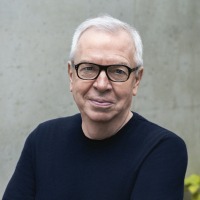
We present a series of videos with their latest statements and works, below.
Jury Citation;
Jury Citation;
The Pritzker Prize is conferred in acknowledgment of those qualities of talent, vision and commitment, which have persistently produced significant contributions to humanity and the built environment through the art of architecture. The career of David Chipperfield is marked by a long term, rigour and consistency in a body of work that has seamlessly integrated and balanced both terms of that equation.
The careful, well-crafted, precise and calm responses he has offered to the goals aspired to in his buildings can only originate in a deep and sustained knowledge of the discipline. Yet, those responses are never self-centred, nor do they serve in any way as art for art’s sake: rather, they always remained focused on the higher purpose of the undertaking and on the pursuit of civic and public good.
David Chipperfield ‘does his job’, and he does it by balancing relevancy and stature. To operate anchored to the body of knowledge of the discipline or architecture requires both intelligence and modesty; to put such knowledge at the service of a given project requires talent and maturity. He has in every case skilfully chosen the tools that are instrumental to the project instead of those that might only celebrate the architect as artist. Such an approach explains how it is that a gifted architect can sometimes almost disappear when working on the restoration or renovation of existing buildings and architectural masterpieces like those on Berlin’s Museum Island or even more in the case of Mies van der Rohe’s iconic Neue Nationalgalerie in Berlin. It also explains why the wide spectrum of David Chipperfield’s skills appears in full when he is called upon to create from scratch.

Morland Mixité Capitale, photograph courtesy of Simon Menges.
Always characterized by elegance, restraint, a sense of permanence, as well as clear compositions and refined detailing, his buildings each time exude clarity, surprise, sophisticated contextuality and confident presence. In an era of excessive commercialization, over-designing, and over-exaggeration, he can always achieve balance: between a modern minimalistic architectural language and freedom of expression, between abstract statements and rigorous elegance never devoid of complexity.
While preserving a meticulous yet consistent quality of design, David Chipperfield has continually worked across a wide array of building types from public civic buildings to commercial, residential and retail structures. But from early in his career, museums have been a particular focus. Ranging across small-scale works free standing in the landscape to large-scale monuments in prominent and often complex and delicate urban locations, his museum buildings have always defied the notion that a museum is a place for elite culture. Over and over, he has interpreted the demands of the museum program to create not only a showcase for art but also a place interwoven with its city, breaking down boundaries and inviting the public at large to engage. Over and over, his museum buildings have generated new civic spaces, new patterns of movement in the city and new ways of integrating existing fabric.
At once architectural and museological projects, in Chipperfield’s hands museums as institutions and buildings offer a transformation of the urban life of the cities where they are located. Generous outdoor spaces make them not fortresses but connectors, places for gathering and observing, such that the building itself is a gift to the city, a common ground even for those who never enter the galleries. In short, his buildings embody a commanding balance of the seemingly contradictory notions of being complete in and of themselves as architectural designs where every detail is conceived as a carefully studied part of a whole, and at the same time create interconnections to the city and to the society in such a way as to fundamentally transform a whole district.

Amorepacific Headquarters, photo courtesy of Noshe.
In his persistent search for a diverse, solid and coherent body of work, David Chipperfield manages not to deviate from a serious consideration of the genius loci—the spirit of the place—or of the growing diverse cultural contexts in which he works. We do not see an instantly recognizable David Chipperfield building in different cities, but different David Chipperfield buildings designed specifically for each circumstance. Each asserts its presence even as his buildings create new connections with the neighbourhood. His architectural language balances consistency with the fundamental design principles and flexibility towards the local cultures. He includes colonnades in his European projects and courtyards in the Chinese ones, he utilizes local materials in luxurious ways, ordinary techniques in complex structures. He enhances the quality of people’s lives through a poetic sensation that always flows from his buildings. The work of David Chipperfield unifies European classicism, the complex nature of Britain and even the delicateness of Japan. It is the fruition of cultural diversity.
This commitment to an architecture of understated but transformative civic presence and the definition—even through private commissions—of the public realm, is done always with austerity, avoiding unnecessary moves and steering clear of trends and fashions, all of which is a most relevant message to our contemporary society. Such a capacity to distil and perform meditated design operations is a dimension of sustainability that has not been obvious in recent years: sustainability as pertinence, not only eliminates the superfluous but is also the first step to creating structures able to last, physically and culturally.

James-Simon-Galerie, photograph courtesy of Simon Menges.
No wonder one of the attributes that come to mind when experiencing the work of David Chipperfield is that of a classic, something that will be able to stand the test of time. Classic not by style but by being faithful to a responsibility towards the act and to the art of building, faithful to the three essential Vitruvian qualities: firmitas, utilitas, venustas (strength, usefulness, beauty). Far from looking towards creating iconic, isolated statements, Chipperfield alternates restraint and courage in a very personal interpretation of the role of architecture.
David Chipperfield believes that is the role of the architect to foster new ways of improving life and livelihoods on a planet where mankind has made our very home a place of fragility. His vision of such role has continually expanded from ways to integrate an individual building into both its site and its local culture, to understanding the broadest definition of site and culture.
In more recent years, this has taken the form not of building but of bringing spatial and environmental expertise to curate and care for the landscapes of a region which he has come to call a second home, Galicia in North-western Spain. Here the Fundación RIA has sought to advise on preserving the intertwined landscape, agriculture, ecology and land traditions of a region to help preserve and extend an eco-system into the coming decades even in the face of the challenges of climate change.
For the rigour, integrity and pertinence of a body of work that—beyond the realm of the architecture discipline—speaks for his social and environmental commitment, David Chipperfield is named the 2023 Pritzker Prize Laureate.