
Description of project by H Arquitectes
Three starting points
Understanding the historic value of Lleialtat Santsenca (1928), an old working-class cooperative in the Sants neighborhood; knowing to the detail the building’s (physical) state to maintain as much as possible, and being sensitive to the whole collaborative process launched in 2009 by neighborhood organizations to recover the building.
To this end, four basic objectives were set out
First, taking advantage of everything that could be used from the original; second, defining an intervention strategy marking out the essential actions, conservative or not, allowing to recover and increase the potential uses of all those spaces; third, to establish an intensive dialogue – and tense, if due – with context; and fourth, to develop a sustainable proposal, regarding the work on the existing as well as the new interventions.
The building consists of three structural bodies
The main one, onto Olzinelles and Altafulla streets, houses the two main halls (old shop on the ground floor and atrium on the first floor); the central one, with access from Altafulla street; and the interior one, without access from the street, which is L-shaped.
The precarious hygiene conditions in the rest of the constructions, besides their being poorly connected, encouraged us to propose a large longitudinal void, joining the three volumes and all their spaces – new and old – through a gradual progression, from the more public to the more private spaces. The void results from completely demolishing the centerline near the party wall to Olzinelles street, becoming a sort of interior street, emphasized in the second structural volume by enlarging the existing light well. Finally, behind the last structural volume, a triple space contiguous to the void of the two previous volumes wraps up the sequence.
The succession of voids configures an atrium limited by ‘new’ facades opposed to the existing party walls, which show traces of the building’s history. The atrium brings light and air to all the spaces, becoming the axis of the horizontal and vertical circulations, and offering new potential of use for unforeseen programs.
The existing roofs could not be used, so only the trusses in the main hall were maintained. A new roof is built above the whole building, associated volumetrically with the three structural bodies: three gable roofs, with cellular polycarbonate to the south and insulated metal sheet to the north, above a metal structure, illuminating and ventilating the atrium, with windows in the highest corners to favour natural convection.
Inspired by Lina Bo Bardi’s Teatro Oficina, the Atrium is an intermediate bio-conditioned space that organizes all the circulations through a series of footbridges and stairs that evoke the image of the scaffolding in a construction site. The building functions thermally through passive strategies based on inertia and insulation; three lightweight roofs permit natural lighting and favour ventilation.
By increasing the volume of the roofs, it is possible to increase solar gain
In winter, heat is collected thanks to a heat recovery system for the interior spaces; in the summer, the air in the top part of the atrium is reheated, forcing a convection which releases the hot air by opening the roof Ridge windows, actioned by automatic sensors.
In winter, the climate-controlled spaces release warm air, tempering the Atrium; in the third body, due to the excess of radiation, a ventilated chamber with a sun filtre optimizes solar capture in winter and summer.
Project for the rehabilitation of the building of a former worker cooperative in the neighborhood of Sants, Lleialtat Santsenca, built in 1928.

The project, carried out by H Arquitectes, is based on three fundamental premises: understanding the historical value of the building, knowing its physical condition precisely, and continuing with the collaborative process initiated in 2009 by the neighbourhood entities to recover it. To this end, preexistence has been used to the maximum; a strategy has been drawn up, classifying the different actions that must be carried out, an important dialogue with the context has been established, and a sustainable intervention has been sought.


More information
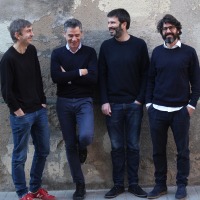
H Aarquitectes is an architecture practice founded in Sabadell in 2000 by David Lorente Ibáñez (born in Granollers, Barcelona, June 7, 1972), architect, ETSAV-UPC, 2000; Josep Ricart Ulldemolins (born in Cerdanyola del Vallès, Barcelona, 1973), architect, ETSAV-UPC, 1999; Xavier Ros Majó (born in Sabadell, Barcelona, 1972), architect, ETSAV-UPC, 1998; and Roger Tudó Galí (born in Terrassa, Barcelona, 1973), architect, ETSAV-UPC, 1999.
They combine their professional practice with teaching at the Faculty of Architecture of the Polytechnic University of Catalonia (ETSAV and ETSAB), as well as at ETH Zurich. and at Harvard GSD.
Among their most representative works are the ICTA-ICP research center at the Autonomous University of Barcelona; the Cristalleries Planell civic center; the Lleialtat Santsenca cultural center; social housing for IMPSOL in Gavà; the new offices for Galenicum; the Clos Pachem winery in El Priorat; and El Vapor Cortès de Prodis in Terrassa. Currently, the studio is working on the expansion of the MACBA museum, the renovation of the Teatre Arnau, the La Teixonera civic center in Vall d’Hebron, as well as the Ideal Flor cultural center and the transformation of La Foneria Reial, all in Barcelona.
Their work has been widely published and exhibited, and he has received numerous awards, including the FAD, the European Prize for Intervention in Architectural Heritage, the City of Barcelona Prize, the Erich Mendelsohn Award, the Berlin Art Prize and the CSCAE Architecture Prize, among others.
Awards.-
2025.- Re-FAD Award 2025.
2025.- Casa de la Arquitectura Award Cohesion category.
2024.- Bonaplata Award, 2024.
2018.- Prize "Detail Prize 2018"
2018.- Prize "XII Premios NAN"
2018.- Prize "XIV BEAU" Bienal Española de Arquitectura y Urbanismo.
2018.- Prize "Ciudad de Barcelona 2017"
2018.- Prize ex aequo de "Arquitectura de Ladrillo Hispalyt XIV."
2017.- Prize "Mapei a la edificación sostenible."
2017.- Prize "BB Construmat 2017."
2017.- Prize AD 2017 Architects of the year.
2016.- Prize "Mostra Arquitectura Vallès."
2016.- Prize "Wienerberger Brick Award 2016."
2016.- Prize "X BIAU" Bienal Iberoamericana de Arquitectura y Urbanismo.
2016.- Prize "XIII BEAU" Biennal Espanyola d’Arquitectura i Urbanisme.
2016.- Prize Arquitectura de Ladrillo Hispalyt XIII Edició.
2016.- Prize "Catalunya Construcció" 2016.
2015.- Prize "Ugo Rivolta" 2015.
2015.- Prize FAD de la opinión 2015.
2015.- Prize "Catalunya Construcció" 2015.
2014.- Prize "Archmarathon" 2014.
2014.- Prize Arquitectura de Cerámica ‘"Fritz Höger Preis" housing category Winner Gold
2013.- 1st Prize A+to Best Projects Sustainable Architecture.
2013.- Prize A+ Extraordinario al Estudio Joven más Prometedor.
2012.- Sacyr Innovación Award for ICTA-ICP Building 1102.
2012.- AJAC 2012 Award for university dwellings in Sant Cugat dle Vallès.
2012.- Hise 2012 excelencia a la innovación Award, for 712 house.
2012.- FAD 2012 Award, 712 house.
2011.- ENOR Arquitectura Joven Award for 704 Gimnasium.
Published on:
March 6, 2018
Cite:
"Civic Centre Lleialtat Santsenca 1214 by H Arquitectes" METALOCUS.
Accessed
<https://www.metalocus.es/en/node/22887>
ISSN 1139-6415


