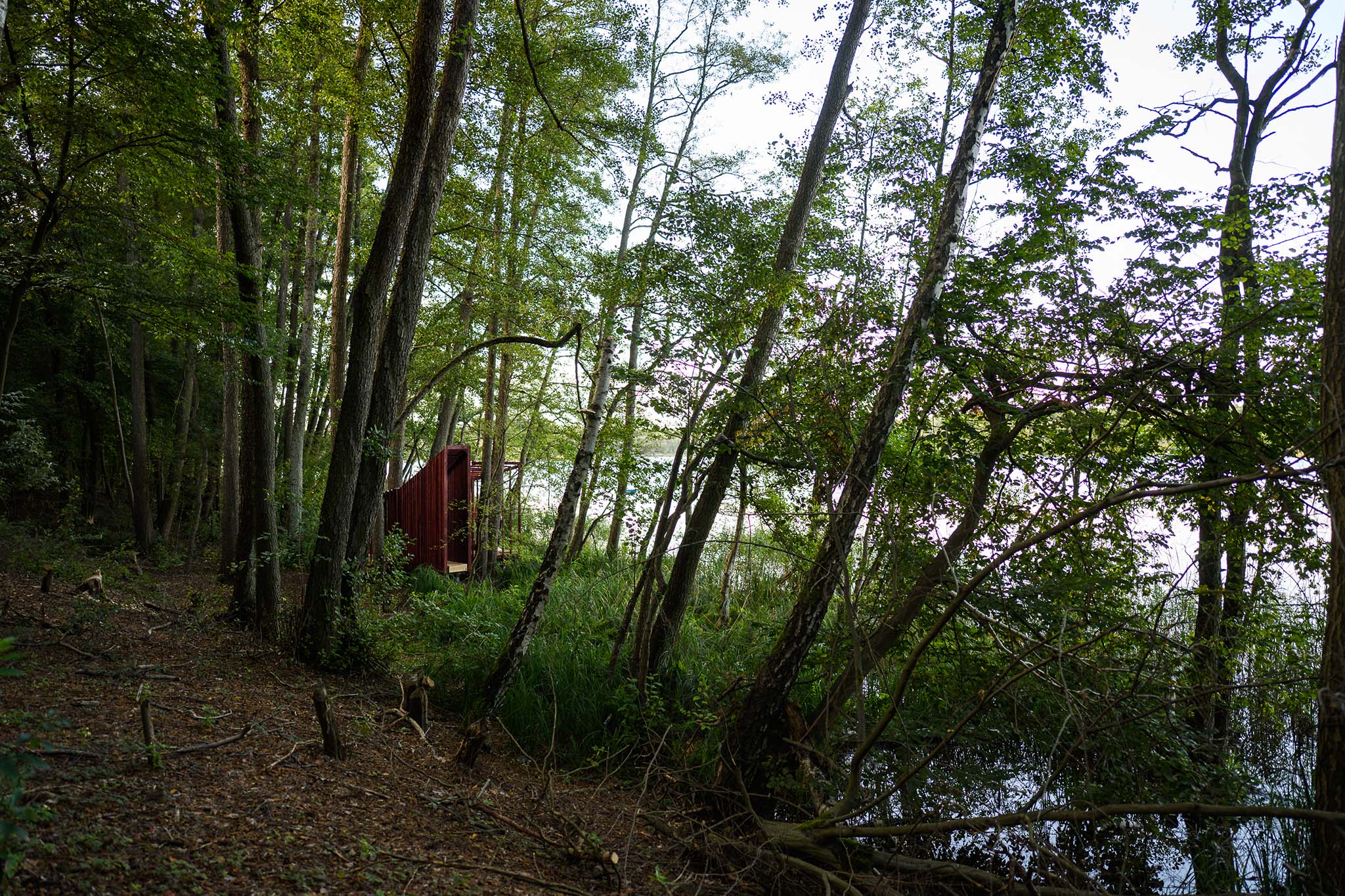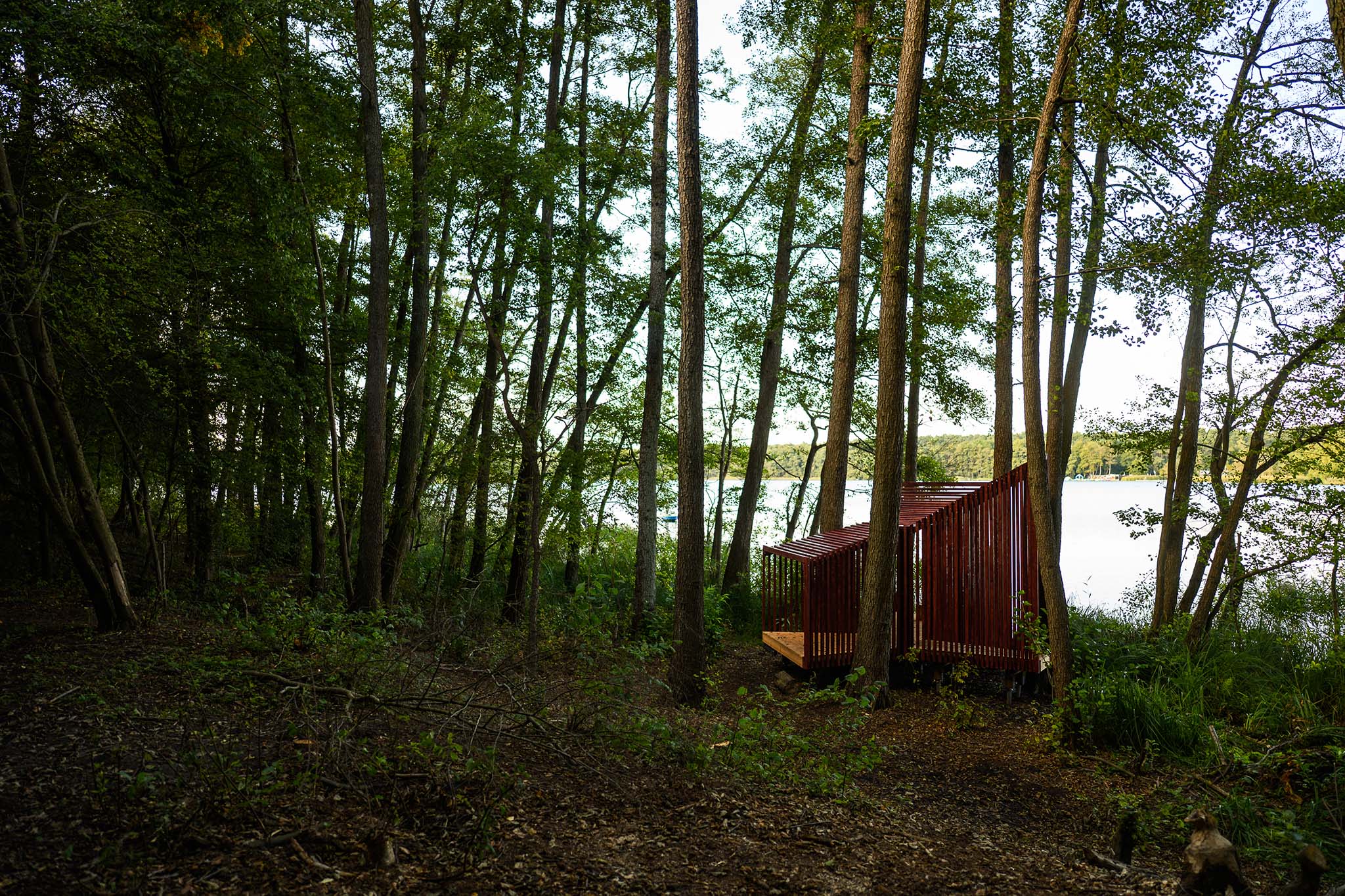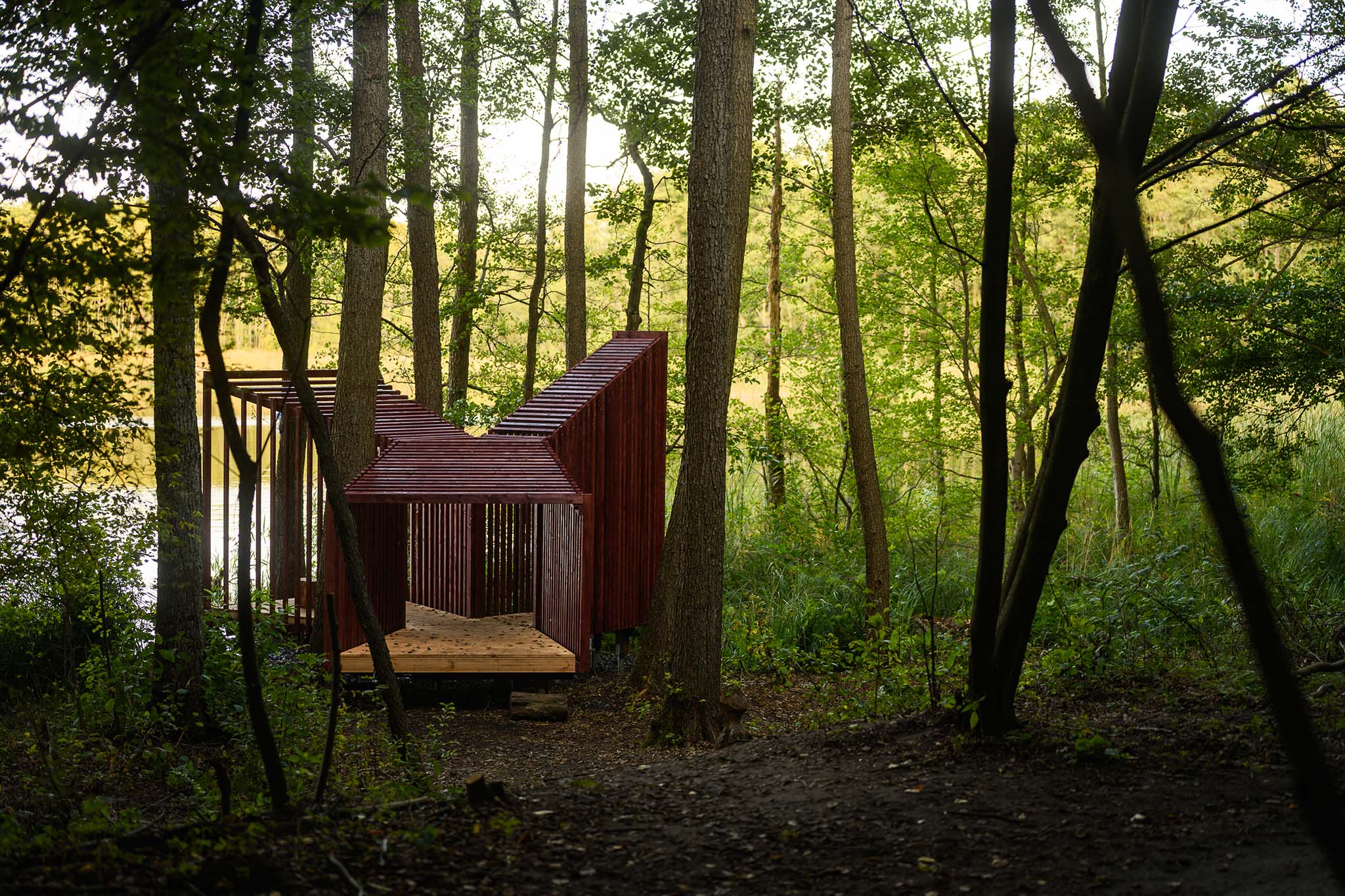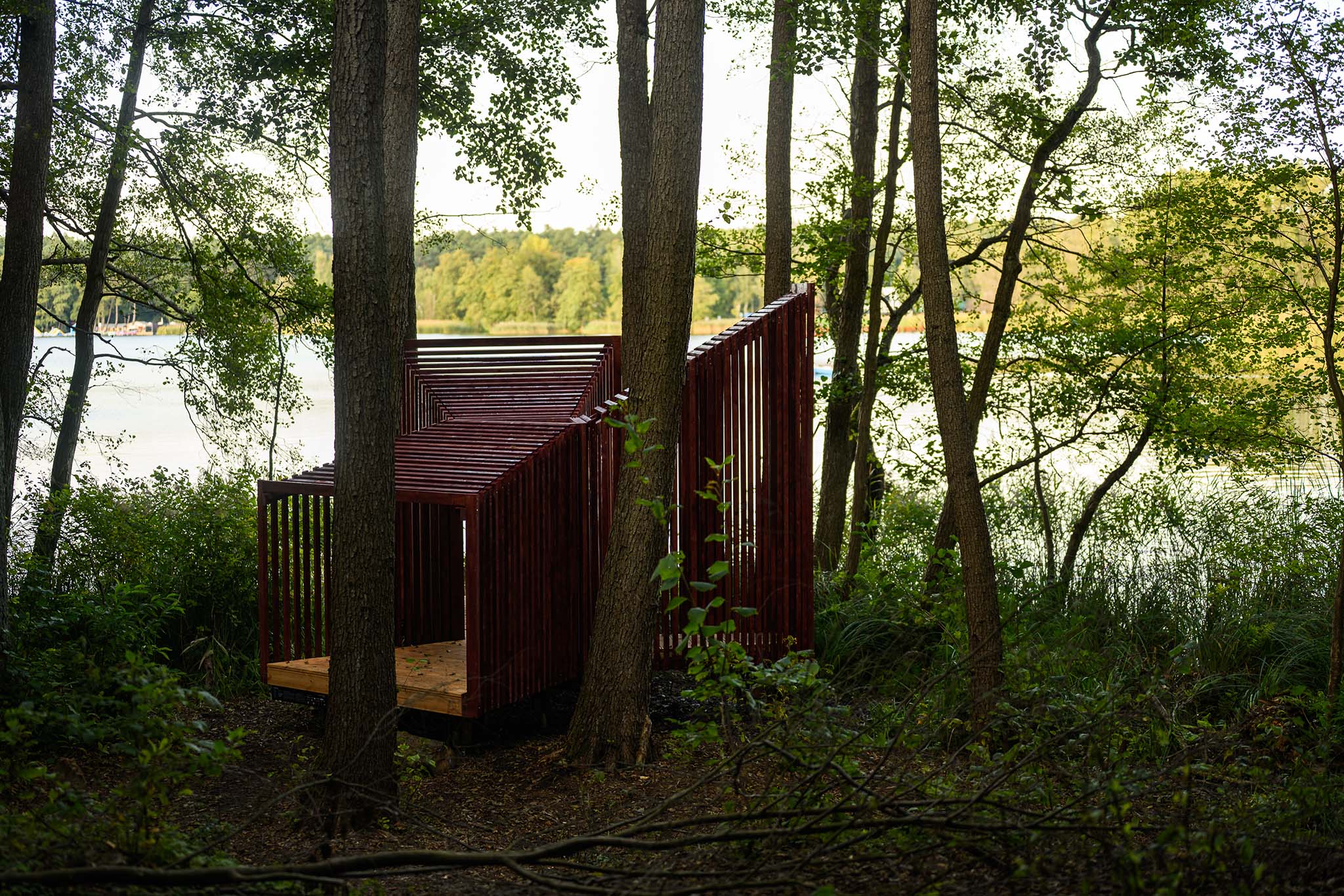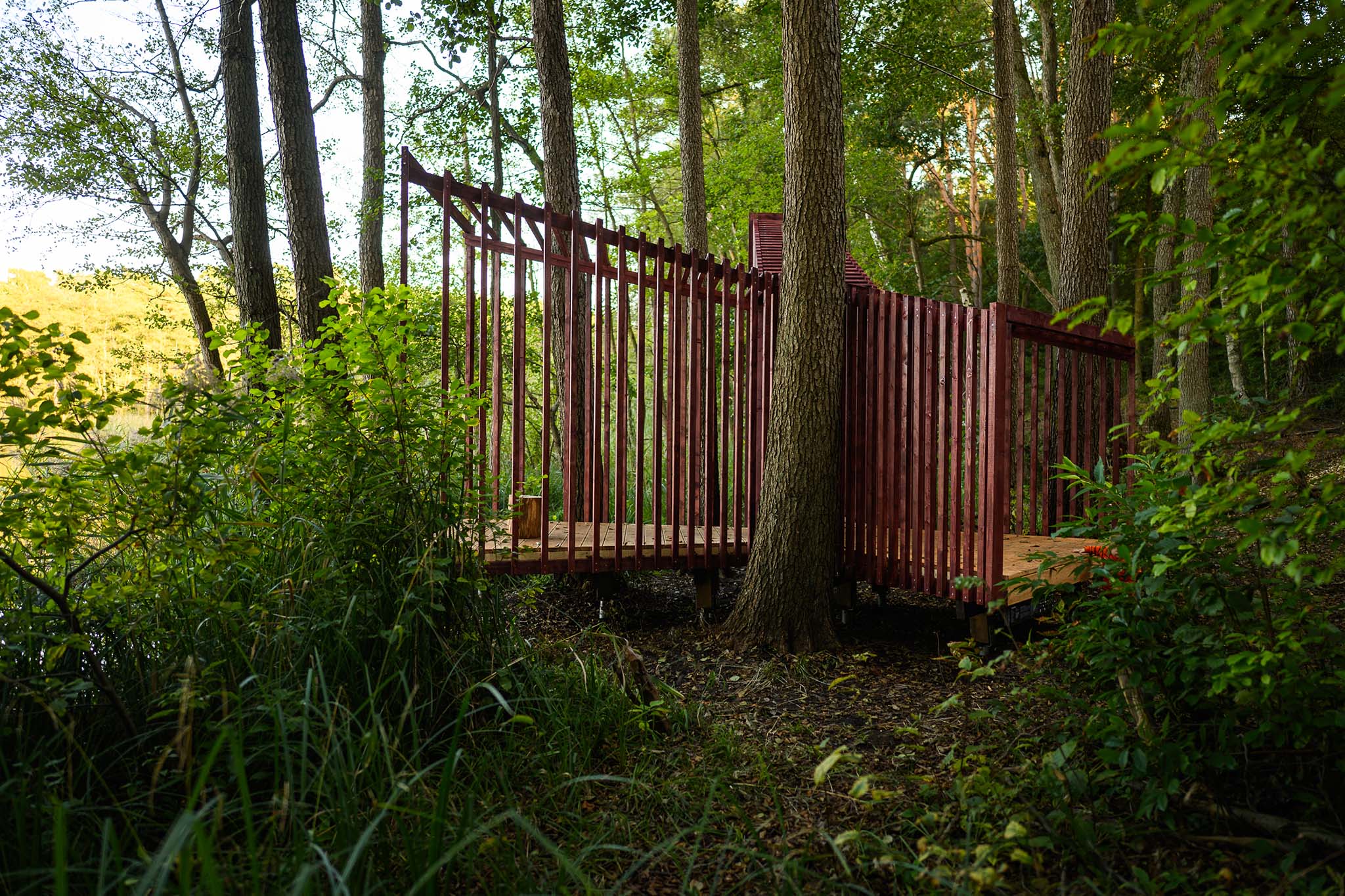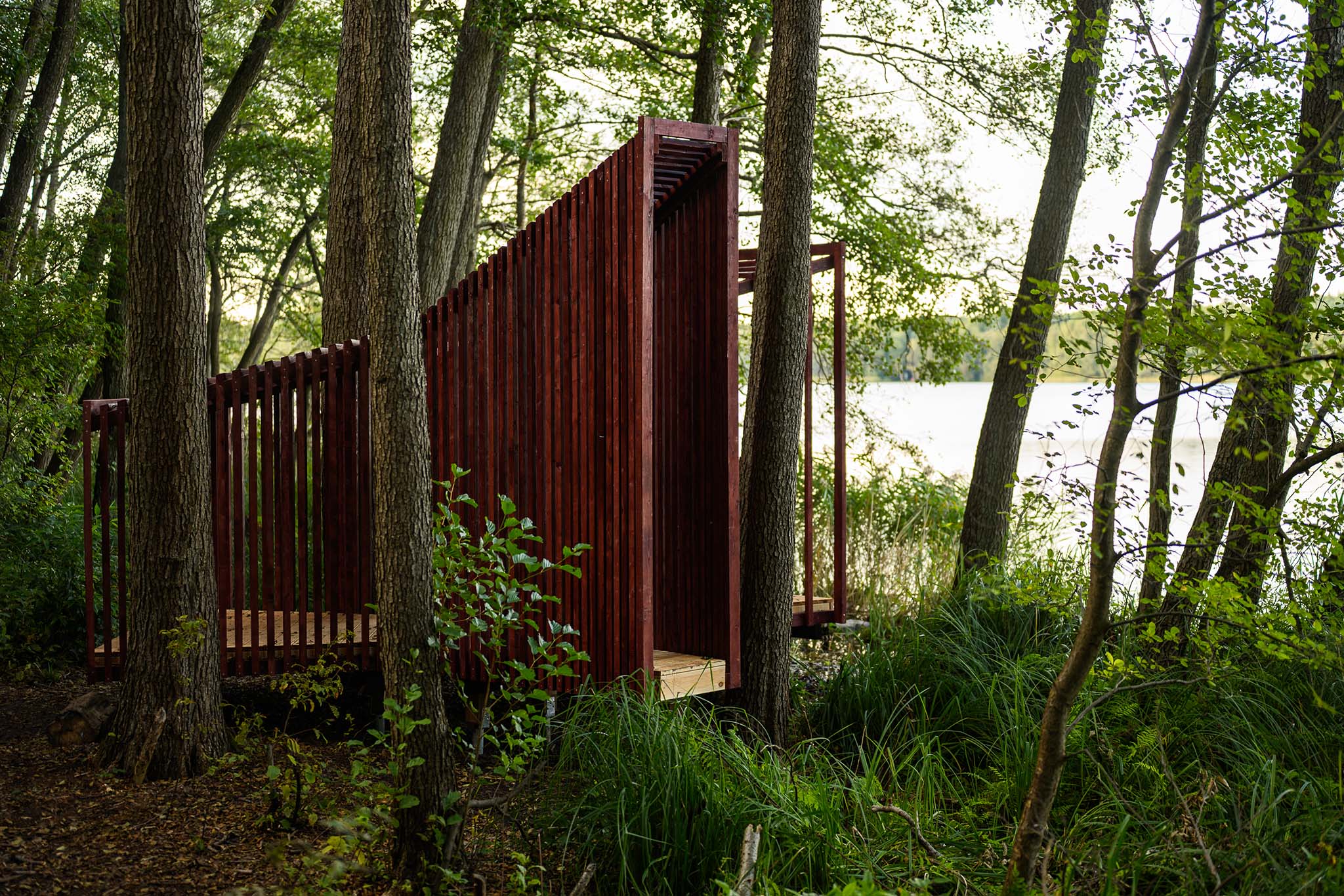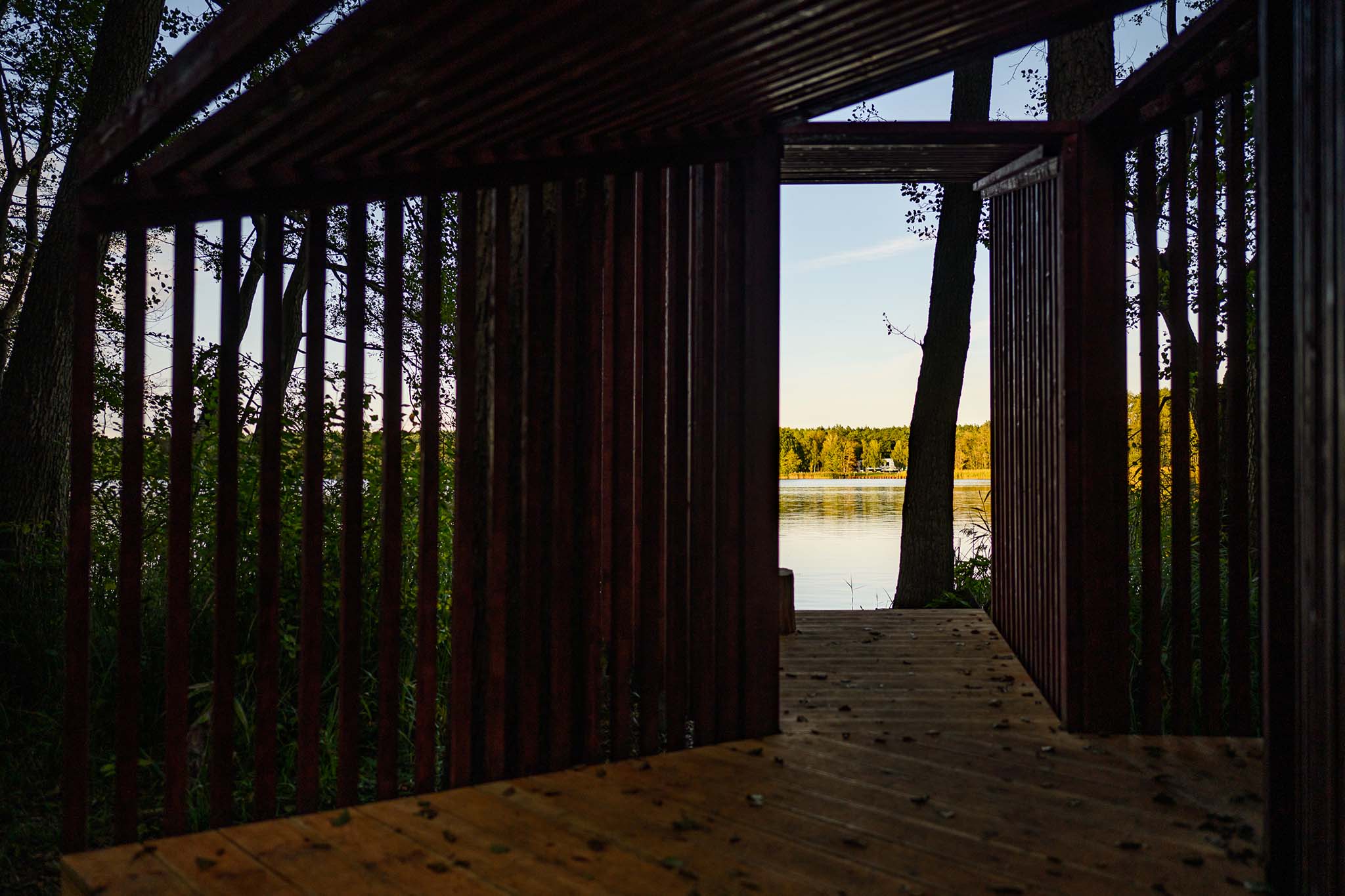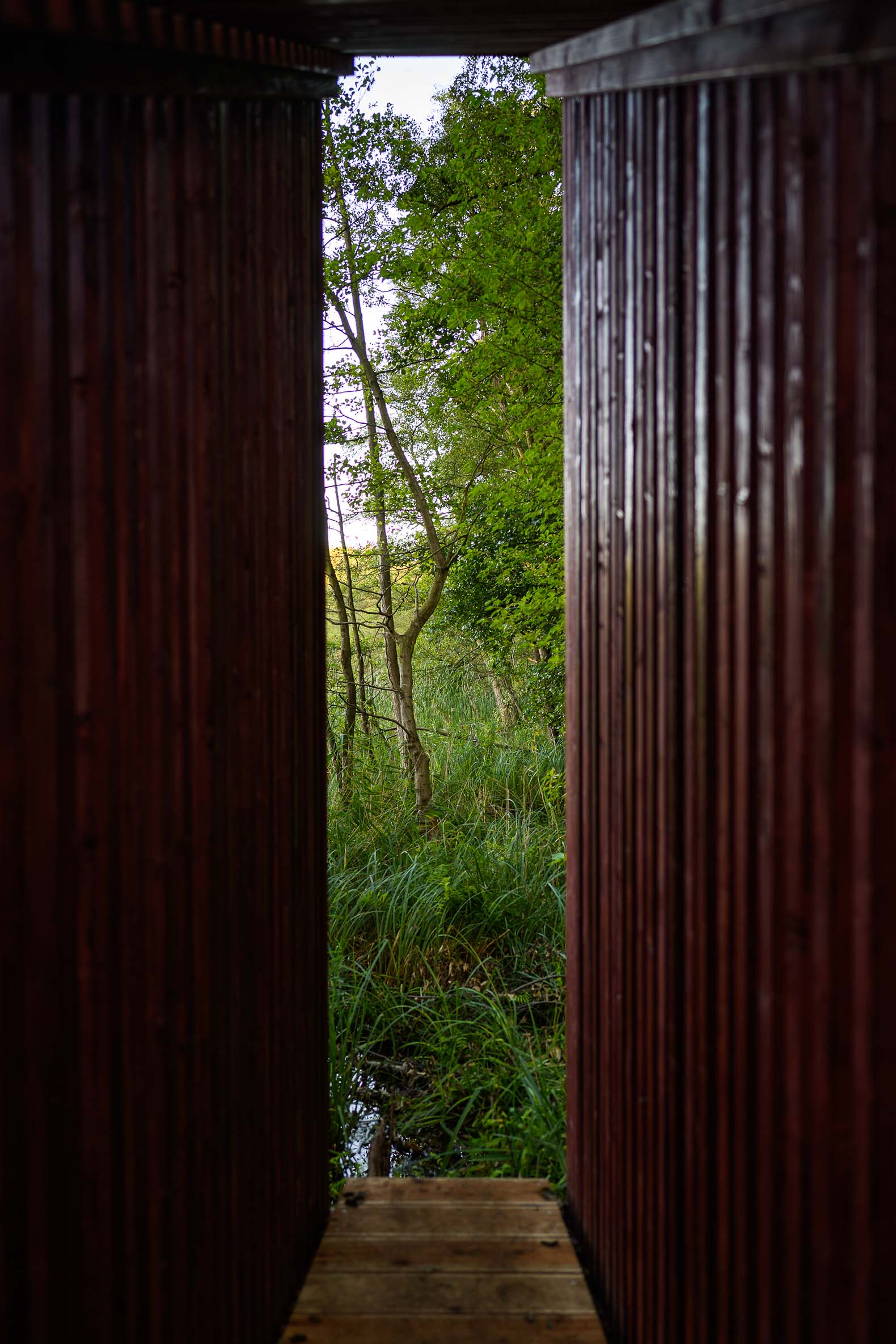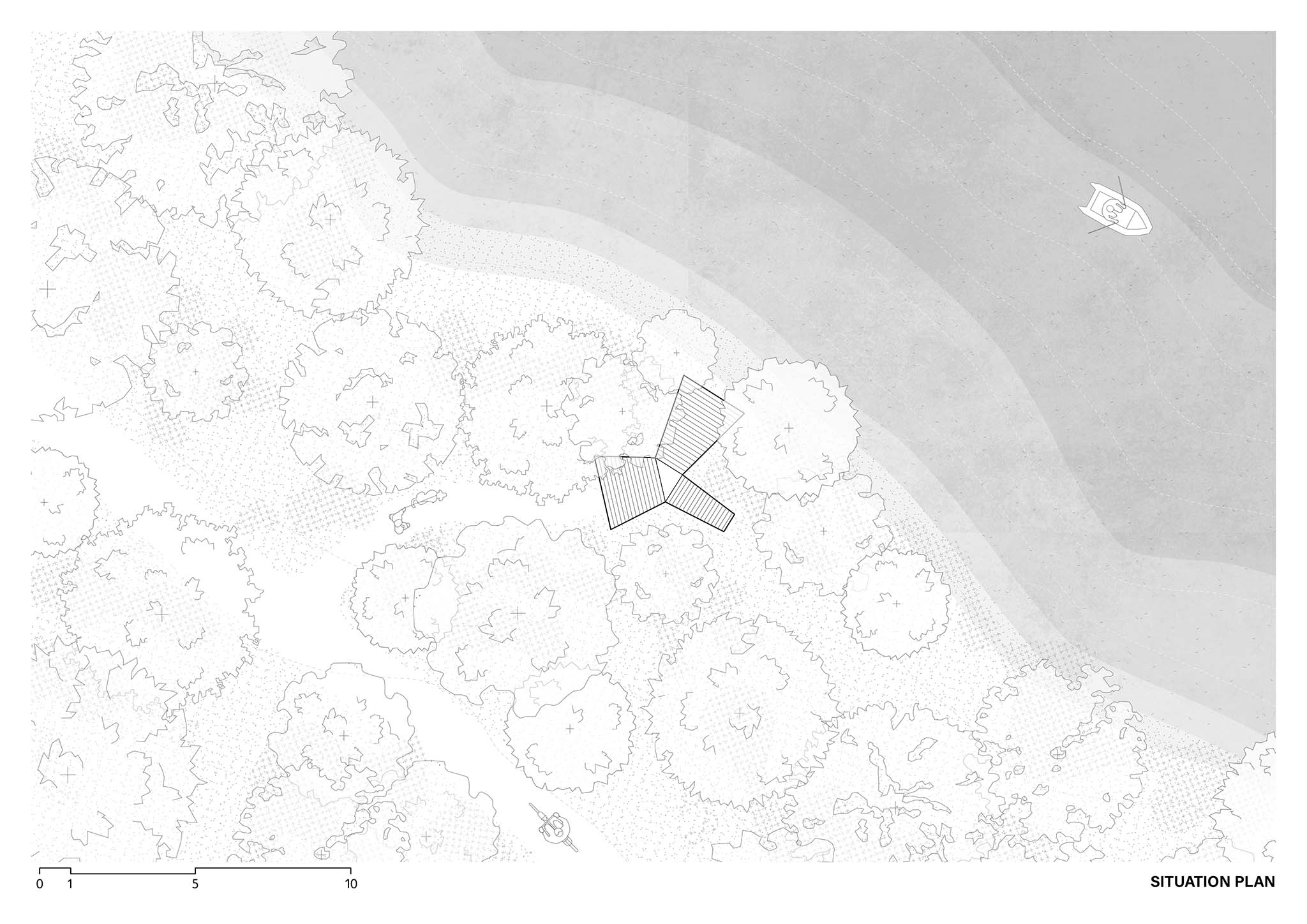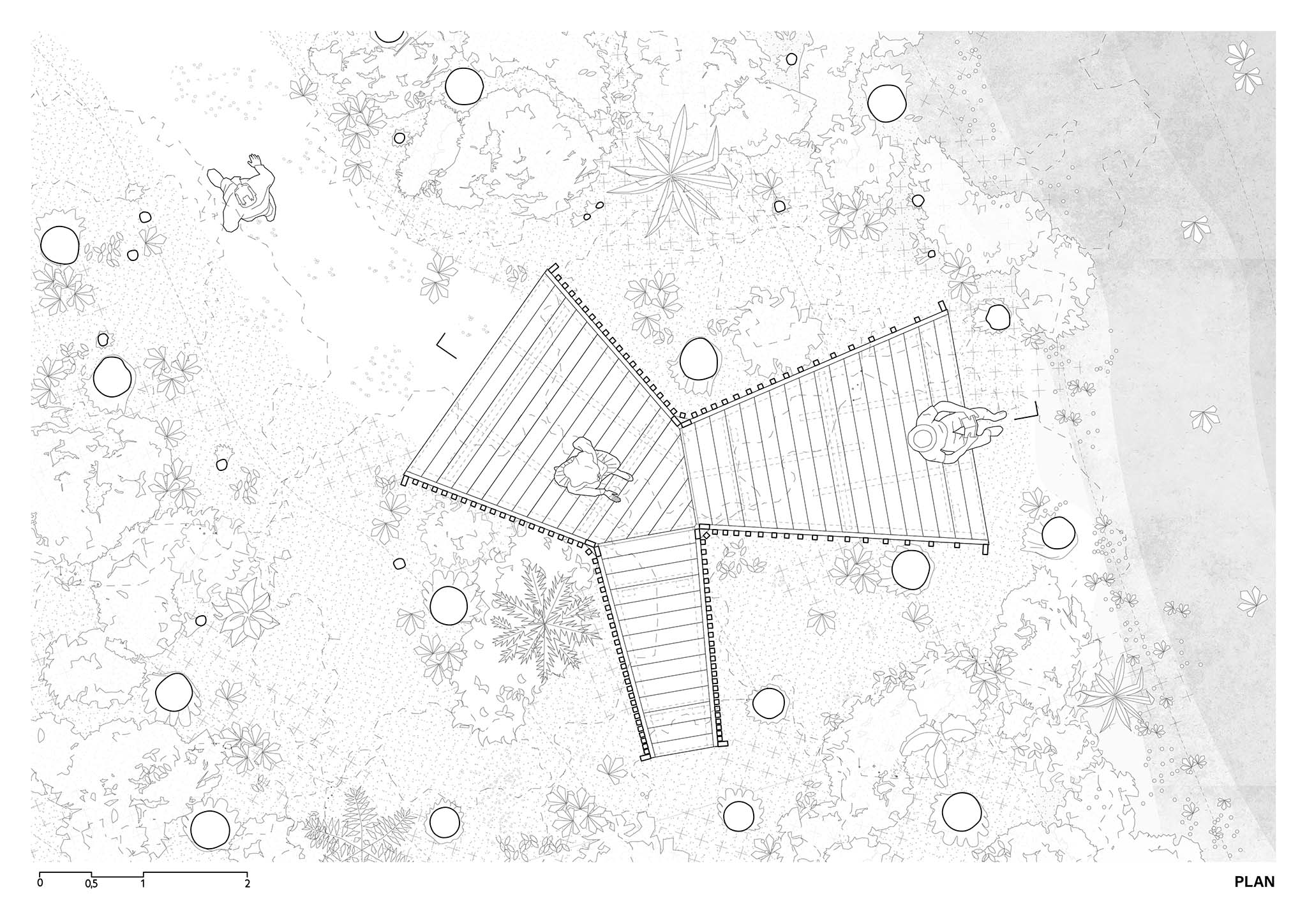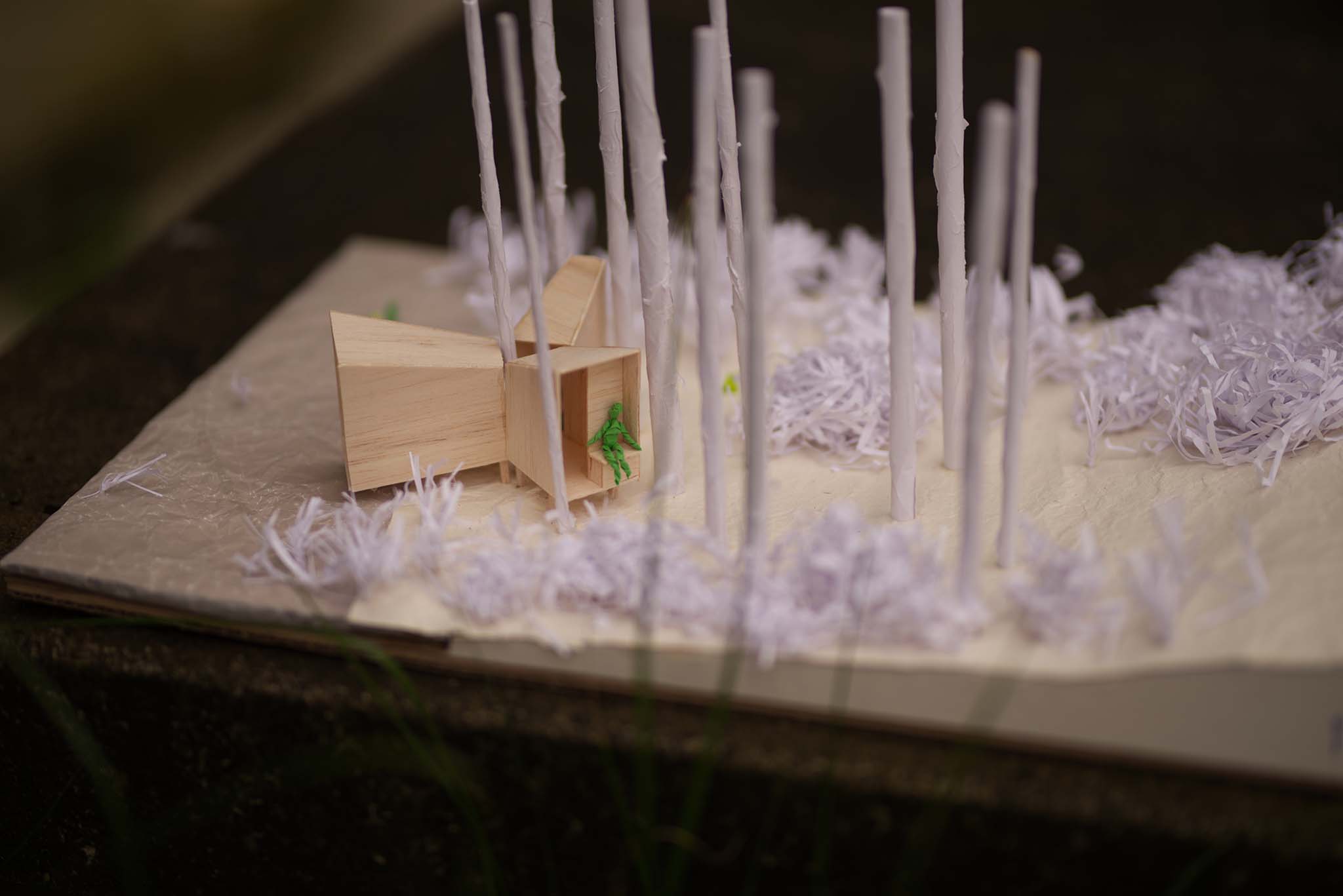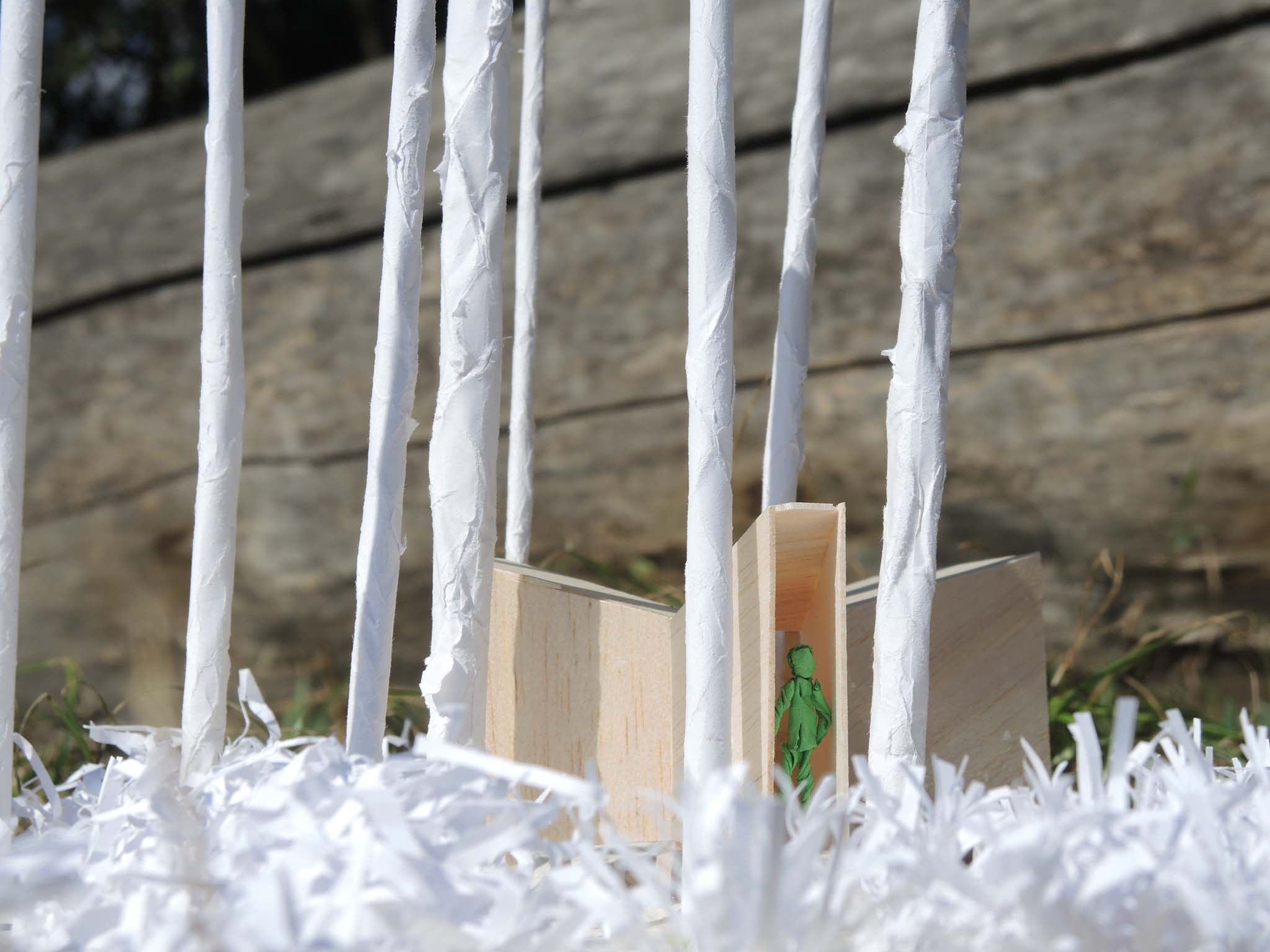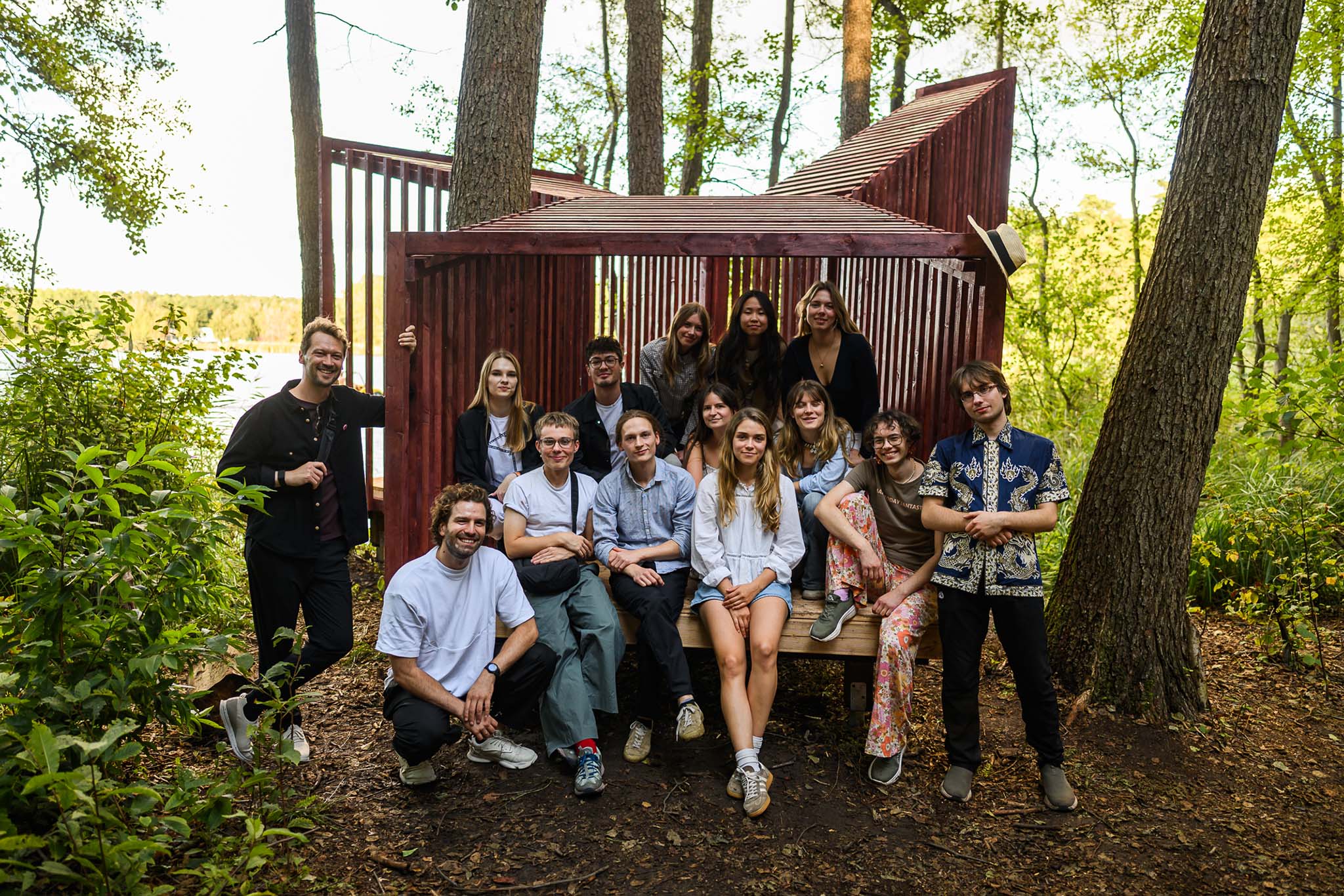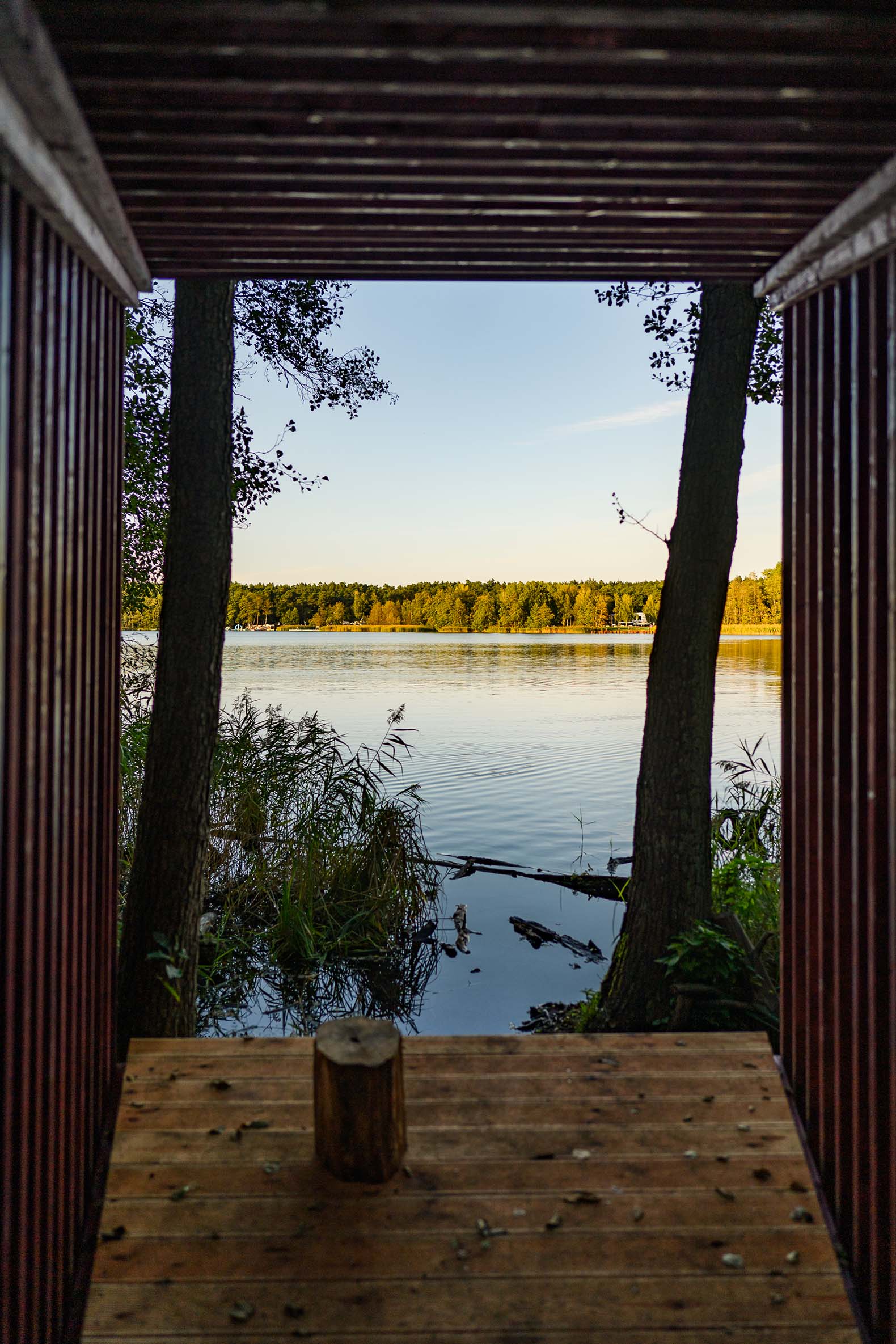
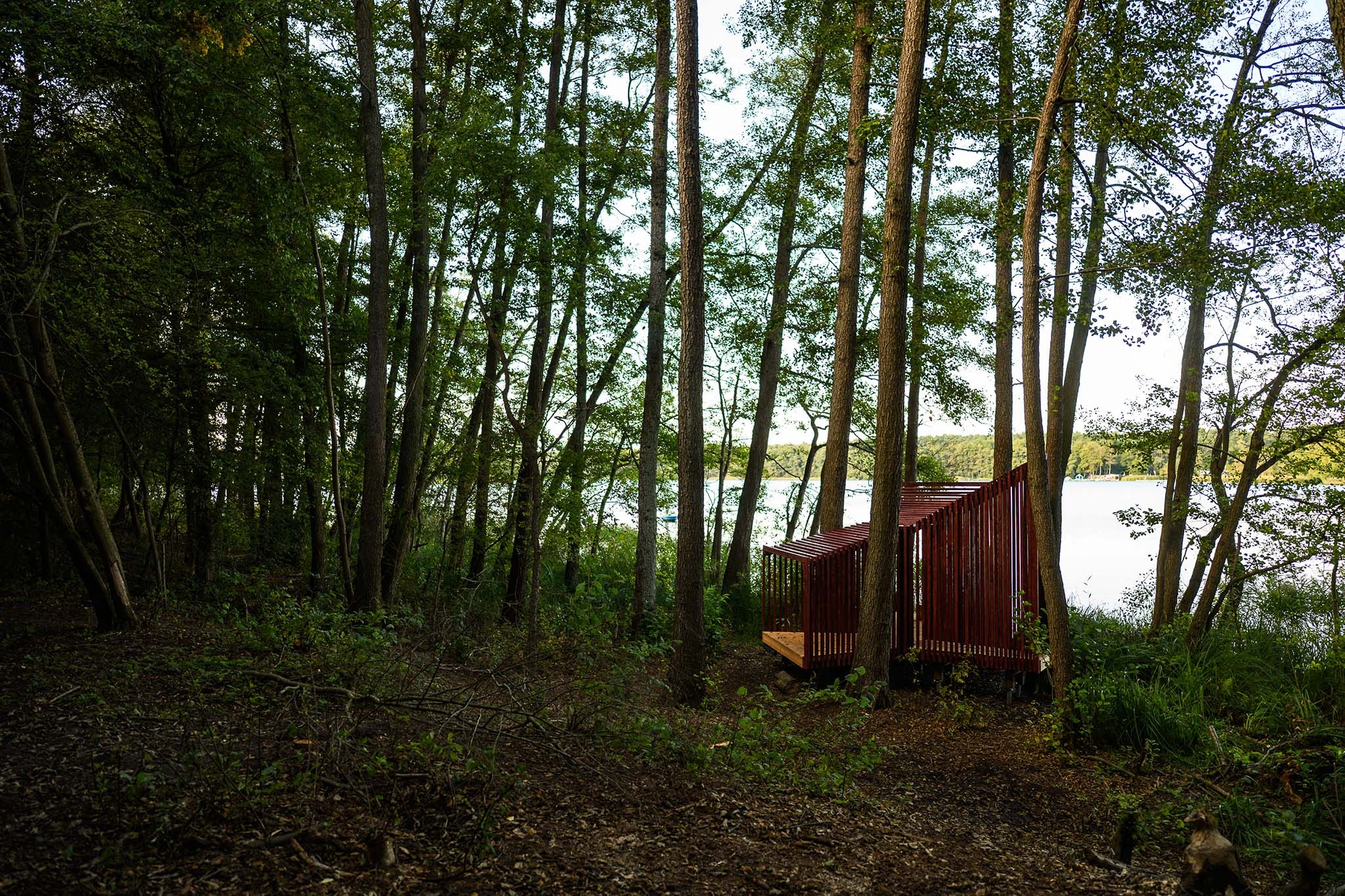
The pavilion, designed by CoLab TU Berlin, Stadtgrad, and the students group, is a geometric structure that unfolds among the trees via three arms, each oriented towards different aspects of the surrounding landscape. A low, open entrance invites contemplation; a narrow volume directs the gaze towards the forest and marshland, while a wider volume frames views of the lake. In the center, a triangular opening connects the space to the treetops.
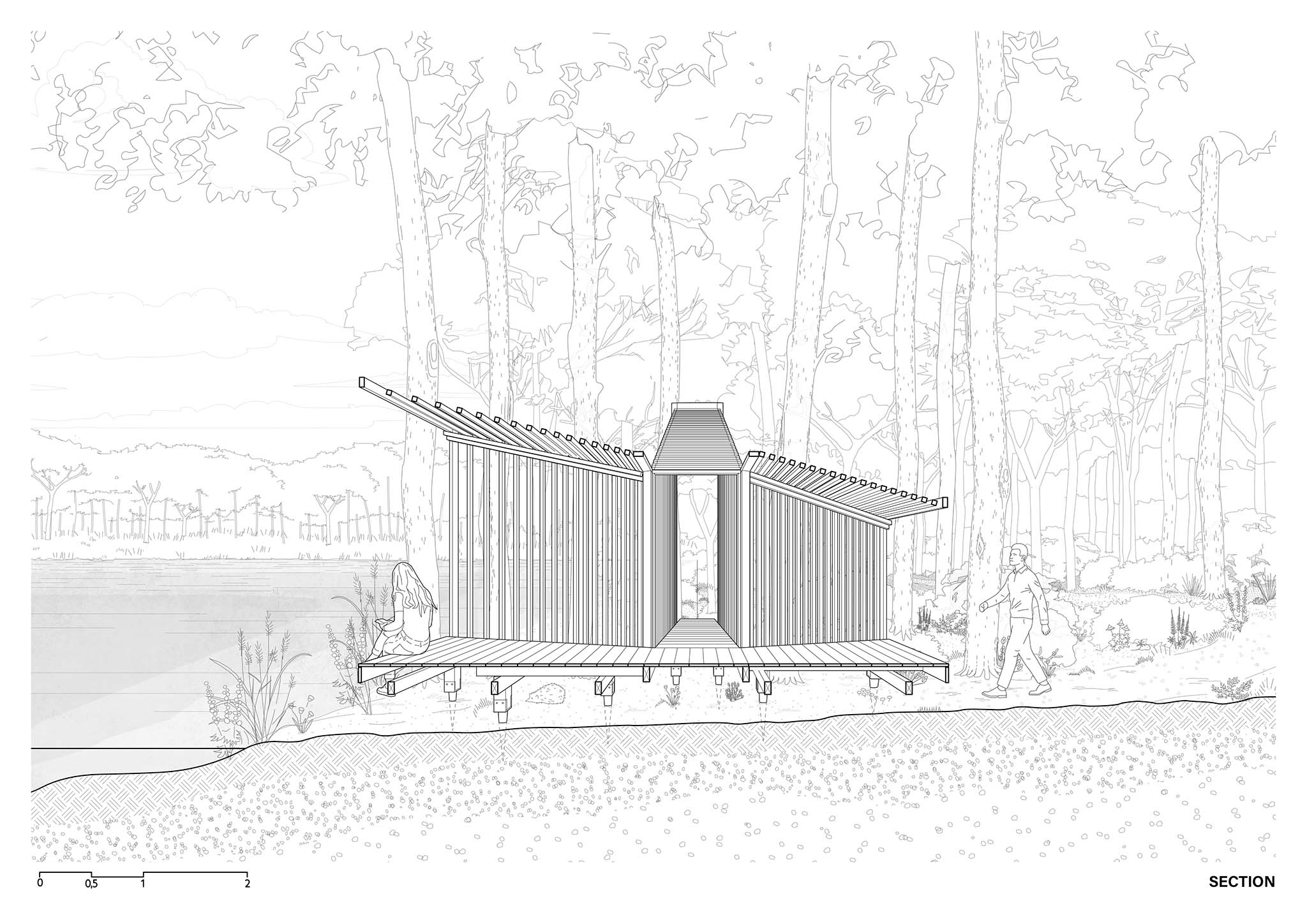
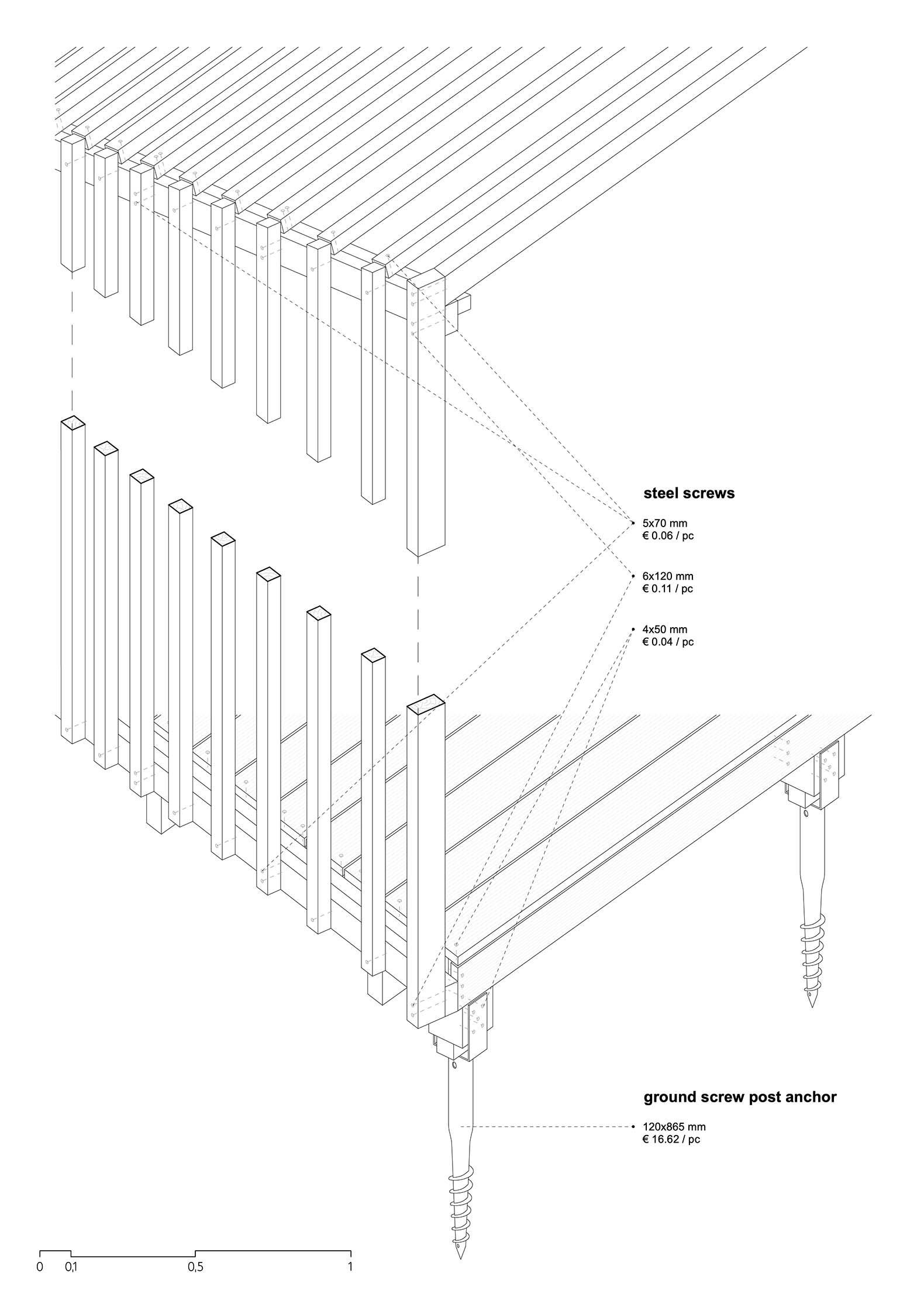
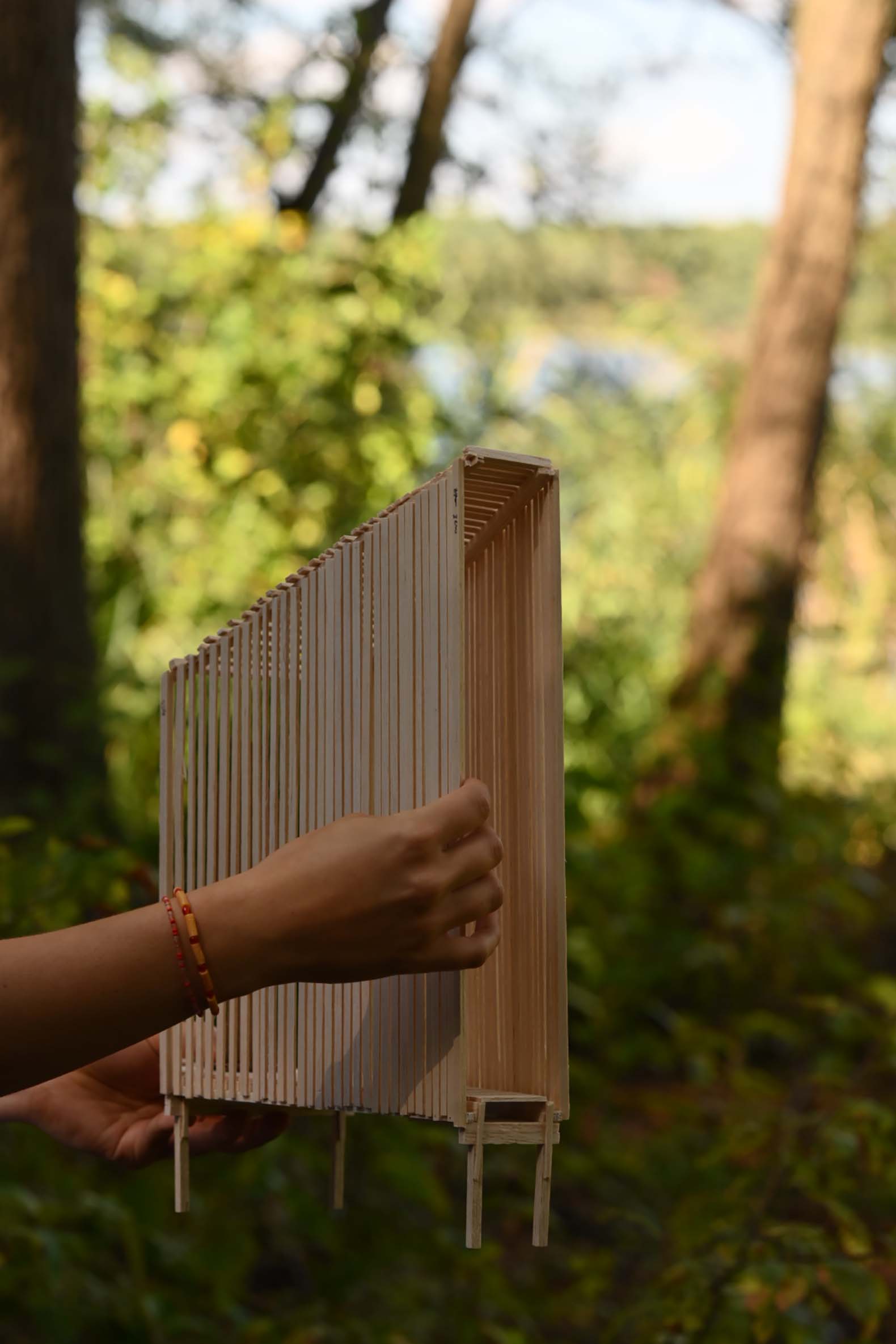
The structure is built on a slightly elevated platform supported by minimal foundations to minimize its impact on the natural terrain. The materials used are wooden slats arranged in varying densities, creating a permeable envelope that filters light and generates a dynamic interplay of shadows, enhancing the sensory experience and the integration of the architecture with the landscape.
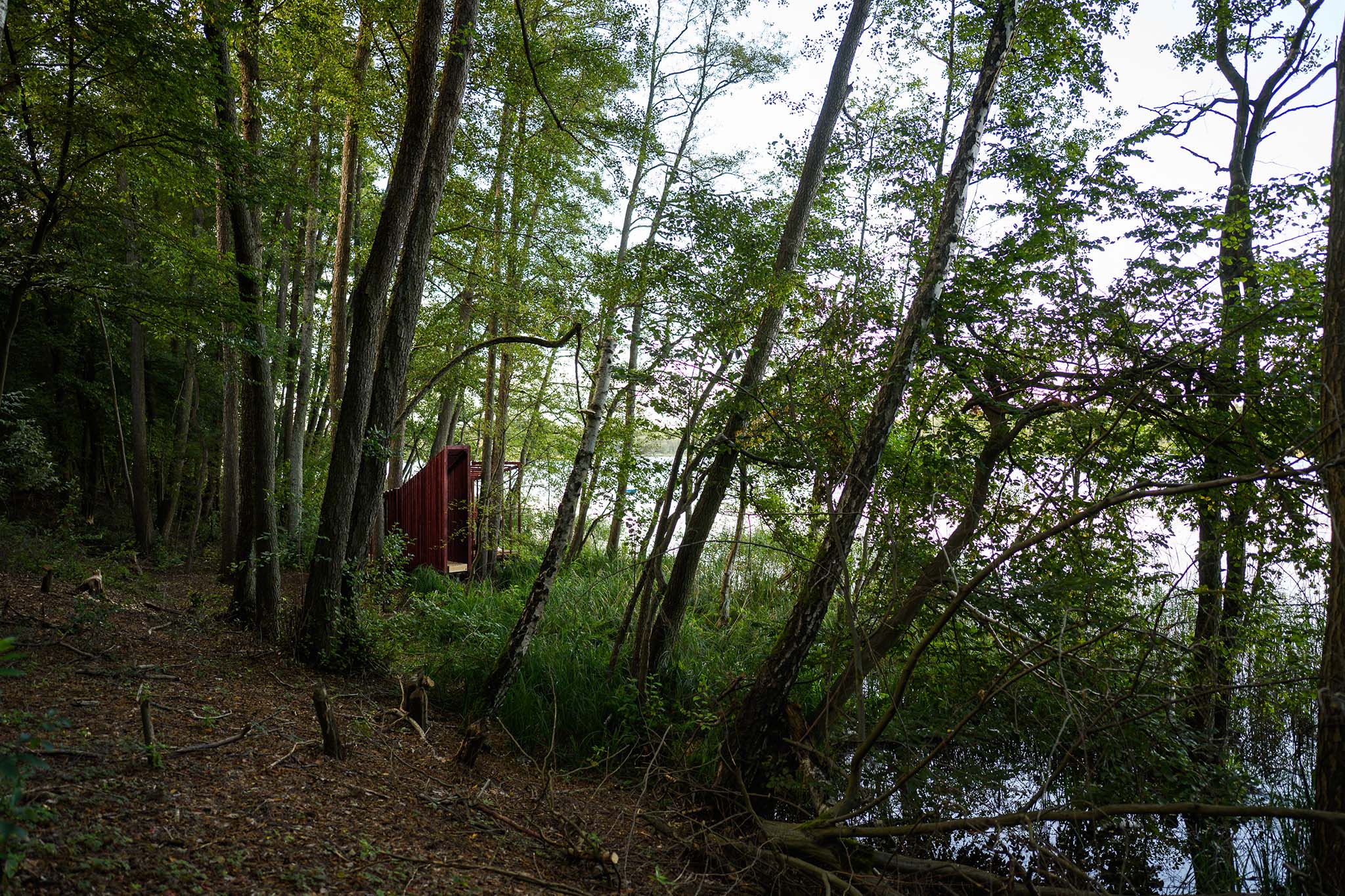
"Y amplifajer" by Stadtgrad and CoLab TU Berlin. Photograph by Dawid Majewski.
Project description by CoLab TU Berlin and Stadtgrad
"Y amplifajer" is a pavilion meant to be a resting stop for wanderers around Strzeszyńskie Lake. It blends together with the surroundings and finds its way between the trunks almost as if it grew along with the trees.
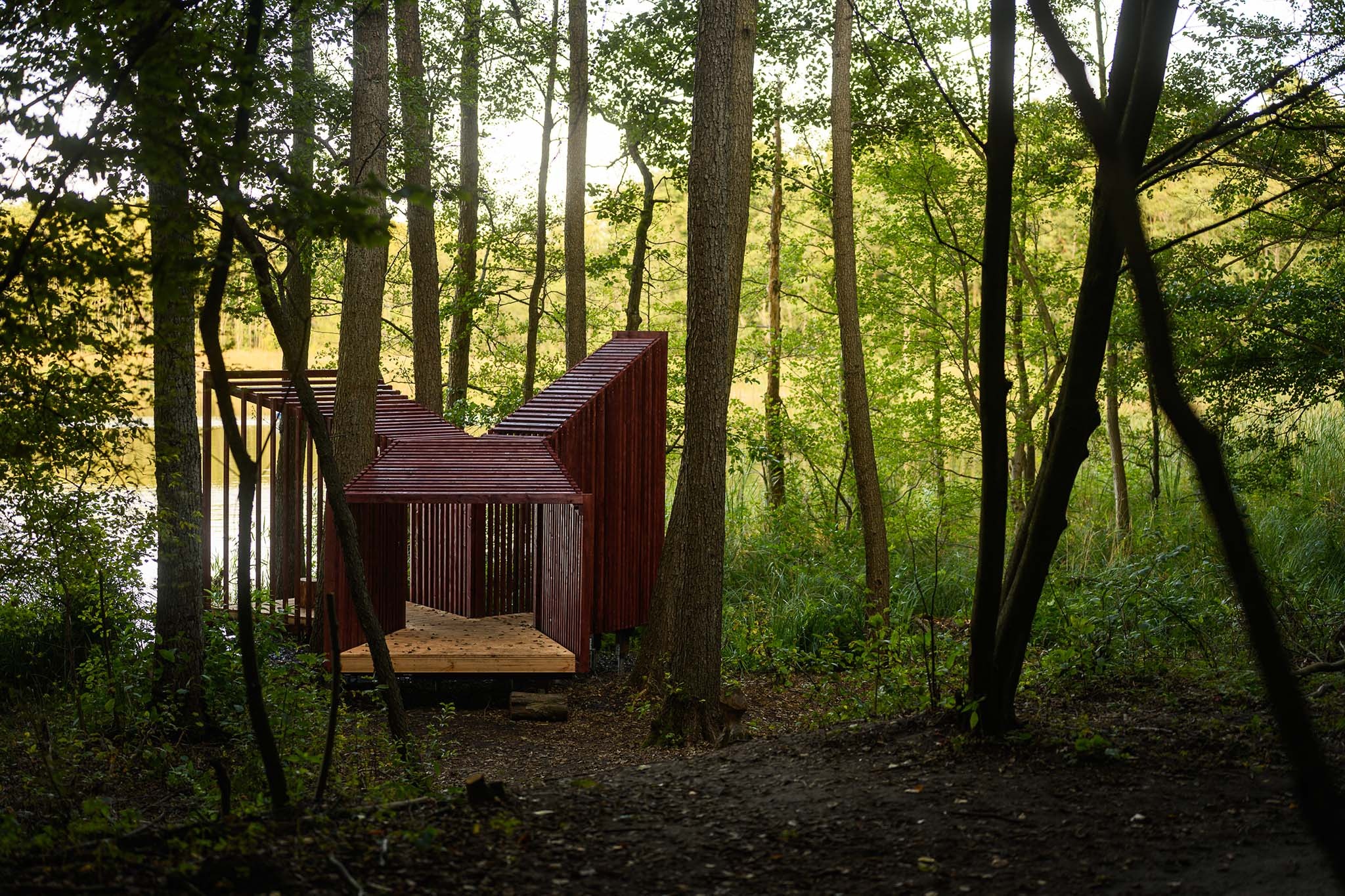
The fluid space bifurcates in three directions framing the different atmospheres of the surroundings. Visitors are welcomed by a low and wide inviting entrance. A narrow, tall arm leads to the side of the marsh and the trees framing the vertical layering of the forest whereas a large square-like arm frames the view of the lake and the far-off eastern shore.
All three arms come together in the middle, where a fourth, triangular opening offers visitors a view of the treetops.
The platform of the structure is slightly elevated, built on foundations in order to minimize impact on nature as much as possible. It is enclosed by wooden slats that create a dramatic effect due to their varying density towards the different lookout points and provide a play of light and shadow.
Mood for Wood
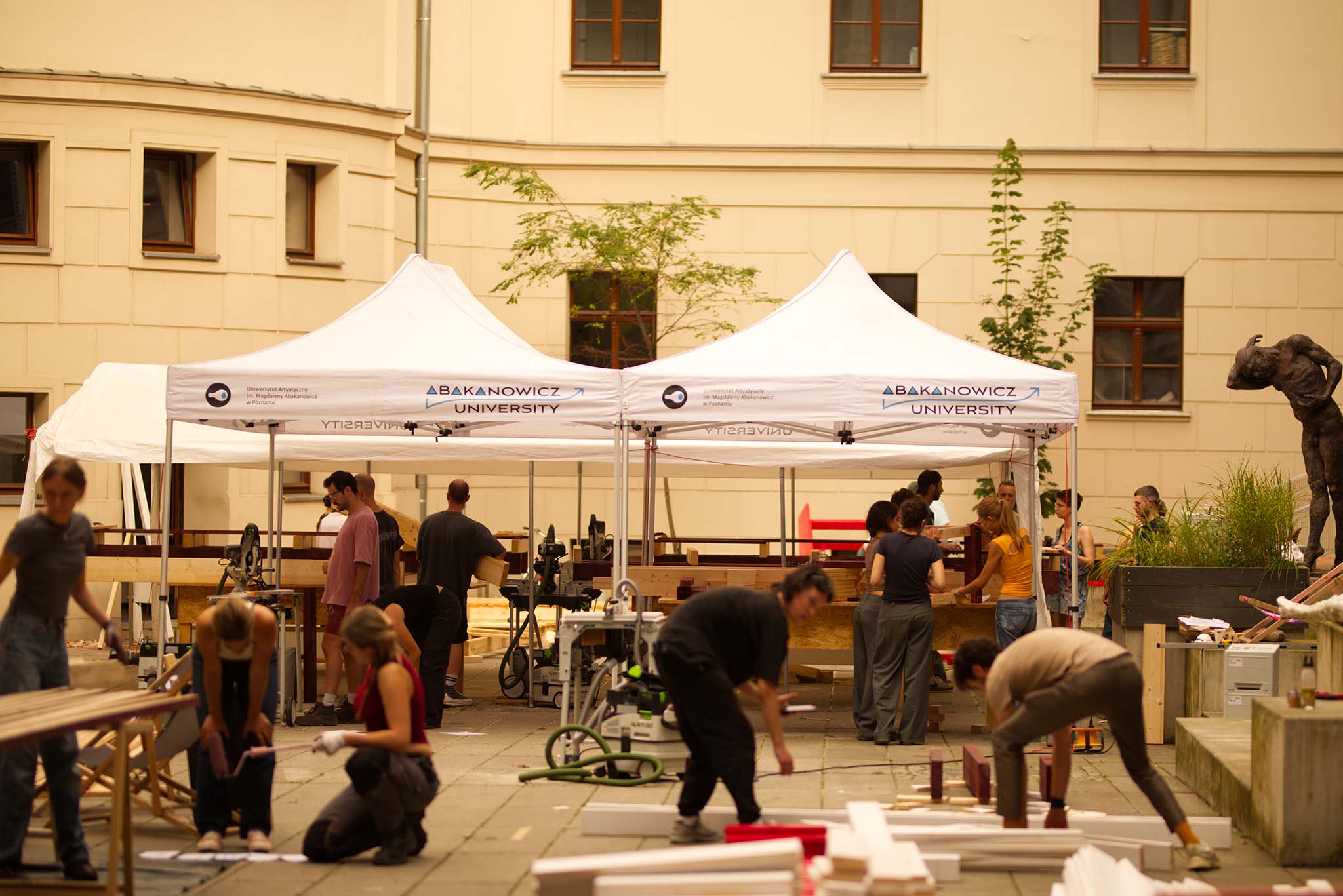
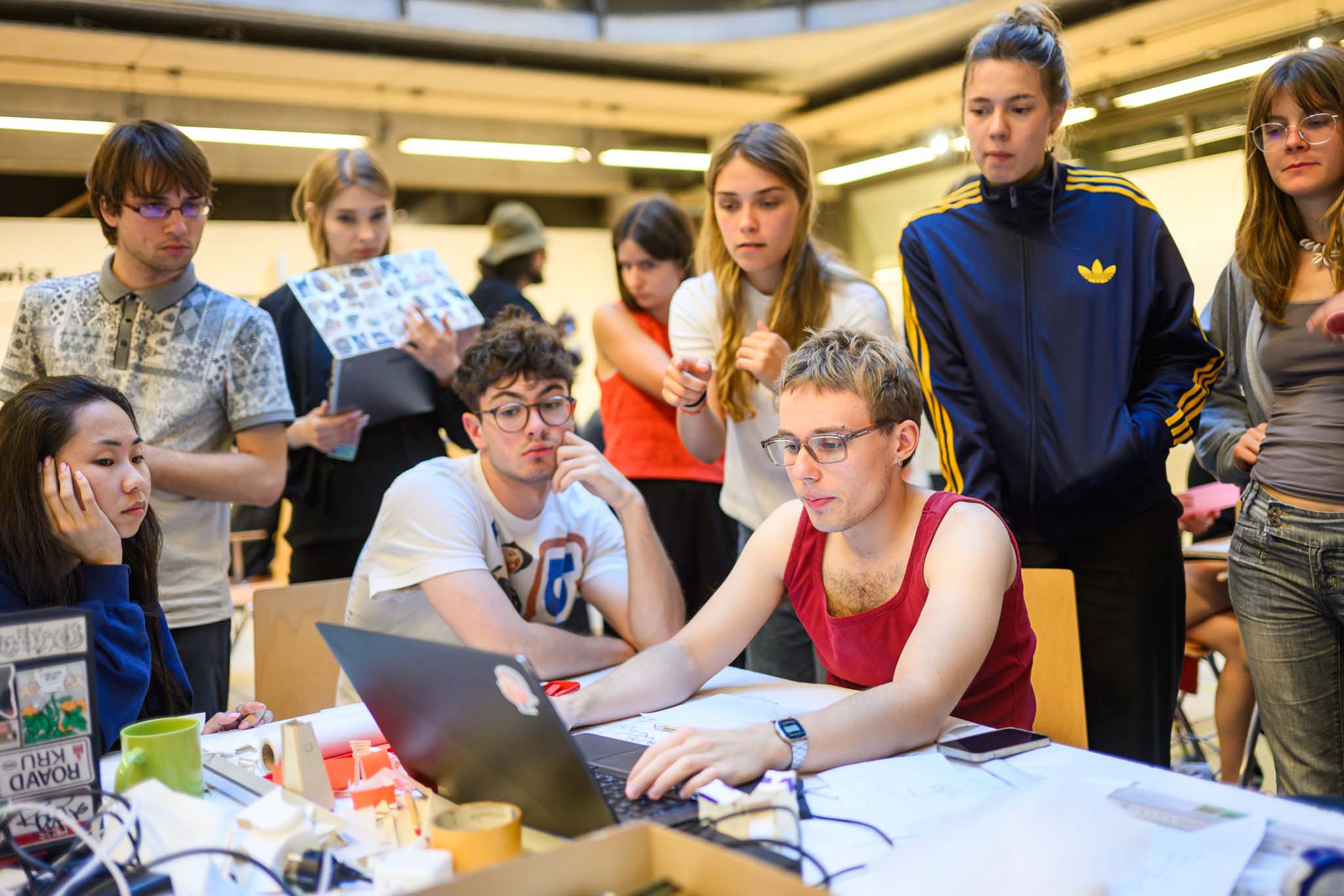
Mood for Wood is an international workshop series held in Poznań, Poland, dedicated to students of design degrees interested in hands-on experience in bringing their ideas to life. Throughout the programme, participants collaborate with established architects, designers from around the world, and skilled carpenters to design and build urban furniture for specific sites and communities. Each team engages directly with future users of the space, learning about their needs and responding to the unique conditions of the location.
Task
In the 2025 edition the students were tasked with designing and constructing a wooden pavilion intended to allow for quiet relaxation and observation of nature the visitors of Lake Strzeszyńskie. The project was developed in cooperation with representatives of the Poznań Forestry Department (ZLP), environmental specialist and landscape architect Magdalena Garczarczyk, as well as local residents, who stressed unanimously that the west bank lacks a comfortable place to rest and learn more about the area’s natural assets.
Site
Lake Strzeszyńskie is located on the outskirts of Poznań, in the valley of the Bogdanka River, and is an important natural enclave. It is surrounded mainly by forests and meadows, which are a valuable habitat for many plant and animal species, including rare and endangered ones. The Bogdanka in this section has retained its natural character - it forms floodplains, changes course under the influence of beaver activity.
The eastern shore and its recreational infrastructure is used intensively all year round. The western shore is far less frequented by tourists, making it quiet and peaceful. The pedestrian and cycling route surrounding the lake is very popular among local residents.
Four potential locations along the western shore were initially considered. The site ultimately selected was not already in use, unlike some of the nearby informal beaches. The flat terrain between the trees made it suitable for construction, while its distance from the cycling route created a more secluded and intimate atmosphere. The diverse surrounding landscape offered an ideal setting for a lookout point, and the nearby beaver settlement added an additional layer of interest to the site.
Core concepts
The structure was designed to enhance a personal connection with the surrounding natural landscape. Its relatively small scale, accommodating two to three users at a time, encourages quiet contemplation and rest. Visual separation from the road allows for a more immersive experience and puts focus on the relationship between the user and nature. Semi-open walls balance intimacy with permeability, maintaining continuity with the surrounding environment.
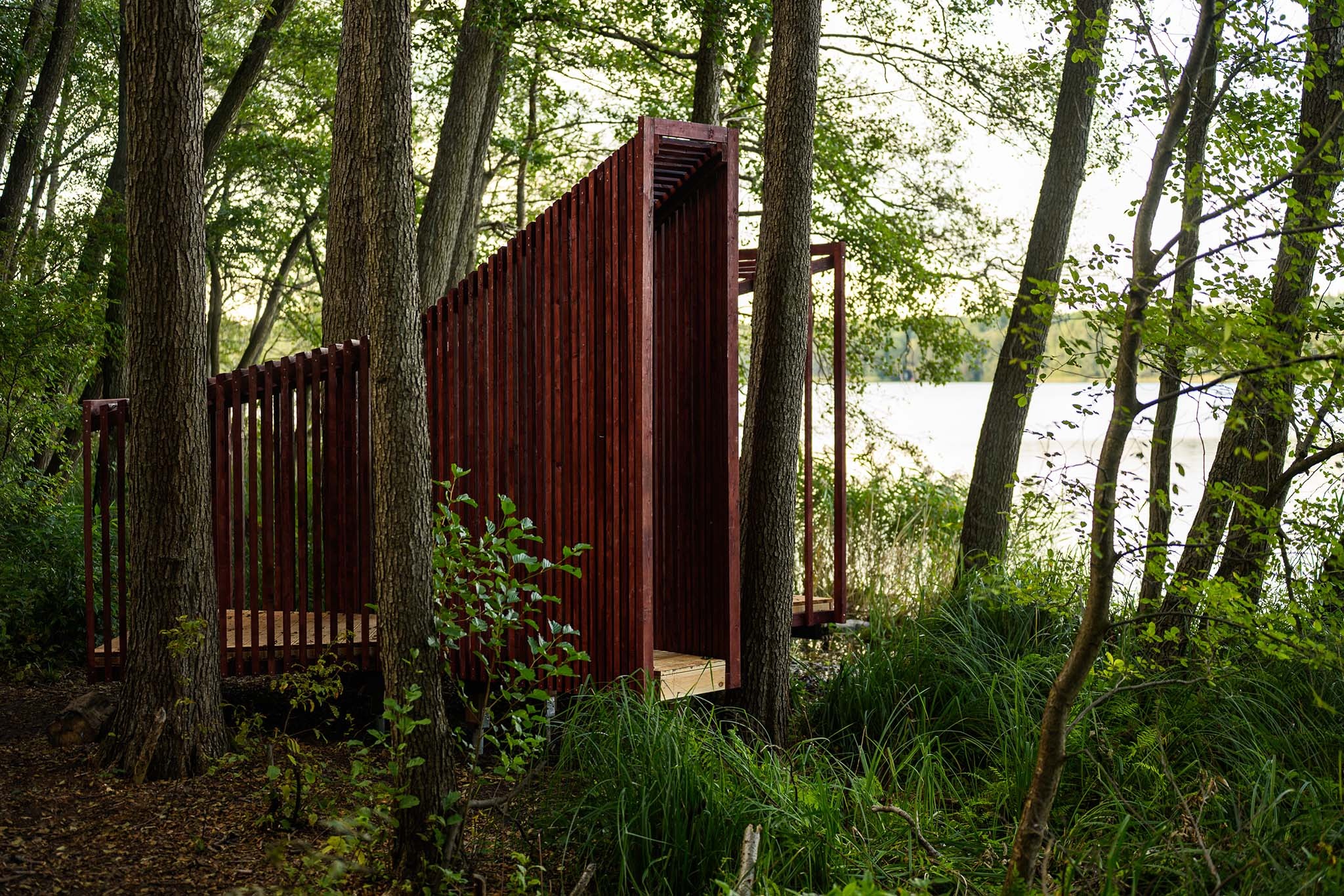
Carefully framed openings capture specific views of the forest and lake. The form extends into three distinct arms, each oriented toward a different viewpoint. A tall, narrow extension directs attention into the forest, a wider opening frames the lake, and a lower, inviting element marks the entrance.
The structure is elevated on stilts, creating a floating effect and minimizing interference with the ground. This solution also responds to fluctuating water levels, reducing the risk of flooding.
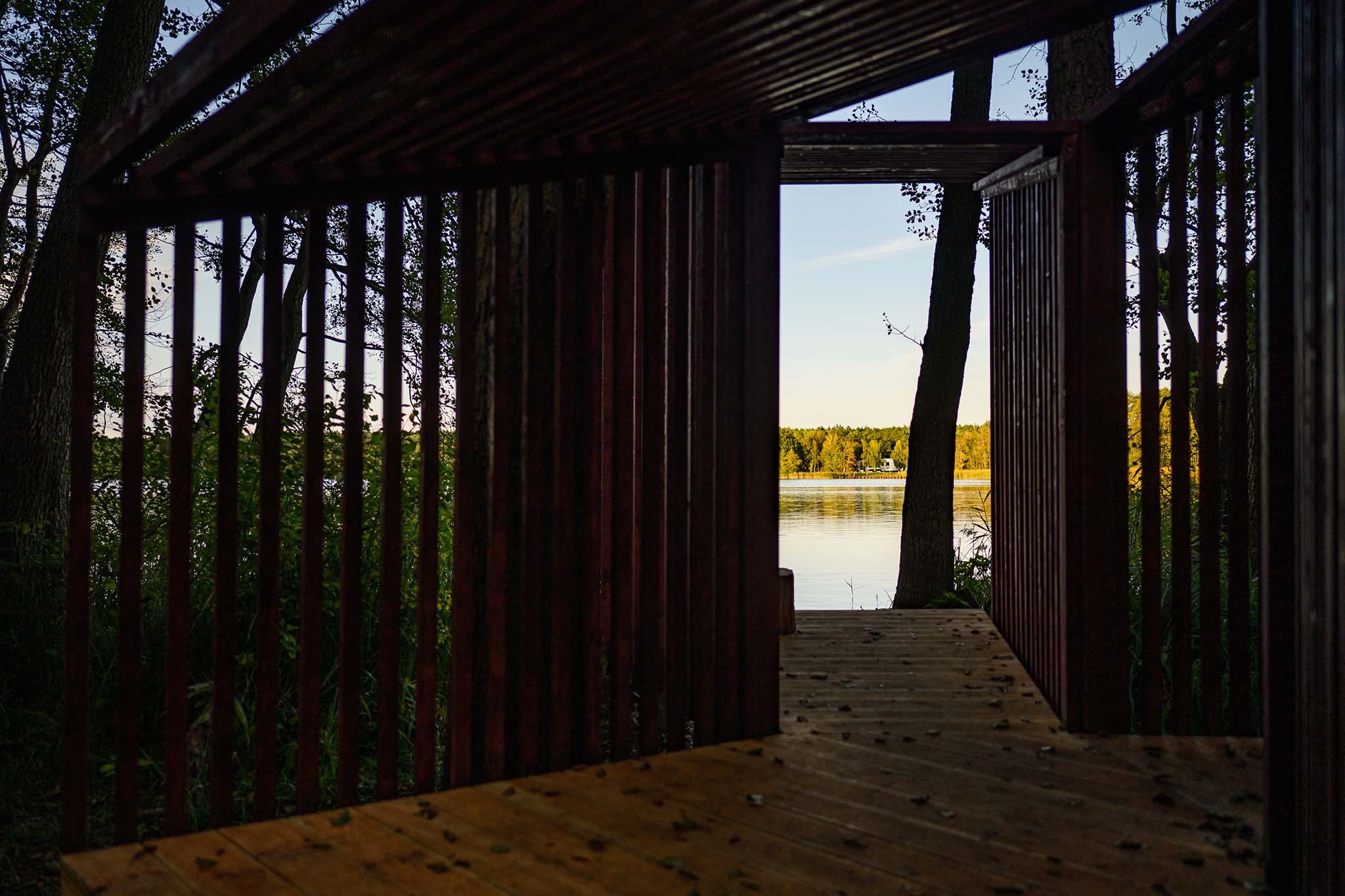
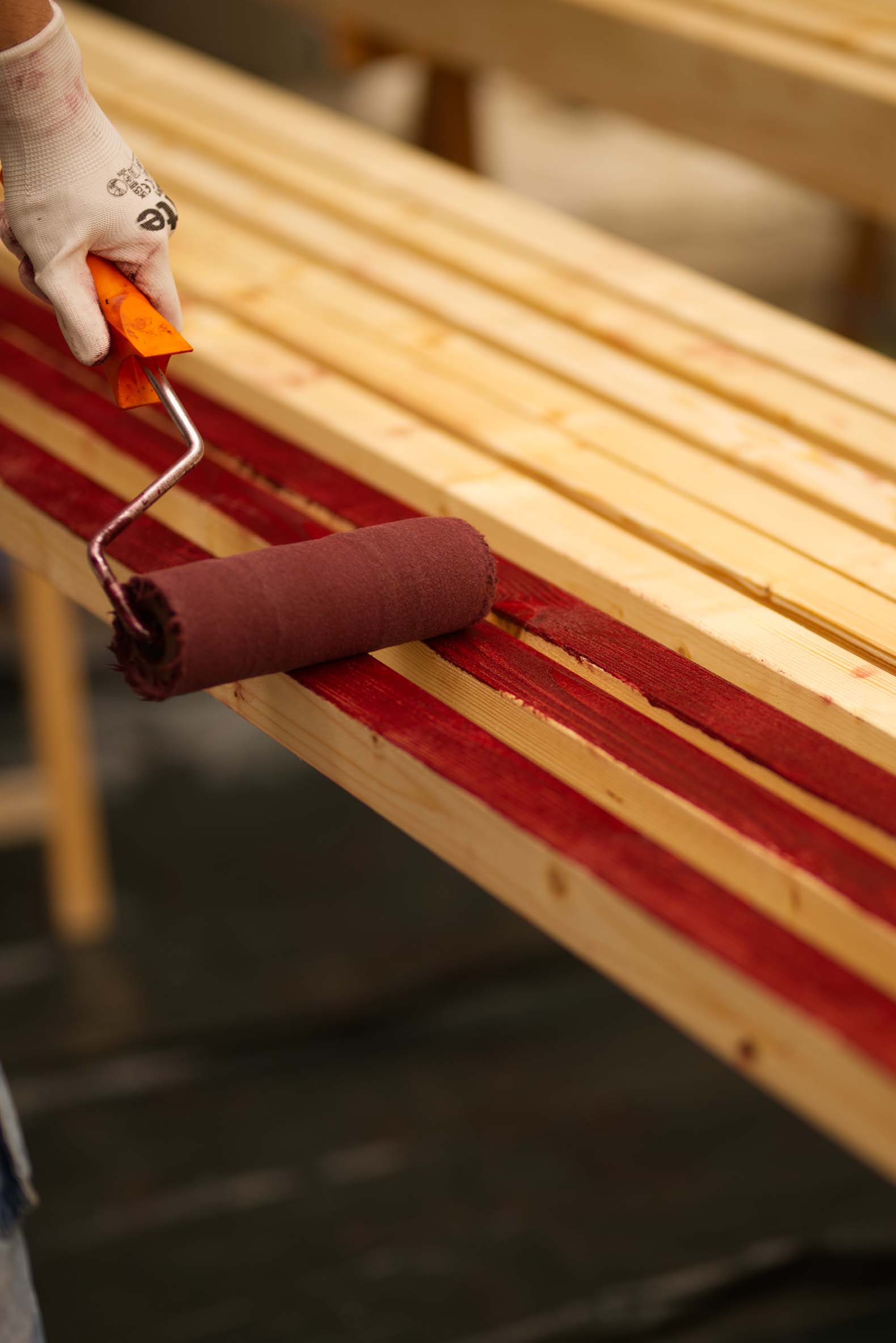
A burgundy tone was chosen for the exterior elements, remaining noticeable throughout the year while complementing the surrounding greenery and the seasonal context of autumn leaves or white snow. The raw, natural wood color of the floor speaks for solidity and honesty of the material. The foundation elements are painted a dark brown tone, intended to visually blend with the ground, reducing their presence and enhancing the perceived lightness and floating character of the structure.
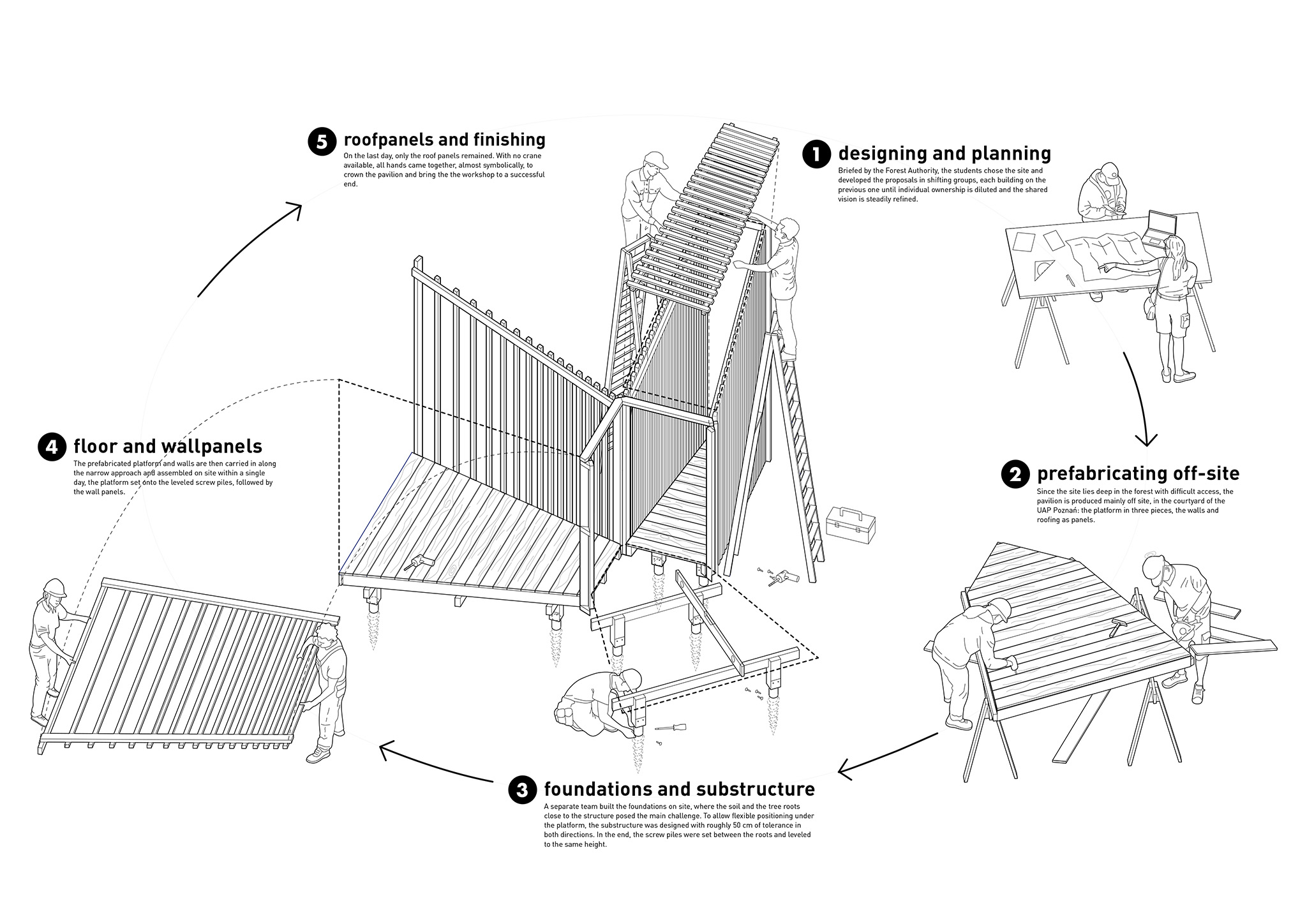
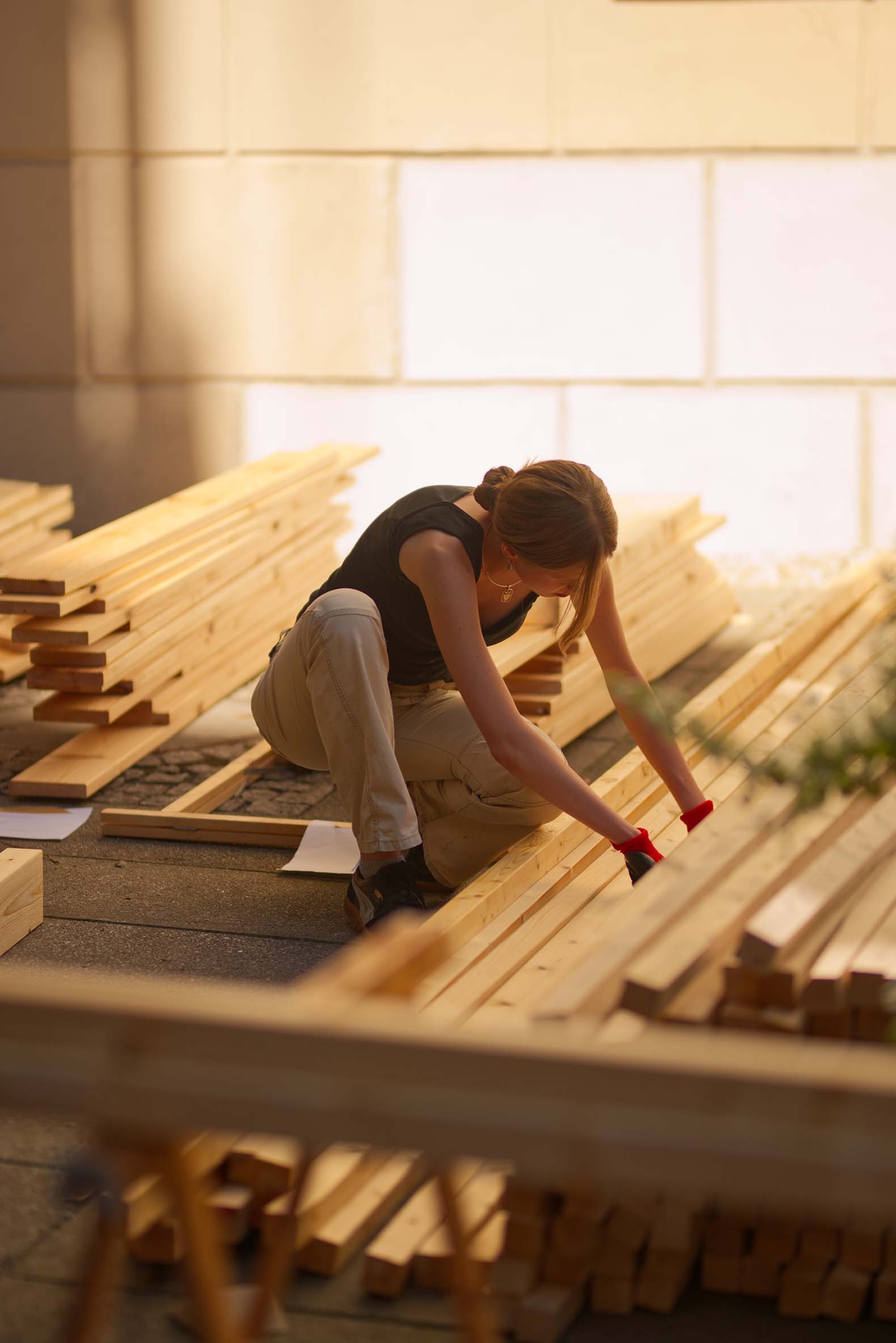
The structure was designed with modularity in mind. Larger components were pre-fabricated in the workshop in order to keep the on-site assembly quick and simple. This approach allowed for efficient use of the given time as well as more precise control over material quality and constructive details.