MADC & Partners's proposal proposes a library building with a rectangular floor plan and a flexible structure. The result was an interesting interior space, acoustically isolated from the city, open on the inside, and where sunlight enters indirectly, subtly bathing the entire interior. The library is organized on two overlapping floors: the ground floor, intended for social use, allowing for speaking engagements, rehearsals, debates, and music performances, and the first floor, for cultural use. It also has a mezzanine where the study area is located.
The materials used for the structure were wooden beams and trusses. Due to the good lighting, the CLT floor was tinted a blue-grey hue. The remaining elements, such as doors, windows, slats, smooth panels, chipboard panels, and slatted panels, are also made of wood. The library is a carefully curated metaphor for a well-organized forest, where natural materials are transformed into building elements.
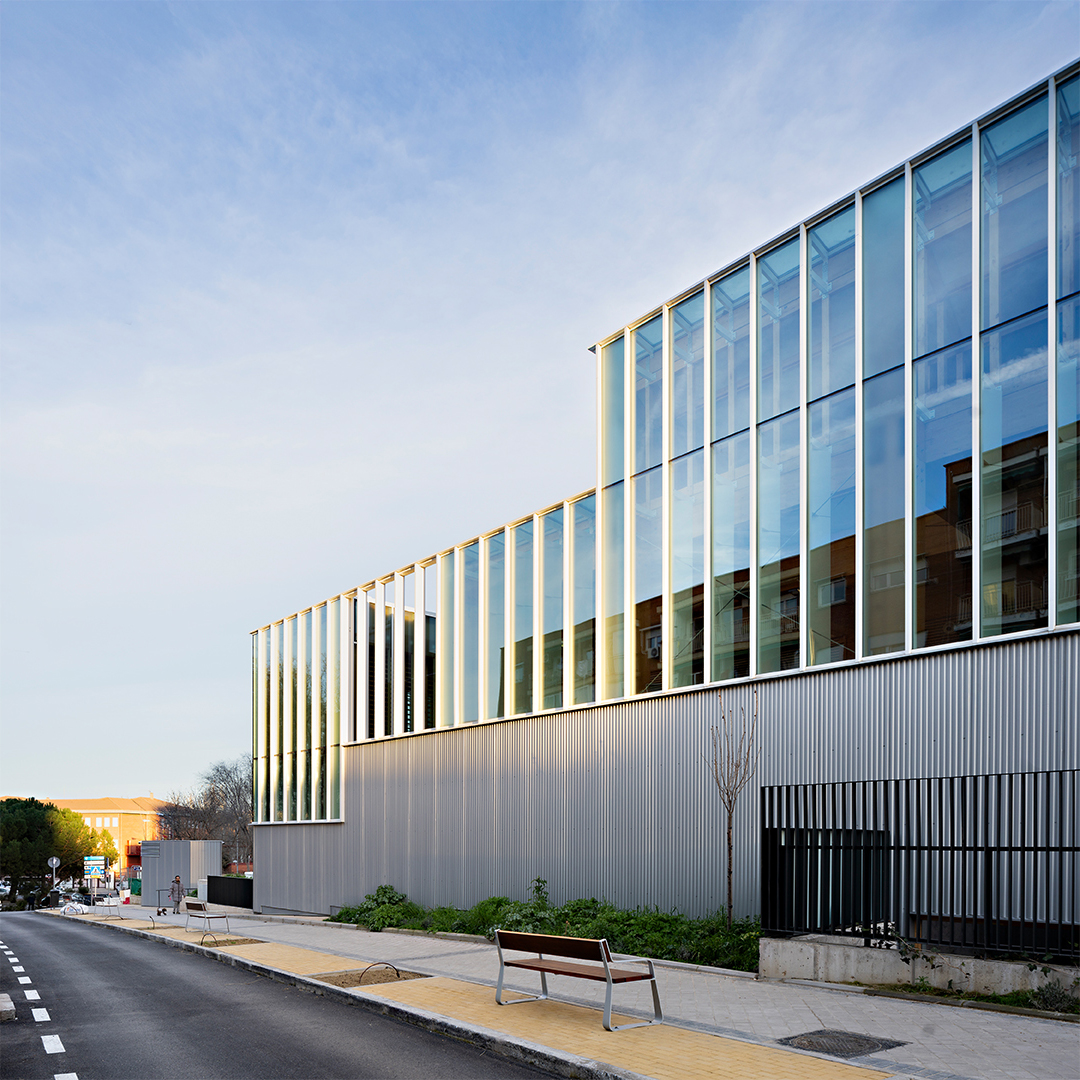
Library of a Thousand Suns by MADC & Partners. Photograph by Javier Callejas (photographer at Verosímil).
Description of project by MADC & Partners SLP
Except in summer, the presence of a high-rise building located to the south casts a shadow over the plot. Given this circumstance, the proposal is based on the construction of numerous artificial light-reflecting devices: the thousand suns. Solar radiation rotates around the roof and falls on a series of skylights, vertical slats on the northwest facade, lattices in the courtyards, the undersides of tree leaves, and so on. These elements are arranged to redirect sunlight toward the white underside of the roof and the wooden structural frame.
Thus filtered, the natural light generates an atmosphere of indirect, warm, and vibrant light—without shadows—interior. At dusk, the library becomes a beacon of the outdoor public space, fulfilling one of the citizens' demands.
Why The Thousand Suns?
Except in summer, the presence of a high-rise building located to the south casts a shadow over the plot. Given this circumstance, the proposal is based on the construction of numerous artificial light-reflecting devices: The Thousand Suns. Solar radiation rotates around the roof and falls on a series of skylights, vertical slats on the northwest facade, lattices in the courtyards, the undersides of tree leaves, and so on. These elements are arranged to redirect sunlight toward the white underside of the roof and the wooden structural frame.
Thus filtered, the natural light creates an atmosphere of indirect, warm, and vibrant light—without shadows—interior. At dusk, the library becomes a beacon of the outdoor public space, fulfilling one of the citizens' demands.

Urban Design: Transitions
The building presents a simple, humble volume in its material configuration. With an everyday appearance, the unitary sheet metal cladding recalls the industrial warehouses that preceded the neighborhood. Toward Calcio Street, the building acquires a horizontal proportion and domestic scale next to the sidewalk, presenting a window as a showcase; toward Miguel Solás Street, the longitudinal façade forms a diverse frontispiece, including patios and variations in skylights that allow sunlight to enter the new sidewalk; toward the lower plaza, however, the façade acquires a more vertical proportion, including a brise-soleil converted into a bench and lighting fixture for the plaza.
The nearby presence of the Manzanares River and the Madrid Metropolitan Forest urban project posed the possibility of continuing the landscape through Miguel Solás Street. This proposal was accepted by the Madrid City Council, which executed it with its own resources, but in coordination with the Mil Soles proposal. Miguel Solas Street is partially pedestrianized and equipped with new street furniture, recreational spaces, and deciduous vegetation. A pedestrian crossing at sidewalk level extends access to the first floor into the existing residential area. Access to the ground floor for social use is located down the street, this time from a newly created plaza, equipped with a small garden, seating, a mural for urban artists, and bicycle parking.

General operation and overall integration of the program.
A flexible structure is proposed, generating pleasant, open spaces designed for meeting and group activities, acoustically isolating essential areas. The project's conception as two spaces on overlapping floors allows for the creation of areas for speaking, rehearsing, debate, or music (ground floor, social use), while others are used for reading, studying, or training in an environment more conducive to concentration (first floor, cultural use).
The mezzanine floor houses the study area, the quietest and highest part of the building. The proximity of the wooden roof and skylights reveals the true dimensions of the beam and truss sections; the textures and colors of the white chipboard ceiling panel or the grain and knots of the wood itself become evident, almost tangible to the hand.
The level of natural light is at its maximum, allowing the CLT floor to be tinted in a blue-gray hue. The scent of wood, the reflected light, the excellent acoustics, and the warmth of the material create a dense and luminous atmosphere very conducive to study or introspection.

A wooden frame.
The library presents itself as a reorganized forest, a "manifesto" in favor of the material transformation of the construction industry. Wood, as a cultivated material capable of organizing industrialized ecosystems, offers a real opportunity for the decarbonization of the sector: a commitment to wood is a commitment to the climate. The library features a wooden structure, as well as doors, windows, slats, smooth panels, chipboard panels, and slatted panels, also made of wood: a large space resolved through diverse applications of a single material.